The UAE has no single healthcare licence. A doctor, nurse, pharmacist, dentist or physiotherapist needs a licence from the regulator that covers the place where they will work, and that regulator may ask them to pass a computer-based licensing exam first. The main names are DHA (Dubai), MOHAP, still often called MOH (the federal ministry), DoH Abu Dhabi (the body once known as HAAD) and DHCC (Dubai Healthcare City, a free zone with its own regulator).
This guide explains who regulates what, how the exams fit into the licensing process, and which details you must always confirm on an official website. Rules, providers and prices in this field change regularly, so every time-sensitive point below is marked. Where we could not confirm a figure on a regulator’s own page, we say so rather than guess.
The four UAE healthcare regulators at a glance
The simplest way to remember the system is by place. Ask yourself: where will the licensed facility be? That answer decides which regulator, and therefore which exam process, applies to you.
| Regulator | Full name | Where it applies |
|---|---|---|
| DHA | Dubai Health Authority | The emirate of Dubai (outside the Dubai Healthcare City free zone) |
| MOHAP (MOH) | Ministry of Health and Prevention | Federal regulator; commonly the route for the northern emirates such as Ajman, Umm Al Quwain, Ras Al Khaimah and Fujairah. Sharjah has its own regulator, the Sharjah Health Authority (SHA) |
| DoH (formerly HAAD) | Department of Health – Abu Dhabi | The emirate of Abu Dhabi, which includes Al Ain and Al Dhafra |
| DHCC / DHCR | Dubai Healthcare City; its regulator is the Dubai Healthcare City Authority – Regulatory (DHCR) | Facilities inside the Dubai Healthcare City free zone only |
One point causes confusion. Dubai Healthcare City sits inside Dubai, yet it is licensed separately from the rest of Dubai. A clinic in the free zone answers to DHCR, while a clinic a few kilometres away answers to DHA. Always confirm which side of the line your employer’s facility is on.


DHA: the Dubai Health Authority
The Dubai Health Authority regulates healthcare professionals and facilities across the emirate of Dubai. Its online licensing system is called Sheryan, and the usual first step for a new applicant is to create an account there and check the profession-specific requirements for their qualification and experience.
The DHA exam is a computer-based test delivered by Prometric. It is sometimes called the “DHA Prometric exam”, which is why many candidates think Prometric is the regulator. It is not. Prometric is an independent testing company that delivers the exam on the authority’s behalf, and DHA decides who needs to sit it and what counts as a pass.
Not everyone has to take the exam. Whether you must sit it depends on your profession, your qualification, where you trained and how much experience you have. Some applicants are exempt, and the rules for that are set by the regulator, not by training websites. We return to exemptions later in this guide.
MOHAP: the federal ministry (MOH)
MOHAP is the federal Ministry of Health and Prevention. Many candidates and employers still say “MOH”, and you will see both names online. Its licences are widely described as covering healthcare professionals working in the northern emirates, including both government and private facilities there. Sharjah is the exception: it has its own regulator, the Sharjah Health Authority (SHA), which is the fourth emirate-level regulator alongside MOHAP, DoH and DHA under the unified Professional Qualification Requirements (PQR). Dubai Healthcare City (DHCR) is a separate free-zone regulator.
Like DHA, MOHAP is widely reported to use a computer-based exam delivered through Prometric for the professions that need one, but check MOHAP for confirmation. Because federal rules can change when the ministry updates its systems, check MOHAP’s site for the live process rather than relying on a blog post from a few years ago, including this one.
DoH Abu Dhabi: the authority people still call HAAD
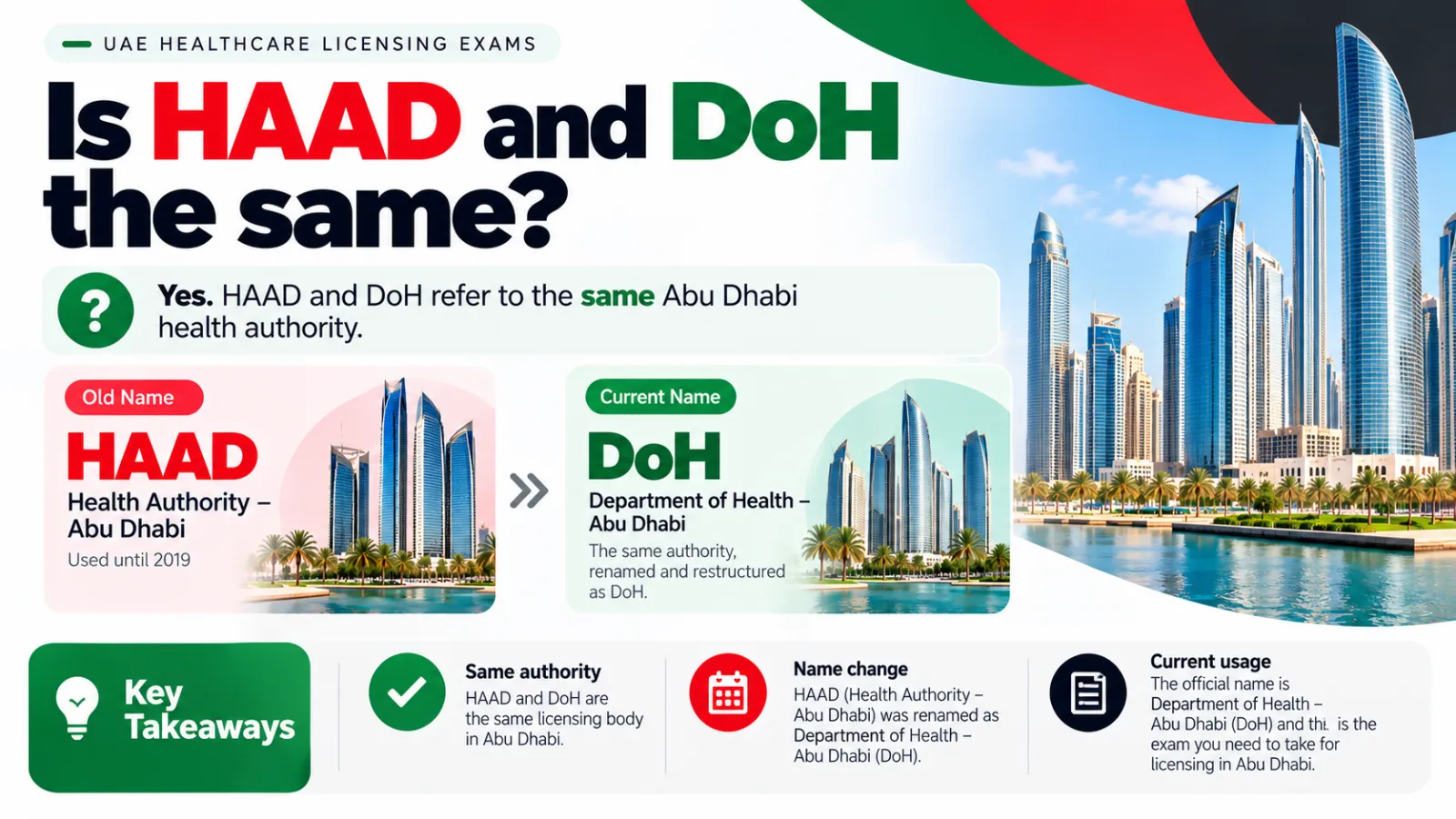
The Department of Health – Abu Dhabi (DoH) regulates healthcare in the emirate of Abu Dhabi. Before it took its present name it was the Health Authority – Abu Dhabi, or HAAD, and many people, including recruiters, still use the old label. When someone says “HAAD licence” today they almost always mean a DoH licence. The two names refer to the same regulator.
On its Standards pages, DoH refers to the Unified Healthcare Professional Qualification Requirements, often shortened to PQR. This document sets out the education and experience a professional needs, and it is a good place to read the rules in the regulator’s own words.
Exam details for Abu Dhabi are often muddled online. DoH Abu Dhabi exams are delivered by Pearson VUE, another global testing company (the older HAAD exams were run through Prometric, which is why some older guides still say so). The provider can change over time, so confirm it on the DoH website or in your booking instructions before you sign up with anyone.
DHCC: Dubai Healthcare City
Dubai Healthcare City is a free zone for hospitals, clinics and wellness providers. Professionals who work there are licensed by its regulatory arm, DHCR, not by DHA. Older web pages sometimes use outdated or inaccurate names for this regulator, so use the name on the official Dubai Healthcare City website when you search.
DHCR does its own primary source verification in-house rather than through DataFlow. DHCR also runs its own computer-based licensing exam, delivered through Prometric, for most physician, dentist, nursing and allied health categories. After DHCR issues an Eligibility ID (valid for three months, with a maximum of three attempts), you book the exam. Some categories do not need an exam, so check the guideline for your category on the Dubai Healthcare City website.
HAAD, DoH, MOH and MOHAP: the name changes explained
Much of the confusion around these exams comes from names that changed while old web pages stayed online. Here is the short version.
- HAAD became DoH. The Health Authority – Abu Dhabi was reorganised and renamed the Department of Health – Abu Dhabi. Sources disagree on the exact year, so we have not stated one. What matters is that “HAAD exam” and “DoH exam” now point to the same regulator.
- MOH is now MOHAP. The federal Ministry of Health is officially the Ministry of Health and Prevention. Many job adverts still say “MOH licence”.
- DHA is still DHA. Its name has stayed stable, although its online systems have changed over the years.
- DHCC is a place, DHCR is the regulator. People say “DHCC licence” as shorthand for a licence from the free zone’s regulator.
DHA vs DoH vs MOHAP: how do they compare?
All three run licensing systems with similar building blocks: a qualification check, primary source verification, an exam for many applicants, and an application by a licensed employer or facility. The details differ, which is why a result or document accepted by one body may not be accepted by another.
| Question | DHA | DoH Abu Dhabi | MOHAP |
|---|---|---|---|
| Area covered | Dubai | Abu Dhabi emirate | Federal; commonly the northern emirates |
| Main online system | Sheryan | DoH licensing services | MOHAP licensing services |
| Exam delivery (as widely reported) | Prometric | Pearson VUE (via the DoH/TAMM process) | Prometric (widely reported — check MOHAP) |
| Primary source verification | Yes, through DataFlow | Yes, through DataFlow | Yes, through DataFlow (widely reported — check MOHAP) |
| Questions, time limit, pass mark | Varies by profession – check the official guide | Varies by profession – check the official guide | Varies by profession – check the official guide |
The last row is deliberate. Blogs often print neat numbers such as a fixed pass mark for every profession, but these figures vary by profession and have changed in the past. The only safe source is the candidate guide for your profession on the regulator’s, Prometric’s or Pearson VUE’s website.
Prometric, Pearson VUE and who actually sets the exam
A frequent mix-up is thinking that the testing company writes and marks the exam on its own. In practice, there are two jobs. The regulator sets the policy: who must test, what the exam covers and what counts as a pass. The testing company handles the logistics: booking, test centres, identity checks, the computer system and delivery of results.
Prometric and Pearson VUE are both global providers of computer-based tests, and both run test centres across the UAE and in other countries. That is why many candidates can sit the exam in their home country, as long as the regulator allows it and there is a centre nearby.

What the exams are like
Licensing guides consistently describe these as computer-based, multiple-choice tests with a single best answer. They are built to check whether a professional can apply knowledge safely in a clinical setting, not to test memory of obscure facts. Questions typically relate to your own profession, so a pharmacist’s exam looks very different from a nurse’s.
Some professions also face an oral or practical assessment instead of, or as well as, the written exam. Third-party guides give different numbers of questions and time allowed for each profession and for different years. Because we found no official page confirming any figure, we treat all such numbers as unconfirmed until you see them on an official page.
DataFlow and primary source verification (PSV)
Before a regulator lets you sit an exam or issue a licence, it wants proof that your certificates and work history are real. This is called primary source verification: the checking is done directly with the university, employer or licensing body that issued the document, not by looking at your copy.
In the UAE, DataFlow Group is the company DHA, DoH and MOHAP use for this step (Dubai Healthcare City’s regulator, DHCR, does its own in-house verification). A DataFlow case usually covers some or all of the following, depending on your profession and the regulator.
- Your education certificates, such as degrees and diplomas.
- Your employment history and experience letters.
- Any professional licences you currently hold or have held.
- A certificate of good standing from your licensing body, where one is required.
PSV is often the slowest part of the whole process, because the checking depends on how quickly universities and former employers reply. Guides report waits ranging from a few weeks to a couple of months, and fees that change over time. We are not quoting a price or a timeframe because neither can be confirmed from a regulator’s page today. Start PSV as early as you can, and keep your documents consistent: names, dates and job titles must match across every certificate.
Why does the UAE insist on PSV?
Healthcare is a regulated profession, and a forged certificate can put patients at real risk. PSV is the safety net that stops a fake qualification from slipping through. It is also why the regulators will not accept a scan of your degree alone as proof, however official it looks.
If you are comparing the UAE route with the UK system, our guide to PLAB and MRCP explains how a different country’s licensing exams are structured, which can help you see why regulators test applicants at all.
The licensing journey, step by step
Each regulator words its process differently, but most applicants follow the same general path. Use this as a checklist to compare against the regulator’s own instructions, and tick each step as you go. The ticks are saved in your browser only.
- Decide which regulator covers the facility where you will work (DHA, DoH, MOHAP or DHCR).
- Read the official requirements for your profession and grade, including the Unified PQR where the regulator refers to it.
- Create an account on the regulator’s portal and complete any self-assessment or eligibility check it offers.
- Gather your documents: passport, degrees, transcripts, experience letters, current licences and certificates of good standing.
- Submit your primary source verification through DataFlow and keep the case number.
- Book the exam through the testing provider named by the regulator, if you are required to sit one.
- Take the exam, then wait for the result to be recorded against your application.
- Complete the licence application, normally with a licensed employer or facility sponsoring it.
The order of these steps is not identical everywhere. For example, some regulators want eligibility confirmed before PSV, and some employers will pay for steps or start them for you. If an agent tells you to pay for an exam before the regulator has confirmed you are eligible, pause and check the portal first.
Who has to take the exam?
Eligibility rules are the part that most often differs between a blog post and the real situation. The usual factors are:
- Profession and grade. Specialist doctor, general practitioner, staff nurse, pharmacist, dental technician and radiographer may each follow a different category.
- Qualification and where you trained. Regulators publish how they assess degrees from different countries and institutions.
- Experience. Required years, recency and the setting you gained them in can all matter.
- An existing licence or exam. A current licence or a recent pass from a recognised authority may count for something.
Some licensing guides say that candidates from certain recognised countries or with particular board certifications may qualify for an exam exemption. That is worth checking, because it can save months. But which countries and qualifications count is set by each regulator, and it can change, so ask the regulator, not the agency selling a preparation package.


Passing scores, validity and attempts: what you can and cannot say
Search for “DHA passing score” and you will find confident numbers. Guides report differing pass marks, and others describe different scoring methods or fixed scores that vary by profession. Because the regulators’ own pages we could reach did not confirm any single figure for every profession, we do not state a pass mark here.
The same applies to three other details, which are worth checking officially before you plan your finances and your calendar.
- Number of questions and time allowed. This varies by profession and may be updated. Look in the candidate handbook or exam content outline.
- How long an exam result stays valid. Many regulators accept a pass for a limited period when you apply for a licence. The period differs and is not the same as the validity of the licence itself.
- How many attempts are allowed, and the waiting time between them. This is set by the regulator and the test provider’s rules.
Licence validity is another figure that third-party guides report inconsistently, and some give one year while others give two. Renewal also usually requires continuing professional development (CPD) hours. Check your regulator for the current length and the CPD rules for your profession.
Why should you not rely on a pass mark quoted by a training website?
Because the pass mark is set by the regulator for each profession, it can change, and a website may be quoting an old year or a different profession. The reliable source is the regulator’s or test provider’s current candidate guide.
Is an exam result from one emirate automatically accepted in another?
Not automatically. The receiving regulator decides whether it accepts a result, a licence or neither, and any conditions for doing so. Ask the regulator before relying on it.
Does DHCC have the same exam as DHA?
Not quite. DHCR runs its own licensing exam, delivered through Prometric, for most categories, and it is separate from the DHA exam. Not every category needs it, so check the guideline for your category.
How to prepare for a licensing exam
Whichever regulator you are dealing with, the exam is a timed test of applied clinical knowledge. The best preparation starts with the exam’s official content outline, if one is published, because it tells you which topics carry the most weight. Then build a plan around what you find.
- Use practice questions in the same format. Single-best-answer questions reward careful reading. Practise spotting the words that change an answer, such as “first”, “most likely” or “except”.
- Revise by topic, then by case. Begin with a list of the subject areas in the outline and finish with mixed sets that jumble topics together, which is closer to the real exam.
- Review your errors. Keep a short log of mistakes and the reason for each one, so you do not repeat them.
- Practise on a computer. Timing, flagging questions and navigating on screen are skills that improve with practice.
Memory techniques help with the large volume of material. Our guides on how to improve memory and pass examinations and how to practise and remember what you study cover spaced repetition and active recall, which work for any professional exam. For nurses, the skills in critical thinking in nursing map neatly onto scenario questions.
Which regulator should you choose?
Most people do not choose a regulator freely. The job decides it. A hospital in Dubai needs a DHA-licensed professional, a clinic in Abu Dhabi needs a DoH licence, and one in a northern emirate usually points to MOHAP (Sharjah has its own regulator, SHA). If you are applying from abroad, look at where your offer letter says you will work and let that decide the route.
If you do have a choice, such as when comparing job offers, ask each employer practical questions. Will they sponsor the licence? Do they cover PSV and exam costs? How long do they expect the process to take? Do they have staff who have recently gone through it? Answers from recent hires are worth more than any guide, including this one.
Mistakes to avoid
- Relying on old information. A blog post from several years ago may name the wrong regulator, provider or exam format. Look for the date and check it against the official site.
- Paying a middleman before reading the regulator’s page. Some agencies are genuinely useful, but you should know what you are buying and be able to find every requirement yourself.
- Starting PSV late. It is typically the longest step, so begin gathering documents before you are ready for anything else.
- Assuming your title decides your category. Regulators classify by qualification and scope of practice, not by job title.
- Ignoring renewal. Plan for CPD hours from your first year, so you are not scrambling at renewal.
If you are comparing how senior roles are structured elsewhere, our explainer on levels of doctors in the NHS shows why regulators sort applicants into grades and why experience requirements differ by level.
Test yourself: guess the term
Frequently asked questions about UAE healthcare licensing exams
What are the DHA, MOH, HAAD and DHCC exams?
They are the licensing processes of four UAE health regulators: Dubai Health Authority, the federal Ministry of Health and Prevention, Abu Dhabi’s Department of Health (formerly HAAD) and Dubai Healthcare City’s regulator. Many applicants sit a computer-based test for their profession. Which one applies depends on where you will work.
Are HAAD and DoH the same?
Yes. HAAD, the Health Authority – Abu Dhabi, is the former name of the Department of Health – Abu Dhabi (DoH). Recruiters often still say “HAAD licence”, but the current regulator is DoH. Always use DoH when searching for official requirements.
Is MOH the same as MOHAP?
MOHAP is the Ministry of Health and Prevention, the federal health ministry. People still commonly say MOH for it. When you search for current licensing rules, use MOHAP and check the ministry’s official website for the process that applies to you.
Who conducts the DHA exam?
The DHA exam is widely reported to be delivered by Prometric, a global computer-based testing company. DHA itself decides who must sit the exam and what counts as a pass. Confirm the current provider and booking steps on DHA’s official pages.
Is the exam a written or computer-based test?
Licensing guides describe these exams as computer-based multiple-choice tests taken at a test centre. Some professions may also have other assessments. Check the exam guide for your profession, because format, question numbers and timing can differ.
What is the passing score for the DHA, MOHAP or DoH exam?
There is no single figure we can confirm. Third-party guides give different numbers, and pass marks can vary by profession and over time. Look in the official candidate handbook or the regulator’s portal for the current requirement.
What is DataFlow primary source verification?
It is the process of checking your education, experience and licences directly with the university, employer or licensing body that issued them. DataFlow Group carries it out for DHA, DoH and MOHAP, while DHCR verifies in-house. It can take weeks, so start early and keep your documents consistent.
Do all healthcare professionals have to take an exam?
Not always. Exam rules depend on your profession, qualification, experience and the regulator. Some applicants are exempt, for example if the regulator recognises their existing licence or credentials. Ask the regulator, because only its decision counts.
Can I use a DHA licence in Abu Dhabi or the northern emirates, including Sharjah?
Not automatically. Each regulator licenses practice in its own area, so you normally need to apply to the regulator for the new location. Some regulators may take your existing licence or exam result into account. The receiving regulator decides, and Sharjah has its own regulator, SHA.
How long is a UAE healthcare licence valid?
Third-party sources give different answers, and validity may vary by regulator and profession. Renewal usually involves continuing professional development. Check your regulator’s current rules, and note your renewal date as soon as you receive the licence.