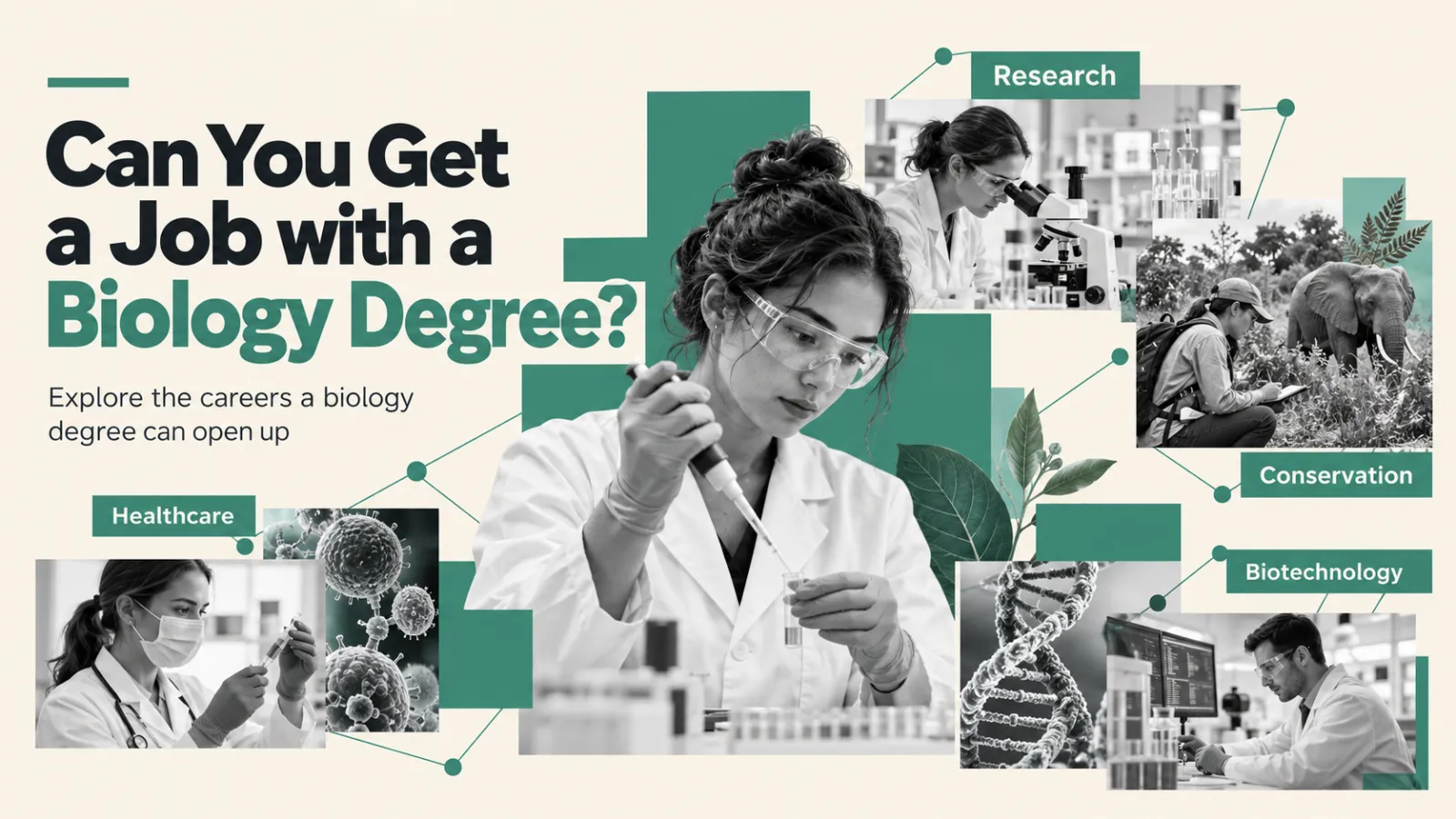
Yes, you can get a job with a biology degree. Biology graduates in the UK work in laboratories, the NHS, conservation, biotechnology, teaching, science communication and data roles, as well as in business and the civil service. Many specialist jobs, such as biomedical scientist, clinical scientist or research scientist, need extra training or a postgraduate qualification on top of the degree.
This guide uses real UK data to show what biology graduates actually do, which careers need more training, and what the jobs pay. Every salary is taken from an official or careers-service source and dated, because pay changes every year.
Can you get a job with a biology degree?
The short answer is yes, but it helps to know what the numbers really say. Biology is a popular degree, so you are competing with many other graduates. The ones who do best usually have relevant work experience as well as a good degree.
Careers service Prospects publishes what biology graduates are doing about 15 months after finishing, using HESA Graduate Outcomes survey data. Here is the picture it gives.
| What biology graduates were doing (15 months on) | Share |
|---|---|
| Employed (full-time or part-time) | 56.5% |
| Further study only | 15.6% |
| Working and studying | 11.8% |
| Unemployed | 9.5% |
| Other (for example travelling or caring) | 6.6% |
Source: Prospects, “What can I do with my biology degree?” (published November 2024), using HESA Graduate Outcomes data.
A newer report, Prospects Luminate’s What do graduates do? 2025/26, looked at UK graduates who finished in 2022/23. It found that 43% of biology graduates were in full-time work and 8% were unemployed. That full-time figure is lower than for chemistry (51%) or physics (47%), partly because so many biology graduates go on to study.
For context, the latest official HESA Graduate Outcomes statistics for 2023/24 graduates, published on 4 June 2026, showed that 87% of all graduates were in work or further study.
What do biology graduates actually do?
The jobs that biology graduates report most often give a useful reality check. Science jobs are common, but they are not the only outcome.
| Most common occupations of biology graduates | Share |
|---|---|
| Laboratory technicians | 8% |
| Biological scientists | 8% |
| Secondary school teachers | 6% |
| Sales and retail assistants | 6% |
| Conservation professionals | 4% |
Source: Prospects, from HESA Graduate Outcomes data.
Two things stand out. First, no single job dominates, so biology degree jobs are spread across many sectors. Second, some graduates are in roles such as retail 15 months after graduating. That is often a stepping stone while they build experience, save for a Masters or apply for training schemes, but it is a reminder that a degree alone does not guarantee a graduate job.
Biology graduates work in science-related roles such as laboratory technicians and conservation professionals, and also in education, health, business and many other areas. Prospects also points out that many employers accept applications from graduates with any degree subject, so your options are wider than the job titles with “biology” in them.
If you are still deciding whether to study the subject, our honest look at whether biology is a hard degree covers the workload, the maths and the practical side.
Skills a biology degree gives you
Employers do not only hire you for what you know about cells or ecosystems. Prospects highlights the general skills a biology degree builds, and these are what make biology graduates employable in so many fields.
- Communication through lab reports, essays and presentations.
- Teamwork and collaboration in practicals, fieldwork and group projects.
- Research and data analysis, including statistics and handling large data sets.
- Problem solving when an experiment does not work and you have to find out why.
- IT skills, from spreadsheets to specialist software.
Day to day, being a biologist means combining these skills: careful observation, accurate records and clear explanations of what the results mean.
Before you apply: choosing the right biology degree
If you are still at school, a few choices now can make the jobs you want easier to reach later. Most biology degrees ask for A-level Biology plus another science, often Chemistry. Some universities also accept Maths, Physics, Psychology or Geography as the second subject, and typical offers range from about ABB to AAA. Science A-levels in England also need a pass in the practical endorsement. Your GCSE choices matter too, and our guide to double science vs triple science explains how each prepares you.
When you compare courses, look for these features:
- Accreditation. The Royal Society of Biology accredits some degrees, including integrated Masters (MSci or MBiol) courses. If you want to be a biomedical scientist in the NHS, an Institute of Biomedical Science (IBMS) accredited biomedical science degree is the most direct route.
- A placement year. A year working in industry, the NHS or a research lab gives you the experience employers ask for.
- An integrated Masters. Some biology courses add a fourth year that ends in a Masters degree, which helps for research careers.
- Specialist modules in areas such as genetics, ecology, microbiology or bioinformatics that match the career you are aiming for.
Research and laboratory careers
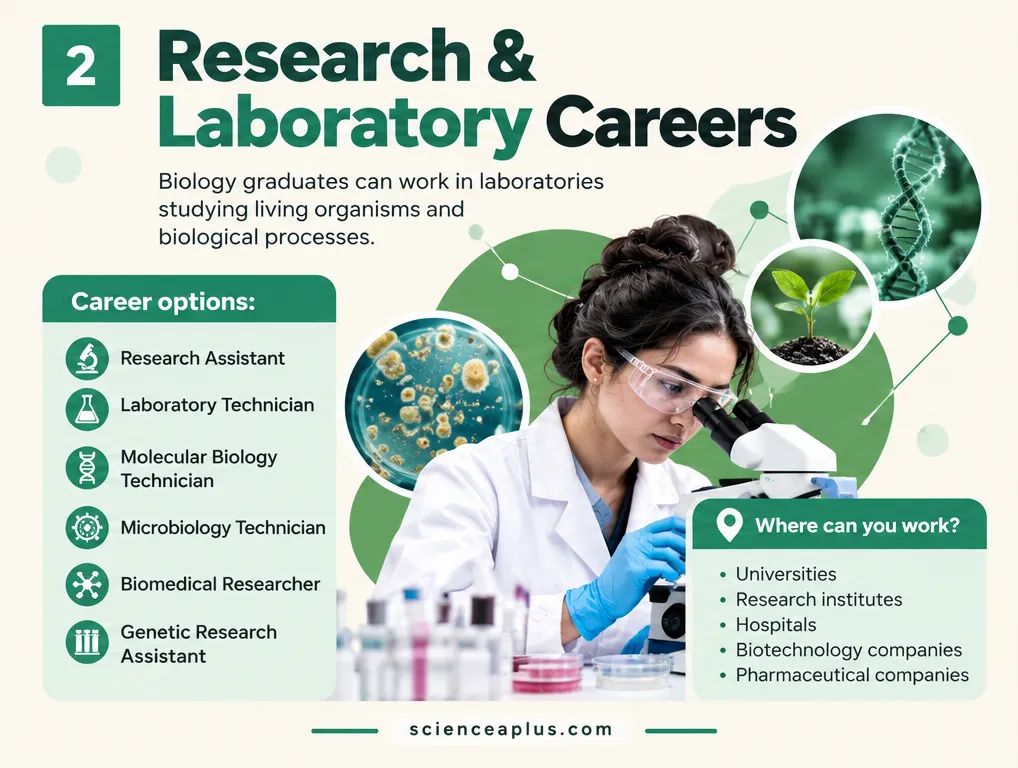
Laboratory work is the career most people picture when they think of biology degree jobs, and it is a common first step. Prospects data shows that laboratory technicians and biological scientists are the two most reported occupations for biology graduates, at 8% each.
Lab jobs exist in universities, research institutes, hospitals, and biotechnology and pharmaceutical companies. They also exist in less obvious places such as food testing, water companies and forensic labs.
Laboratory technician
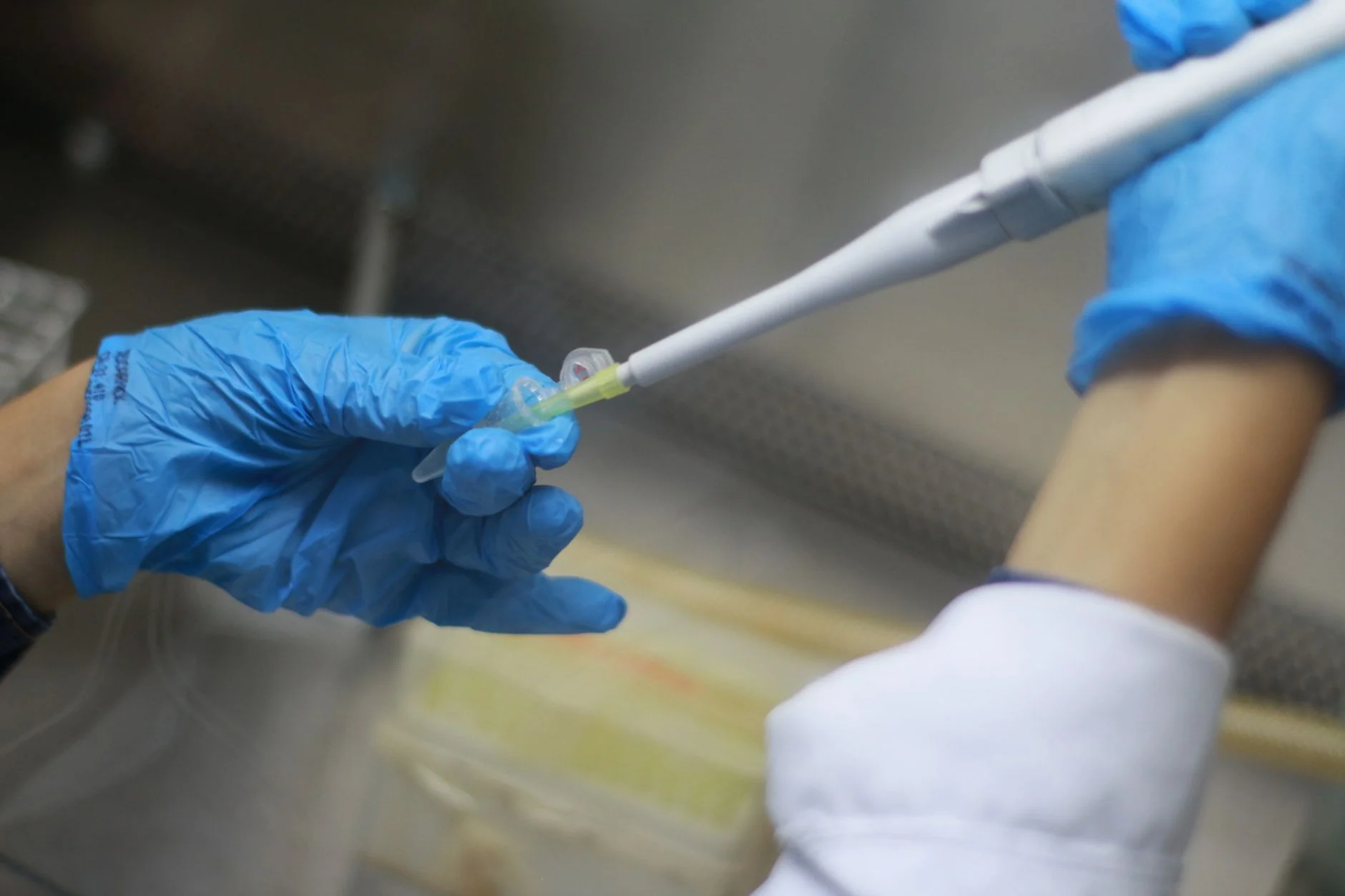
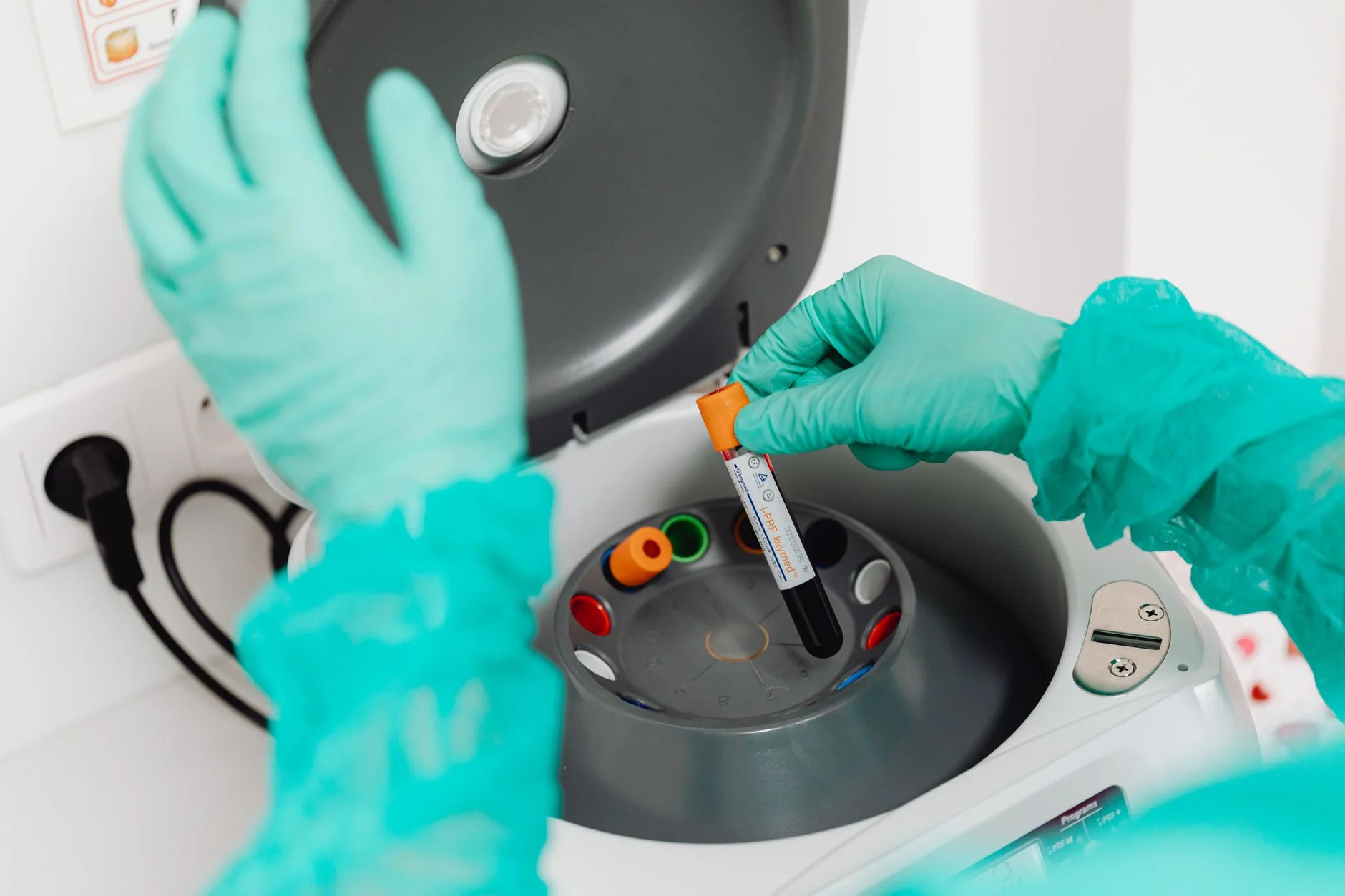
A laboratory technician prepares samples, runs tests, keeps equipment working and records results accurately. You need to be confident with standard biology lab equipment, from micropipettes and centrifuges to microscopes, and you must follow safety rules carefully.
Prospects gives these salary guides for laboratory technicians (checked October 2026, a guide only):
- Starting salaries: typically around £24,000 to £27,000, although some entry-level roles and apprenticeships pay less.
- With experience: about £28,000 to £35,000.
- Senior, specialist or supervisory technicians: £35,000 to £40,000 or more.
A technician job is useful even if you plan to move on. It shows employers that you can work safely and accurately in a real lab, which helps if you later apply for a research post or an NHS training scheme.
Research assistant and research scientist
Research assistants help to run experiments in university or company labs, often on a fixed-term contract linked to a grant. To lead your own research as a research scientist or become a university lecturer, Prospects says you will often be expected to have a PhD.
A PhD usually comes with a funded studentship. If it is funded by UK Research and Innovation (UKRI), the tax-free stipend is at least £21,805 for 2026/27, according to Prospects. After a PhD, research scientists typically earn £25,000 to £40,000, and senior researchers such as principal investigators can earn £50,000 to £75,000. Senior salaries are often higher in industry, particularly in pharmaceutical and biotechnology companies.
Research careers suit people who enjoy puzzles and can cope with setbacks. Many experiments fail before one works, and funding is competitive.
Healthcare and clinical careers
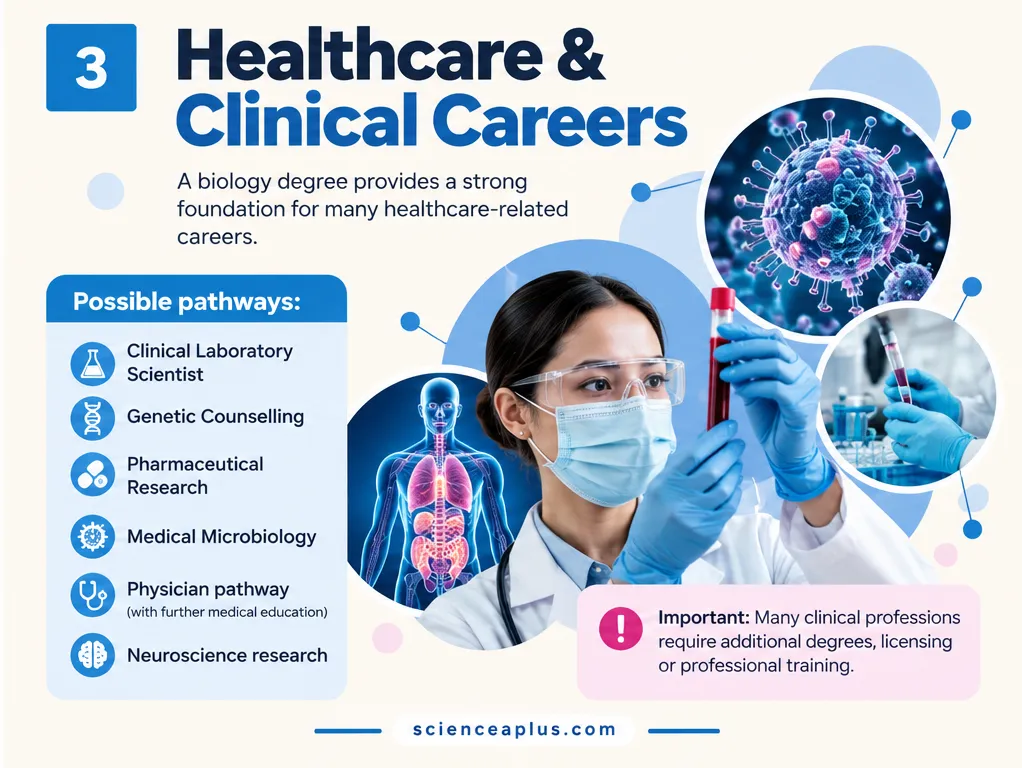
Can you work in the NHS with a biology degree? Yes, and the NHS is one of the biggest employers of science graduates. However, many clinical roles are regulated, which means you need a specific accredited qualification and professional registration before you can use the job title. The infographic above puts it well: many clinical professions need additional degrees, licensing or professional training.
Biomedical scientist
Biomedical scientists test samples such as blood and tissue in hospital laboratories, helping doctors to diagnose and monitor disease. To work as one in the UK you must be registered with the HCPC (the Health and Care Professions Council).
The usual route is an IBMS-accredited biomedical science degree followed by the IBMS Registration Training Portfolio, which leads to the IBMS Certificate of Competence. If your degree is in general biology and is not IBMS-accredited, you can ask the IBMS to assess it. You may need to complete extra “top-up” modules, and Prospects notes that these can often be studied while working in a laboratory support role. Newly qualified biomedical scientists in the NHS start on Band 5.
Clinical scientist (NHS Scientist Training Programme)
Clinical scientists work in areas such as genomics, microbiology and immunology, and many lead specialist testing services. The main route is the NHS Scientist Training Programme (STP). It lasts three years and combines training in the workplace with a master’s degree in clinical science.
Entry is competitive. You need a 1st or 2:1 honours degree, or an integrated master’s degree, in a pure or applied science that is relevant to the specialism you apply for. Applicants with a 2:2 can still apply if they also have a relevant higher degree, such as an MSc. Trainees are paid a salary on a fixed-term contract, usually at Agenda for Change Band 6 in England (check the National School of Healthcare Science for current details), and qualified clinical scientists are usually employed at Band 7.
Becoming a doctor after a biology degree
A biology degree does not qualify you to practise medicine, but it can be a step towards it. Graduates can apply for accelerated graduate-entry medicine courses, which usually take four years instead of five or six. Most medical schools expect at least a 2:1, often in a science subject. After medical school, new doctors complete the two-year Foundation Programme before specialty training.
Other health routes, such as genetic counselling, physiotherapy or nursing, also need their own accredited courses. If you are thinking about patient-facing work, skills such as critical thinking in nursing show how clinical reasoning works in practice.
NHS pay for science roles in 2026/27
Most NHS staff, apart from doctors and dentists, are paid on the Agenda for Change pay scale. The 2026/27 rates for England apply from 1 April 2026, after a 3.3% pay award.
| Band | Annual pay range (England, 2026/27) | Example science roles |
|---|---|---|
| Band 4 | £28,392 – £31,157 | Some senior laboratory support roles (varies by trust) |
| Band 5 | £32,073 – £39,043 | Newly qualified biomedical scientist |
| Band 6 | £39,959 – £48,117 | Trainee clinical scientist (STP) |
| Band 7 | £49,387 – £56,515 | Qualified clinical scientist |
| Band 8a | £57,528 – £64,750 | Principal or lead scientist roles |
Source: NHS Employers, Agenda for Change pay scales 2026/27. Scotland, Wales and Northern Ireland set their own rates, and staff in and around London receive an extra high-cost area supplement.
Can you become a biomedical scientist with a general biology degree?
Yes, but usually not straight away. You need HCPC registration, which normally requires an IBMS-accredited degree plus the IBMS Registration Training Portfolio. With a non-accredited biology degree, the IBMS can assess your qualification and may ask you to complete top-up modules, often while you work in a lab support role.
What degree result do you need for the NHS Scientist Training Programme?
A 1st or 2:1 honours degree (or an integrated master’s) in a pure or applied science relevant to the specialism. A 2:2 is accepted only if you also hold a relevant higher degree such as an MSc.
Environment and conservation careers
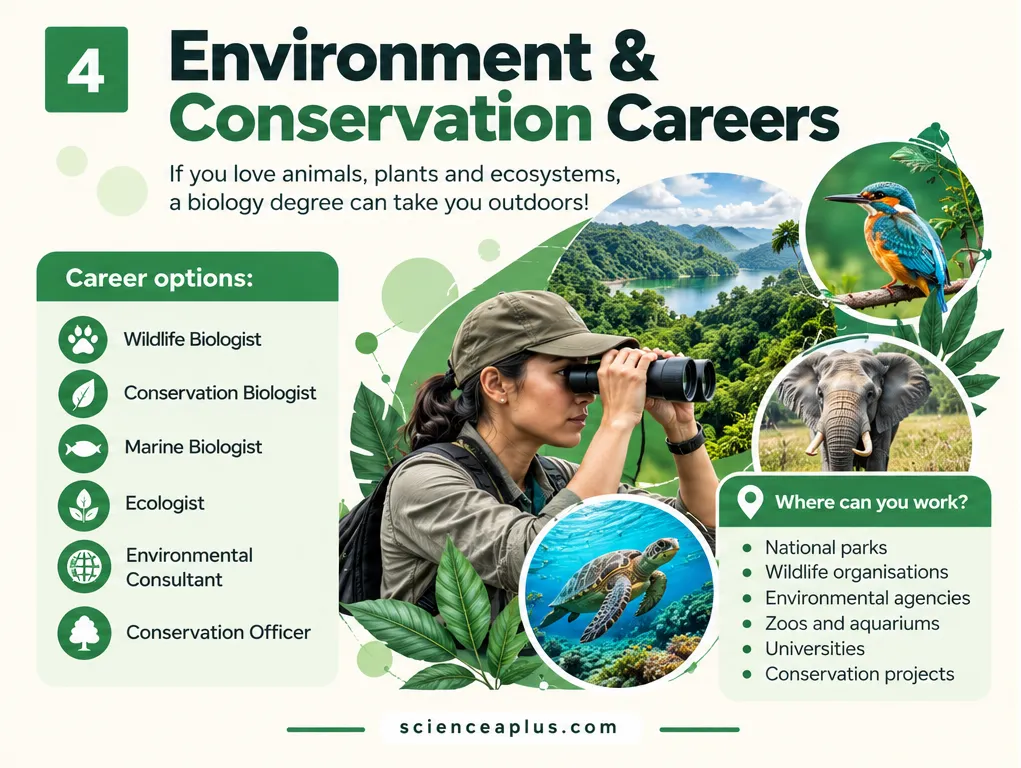
If you love animals, plants and being outdoors, environmental work is one of the most popular biology degree careers. Conservation professionals are among the five most common occupations of biology graduates, at 4% in the Prospects data.
Typical job titles include ecologist, conservation officer, wildlife biologist, marine biologist and environmental consultant. Employers range from environmental agencies and wildlife charities to water companies, zoos, aquariums, national parks and ecological consultancies that survey land before building work starts.
What does an ecologist do?
Ecologists study how living things interact with each other and with their environment. In practice, much of the work is surveying: identifying plants, counting birds, setting up camera traps, checking for protected species such as bats or great crested newts, and writing reports that explain what was found. Understanding conservation in biology helps you see why that evidence matters for decisions about land and wildlife.
Prospects gives these salary guides for ecologists (checked October 2026, a guide only):
- Assistant ecologists and conservation officers: usually around £22,000 to £29,000.
- With a few years’ experience: about £32,000 to £36,000.
- Senior or principal ecologists: about £30,000 to £46,000, with some senior roles reaching £75,000. Consultancy jobs may pay more.
Starting pay in conservation is often lower than in lab or NHS roles, and competition for paid posts is strong. Many entrants build up field identification skills through volunteering, seasonal survey work or a placement year before landing a permanent job.

Biotechnology and pharmaceutical careers
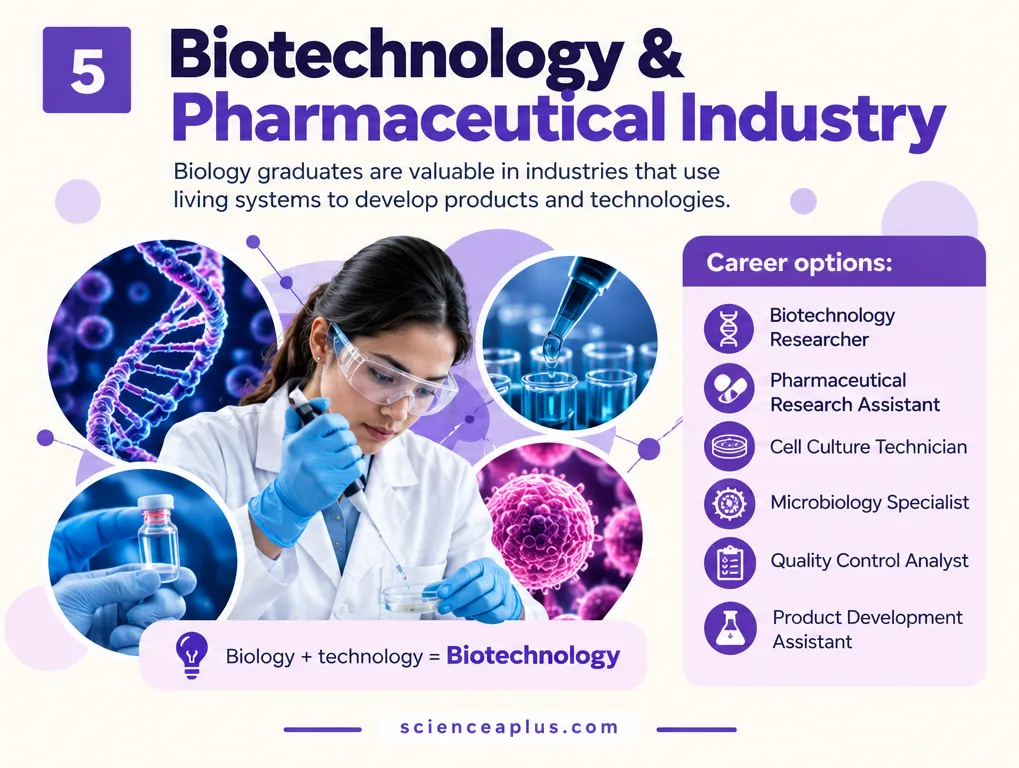
Biotechnology uses living cells and molecules to make products, from medicines and vaccines to enzymes for industry. Pharmaceutical and biotechnology companies are listed by Prospects among the typical employers of biology graduates, and the work often sits close to chemistry.
Graduate-level roles in this sector include:
- Research or development assistant – helping scientists design and run experiments on new products.
- Cell culture technician – growing and maintaining cells that are used in research or manufacturing.
- Quality control analyst – testing raw materials and finished products to check they meet strict standards before they reach patients.
- Microbiology specialist – checking that products and clean rooms are free from contamination.
- Product development assistant – helping to turn a lab discovery into something that can be made safely at scale.
Quality and manufacturing roles reward people who are precise and enjoy following detailed procedures. Every step is recorded, because medicines are tightly regulated. If you are weighing biology against chemistry, our guide to the top careers in chemistry shows how much the two fields overlap in industry.
Prospects notes that senior pay in research is often higher in pharmaceutical and biotechnology companies than in universities. Starting salaries vary a lot by company and region, so check real job adverts in the area where you want to live.
Teaching and science communication
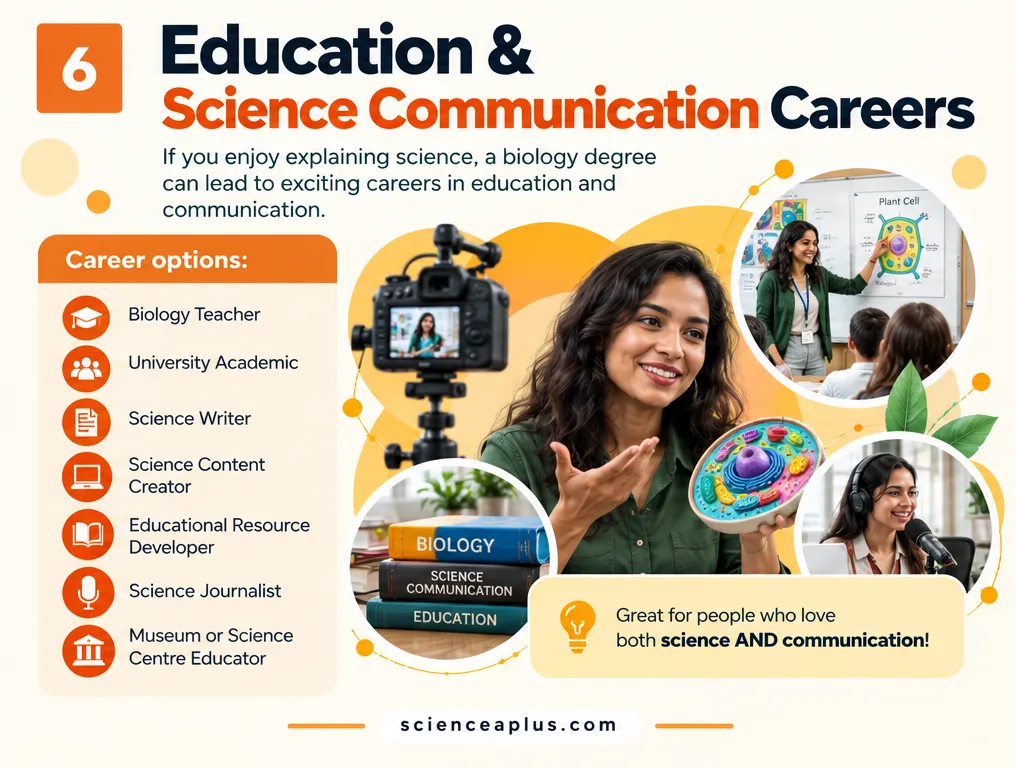
If you enjoy explaining ideas, teaching is a major career for biology graduates. Secondary school teaching is the third most common occupation in the Prospects data, at 6%.
Becoming a biology teacher in England
To teach in most state schools in England you need Qualified Teacher Status (QTS). Graduates usually gain it through a postgraduate teacher-training course, such as a PGCE, which typically takes one year full-time. Salaried routes, where you train while employed by a school, also exist.
- Bursary: trainee biology teachers starting a fee-funded postgraduate course in 2026/27 can get a £5,000 bursary from the Department for Education. Biology is not on the scholarship list, which covers a small number of shortage subjects (check the latest list on GOV.UK).
- Starting pay: according to the Get Into Teaching service, minimum starting salaries for qualified teachers in England will be over £34,000 from September 2026, and more in London. The government has accepted the award: 3.5% from September 2026 and a further 3% from September 2027.
- Average pay: the same source says the average teacher salary will be over £52,800 from September 2026.
Good teachers need more than subject knowledge. Patience, clear explanations and classroom organisation matter just as much, as our article on what makes an effective teacher explains.

Science writing, museums and media
Not every science communicator works in a classroom. Biology graduates also become science writers and journalists, museum or science centre educators, educational resource developers and online science content creators. Prospects lists museums, science centres and broadcast companies among the outreach organisations that recruit biology graduates.
Prospects gives these salary guides for science writers (checked October 2026, a guide only): entry-level science writers earn about £26,875 to £33,000, rising to about £35,000 to £44,000 with experience, and senior or specialist writers may earn up to £51,000.
These jobs are competitive. A portfolio of your own writing, videos or outreach events often matters more than your degree classification, so start building one while you study.
Do you need a PGCE to teach biology?
In most state schools in England you need Qualified Teacher Status (QTS). A postgraduate course such as a PGCE is the most common way for graduates to gain it, but salaried school-based routes also lead to QTS. Independent schools and academies can legally employ teachers without QTS, but many still prefer it.
New and unexpected biology careers
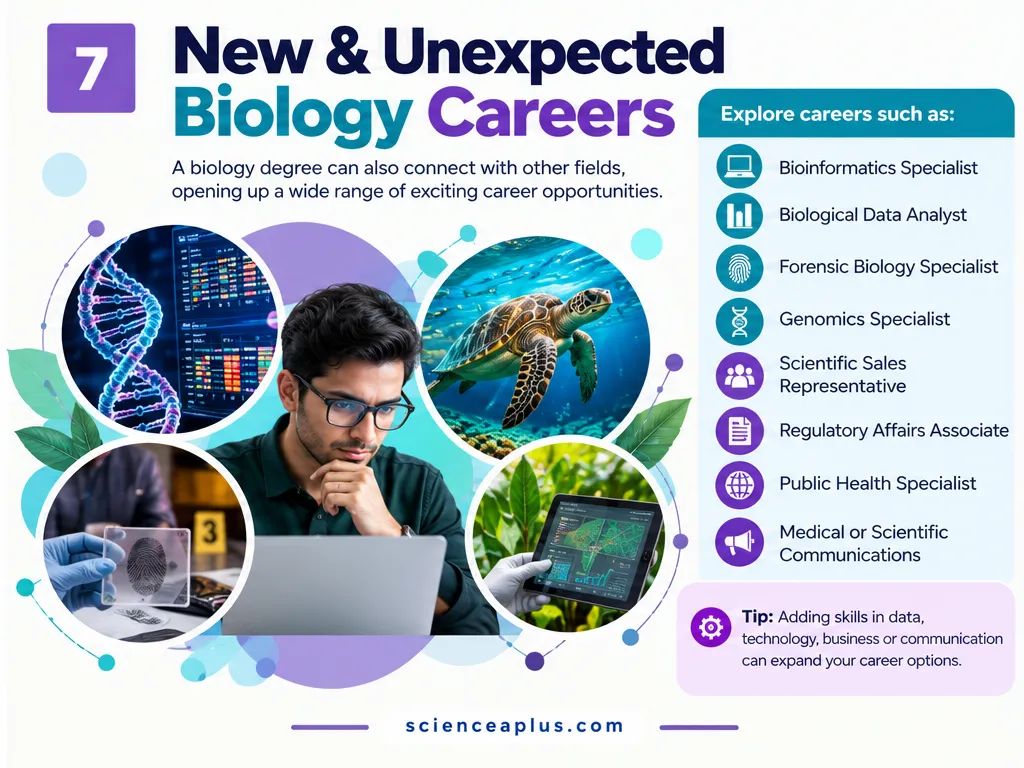
Some of the fastest-changing biology degree jobs combine biology with another skill, such as computing, law, business or communication. These roles do not always have “biologist” in the title, so they are easy to miss.
- Bioinformatics and genomics. Modern biology produces huge amounts of DNA and protein data. Bioinformaticians write code and use statistics to make sense of it, for example in genomics labs and drug discovery.
- Biological data analyst. Health, agriculture and environmental organisations need people who understand both the biology and the numbers.
- Forensic biology. Forensic scientists analyse biological evidence such as blood and DNA for criminal investigations. Prospects lists forensic science among the jobs where a biology degree is useful.
- Regulatory affairs. Medicines, pesticides and foods must meet strict legal standards. Regulatory staff prepare the evidence that shows a product is safe and effective.
- Scientific sales and medical communications. Companies that sell lab equipment or medicines need staff who can talk to scientists and doctors in their own language.
- Public health and policy. Biology graduates also work in public health teams and the civil service, where scientific evidence shapes decisions.
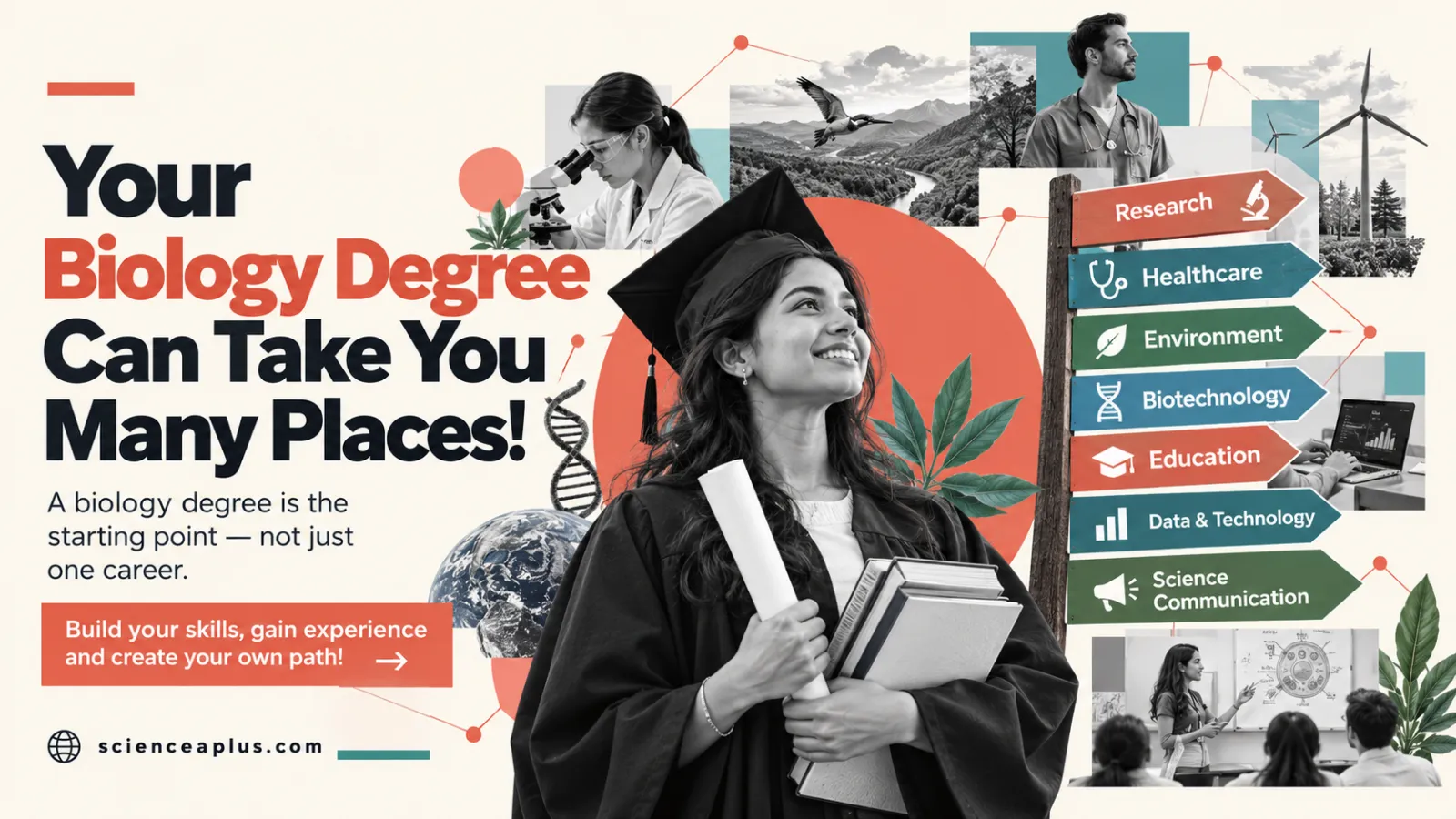
The infographic’s tip is sound: adding skills in data, technology, business or communication widens your options. Learning to code in a language such as Python or R, even at a basic level, is one of the most useful extras for a biology student. It also helps to make your career AI-proof by pairing scientific judgement with digital skills.
How long does it take to qualify?
Some careers start straight after your degree, while others need several more years of training. Pick a route below to see roughly how old you could be when you finish. It assumes a three-year degree and full-time study with no gaps, so treat it as a rough guide.
Highest-paying jobs with a biology degree
People often ask which job with a biology degree pays the most. The honest answer is that pay rises mainly with further training and responsibility, not with the degree itself. Most starting salaries for biology graduates are modest. For comparison, the most common salary band for all UK graduates in full-time work, 15 months after graduating, was £30,000 to £32,999 (18% of them) in the 2023/24 HESA Graduate Outcomes data.
Routes that lead to higher pay over time include:
- Medicine and dentistry. Usually the best-paid long-term options, but they need a further degree, such as four-year graduate-entry medicine, and years of training.
- Senior NHS science roles. Principal clinical scientists reach Band 8a (£57,528 to £64,750 in England in 2026/27), and consultant-level posts are on higher bands still.
- Senior industry research. Prospects says senior researchers can earn £50,000 to £75,000, with higher salaries possible in pharmaceutical and biotechnology companies.
- Senior ecology and consultancy. Some senior ecologist roles reach £75,000, according to Prospects.
When you are offered a role, it is worth knowing how to discuss pay. Our tips on how to negotiate salary in a job interview help you do it politely and with evidence.
How to improve your chances
Whatever career you aim for, the same steps make a real difference. Tick them off as you go, and your progress is saved in this browser.
- Pick two or three target careers and check their entry requirements on Prospects or NHS Health Careers.
- Choose modules (and an accredited course, if the career needs one) that match those careers.
- Apply for a placement year, summer research project or lab internship.
- Volunteer with a wildlife group, museum, school or hospital, depending on your interests.
- Learn a data skill, such as statistics software, Python or R.
- Join the Royal Society of Biology as a student member (free on accredited courses).
- Keep a record of practical techniques you can do confidently, to use in applications.
- Build a short CV and ask your university careers service to review it.
- Decide whether you need a Masters or PhD, and research funding before you apply.

Professional bodies can also support your career later on. The Royal Society of Biology awards Chartered Biologist (CBiol) status, a professional registration rather than an academic qualification. It normally requires a Level 7 qualification (or equivalent), around six to eight years of experience after graduating, and RSB membership at MRSB or FRSB level.
Frequently asked questions about jobs with a biology degree
Can you get a job with a biology degree?
Yes. Biology graduates work in laboratories, the NHS, conservation, biotechnology, teaching, science communication and many non-science roles. Prospects data shows 56.5% employed and 15.6% in further study about 15 months after graduating. Relevant work experience, such as a placement year, makes it much easier to get a science job.
What jobs can you get with a biology degree?
Common jobs include laboratory technician, research assistant, biomedical scientist (with accredited training), ecologist, conservation officer, quality control analyst, biology teacher, science writer and bioinformatician. Prospects says many employers accept graduates of any subject, so biology graduates also work in business, finance, the civil service, marketing and sales.
Is a biology degree worth it?
It can be, if you plan your route. A biology degree builds data, practical and communication skills that many employers want, and it leads to regulated careers such as clinical science. However, starting pay can be modest and many specialist jobs need further study, so check entry requirements early and gain experience.
What is the highest-paying job with a biology degree?
The best-paid long-term routes usually need further training. Medicine and dentistry need another degree. In the NHS, senior clinical scientists reach Band 8a (£57,528 to £64,750 in England, 2026/27) or above. Prospects says senior researchers can earn £50,000 to £75,000, often more in pharmaceutical companies.
Can you work in the NHS with a biology degree?
Yes. The NHS employs many science graduates in laboratory and healthcare science roles. Biomedical scientists need HCPC registration, usually via an IBMS-accredited degree, while the three-year Scientist Training Programme trains clinical scientists. Most of these roles are paid on Agenda for Change bands, such as Band 5 at £32,073 to £39,043 in 2026/27.
Can you become a doctor with a biology degree?
A biology degree alone does not qualify you as a doctor, but it can help you apply for graduate-entry medicine. These accelerated courses usually take four years instead of five or six, and most medical schools expect at least a 2:1, often in a science. After graduating, new doctors complete a two-year Foundation Programme.
Can you be a biomedical scientist with a biology degree?
Possibly. You must be registered with the HCPC. The usual route is an IBMS-accredited biomedical science degree plus the IBMS Registration Training Portfolio. If your biology degree is not accredited, the IBMS can assess it and may ask you to complete top-up modules, often while you work in a laboratory support role.
Do you need a Masters or PhD to work in biology?
Not for every job. Many laboratory technician, conservation, teaching and industry roles accept a bachelor’s degree plus experience. A Masters helps for specialist roles, and Prospects says a PhD is often expected for research scientist and university lecturer roles.
How much do biology graduates earn in the UK?
It depends on the job. Prospects guides suggest laboratory technicians start around £24,000 to £27,000 and assistant ecologists around £22,000 to £29,000. Newly qualified NHS biomedical scientists start on Band 5 (£32,073 in England, 2026/27), and qualified teachers in England start on over £34,000 from September 2026.