Walk into almost any conversation about saving the rainforest and sooner or later someone says that Indigenous Peoples are its best protectors. There is real evidence behind that idea, and there is also a lot of loose talk. This guide sorts out which is which. You will see what scientists have actually measured, where a famous statistic goes wrong, and why the role of Indigenous communities in jungle conservation depends as much on law and power as on knowledge.
Who are Indigenous Peoples?
There is no single definition, but the United Nations uses the term for peoples who have a long connection to a particular territory, keep distinct cultures and languages, and see themselves as separate from the dominant society around them. The UN estimates that there are about 476 million Indigenous people in around 90 countries. That is roughly 6% of the world’s population.
Within that figure are more than 5,000 distinct groups. They speak most of the world’s roughly 7,000 languages. So “Indigenous communities” is a huge and varied category, not one culture. People in the Amazon basin, the forests of Central Africa, the islands of South-East Asia and the Arctic live in very different ways, with different laws, beliefs and economies.
This matters for how we write and think about the topic. We capitalise “Indigenous” when it refers to peoples, in the same way we capitalise “French” or “Kenyan”. And we try to name specific peoples rather than saying “the tribes” or “the natives”, which flattens thousands of societies into one picture.
The big idea: land, not magic
It is tempting to explain Indigenous conservation with a romantic story: people who simply “live in harmony with nature”. Scientists tend to look for something more testable. Where Indigenous Peoples hold secure rights to their land, they usually have a long-term stake in keeping the forest standing, because their food, medicine, homes, water and cultural sites depend on it. They also know the local ecology in great detail, and they are on the spot every day.
None of this means every Indigenous community protects every forest in every situation. Communities are made of people with their own needs, disagreements and choices, and some sell timber or rent land for farming. The useful question is not “are Indigenous Peoples perfect?” but “what happens to forests when Indigenous Peoples’ rights and decisions are respected?” On that, the evidence is strong, as the next sections show.
How much of the world do Indigenous Peoples look after?
The most-cited estimate comes from a 2018 study in the journal Nature Sustainability, led by Stephen Garnett and a large international team. They mapped land that Indigenous Peoples manage or hold tenure rights over, using many sources. Their result was that over a quarter of the world’s land surface falls into this category: at least about 38 million square kilometres, across 87 countries or politically distinct areas on all inhabited continents.
The same study found that this land overlaps about 40% of all terrestrial protected areas and ecologically intact landscapes. These include boreal and tropical primary forests, savannas and marshes. In other words, a very large share of the places that conservationists care most about are also places where Indigenous Peoples live and work.
A 2019 global report from the Intergovernmental Science-Policy Platform on Biodiversity and Ecosystem Services (IPBES) reached a similar picture. It stated that at least a quarter of the global land area is traditionally owned, managed, used or occupied by Indigenous Peoples. That land includes about 35% of formally protected areas and about 35% of all remaining terrestrial areas with very low human intervention. The report was written by 145 expert authors from 50 countries and drew on around 15,000 scientific and government sources. It was also the first global assessment to systematically include Indigenous and local knowledge.
The IPBES wording is careful and worth reading slowly. It says nature managed by Indigenous Peoples and local communities is “under increasing pressure but is generally declining less rapidly than in other lands”. Notice both halves. Nature on these lands is declining less rapidly, which is good news. But it is still under pressure and still declining, which is a warning. The same assessment adds that 72% of local indicators developed and used by Indigenous Peoples and local communities show deterioration of the nature that supports their livelihoods.
Intact forests: a closer look
For jungles specifically, a 2020 paper by Julia Fa and colleagues in Frontiers in Ecology and the Environment looked at Intact Forest Landscapes. These are large, unbroken areas of forest with no sign of significant human disturbance, visible from satellite images. They found that at least 36% of them lie within Indigenous Peoples’ lands. Loss of these forests was considerably lower on Indigenous lands than on other lands, though the authors stressed that they remain vulnerable to clearing and other threats.
Why do intact forests matter so much? They hold huge stores of carbon, they shelter species that cannot survive in broken-up habitat, and they cannot be replaced quickly: a cleared old-growth forest takes centuries to rebuild its structure. If you want the science behind that, see our guide to biodiversity in jungle ecosystems and our explainer on what an ecosystem is.
So the headline is solid: Indigenous Peoples are linked to a very large share of the planet’s remaining natural land, and forest loss tends to be lower there. The next question is what the evidence does not say, because one particular statistic has been repeated far beyond what the data support.
The “80% of biodiversity” claim: what the evidence really says
You have probably seen it on posters, in speeches and in news stories: “Indigenous Peoples protect 80% of the world’s biodiversity.” It sounds powerful, and it is repeated by many well-meaning organisations. But when researchers tried to trace it back to a source, the claim did not hold up.
In September 2024, a commentary in the journal Nature led by Álvaro Fernández-Llamazares and co-authors set out where the number came from. It seems to trace back to a line in a 2001 reference book, the Encyclopedia of Biodiversity, which said that nearly 80% of terrestrial ecoregions are inhabited by one or more Indigenous peoples. That is a statement about where people live, not about how much biodiversity they protect.
A second ingredient was a 2005 World Resources Institute report noting that seven Indigenous communities in the Philippines were maintaining over 80% of their original high-biodiversity forest cover. That was a local finding about seven places. Later publications, including a widely read World Bank report in 2008, spread a blended version of these figures around the world, until it looked like a global fact.
Why does this matter? Because a statistic that cannot be checked is easy to attack. If a critic proves the 80% figure is wrong, it can seem as if the whole case for Indigenous land rights has collapsed. In fact the case does not need that number. It stands on better-supported evidence:
- Indigenous Peoples manage or hold tenure over at least a quarter of the world’s land (Garnett et al. 2018; IPBES 2019).
- That land overlaps about 40% of terrestrial protected areas and ecologically intact landscapes (Garnett et al. 2018) and at least 36% of Intact Forest Landscapes (Fa et al. 2020).
- A 2021 study in Conservation Biology (O’Bryan and colleagues) found that about 60% of the 4,460 terrestrial mammal species assessed (2,695 species) have at least 10% of their range on Indigenous Peoples’ lands, and 23% have more than half of their range there. That is a large share, but it measures range overlap, not biodiversity protected, and it is not 80%.
Good science communication means using the number you can defend. “More than a quarter of the land, and a much larger share of the most intact places” is both accurate and impressive.
Does Indigenous land really have less deforestation?
Here the evidence is much firmer, especially in Latin America. In 2021 the UN Food and Agriculture Organization (FAO) and the Fund for the Development of Indigenous Peoples of Latin America and the Caribbean (FILAC) published Forest Governance by Indigenous and Tribal Peoples. The report reviewed more than 300 studies from the previous two decades.
Its main finding was that deforestation rates are significantly lower in Indigenous and tribal territories where governments have formally recognised collective land rights, compared with other forests in the region. The report also estimated that these territories hold about a third of all the carbon stored in the forests of Latin America and the Caribbean, and about 14% of the carbon stored in tropical forests worldwide.
The key phrase is “where governments have formally recognised collective land rights”. That is not a small detail. It points to a cause, which we can test.
A natural experiment in the Brazilian Amazon
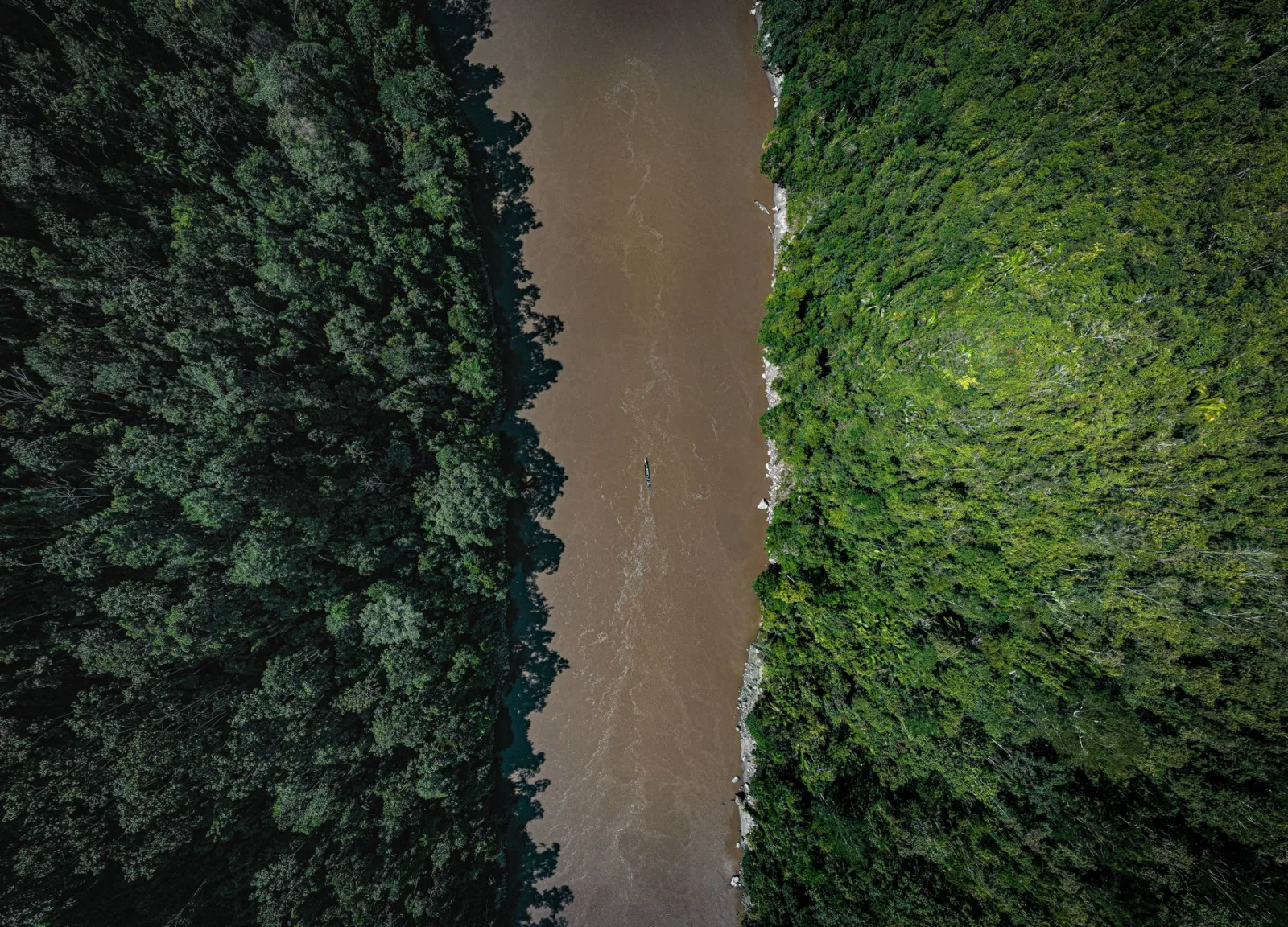
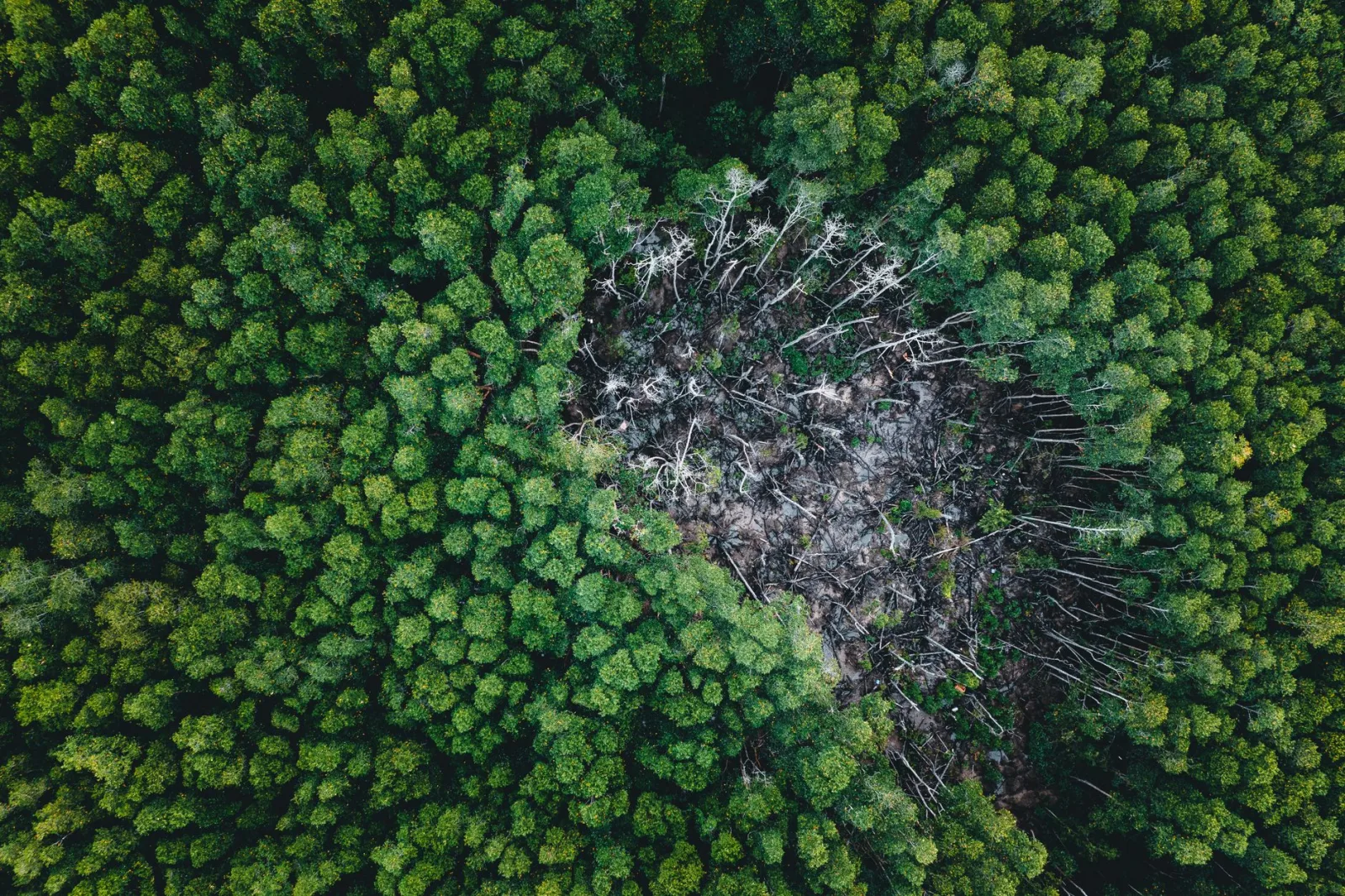
A 2020 study in PNAS by Kathryn Baragwanath and Ella Bayi examined 245 Indigenous territories in the Brazilian Amazon that were legally recognised between 1982 and 2016. Using satellite data, they compared forest loss before and after the final step of recognition, called homologation, which gives full property rights. Deforestation fell significantly once full rights were granted. Territories that did not have full property rights did not show the same effect.
This is a powerful result because it speaks to cause and effect. If Indigenous land simply happened to be remote, deforestation would not change when the legal status changed. Instead, secure rights seem to give communities the legal backing to keep outsiders such as illegal loggers, miners and land-grabbers out.
Correlation, causation and fairness
Even good studies have limits, and being honest about them makes the argument stronger.
- Overlap is not proof of credit. Saying that 40% of protected areas overlap Indigenous land does not tell us how each community manages it, or how much of the result is due to Indigenous action rather than remoteness or government policy.
- The evidence is uneven. It is strongest for the Amazon and Latin America, where satellite records and legal data are good. Elsewhere there is less data, so conclusions should be more cautious.
- Pressure is rising. The IPBES report found that nature on Indigenous lands is declining less quickly, not that it is safe.
- Communities are diverse. Some Indigenous organisations have chosen to partner with industry, and those decisions deserve to be respected as theirs to make, not judged from outside.
The clearest way to put it is this: land rights and forest protection often go hand in hand. For more on what happens when forest is lost, see our guides to the threat of deforestation and to deforestation, afforestation and reforestation.
How Indigenous knowledge helps conserve forests
Law and land rights explain why Indigenous communities can protect a forest. Knowledge explains how. Scientists call it traditional ecological knowledge (or Indigenous and local knowledge): detailed understanding of plants, animals, soils, water and seasons that is built up over many generations through direct experience and passed on through stories, language, skills and practice.
This is not the opposite of science. It is a different, complementary way of building evidence. IPBES made it a central part of its 2019 global assessment for exactly that reason. Here are the main ways it can help a forest.
1. Taking what you need, in a way that lets the forest recover
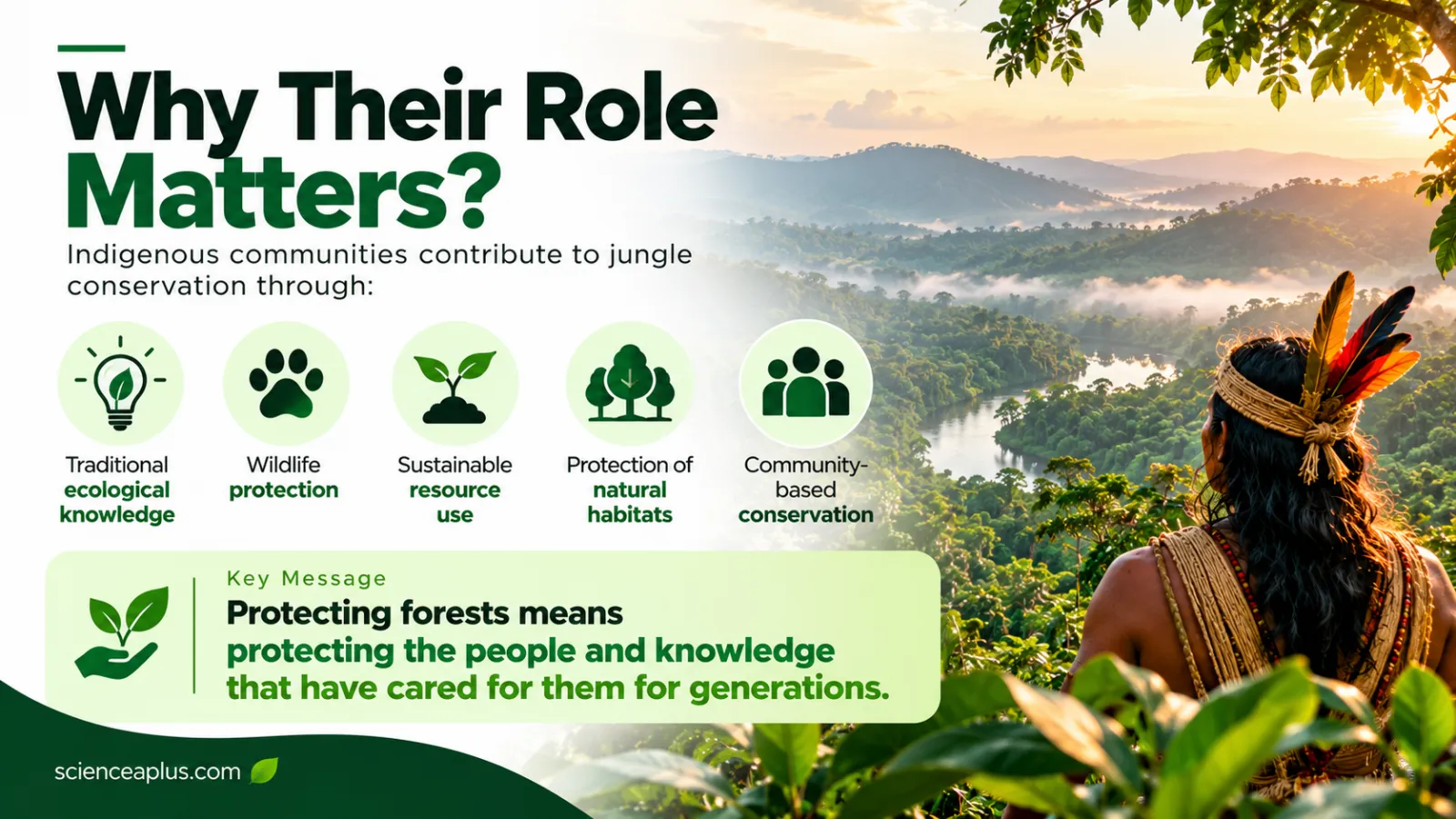
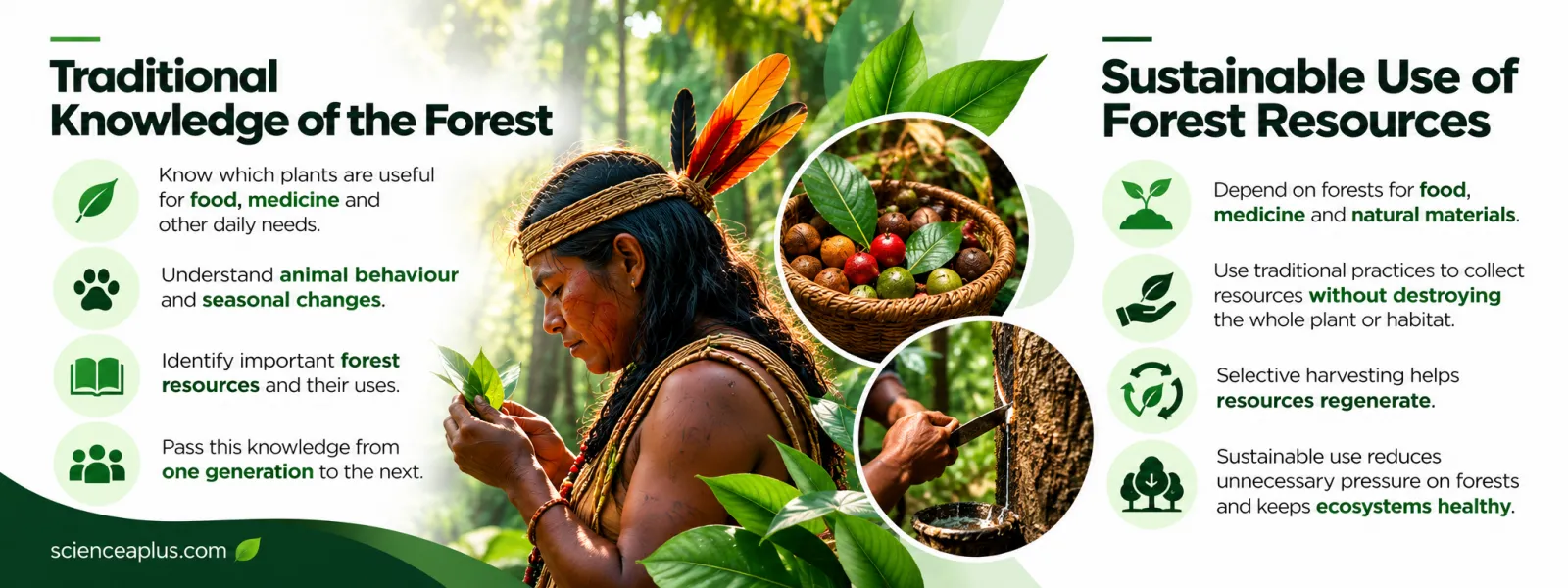
Many forest products can be gathered without killing the plant or clearing the habitat. Tapping latex from a rubber tree, collecting wild fruits and nuts, or cutting only certain stems all leave the tree or forest standing. The infographic above summarises the idea: selective harvesting gives resources time to regenerate.
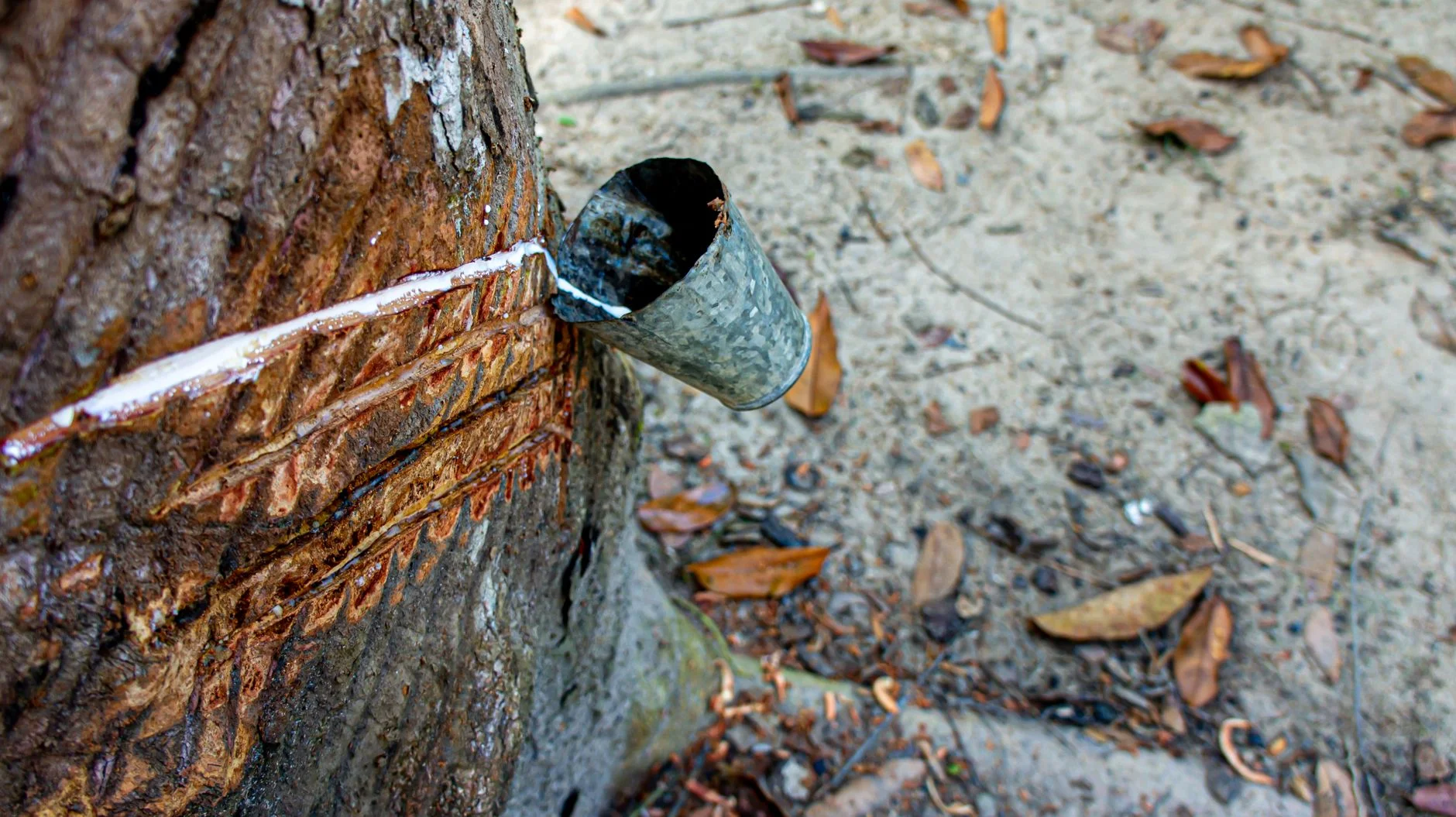
There is a caution here. Sustainable use depends on how many people harvest, how much they take, and how much demand comes from outside. A method that is sustainable for a small community can be overloaded if markets suddenly demand far larger amounts. Knowledge helps, but it works best when the community also controls how much is taken.
2. Watching the forest closely
People who live in a forest notice changes early: a stream that runs low, a fruit that fails to appear, a bird that has not returned. Community monitoring programmes use that everyday attention, often with GPS devices and smartphones, to record wildlife and spot illegal activity such as unauthorised logging or hunting. Combining local records with satellite images and scientific surveys can give a more complete picture than either method alone.
3. Managing fire and shaping landscapes
People have shaped forests and landscapes for thousands of years. In northern Australia, for example, Aboriginal ranger groups use carefully timed cool, low-intensity burns in the early dry season, which can reduce the risk of larger, hotter fires later in the year. In the Amazon, areas of dark, fertile soil known as terra preta (“black earth”) show that people enriched the ground and managed plants in some places long before modern times.
That second example challenges a common picture. The Amazon is often described as “untouched wilderness”. In reality, parts of it have been lived in and shaped by people for thousands of years, which is why many scientists talk about forests and people as long partners rather than opposites.
4. Keeping food webs and canopies working
A forest’s canopy supports fruit-eaters, pollinators and seed-spreaders, and each of those animals is part of a rainforest food web. When hunters, fishers and gatherers know which species are breeding, which are scarce and which places should be left alone, they can adjust their behaviour. Seasonal and place-based rules about when and where to hunt or fish are found in many societies, though their form differs from one community to the next.
Climate and soil also matter. Some of the environmental factors of rainforests, such as heavy rain and thin, quickly leached soils, mean that cleared land often loses fertility fast. Communities who have farmed small plots and then let them regrow have long worked around this, while large-scale clearing for pasture or crops tends to leave degraded land behind.
Test your understanding: knowledge or myth?
Tap each card to flip it and check your answer.
Avoiding the romantic trap
It is easy to swing from ignoring Indigenous Peoples to putting them on a pedestal. Neither is accurate. Calling people “guardians of the forest” can sound respectful, but it can also hide three problems.
- It treats a duty as a trait. Conservation is something communities do under particular conditions, often with little support. It is not something people are born with.
- It ignores modern lives. Indigenous people also run businesses, study at university, use phones and sit in parliaments. Wanting a better road or a clinic does not make a community any less Indigenous.
- It shifts responsibility. If Indigenous Peoples are cast as the planet’s saviours, the countries and companies that drive most forest loss can feel less responsible for changing.
A better way to describe the picture is as partnership: communities, governments, scientists and conservation groups each contribute something. The strongest evidence says that this works best when Indigenous Peoples make the decisions about their own territories.
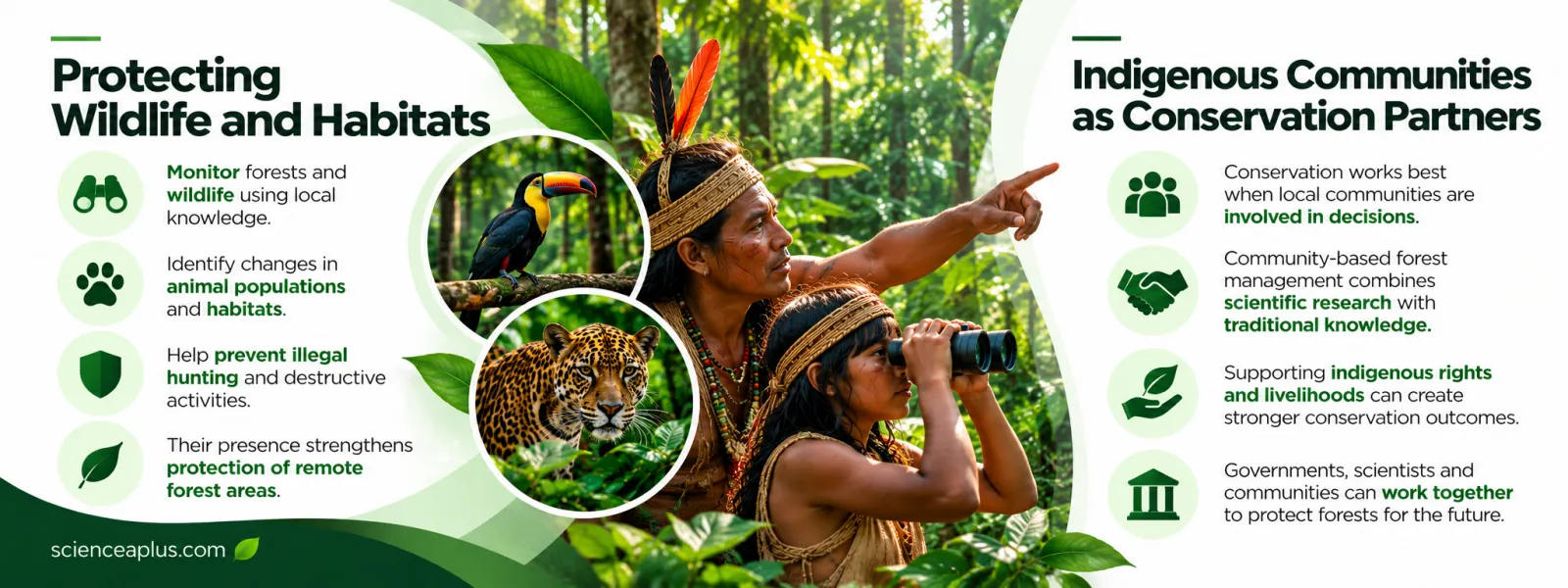
The conservation approaches in the infographic above, such as monitoring wildlife and combining scientific research with traditional knowledge, are described by many organisations as community-based conservation. The details vary by place, but the principle is the same: people who live with the forest should have a real say in how it is protected.
The threats Indigenous communities face
If secure land rights help forests, then insecure rights put both people and forests at risk. Indigenous territories are often the target of illegal logging, mining, cattle ranching, large dams, roads and oil and gas projects, especially where land titles are missing, disputed or ignored.
The human cost is severe. In its 2024 report, the organisation Global Witness documented 196 killings of land and environmental defenders in 2023, bringing its total since 2012 to more than 2,000. About 43% of the victims in 2023 were Indigenous people. Latin America accounted for 85% of the killings, and Colombia recorded 79, the highest of any country in 2023. Global Witness’s 2025 report counted 146 defenders killed or disappeared in 2024 (2,253 since 2012), with Colombia again highest at 48 and about a third of those attacked Indigenous. These are figures about people, not only forests: each one is a person who tried to protect a home.
Rights on paper: UNDRIP and national laws
The key international document is the United Nations Declaration on the Rights of Indigenous Peoples (UNDRIP). The UN General Assembly adopted it on 13 September 2007, with 144 countries in favour, 4 against (Australia, Canada, New Zealand and the United States) and 11 abstentions. All four of those countries have since changed their position and now support it.
UNDRIP is a declaration, so it is not legally binding in the way a treaty is. But it sets out standards that many countries and courts refer to. It includes the right of Indigenous Peoples to the lands and territories they have traditionally owned or used, and the principle of free, prior and informed consent: a community should be properly informed and able to say yes or no before projects such as mines or dams go ahead on its land.
National laws matter even more day to day, and they can change. In Brazil, for example, a long legal and political struggle has centred on the “marco temporal” or “time limit” argument, which says Indigenous peoples can only claim land they were occupying on 5 October 1988, the date of the Brazilian constitution. Brazil’s Supreme Court rejected the time-limit argument in September 2023, but Congress passed Law 14.701 in 2023 to reinstate it. In December 2025 the Court again ruled the 5 October 1988 cut-off unconstitutional and struck down parts of the law, though other provisions were kept. Appeals against that ruling were still being judged in August 2026, and Indigenous organisations report that lower courts still apply the law, so the issue is still contested. The dispute shows how much forest protection depends on what courts and parliaments decide.
What past conservation got wrong
For much of the twentieth century, many national parks were created by excluding the people who lived there, sometimes by force. This approach is often called “fortress conservation”. Today most major conservation organisations accept that it was unfair and, in many cases, unnecessary. The newer approach recognises Indigenous-led conservation, joint management and community-held lands as legitimate and effective models.
It also asks scientists and teachers to make sure Indigenous voices are in the room, not just in the footnotes. That is why the Fernández-Llamazares commentary on the 80% figure matters: it argued that accurate statistics help communities more than impressive but unverified ones. Our own guide to conservation in biology covers the wider toolkit, and our article on jungle rivers and local communities shows how water, food and travel link forest peoples to their landscapes.
What can help forests and forest peoples?
- Secure collective land titles. The FAO and FILAC review describes recognising territorial rights as an efficient, cost-effective way to cut deforestation and emissions.
- Respect consent. Projects affecting Indigenous land should follow the principle of free, prior and informed consent.
- Fund Indigenous-led work directly. Communities can run monitoring, patrols and enterprises, but they need funding and training on their own terms.
- Protect defenders. Stopping violence against land defenders is a basic requirement for any forest plan.
- Cut demand for forest-risk goods. Consumers and companies that buy beef, soy, timber or gold linked to forest clearing share responsibility.
- Use accurate numbers. Quote the figures you can source, so the case for Indigenous rights cannot be dismissed.
Check your thinking
Why is the “80% of biodiversity” statistic misleading? (2 marks)
It comes from a 2001 statement that nearly 80% of terrestrial ecoregions are inhabited by one or more Indigenous peoples, which measures where people live and not how much biodiversity they protect. It was later repeated as if it were a global measure of biodiversity.
Give two pieces of evidence that Indigenous land rights can reduce deforestation. (2 marks)
The 2021 FAO and FILAC review found significantly lower deforestation in Indigenous and tribal territories with formally recognised collective rights. A 2020 PNAS study of 245 territories in the Brazilian Amazon found that deforestation fell once full property rights were granted.
Why should we be cautious about saying Indigenous Peoples “save” the forest? (2 marks)
Because it can ignore the diversity of communities, treat conservation as a natural trait rather than a result of rights and support, and move responsibility away from the governments and companies that drive forest loss.
Key points to remember
Frequently asked questions about Indigenous communities and jungle conservation
What is the role of Indigenous communities in jungle conservation?
Many Indigenous communities live in and depend on tropical forests, so they monitor wildlife, manage resources and defend their land from outsiders. Evidence shows forest loss is often lower on Indigenous territories with secure legal rights. Their role depends on land rights, support and local decisions, not just tradition.
How much of the world’s land do Indigenous Peoples manage?
A 2018 study in Nature Sustainability found that Indigenous Peoples manage or hold tenure rights over at least about 38 million square kilometres in 87 countries or areas. That is over a quarter of the world’s land surface, and the 2019 IPBES assessment gave a similar estimate.
Do Indigenous Peoples protect 80% of the world’s biodiversity?
No study supports that figure. It appears to come from a 2001 line saying nearly 80% of terrestrial ecoregions are inhabited by Indigenous peoples, which measures occupancy rather than biodiversity. Better-supported facts are that Indigenous lands cover at least a quarter of the land and overlap about 40% of protected areas.
Is deforestation lower in Indigenous territories?
In Latin America, yes, particularly where governments formally recognise collective land rights. A 2021 FAO and FILAC review of more than 300 studies found significantly lower deforestation in those territories, and a 2020 study of the Brazilian Amazon found that deforestation fell after full property rights were granted.
What is traditional ecological knowledge?
It is detailed knowledge of plants, animals, seasons and ecosystems built over many generations in a place and passed on through language, stories and practice. It complements scientific research, and the 2019 IPBES global assessment systematically included Indigenous and local knowledge for the first time at that scale.
What does UNDRIP say about Indigenous land?
The UN Declaration on the Rights of Indigenous Peoples, adopted on 13 September 2007, recognises Indigenous Peoples’ rights to the lands and territories they have traditionally owned or used. It also promotes free, prior and informed consent before projects affect them. It is a declaration, not a binding treaty.
Why are Indigenous land defenders in danger?
Indigenous lands are often wanted for timber, mining, farming and energy projects. Global Witness recorded 196 land and environmental defender killings in 2023, and about 43% of the victims were Indigenous. Weak enforcement of land rights and violence against defenders leave communities exposed.
Is it accurate to call Indigenous Peoples guardians of the forest?
The phrase is meant respectfully but can mislead. Indigenous societies are diverse, and conservation outcomes depend on rights, resources and choices rather than a fixed trait. It is more accurate to say that supporting Indigenous land rights is an effective way to protect forests.
Why should the word Indigenous start with a capital letter?
When it refers to specific peoples, “Indigenous” is capitalised in the same way as the names of nationalities. This signals respect for them as distinct peoples with their own cultures and rights, rather than treating the word as a generic description.
How can students help protect rainforests and Indigenous rights?
You can learn from reliable sources, check statistics before sharing them, support organisations led by Indigenous Peoples, and reduce demand for goods linked to deforestation, such as beef, soy and illegally logged timber. Writing to political representatives about land rights and forest protection also helps.