
Can you keep a capybara as a pet? In a few places, yes, but the answer depends on where you live, and the animal’s needs make it a poor fit for almost every home. A capybara is a wild, social, semi-aquatic giant, not a large guinea pig. This article gives the sources and the dates, so you can see what is known, what is disputed and what we could not check.

What is a capybara, and why does everyone want one?
The capybara (Hydrochoerus hydrochaeris) is the largest rodent on Earth. Adults weigh about 35–66 kg and measure about 106–134 cm long, standing roughly 0.6 m at the shoulder. That is closer to a large dog than to a hamster. For other record-holders, see our guide to the largest animals in the world. Closer to home for North American readers, the beaver is covered in our article on the largest rodent in North America.
Capybaras live in South America, across most of Brazil, Uruguay, Venezuela and Colombia, and south into the Argentine pampas. They are close relatives of cavies and guinea pigs, which explains the familiar rounded head and blunt nose. Rodents are a huge group, and you can see where they sit in our overview of the families of mammals.
So why the fame? Capybaras look relaxed, they often rest in groups, and they spend long periods in water. Short videos make that calm look like friendliness. But a video shows a few seconds of an animal that is behaving normally in its own habitat. It tells you nothing about how that animal copes in a house, a garden or a small pen.
Is it legal to keep a capybara as a pet?
There is no single worldwide rule. Laws differ between countries, and within countries they differ between states, counties and cities. Everything below was checked on 5 November 2026 against the sources named. It is general information, not legal advice, and rules change, so always ask the relevant authority before doing anything.

Are capybaras legal in the UK?
In Great Britain, the usual starting point for exotic animals is the Dangerous Wild Animals Act 1976. Its Schedule lists marsupials, primates, edentates, carnivores, pinnipeds, elephants, the aardvark, odd-toed and even-toed ungulates and hybrids. It lists no rodents and does not name the capybara. So we could not find a national “capybara licence” under that Act.
Not every website agrees. Some UK pet sites say a licence is needed, so sources disagree. Local example: Wokingham Borough Council answered a freedom of information request on 17 October 2022 with “We have never licensed Capybaras in this Borough.” That is one council’s answer, not national evidence. We could not check the equivalent rules for Northern Ireland, so people there should ask their council.
Whatever the licence position, the law still applies to every owner. In England and Wales, section 9 of the Animal Welfare Act 2006 requires a suitable environment, a suitable diet, the ability to show normal behaviour, housing with or apart from other animals, and protection from pain, suffering, injury and disease. Scotland has a similar duty in section 24 of the Animal Health and Welfare (Scotland) Act 2006, and Northern Ireland in section 9 of the Welfare of Animals Act (Northern Ireland) 2011. Under section 14 of the Wildlife and Countryside Act 1981, it is also an offence to release, or allow to escape into the wild, an animal not ordinarily resident in Great Britain.
Are capybaras legal in the US?
There is no reliable national list. The rules we found are set by individual states and cities, and online “legal states” lists contradict each other, so we do not publish one. Four examples from primary sources show how much the picture varies.
| Place | What the law says | Source and date |
|---|---|---|
| New York City | Prohibited. The Health Code lists “all large rodents”, naming the capybara, among banned wild animals. | NYC Health Code, Article 161 |
| New York State | The state’s “wild animal” pet definition covers primates, cats, canids, bears and certain reptiles and crocodilians, but no rodents. | Environmental Conservation Law §11-0103 (checked 5 November 2026) |
| California | Restricted. The capybara is not named, but the rules cover all rodent species except a short list such as domesticated hamsters, rats, mice and guinea pigs, so a permit would normally be needed. Check with the California Department of Fish and Wildlife. | 14 CCR §671 |
| Florida | Capybaras are not named in Rule 68A-6.002 and appear to fall under the Class III catch-all (“all other wildlife not listed”). Confirm with the state wildlife commission (FWC). | UF/IFAS, December 2017; Rule 68A-6.002 (amended 2019) |
Look at New York closely. The state law does not list rodents, yet the city bans capybaras by name. Local rules can be stricter than state rules, which is why “is it legal in my state?” is never the whole question.
New York State’s pet law does not list rodents. Could a capybara still be banned in New York City? (2 marks)
Yes. New York City’s Health Code names the capybara among prohibited large rodents. Local rules can be stricter than state rules, so owners must check every level.
Even where a capybara is legal, the law says nothing about whether you can meet its needs. The next sections look at those needs, starting with the one most people forget.
What does a capybara need? Water first
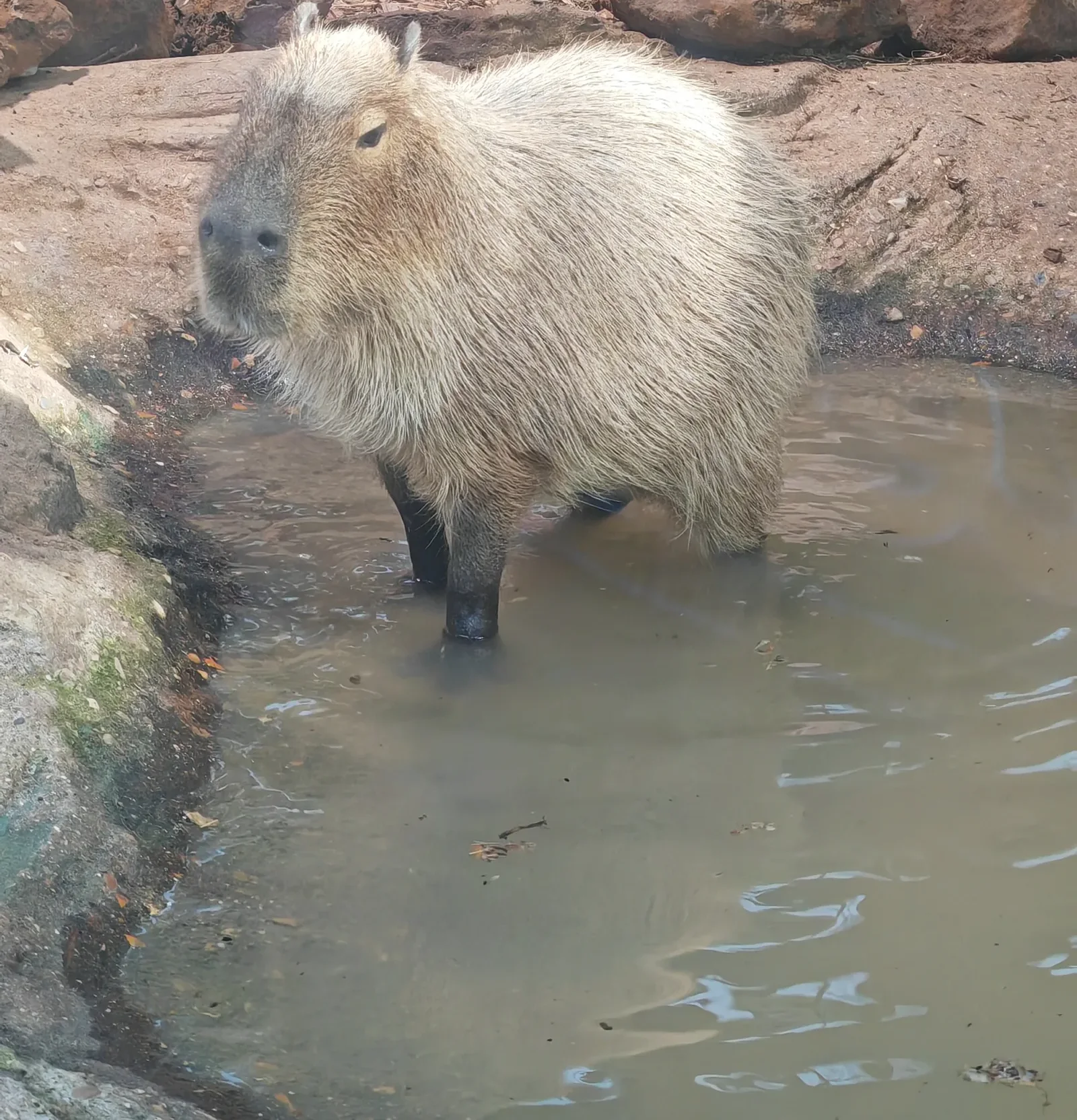
Ask what a capybara needs and the first answer is water. In the wild, capybaras use it for drinking, mating, temperature control, grazing aquatic plants and, above all, escaping predators. Their feet are slightly webbed, they are strong swimmers, and their eyes, nose and ears sit high on the head so they can float with almost everything hidden. They spend the hottest hours of the day in water, and time in water helps them keep cool.


This is a classic example of an adaptation, a feature that helps an organism survive in its habitat. Our guide to adaptations seen in plants and animals explains more examples. For a capybara, the high-set eyes, nose and ears are the adaptation that matters most to anyone thinking about a pool.
What would this mean at home? We found no reliable, checkable standard for enclosure size, so we give no figures. Capybaras are semi-aquatic and use water for cooling and escape, so any set-up would need a large area and a pool that is cleaned regularly. Keeper guides add that a capybara “will not do well confined in a small space”.
Capybara diet: grass, fibre and vitamin C
Capybaras are herbivores. In the wild they eat mainly grasses and aquatic plants, with some bark and fruit. They are selective grazers, picking the plants they prefer, and they widen their menu in the dry season when fresh growth is scarce. San Diego Zoo Wildlife Alliance gives about 3 kg of fresh forage a day for an adult. Herbivores are one of three feeding groups, which you can compare in herbivores, carnivores and omnivores in rainforest food chains.

Plant food is tough, so capybaras have a trick: they eat some of their own droppings, usually in the morning. This lets them digest tough fibre a second time and take in gut bacteria. It looks odd, but it is normal biology and not a sign of illness.
Do capybaras eat meat?
No. A capybara is a plant eater. It does not hunt, and we found no source showing insects or small invertebrates as part of the diet. Advice that suggests meat or insects is not supported by the zoo and wildlife sources we checked.
The vitamin C problem
A good example of why diet matters comes from a study in the Journal of Wildlife Diseases (Cueto and colleagues, 2000). Researchers gave young captive capybaras pellets either without vitamin C or with 1 g of vitamin C a day, with 7 animals in one group and 8 in the other. Animals without the vitamin developed signs of scurvy between 25 and 104 days, and one died. The authors concluded that captive capybaras need a suitable source of vitamin C.
This article is not feeding advice. It shows why a vet who knows exotic animals must be involved, because a diet that looks fine to a human can leave out something a capybara cannot do without.
Grazing is also a numbers problem. Try the calculator below to see how much fresh forage a group of capybaras gets through over the years. The default is two animals, because, as the next section explains, capybaras are social.
Teeth, chewing and what they do to a house
Like all rodents, capybaras have front teeth that never stop growing. Chewing wears them down, so a wild capybara does this naturally by grazing for hours on tough plants.

The skeleton above shows how long and curved the front teeth are. If an animal cannot wear them down, it has a problem. Newsweek notes that continually growing teeth need bark or chew items, and keeper guides report chewing and territory-marking around the home and pool. These are reports from keepers, not controlled studies, so treat them as warnings from experience rather than measured results.

The infographic above sums up the challenges: housing, diet, chewing, mess and vet care. The last one is easy to overlook. Keeper guides say it can be hard to find a vet willing to treat a capybara at all, which matters when a disease or injury needs fast action.
How long do capybaras live?
In the wild, the average is about 6 years and the maximum about 10, according to Animal Diversity Web. San Diego Zoo Wildlife Alliance gives a typical 7–10 years. In captivity, capybaras can reach up to about 12 years, and the managed-care median is about 7.1 years for males and 8.6 years for females. So anyone considering one is looking at a commitment of roughly a decade, with the costs of space, water, food and vet care running the whole time.
Why one capybara is not enough
Wild capybaras live in groups. Animal Diversity Web gives a typical group of about 10, with a range of 3 to 30, while UF/IFAS describes herds of 5 to 14. In the dry season, up to about 100 may gather at the same water. A group usually has a dominant male, several females, young animals and sometimes subordinate males.
The picture is not perfectly simple. Adult males are often pushed out of groups and may live alone or in small bunches, and National Geographic says capybaras can be comfortable alone. But Henry Vilas Zoo staff have said that capybaras are social and that a lone animal needs a companion. Keeper guides advise at least one companion of the same species. We found no measured study of loneliness in capybaras, so we do not claim one.
The practical result is that costs and space double. A plan for “a capybara” is really a plan for at least two, plus the young they can produce. Gestation lasts about 150 days, litters hold 2–8 young (average 4), and a female usually has one litter a year. Unplanned breeding would mean more animals needing space, water and food.


Can capybaras bark?
Yes. Capybaras bark: an alarm bark warns the group of danger. Young capybaras make sounds almost constantly, and adults often do too. Anyone who plans to live next to neighbours should know that these are not silent animals.
Are capybaras dangerous? Bites, stress and dogs
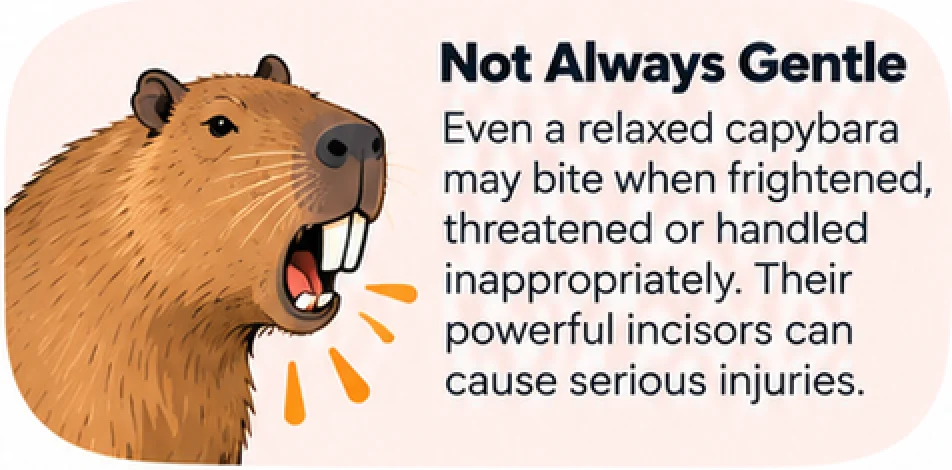
Capybaras are generally described as docile and unlikely to bite. But they have long, sharp front teeth, and Newsweek reports that a frightened or threatened animal can cause serious injury. No reliable bite statistics exist, so nobody can say how often it happens. The sensible reading is that a calm animal is not a guarantee, because fear changes behaviour in every mammal.
What to do if a capybara bites you
This is educational, not medical advice. The NHS guidance on animal bites says to wash the wound with soap and warm water and cover it. Call NHS 111 if there are signs of infection, if the bite is on the hands, feet, face or head, if teeth or dirt are in the wound, or if you have not had a tetanus vaccine in the last 10 years. Go to A&E if the wound is large or deep, or if the bleeding will not stop.
Are capybaras friendly to dogs?
We found no good study of how capybaras and dogs get along, so we cannot give a rule. What we do know is that feral dogs are listed among the predators of young capybaras. Dogs and capybaras need not be natural friends, and a viral clip of one calm meeting does not show what would happen in your garden.
Why don’t crocodiles eat capybaras?
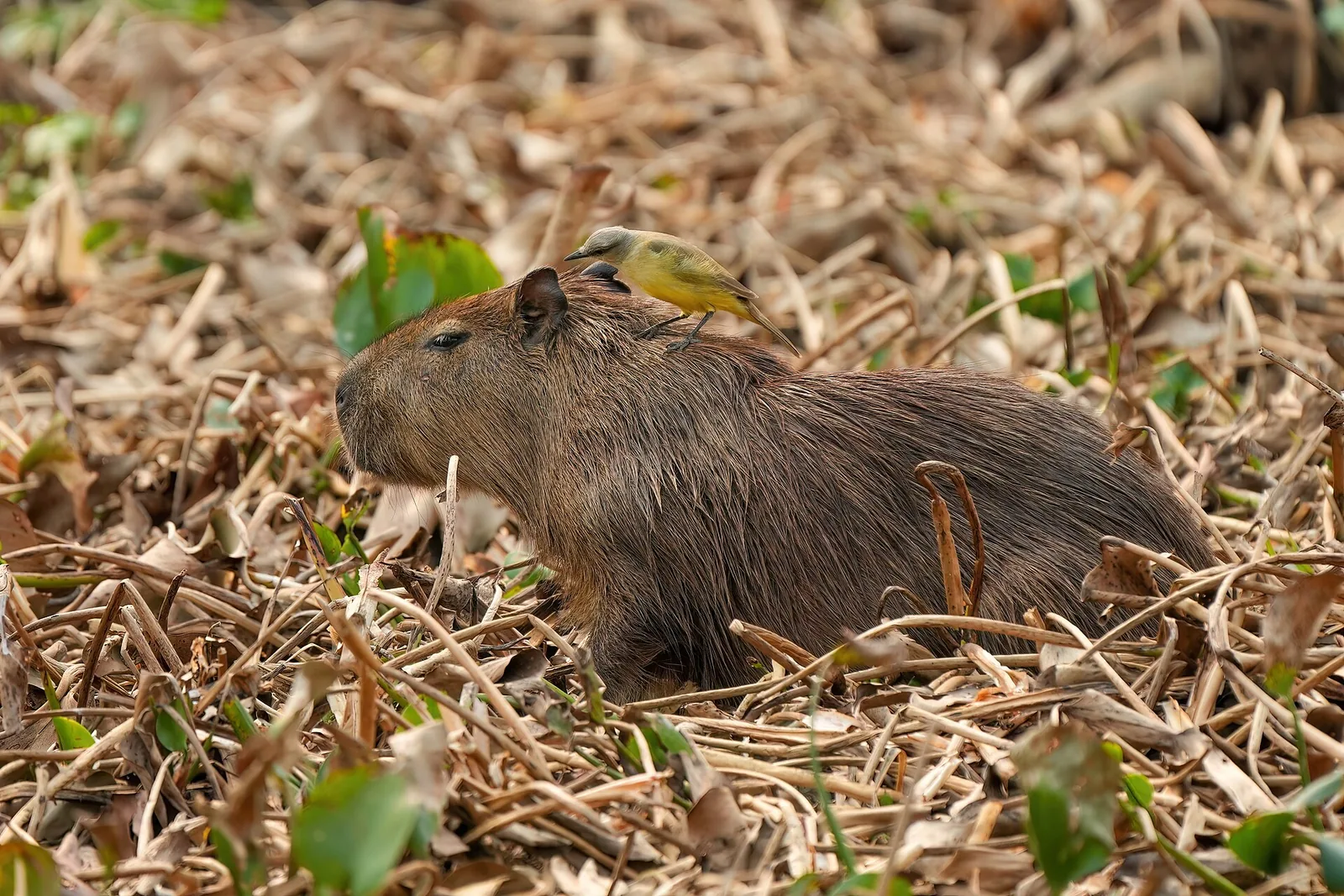
The question assumes they don’t, and that is a myth. Capybaras are eaten by caimans and green anacondas, as well as by jaguars and pumas. You can read about the snake in our article on the anaconda in the rainforest. The jaguar is the main predator of adults, and it features in our guide to the food chain in the rainforest. Water hides capybaras some of the time, but it is not a guarantee of safety.
Disease: ticks and spotted fever
Capybaras also appear in disease research. A 2020 paper in Scientific Reports describes capybaras as amplifying hosts of Rickettsia rickettsii, the bacterium that causes Brazilian spotted fever, for Amblyomma sculptum ticks in endemic areas of Brazil. In simple terms, ticks feeding on infected capybaras can become infected and then spread the bacteria to people. This applies to ticks in particular parts of Brazil. A pet in the UK is not said to carry it, so this is not a reason for alarm, but it shows how wild animals connect to human health.
Explain why the phrase “amplifying host” matters for spotted fever. (2 marks)
An infected capybara carries enough of the bacteria for feeding ticks to become infected. Those ticks can then pass the infection to people, so the capybara increases the amount of infection in the area.
How much does a capybara cost?
Prices are the least reliable part of the story. Figures quoted online vary so widely that we give none here, and we found no reliable UK price. Capybaras are social, so keeper guides advise at least two, which doubles any quote, with enclosures, pools, heated shelters and vet care on top. The purchase is the smallest part of the bill, because the animal lives for years and needs space, clean water and fresh plant food every day.
Escapes, confiscations and real cases
Real cases show what happens when wild animals meet human plans. In Florida, some capybaras escaped in 1994 after a storm damaged a fence at the Lubee Foundation in Alachua County (sources differ on how many). They had already bred, and more were removed in later years. According to UF/IFAS in December 2017, the species had “observed” status in the state, many sightings were possibly escaped or abandoned pets, and no negative impacts had been documented.
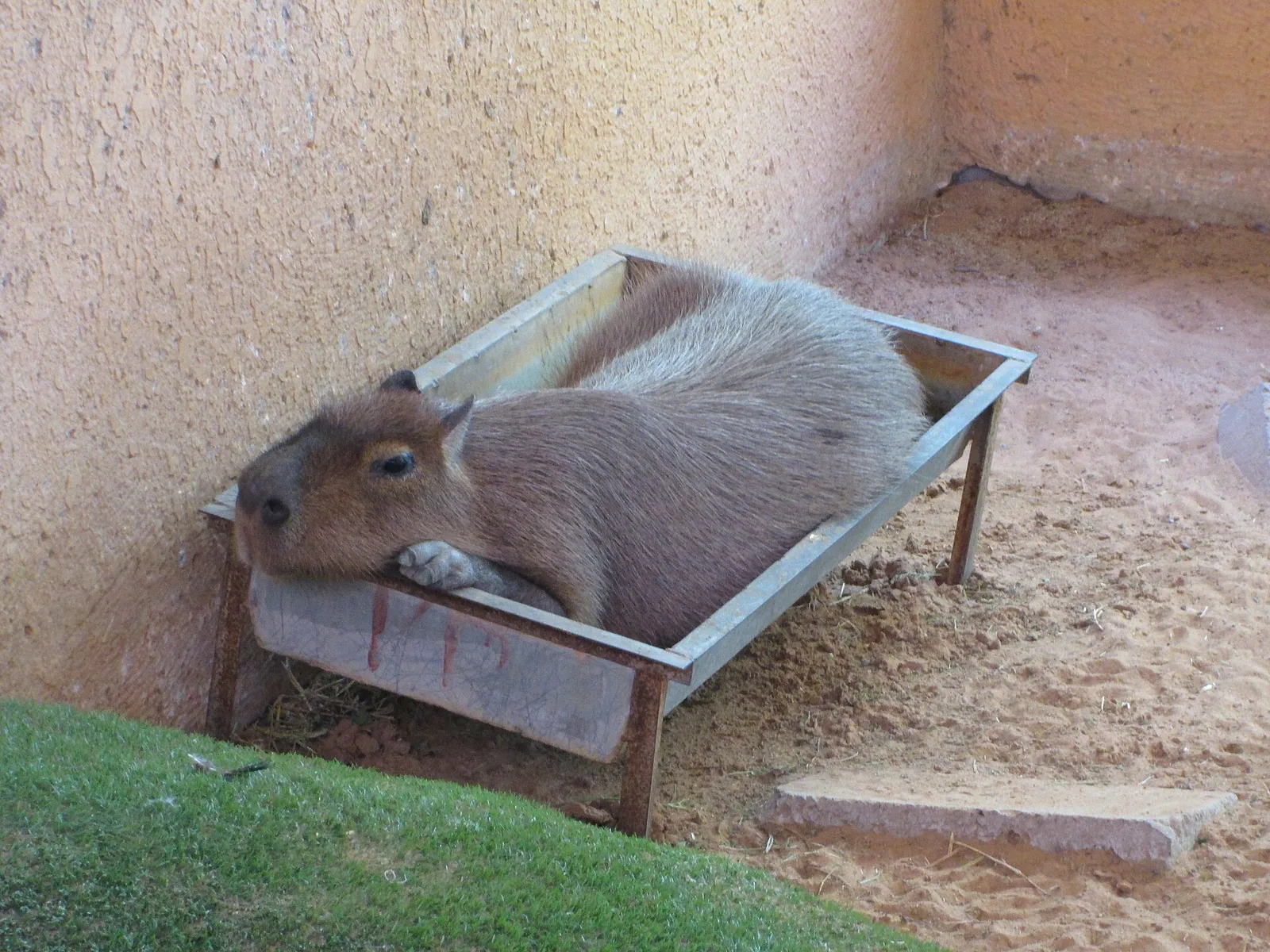
In Brazil, the environmental agency IBAMA fined the influencer Agenor Tupinambá more than 17,000 reais on 18 April 2023, and he handed his capybara Filó over on 27 April 2023. A federal court then granted him provisional custody, and Filó was handed back to him on 30 April 2023, according to Brazilian press reports. We found no final ruling, so the outcome may still change. If you live in Brazil, ask the environmental authorities what the law allows before keeping any wild animal.
The lesson is the same in both cases: a capybara is difficult to contain, and the law, the welfare duty and the animal’s needs all matter at once. Release is never the answer. As covered earlier, releasing an animal not ordinarily resident in Great Britain is an offence under the Wildlife and Countryside Act 1981.
Do capybaras make good pets? A pet checklist
For almost everyone, no. A capybara needs a group, a clean swimming area, large grazing space, a diet that includes a vitamin C source, an exotic vet and about a decade of commitment. If you love capybaras, the better route is to see them in an accredited zoo and to support wetland conservation. The IUCN rates the species Least Concern, so wild populations are not under threat. The problem is the mismatch between the animal and a home.
Use this checklist as a reality test. If you cannot tick every line, the answer is no. It is not a set of instructions for buying one.
- I have confirmed the law in writing with the relevant authority.
- I have space for a group, not a single animal.
- I have a swimming area that can be kept clean.
- I have secure fencing.
- A vet has agreed a grazing and vitamin C plan.
- An exotic vet is confirmed nearby.
- I have a plan for about 12 years.
- I have a plan for what happens if I can no longer keep them, and I will never release them.
To compare other animals that start with the same letter, see our list of animals that start with C.
Capybara: true or false?
Frequently asked questions about keeping a capybara as a pet
Can you keep a capybara as a pet?
In some places, yes, but it depends on local law and it is rarely a good idea. Capybaras are wild, social, semi-aquatic animals that need a group, a large clean pool, grazing space and an exotic vet. Check the rules with your council or state authority before anything else.
Are capybaras legal in the UK?
The Dangerous Wild Animals Act 1976 Schedule lists no rodents and does not name the capybara, so we found no national licence requirement. Some pet sites disagree, so ask your local council in writing. The Animal Welfare Act 2006 applies to every owner in England and Wales.
Are capybaras legal in the US?
It depends on the state and city. New York City bans them, California restricts all rodents unless listed, and Florida requires a Class III wildlife permit. New York State’s pet definition lists no rodents. There is no reliable national list, so check state and local rules.
How much does a capybara cost?
There is no reliable figure. Online quotes vary too widely to trust, and we found no reliable UK price. Keeper guides advise at least two, which doubles any quote, and enclosures, pools, heated shelters and vet care add more.
Do capybaras make good pets?
For almost every household, no. They need a group, a swimming area, large grazing space, a vitamin C source and an exotic vet, and they can live around a decade. Seeing them in an accredited zoo is a better way to enjoy them than keeping one.
Do capybaras bite?
They are generally docile, but their long, sharp front teeth can cause serious injury if they are frightened or threatened. No reliable bite statistics exist. If you are bitten, wash the wound with soap and warm water and call NHS 111 for advice.
Can a capybara live alone?
Wild capybaras live in groups, and keeper guides advise at least one companion of the same species. Some adult males do live alone, and National Geographic says they can be comfortable alone. Henry Vilas Zoo staff have said a lone animal needs a companion, so one is rarely the safe plan.
How long do capybaras live as pets?
In captivity, they can live up to about 12 years. The managed-care median is about 7.1 years for males and 8.6 years for females, according to San Diego Zoo Wildlife Alliance. In the wild the average is about 6 years and the maximum about 10.
Do capybaras eat meat?
No. Capybaras are herbivores. They eat mainly grasses and aquatic plants, with some bark and fruit. They also eat some of their own droppings, usually in the morning, to digest tough fibre a second time. Captive animals need a vitamin C source.
Can capybaras bark?
Yes. An alarm bark warns the rest of the group of danger. Young capybaras vocalise almost constantly, and adults often do too. They are not silent animals, which matters for anyone living near neighbours.