Key points at a glance
- A gene is a section of DNA that codes for a protein. An allele is one of the different versions of that gene.
- You inherit two alleles of every gene, one from each parent, because chromosomes come in pairs.
- Gametes carry only one allele of each gene. Fertilisation puts the pair back together in the zygote.
- A dominant allele shows whenever present; a recessive allele shows only when both alleles are recessive.
- Genotype is the alleles carried; phenotype is the characteristic you can observe.
- Two heterozygous parents give a 3:1 phenotype ratio; heterozygous × homozygous recessive gives 1:1.
Why do two brown-eyed parents sometimes have a blue-eyed child? Why can a characteristic skip a generation? Because you do not inherit characteristics directly — you inherit alleles, and it is the combination you end up with that decides how you turn out.
Genes, alleles and chromosomes
What is an allele?
A gene is a short section of DNA on a chromosome that codes for a particular sequence of amino acids, and therefore for a particular protein. That protein-coding step is the link between DNA and a visible characteristic, and is set out in the central dogma of biology.
An allele is a different version of the same gene. The gene sits at the same position on the same chromosome in every member of a species, but the DNA sequence there can vary — and each variant is an allele.
Human body cells contain 23 pairs of chromosomes, 46 in total. One chromosome of each pair came from your mother and one from your father, and both carry the same genes in the same order — which is why you carry two alleles of every gene.
Dominant and recessive alleles
A dominant allele is expressed whenever it is present, even as a single copy. A recessive allele is expressed only when there is no dominant allele to mask it — only when both alleles are recessive. By convention the dominant allele is a capital letter and the recessive the same letter in lower case: T and t, never T and s.
Homozygous, heterozygous, genotype and phenotype
Homozygous means the two alleles are the same (TT or tt), and such an organism is also called true-breeding; heterozygous means they are different (Tt). The genotype is the alleles carried, while the phenotype is the characteristic you can see or measure — TT and Tt are different genotypes but the same phenotype, and the phenotype is affected by the environment too. For the surrounding terminology, see genetics definitions, DNA and RNA types, and mitosis and meiosis.
| Term | What it means | Example |
|---|---|---|
| Gene | A section of DNA coding for a protein | The gene for plant height |
| Allele | A version of a gene | T (tall) or t (short) |
| Genotype | The alleles an organism has | TT, Tt or tt |
| Phenotype | The observable characteristic | Tall or short |
| Homozygous | Two identical alleles | TT or tt |
| Heterozygous | Two different alleles | Tt |
How alleles are passed from parent to offspring
Meiosis puts one allele into each gamete
Gametes — sperm and egg cells in animals, pollen and egg cells in plants — are made by meiosis, which separates the chromosome pairs. Each gamete therefore receives only one chromosome from each pair, and only one allele of each gene. A body cell with 46 chromosomes is diploid; a human gamete with 23 is haploid.
Which allele ends up in which gamete is chance. A Tt parent makes T and t gametes in roughly equal numbers; a TT parent can make only T gametes.
Fertilisation restores the pair
At fertilisation a haploid male gamete fuses with a haploid female gamete to form a diploid zygote — 46 chromosomes again, and two alleles of every gene, one from each parent. The zygote then divides by mitosis to form the embryo. Fertilisation is random: any sperm can fertilise any egg, which is why genetic predictions are probabilities, never certainties.
Punnett squares and monohybrid crosses
A monohybrid cross follows a single gene through one generation. A Punnett square is the grid used to combine every possible pair of parental gametes: one parent's gametes go along the top, the other's down the side, and each box is filled by combining the allele at the head of its column with the allele at the side of its row.
Worked example 1: Tt × Tt gives 3:1
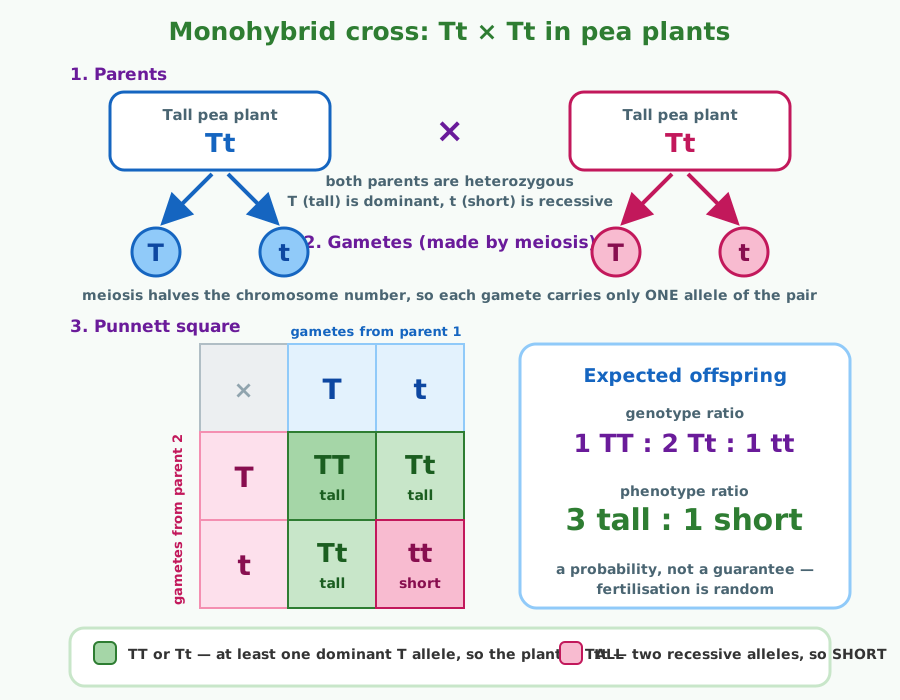
Two tall pea plants are crossed. Both are heterozygous (Tt), where T (tall) is dominant and t (short) is recessive. Each parent makes T and t gametes.
| Gametes | T | t |
|---|---|---|
| T | TT — tall | Tt — tall |
| t | Tt — tall | tt — short |
Genotype ratio: 1 TT : 2 Tt : 1 tt. Phenotype ratio: 3 tall : 1 short, because three of the four boxes contain at least one T allele. The probability that any one offspring is short is 1 in 4, or 25%.
A 3:1 ratio does not mean four offspring will be three tall and one short. It means each offspring independently has a 3 in 4 chance of being tall, so the proportions only settle close to 3:1 over large numbers of offspring. That is why Mendel used pea plants.
Worked example 2: Tt × tt gives 1:1
Now cross a heterozygous tall plant with a short one. A short plant must be tt, since the recessive phenotype appears only when both alleles are recessive, so that parent can make only t gametes.
| Gametes | T | t |
|---|---|---|
| t | Tt — tall | tt — short |
| t | Tt — tall | tt — short |
Genotype ratio: 2 Tt : 2 tt, which simplifies to 1 : 1. Phenotype ratio: 1 tall : 1 short — a 50% chance of each.
Test crosses: finding an unknown genotype
A tall pea plant could be TT or Tt — you cannot tell by looking. A test cross solves this: cross it with a homozygous recessive individual (tt).
| If the unknown parent is… | Cross | Expected offspring |
|---|---|---|
| Homozygous dominant (TT) | TT × tt | All Tt — every offspring tall |
| Heterozygous (Tt) | Tt × tt | 1 Tt : 1 tt — about half short |
A single short offspring proves the unknown parent was heterozygous, because it must have received a recessive allele from each parent. If none appear the parent was probably TT — evidence, not proof.
When neither allele is fully dominant
Incomplete dominance
In incomplete dominance the heterozygote shows a blended, intermediate phenotype: a red-flowered snapdragon crossed with a white-flowered one gives pink flowers. Because neither allele is dominant, both are written as capitals with a superscript — CR for red, CW for white. Crossing two pink plants gives:
| Gametes | CR | CW |
|---|---|---|
| CR | CRCR — red | CRCW — pink |
| CW | CRCW — pink | CWCW — white |
The phenotype ratio is 1 red : 2 pink : 1 white, not 3:1. Genotype and phenotype ratios match here, because every genotype looks different.
Codominance
In codominance both alleles are fully expressed at once, so the heterozygote shows both features side by side rather than a blend. Cattle with one red-hair and one white-hair allele have a roan coat — individual red and white hairs mixed, not pink ones. Human ABO blood groups behave the same way: the IA and IB alleles are codominant, so someone carrying both has blood group AB.
Both patterns give a 1:2:1 phenotype ratio, and some textbooks use "codominance" loosely to cover both. Use the term your own specification uses, and describe what the heterozygote actually looks like — a clear description earns the mark either way.
Sex determination in humans
One of the 23 pairs of human chromosomes is the pair of sex chromosomes: females are XX and males XY, and the other 22 pairs are autosomes. Every egg carries an X, while half the sperm carry X and half carry Y — so the father's sperm determines the sex of the child.
| Gametes | X (egg) | X (egg) |
|---|---|---|
| X (sperm) | XX — female | XX — female |
| Y (sperm) | XY — male | XY — male |
The ratio is 1 female : 1 male — a 50% chance of each at every fertilisation. The Y chromosome is much smaller than the X and carries far fewer genes, which is why some conditions are inherited differently in males and females; those sex-linked disorders belong to the companion lesson on inherited disease.
Exam tips
- Never write "gene" when you mean "allele". A gene is the section of DNA; an allele is a version of it, and this is marked strictly.
- Define your symbols first: "Let T = allele for tall, t = allele for short." Marks are routinely awarded for the key alone — and keep capitals and lower case clearly different in handwriting, because a "t" that looks like "T" turns a correct answer into a wrong one.
- Show the gametes as well as the parental genotypes — mark schemes often credit them separately. Each gamete gets one allele, not two; "Tt" in a gamete circle is a common and costly slip.
- Say "1 in 4", "25%" or "a probability of 0.25", not "one of the four children will be short" — fertilisation is random.
- The recessive phenotype can only be homozygous, so a short plant must be tt. Use that to fill in genotypes the question has not given you.
Frequently asked questions about alleles and inheritance
What is the difference between a gene and an allele?
A gene is a section of DNA on a chromosome that codes for a protein, and so for a characteristic. An allele is one of the different versions of that gene: the gene for plant height has a tall allele and a short allele. Every member of a species has the same genes but not the same alleles.
What is the difference between genotype and phenotype?
The genotype is the combination of alleles an organism carries, such as TT, Tt or tt. The phenotype is the observable characteristic they produce, such as tall or short. Different genotypes can give the same phenotype: TT and Tt both give a tall plant, because T is dominant.
What does homozygous and heterozygous mean?
Homozygous means the two alleles of a gene are the same, either both dominant (TT) or both recessive (tt). Heterozygous means they are different (Tt). A homozygous organism is also called true-breeding, because it can pass on only one type of allele.
How do you draw a Punnett square?
Write one parent's possible gametes along the top of a two-by-two grid and the other parent's down the left-hand side. Fill each box by combining the allele at the top of its column with the allele at the side of its row. Each box is one possible offspring genotype; convert those to phenotypes and state the ratio.
Why do two heterozygous parents give a 3:1 ratio?
Each Tt parent makes T and t gametes in equal numbers, so the four equally likely combinations are TT, Tt, Tt and tt. Three contain at least one dominant T allele and show the dominant phenotype; only tt shows the recessive one. That is a 3:1 phenotype ratio and a 1:2:1 genotype ratio.
Can two parents without a characteristic have a child who has it?
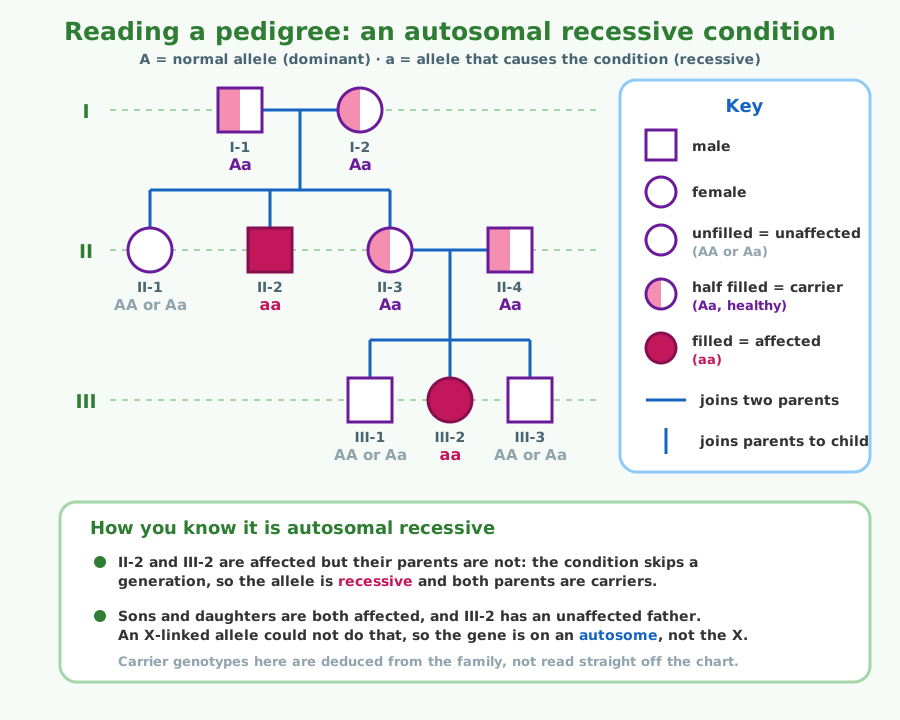
Yes, if the characteristic is recessive and both parents are heterozygous. Each parent shows the dominant phenotype but can pass on the recessive allele, so there is a 1 in 4 chance a child inherits two recessive alleles and shows the characteristic. This is why some characteristics seem to skip a generation.
What is a test cross and why is it used?
A test cross works out whether an organism showing the dominant phenotype is homozygous dominant or heterozygous, which cannot be told by looking. It is crossed with a homozygous recessive individual. If any offspring show the recessive phenotype the unknown parent was heterozygous; if none do, it was probably homozygous dominant.
What is the difference between codominance and incomplete dominance?
In incomplete dominance the heterozygote shows a blended, intermediate phenotype, such as a pink snapdragon from red and white parents. In codominance both alleles are fully expressed at once, so both features appear separately — roan cattle with red and white hairs mixed, or blood group AB. Both give a 1:2:1 phenotype ratio.
Does the mother or the father determine the sex of a baby?
The father. The mother is XX, so every egg carries an X chromosome; the father is XY, so half his sperm carry X and half carry Y. Whether the fertilising sperm carries X or Y decides whether the zygote is XX (female) or XY (male), giving a 1:1 ratio.