Key points at a glance
- Osmosis is the movement of water molecules from a dilute solution to a concentrated solution through a partially permeable membrane.
- It is a passive process: it needs no energy from respiration.
- Water moves down its own concentration gradient — from where there is more water to where there is less.
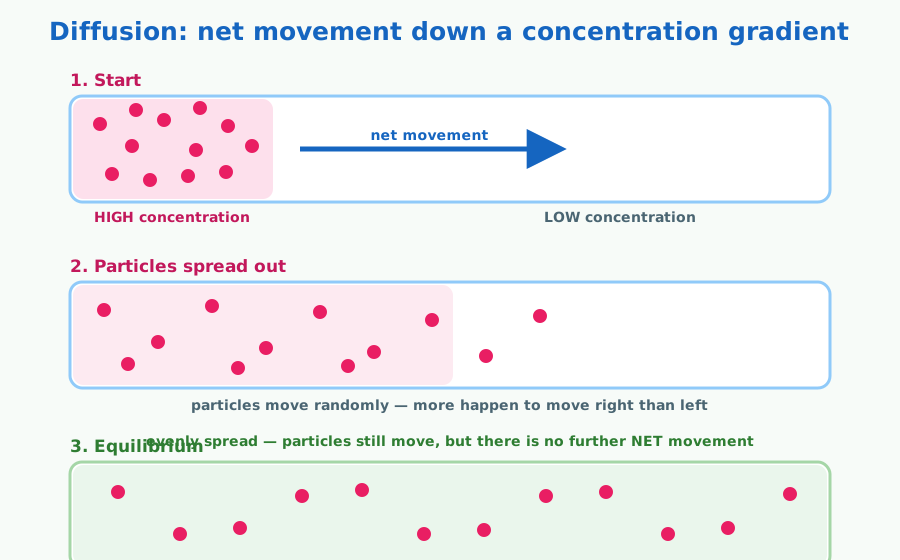
- Osmosis is really a special case of diffusion, but the moving particle is always water.
- In a dilute solution, plant cells become turgid and animal cells may burst (lyse).
- In a concentrated solution, plant cells become plasmolysed and animal cells shrink (crenate).
Osmosis explains why a wilting plant recovers after watering, why a slug shrivels when salt is poured on it, and why the cells lining your small intestine can absorb water from your food. It is one of the three transport processes you need for GCSE and IGCSE biology, alongside diffusion and active transport.
This lesson covers the definition, what partially permeable actually means, what happens to plant and animal cells in different solutions, the required potato practical, and how to calculate percentage change in mass.
What is osmosis?
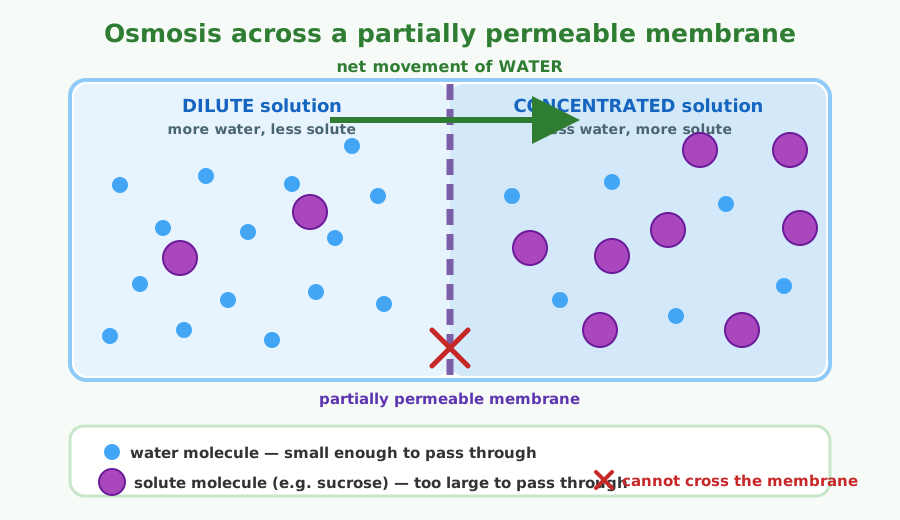
Water molecules are small enough to cross the membrane in both directions, but there is a net movement towards the concentrated side. The larger solute molecules cannot pass through.
Osmosis is the movement of water molecules from a region of higher water concentration (a dilute solution) to a region of lower water concentration (a concentrated solution), through a partially permeable membrane.
Notice what is moving. In diffusion, any kind of particle can move. In osmosis, it is always water. That is the single most useful thing to remember.
A dilute solution contains a lot of water and only a little solute. A concentrated solution contains less water and more solute. Water always moves from the dilute side to the concentrated side, which has the effect of evening out the two concentrations.
What "partially permeable" means
A partially permeable membrane has tiny holes in it. Small water molecules can pass through freely, but larger solute molecules such as sucrose are too big to fit and stay where they are.
This is the key to the whole process. If the solute could move too, both substances would simply diffuse until everything was even. Because only water can cross, water alone moves — and that is osmosis.
Cell membranes are partially permeable, which is why osmosis happens in every living cell.
Osmosis and animal cells
Animal cells have no cell wall, only a membrane, so they are vulnerable to changes in water content.
| Surrounding solution | Net water movement | What happens to the cell |
|---|---|---|
| More dilute than the cell | Water moves in | The cell swells and may burst. This is called lysis. |
| Same concentration as the cell | No net movement | The cell stays the same. It is in equilibrium. |
| More concentrated than the cell | Water moves out | The cell shrinks and the membrane wrinkles. This is called crenation. |
This is why patients are given a saline drip rather than pure water. Pure water entering the blood would be far more dilute than the cytoplasm of red blood cells, so water would rush in and burst them.
Osmosis and plant cells
Plant cells behave differently because they have a strong cellulose cell wall outside the membrane. The wall is fully permeable — it does not control what enters — but it is rigid, and that rigidity stops the cell bursting.
| Surrounding solution | Net water movement | What happens to the cell |
|---|---|---|
| More dilute than the cell sap | Water moves in | The vacuole swells and pushes the membrane against the wall. The cell becomes turgid and firm. The wall prevents bursting. |
| Same concentration | No net movement | The cell is flaccid — soft, but not damaged. |
| More concentrated than the cell sap | Water moves out | The vacuole shrinks and the membrane pulls away from the wall. The cell is plasmolysed. |
Turgor pressure is the outward pressure of the vacuole pushing against the cell wall. It is what keeps non-woody plants upright and their leaves held out flat to catch light. When a plant is short of water the cells lose turgor, become flaccid, and the plant wilts.
In severe water shortage the cells become fully plasmolysed. Watering the plant can often reverse wilting, but a badly plasmolysed cell may not recover.
Osmosis compared with diffusion and active transport
| Feature | Diffusion | Osmosis | Active transport |
|---|---|---|---|
| What moves | Any particle | Water only | Dissolved substances (ions, glucose) |
| Direction | Down the concentration gradient | Down the water concentration gradient | Against the concentration gradient |
| Membrane needed? | No | Yes — partially permeable | Yes, with carrier proteins |
| Energy from respiration? | No | No | Yes — requires ATP |
The one line worth memorising: only active transport requires energy, and only active transport moves substances against the gradient.
Required practical: osmosis in potato
This experiment investigates the effect of sugar or salt concentration on the mass of potato tissue.
- Use a cork borer to cut potato cylinders of equal diameter, then trim them to the same length.
- Blot each cylinder gently with a paper towel to remove surface water.
- Measure and record the mass of each cylinder. This is the initial mass.
- Place one cylinder into each of several sucrose solutions of different concentrations — for example 0.0, 0.2, 0.4, 0.6, 0.8 and 1.0 mol/dm³. Pure water is the 0.0 control.
- Leave for a set time, typically 20–30 minutes or overnight.
- Remove each cylinder, blot it in exactly the same way as before, and record the final mass.
- Calculate the percentage change in mass for each concentration.
Why blot the potato? Surface liquid would add mass that has nothing to do with osmosis. Blotting each cylinder the same way keeps the measurement fair.
Control variables: the size and shape of the potato pieces, the volume of solution, the temperature, the time left in solution, and using potato from the same tuber.
Calculating percentage change in mass
Use this formula:
percentage change = (final mass − initial mass) ÷ initial mass × 100
Worked example: a cylinder starts at 4.0 g and ends at 4.6 g.
(4.6 − 4.0) ÷ 4.0 × 100 = +15%
A second cylinder starts at 4.0 g and ends at 3.4 g.
(3.4 − 4.0) ÷ 4.0 × 100 = −15%
Percentage change is used rather than raw mass change because the cylinders are never exactly identical. Converting to a percentage makes the results comparable.
Interpreting the graph
Plot percentage change in mass against sucrose concentration. The line crosses the x-axis — zero change — at the point where the sugar solution has the same concentration as the potato cell sap. At that concentration there is no net movement of water, so this reading tells you the internal concentration of the potato tissue.
Above that concentration the potato loses mass, because water leaves the cells. Below it the potato gains mass, because water enters.
Everyday examples of osmosis
- Wilting plants recovering after watering, as cells regain turgor.
- Salting slugs — salt makes the outside solution very concentrated, so water leaves the slug's cells.
- Preserving food in salt or sugar — water is drawn out of any bacteria present, so they cannot grow.
- Fingers wrinkling in the bath — water moves into the skin cells of the fingers and toes.
- Root hair cells absorbing water from soil, where the soil water is more dilute than the cell sap.
Exam tips
- Always say water molecules move. Saying "the solution moves" loses marks.
- Include all three parts of the definition: water, partially permeable membrane, and dilute to concentrated.
- Osmosis needs no energy. Only active transport does.
- Use turgid and plasmolysed for plant cells; lysis and crenation for animal cells. Do not mix them up.
- Plant cells do not burst because the cell wall resists the pressure — not the membrane.
- In the potato practical, always mention blotting and using percentage change.
Frequently asked questions about osmosis
What is the definition of osmosis?
Osmosis is the movement of water molecules from a dilute solution (high water concentration) to a concentrated solution (low water concentration) through a partially permeable membrane. It is a passive process and requires no energy.
What is the difference between osmosis and diffusion?
In diffusion any type of particle moves down its concentration gradient, and no membrane is needed. In osmosis only water moves, and it must pass through a partially permeable membrane. Osmosis is really a special case of diffusion involving water.
Does osmosis require energy?
No. Osmosis is passive, driven by the random movement of water molecules and the concentration gradient. Only active transport requires energy from respiration.
What does partially permeable mean?
It means the membrane has holes small enough to let water molecules through but too small for larger solute molecules such as sucrose. Because only water can cross, only water moves — which is what makes osmosis happen.
Why do plant cells not burst in pure water?
Because of the rigid cellulose cell wall outside the membrane. As water enters, the vacuole swells and pushes the membrane against the wall, creating turgor pressure. The wall resists that pressure, so the cell becomes turgid rather than bursting. Animal cells have no wall and can burst.
What is the difference between turgid, flaccid and plasmolysed?
A turgid cell has taken in water and is firm, with the membrane pressed against the wall. A flaccid cell has lost some water and is soft. A plasmolysed cell has lost so much water that the membrane has pulled away from the cell wall.
Why do we calculate percentage change in mass rather than mass change?
Because the potato cylinders are never exactly the same mass at the start. Converting to a percentage makes the results directly comparable and lets you plot a fair graph.
Why does salt kill slugs?
Salt creates a very concentrated solution on the slug's moist skin. Water moves out of the slug's cells by osmosis, down the water concentration gradient, and the animal rapidly dehydrates.
What does it mean when the graph crosses the x-axis?
The concentration at which there is zero percentage change in mass is the concentration where the external solution matches the potato cell sap. There is no net movement of water at that point, so it tells you the internal solute concentration of the tissue.