Key points at a glance
- Diffusion is the net movement of particles from an area of higher concentration to an area of lower concentration, down a concentration gradient.
- It happens because particles are in constant random motion — nothing pushes them.
- Diffusion is passive: it needs no energy from respiration.
- It occurs in gases and liquids, where particles are free to move, but not in solids.
- Rate increases with a steeper concentration gradient, higher temperature, larger surface area and shorter diffusion distance.
- Exchange surfaces such as alveoli and villi are adapted to make all four of those factors as favourable as possible.
When someone opens a bottle of perfume across the room, you smell it moments later without anyone fanning it towards you. That is diffusion. The same process moves oxygen from your lungs into your blood, carbon dioxide out of a leaf, and digested food from your intestine into your bloodstream.
This lesson explains what diffusion is, why it happens, the factors that affect its rate, how exchange surfaces are adapted for it, and how it compares with osmosis and active transport. It is written for GCSE and IGCSE biology.
What is diffusion?
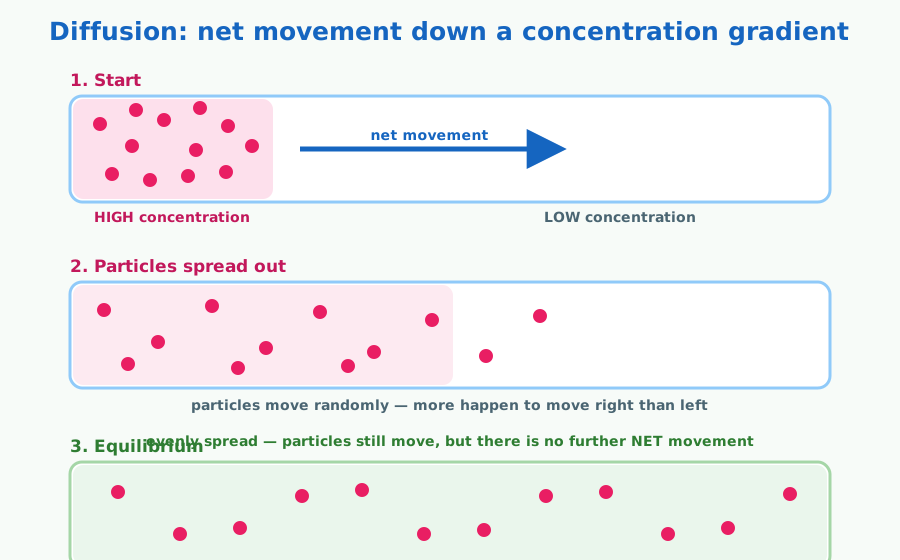
Particles move randomly. Where they start crowded together, more happen to move away than towards, so the net movement is down the concentration gradient until the spread is even.
Diffusion is the net movement of particles from a region where they are more concentrated to a region where they are less concentrated.
The word net matters. Particles are always moving randomly in every direction. When there are more particles on one side, more of them happen to move away from that side than towards it, purely by chance. The overall — net — result is movement down the concentration gradient.
A concentration gradient is simply the difference in concentration between two regions. Particles diffuse down the gradient, from high to low. Once the concentration is even everywhere, the particles keep moving but there is no further net movement. This state is called equilibrium.
Diffusion is a passive process. No energy from respiration is needed, because the particles' own kinetic energy does the work.
Why diffusion does not happen in solids
In gases and liquids the particles can move past one another freely, so diffusion happens readily — fastest in gases, where particles move quickest and are furthest apart. In a solid the particles only vibrate about fixed positions, so they cannot move through the substance and diffusion effectively does not occur.
Factors affecting the rate of diffusion
| Factor | Effect on rate | Why |
|---|---|---|
| Concentration gradient | Steeper gradient, faster diffusion | A bigger difference means proportionally more particles move from high to low concentration |
| Temperature | Higher temperature, faster diffusion | Particles gain kinetic energy and move faster |
| Surface area | Larger surface area, faster diffusion | More area is available for particles to cross at once |
| Diffusion distance | Shorter distance, faster diffusion | Particles have less far to travel, so they arrive sooner |
| Size of particle | Smaller particles diffuse faster | Small, light particles move more quickly at a given temperature |
These combine in a useful relationship you may meet as Fick's law:
rate of diffusion ∝ (surface area × concentration difference) ÷ diffusion distance
Read it as: increase the surface area or the concentration difference and the rate goes up; increase the distance and the rate goes down.
Adaptations of exchange surfaces
Small single-celled organisms can rely on diffusion across their outer surface, because every part of the cell is close to the outside. Larger organisms cannot — their surface area to volume ratio is too small and the diffusion distance to inner cells is too great. They need specialised exchange surfaces.
Effective exchange surfaces share the same four adaptations:
- Large surface area, so many particles can cross at once.
- Thin walls, giving a short diffusion distance.
- Good blood supply in animals, to carry substances away and maintain a steep concentration gradient.
- Ventilation in gas exchange surfaces, which also maintains the gradient.
The alveoli in the lungs
| Adaptation | How it speeds up diffusion |
|---|---|
| Millions of tiny air sacs | Enormous total surface area for gas exchange |
| Wall one cell thick | Very short diffusion distance between air and blood |
| Surrounded by a dense capillary network | Blood constantly removes oxygen, maintaining a steep gradient |
| Ventilated by breathing | Fresh air keeps the oxygen concentration in the alveolus high |
| Moist lining | Gases dissolve before diffusing across the membrane |
Oxygen diffuses from the alveolus (high concentration) into the blood (low concentration). Carbon dioxide diffuses the opposite way, from the blood into the alveolus, and is breathed out.
The villi in the small intestine
The small intestine is lined with finger-like projections called villi, each covered in even smaller microvilli. Together these give a very large surface area for absorbing digested food. The villi have walls one cell thick and a rich blood supply, which carries absorbed glucose and amino acids away and keeps the concentration gradient steep.
Leaves
In a leaf, carbon dioxide diffuses in through the stomata and then through the air spaces of the spongy mesophyll to the photosynthesising cells. Oxygen diffuses out the same way. The leaf's broad flat shape gives a large surface area, and its thinness keeps the diffusion distance short.
Diffusion, osmosis and active transport compared
| Feature | Diffusion | Osmosis | Active transport |
|---|---|---|---|
| What moves | Any particle that can cross the membrane | Water only | Dissolved substances such as ions and glucose |
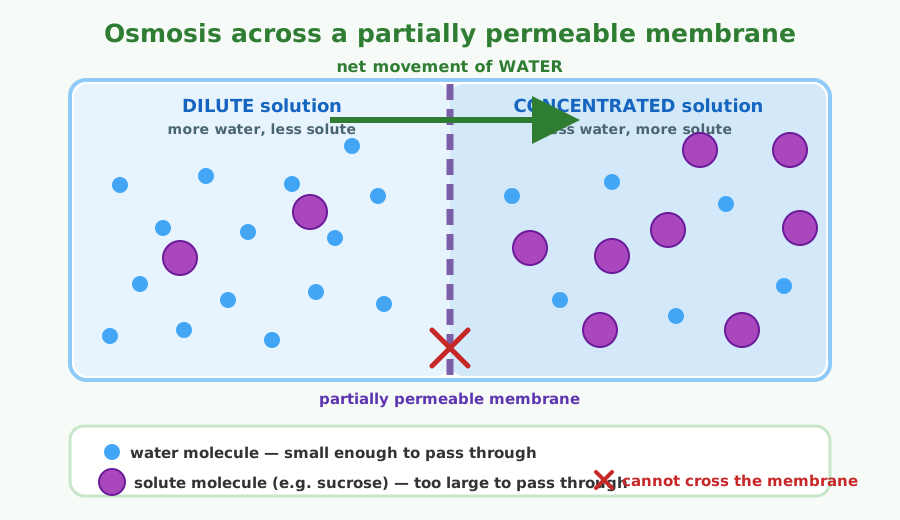
| Direction | High to low concentration | Dilute to concentrated solution | Low to high — against the gradient |
| Membrane required? | No | Yes — partially permeable | Yes, with carrier proteins |
| Energy needed? | No | No | Yes — ATP from respiration |
| Example | Oxygen entering the blood at the alveoli | Water entering root hair cells | Mineral ions absorbed by root hair cells |
The clearest way to tell active transport apart in an exam question: if a substance moves from a low concentration to a high one, it must be active transport, and it must require energy.
Demonstrating diffusion
Two simple experiments show diffusion clearly.
Potassium manganate(VII) in water. Drop a crystal into a beaker of still water. The purple colour spreads out from the crystal until the whole beaker is evenly coloured. Nothing stirs it — the particles spread by random motion alone. Repeating this in hot and cold water shows the effect of temperature: the colour spreads faster in hot water.
Agar jelly cubes. Cubes of agar containing an indicator are cut to different sizes and placed in acid. Timing how long the acid takes to reach the centre of each cube shows that smaller cubes are penetrated faster, because they have a larger surface area to volume ratio and a shorter distance to the centre. This models why large organisms cannot rely on diffusion alone.
Surface area to volume ratio
As an object gets bigger, its volume increases faster than its surface area, so the surface area to volume ratio falls.
Compare two cubes:
- A 1 cm cube has a surface area of 6 cm² and a volume of 1 cm³, giving a ratio of 6:1.
- A 2 cm cube has a surface area of 24 cm² and a volume of 8 cm³, giving a ratio of 3:1.
The larger cube has proportionally far less surface for its bulk. This is why a large organism cannot supply its inner cells by diffusion through its skin, and why it needs lungs, a circulatory system and specialised exchange surfaces.
Exam tips
- Always write net movement of particles, and mention that movement is random.
- State the direction fully: from high to low concentration, down the concentration gradient.
- Diffusion needs no energy. If the question says a substance moves against the gradient, the answer is active transport.
- When explaining an exchange surface, link each adaptation to why it speeds diffusion — the mark is for the reason, not the feature.
- Blood supply and ventilation both work by maintaining the concentration gradient. Say so explicitly.
- For surface area to volume questions, show the calculation for both objects before comparing.
Frequently asked questions about diffusion
What is diffusion in simple terms?
Diffusion is the net movement of particles from an area where they are more concentrated to an area where they are less concentrated. It happens because particles move randomly, and it needs no energy.
Why does diffusion happen?
Because particles in a gas or liquid are constantly moving in random directions. Where particles are crowded together, more of them happen to move away than towards, so the overall result is spreading out until the concentration is even.
Does diffusion need energy?
No. Diffusion is a passive process driven by the particles' own kinetic energy. Only active transport requires energy from respiration.
What is the difference between diffusion and osmosis?
In diffusion any particle can move, and no membrane is required. In osmosis only water moves, and it must cross a partially permeable membrane. Osmosis is a special case of diffusion involving water.
What factors affect the rate of diffusion?
A steeper concentration gradient, a higher temperature, a larger surface area and a shorter diffusion distance all increase the rate. Smaller particles also diffuse faster than larger ones.
Why are alveoli good exchange surfaces?
They provide a huge surface area, their walls are one cell thick for a short diffusion distance, they have a dense capillary network that removes oxygen and maintains a steep gradient, and breathing ventilates them with fresh air.
Can diffusion happen in solids?
Not in any meaningful way. In a solid the particles only vibrate about fixed positions and cannot move through the substance, so diffusion requires a gas or a liquid.
What does down the concentration gradient mean?
It means moving from a region of higher concentration to a region of lower concentration — the natural direction of diffusion. Moving the other way, from low to high, is against the gradient and requires active transport.
Why do large organisms need exchange surfaces?
Because their surface area to volume ratio is too small and the distance from the outside to their inner cells is too great. Diffusion alone would be far too slow, so they need lungs, villi and a circulatory system to move substances efficiently.