Key points at a glance
- An inherited disease is caused by a faulty allele passed on in a gamete, not by infection or lifestyle.
- An autosomal recessive condition needs two faulty alleles. A carrier has one, is healthy, and can still pass it on.
- Two carrier parents have a 1 in 4 chance of an affected child at every pregnancy — so healthy parents can have one.
- In an autosomal dominant condition one faulty allele is enough, so there are no carriers and it appears in every generation.
- X-linked recessive conditions affect males far more often: a male has one X chromosome and cannot be a carrier.
- A pedigree chart reveals the pattern: squares are males, circles females, filled symbols affected.
Some diseases are caught and some come from how we live. An inherited (or hereditary) disease is neither: it is caused by a faulty version of a gene received from a parent in the sperm or egg cell, then copied into every body cell for life.
This lesson assumes you can handle genotypes and Punnett squares; if those are shaky, work through alleles and inheritance first. What follows is that machinery applied to real conditions.
What makes a disease inherited?
Faulty alleles, not faulty genes
Everyone has the gene involved in cystic fibrosis. What differs is the allele — the version they carry. A faulty allele codes for a protein that does not work properly, and the disease is the consequence.
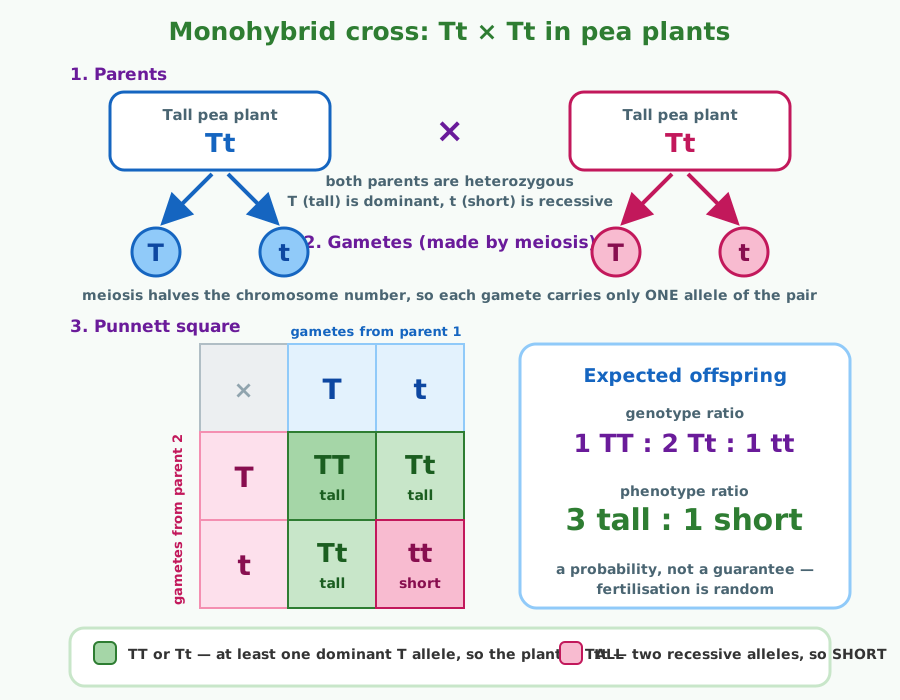
That allele sits on a chromosome, so it follows the ordinary rules: meiosis separates it into gametes and fertilisation recombines it, so inherited disease uses the same Punnett squares as pea plant height.
Inherited, chromosomal and acquired conditions
| Type of condition | Cause | Example |
|---|---|---|
| Inherited (single gene) | A faulty allele of one gene, passed on in a gamete | Cystic fibrosis, Huntington's disease |
| Chromosomal | The wrong number or structure of whole chromosomes | Down syndrome — an extra chromosome 21 |
| Acquired | Infection, diet, environment or injury | Influenza, scurvy, a broken bone |
Down syndrome is a common trap. It is caused not by a dominant or recessive allele but by having three copies of chromosome 21 instead of two, usually because a chromosome pair failed to separate when a gamete was made. It is genetic, but not passed down like an allele.
The three patterns of inheritance
An autosome is any chromosome that is not a sex chromosome — in humans, the 22 pairs that are neither X nor Y. Where the allele sits, and whether it is dominant or recessive, gives three patterns.
Autosomal recessive
The faulty allele is recessive and on an autosome, so two copies are needed and an affected person is homozygous recessive. Someone with one is a carrier: healthy, because the working allele makes enough functioning protein, but able to pass the faulty one on. The condition can appear to skip generations and affects both sexes equally.
Autosomal dominant
One faulty allele is enough, so an affected person is heterozygous or homozygous dominant. There are no carriers: anyone with the allele has the condition, so it appears in every generation: an affected person normally has an affected parent.
X-linked recessive
Here the recessive faulty allele sits on the X chromosome. A female is XX, so she needs two faulty alleles and is a carrier with one. A male is XY: his single X has no partner, so one allele is enough and he can never be a carrier — hence the male bias. An X-linked allele also never passes from father to son, since a father gives his son only a Y.
| Feature | Autosomal recessive | Autosomal dominant | X-linked recessive |
|---|---|---|---|
| Faulty alleles needed | Two | One | Two in females, one in males |
| Are there carriers? | Yes | No | Females only |
| Who is affected | Both sexes equally | Both sexes equally | Males far more often |
| Pattern in a family | Can skip generations | In every generation | Affected males linked through the mother |
| Affected child of unaffected parents | Possible (both carriers) | Not expected | Possible (carrier mother) |
| Examples | Cystic fibrosis, sickle cell anaemia | Huntington's disease, polydactyly | Haemophilia, colour blindness |
Carriers and the 1 in 4 risk
Let A be the working allele and a the faulty recessive one. Both parents are carriers, so both are Aa and healthy, and each makes A and a gametes equally.
| Gametes | A | a |
|---|---|---|
| A | AA — unaffected | Aa — carrier |
| a | Aa — carrier | aa — affected |
Four equally likely combinations: one AA, two Aa, one aa. Each child therefore has a 1 in 4 (25%) chance of being affected, 2 in 4 of being a healthy carrier, and 1 in 4 of inheriting no faulty allele.
That square answers the strangest question: healthy parents can have an affected child because neither parent's phenotype reveals the hidden allele. It also shows why the risk never "uses itself up" — fertilisation is random, so 1 in 4 applies afresh to every pregnancy.
The named conditions to learn
| Condition | Pattern | Effect |
|---|---|---|
| Cystic fibrosis | Autosomal recessive | Thick, sticky mucus builds up in the lungs and blocks the pancreatic ducts |
| Sickle cell anaemia | Autosomal recessive | Abnormal haemoglobin makes red blood cells sickle-shaped, so they block capillaries and carry less oxygen |
| Huntington's disease | Autosomal dominant | Progressive damage to nerve cells in the brain, usually starting in middle age |
| Polydactyly | Autosomal dominant | Extra fingers or toes form |
| Haemophilia | X-linked recessive | A missing clotting factor, so the blood clots very slowly |
| Red-green colour blindness | X-linked recessive | Cone cells in the retina cannot distinguish red from green |
Sickle cell anaemia and malaria
Sickle cell anaemia shows why a harmful allele is not always removed by natural selection: a carrier has some protection against malaria. Where malaria is common, carriers reproduce more successfully than either homozygote — two normal alleles leave a person vulnerable to malaria, two sickle cell alleles give the disease. That keeps the allele common in those regions.
Huntington's disease and late onset
Huntington's disease is dominant, so an affected heterozygous parent (Hh) crossed with an unaffected parent (hh) gives each child a 1 in 2 risk. Symptoms usually appear well into adult life, so a person may have children before knowing they have it — the point exam questions on testing turn on.
Why haemophilia mostly affects males
Write the alleles on the chromosome: XH is normal, Xh is the haemophilia allele, and the Y carries no copy. Cross a carrier mother (XHXh) with an unaffected father (XHY).
| Gametes | XH (mother) | Xh (mother) |
|---|---|---|
| XH (father) | XHXH — unaffected girl | XHXh — carrier girl |
| Y (father) | XHY — unaffected boy | XhY — boy with haemophilia |
No daughter is affected, because each receives a normal XH from her father. Half the sons are, because a son's only X comes from his mother. Overall 1 in 4 of the children are affected boys. Red-green colour blindness behaves identically.
Reading a pedigree chart
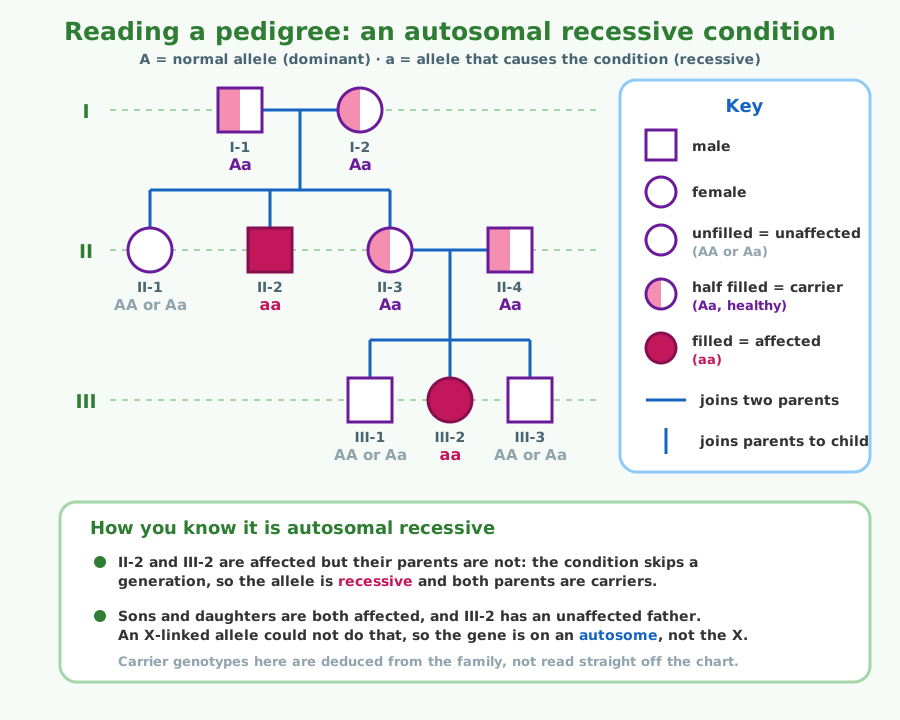
A pedigree chart is a family tree drawn with agreed symbols. Squares are males and circles are females. A filled symbol is affected, an unfilled one unaffected, a half-filled one a known carrier. A horizontal line joins two parents, a vertical line drops to their children, and generations are numbered in Roman numerals.
Dominant or recessive?
Look for two unaffected parents with an affected child. That is only possible if both carry a hidden allele, so the condition is recessive and both are carriers. If instead every affected person has an affected parent and nothing skips a generation, it is dominant.
Autosomal or sex-linked?
Once you know it is recessive, check the affected females. An affected female inherited a faulty allele from each parent, so if it were X-linked her father would be affected too — he gives her his only X. An affected daughter with an unaffected father rules out X-linkage. Equal numbers of affected males and females point the same way; a male bias suggests X-linkage.
Screening, counselling and the arguments about them
What each term means
Genetic screening tests DNA for faulty alleles — in adults, to see if they are carriers, or in a fetus during pregnancy. Genetic counselling is the process in which trained specialists explain how a condition is inherited, the risk to a family's children and the options; they set out information rather than telling people what to choose. Embryo screening is used with IVF: several embryos are made, a cell from each is tested, and embryos without the faulty allele can be selected.
Arguments for and against
| Arguments in favour | Arguments against |
|---|---|
| Families can make informed decisions rather than guess at their risk | Acting on a result can be stressful, and results might be misused by insurers or employers |
| Fewer people are born with painful or life-shortening conditions | Implies lives with a condition are worth less, which many disabled people reject |
| Treatment and support can be planned from birth | Some tests during pregnancy carry a small risk, and no test is perfect |
| Embryo screening avoids later decisions about ending a pregnancy | Raises the prospect of selecting embryos for non-medical traits |
These answers are marked for balance: give both sides, then a conclusion that follows from them. Religious and moral objections count, as does the fact that one person's result reveals information about relatives who did not consent. This page is a revision resource, not medical advice; anyone worried about a condition in their family should speak to a doctor or genetic counsellor, and our medical disclaimer sets out the limits.
Exam tips
- Define your symbols first: "Let A = normal allele, a = cystic fibrosis allele." In X-linked crosses write the allele on the chromosome, as XH and Xh; the father's gametes are XH and Y.
- "Carrier" means heterozygous for a recessive condition. There is no carrier of a dominant condition; writing one costs marks.
- Give risk as a probability — "1 in 4", "25%" — never "one of their four children". The chance resets at every fertilisation.
- For the risk of an affected boy, read carefully: from a carrier mother it is 1 in 4 of all the children but 1 in 2 of the sons.
- Write about people respectfully — "a person with sickle cell anaemia" — and treat Down syndrome as a chromosome-number problem.
Frequently asked questions about inherited diseases
What is an inherited disease?
An inherited disease is caused by a faulty allele passed from parent to child in the sperm or egg cell. That allele is copied into every body cell as the embryo grows, so the condition is present for life. It is not caught, and nothing the parents did caused it.
What is a carrier?
A carrier is heterozygous: one faulty recessive allele and one working allele. The working allele makes enough functioning protein, so the carrier is healthy and has no symptoms. Half their gametes carry the faulty allele, so it can be passed on.
How can two healthy parents have a child with an inherited disease?
If the condition is recessive and both parents are carriers, each can pass on the hidden allele without showing symptoms. A Punnett square for Aa crossed with Aa gives AA, Aa, Aa and aa, so a child has a 1 in 4 chance of inheriting two faulty alleles.
Why are more males affected by haemophilia and colour blindness?
Both are caused by recessive alleles on the X chromosome. A female is XX, so she needs two faulty copies and is only a carrier with one. A male is XY: his single X has no partner to mask the allele, so one copy is enough.
Can a father pass haemophilia to his son?
No. A father gives his son a Y and his daughter an X, so an X-linked allele never passes from father to son. An affected father passes it to all his daughters, who are carriers if their mother's X is normal.
Is Down syndrome an inherited disease?
Down syndrome is genetic but not a single-gene inherited disease. It is caused by having three copies of chromosome 21 instead of two, usually because a chromosome pair failed to separate when a gamete formed. No single faulty allele is involved, so a Punnett square cannot model it.
Why has the sickle cell allele not disappeared?
Carriers of the sickle cell allele have some protection against malaria. Where malaria is common they reproduce more successfully than people with two normal alleles, who are vulnerable to malaria, and than those with two sickle cell alleles, who have the disease. Natural selection keeps the allele in the population.
How do you tell from a pedigree chart whether a condition is dominant or recessive?
Find two unaffected parents with an affected child. That is only possible when both carry a hidden allele, so it is recessive and both are carriers. If every affected person has an affected parent and nothing skips a generation, it is dominant.
What is the difference between genetic screening and genetic counselling?
Genetic screening is the laboratory test that examines DNA for a faulty allele. Genetic counselling is the conversation around it: specialists explain the inheritance pattern, the risk to future children and the options, so a family can make its own informed decision.