

The best weekend motivation tips are not about doing more. They are about starting small, resting properly, sleeping at regular times and giving the weekend a simple plan. Research on recovery, sleep and behavioural activation backs each of these. This guide explains the evidence in plain English and shows you how to use it, whether you are a GCSE student, a sixth-former or an adult with a full week behind you.
Why weekends can feel flat
On Friday afternoon the weekend looks full of promise. By Saturday lunchtime you are on the sofa, scrolling, and by Sunday evening you feel guilty about it. Almost everyone knows this pattern. It does not mean you are lazy.
After five days of deadlines, lessons or work, your brain is tired and your routine has disappeared. With no timetable telling you what to do next, every choice is yours. Without a routine, it is easy to drift towards the easiest option (the phone, the sofa) by default.
The fix is not a stricter schedule or a motivational quote. The fix is to understand three things the research says about weekends: rest is part of progress, regular sleep matters even on days off, and motivation often follows action rather than arriving first.
Motivation follows action: the idea behind behavioural activation
Behavioural activation is a psychological approach that the NHS uses to help people with low mood. The principle is simple. When we feel flat we do less, which means fewer good things happen, which makes us feel flatter. Behavioural activation breaks that loop by scheduling small, specific activities and doing them whether or not you feel like it.
You do not need to have depression to borrow the idea. Anyone whose weekend has slid into a blur of screens can use it. The method has three parts.
- Pick small activities. “Walk to the shop and back” is better than “get fit”. A task you can finish in 10–30 minutes is easier to start.
- Mix two kinds of activity. Aim for some that give pleasure (a hot chocolate with a friend, a favourite film) and some that give a sense of achievement (tidying your desk, finishing one past-paper question).
- Put them in the diary. Write the day, the time and the activity. Starting with one or two a day and building up gradually is a common approach.
This is an everyday self-help technique, not a treatment. If your low mood lasts for weeks, or it is affecting your sleep, appetite or schoolwork, speak to your GP or school wellbeing team. You can also find NHS advice on low mood at nhs.uk.

If getting started is the hardest part, our guide to having no motivation to get out of bed has more ideas for the first five minutes of the day.
Use an “if–then” plan to remove decisions
A well-known piece of psychology research, by Peter Gollwitzer, looks at “implementation intentions”. These are plans written in the form “If it is X, then I will do Y.” The idea is that the situation itself becomes the cue to act, so you do not have to find the willpower in the moment.
For example:
- If it is 10 am on Saturday, then I will put on my shoes and walk for 20 minutes.
- If I finish breakfast on Sunday, then I will do one 30-minute revision block at the kitchen table.
- If it is 9 pm on Sunday, then I will pack my bag for Monday.
Notice how small and concrete each one is. Vague plans (“be more productive”) do not give your brain anything to act on. If you struggle with the same problem during the week, what to do when you have no motivation to work uses the same approach for the working day.
The Friday 10-minute plan
A short planning session at the end of the week is the most useful weekend habit you can build. It takes about 10 minutes and it means you arrive at Saturday morning with decisions already made.
Tick these off as you do them. Your ticks are saved in your browser, so you can come back to the list next Friday.
- Write down the one thing you most want from this weekend (a rest, a trip, a finished piece of work).
- Choose one achievement task and one pleasure activity for Saturday.
- Choose one achievement task and one pleasure activity for Sunday.
- Put each one in your calendar with a start time.
- Decide your wake-up window (for example, no more than an hour later than on school or work days).
- Tell one person your plan so that someone else knows about it.
Notice that the plan includes pleasure, not just chores. Leisure is not a reward you earn at the end; it is part of how you recover. The next section explains why.
Rest properly: the science of switching off
Rest is the part of weekend motivation tips that people most often skip, because it feels unproductive. Yet recovery researchers have studied it for decades. The organisational psychologist Sabine Sonnentag and her colleagues describe four “recovery experiences” that help people bounce back from a demanding week.
| Recovery experience | What it means | A weekend example |
|---|---|---|
| Psychological detachment | Mentally switching off from work or study | Leaving your school bag in the hall and muting group chats about homework |
| Relaxation | Low mental and physical activation | A bath, a slow walk, listening to music |
| Mastery | Learning something new or taking on a challenge outside work | Baking a new recipe, learning a guitar chord, a new route for a run |
| Control | Choosing what you do and when | Deciding that Saturday afternoon is yours |

Of the four, detachment has had the most attention. In studies of workers, people who were better at not thinking about work in their free time tended to report better mood and less strain, and they were not less engaged when they returned to work. One weekend study of employees (Fritz and Sonnentag, 2005) found that more recovery experiences over the weekend (relaxation, mastery, control and detachment) were linked with better wellbeing on Monday.
Two cautions are worth knowing. First, most of this research is on adults at work rather than school students, so the exact effects for GCSE students may differ. Second, the findings are correlations: they show that rest and good mood go together, not that rest is the only cause. Even so, the pattern fits common sense, and the idea carries over to revision very well.
How to detach when your mind keeps wandering back
- Park it on paper. If a worry about Monday pops up, write it on a list for Sunday evening, then return to what you were doing.
- Set a cut-off time. Decide when work or revision stops on Saturday (for example, 1 pm) and treat it as a real finish.
- Change the setting. Revise at a desk; rest somewhere else. Places can become linked with habits and moods, so a separate rest spot can help.
- Do something absorbing. Sport, cooking, drawing or a game with friends takes up enough attention that school thoughts fade.
The same principle appears when we look at sleep. Too little of it makes everything harder, as we explain in our article on the effects of sleep deprivation.
Sleep consistency and social jetlag
Many people treat weekends as a chance to “catch up” on sleep by staying up late and sleeping in. That feels sensible, but sleep scientists have a name for what it can do: social jetlag.
The term was introduced in 2006 by Marc Wittmann, Till Roenneberg and colleagues. It describes the gap between your body clock and your social clock. They measured it by comparing the midpoint of your sleep (halfway between falling asleep and waking) on school or work days with the midpoint on free days. If you sleep from 11 pm to 7 am on weekdays, your midpoint is 3 am. If you sleep from 2 am to 11 am at the weekend, your midpoint is 6.30 am, a shift of three and a half hours. That is a bit like flying west across several time zones every Friday and back again on Sunday night.

Studies have linked larger social jetlag with feeling more tired, and with poorer health measures. These are associations, so they cannot prove that irregular sleep is the cause. But the advice that comes from the research matches what the NHS says: go to bed and get up at similar times each day, even on days when you are not working or at school. The NHS also suggests avoiding screens for an hour before bed.
How much sleep do you need?
Sleep experts, such as the American Academy of Sleep Medicine, suggest that teenagers (13–18) need about 8 to 10 hours of sleep a night, and adults 7 hours or more. Individuals vary, so use these figures as a guide rather than an exact target.
| Weekend sleep habit | What to try |
|---|---|
| Wake-up time | Keep it within about an hour of your weekday time on most mornings |
| Going to bed | A slightly later night is fine, but avoid sliding by several hours |
| If you are very tired | A short daytime rest, or an earlier night, instead of a long lie-in |
| Before bed | Screens off for an hour; read, listen to music or do breathing exercises |
The “within an hour” figure is a practical rule of thumb for this guide, not an official NHS limit. The point is to keep the gap small.
For more practical routines, read our guide to sleep hygiene and mental health, or our article on balancing sleep and work for GCSEs.
A sample weekend sleep plan
Imagine a Year 11 student who wakes at 7 am on school days. A realistic weekend plan could be an 8 am wake-up on Saturday after a night out, a 7.30 am wake-up on Sunday, and screens off by 9.30 pm on Sunday so that Monday is not a shock. Nothing about that plan is strict, but it protects the body clock. If you are struggling to sleep for a long period, speak to a GP or school nurse.
Weekend revision without burnout
If you are a student, the weekend is probably when you plan to catch up on revision and homework. That is sensible, as long as you protect your rest. A weekend of 10-hour study days usually ends in a tired, resentful Monday and little extra learning.
Here is a gentler way to plan revision at weekends.

- Choose blocks, not days. Plan two or three focused sessions of 30–60 minutes, with breaks between them. Many people find short, focused blocks easier to start than an open-ended “revise all day”.
- Start with the hardest topic. Many people have more energy earlier in a session, after a break or rest, so use it on something that really needs thinking.
- Use active methods. Past-paper questions, flashcards and explaining a topic out loud are generally better than re-reading notes. Our guide on how to practise and remember what you study shows how.
- Protect one free half-day. Put a real, guilt-free rest period in the diary before you add study blocks.
- Stop at the time you set. Finishing a plan feels like a win, which makes it easier to start the next one.
If you keep putting things off, try the two-minute rule: tell yourself you will work for just two minutes, then decide whether to stop. Starting is the hardest bit. Our article on what to do when you have no motivation to study has three more tips, and the guide to how to stop procrastinating goes deeper on the habit of delaying.
Signs you are tipping into burnout
The World Health Organization (ICD-11) describes burnout as an occupational phenomenon resulting from chronic workplace stress that has not been successfully managed, marked by exhaustion, mental distance or cynicism about the job, and reduced effectiveness. It is not a medical condition, but students can feel similar long-term strain. It is more than being tired after a busy week. Warning signs can include feeling constantly drained, losing interest in things you usually enjoy, getting irritable, sleeping badly and finding it hard to concentrate. If you recognise several of these for more than a short spell, talk to someone: a parent or carer, a teacher, your school wellbeing lead or your GP.
A weekend alone cannot fix burnout, but a weekend that includes real rest is a good start.
Do something that gives you energy
Rest does not always mean doing nothing. Some of the best recovery comes from activities that make you feel alive. That is the “mastery” and “pleasure” side of behavioural activation. The trick is to choose activities that match the energy you actually have.

The graphic above lists six ideas: reading, exercise or a walk, exploring somewhere new, a hobby, music, and time with family or friends. Here is how to decide between them.
| If you feel… | Try… | Why it can help |
|---|---|---|
| Wired and stressed | A slow walk, a bath, calm music | Relaxation lowers mental activation |
| Flat and sluggish | 10 minutes outside, a quick tidy, a short jog | Small action can lift mood and break inertia |
| Bored | A hobby or a new skill | Mastery gives a sense of progress |
| Lonely | Message a friend and make a plan | Connection is one of the NHS five steps |
The NHS five steps to mental wellbeing, applied to a weekend
The NHS recommends five steps for mental wellbeing. They fit neatly into a weekend, and you do not need to do all of them.
- Connect with other people. Arrange a meal, a call or an outing with friends or family.
- Be physically active. The NHS advises finding activities you enjoy rather than forcing yourself into the gym.
- Learn new skills. Cook something new, start a hobby, or take a short course.
- Give to others. A small kindness, such as helping a neighbour or listening properly, creates positive feelings.
- Pay attention to the present moment. Notice your thoughts, feelings, body and surroundings; this is mindfulness.
A simple target is one step on Saturday and a different one on Sunday. Two steps a weekend is plenty.


Spending time outdoors is a handy way to combine several steps at once. A walk with a friend is connection, activity and (if you leave your phone in your pocket) a chance to be present. Our article on how to motivate yourself to exercise offers ways to get moving when you do not feel like it.
What about screens?
Phones are not automatically bad for rest. A funny video call with a friend is a good way to connect. The trouble starts when scrolling replaces everything else and you feel worse afterwards. Try this test: after any activity, ask yourself, “Do I feel better, the same or worse?” Do more of the “better” ones and less of the “worse” ones.
The NHS recommends avoiding screens for an hour before bed, so keep your phone out of the Sunday night wind-down.
Prepare for the week ahead (without ruining Sunday)
Sunday evening worry is common. A little preparation can shrink it, because many Monday worries are really unanswered questions: “What do I need? When is that deadline? Have I packed my kit?” Answering them on Sunday lets your mind relax.

Keep it short, around 20–30 minutes, and do it earlier in the evening rather than at bedtime. A simple routine looks like this.
- Look at your calendar or timetable for the coming week.
- Pack your bag and lay out clothes and essentials.
- Tidy your desk or workspace.
- Write down the important tasks and deadlines.
- Choose your top three priorities for Monday.
- Set one or two realistic goals, then close the notebook.
The “close the notebook” step matters. It is a signal that planning is finished, which helps you detach. It is a small version of the park-it-on-paper trick from earlier.
If stress is a regular visitor, take a look at achieving goals with minimum stress for more planning ideas.
Finish the weekend with a positive reflection
Before the weekend ends, take a few minutes to look back. Reflection helps you notice what is working and keep doing it. Three questions are enough:
- What went well?
- What did I enjoy?
- What do I want to accomplish next week?
Then choose one positive action to start Monday well, such as a short walk before school or work, or a good breakfast.
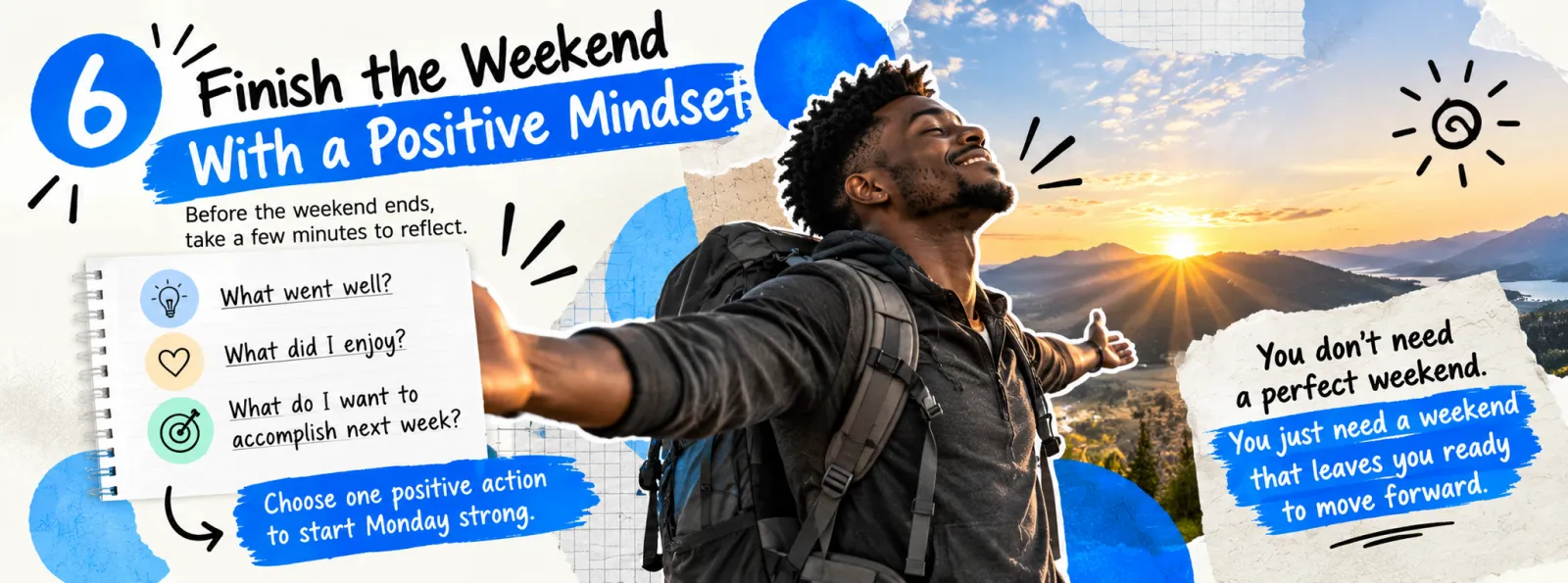

Notice that the questions ask what went well. Looking for a few good things is not the same as pretending everything was perfect. It helps balance the mind’s tendency to remember problems more than successes.
Weekend motivation: flip the cards
Tap each card to check you can remember the key idea.
Frequently asked questions about weekend motivation
What are some weekend motivation tips?
Plan one small achievement task and one enjoyable activity per day, protect time for proper rest, keep your wake-up time close to your weekday time, and spend time with other people. Starting with a small, specific action usually works better than waiting to feel motivated.
Why do I have no motivation at the weekend?
After a busy week your energy is low and the usual structure disappears. Without a timetable, easy options like scrolling win. Small planned activities and good sleep help. If low mood lasts for weeks or affects daily life, speak to your GP.
How do I stop wasting my weekend?
Decide on a short plan on Friday: one thing you want from the weekend, a few small activities with start times, and a rest period. Plans with a time and a place are easier to follow than vague intentions.
Should I revise at weekends?
Many students do, and it can help if you keep it balanced. Plan two or three focused blocks, use active methods like past-paper questions, and keep time free for rest and friends. Long marathons often lead to tiredness rather than learning.
Is it bad to sleep in at weekends?
A small lie-in is fine, but large differences between weekday and weekend sleep times can cause social jetlag, which is linked with tiredness. The NHS advises similar bedtimes and wake-up times every day, including days off.
What is social jetlag?
Social jetlag is the gap between your body clock and your social schedule. It is measured by comparing the midpoint of your sleep on work or school days with the midpoint on free days. The term was introduced by Marc Wittmann, Till Roenneberg and colleagues in 2006.
What is psychological detachment from work?
It means mentally disconnecting from work or study during your free time. Research by Sabine Sonnentag and others links detachment with better mood and less strain. You can practise it by setting a cut-off time, writing worries down and doing absorbing activities.
How can I feel less anxious on Sunday evening?
Prepare briefly earlier in the evening: check your timetable, pack your bag, choose three priorities and close your notebook. Avoid screens for an hour before bed, as the NHS suggests. If worry is constant, talk to someone you trust or your GP.
What are the NHS five steps to mental wellbeing?
The five steps are to connect with other people, be physically active, learn new skills, give to others, and pay attention to the present moment (mindfulness). You can fit one or two into any weekend, such as a walk with a friend.