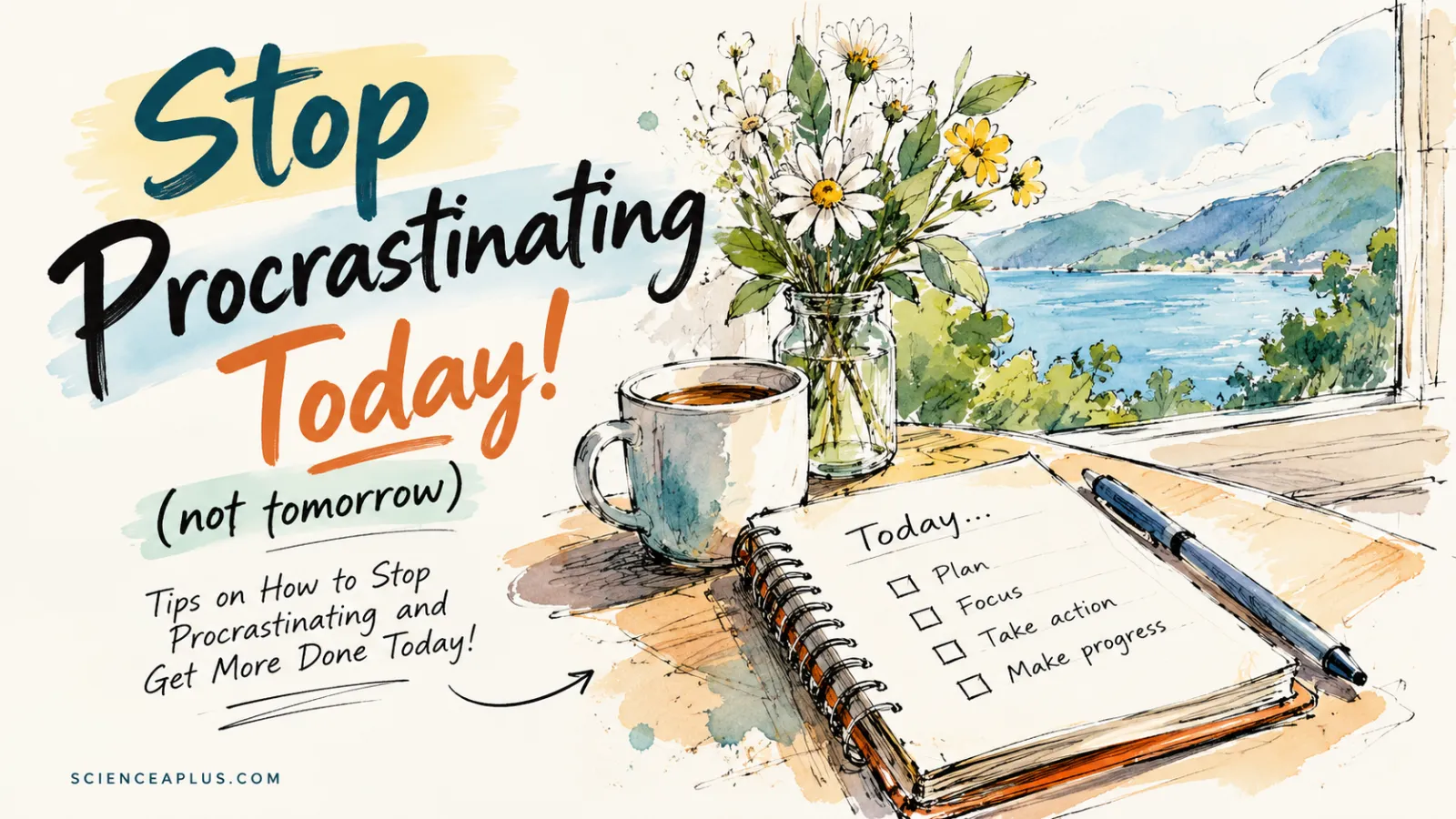
It is 7 pm. You meant to start your homework at four. Instead you have tidied your desk, checked your phone far too many times and watched a video you did not even like. Sound familiar? You are in very good company. If you are searching for how to stop procrastinating, this guide gives you 12 practical tips, starting with a clear look at what is really going on.
Nothing here is a lecture or a diagnosis. It is a friendly, evidence-based toolkit you can try today, plus a few pointers on where to find extra support if you need it.
What is procrastination?
Procrastination means voluntarily putting off a task you intend to do, even though you know you will probably be worse off for the delay. The key word is voluntarily. If you cannot start because you are ill or genuinely have no time, that is not procrastination. If you could start but keep choosing something easier, that is.
It looks different for everyone. For one student it is scrolling before revision. For another it is rewriting the same essay plan for the fifth time, or answering every email except the one that matters. The task slips, the deadline creeps closer and the stress grows.
Researchers have been studying this for decades. A well-known 2007 meta-analysis by Piers Steel, published in Psychological Bulletin, estimated that 80–95% of college students procrastinate. It also found that procrastination is a chronic problem for about 15–20% of adults. So if you put things off, you are far from alone, and it does not mean something is wrong with you.

Common signs you are putting something off
- You do small, easy jobs instead of the important one and call it "being productive".
- You tell yourself you work better under pressure, then feel rushed and unhappy with the result.
- You keep "getting ready" (finding the perfect playlist, the right pen, a clean desk) without actually starting.
- You open the book, feel a wave of dread and reach for your phone.
Spotting these patterns is not about blaming yourself. It simply gives you something specific to change, and small changes are far easier than trying to become a completely different person overnight.
Why do we procrastinate?
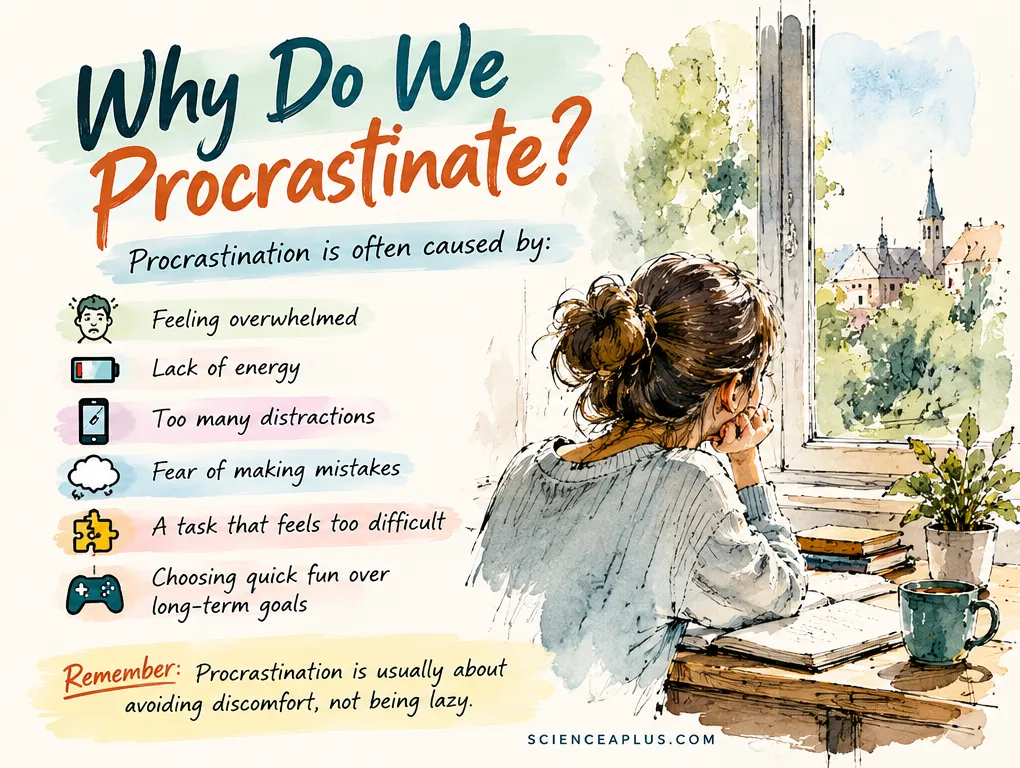
If you have ever asked yourself, why do I procrastinate when I know it makes things worse, the research offers a kinder answer than "lack of willpower". It is mostly about feelings.
Procrastination is an emotion problem
Psychologists Fuschia Sirois and Timothy Pychyl describe procrastination as short-term mood repair (2013). A task brings up an uncomfortable feeling such as boredom, anxiety or self-doubt. Putting it off makes that feeling go away for a while, so your brain learns that avoiding the task feels better.
The relief is short-lived. The task is still there, and now you also feel guilty. That is why procrastination keeps repeating, and why it is associated with higher stress and lower wellbeing.
Think of it as a loop: the task feels uncomfortable, you avoid it, you feel better for a moment, then the pressure and guilt build. The next time the task appears, the discomfort is even bigger. Understanding this loop is the key to breaking it, because the goal is not to force yourself through the feeling but to make starting feel easier and safer.
What causes procrastination?
Steel's analysis found several strong predictors. Here they are in plain English:
- Task aversiveness. The more unpleasant, boring or confusing a task feels, the more likely you are to avoid it.
- Delay before the reward. Revision pays off in an exam weeks away, while a game or a message pays off right now. Distant rewards are easy to ignore.
- Low self-efficacy. If you doubt you can do the task well, avoiding it protects you from finding out.
- Impulsiveness and distractibility. If you are easily pulled towards whatever is nearby, starting and staying on task gets harder.
Other common contributors include perfectionism, fear of failure, unrealistic plans and being tired. Many of these are things you can adjust, which is good news. The tips later in this guide target each one.
Where does low motivation fit in?
Waiting until you "feel like it" is a common trap. Motivation often follows action rather than coming before it. If this sounds like you, our guide to what to do when you have no motivation to work is a good companion read. For exam students, three tips for studying without motivation may help too.
Now that you know what is happening, let us move on to what you can do about it. The first five tips are about getting started, and the rest are about keeping going.
12 tips to stop procrastinating today
Knowing why do I procrastinate is useful, but it will not get your homework done. This section is about how to stop procrastinating in practice. The 12 tips below are small, tried-and-tested habits, and you do not need to use all of them. Pick one or two that feel doable and try them today.
Be kind to yourself as you go. Researchers describe procrastination as mainly an emotion problem, not a character flaw. We put tasks off to escape feelings like boredom, anxiety or self-doubt. So the best tips make a task feel less scary, not just more urgent.
1. Use the 5-minute rule
The 5-minute rule is simple: commit to working on the task for just five minutes. You are allowed to stop when the time is up. That is the deal.
Why does it work? Starting is often the hardest part. A whole evening of revision feels heavy, but five minutes feels almost silly to refuse. Once you have begun, the task usually feels less unpleasant than you imagined, and many people carry on without needing to be persuaded.
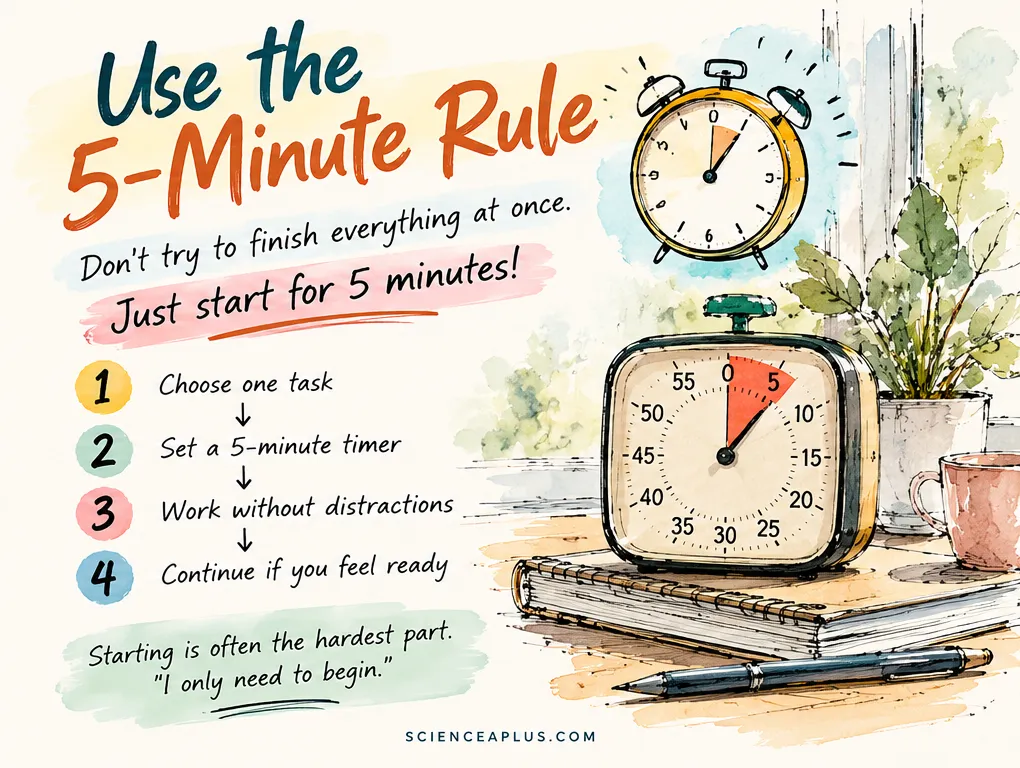
Try it now: set a timer, open your book at the right page and write the date. If you stop after five minutes, you still did five minutes more than you had before.
2. Make the task smaller
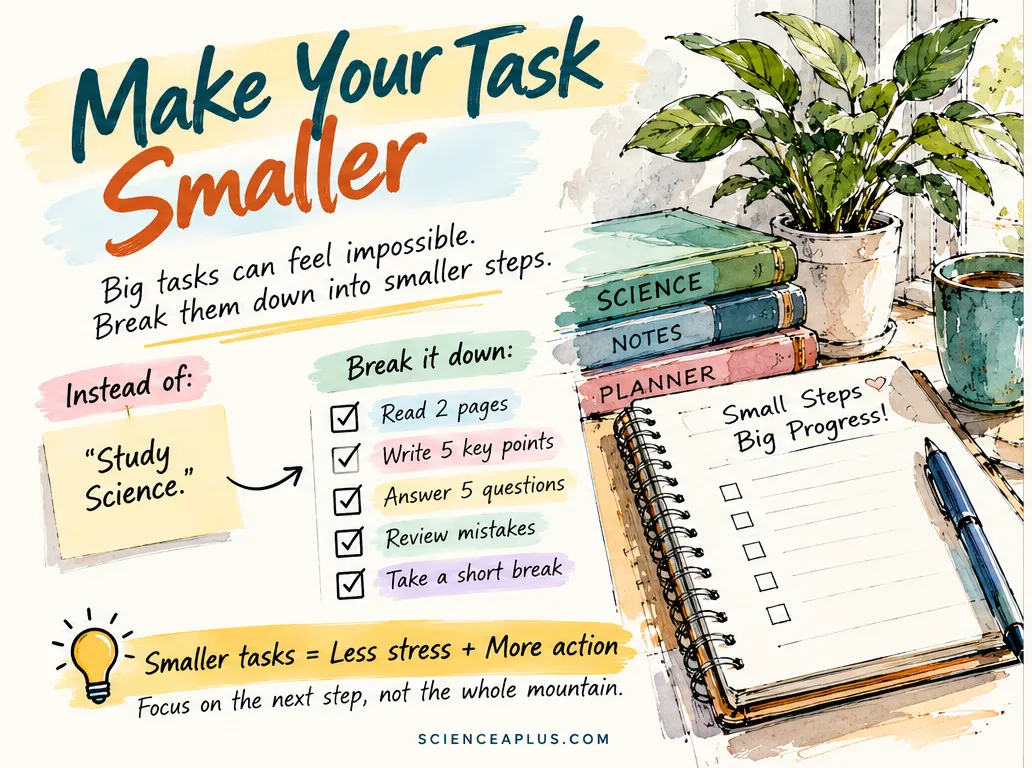
"Study science" is not really a task. It is a mountain, and your brain can tell. A vague, huge job is exactly the sort of unpleasant task that makes people procrastinate, because you cannot see where to begin.
Break it into steps small enough to start without thinking. For example, "Study science" becomes:
- Read two pages of your notes.
- Write down five key points.
- Answer five practice questions.
- Review your mistakes.
- Take a break.
Each step has a clear finish line, and ticking them off gives you a small sense of progress. If you are not sure where to begin with GCSE science, our guide on how to start revising for GCSE science shows you how to split subjects into manageable chunks.
3. Eat the frog: hardest task first
"Eat the frog" means doing your hardest or most dreaded task first, before you do anything else. The idea was popularised by the writer Brian Tracy. The logic is straightforward. The thing you are avoiding tends to take up mental space all day, so getting it done early frees you up for everything else.
You do not need to be dramatic about it. Choose the one task you would most like to avoid and give it your first focused session. Then the rest of your list feels lighter.
A quick way to spot your frog: ask yourself which task you keep moving to tomorrow's list. That is usually the one. Naming it honestly, without judging yourself, is already a step forward.
Being realistic matters here. If your plan has six frogs in one evening, it will not survive contact with real life. Our article on having realistic goals explains how to set targets you can actually meet.
4. Plan with "if–then" statements
Vague intentions like "I'll revise this evening" are easy to dodge. A better approach is an implementation intention, a specific plan that links a time and place to an action. It was developed by the psychologist Peter Gollwitzer, and it follows the pattern "If X happens, then I will do Y".
For example:
- If it is 4 pm, then I will open my maths book at my desk.
- If I finish dinner, then I will do ten minutes of flashcards.
- If I sit down at my desk, then I will put my phone in another room.
A large meta-analysis (Gollwitzer and Sheeran, 2006) found that it helps people act on their goals, with a medium-to-large effect. The reason is that you decide in advance, so there is no moment of "shall I, shan't I?" when procrastination can creep in.
5. Try the Pomodoro technique
The Pomodoro technique was developed by Francesco Cirillo in the late 1980s. It is named after a tomato-shaped kitchen timer he used as a student ("pomodoro" is Italian for tomato). It works like this:
- Work with full focus for 25 minutes.
- Take a 5-minute break.
- Repeat the cycle four times.
- After four rounds, take a longer break of 15–30 minutes.
The technique turns a vague stretch of time into short, defined bursts. You know the break is coming, which makes it easier to stop procrastinating and stay on one thing. It also gives you a built-in rhythm of effort and rest.
If 25 minutes feels like too much on a difficult day, combine this with tip 1. Start with the 5-minute rule, and if you are still going when it ends, carry on until the timer rings. During breaks, stand up, stretch or get a drink of water rather than opening social media, because it is easy to lose the break to scrolling. Use the planner below to see how a study session could look.
6. Remove distractions

Distractions are one of the strongest reasons people stop procrastinating and then slip straight back into it. Research on procrastination points to impulsiveness and distractibility as key predictors, which means a buzzing phone is not a small problem. It is an easy escape hatch from a task that already feels uncomfortable.
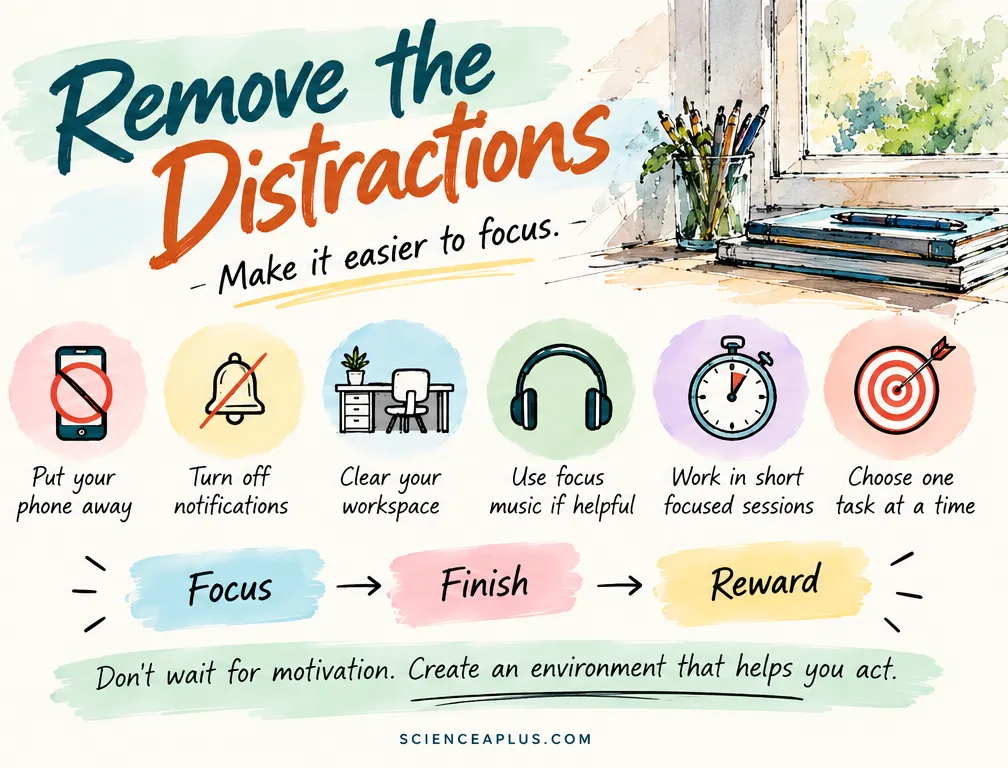
You do not need iron willpower here. You need to make the distraction harder to reach than the work. Try these changes for your next study session:
- Put your phone in another room, or at least out of sight and out of reach.
- Turn notifications off on your laptop and phone, so nothing pulls you away mid-sentence.
- Single-task. Keep one tab, one book or one worksheet open at a time.
- Clear your workspace. Anything that is not needed for this task goes in a bag or drawer.
If you spend long hours on screens, it is also worth looking after your eyes and taking regular breaks. Our guide to eye safety from digital devices has simple habits that fit neatly into a study routine.
Not every distraction is on a screen. A messy desk, a noisy room or a hungry stomach can all pull your attention away. Spend two minutes setting up before you begin, and you will usually save far more time than you spent.
7. Watch your energy
Sometimes what looks like procrastination is partly tiredness. When you are low on sleep or have been sitting still for hours, starting a hard task feels much heavier than it needs to. That is not a character flaw. It is a sign your energy needs attention, as well as your timetable.
A few gentle habits can help you protect it:
- Protect your sleep. A tired brain finds everything harder, including getting started.
- Take proper breaks. Stand up, stretch, drink some water or step outside for a few minutes.
- Match the task to your energy. If you are sharpest in the morning, put the tough work there and save lighter jobs for later.
- Use short work blocks. The Pomodoro rhythm of 25 minutes of work and a 5-minute break builds rest into the plan, rather than leaving it to chance.
Planning your week with enough space to recover also makes things feel less overwhelming. If you want help with this, our post on achieving goals with minimum stress shows how to pace yourself without burning out.
Procrastination is linked with stress and lower wellbeing, so looking after your energy is not a luxury. It is part of how you stop procrastinating in a way that lasts.
8. Forgive yourself
It may sound too soft to work, but there is encouraging research behind it. Beating yourself up after putting something off usually adds guilt and shame, and those are exactly the feelings that make the next task feel worse to face.
In a study by Wohl and colleagues in 2010, students who forgave themselves for procrastinating before a first exam procrastinated less before the next one. The researchers found this was linked to less negative emotion. In other words, kindness towards yourself did not make people lazier. It helped them get on with it.
Because procrastination is mainly about avoiding uncomfortable feelings, reducing those feelings makes starting easier. Here is a simple way to try it:
- Notice it without judging. “I put that off, and it felt uncomfortable.”
- Be as kind as you would be to a friend. What would you say to them in the same situation?
- Move on to the next small step. Do not wait for tomorrow or Monday. Pick one thing you can do now.
Forgiving yourself does not mean ignoring the deadline. It means you stop spending energy on guilt and use it for the work instead.
9. Reward yourself
Many tasks feel hard to start because the payoff is far away. A revision session today might only pay off in a result months from now, and that delay is a known reason people put things off. Small, quick rewards bring the payoff closer.
Keep it simple. Decide the reward before you begin, and only enjoy it after you have finished the block of work:
- A snack or a cup of tea after one Pomodoro.
- Ten minutes of your favourite music or a short walk after you finish a set of questions.
- An episode of a show you like after you complete your plan for the day.
A related idea is temptation bundling, suggested by Katy Milkman. You pair something you want to do with something you need to do, such as saving a favourite playlist for when you tidy your notes. Choose rewards that are enjoyable but do not swallow your evening. The aim is to make starting feel a little more appealing.
10. Tell a friend

Accountability is a simple way to stop procrastinating, because it adds a little outside support to your plan. When someone else knows what you intend to do, many people find they are more likely to follow through, and you are no longer carrying the plan alone.
You do not need a formal arrangement. Try one of these:
- Send a friend a message: “I’m doing 25 minutes of chemistry at 4 pm.” Then tell them when you are done.
- Study side by side, in person or on a video call, with each person working on their own task.
- Ask a parent, teacher or classmate to check in with you at the end of the week.
Choose someone supportive, not someone who will criticise you. The goal is encouragement. If you miss a session, tell them honestly, forgive yourself as in tip 8, and agree on a new time.
Before you move on to the final tips, here is a quick checklist to set up your next focused session. Tick each item as you do it.
- Put my phone in another room or out of sight
- Turn off notifications on my laptop
- Clear my desk, leaving only what I need
- Fill a water bottle and have a snack ready
- Set a 25-minute timer for one focused block
- Tell a friend what I am working on, and plan my reward
11. Lower the bar: done beats perfect
Sometimes we put things off because we want them to be perfect. If you feel the work has to be brilliant straight away, starting can feel risky, so your brain finds something easier to do instead. Perfectionism and fear of failure are common causes of procrastination, and they are very human.
Self-doubt is part of this too. Researchers have found that low self-efficacy, which means doubting you can do the task, is one of the strong predictors of putting things off. A lower bar for a first attempt gives that doubt less to work with.
Here are some ways to lower the bar without lowering your standards for the final result:
- Aim for a rough first draft. Write the messy version first. You can improve something that exists, but you cannot improve a blank page.
- Set a “good enough for now” target. For example, “five bullet points on osmosis” is easier to begin than “perfect notes”.
- Separate making from judging. Do the writing or problem-solving first, and check or tidy it afterwards.
- Treat mistakes as information. A wrong answer in practice shows you what to revise next. This links nicely with a growth mindset, where effort and feedback help you improve.

12. Start today
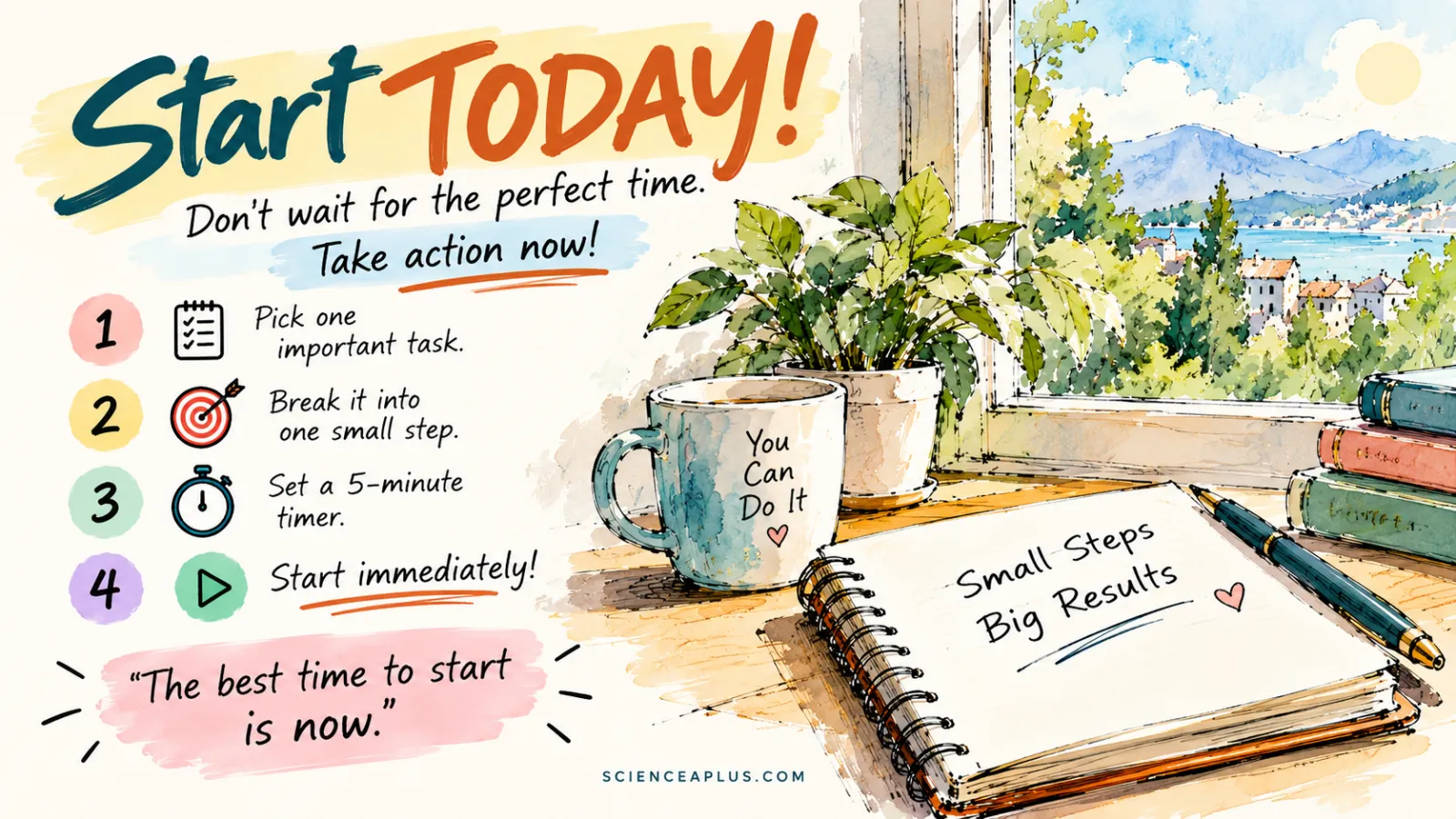
You do not need a fresh week, a new notebook or the perfect mood. The best moment to begin is usually a small one, today, with one tiny step.
Pick one task. Shrink it until it feels almost too easy, such as opening the document, writing the date and the title, or getting out your science book. Then use the tools from earlier: the 5-minute rule, an if–then plan, or one Pomodoro round. If you only manage five minutes, that is still five minutes more than none, and starting is often the hardest part.
Starting early also takes pressure off later. If you are preparing for exams, there are good reasons for starting your GCSE revision early, and today is an easy day to take the first small step.
If you slip, that is fine. Forgive yourself, then pick the next small step. That is how habits are built.
Procrastination and revision
Revision is a classic place for procrastination. It can feel big, vague and unpleasant, and the reward is a long way off. Those are exactly the conditions that researchers link with delay: unpleasant tasks and rewards that arrive late.
If you are wondering how to stop procrastinating on revision or homework, try making the session small, specific and time-limited. Here is a sample one-hour plan using Pomodoro-style blocks. Swap in your own subjects and topics.
| Time | What to do | Why it helps |
|---|---|---|
| 0–5 min | Clear your desk, put your phone in another room, write down today’s one goal. | Removes distractions and makes the task clear. |
| 5–30 min | Pomodoro 1: read two pages and write five key points. | A small, specific target is easier to begin. |
| 30–35 min | Short break: water, stretch, look out of the window. | Rest between focused rounds. |
| 35–60 min | Pomodoro 2: answer five questions, then check and review your mistakes. | Practice shows what to revise next. |
After four rounds, the Pomodoro Technique suggests a longer break of 15–30 minutes. Finish with a small reward you have chosen in advance.
Sleep matters too. If you are tired, everything feels harder to start, so protect your rest. Our guide to balancing sleep and work explains how to fit both into a busy term.
When procrastination is something more
Most people put things off sometimes. It is also linked with stress and lower wellbeing, so it is worth taking seriously, and kindly.
If you often feel low, anxious or overwhelmed, and it keeps getting in the way of schoolwork, sleep or daily life, please talk to someone. That could be a GP, a school counsellor or a teacher you trust. You do not need to wait until things feel serious.
Some people find that they struggle to start or finish tasks along with ongoing problems with attention. That can sometimes be a sign of ADHD, but only a qualified professional can say. If this sounds familiar, speak to your GP, who can discuss it and your options through the NHS. This article is for education only and cannot diagnose anything.
If you need urgent help for your mental health, contact NHS 111 and choose the mental health option. If your life is at risk or you cannot keep yourself safe, call 999 or go to A&E.
Quick recap: flip the cards
Key points to remember
- Most students procrastinate sometimes. An estimated 80–95% of college students do, and it is a chronic problem for about 15–20% of adults.
- Procrastination is mainly about managing feelings, not laziness.
- Unpleasant tasks, delayed rewards, self-doubt and distractibility make it more likely.
- Start small with the 5-minute rule, smaller tasks and if–then plans.
- Use Pomodoro rounds, a clear desk and a phone out of reach to stay focused.
- Rest, rewards, a friend to tell and self-forgiveness all help.
- Aim for done first and polished later.
- If it affects your wellbeing or comes with attention difficulties, speak to a GP or school counsellor.
Frequently asked questions about procrastination
Why do I procrastinate so much?
Often it is because a task feels unpleasant, boring or scary, and avoiding it brings short-term relief. Doubting your ability, perfectionism, tiredness and distractions all add to it. It is usually about managing feelings in the moment, not a flaw in your character.
Is procrastination a sign of laziness?
No. Research suggests procrastination is mainly an emotion-regulation problem. People delay tasks to escape feelings such as boredom, anxiety or self-doubt. Many people who procrastinate care a great deal about their work, which is partly why starting can feel stressful, so kindness helps more than blame.
How do I stop procrastinating on revision?
Make each session small, specific and timed. Choose one clear goal, such as answering five questions, clear your desk, put your phone in another room and work in 25-minute rounds with short breaks. Plan the first step in advance and reward yourself afterwards. Start with something easy if needed.
What is the 5-minute rule?
The 5-minute rule means committing to work on a task for just five minutes. Starting is often the hardest part, so a tiny commitment feels manageable. Once you have begun, you may well carry on, but if you stop after five minutes, you have still made progress.
What is the Pomodoro technique?
The Pomodoro Technique was developed by Francesco Cirillo in the late 1980s. You work with full focus for 25 minutes, then take a 5-minute break. After four rounds, you take a longer break of 15–30 minutes. It is named after a tomato-shaped kitchen timer.
Is procrastination linked to anxiety?
Yes, it can be. People may put tasks off to escape anxious feelings, and delaying can then add stress, creating a cycle. Procrastination is also linked with stress and lower wellbeing. If anxiety is persistent or affects daily life, speak to a GP or school counsellor for support.
Can procrastination be a sign of ADHD?
Sometimes. Ongoing difficulty starting or finishing tasks, together with attention problems, can be a sign of ADHD. However, many people procrastinate without having ADHD, and only a qualified professional can assess it. If you are concerned, speak to your GP, who can explain the NHS options.
How do I stop procrastinating on my phone?
Make your phone harder to reach. Put it in another room or out of sight, turn off notifications and focus on one task at a time. Clearing your workspace also helps. Then use a timer, such as a 25-minute Pomodoro round, and enjoy your phone as a reward afterwards.
How long does it take to stop procrastinating?
There is no fixed timescale, and everyone is different. Most people improve gradually by practising small habits, such as the 5-minute rule and if–then plans, and forgiving themselves after slips. Focus on starting one small task today rather than on becoming a different person overnight.