NHS doctor levels follow a clear ladder. After medical school, a doctor completes two Foundation years (FY1 and FY2), then enters specialty training (core training or ST1). Higher trainees from ST3 upwards are called registrars. Training ends with a Certificate of Completion of Training (CCT), which leads to work as a consultant or a GP.
NHS doctor levels at a glance
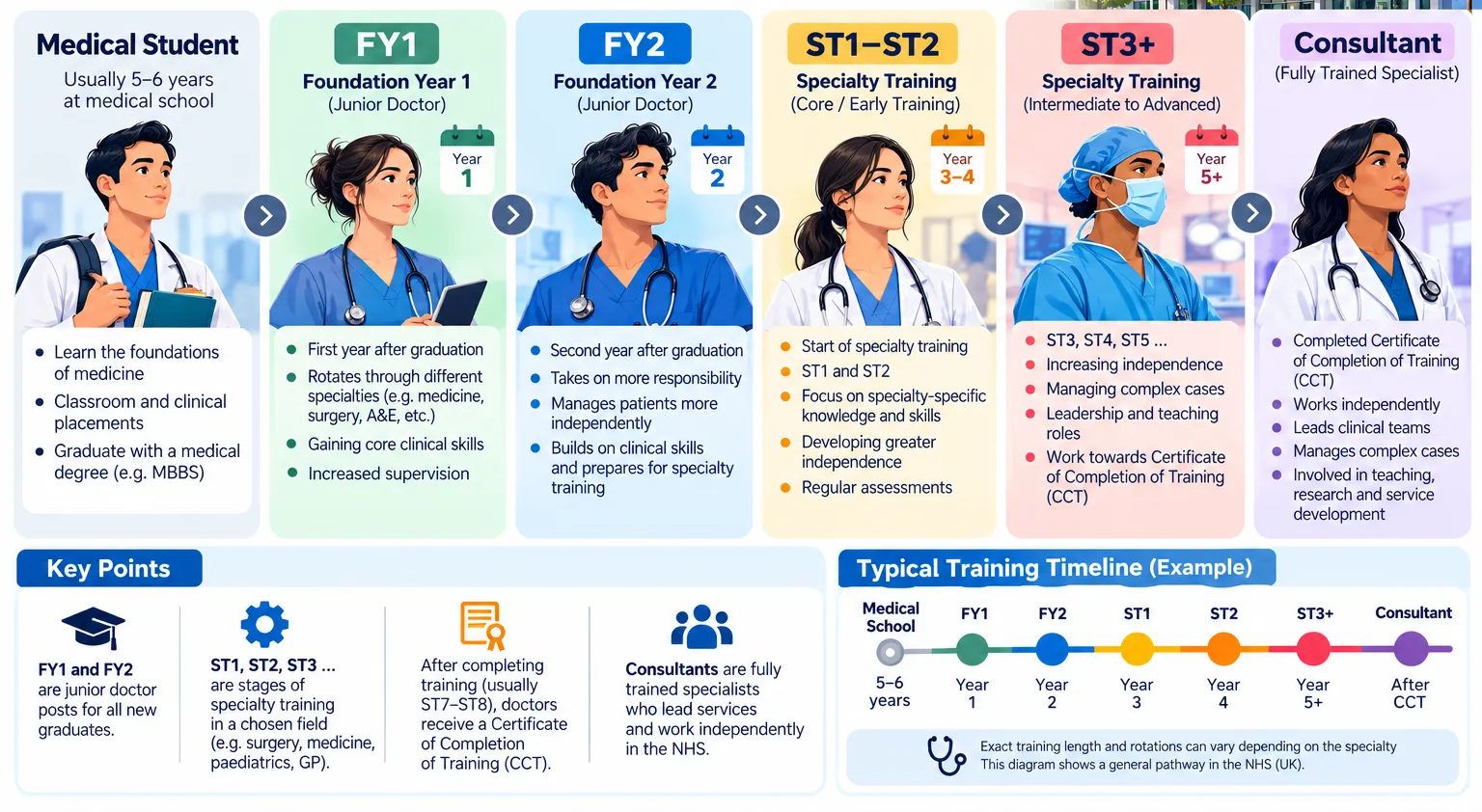
The table below shows the main levels of doctors in the NHS in the order most people meet them. Training lengths are typical for full-time doctors and vary by specialty, so treat the year numbers as a guide rather than a rule.
| Level | Also called | Typical year after graduation | What they do |
|---|---|---|---|
| Medical student | Undergraduate | Before graduation (usually 5 years of study) | Learns medicine at university and on hospital and GP placements. Not yet a doctor. |
| FY1 | F1, Foundation Year 1 | Year 1 | First year as a doctor. Rotates through usually three four-month posts, closely supervised. |
| FY2 | F2, Foundation Year 2, often “SHO” | Year 2 | Takes on more responsibility across further rotations, often including emergency medicine or general practice. |
| Core trainee | CT1–CT3, IMT1–3, often “SHO” | From year 3 (2 to 3 years, depending on the programme) | Builds broad skills in a group of specialties before applying again for higher training. |
| ST1–ST2 | Run-through specialty trainee | From year 3 | Starts specialty training straight away, for example in GP, paediatrics or obstetrics and gynaecology. |
| ST3 and above | Registrar, specialty registrar (StR) | After core or early run-through training | Higher specialty trainee. Leads the junior team, supervises Foundation doctors and is often called first for difficult cases. |
| CCT holder | Completed specialty training | End of training | Has finished the curriculum and can join the GMC Specialist Register or GP Register. |
| Consultant | Hospital specialist | After CCT | Holds overall responsibility for hospital patients under their care. |
| GP | General practitioner | About 5 years after medical school | Works in general practice after three years of GP training (ST1–ST3). |
| SAS doctor | Specialty or Specialist doctor | Varies | Senior, experienced doctor who is not in training and not a consultant. |
Two of these labels cause the most confusion. A registrar is a doctor in higher specialty training, usually ST3 or above. SHO stands for senior house officer, an old informal title still used for FY2s and core trainees.
Resident doctors (formerly junior doctors)
In September 2024, the BMA and the government renamed “junior doctors” as resident doctors. The term covers all doctors in training below consultant or GP level. That includes FY1 and FY2 doctors, core trainees and registrars.
Patients may still hear the phrase “junior doctor” on wards and in the news. The word “junior” describes where someone is in training, not how much experience they have. A registrar in their seventh year as a doctor could be called a resident doctor and still be one of the most experienced people on a night shift.
Medical school: before the levels begin
Medical school usually lasts 5 years. It becomes 6 years with an intercalated degree, and 4-year graduate-entry courses also exist. Students spend their early years on science and clinical skills, then move into hospital and community placements.
Before they can work, UK graduates must pass the Medical Licensing Assessment (MLA). This applies from the 2024–25 graduating cohort. International graduates usually take PLAB, or hold another acceptable qualification, in order to register with the GMC.
On graduating, UK doctors receive provisional GMC registration. Full registration comes after they successfully complete FY1. That is why FY1 is such a significant step: it is the point where a new graduate becomes a fully registered doctor.
Many students ask whether all this study is worth it. Our article on why education is important for your career looks at how qualifications shape the options open to you, and medicine is one of the clearest examples of a career built on a long training route.
With medical school and registration covered, the next step is the Foundation Programme, a two-year scheme run by the UK Foundation Programme Office (UKFPO). It begins with FY1, which we look at in the next section.
FY1: Foundation Year 1

FY1 (often written F1) is the first year after graduation, and it is the first of two years in the Foundation Programme, which is run by the UK Foundation Programme Office (UKFPO). Newly qualified doctors start with provisional GMC registration. They move to full registration once they have successfully completed FY1.
During the year, an FY1 doctor usually rotates through three four-month posts. A typical mix might be medicine, surgery and a third specialty. Each rotation gives a different view of hospital life, which helps doctors decide where their careers might go next.
Because the posts rotate, an FY1 doctor may work on a surgical ward in one four-month block and a medical ward in the next. Each team has senior doctors, including registrars and consultants, who oversee the work and who can be asked for help. The aim of the year is to build safe, confident habits before taking on more independent decisions.
FY1 doctors are closely supervised. Their day-to-day work usually includes:
- Taking part in ward rounds with the wider team.
- Clerking new patients, which means recording their history and examination findings.
- Prescribing medicines under supervision.
- Carrying out routine tasks and reviews for the patients on their ward.
FY2: Foundation Year 2
FY2 (F2) is the second year of the Foundation Programme. Doctors take on more responsibility and complete further rotations, which often include emergency medicine or general practice (GP). Like FY1, the year is usually split into several shorter placements in different specialties.
You will often hear FY2 doctors called SHOs. “SHO” stands for senior house officer, an old informal title that is still used for FY2s and for core trainees. It is not an official grade today, but it remains common in hospital conversation.
Many FY2 doctors find that this year shapes their choice of career. Spending time in emergency medicine or general practice shows how different the day-to-day work can feel compared with a hospital ward. FY2 doctors also tend to supervise and guide the newest FY1s, which is good practice for the leadership expected of later trainees.
The Foundation Programme ends with the Foundation Programme Certificate of Completion. That certificate marks the end of the two foundation years, and it is the point at which doctors decide what to do next.
What happens after FY2?
There is no single route after FY2. Doctors can choose from several options:
- Apply for specialty training. This leads towards becoming a hospital consultant or a GP.
- Take a break. Some doctors take time out for travel, study or other reasons. This is sometimes jokingly called “F3”.
- Work as a locally employed doctor (LED). These posts are sometimes called “trust grade” posts and are offered by individual hospitals rather than through a national training programme.
- Work abroad. Some doctors take their skills overseas for a period of time.
Specialty training is competitive in many areas, and nobody can promise a particular post, so it helps to read the official recruitment guidance for the year you plan to apply. Doctors who take a break or work as locally employed doctors can still apply for training later, and many use that time to gain experience in a specialty they are considering.
Whichever route a doctor takes, the specialty training options described below are the main route to becoming a consultant or GP.
Core training vs run-through training
Specialty training comes in two kinds. In run-through training, you apply once at ST1 and continue to the end of the programme. In uncoupled training, you complete a period of core training first and then apply again for higher specialty training, usually entering at ST3 or ST4.
| Feature | Run-through | Uncoupled (core, then higher) |
|---|---|---|
| When you apply | Once, at ST1 | At the start of core training, and again for higher training |
| Examples | GP, paediatrics, obstetrics and gynaecology, clinical radiology | Internal medicine, surgery, psychiatry, anaesthetics, emergency medicine |
| Typical entry to higher training | Continues without reapplying | Usually ST3 or ST4 |
Core training programmes vary in length. Internal Medicine Training (IMT) lasts three years (IMT1–3). Core Surgical Training lasts two years (CT1–2). Core psychiatry takes three years, the core stage of anaesthetics takes three years, and ACCS, the route into emergency medicine, also takes three years.
The choice between the two kinds of training is not a matter of one being better. It depends on the specialty, because each Royal College and curriculum sets out how its training is structured. GP training, for example, is run-through and lasts three years (ST1–ST3), whereas surgical training uses a two-year core stage followed by ST3–ST8.
Royal College exams are taken along the way, and doctors who trained outside the UK often meet them through different routes. If you want to compare how exam pathways work for overseas graduates, our guide to PLAB vs MRCP explains the difference between the two.
ST1 and ST2: early specialty training

After the Foundation Programme, a doctor who wants to follow a particular career applies for specialty training. The first two years are called ST1 and ST2, where "ST" stands for specialty training. Which title a doctor holds at this stage depends on the type of programme they have joined.
In a run-through programme, such as GP, paediatrics, obstetrics and gynaecology or clinical radiology, a doctor applies once at ST1 and continues to the end of training. Their first two years are ST1 and ST2, then ST3 and so on.
In an uncoupled programme, the first years are core training, and the doctor applies again for higher specialty training, usually entering at ST3 or ST4. Core trainees are labelled differently from ST1 and ST2 doctors:
- Internal Medicine Training (IMT): 3 years, called IMT1 to IMT3.
- Core Surgical Training: 2 years, called CT1 and CT2.
- Core psychiatry: 3 years.
- Anaesthetics: 3 years of core training.
- ACCS for emergency medicine: 3 years.
Many people use "ST1 and ST2" loosely to mean any early-stage trainee. Doctors at this level are often still called SHOs, the older informal title that is also used for FY2s. They work under the supervision of registrars and consultants, take on more independent decisions as they gain experience, and prepare for the Royal College exams of their chosen field.
ST3 and above: what is a registrar in the NHS?
A registrar (formally a specialty registrar, or StR) is a higher specialty trainee, usually at ST3 or above. The title can be heard in every hospital specialty, from surgery to paediatrics.
Registrars lead the junior team, supervise doctors in the Foundation Programme, and are often the first to be called when a case is difficult. They are still in training, so a consultant remains responsible for the care of their patients, but registrars carry a lot of day-to-day clinical decision-making.
Doctors on the uncoupled route usually become registrars on entering higher specialty training at ST3 or ST4. Those on run-through programmes reach ST3 automatically if they progress. Training continues until the doctor is awarded a Certificate of Completion of Training, covered in the next part of this guide.
Registrar-level training includes on-call work and out-of-hours shifts, which is why so many doctors take an interest in managing their sleep around nights. Our guide to sleep hygiene tips for shift workers covers practical habits that apply well beyond medicine.
How long does training take?
The length of specialty training depends on the specialty and the curriculum. The figures below are indicative full-time lengths, and they run after the two foundation years. Adding medical school (usually 5 years) and foundation (2 years) means that becoming a consultant usually takes 8–10+ years after medical school.
| Specialty | Training after foundation (approx.) |
|---|---|
| General practice | 3 years |
| Psychiatry | ≈ 6 years |
| Emergency medicine | ≈ 6 years |
| Anaesthetics | ≈ 7 years |
| Internal medicine specialties (IMT plus higher training) | ≈ 7 years |
| Paediatrics | ≈ 7 years |
| Obstetrics and gynaecology | ≈ 7 years |
| Surgical specialties (core 2 years, then ST3–ST8) | ≈ 8 years |
Want to work out your own timeline? Use the calculator below to see how the stages add up for a given specialty.
These figures assume full-time training. Less-than-full-time (LTFT) training is available and lengthens training proportionally, so each stage takes correspondingly longer. Exams are taken along the way, set by the Royal Colleges, such as MRCP for physicians, MRCS for surgeons, MRCGP for GPs and FRCA for anaesthetists.
GP training: three years from foundation
General practice is the shortest route to a fully qualified senior doctor. GP training is a run-through programme lasting 3 years (ST1 to ST3) after the Foundation Programme, so a GP is usually fully trained about 5 years after medical school.
During training, doctors rotate through hospital posts and spend time in general practice. The key exam is the MRCGP, set by the Royal College of General Practitioners. After completing training and receiving the CCT, a doctor joins the GMC GP Register and can work as a GP.
Not every health career runs through a medical degree. If you are weighing options, see our guide on whether you can get a job with a biology degree for other routes into health and science.
CCT and becoming a consultant
Specialty training does not go on forever. It ends when a doctor has met every requirement of their curriculum and is awarded a Certificate of Completion of Training, known as the CCT. For a GP trainee this comes at the end of ST3. For a surgical trainee it comes after ST8.
The CCT leads to entry on the GMC Specialist Register (for hospital specialties) or the GP Register (for general practice). Being on the right register is what allows a doctor to apply for a consultant post in the NHS, or to work as a GP.
The timing depends on the specialty. Full-time training after foundation is roughly 3 years for GP, about 6 for psychiatry and emergency medicine, about 7 for anaesthetics, internal medicine specialties, paediatrics and obstetrics and gynaecology, and about 8 for surgical specialties. In total, becoming a consultant usually takes 8–10+ years after medical school.
What does a consultant do?
A consultant is the senior doctor in a hospital team. Consultants hold overall responsibility for the patients under their care, even when registrars and resident doctors do much of the day-to-day work. Registrars, who are usually ST3 and above, often call the consultant when a case is difficult.
If you want the full picture of how one level leads to the next, the table near the top of this article shows every step of the ladder from FY1 to consultant.
The Portfolio pathway
Not every specialist trained on a UK programme. The Portfolio pathway (formerly known as CESR or CEGPR) is another route onto the Specialist Register or GP Register. It is designed for doctors who trained outside a UK programme and can show, through evidence, that their training and experience match the UK standard.
SAS doctors and locally employed doctors
Not every senior doctor is a consultant. SAS doctors (specialty and specialist doctors) are experienced doctors who are neither in a training programme nor consultants. The Specialist grade was introduced in England in 2021. SAS roles are a valued career path in their own right, and many doctors choose them deliberately.
You may also hear about locally employed doctors (LEDs), sometimes called trust grade doctors. After FY2, some doctors choose to work in this way rather than apply straight away for specialty training. Others take a break or work abroad. These are all recognised options.
Royal College exams along the way
Alongside hospital work, trainees sit exams set by the Royal Colleges. The exact exams depend on the specialty and curriculum, but these four are the best known.
| Exam | Who takes it |
|---|---|
| MRCP | Physicians (internal medicine and its specialties) |
| MRCS | Surgeons |
| MRCGP | GPs |
| FRCA | Anaesthetists |
Training can also be done less than full time (LTFT). This is available to trainees, and it lengthens training in proportion to the hours worked.
Recent changes: the Medical Training (Prioritisation) Act 2026
The Medical Training (Prioritisation) Act 2026 has been in force since 6 March 2026. It prioritises UK graduates, and some other specified groups of graduates, for foundation and specialty training places.
For 2026 specialty recruitment, prioritisation applies at the offer stage. For posts starting from August 2027, prioritisation is due to apply at shortlisting as well as offer, with priority groups (including doctors with significant NHS experience) defined in regulations. Anyone applying for training should check the latest official guidance, because the details can change.
Tips for students thinking about medicine
If you are in school and curious about this career, the route from here to FY1 is long, but each stage is manageable. Medical school usually lasts 5 years, and graduates must pass the Medical Licensing Assessment. Here is a simple plan you can tick off.
- Gain work experience or volunteering in a caring setting.
- Study the science subjects your chosen medical schools ask for at A level.
- Check the admissions test used by your medical schools, such as the UCAT, and prepare early.
- Draft your personal statement and show what you learned from your experiences.
- Practise for interviews, including talking through ethical situations calmly.
- Research the NHS pathway, from FY1 to CCT, so you know what the whole journey involves.
Medicine is also changing fast, so think about the skills you will need over a long career. Our guide on how to make your career AI-proof is a useful starting point. If you enjoy the science side, read about the uses of nanotechnology in medicine to see where treatments are heading.
Frequently asked questions about NHS doctor levels
What are the levels of doctors in the NHS?
The usual path runs from medical student to FY1 and FY2, then specialty training (core training or ST1 onwards), then registrar level at ST3 and above. Training ends with a CCT, after which a doctor becomes a consultant or GP. SAS doctors are senior doctors outside this training ladder.
What is an FY1 doctor?
An FY1 doctor is in Foundation Year 1, the first year after medical school. They usually rotate through three four-month posts, such as medicine and surgery, under close supervision. They hold provisional GMC registration, and full registration follows successful completion of the year.
What is the difference between FY1 and FY2?
FY1 is the first foundation year, with close supervision and provisional GMC registration. FY2 is the second year, with more responsibility and further rotations, often including emergency medicine or general practice. FY2 ends with the Foundation Programme Certificate of Completion.
What is an ST3 doctor?
An ST3 doctor is a specialty trainee in the third year of specialty training. ST3 is usually the point at which a doctor is called a registrar. Doctors on uncoupled pathways often enter higher specialty training at ST3, after core training, while GP trainees reach ST3 as their final year.
What is a registrar in the NHS?
A registrar, or specialty registrar, is a higher specialty trainee, usually ST3 and above. Registrars lead the junior team, supervise foundation doctors and are often the first to be called for difficult cases. They are still in training and work under a consultant.
Is an SHO a junior doctor?
Yes, in the traditional sense. SHO means senior house officer, an old informal title still used for FY2 doctors and core trainees. “Junior doctors” were renamed resident doctors in September 2024, so an SHO would now be described as a resident doctor.
How long does it take to become a consultant in the UK?
It usually takes 8–10+ years after medical school. That includes the two-year Foundation Programme and specialty training, which varies from about 6 to 8 years for many hospital specialties. Less-than-full-time training lengthens the process in proportion.
How long is GP training in the UK?
GP training lasts 3 years, from ST1 to ST3, and follows the two-year Foundation Programme. A GP is therefore usually fully trained about 5 years after medical school. Trainees sit the MRCGP exam and, on completion, are entered on the GP Register.
What does CCT mean?
CCT stands for Certificate of Completion of Training. It is awarded when a doctor completes specialty or GP training. It leads to entry on the GMC Specialist Register or GP Register, which allows a doctor to apply for consultant posts or work as a GP.