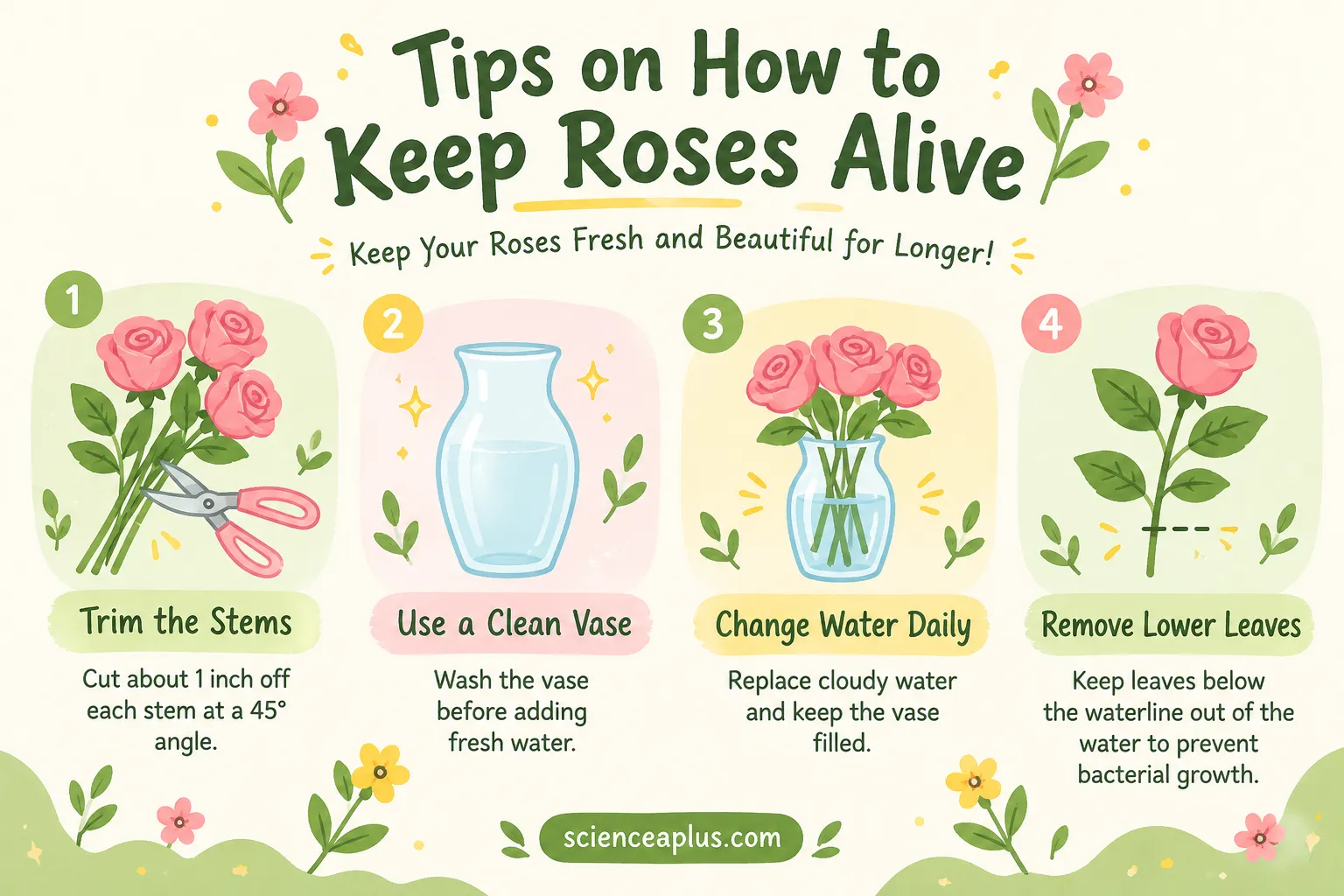
A bunch of roses can look perfect on Monday and sad by Thursday. Most people blame the roses, but the real cause is usually plumbing. How to keep roses alive in a vase is a biology problem: a stem that is cut off from its roots must keep drinking through tiny tubes, and anything that blocks those tubes shortens the life of the flower. Fix the plumbing and the flowers last longer.
The four-step card below sums up the routine: trim the stems, use a clean vase, change the water and strip the lower leaves. This article explains why each step works, then moves outdoors to look at roses growing in the garden, including the two fungi that cause most of their problems.
The science behind it: how a cut rose drinks
A rose stem is packed with xylem, bundles of hollow tubes that carry water upwards from the roots. On a living plant, water evaporates from the leaves and petals, a process called transpiration. Because water molecules stick together, the loss at the top pulls a continuous column of water up the xylem, a bit like drinking through a straw.
When you cut the stem and stand it in a vase, the roots are gone but the flower is still losing water into the air. The pulling force carries on, so the rose must now take everything it needs from the vase. If water leaves the petals faster than the stem can supply it, the cells lose pressure and the head droops. That is wilting.
Water also moves into individual cells by osmosis. Cells full of water are firm (turgid), which holds the petals out. Cells that lose water go limp. So the whole aim of vase care is to keep the xylem open, clean and supplied with water that the stem can easily take up.
Step 1: trim the stems and why the cut matters
The first card says to cut about 1 inch (2.5 cm) off each stem at an angle. There are two separate ideas hidden in that instruction: how much you cut and how you cut.
Air bubbles block the tubes
When a stem is cut in the open air, small bubbles can be drawn into the open xylem tubes. A bubble in a tube is called an air embolism. Water cannot be pulled past it easily, so the stem takes up less water than it should. A researcher at the University of California, Davis describes how these air bubbles can be cleared by recutting the stem under water, taking off about an inch, so the new cut face fills with water instead of air.
The evidence for cutting under water is mixed. Other florist research suggests it matters less if stems are cut dry and put into water quickly, because air in the tubes often clears by itself in the first hours. A sensible reading is that a fresh cut just before the stems go into water is the important part, and cutting under a bowl of water is a cheap extra if you want it.
Why cut at an angle?
The RHS advises “a clean, angled cut without leaving jagged edges that could lead to decay”. An angled cut makes a longer oval face, so there is more open xylem in contact with water. It may also help by stopping a flat-cut stem from resting against the bottom of the vase and restricting water entry.
cut face area = A ÷ cos 45° ≈ 1.41 × A
Here A is the area of a straight cut across the stem. A 45° cut therefore exposes about 41% more surface than a straight one. We should be honest that the sloping cut is widely recommended and makes sense, but there is little direct research showing it alone lengthens vase life. The cut needs to be clean above everything else: use sharp secateurs or a sharp knife, because blunt scissors crush the xylem.

Step 4: remove the lower leaves
The fourth part of the first card is to keep leaves below the waterline out of the water. The reason is microbiology. Leaves and stems that sit underwater start to break down, releasing sugars and proteins into the vase. Bacteria feed on these, multiply quickly and fill the water with slime. The RHS advises stripping leaves from the bottom half to two-thirds of each stem, because foliage below the waterline can rot.
Take the leaves off cleanly, with a thumb or a knife, rather than tearing the stem. A torn stem has damaged tissue that bacteria can enter. Leave the thorns alone unless you need to handle the stems.
Pick roses at the right stage
If you are cutting roses from your own garden, the RHS says to cut in the morning, when the stems are full of water, and to choose flowers in loose bud. Roses cut in tight bud may not open properly. Stand them in clean water straight away, in a cool place, for two to three hours or overnight before arranging them.
Shop-bought roses have usually been out of water for a while on their way to you, so the first thing to do at home is to give them a fresh cut and a proper drink. The fresh cut removes the dried end of the stem and gives the tubes a clean start.
How far to trim
The card says 1 inch, which is about 2.5 cm. Using the conversion 1 inch = 2.54 cm, one inch is 2.54 cm, so a trim of 2.5 cm is close enough. If a stem is very long and the vase is short, you can cut more. Just make sure that the bottom of the stem sits well under the water, and that the water line stays above the cut every day.
Steps 2 and 3: a clean vase and fresh water
The second and third cards on the first slide are about hygiene: wash the vase before adding fresh water, and replace cloudy water so the vase stays filled. Cloudy water is the visible sign of a population explosion. Bacteria multiply by dividing, so one cell becomes two, then four, then eight. In warm vase water that can happen within hours.
How bacteria shorten the life of a rose
A cut stem leaks sugars and proteins into the water, which is a ready-made meal for microbes. According to the UC Davis postharvest bulletin, the bacteria that grow on it can plug the water-conducting tissue, so the stem cannot take up water. The result looks like a cruel trick: the vase is full, but the rose wilts anyway, because the xylem is blocked.
A University of Florida rose-handling protocol reports that vase life fell by up to 50% when roses were hydrated in a solution that had already been used, so start with fresh solution. A dirty vase works in the same way. Residue on the glass seeds the new water with bacteria, so a quick wash with soap and hot water, then a rinse, is a real science step, not just tidiness.
Why the water change and the re-trim go together
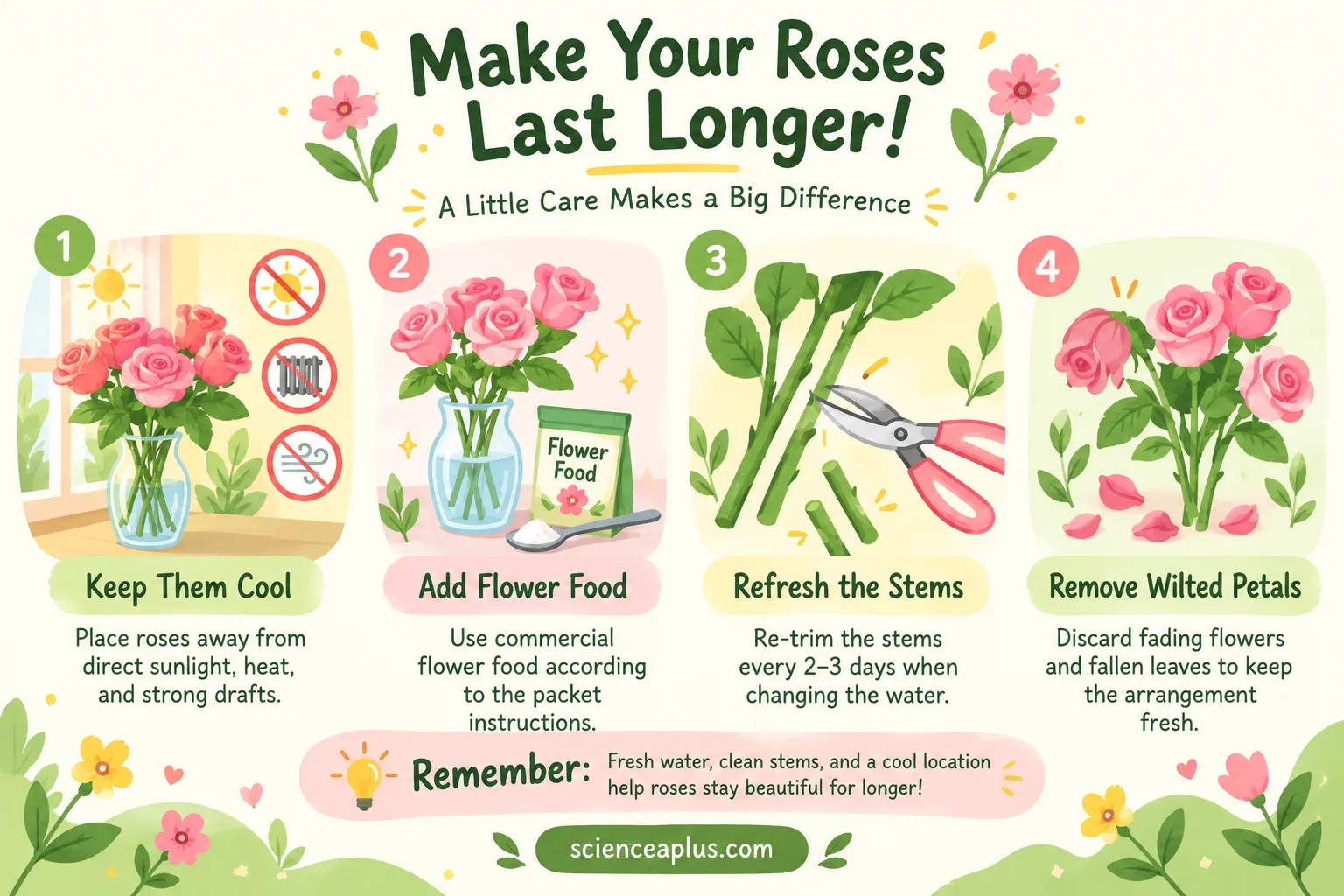
The RHS says to top up the water every couple of days and to change it, and re-cut the stem bases, every two to four days. The second slide says to re-trim every 2–3 days when changing the water. Both are in the same range, and the logic is the same: a new cut removes the blocked end, and fresh water resets the bacteria count to nearly zero.
Flower food: what is in the packet?
The second slide tells you to use commercial flower food according to the packet instructions. It is worth knowing what is inside. According to university extension guidance, an effective cut flower food has up to three components: an acidifier, an antimicrobial agent (a biocide) and a carbohydrate source. Here is what each does.
- Sugar (the carbohydrate). Once the stem is cut, the flower can no longer be fed by sugar made in the leaves by photosynthesis. The sugar in the vase water replaces that supply, so the petals can keep growing and the buds can open.
- Acidifier. Tap water is usually much less acidic than a good vase solution. An acid, such as citric acid, lowers the pH. Extension and government guides suggest a pH of around 3 to 3.5 for holding solutions; this helps water move up the stem and slows microbes. If pH is new to you, see our guide to acids and bases.
- Biocide. A chemical that kills bacteria and fungi in the water. Without it, the sugar would simply feed the microbes and make things worse. This is why plain sugar in water is not a good idea.
The RHS says that cut flower food contains an anti-bacterial treatment and that a home mix of vinegar and sugar is cheaper but “unlikely to be as effective”. Rose-specific flower foods are also sold, but the evidence for them comes mostly from manufacturers’ own trials, so follow the instructions on the packet rather than expecting a guaranteed extra few days.
Maths: getting the dose right
Flower food only works at the right strength. Too weak and it does little; too strong and the sugar and chemicals can harm the stems. The packet says how much to use, and the calculation is just proportion.
Suppose a sachet is labelled to make 0.5 litres of solution and your vase holds 1.5 litres. The number of sachets is 1.5 ÷ 0.5 = 3. If each sachet held 5 g of powder (an example figure, not a real brand), you would add 3 × 5 = 15 g. The concentration is 5 g ÷ 0.5 L = 10 g per litre, and it stays the same however much water you make. Try your own numbers below.
Biocides are often described in parts per million (ppm). One ppm in water is 1 mg in a litre. As an example, a biocide used at 50 ppm means 50 mg in every litre of water, or 100 mg in a 2-litre vase. These are tiny amounts, which is why it is best to use a commercial flower food made to give the right dose and a clean vase, rather than improvising with household chemicals.
Keep roses cool, and away from fruit
The first panel on the second slide says to keep roses away from direct sunlight, heat and strong draughts. Those three have one thing in common: they speed up water loss from the petals and leaves, because evaporation is faster when it is warm, sunny or windy. That puts more strain on a stem that can only take up water slowly. Warm water also lets bacteria grow faster.
The RHS gives the same advice: keep the vase away from heat sources such as radiators and fires. It adds one more tip, which is to keep flowers away from ripe fruit, and that leads to a plant hormone.
Ethylene: the ageing gas
Ethylene is a simple gas, C₂H₄, that plants use to control ripening and ageing. Ripe fruit releases it, and so do damaged and dying plant tissues. In flowers, ethylene can trigger petal wilting and drop. Roses are sensitive to it, although sensitivity varies a lot between varieties, which helps explain why some bouquets last far longer than others. The wilted petals and leaves on the second slide are a good reason to remove them: ageing tissue can release ethylene and it is also food for microbes.

The RHS also advises removing any dead or dying flowers. Do it daily, and pick up fallen petals from the table too. UC Davis notes that the grey mould Botrytis often follows free moisture on rose petals, so soggy, decaying petals are something to clear away rather than leave.
Maths: how fast does a vase empty?
A thirsty bouquet uses a lot of water. If a vase starts with 800 mL and holds 560 mL two days later, then the loss is (800 − 560) ÷ 2 = 120 mL per day, which is 120 ÷ 800 × 100 = 15% of the start each day. At that rate the remaining 560 mL lasts 560 ÷ 120 ≈ 4.7 more days. Measuring this yourself shows why topping up matters, and why you should not let the stem ends sit in a dry vase.
Remember that a daily top-up replaces only the water that has gone. It does not replace the bacteria-laden water that is left behind, which is why the card says to change the water completely every few days.
Garden roses: keeping the whole plant alive
So far we have looked at cut roses, which are living flowers on a borrowed supply of water. A rose that is still growing in the ground has roots, leaves and a whole year-round life cycle to look after. The question changes from “how do I stop the xylem blocking?” to “how do I keep the roots healthy and the leaves free of fungus?”.
Soil, roots and planting depth
Roses are hungry shrubs. The RHS recommends forking in about one bucket of well-rotted organic matter per square metre, into the top 20–30 cm of soil. Organic matter does two jobs: it holds water like a sponge and it keeps air spaces open so that roots can breathe. Roots need oxygen for respiration, which is why waterlogged soil is so harmful. If you want to know more, see our guide to soil types and composition.
The RHS also gives a precise planting rule: dig a hole about twice the width of the roots and about one spade blade deep, and set the graft union (the knobbly join where the cultivar was grafted onto a rootstock) at soil level. Planting it below soil level raises the risk of dieback.
Replant disease
If you are replacing an old rose with a new one in the same spot, the RHS warns about replant disease, also called soil sickness. The advice is clear: dig out the soil to 45 cm (18 in) deep and wide, and replace it with soil from another part of the garden.
Mulch and water
The RHS suggests mulching every spring with well-rotted manure or garden compost up to 8 cm (3 in) deep, leaving a gap of 10 cm (4 in) between the mulch and the stems. Mulch slows evaporation from the soil surface and keeps the soil temperature steadier. Newly planted roses need watering well during dry spells for at least two summers while their roots spread.
Maths: how much mulch?
Volume = area × depth. A rose bed 2 m by 3 m has an area of 6 m². An 8 cm layer is 0.08 m deep, so you need 6 × 0.08 = 0.48 m³ of mulch, or 480 litres. The same bed needs about 6 buckets of organic matter for planting, at one bucket per square metre. Work in metres throughout so the units match: 8 cm = 0.08 m.
Pruning: cut to the right bud
Pruning removes dead, damaged and diseased wood and helps the plant keep an open shape, which lets air move through. The RHS advises cutting no more than 5 mm above a bud, with a cut that slopes down and away from the bud so that water runs off instead of collecting on it. Cutting to an outward-facing bud encourages growth outwards, giving an open-centred shrub.
There is a link back to the vase here. In both cases a clean, sharp cut matters, because a ragged cut leaves dead tissue where microbes can get a start. On a garden rose the sloping cut sheds water; on a vase stem it exposes more xylem.
Two fungi that cause most rose problems
Fungi are not plants or animals. They are made of thread-like filaments called hyphae, and they feed by absorbing nutrients from living or dead material. Two fungi are responsible for the diseases gardeners dread most on roses.
Black spot (Diplocarpon rosae)
The RHS calls black spot “the most serious disease of roses”. It shows up as purplish or black patches on the upper side of the leaves, often with yellowing around them, and then the leaf drops. In a bad attack nearly all the leaves can fall, which greatly reduces the plant’s vigour. That matters because leaves make the sugar that feeds the whole plant.
The spores form in the spots and spread in water, so rain splashing from leaf to leaf spreads the disease; wind-blown rain can bring it in from elsewhere. Most British summers are wet enough for it. The fungus survives the winter on fallen leaves and in dormant infections on young stems and buds, then produces spores again in spring.
Powdery mildew (Podosphaera pannosa)
Powdery mildew looks quite different: a white, powdery coating on leaves, shoots and flower buds, with young leaves curling and badly infected buds failing to open. The surprise is the weather it likes. According to the RHS, spores do not need long periods of leaf wetness to germinate, so the disease is often a problem in dry summers. Dry soil and drought stress make roses more susceptible, as does humid, still air, such as the air next to a wall or fence. Too much nitrogen in fertiliser causes soft, leafy growth, and that soft growth is easier for the mildew to attack.
| Feature | Black spot | Powdery mildew |
|---|---|---|
| Fungus | Diplocarpon rosae | Podosphaera pannosa |
| What you see | Purple-black patches, yellowing, leaf drop | White powdery coating, curled young leaves |
| Weather that favours it | Wet conditions (spores spread in water) | Dry soil, humid still air, dry summers |
| Survives winter | On fallen leaves and young stems | On stems and inside dormant buds |
| Garden tactics | Clear fallen leaves, mulch at least 5 cm thick, prune out stem spots | Space plants, open structure, water in dry spells, avoid excess nitrogen |
What the RHS recommends instead of spraying
Both diseases are best managed by good gardening first. For black spot, the RHS says to collect and destroy fallen leaves in autumn or bury them under mulch at least 5 cm (2 in) thick, applied from November to February, and to prune out any stem spots in spring before the leaves open. These steps delay the start of the disease rather than abolishing it, because spores can blow in from elsewhere. For powdery mildew, it advises planting in full sun with good air circulation, spacing the plants, watering in dry spells and cutting out badly affected shoots.
The RHS recommends not using fungicides, including organic ones, because they may reduce biodiversity and affect soil health. It also notes that disease resistance bred into new cultivars often fails over time, because new fungal strains arise that overcome it. Older species roses are little affected by black spot, while hybrid teas, floribundas and climbers are often susceptible.
Practice: maths for roses
These short questions use the same ideas as the sections above: ratios, percentages and volumes. Try each one on paper first, then tap to check.
A straight cut across a rose stem has an area of 50 mm². What is the area of a 45° cut across the same stem? Give your answer to the nearest whole number. (2 marks)
Area = 50 ÷ cos 45° = 50 ÷ 0.7071 ≈ 71 mm², about 1.41 times larger.
A sachet makes 0.5 litres of solution and contains 4 g of powder. How many sachets, and how many grams, are needed for a 2-litre vase? (3 marks)
Sachets = 2 ÷ 0.5 = 4. Mass = 4 × 4 = 16 g. The concentration is 4 ÷ 0.5 = 8 g per litre.
A biocide is used at 50 ppm, which means 50 mg per litre. How many milligrams are needed in 3 litres? (1 mark)
50 × 3 = 150 mg.
A vase holds 900 mL at the start and 600 mL after 3 days. What is the mean loss per day, and what is that as a percentage of the starting volume? (3 marks)
Loss = (900 − 600) ÷ 3 = 100 mL per day. Percentage = 100 ÷ 900 × 100 ≈ 11.1% of the starting volume per day.
A rose bed measures 4 m by 1.5 m. How many cubic metres of mulch make a layer 5 cm deep? How many litres is that? (3 marks)
Area = 4 × 1.5 = 6 m². Depth = 5 cm = 0.05 m. Volume = 6 × 0.05 = 0.3 m³. Since 1 m³ = 1000 litres, that is 300 litres.
Flip cards: test your memory
Your vase-care checklist
Tick the steps as you do them. Your ticks are remembered in this browser.
- Wash the vase with soap and hot water, then rinse
- Strip leaves from the bottom half to two-thirds of each stem
- Re-cut about 2.5 cm off each stem with sharp secateurs
- Dissolve flower food in the water, following the packet
- Stand the vase somewhere cool, away from sun, heaters, draughts and fruit
- Every 2 to 3 days, change the water and re-trim the stems
- Remove wilted petals and fallen leaves
Frequently asked questions about keeping roses alive
How do you keep roses alive in a vase?
Wash the vase, strip the lower leaves, cut about an inch off each stem with a sharp blade, and stand the roses in clean water with flower food. Keep them cool, away from sun, heat and ripe fruit, and change the water and re-trim every two to three days.
Why do cut roses wilt so quickly?
Petals keep losing water into the air, so the stem must keep supplying it. If air bubbles or bacteria block the xylem, water cannot reach the flower fast enough, the cells lose pressure and the head droops. Heat and draughts make the loss faster.
Why should you cut rose stems at an angle?
A sloping cut exposes a larger oval of open xylem and avoids a flat cut resting against the bottom of the vase. The RHS advises a clean, angled cut. A 45° cut has about 41% more area than a straight cut, but a clean sharp cut matters most.
Do you really need to cut roses under water?
It can help, because it stops air entering the xylem and lets bubbles clear. Some research suggests it matters less if stems are cut dry and placed in water at once. A fresh cut just before the stems go into water is the key step, and cutting under water is a cheap extra.
What is in flower food and does it work?
Flower food usually contains a sugar for energy, an acidifier to lower the water’s pH, and a biocide to kill microbes. The RHS says it feeds the flowers and keeps the water cleaner. A home mix of vinegar and sugar is cheaper but unlikely to be as effective.
How often should you change the water for roses?
The RHS advises topping up every couple of days and changing the water and re-cutting the stem bases every two to four days. Change it sooner if it turns cloudy, because cloudiness is a sign that bacteria are multiplying and can block the stems.
Why should you remove the lower leaves from roses?
Leaves left underwater rot and release sugars and proteins that feed bacteria. The bacteria multiply, cloud the water and can plug the stem. The RHS advises stripping leaves from the bottom half to two-thirds of each stem so none sit below the waterline.
Does ripe fruit really make flowers die faster?
Ripe fruit releases ethylene, a gas that speeds ageing in plants, and the RHS advises keeping cut flowers away from it. Roses are sensitive to ethylene, although how much varies between varieties. A cool spot away from the fruit bowl is a simple fix.
What causes black spots on rose leaves?
A fungus called Diplocarpon rosae causes black spot. It makes purplish-black patches on the upper leaf surface, often with yellowing, and the leaves then fall. Spores spread in splashing water and survive the winter on fallen leaves, so clearing them in autumn and mulching helps.
How do you stop powdery mildew on roses?
Powdery mildew, caused by Podosphaera pannosa, is helped by dry soil, still humid air and excess nitrogen. The RHS advises full sun, good spacing and air circulation, watering in dry spells, avoiding too much nitrogen and cutting out badly affected shoots.