
Weak Acid Strong Base Titration
In a weak acid-strong base titration, a weak acid is titrated with a strong base to determine its concentration. Base is added to the acid in small amounts until exactly enough has been added to react with all of the acid: that is the equivalence point. The pH at the equivalence point is not 7. Because the salt formed contains the conjugate base of a weak acid, the solution at the equivalence point is alkaline, typically around pH 8 to 9. The end point is a separate idea: it is the point at which the indicator changes colour, and a good indicator for this titration is one that changes in that alkaline range, such as phenolphthalein. As base is added the pH rises gradually at first, then rises sharply as the equivalence point is passed.
During the titration process, the concentration of the weak acid is determined by using the known concentration of the base and the volume of base required to reach the equivalence point.
Titration definition chemistry
Titration is a common laboratory technique used in chemistry to determine the concentration of an unknown substance in a sample. The process involves the gradual addition of a standardized solution of a known concentration (the titrant) to the solution containing the unknown substance until the reaction between the two is complete. The point at which the reaction is complete is known as the equivalence point, and it can be determined by monitoring a change in the properties of the solution, such as a change in color or pH.
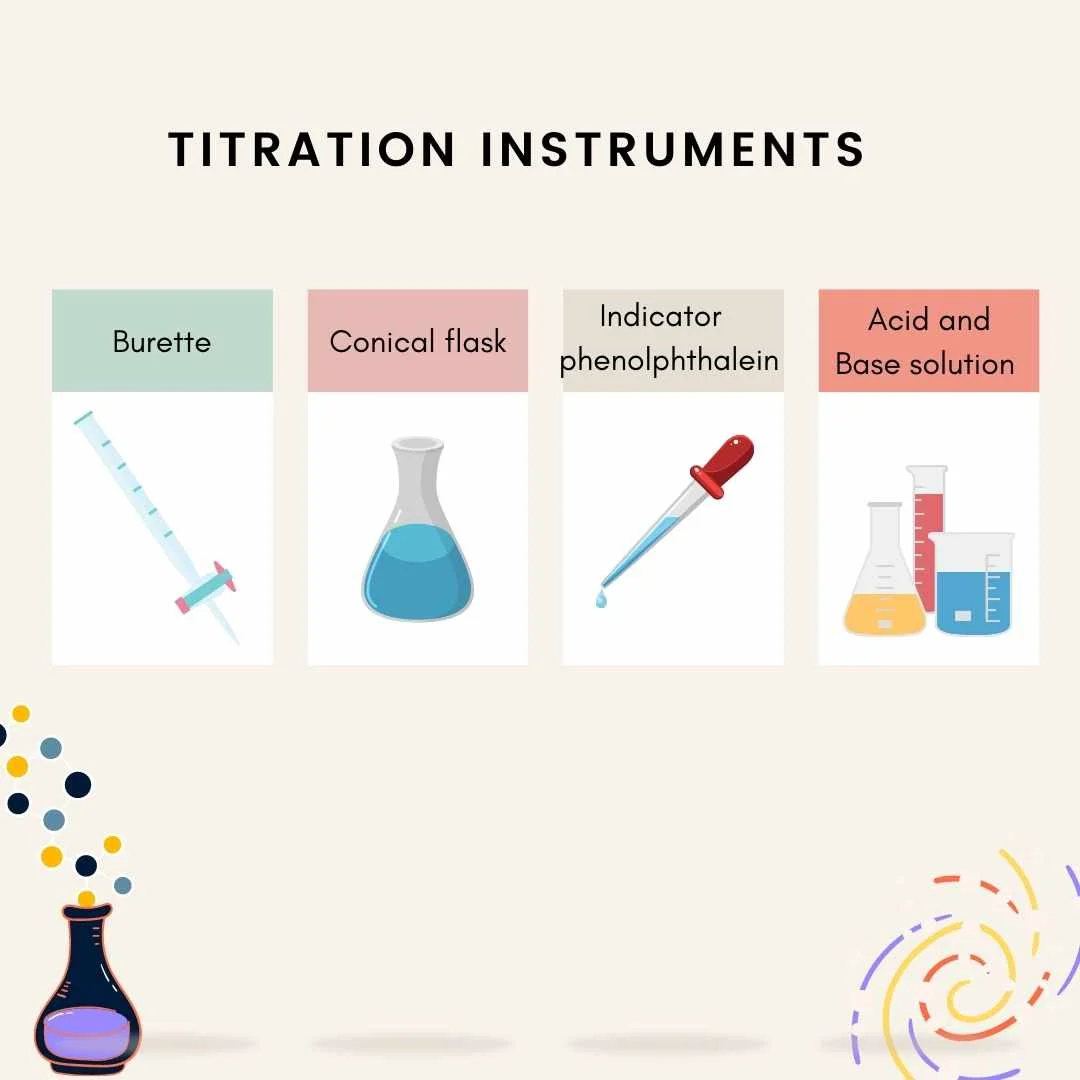
Titration instruments
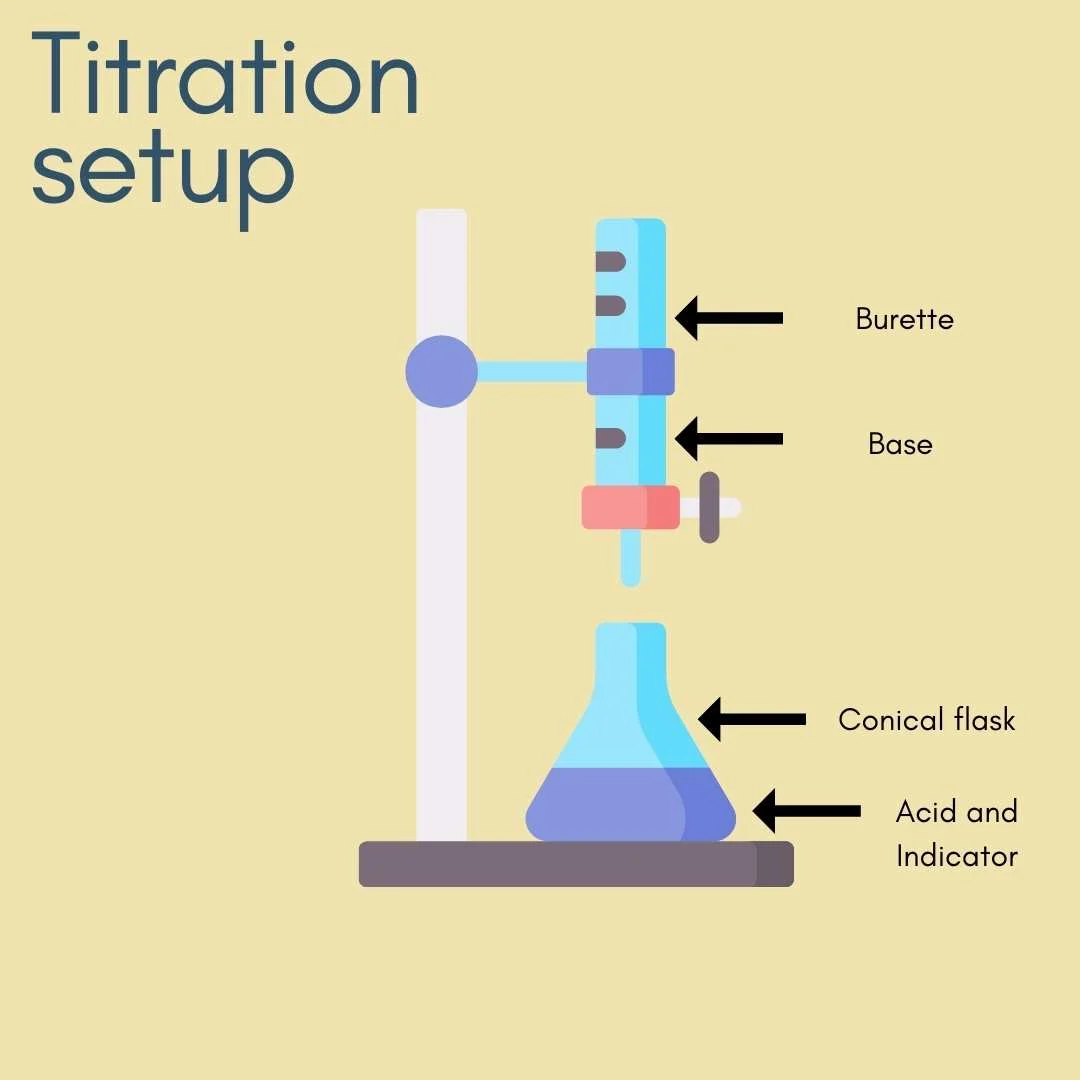
Titration setup
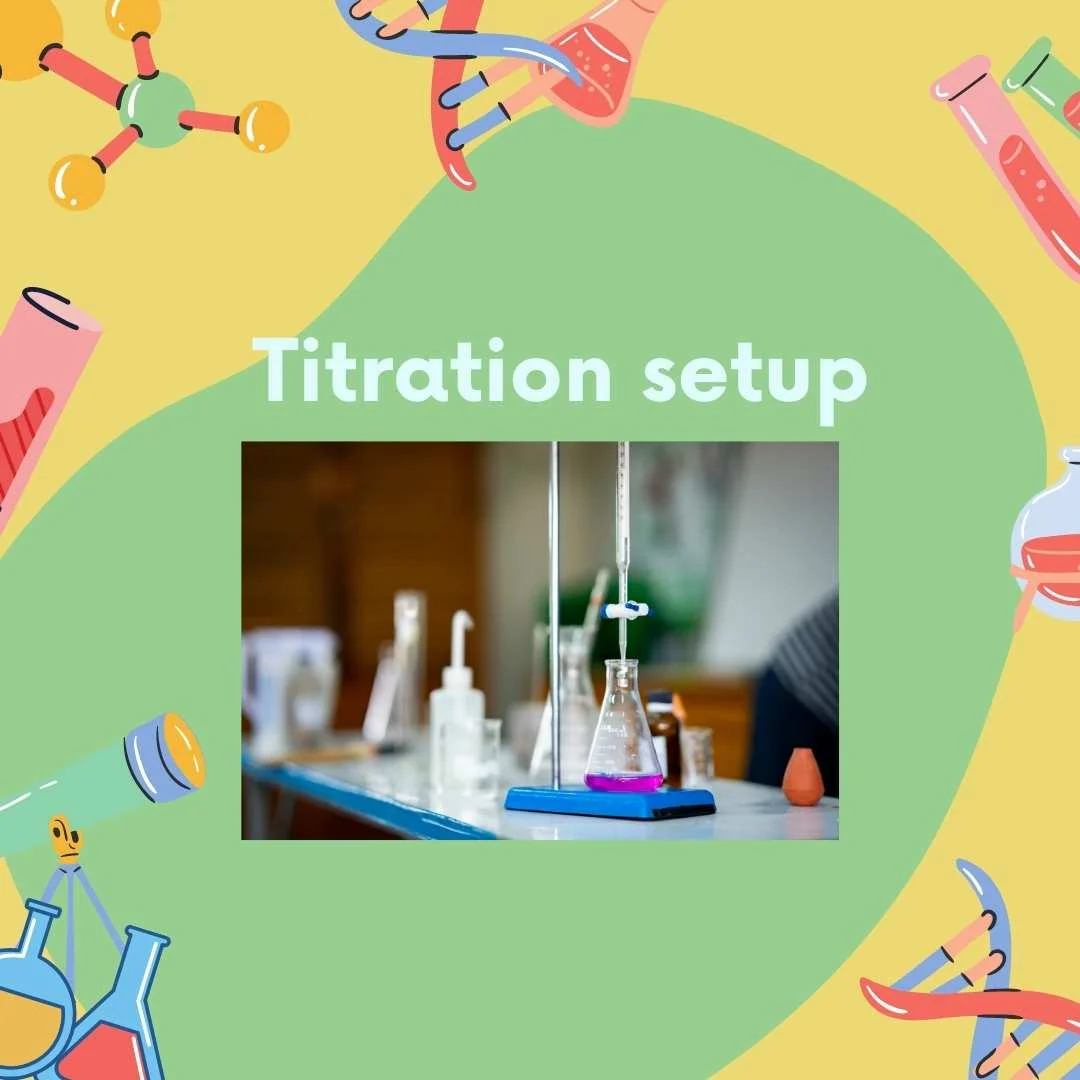
Titration setup picture
Acid base titration steps
Materials needed:
- Acid solution of known concentration
- Base solution of unknown concentration
- Indicator (e.g. phenolphthalein)
- Burette
- Pipette
- Conical flask
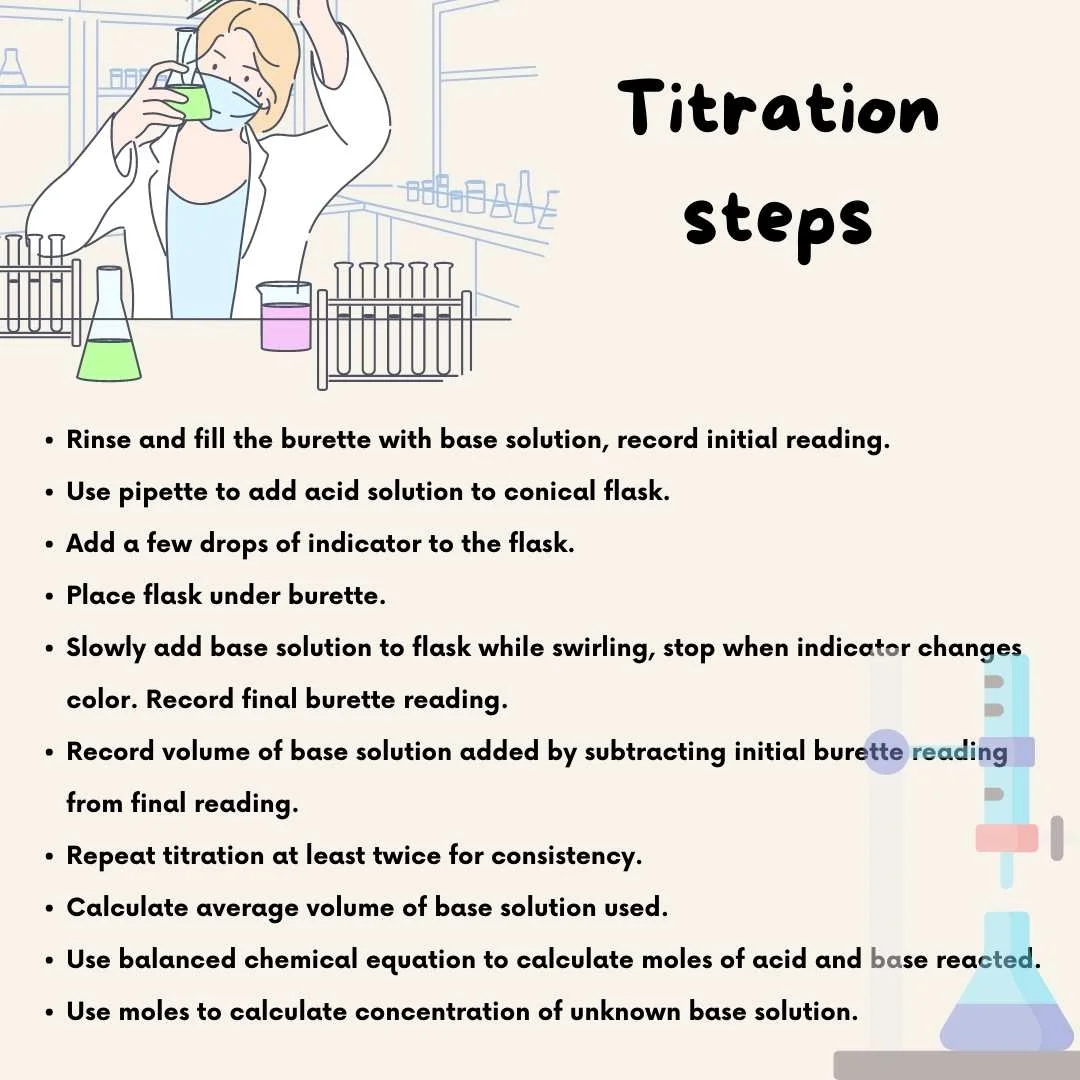
Steps:
- Rinse the burette with the base solution and fill it with the base solution up to the zero mark. Record the initial burette reading.
- Use a pipette to accurately measure a known volume of the acid solution into a conical flask.
- Add a few drops of indicator (e.g. phenolphthalein) to the conical flask.
- Place the conical flask under the burette.
- Slowly add the base solution from the burette to the acid solution in the conical flask, while swirling the flask. Stop adding base solution once the indicator changes color. Note the final burette reading.
- Record the volume of the base solution added to the acid solution by subtracting the initial burette reading from the final burette reading.
- Repeat the titration at least twice to obtain consistent results.
- Calculate the average volume of the base solution used.
- Use the balanced chemical equation for the reaction between the acid and base to calculate the moles of acid and base reacted.
- Use the number of moles of acid and base to calculate the concentration of the unknown base solution.
Titration steps
Titration equation
The equation used for the titration of a weak acid with a strong base is:
HA + OH- → A- + H2O
where HA is the weak acid and A- is the conjugate base of the acid. The endpoint of the titration is determined by using an indicator such as phenolphthalein, which changes color from colorless to pink when the pH of the solution reaches around 8.2.
Titration Curve

A titration curve is a graphical representation of the pH of a solution during a titration process. The x-axis of the titration curve represents the volume of the titrant added to the solution, while the y-axis represents the pH of the solution.
The titration curve of a weak acid-strong base titration has a characteristic shape, with a gradual increase in pH until the equivalence point is approached, followed by a sharp increase in pH. The steep part of the curve shows that all the acid has now been reacted, so each further drop of base raises the pH a great deal. The midpoint of that steep section is the equivalence point, and for a weak acid with a strong base it sits above pH 7, not at pH 7.
Equivalence Point Titration
The moles of the analyte being titrated are equivalent to the moles of the titrant given to the solution at the equivalence point of a titration.
For example, in a weak acid-strong base titration, the equivalence point is reached when all the acid has reacted with the base. The solution is not neutral at that point – it is alkaline, because the salt formed contains the conjugate base of the weak acid. The pH is equal to the pKa of the acid at the half-equivalence point, when half the acid has been neutralised, not at the equivalence point itself. The pH changes rapidly as the equivalence point is approached, showing that the reaction is nearly complete.
Equivalence Point on Titration Curve

The equivalence point on a titration curve is the point at which the analyte has reacted completely with the titrant, and it lies at the middle of the steep section of the curve. Only in a strong acid-strong base titration is the solution neutral there. With a weak acid and a strong base the equivalence point is above pH 7, and with a weak base and a strong acid it is below pH 7. The volume of titrant needed to reach the equivalence point is what is used to calculate the concentration of the analyte.
Titration Formula
The formula used to calculate the concentration of the analyte being titrated is:
C1V1 = C2V2
where C1 is the concentration of the analyte, V1 is the volume of the analyte, C2 is the concentration of the titrant, and V2 is the volume of the titrant added to the solution. This formula is used to calculate the concentration of the analyte at the equivalence point of the titration.
Titration Calculator
A titration calculator is a tool used to calculate the concentration of an analyte being titrated. The titration calculator requires the volume and concentration of the analyte, as well as the volume and concentration of the titrant. The calculator uses the titration formula to calculate the concentration of the analyte at the equivalence point.
Strong acid strong base titration
One of the most common types of titrations is the strong acid-strong base titration. In this type of titration, a strong acid is titrated with a strong base to determine the concentration of the acid. The reaction between the acid and base is typically a neutralization reaction, which produces water and a salt.
The equation for the reaction is:
acid + base → salt + water
During the titration, the base is gradually added to the acid until the equivalence point is reached, at which point all of the acid has reacted with the base. The equivalence point is typically detected using an indicator, such as phenolphthalein, which changes color at a specific pH. The amount of base required to reach the equivalence point can then be used to determine the concentration of the acid. The equation for the titration is written as:
Determination of the concentration of the acid
acid + base → salt + water
n acid V acid = n base V base
where c is the concentration of the acid or base in mol dm−3 and V is its volume. Note that this simple form only works when the acid and base react in a 1:1 ratio. If the balanced equation is not 1:1 you must work in moles instead: find moles = c × V for the solution you know, scale by the ratio in the balanced equation, and then divide by the volume of the other solution to get its concentration.
titration is an essential technique in chemistry that allows scientists to determine the concentration of an unknown substance in a sample. The strong acid-strong base titration is one of the most common types of titrations and involves the gradual addition of a strong base to a strong acid to determine the concentration of the acid.