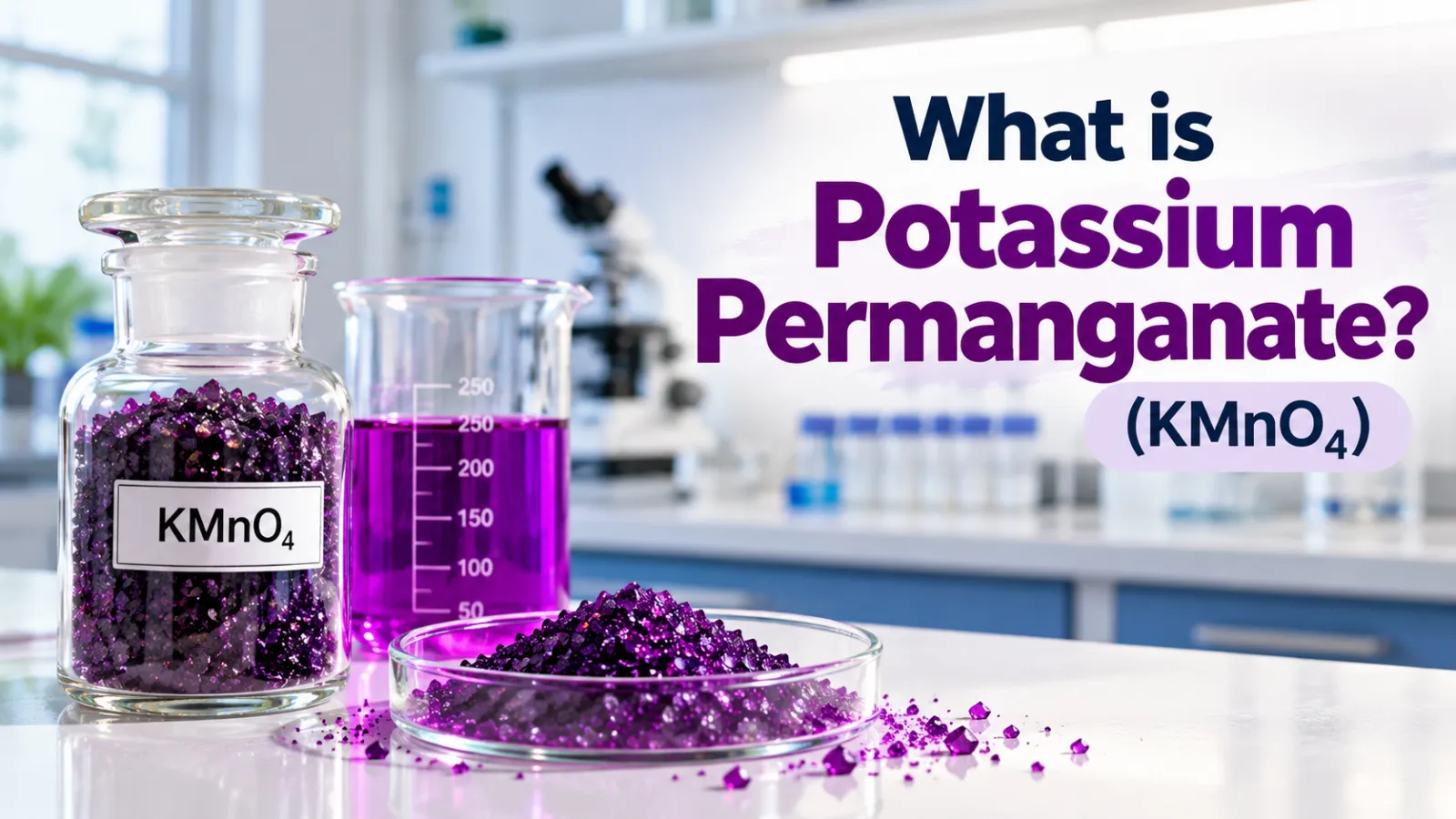
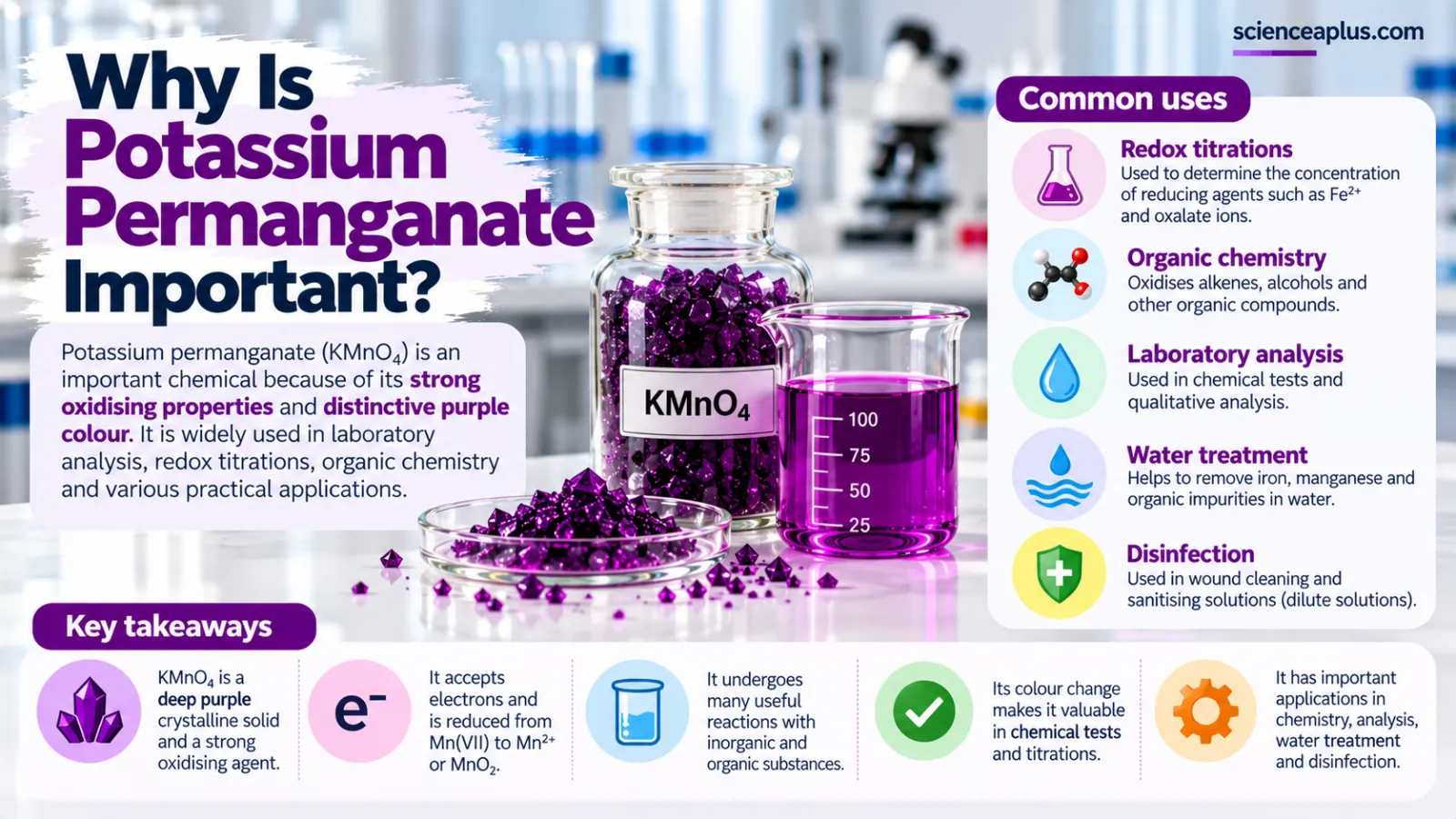
Potassium permanganate (KMnO₄) is a dark purple, crystalline salt made of potassium ions (K⁺) and permanganate ions (MnO₄⁻). It is a powerful oxidising agent: it dissolves in water to give an intensely purple solution and is used in redox titrations, water treatment and dilute skin soaks prescribed by doctors.
Chemists also call it potassium manganate(VII), which is the name you will usually meet in A-level papers. This guide covers its formula, molar mass and oxidation state, why it is purple, the balanced equations behind its most famous reactions, how a KMnO₄ titration works, what it is used for and how to handle it safely.
What is potassium permanganate?
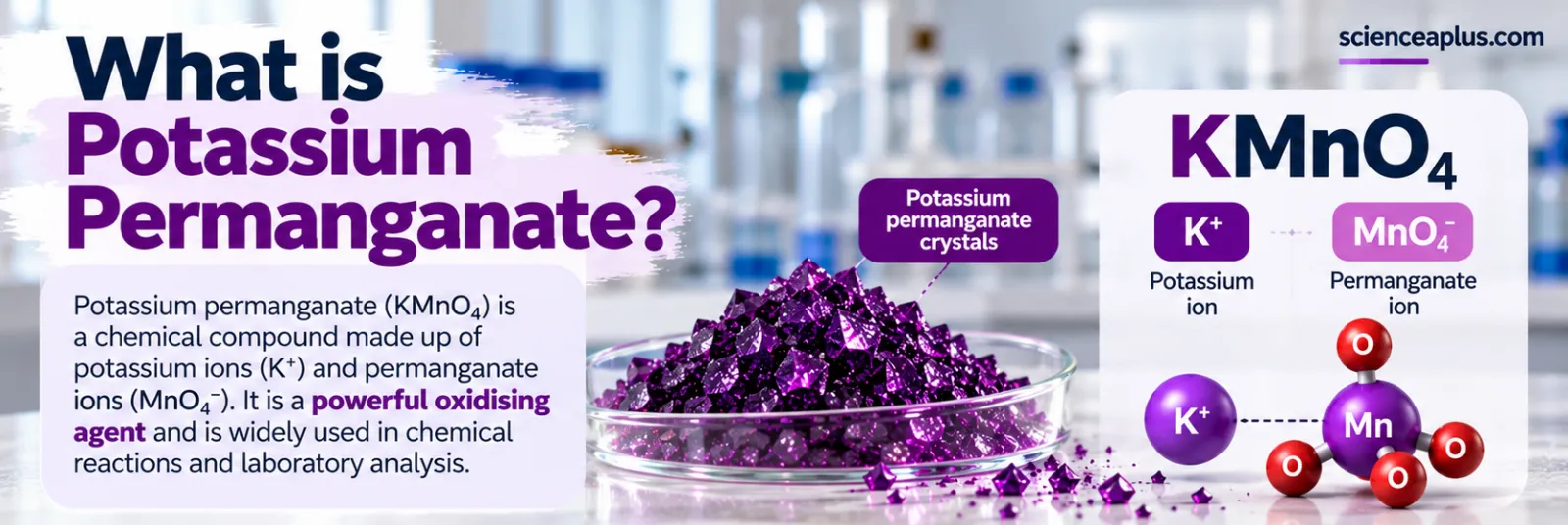
Potassium permanganate is an ionic compound. Each formula unit contains one potassium ion, K⁺, and one permanganate ion, MnO₄⁻. The two ions are held together in a giant lattice by strong electrostatic attraction, which is why the solid forms hard, glittering crystals rather than a liquid or gas.
The interesting part is the permanganate ion. It has a manganese atom at the centre with four oxygen atoms arranged around it in a tetrahedral shape. The ion as a whole carries a charge of −1. The potassium ion is a spectator in most reactions: it simply balances the charge. Almost all the chemistry you will learn about this compound is really the chemistry of MnO₄⁻.
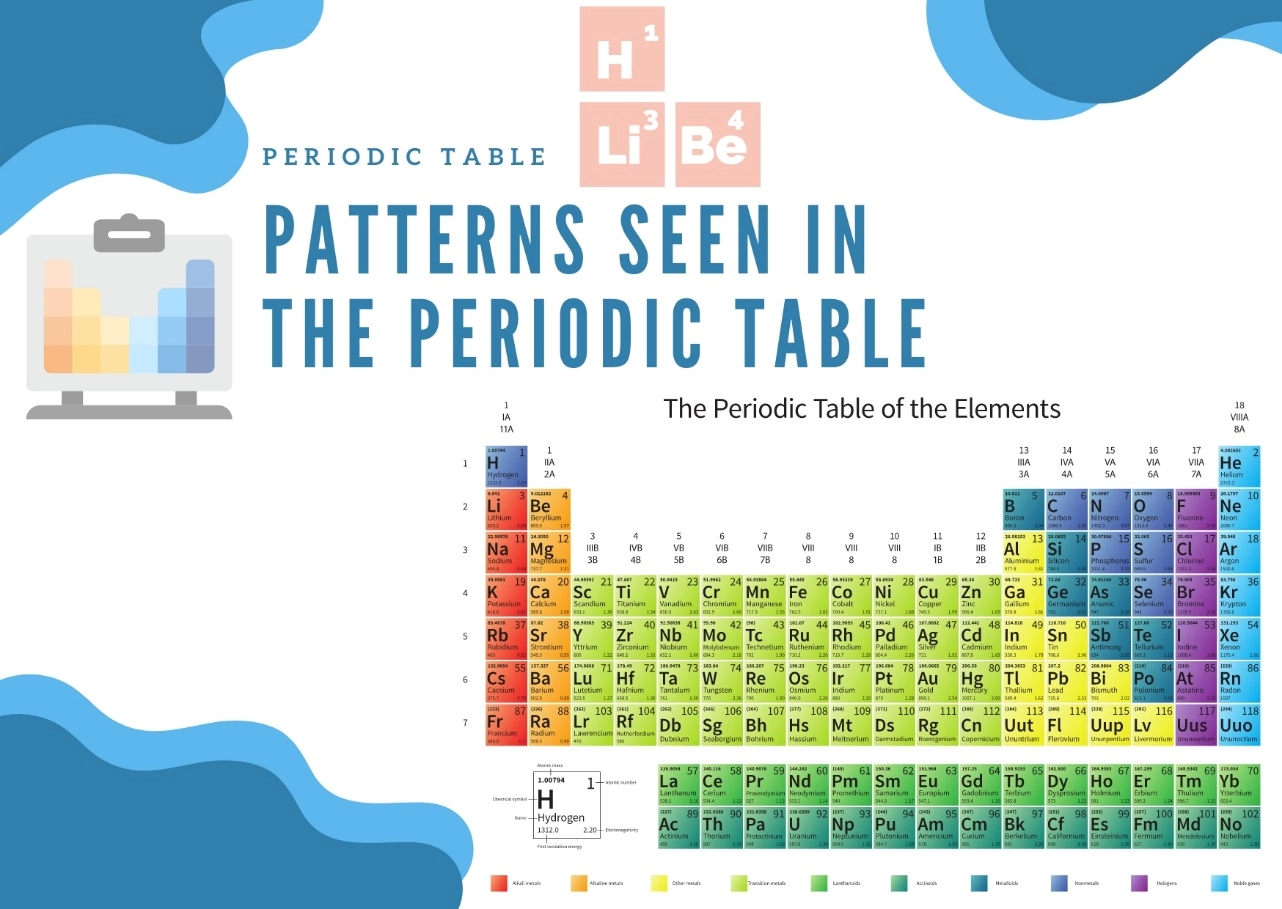
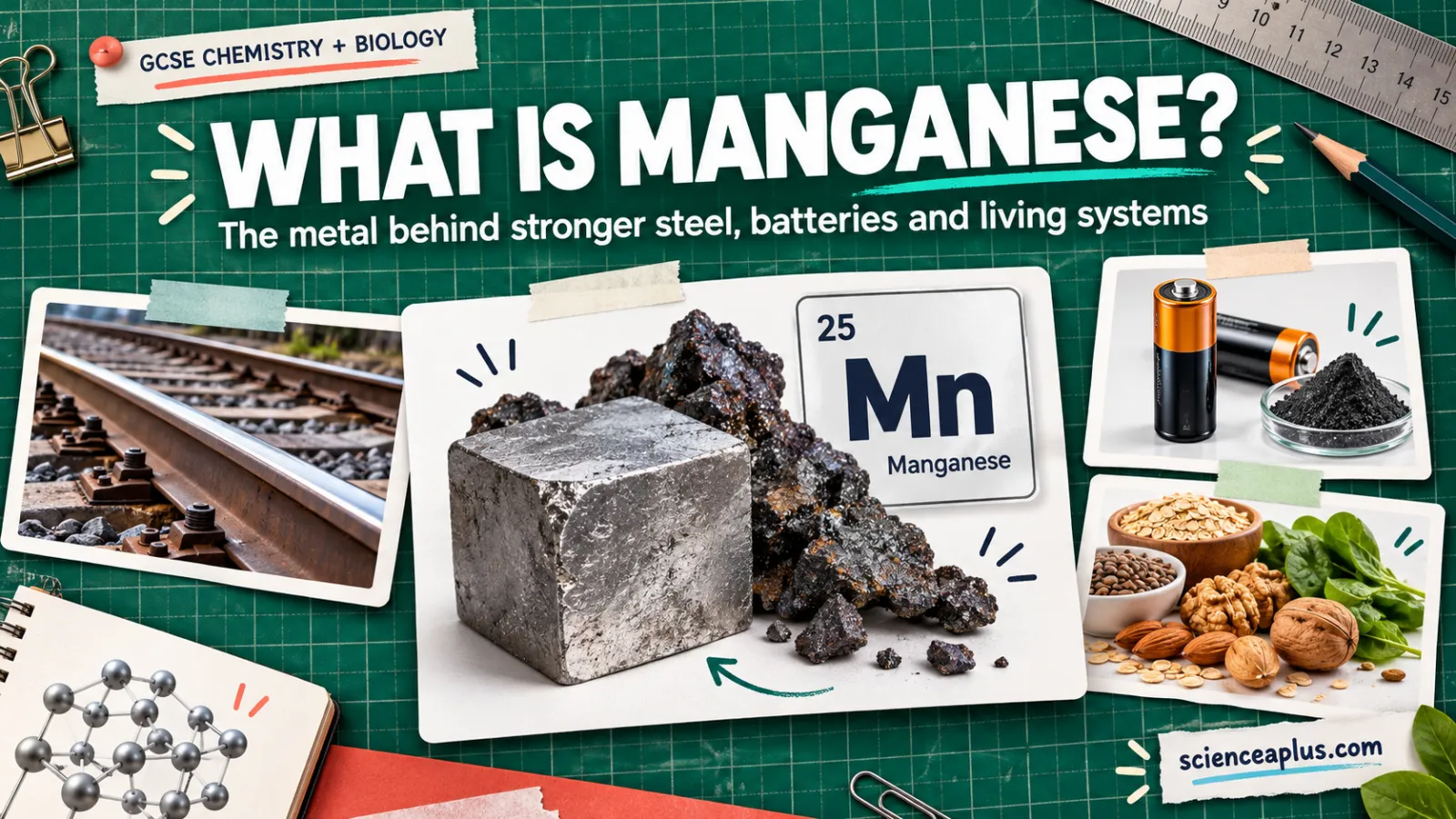
The compound has collected a few nicknames over the centuries. Older books call it permanganate of potash, gardeners and campers knew it as Condy’s crystals, and early chemists called it the chameleon mineral because of the way its solutions change colour. You can read more about the two elements involved in our guides to manganese and potassium.
Formula, molar mass and oxidation state of KMnO₄
The formula of potassium permanganate is KMnO₄: one potassium atom, one manganese atom and four oxygen atoms. You can work out its relative formula mass (Mr) by adding up the relative atomic masses.
| Element | Number of atoms | Ar | Contribution |
|---|---|---|---|
| Potassium (K) | 1 | 39.10 | 39.10 |
| Manganese (Mn) | 1 | 54.94 | 54.94 |
| Oxygen (O) | 4 | 16.00 | 64.00 |
| Total (Mr) | ≈ 158.0 | ||
Using these rounded values gives 158.04. The accepted molar mass of KMnO₄ is 158.03 g/mol; the tiny difference comes from rounding the atomic masses. In an exam, use the Ar values on your own data sheet and you will get the mark.
What is the oxidation state of manganese in KMnO₄?
Oxidation states in a neutral compound add up to zero. Potassium is always +1 in its compounds and oxygen is usually −2. So:
(+1) + Mn + 4 × (−2) = 0 → Mn = +7
You can also do it with the ion alone: in MnO₄⁻ the oxidation states must add up to the charge, −1, so Mn + (−8) = −1 and again Mn = +7. This is the highest oxidation state manganese can reach. Manganese in +7 has given away all of its outer electrons, so it is desperate to get some back. That hunger for electrons is exactly what makes potassium permanganate such a strong oxidising agent.
Calculate the number of moles in 3.16 g of potassium permanganate. (2 marks)
n = mass ÷ Mr = 3.16 ÷ 158 = 0.0200 mol (1 mark for the method, 1 mark for the answer to 3 significant figures).
Physical properties of potassium permanganate
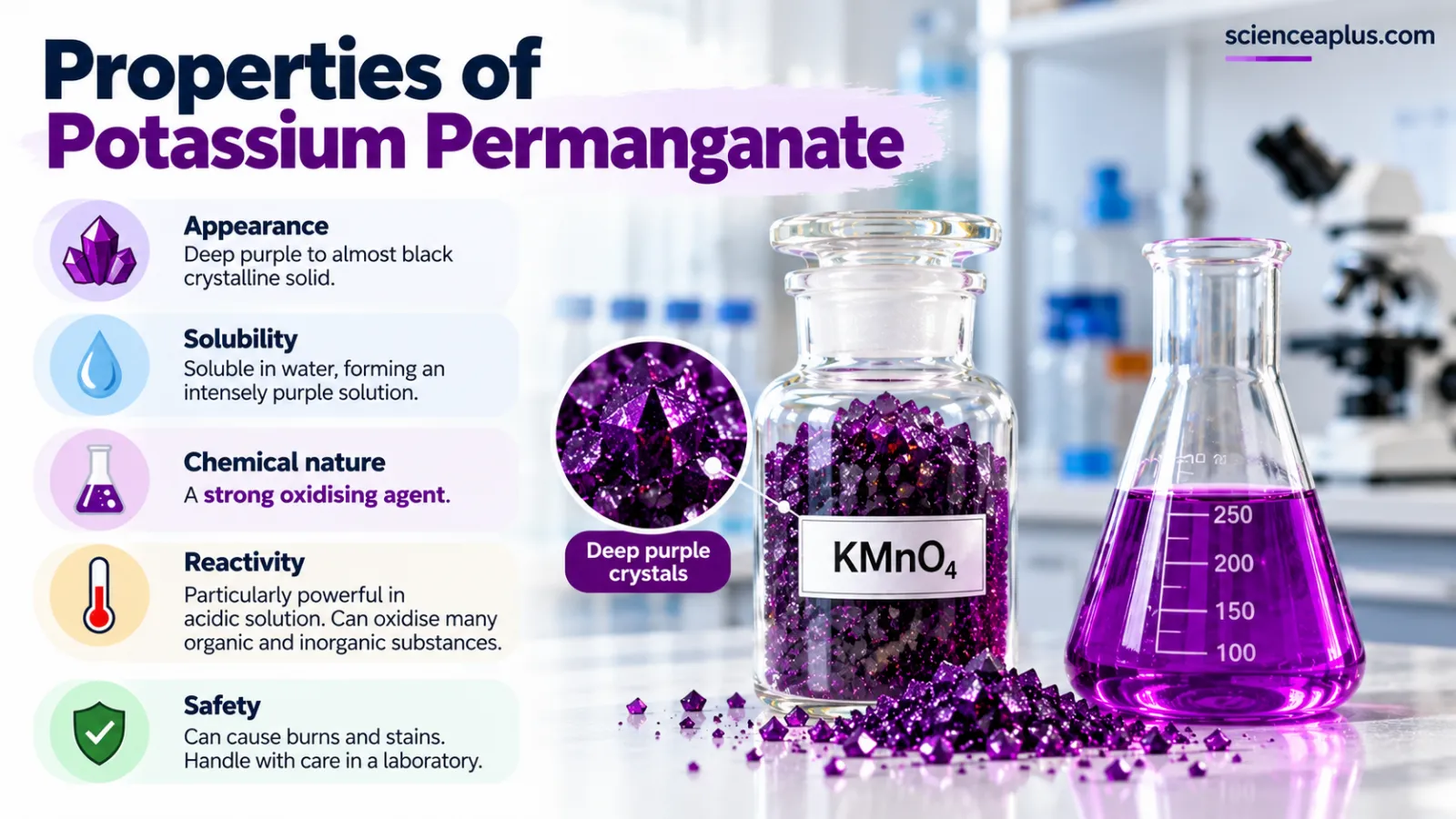
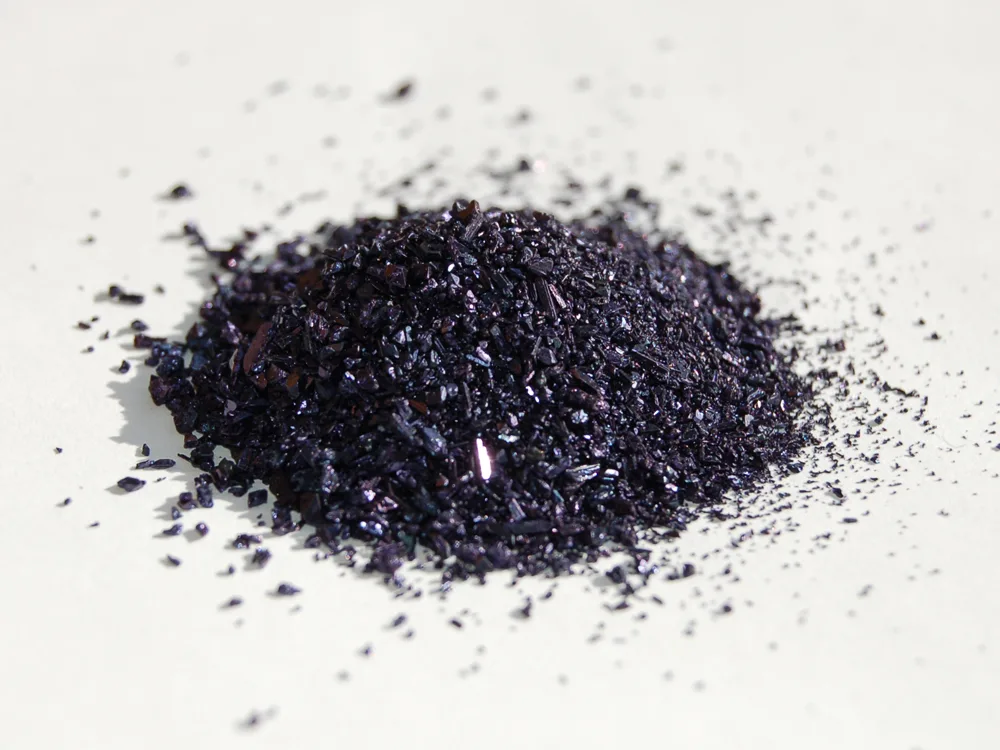
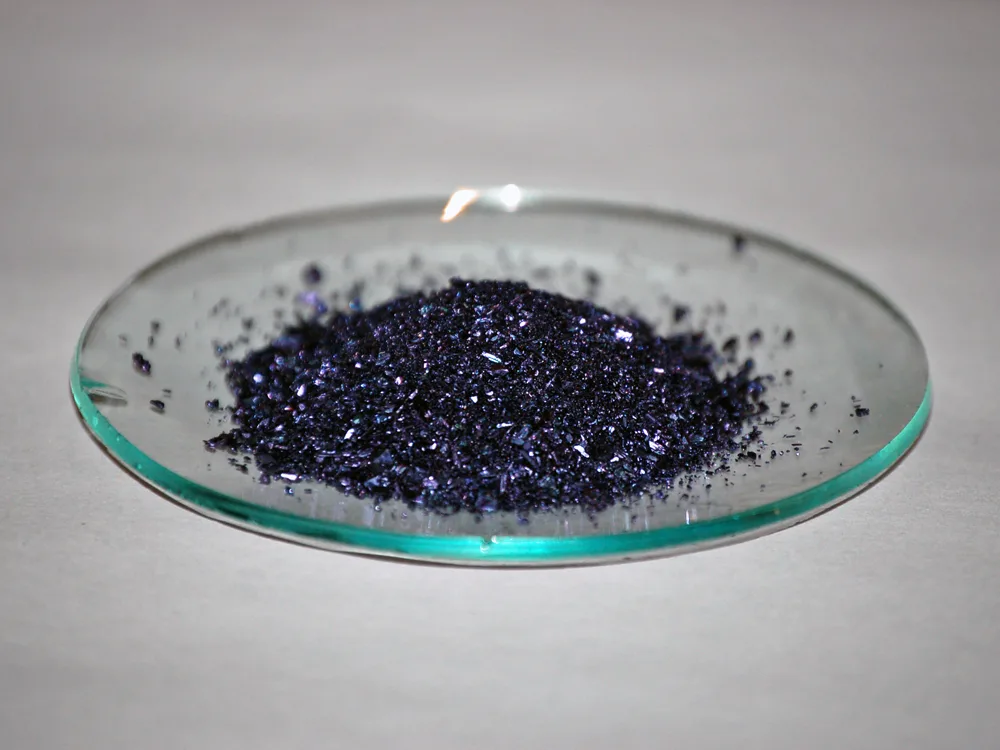
Potassium permanganate is easy to recognise. The solid is made of dark purple, almost black crystals with a metallic sheen; reference books describe the lustre as bronze-like or bluish. It has no smell. When it dissolves, even a few crystals turn a large volume of water deep purple.
| Property | Value |
|---|---|
| Appearance | Dark purple to almost black crystals with a metallic lustre |
| Odour | None (odourless) |
| Density | 2.7 g/cm³ |
| Melting point | Does not melt; decomposes at about 240 °C, releasing oxygen |
| Solubility in water | About 6.4 g per 100 cm³ at 20 °C; much more soluble in hot water |
| Colour of solution | Intense purple; very dilute solutions look pale pink |
| Chemical nature | Strong oxidising agent |
Notice that potassium permanganate does not have a melting point. Before the crystals can melt, the heat breaks the compound down and oxygen is released. You will see the equation for this in the reactions section below.
Why is potassium permanganate purple?
Most coloured compounds you meet at GCSE and A-level are transition metal compounds, and their colour is normally explained by electrons jumping between d orbitals. Potassium permanganate is a famous exception. Manganese in the +7 state has no d electrons left, so d–d transitions cannot happen.
Instead, the colour comes from charge transfer. When visible light hits the permanganate ion, an electron moves briefly from an oxygen atom towards the manganese atom. This absorbs light from the green-yellow part of the spectrum. The light that is left over, mostly red and blue, reaches your eye, and your brain sees purple or magenta.
Charge-transfer absorptions are very strong, which is why permanganate solutions are so intensely coloured. A solution only one part in ten thousand strength is still clearly pink. This strong colour is extremely useful: it means potassium permanganate acts as its own indicator in titrations, as you will see in the next part.
Why is potassium permanganate a strong oxidising agent?
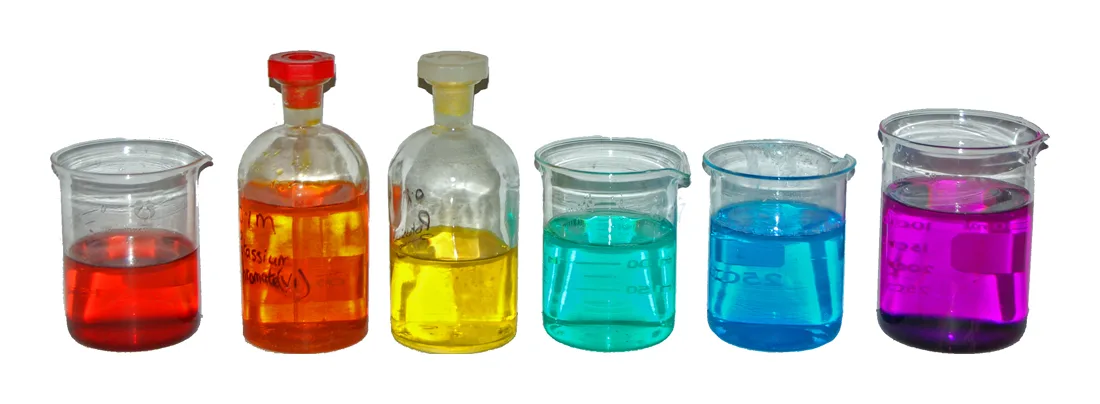
An oxidising agent is a substance that takes electrons from something else and is itself reduced. Potassium permanganate is one of the strongest oxidising agents used in school laboratories because manganese starts in its highest oxidation state, +7, and can drop down to +6, +4 or +2 by gaining electrons.
How far the manganese is reduced depends on the conditions, especially how acidic the solution is. This is why exam questions always tell you whether the KMnO₄ is “acidified”. The three half-equations below are the ones to know.
In acidic solution: reduced to Mn²⁺
MnO₄⁻ + 8H⁺ + 5e⁻ → Mn²⁺ + 4H₂O
Check it balances: on the left there is 1 Mn, 4 O and 8 H; on the right 1 Mn, 4 O and 8 H. Charge on the left is (−1) + (+8) + (−5) = +2, and on the right it is +2. Each manganese gains five electrons and drops from +7 to +2. The purple colour disappears because Mn²⁺ ions are so pale pink they look colourless in dilute solution.
In neutral or weakly alkaline solution: reduced to MnO₂
MnO₄⁻ + 2H₂O + 3e⁻ → MnO₂ + 4OH⁻
Here manganese gains three electrons and drops to +4. Manganese(IV) oxide is insoluble, so you see a brown precipitate or a muddy brown cloudiness. Charge check: (−1) + (−3) = −4 on the left, and 4 × (−1) = −4 on the right.
In strongly alkaline solution: reduced to green manganate(VI)
MnO₄⁻ + e⁻ → MnO₄²⁻
With lots of hydroxide ions around, manganese can gain just one electron and stop at +6. The manganate(VI) ion, MnO₄²⁻, is a striking green.
| Conditions | Manganese product | Change in oxidation state | What you see |
|---|---|---|---|
| Acidic (dilute H₂SO₄) | Mn²⁺ | +7 → +2 (5 e⁻) | Purple → very pale pink / colourless |
| Neutral or weakly alkaline | MnO₂ | +7 → +4 (3 e⁻) | Purple → brown precipitate |
| Strongly alkaline | MnO₄²⁻ | +7 → +6 (1 e⁻) | Purple → green |
The “chemical chameleon”: a little history
Potassium permanganate has been amazing chemists for more than 350 years. In 1659 the German chemist Johann Rudolf Glauber melted the mineral pyrolusite (manganese dioxide) with potassium carbonate. When he dissolved the product in water, the solution was green, then slowly turned violet and finally red. This is the first known description of making a permanganate, and it earned the substance the name chameleon mineral.
The colour changes you met in the table above are the same chemistry running in reverse. A popular school demonstration, often called the chemical chameleon, adds sugar to an alkaline solution of potassium permanganate. The sugar is a reducing agent, so the solution changes from purple to green (manganate(VI)) and then to an orange-brown colour as manganese(IV) oxide forms.
About two hundred years after Glauber, a London chemist called Henry Bollmann Condy sold permanganate disinfectants: Condy’s Fluid (originally a sodium-based solution) and later Condy’s crystals. The dry potassium salt became known as Condy’s crystals, a name many people still use.
Potassium permanganate titrations with iron(II) ions
The most important practical use of KMnO₄ in A-level chemistry is the redox titration. It works just like an acid–base titration, but instead of measuring how much acid reacts with an alkali, you measure how much oxidising agent reacts with a reducing agent. The classic example is finding the concentration of iron(II) ions, for example in an iron tablet.
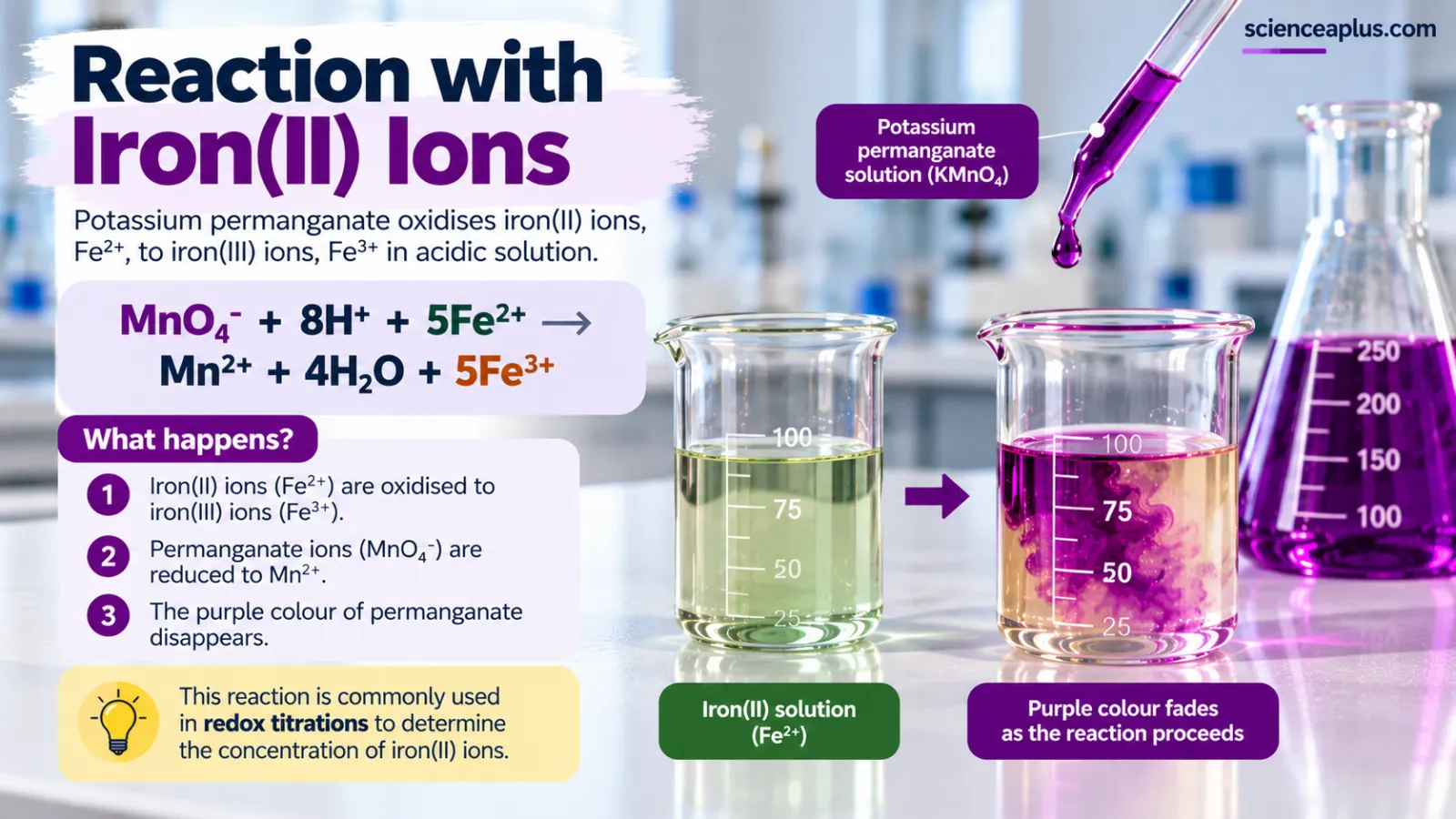
Combining the manganese half-equation with Fe²⁺ → Fe³⁺ + e⁻ (multiplied by 5) gives the full ionic equation:
MnO₄⁻ + 8H⁺ + 5Fe²⁺ → Mn²⁺ + 4H₂O + 5Fe³⁺
Atoms: 1 Mn, 4 O, 8 H and 5 Fe on each side. Charge: (−1) + (+8) + (+10) = +17 on the left, and (+2) + (+15) = +17 on the right. The key number for calculations is the 1 : 5 ratio of MnO₄⁻ to Fe²⁺.
Why is KMnO₄ a self-indicator?
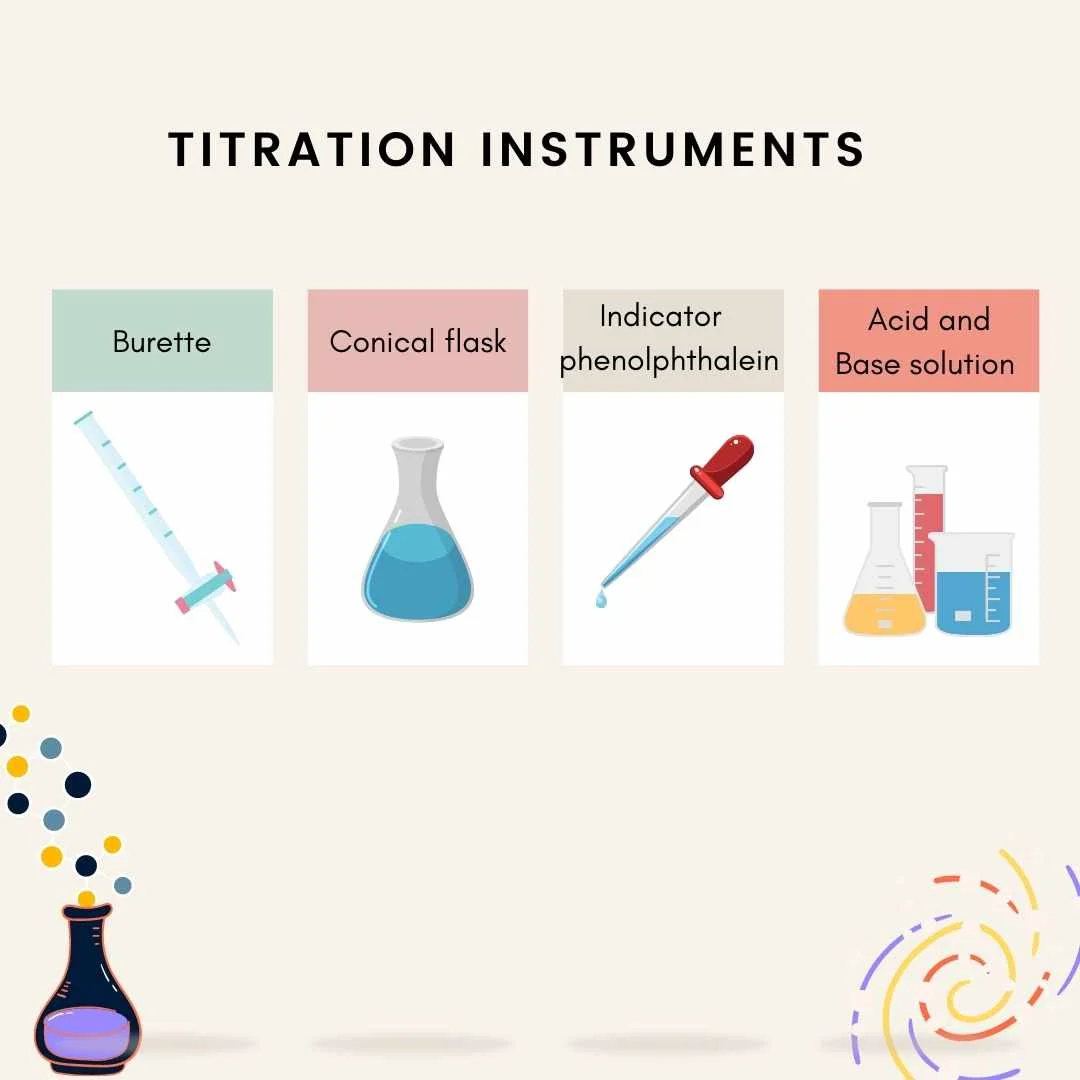
You do not need to add an indicator. Potassium permanganate goes in the burette and is added to the acidified iron(II) solution in the conical flask. Each drop is decolourised immediately while Fe²⁺ ions are left to react with it. Once all the Fe²⁺ has been used up, the next drop has nothing to react with, so the solution turns a permanent pale pink. That first lasting pink is the end point.
Why use dilute sulfuric acid, not hydrochloric acid?
- Sulfuric acid supplies the H⁺ ions needed by the half-equation and does not react with permanganate. It must be in excess, otherwise brown MnO₂ forms and the end point is spoiled.
- Hydrochloric acid is unsuitable because permanganate oxidises chloride ions to chlorine. That uses up extra KMnO₄, so your titre would be too large.
- Nitric acid is unsuitable because it is an oxidising agent itself and could oxidise some of the Fe²⁺.
- Rinse the burette with the KMnO₄ solution, then fill it.
- Pipette 25.0 cm³ of the iron(II) solution into a conical flask.
- Add an excess of dilute sulfuric acid (about 10 cm³ of 1 mol/dm³ is typical).
- Read the burette at the top of the meniscus, because the purple solution is too dark to see the bottom.
- Add KMnO₄ while swirling until the first permanent pale pink appears.
- Repeat until you have concordant titres (within 0.10 cm³).
Worked example
25.0 cm³ of an iron(II) solution needs 22.50 cm³ of 0.0200 mol/dm³ potassium permanganate. What is the concentration of Fe²⁺?
- Moles of MnO₄⁻ = 0.0200 × (22.50 ÷ 1000) = 4.50 × 10⁻⁴ mol
- Moles of Fe²⁺ = 5 × 4.50 × 10⁻⁴ = 2.25 × 10⁻³ mol
- Concentration of Fe²⁺ = 2.25 × 10⁻³ ÷ (25.0 ÷ 1000) = 0.0900 mol/dm³
A student forgets to add sulfuric acid to the flask. What would they see, and why does it matter? (2 marks)
A brown precipitate of manganese(IV) oxide (MnO₂) forms instead of a colourless solution (1). The manganese is only reduced to +4, so the 1 : 5 ratio no longer applies and the end point is hidden, giving an inaccurate result (1).
Making a potassium permanganate standard solution
To make a solution of known concentration you weigh the solid, dissolve it and make it up to the mark in a volumetric flask, exactly as described in our standard solution practical. For 250 cm³ of 0.0200 mol/dm³ KMnO₄, you need 0.0200 × 0.250 × 158.03 = 0.790 g. Try other values below.
Potassium permanganate titration with ethanedioate (oxalate) ions
The second titration you are likely to meet at A-level uses ethanedioate ions, C₂O₄²⁻, which older books and many websites call oxalate ions. Ethanedioate is a reducing agent: each ion gives up two electrons and turns into two molecules of carbon dioxide.
C₂O₄²⁻ → 2CO₂ + 2e⁻
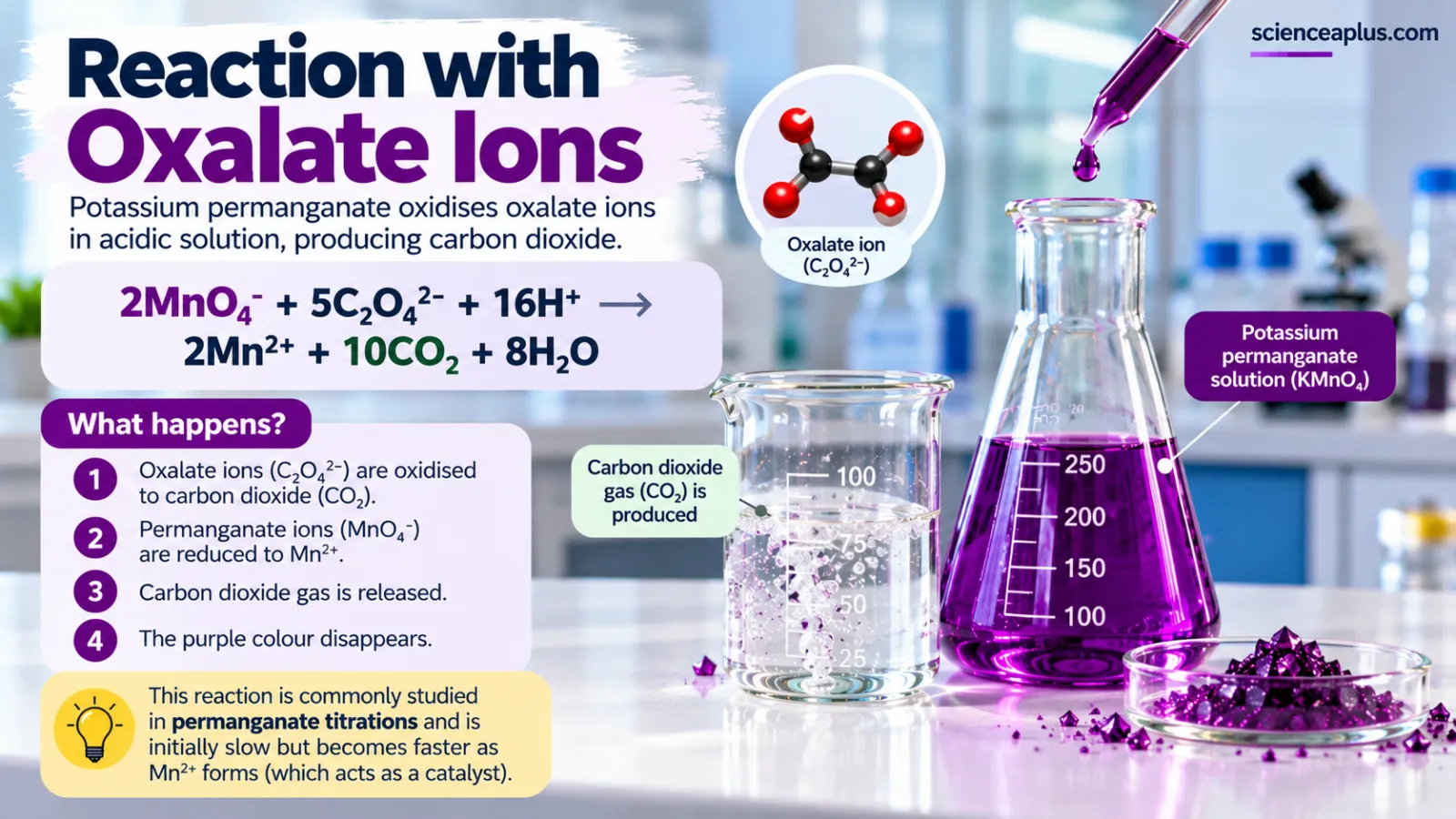
Manganese needs five electrons and ethanedioate gives two, so the lowest common number is ten. Multiply the manganese half-equation by 2 and the ethanedioate half-equation by 5, then add them and cancel the electrons:
2MnO₄⁻ + 5C₂O₄²⁻ + 16H⁺ → 2Mn²⁺ + 10CO₂ + 8H₂O
Check the atoms: 2 Mn, 10 C, 28 O and 16 H on each side. Check the charge: (2 × −1) + (5 × −2) + 16 = +4 on the left, and 2 × (+2) = +4 on the right. For calculations, the ratio to remember is 2 : 5 of MnO₄⁻ to C₂O₄²⁻.
Why does the reaction start slowly and then speed up?
This titration is usually carried out warm, at about 60 °C. Even then, the first few drops of potassium permanganate take a while to lose their colour. After that, each drop is decolourised almost instantly.
The reason is autocatalysis: one of the products catalyses the reaction. Both reactants are negative ions, so they repel each other and the reaction has a high activation energy. The Mn²⁺ ions made in the first few seconds act as a catalyst, giving the reaction a new route with a lower activation energy. The more Mn²⁺ forms, the faster the reaction goes. If you are unsure how catalysts differ from other substances that speed things up, see our guide to catalysts, promoters and accelerators.
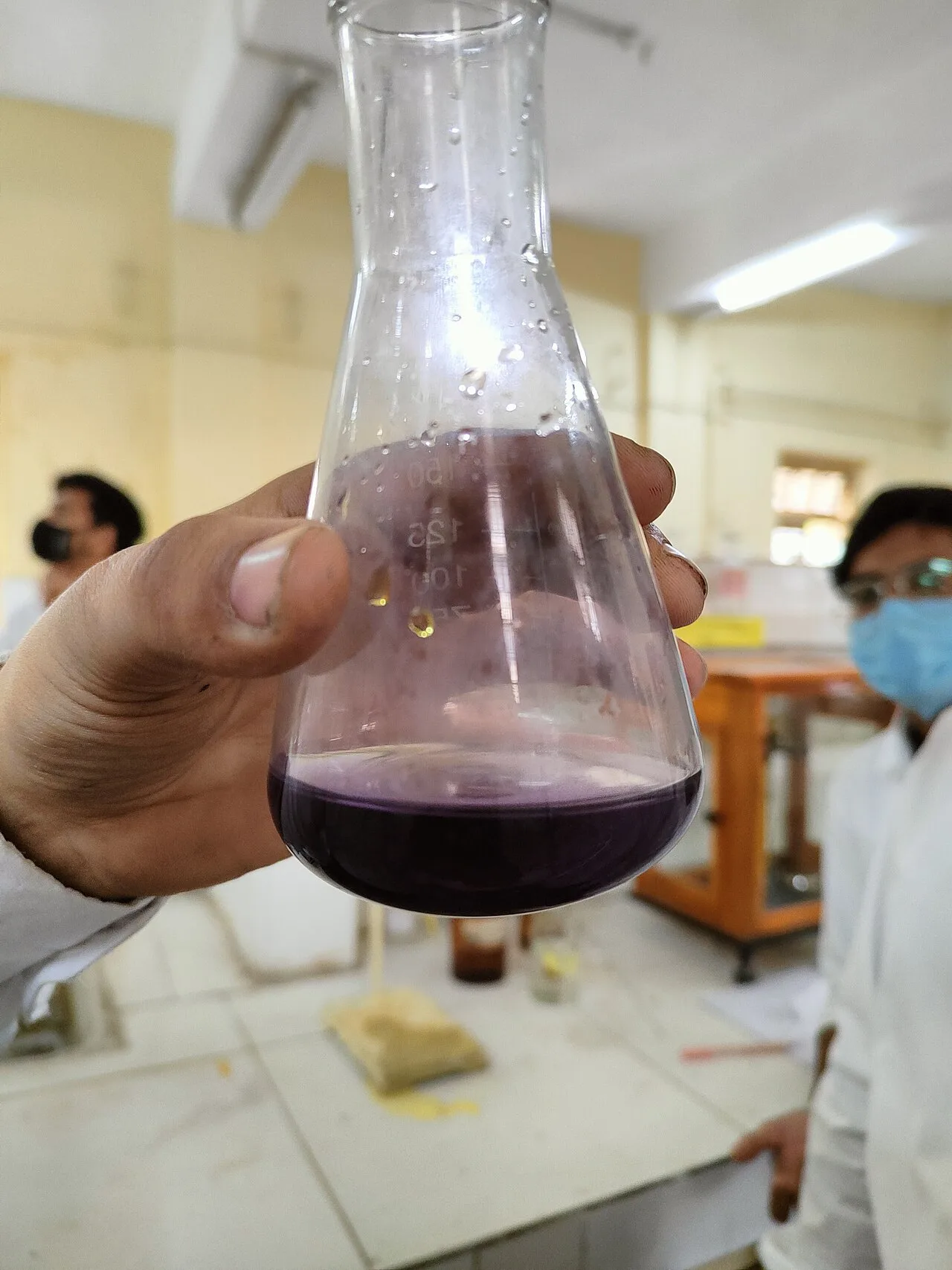
25.0 cm³ of sodium ethanedioate solution reacts with 20.00 cm³ of 0.0200 mol/dm³ KMnO₄. Find the concentration of the ethanedioate. (3 marks)
Moles of MnO₄⁻ = 0.0200 × 0.02000 = 4.00 × 10⁻⁴ mol (1). Moles of C₂O₄²⁻ = 4.00 × 10⁻⁴ × 5 ÷ 2 = 1.00 × 10⁻³ mol (1). Concentration = 1.00 × 10⁻³ ÷ 0.0250 = 0.0400 mol/dm³ (1).
Reaction of potassium permanganate with hydrogen peroxide
Most of the time hydrogen peroxide is thought of as an oxidising agent, the job it does in hair bleach. Faced with something as strong as acidified potassium permanganate, though, it is forced to act as a reducing agent. The peroxide is oxidised to oxygen gas, and the permanganate is reduced to Mn²⁺.
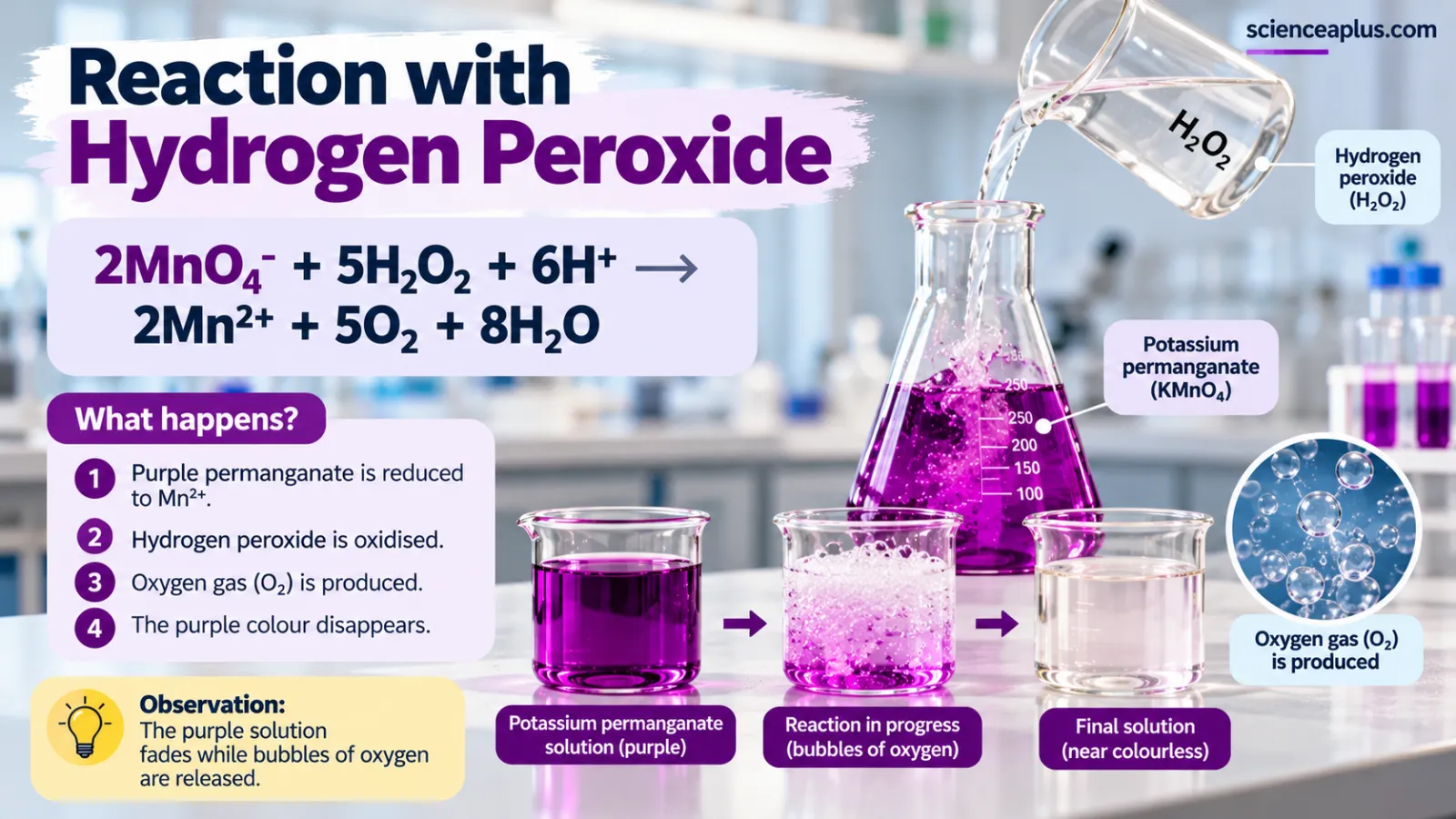
2MnO₄⁻ + 5H₂O₂ + 6H⁺ → 2Mn²⁺ + 5O₂ + 8H₂O
Atoms: 2 Mn, 18 O and 16 H on each side. Charge: (2 × −1) + 6 = +4 on the left, and 2 × (+2) = +4 on the right. What you see is the purple colour fading while bubbles of oxygen fizz out of the solution. Because the ratio is fixed, this reaction can also be used as a titration to find the concentration of a hydrogen peroxide solution.
Testing for alkenes with potassium permanganate
Potassium permanganate reacts with the carbon–carbon double bond, C=C, in alkenes. When an alkene is shaken with cold, dilute potassium permanganate, the purple colour disappears. Alkanes, which only have single bonds, leave the colour unchanged. This is called Baeyer’s test.
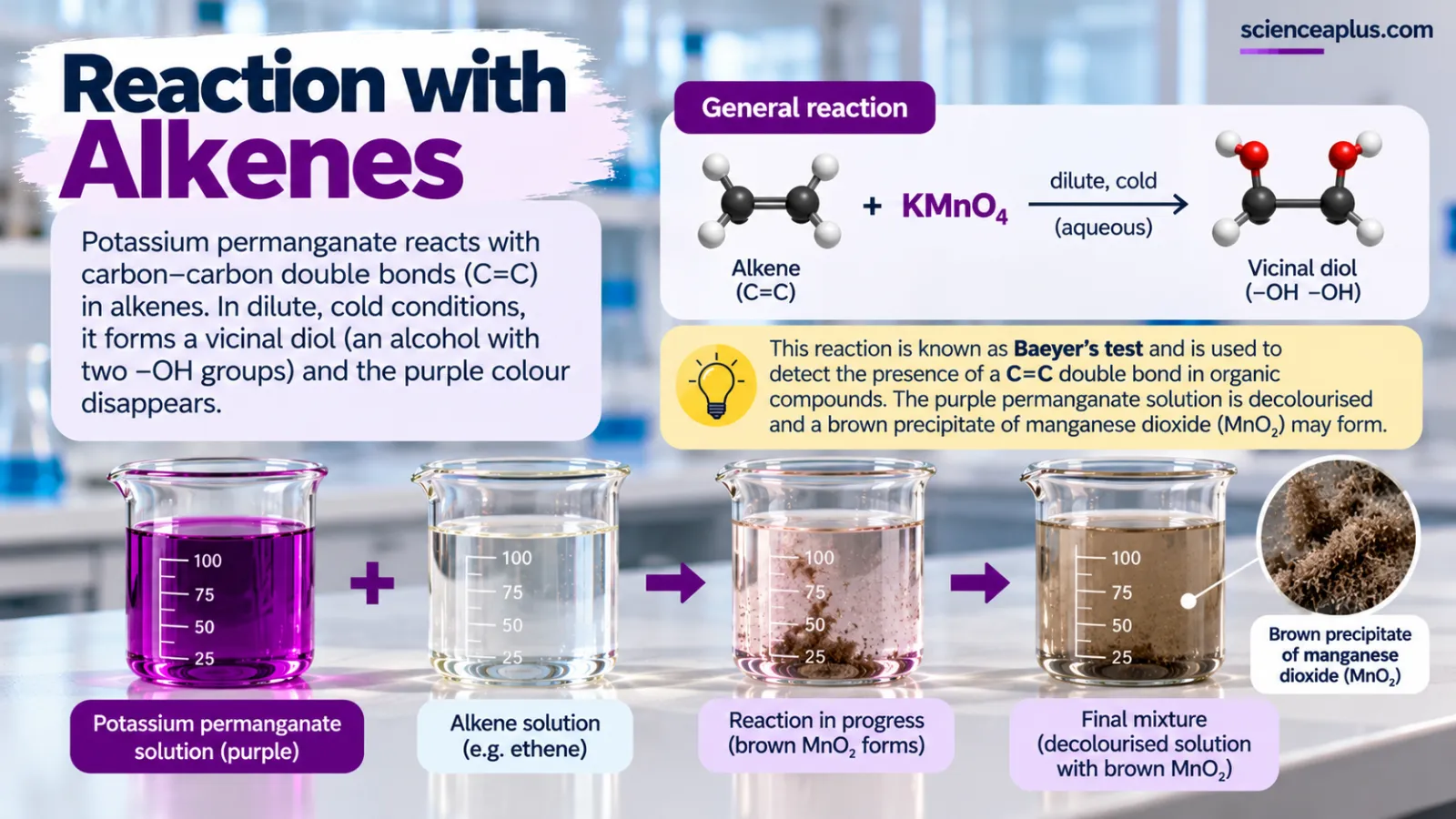
In the reaction, two −OH groups are added across the double bond, turning the alkene into a diol (a compound with two alcohol groups). Ethene, for example, becomes ethane-1,2-diol. Chemists often show the oxygen from the oxidising agent as [O]:
CH₂=CH₂ + [O] + H₂O → HOCH₂CH₂OH
In neutral solution the manganese ends up as manganese(IV) oxide, so you often see a brown precipitate as the purple fades. If the permanganate is acidified, the manganese ends up as colourless Mn²⁺, so there is no brown precipitate (and warm acidified permanganate can break the C=C bond completely).
Acidified potassium permanganate oxidises other organic compounds too. When heated, it oxidises primary alcohols to carboxylic acids and secondary alcohols to ketones. In each case the purple colour fading is the sign that a reaction has happened.
What happens when you heat potassium permanganate?
As you saw in the properties table, potassium permanganate does not melt. When the crystals are heated to about 240 °C, they decompose and release oxygen gas:
2KMnO₄ → K₂MnO₄ + MnO₂ + O₂
Check it: 2 K, 2 Mn and 8 O on each side. The products are potassium manganate(VI), manganese(IV) oxide and oxygen. This was once a common way to make a small amount of oxygen in the school laboratory, and it still appears in lists of methods for the preparation of gases. A glowing splint held at the mouth of the tube relights, which is the test for oxygen.
Notice that this is also a redox reaction. Some manganese is reduced (from +7 to +6 and to +4), while some oxygen is oxidised from −2 to 0 in the oxygen gas.
Fire risk: when an oxidiser meets a fuel
Every fire needs fuel, heat and oxygen. A strong oxidising agent like potassium permanganate can supply the “oxygen” side of that triangle itself, which is why it is classed as an oxidiser that may intensify a fire. Kept on its own, it does not burn. Mixed with a fuel, it can be dangerous.
The best-known example is a teacher demonstration in which solid potassium permanganate is mixed with glycerol (propane-1,2,3-triol). After a short delay, the mixture bursts into flame. This is a demonstration for trained staff with safety screens only. It shows why potassium permanganate must be stored away from combustible materials and organic liquids.
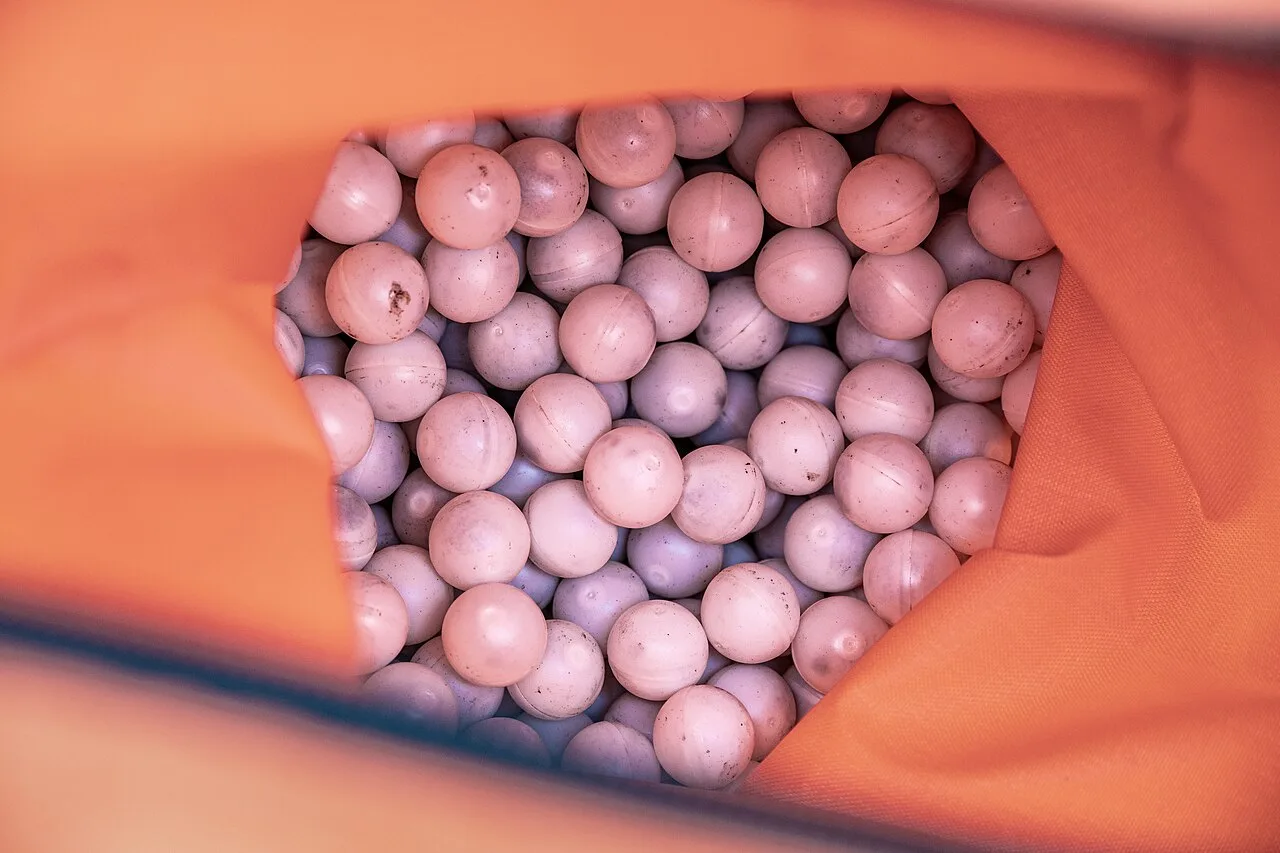
Wildfire crews in the United States put the same chemistry to work. For prescribed burns, they use small plastic spheres containing potassium permanganate. A machine in a helicopter injects each sphere with glycol and drops it, and the sphere catches fire about 20–30 seconds later, once it is safely on the ground. This lets crews light controlled fires across large areas without walking into rough terrain.
What is potassium permanganate used for?
The same strong oxidising power that makes potassium permanganate useful in titrations also makes it useful outside the laboratory. Its main jobs are in water treatment, in medicine as a dilute skin soak, and in chemical analysis.
Water treatment
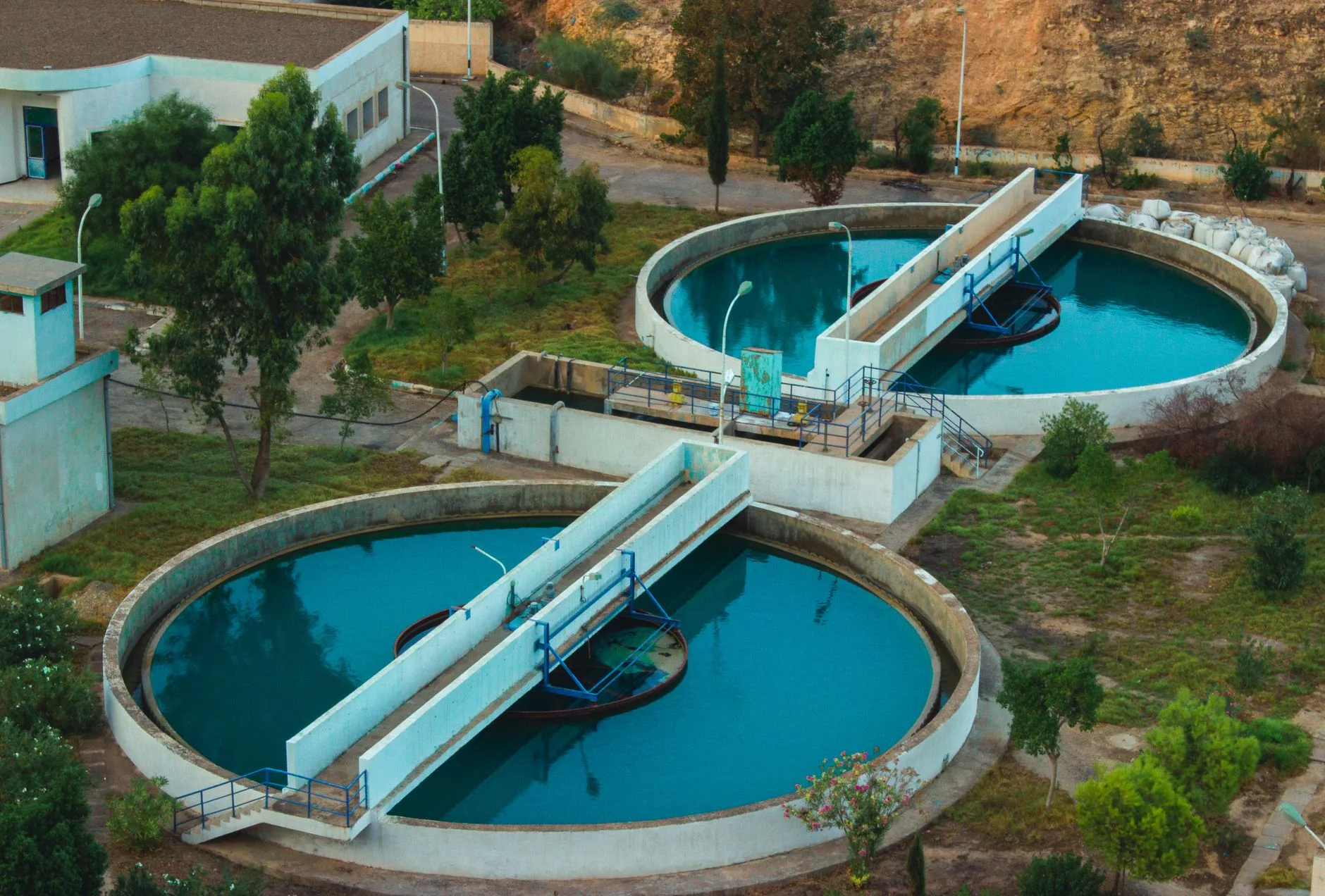
Some groundwater contains dissolved iron and manganese ions. They are harmless in small amounts, but they give water a metallic taste and leave brown or black stains on sinks and washing. Potassium permanganate oxidises them: Fe²⁺ becomes Fe³⁺ and Mn²⁺ becomes MnO₂. The iron ends up as insoluble iron(III) hydroxide and the manganese as insoluble MnO₂, so both can be filtered out. Water treatment works also use it to control tastes and smells, remove colour and limit the growth of organisms in pipes and tanks.
It is usually an early “pre-oxidation” step rather than the main disinfectant. In UK public water supplies, that job is done by chlorine.
Skin soaks prescribed by doctors
In the NHS, potassium permanganate is prescribed as tablets that are dissolved in water to make a very dilute, pale pink solution (1 in 10,000). It is used as a soak for weeping or blistering skin, such as weeping or infected eczema and leg ulcers. It works as a mild antiseptic and as an astringent, helping to dry out weepy skin.
Only use it if a doctor, nurse or pharmacist has prescribed it, and follow their instructions exactly. This article does not give dosing advice.
In the laboratory
- Redox titrations to find the amount of iron(II), ethanedioate or hydrogen peroxide in a sample.
- Testing for C=C double bonds in organic compounds.
- Oxidising organic compounds, such as alcohols.
- Demonstrations, such as the chemical chameleon colour change.
Hazards and safe handling of potassium permanganate
Potassium permanganate is a useful chemical, but it carries the signal word Danger. Suppliers classify it using the GHS hazard system. The statements below are the ones most commonly notified to the European Chemicals Agency; individual suppliers’ labels can differ slightly.
| Hazard statement | What it means |
|---|---|
| H272 | May intensify fire; oxidiser |
| H302 | Harmful if swallowed |
| H314 | Causes severe skin burns and eye damage (on many suppliers’ labels) |
| H410 | Very toxic to aquatic life with long-lasting effects |
| H361d | Suspected of damaging the unborn child (some notifications) |
Because it is an oxidiser, it can make a fire burn far more fiercely by supplying the oxygen side of the combustion triangle. Good practice in a school or workplace, where it falls under the COSHH regulations, includes:
- Wear eye protection and gloves when handling the solid or concentrated solutions.
- Store it in a closed container, away from combustible materials, reducing agents, acids and glycerol.
- Wipe up spills promptly; brown stains are manganese(IV) oxide.
- Never pour quantities down the drain, because it is very toxic to aquatic life.
Potassium permanganate flash cards
Frequently asked questions about potassium permanganate
What is potassium permanganate?
Potassium permanganate, KMnO₄, is a dark purple crystalline salt made of potassium ions and permanganate ions. It is a strong oxidising agent that dissolves in water to give an intensely purple solution. It is used in redox titrations, water treatment and dilute skin soaks prescribed by doctors.
What is potassium permanganate used for?
Potassium permanganate is used to remove dissolved iron and manganese and control tastes and smells in water treatment. Doctors prescribe very dilute solutions as soaks for weeping or blistering skin. In laboratories it is used in redox titrations, as a test for carbon–carbon double bonds and to oxidise organic compounds.
Why is potassium permanganate purple?
The permanganate ion absorbs green-yellow light, so the light that reaches your eye looks purple. The colour comes from charge transfer, where an electron moves briefly from oxygen towards manganese. It is not caused by d–d transitions, because manganese in the +7 state has no d electrons left.
What is the oxidation state of Mn in KMnO₄?
Manganese is in the +7 oxidation state in KMnO₄. Potassium is +1 and each of the four oxygens is −2, and the total must be zero, so manganese must be +7. This is its highest possible oxidation state, which is why the compound is such a strong oxidising agent.
What is the molar mass of KMnO₄?
The molar mass of potassium permanganate is 158.03 g/mol. Adding rounded relative atomic masses gives 39.10 for potassium, 54.94 for manganese and 4 × 16.00 for oxygen, which totals about 158.0. In exams, use the values on your data sheet.
Why is KMnO₄ called a self-indicator?
Potassium permanganate is intensely purple, but its reduced form, Mn²⁺, is almost colourless. During a titration each drop loses its colour while there is still reducing agent to react with. The first drop that is not used up turns the solution a permanent pale pink, which marks the end point without an added indicator.
Why is sulfuric acid used in permanganate titrations?
Dilute sulfuric acid supplies the hydrogen ions that the reduction needs and does not react with permanganate. Hydrochloric acid is avoided because permanganate oxidises chloride ions to chlorine, and nitric acid is avoided because it is an oxidising agent itself. Too little acid lets brown manganese(IV) oxide form.
Is potassium permanganate dangerous?
Yes, it needs careful handling. It is an oxidiser that can intensify a fire, it is harmful if swallowed, it can burn skin and eyes, and it is very toxic to aquatic life. It can be fatal if swallowed, so anyone who swallows it should go to A&E or call 999.
What happens when potassium permanganate reacts with an alkene?
Cold, dilute potassium permanganate adds two −OH groups across the C=C double bond, turning the alkene into a diol. The purple colour disappears, and in neutral solution a brown precipitate of manganese(IV) oxide forms. This colour change, called Baeyer’s test, shows that a compound contains a C=C bond.