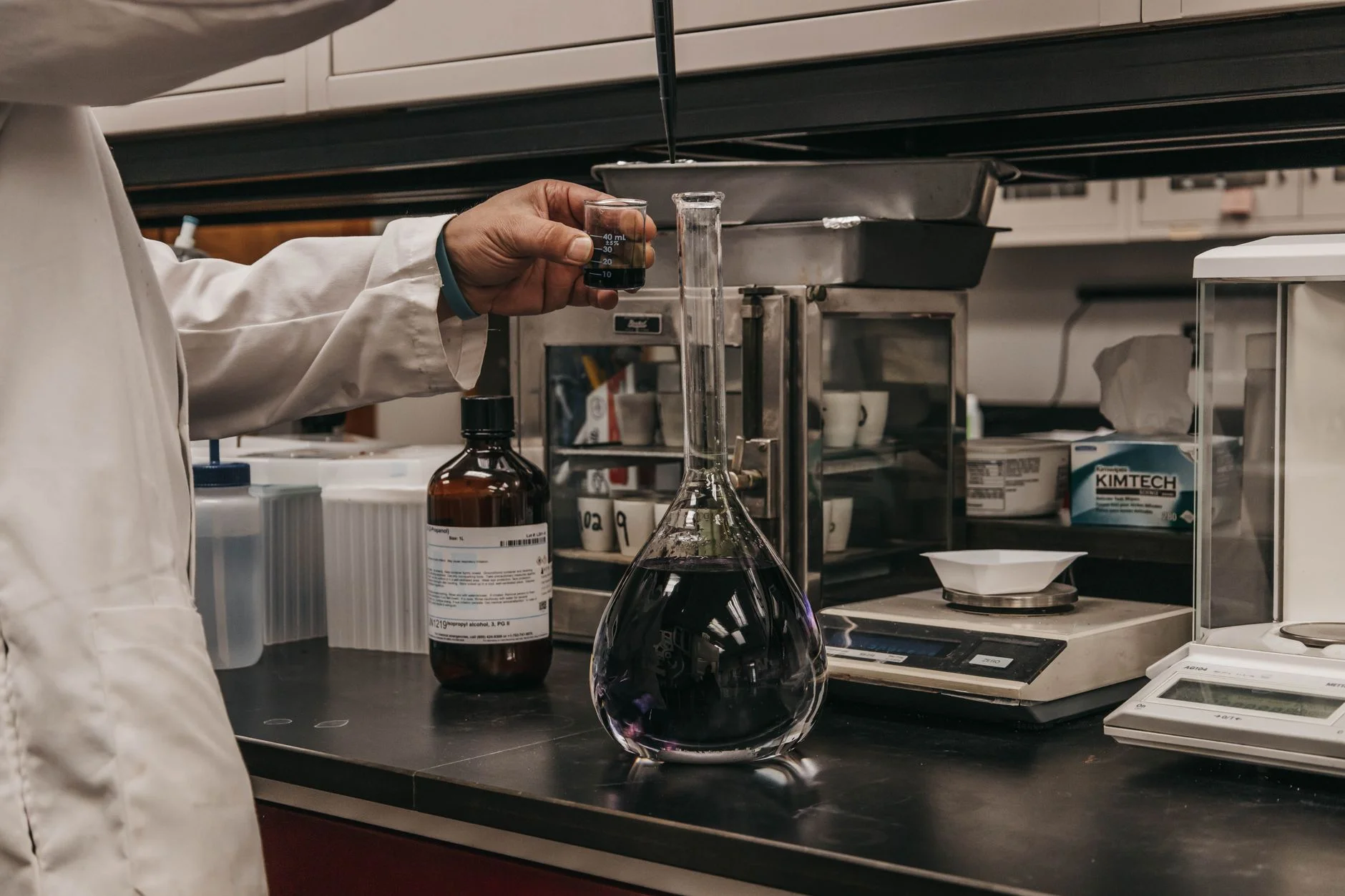
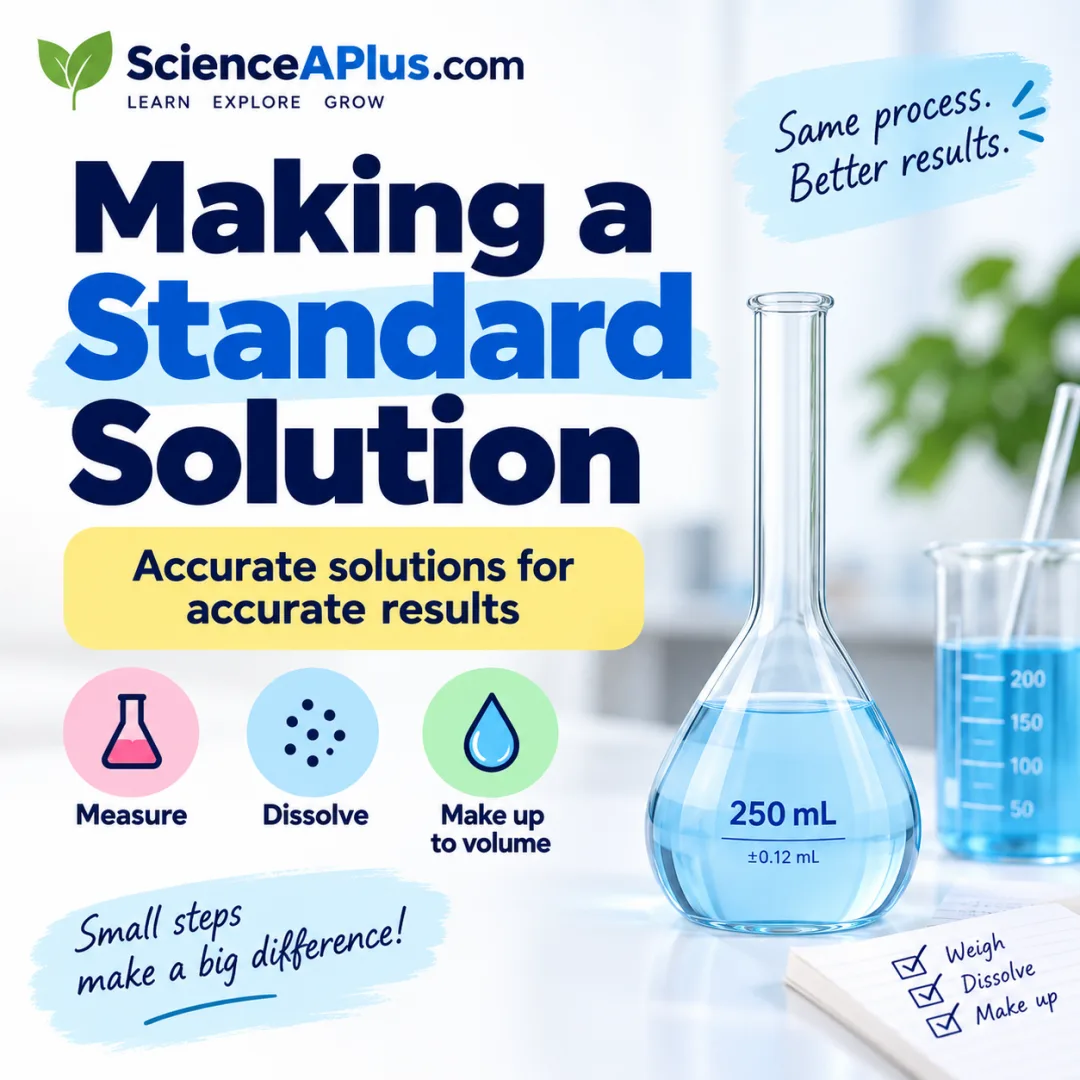
A standard solution is a solution whose concentration is accurately known. Chemists make one by dissolving a carefully weighed mass of a pure solid in water and making it up to an exact volume in a volumetric flask. Once you know exactly how much solute is in exactly how much solution, you can use it to measure other substances with confidence.
This guide explains what a standard solution is, why it matters, and the maths behind it. Learning how to prepare a standard solution starts with understanding concentration, so we begin there before moving on to the equipment, the method and the calculations.
What is a standard solution?
Most solutions you meet in everyday life have a concentration that is only roughly known. A standard solution is different: its concentration is known accurately, usually to three significant figures, and is written on the label in mol/dm³. That accuracy comes from two careful measurements, the mass of solute and the final volume of the solution.
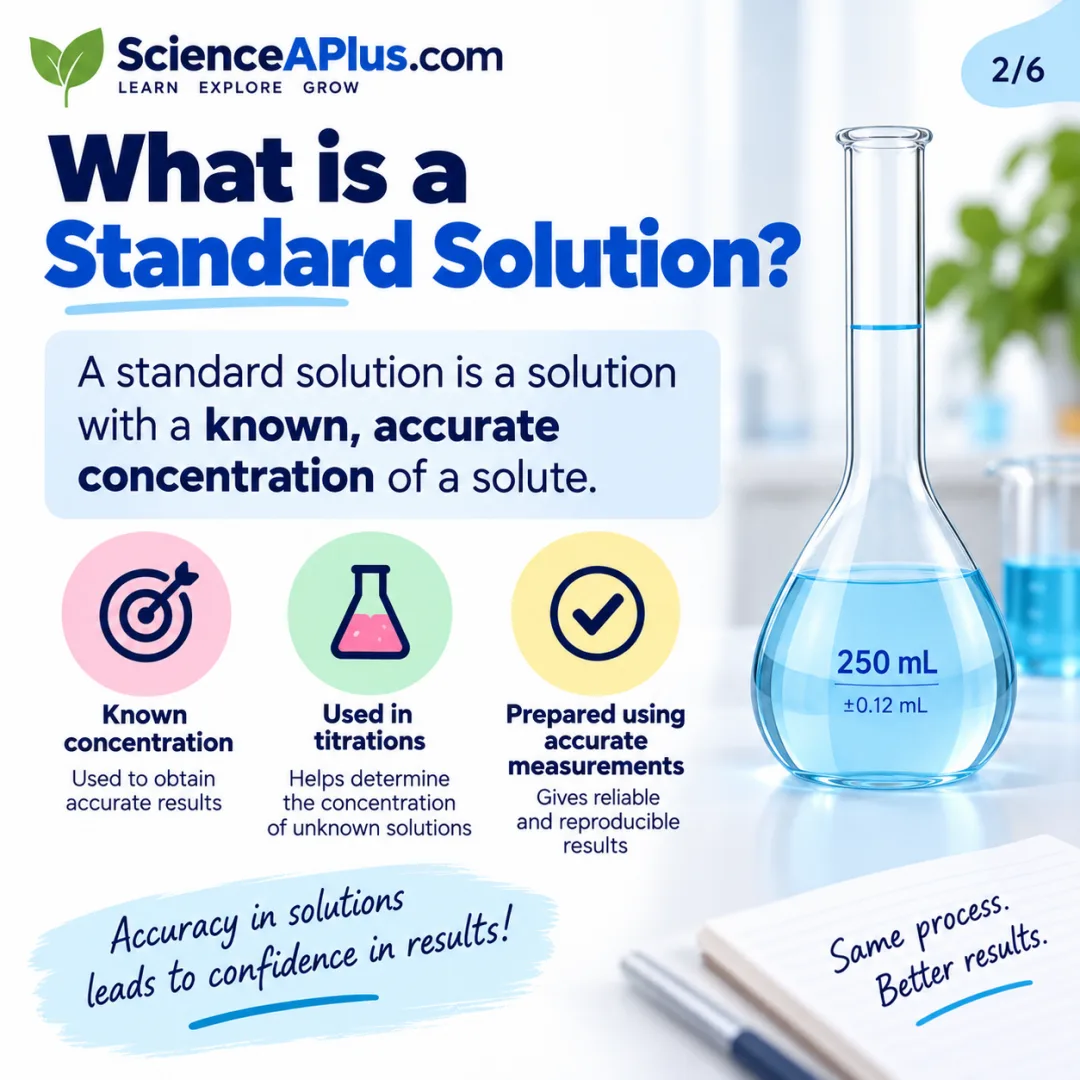
Because the concentration is trustworthy, a standard solution works like a ruler for chemistry. You compare an unknown against it, and the known value lets you work out the unknown one.
Where standard solutions are used
The best-known use is in titrations, where a standard solution is used to find the unknown concentration of another solution. If you are new to the technique, our guide to acid–base titration shows how the two solutions react and how the end point is found. Standard solutions are also used in:
- Calibration, for example in colorimetry, where solutions of known concentration are used to compare with a sample.
- Quality control, checking that a product contains the amount it should.
- Water testing, measuring dissolved substances in drinking water and rivers.
- Pharmaceutical and food laboratories, where the amount of an ingredient must be known precisely.
The topic also links closely to the chemistry of acids and bases, since many standard solutions are used to measure the strength of an acid or an alkali.
Primary standards: what makes a good one
Not every chemical can be used to make a standard solution straight from the bottle. A substance that can is called a primary standard. A good primary standard is:
- Pure, so the mass you weigh really is the mass of the substance you want.
- Stable, so it does not break down while it sits on the shelf.
- Not hygroscopic, meaning it does not absorb water from the air. Otherwise part of the mass you weigh would be water.
- Unreactive with air, so it does not take in carbon dioxide or oxygen.
- High in relative formula mass (Mr), because a larger mass is needed for the same number of moles, which reduces the effect of weighing errors.
- Soluble, so it dissolves fully in water.
Anhydrous sodium carbonate is a common primary standard for acids, and potassium hydrogen phthalate is used for alkalis. In practice, even sodium carbonate picks up a little moisture, so it is dried in an oven first and cooled in a desiccator before weighing.
Concentration explained: mol/dm³ and g/dm³
Concentration tells you how much solute is dissolved in a given volume of solution. In chemistry you will meet two units. The first is concentration in mol/dm³, which counts the amount of solute in moles. The second is mass concentration in g/dm³, which uses the mass of solute in grams.
The key relationship links concentration (c), amount in moles (n) and volume (V):
c = n ÷ V
The amount in moles comes from the mass (m) and the relative formula mass (Mr):
n = m ÷ Mr
Combine the two and rearrange, and you get the equation that tells you how much solid to weigh out when making a standard solution:
m = c × V × Mr
To convert between the two units of concentration, use:
mass concentration (g/dm³) = c (mol/dm³) × Mr
For example, a 0.100 mol/dm³ solution of sodium chloride (Mr = 58.5) has a mass concentration of 0.100 × 58.5 = 5.85 g/dm³.
You need Mr for these calculations. If you need a refresher, see our guide to calculating the molar mass of compounds, and if you are unsure how to build a formula from the name of a compound, read how to write a chemical formula.
Converting cm³ to dm³
Volumes in the lab are measured in cm³, but the concentration equation needs dm³. One dm³ is the same as one litre, 1000 cm³ or 1000 mL. To convert, divide the volume in cm³ by 1000.
| Volume in cm³ | Calculation | Volume in dm³ |
|---|---|---|
| 25.0 cm³ | 25.0 ÷ 1000 | 0.0250 dm³ |
| 100 cm³ | 100 ÷ 1000 | 0.100 dm³ |
| 250 cm³ | 250 ÷ 1000 | 0.250 dm³ |
| 500 cm³ | 500 ÷ 1000 | 0.500 dm³ |
| 1000 cm³ | 1000 ÷ 1000 | 1.00 dm³ |
With these relationships in place, you are ready to look at the apparatus and the step-by-step method for making a standard solution.
Equipment you need to make a standard solution
Making a standard solution needs only a handful of items, but each one has a job, and choosing the wrong one quietly ruins the accuracy.

| Equipment | What it is for | Tip |
|---|---|---|
| Digital or analytical balance | Measuring the mass of solid accurately | Use one reading to 0.01 g or 0.001 g (2 or 3 decimal places), not a rough kitchen-style balance. |
| Weighing boat or weighing bottle | Holding the solid on the balance | Use it for weighing by difference so no solid is lost. |
| Spatula | Transferring solid | Keep it clean and dry. |
| Beaker (about 100–150 cm³) | Dissolving the solid first | Choose one big enough to stir without splashing. |
| Glass stirring rod | Helping the solid dissolve | Rinse it into the flask afterwards. |
| Wash bottle of distilled (deionised) water | Dissolving, rinsing and making up to the mark | Never use tap water: its ions contaminate the solution. |
| Filter funnel | Pouring the solution into the narrow flask neck | Rinse it too, and remove it before the final top-up. |
| 250 cm³ volumetric flask with stopper | Making the final volume exactly right | A class A flask has a tolerance of about ±0.15 cm³; the label often reads ±0.12 mL for ASTM class A. |
| Dropping pipette | Adding the last few drops to the line | Add drop by drop near the mark. |
| Label | Recording what is in the flask | Write the name, concentration, date and your name. |
The volumetric flask is the star of the show. Unlike a beaker or a measuring cylinder, it is made to hold one precise volume when filled to its single graduation line. A flask that is wet with distilled water is fine to use, because you are going to add water anyway.
How to make a standard solution: step-by-step method
Here is the full method for making a standard solution by weighing by difference. Tick each step as you go, and your progress is remembered in your browser.
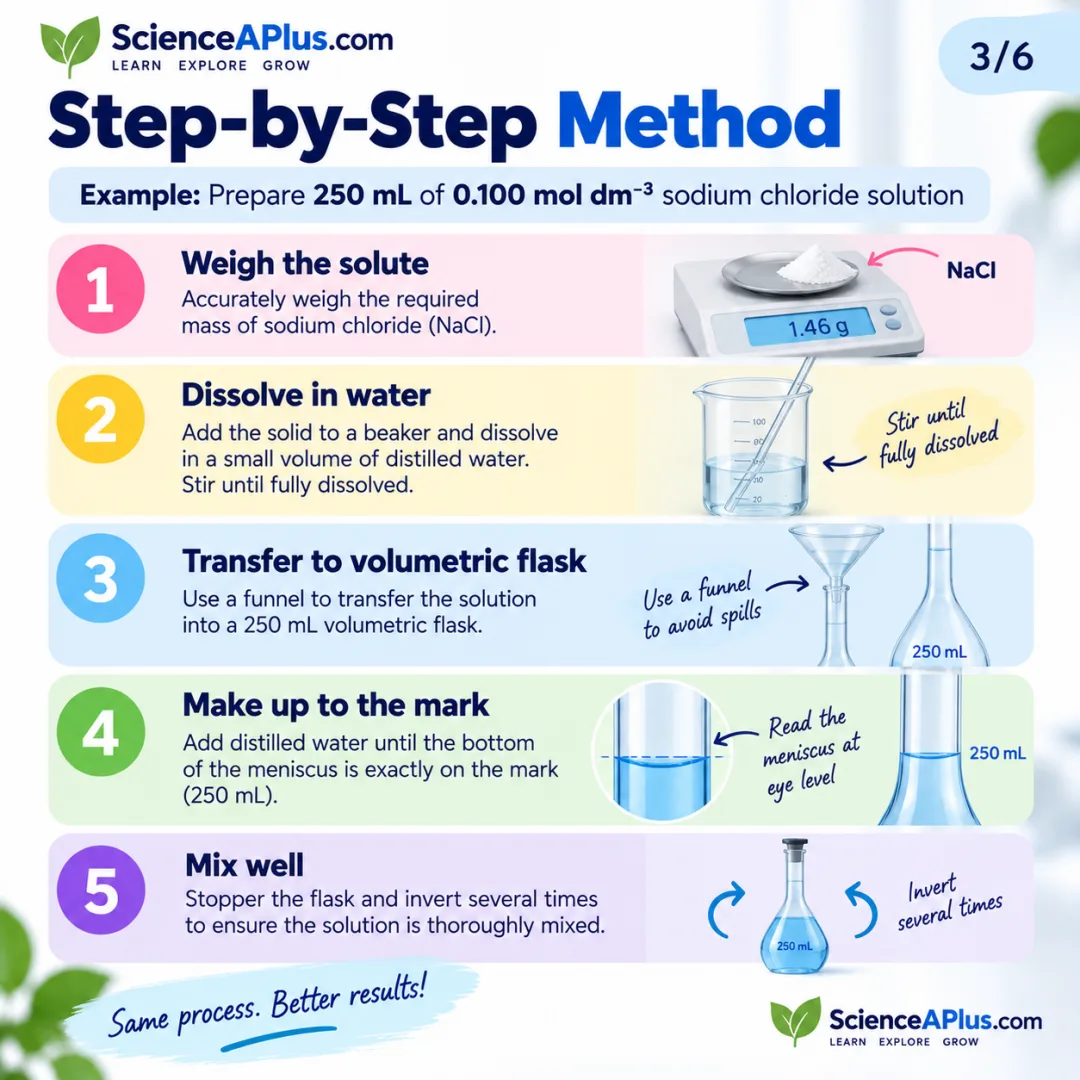
- Put on eye protection and check you have all the equipment ready, including a clean volumetric flask.
- Weigh the weighing bottle containing the solid on the balance and record the mass.
- Tip the solid into a clean beaker, taking care not to lose any.
- Reweigh the (now nearly empty) weighing bottle and record the mass. The mass used is the difference between the two readings.
- Add about 100 cm³ of distilled water to the beaker and stir with the glass rod until all the solid has dissolved.
- If the solution has warmed up or cooled down, wait until it is back at room temperature.
- Pour the solution through a funnel into the volumetric flask.
- Rinse the beaker, stirring rod and funnel with distilled water several times, adding all the washings to the flask.
- Add distilled water until it is close to the line, then add it drop by drop until the bottom of the meniscus sits on the graduation line, viewed at eye level.
- Stopper the flask, invert it about 10 times to mix, then label it with the name, concentration, date and your name.
Why each step matters
Examiners love to ask why you do something, so it helps to know the reason behind every step.
Weighing by difference. Some solid always sticks to the weighing bottle or boat. By weighing the bottle before and after tipping, you measure only what actually went into the beaker. Any solid left behind does not matter.
Dissolving in a beaker first. Some solids dissolve slowly, and it is far easier to stir in a wide beaker than in a narrow flask neck. Dissolving can also change the temperature: sodium hydroxide warms the water, while some other solids cool it. The flask is calibrated at 20 °C, so let the solution return to room temperature before you make it up to the mark.
Rinsing the beaker, rod and funnel. A thin film of solution clings to the glass. If you do not rinse it into the flask, some of the solute stays behind and the concentration comes out too low. Adding all the washings makes sure every bit of solute is transferred.
Using distilled water. Tap water contains dissolved ions that would contaminate your solution and change its true concentration.
Reading the meniscus at eye level. Looking from above or below gives a parallax error, so the volume you think you have is not the volume in the flask.
Inverting the flask. A solution that has been made up but not mixed has an uneven concentration, with stronger solution at the bottom and weaker at the top. Inverting about 10 times fixes that.
Making up to the mark: reading the meniscus
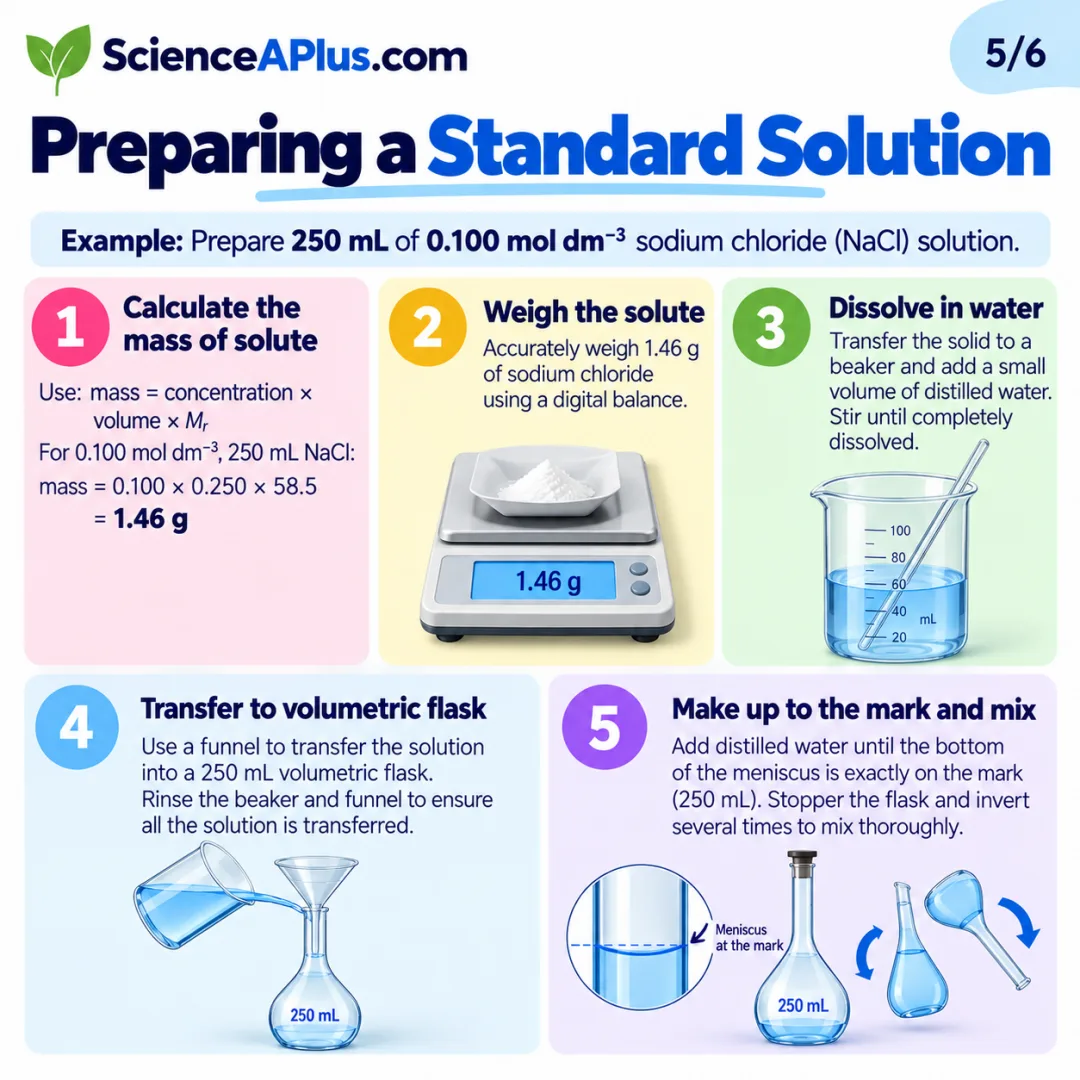
The last few cm³ are where most accuracy is won or lost. The surface of water in a narrow neck curves downwards in the middle. That curve is called the meniscus, and the bottom of it must sit exactly on the graduation line.
Add water until it is close to the line, then switch to the dropping pipette and add it drop by drop. Bend down so your eyes are level with the mark, and stop when the bottom of the curve touches the line.
Once the meniscus is in the right place, put in the stopper and mix by inverting. Your standard solution is ready, and its concentration can now be worked out from the mass you weighed and the volume of the flask.
Standard solution calculations
Before you touch the balance, you need to know how much solid to weigh out. Every standard solution calculation uses the same three links in a chain: volume and concentration give moles, and moles give mass.
n = c × V
m = n × Mr
Put together, that gives the shortcut m = c × V × Mr, where c is in mol/dm³, V is in dm³ and m is in grams. Remember to convert the volume first: V (dm³) = V (cm³) ÷ 1000.
Worked example 1: sodium chloride
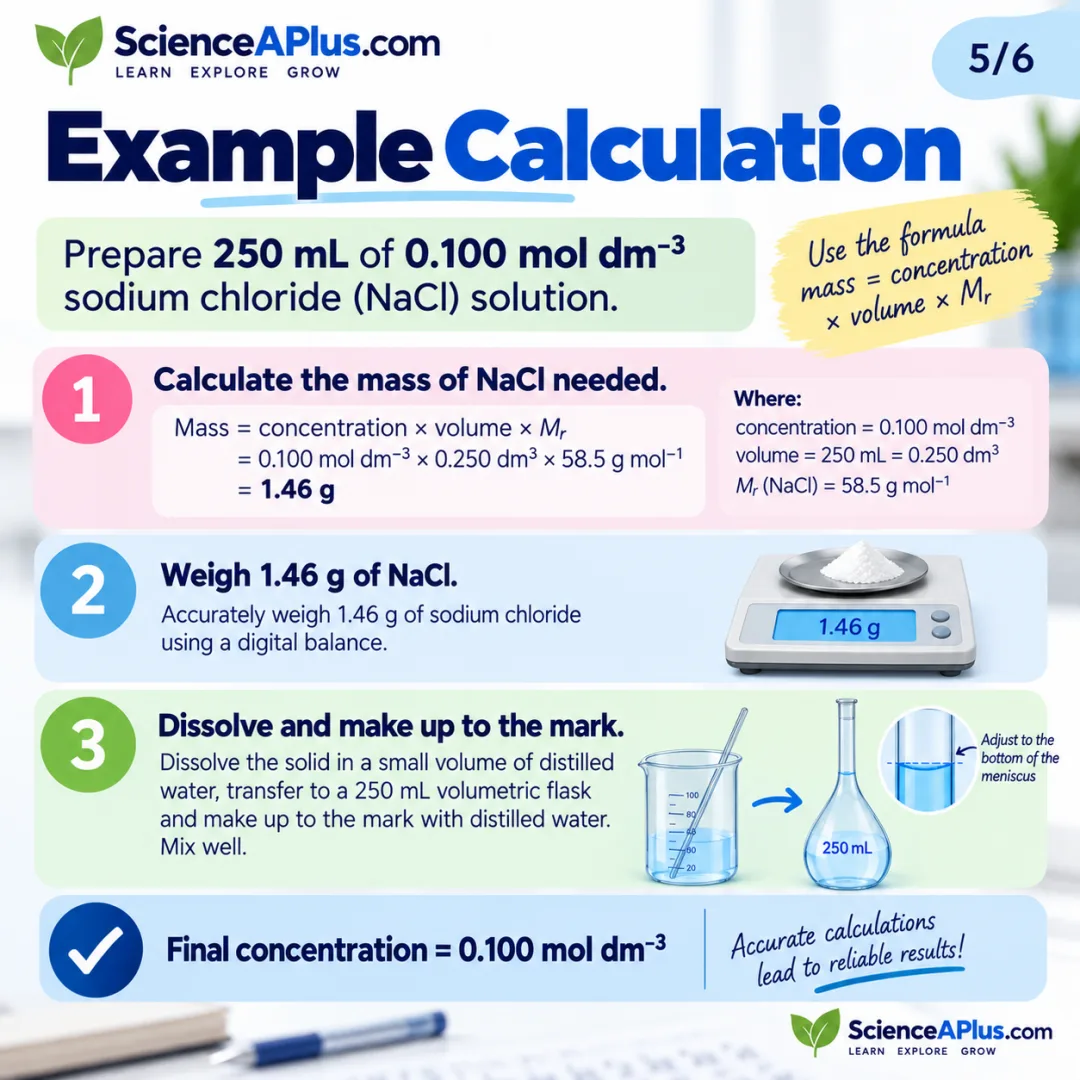
Question: what mass of sodium chloride, NaCl, is needed to make 250 cm³ of a 0.100 mol/dm³ standard solution?
Step 1: convert the volume to dm³.
V = 250 ÷ 1000 = 0.250 dm³
Step 2: calculate the moles needed.
n = c × V = 0.100 × 0.250 = 0.0250 mol
Step 3: find the relative formula mass.
Mr (NaCl) = 23.0 + 35.5 = 58.5
Step 4: convert moles to mass.
m = n × Mr = 0.0250 × 58.5 = 1.4625 g ≈ 1.46 g
So you would weigh out about 1.46 g of NaCl, dissolve it, and make it up to 250 cm³ in a volumetric flask. Your balance will not read exactly 1.4625 g, and that is fine. Whatever mass you actually weigh (say 1.47 g), you record it and recalculate the true concentration afterwards (see the reverse calculation below).
Worked example 2: sodium carbonate
Sodium carbonate is a better choice when you are going to standardise an acid, because anhydrous Na₂CO₃ is a primary standard. Question: what mass of anhydrous sodium carbonate, Na₂CO₃ (Mr = 106.0), is needed for 250 cm³ of a 0.0500 mol/dm³ solution?
V = 250 ÷ 1000 = 0.250 dm³
n = 0.0500 × 0.250 = 0.0125 mol
m = 0.0125 × 106.0 = 1.325 g ≈ 1.33 g
Notice how the mass is smaller than in example 1 even though the formula mass is larger, because the concentration is lower. If you are unsure how to get Mr for a compound, look back at the concentration section above, which links to a full guide on molar mass.
Use the calculator to check your own numbers.
From mass to concentration
Often you work backwards. After weighing, you know the exact mass you used and want the real concentration of your standard solution. Question: 2.65 g of anhydrous sodium carbonate is dissolved and made up to 250 cm³. What is the concentration in mol/dm³?
n = m ÷ Mr = 2.65 ÷ 106.0 = 0.0250 mol
c = n ÷ V = 0.0250 ÷ 0.250 = 0.100 mol/dm³
You can also give the answer as a mass concentration: 0.100 × 106.0 = 10.6 g/dm³. The two forms describe the same solution, so check which unit the question asks for.
Diluting a standard solution
Sometimes you need a weaker solution than the one you made. Rather than weighing a tiny, error-prone mass of solid, you dilute a stronger standard solution. Adding water does not change the number of moles of solute, so:
c₁V₁ = c₂V₂
Here c₁ and V₁ are the concentration and volume of the original solution, and c₂ and V₂ are those of the diluted solution. The volumes can stay in cm³ as long as both use the same unit.
Example A: 25.0 cm³ of 0.100 mol/dm³ solution is made up to 250 cm³ with distilled water. What is the new concentration?
c₂ = (c₁ × V₁) ÷ V₂ = (0.100 × 25.0) ÷ 250 = 0.0100 mol/dm³
The solution is ten times more dilute, because the volume increased tenfold.
Example B: what volume of 0.100 mol/dm³ solution is needed to make 250 cm³ of 0.0200 mol/dm³?
V₁ = (c₂ × V₂) ÷ c₁ = (0.0200 × 250) ÷ 0.100 = 50.0 cm³
In practice, measure V₁ with a pipette, transfer it to a volumetric flask, then add distilled water to the mark exactly as before. A pipette and a flask are used because both are calibrated for accuracy; a measuring cylinder is not good enough here.
Accuracy, errors and percentage uncertainty
A standard solution is only useful if its concentration really is what you say it is. Most mistakes change the concentration in a predictable direction, which is handy when an exam asks you to explain the effect.
| Error | Effect on concentration | How to avoid it |
|---|---|---|
| Solid left in the beaker or washings not transferred | Too low (less solute in the flask) | Rinse the beaker, rod and funnel several times into the flask |
| Water added past the graduation line | Too low (too much solvent) | Add the last few cm³ drop by drop; if you overshoot, start again |
| Reading the meniscus from above or below | Volume slightly wrong (parallax error) | Read at eye level, bottom of the meniscus on the line |
| Solution not mixed | Uneven concentration through the flask | Stopper and invert about 10 times |
| Hygroscopic solid has absorbed water | Too low (fewer moles than calculated) | Use a primary standard and keep the bottle closed |
| Tap water used | Contaminated with dissolved ions | Use distilled or deionised water |
A flask that is wet with distilled water is not an error, because you are going to add water anyway.
Percentage uncertainty
Every measuring instrument has an uncertainty, and you can compare their effects using percentage uncertainty:
percentage uncertainty = (uncertainty ÷ measured value) × 100
A balance that reads to 0.01 g has an uncertainty of ±0.005 g on each reading. Weighing by difference uses two readings, so the uncertainty in the mass is ±0.01 g. For the 1.46 g of sodium chloride in example 1:
0.01 ÷ 1.46 × 100 ≈ 0.68 %
A 250 cm³ class A volumetric flask has a tolerance of about ±0.15 cm³:
0.15 ÷ 250 × 100 = 0.06 %
Adding the two gives a total of about 0.74 %. The balance contributes far more than the flask, so the weighing is the weak point. Using a larger mass reduces the percentage uncertainty: for example, 5.85 g (the NaCl needed for 500 cm³ of 0.200 mol/dm³) gives 0.01 ÷ 5.85 × 100 ≈ 0.17 %.
The payoff comes in the next stage of the practical. The accurately known concentration is what lets you work out an unknown concentration from a titration, and the same care applies there, from choosing the right indicator (see chemical indicators in the laboratory) to reading the burette at eye level. A careful standard solution means a titration result you can trust.
Safety in the lab
Wear eye protection throughout, and wipe up any spills straight away. Check the hazard label on your solid before you open it. Sodium hydroxide is corrosive, so avoid skin contact. Sodium carbonate is an irritant, so keep it away from your eyes and wash your hands afterwards.
The same care applies to the acids, alkalis and salts you will meet in the titrations that follow. If you want to see why these chemicals matter outside the lab, read about the uses of acids, bases and salts.
Exam-style questions
Try each question first, then tap it to check the model answer. Many marks in this practical come from explaining why a step is done, so practise writing full sentences. Sodium chloride, used in the calculation question, is a good example of an ionic solid that dissolves well, and you can compare it with other substances in properties of ionic and covalent compounds.
Explain why you rinse the beaker and stirring rod into the volumetric flask. (2 marks)
Some of the dissolved solute is left on the beaker, rod and funnel. Rinsing with distilled water and adding the washings to the flask transfers all of the solute. Otherwise there would be fewer moles in the flask and the concentration would be lower than calculated.
Why must you use distilled water, not tap water, to make a standard solution? (1 mark)
Tap water contains dissolved ions that contaminate the solution, so its concentration would no longer be accurately known.
Calculate the mass of sodium chloride needed to make 500 cm³ of a 0.200 mol/dm³ standard solution. Ar: Na = 23.0, Cl = 35.5. (3 marks)
n = c × V = 0.200 × 0.500 = 0.100 mol. Mr(NaCl) = 23.0 + 35.5 = 58.5. m = n × Mr = 0.100 × 58.5 = 5.85 g.
Explain why sodium hydroxide is not a primary standard. (2 marks)
Solid sodium hydroxide absorbs water and carbon dioxide from the air, so its mass is not a reliable measure of the amount of NaOH. The concentration of a sodium hydroxide solution therefore has to be found by titration.
Test yourself
Key points to remember
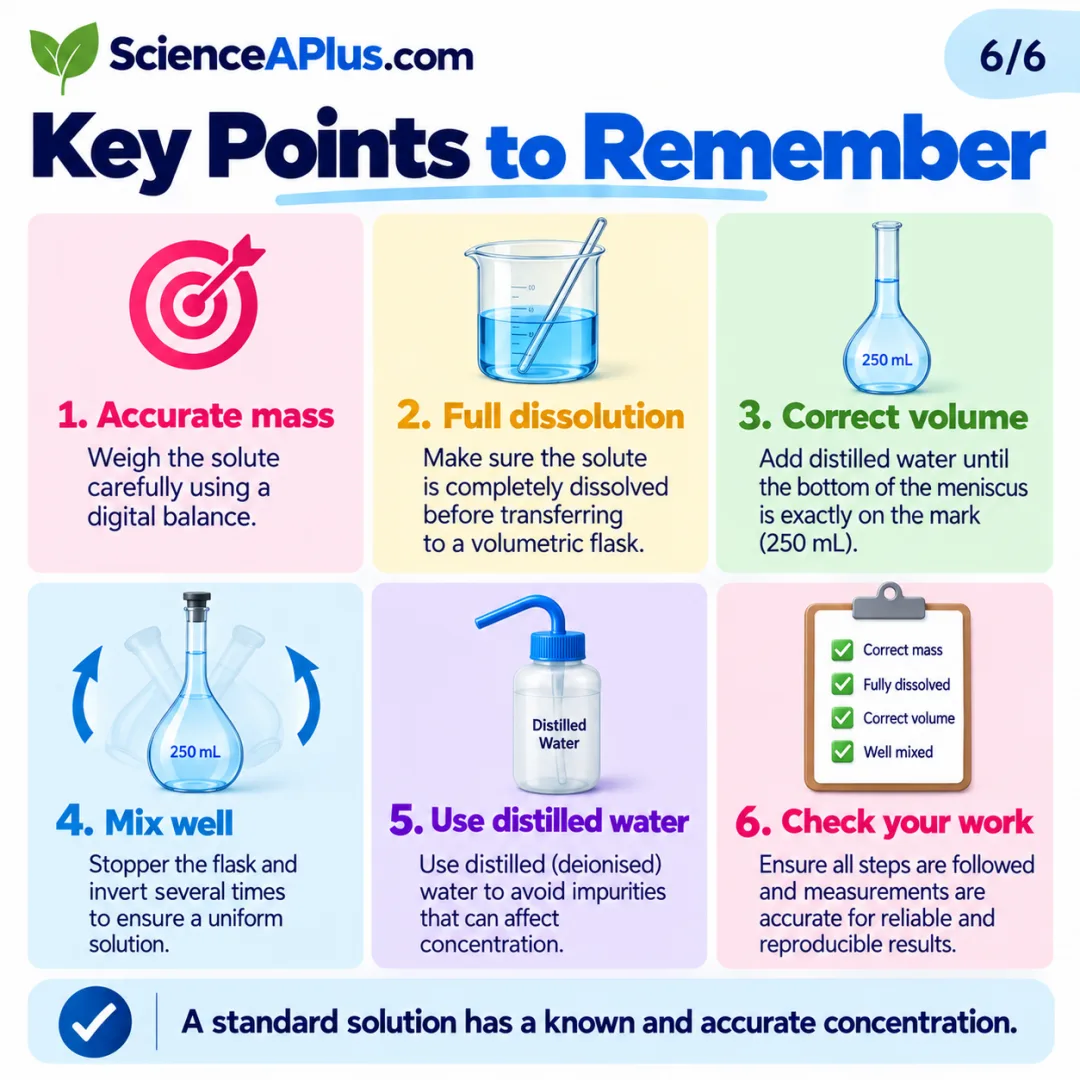
Watch: making a standard solution (slides)
Prefer to flick through slides? This short deck walks through the same practical.
Frequently asked questions about standard solutions
What is a standard solution?
A standard solution is a solution whose concentration is accurately known. Chemists make one by dissolving a precisely weighed mass of solute in distilled water and making it up to an exact volume in a volumetric flask. It is then used in titrations, calibration and quality control.
How do you prepare a standard solution?
Weigh the solid by difference, dissolve it in about 100 cm³ of distilled water in a beaker, and pour it through a funnel into a volumetric flask. Rinse the beaker and rod into the flask, add water to the mark using a dropping pipette, then stopper and invert about ten times.
How do you calculate the mass needed for a standard solution?
Use m = c × V × Mr, with volume in dm³. For 250 cm³ of 0.100 mol/dm³ sodium chloride, n = 0.100 × 0.250 = 0.0250 mol. Multiply by Mr 58.5 to get 1.46 g. Always divide cm³ by 1000 first, because concentration is measured per dm³.
Why use a volumetric flask?
A volumetric flask is calibrated to hold one exact volume, usually at 20 °C, with a class A tolerance of about ±0.15 cm³ for 250 cm³. A beaker or measuring cylinder is far less accurate, so the concentration would be less certain. The narrow neck also makes the mark precise to read.
Why rinse the beaker into the volumetric flask?
Some solute always clings to the beaker, stirring rod and funnel. If you leave it behind, fewer moles reach the flask and the concentration is lower than calculated. Rinsing with distilled water several times and adding every washing to the flask makes sure all of the weighed solute is transferred.
What is a primary standard?
A primary standard is a pure, stable, soluble solid that does not absorb water or react with air, and ideally has a high molar mass. Anhydrous sodium carbonate and potassium hydrogen phthalate are examples. Because its mass can be trusted, you can calculate its concentration directly.
What happens if you go past the mark on the flask?
You must start again. You cannot remove water without also removing solute, so the concentration would be lower than intended. This is why the last few cm³ are added drop by drop with a dropping pipette, watching the meniscus at eye level until it sits on the line.
Can you use tap water to make a standard solution?
No. Tap water contains dissolved ions that contaminate the solution, so the concentration would no longer be accurately known. Use distilled or deionised water. A flask that is wet with distilled water is fine, because you add water to it anyway.
How do you dilute a standard solution?
Use c₁V₁ = c₂V₂, because the moles of solute stay the same. Measure V₁ with a pipette, transfer it to a volumetric flask and make up to the mark with distilled water. For example, 25.0 cm³ of 0.100 mol/dm³ made up to 250 cm³ gives 0.0100 mol/dm³.