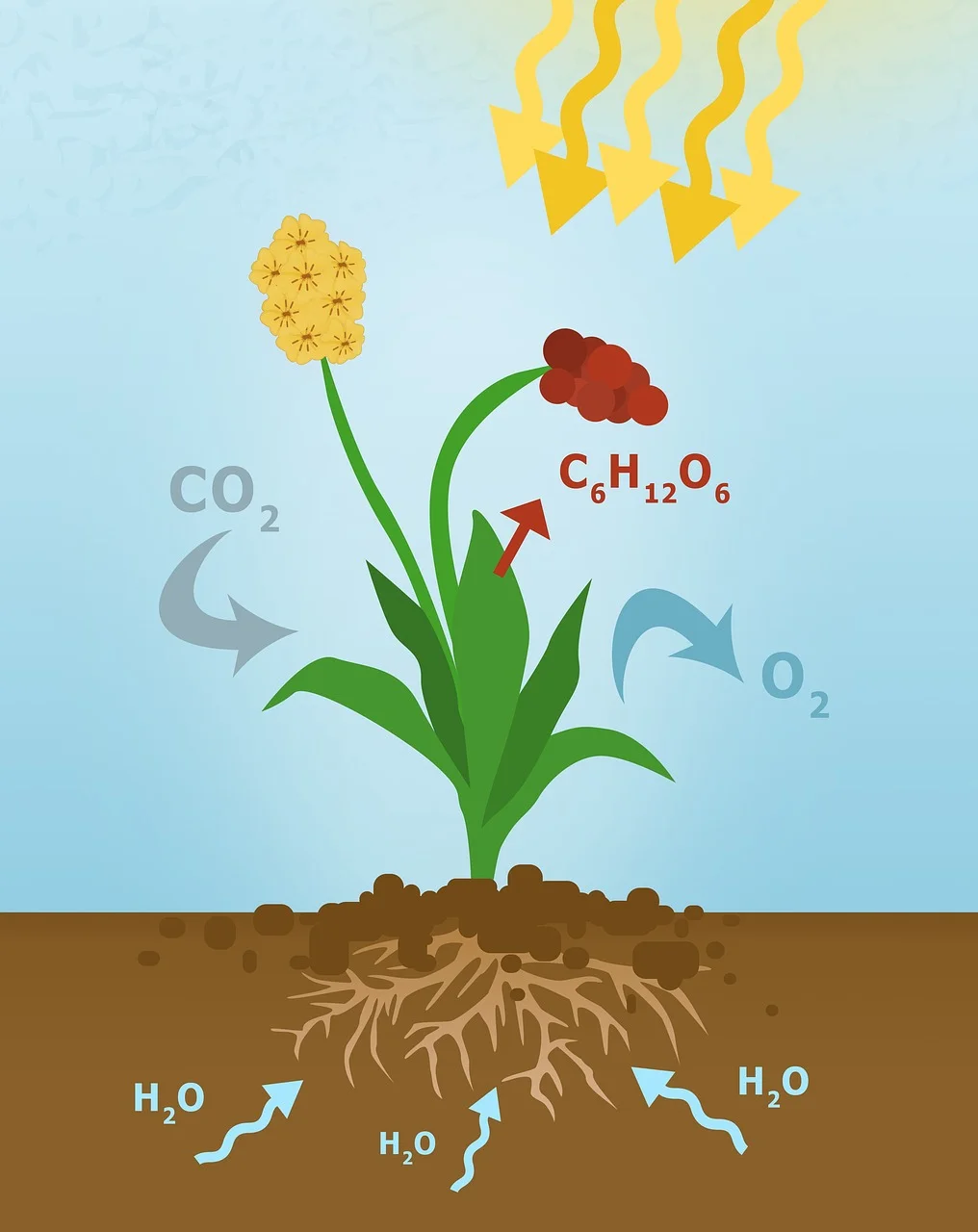
Key points at a glance
- Photosynthesis is the process plants use to make their own glucose using light energy. Respiration releases energy from that glucose — the two are opposites, not the same thing.
- Word equation: carbon dioxide + water → glucose + oxygen, in the presence of light and chlorophyll.
- Balanced symbol equation: 6CO2 + 6H2O → C6H12O6 + 6O2.
- It happens in chloroplasts, mostly in the palisade mesophyll cells near the top of the leaf, using the green pigment chlorophyll.
- The three main limiting factors are light intensity, carbon dioxide concentration and temperature.
- Photosynthesis is an endothermic reaction: it takes in energy from the surroundings.
Photosynthesis is the reaction that feeds almost every food chain on Earth. Plants, algae and some bacteria use it to convert light energy into chemical energy stored in glucose. Every time you eat a meal, you are eating energy that was originally captured by photosynthesis — and the oxygen you just breathed in was released as a waste product of the same reaction.
This lesson covers what photosynthesis is, where it happens, the equations you need to know, what limits the rate of the reaction, and the required practical. It is written for GCSE and IGCSE biology students, but the explanations work for anyone meeting the topic for the first time.
What is photosynthesis?
Photosynthesis is the process by which green plants and some other organisms use light energy to convert carbon dioxide and water into glucose and oxygen.
The important idea is that plants do not "absorb food from the soil". They make their own food. This is why plants are called producers (or autotrophs) — they produce the organic molecules that every consumer in the food chain later depends on. Minerals such as nitrates are taken from the soil, but those are used to build proteins, not to supply energy.
Photosynthesis is an endothermic reaction, meaning energy is taken in from the surroundings. That energy comes from light and ends up stored in the chemical bonds of glucose.
The photosynthesis equation
You need to be able to write both forms of the equation.
Word equation:
carbon dioxide + water → glucose + oxygen
Light and chlorophyll are written above or below the arrow, because they are needed for the reaction but are not reactants that get used up in the way carbon dioxide and water are.
Balanced symbol equation:
6CO2 + 6H2O → C6H12O6 + 6O2
A very common exam mistake is writing the equation backwards. If carbon dioxide and water are on the left, it is photosynthesis. If glucose and oxygen are on the left, it is respiration.
Where photosynthesis happens
Photosynthesis takes place inside chloroplasts, small green organelles found in plant cells. Chloroplasts contain chlorophyll, the pigment that absorbs light energy. Chlorophyll absorbs red and blue light strongly and reflects green light, which is why leaves look green to us.
Not every plant cell photosynthesises. Root cells, for example, have no chloroplasts because they are underground and receive no light. The cells doing most of the work are the palisade mesophyll cells, packed in a column near the upper surface of the leaf where the light arrives first.
How a leaf is adapted for photosynthesis
| Adaptation | How it helps |
|---|---|
| Broad and flat | Large surface area to absorb as much light as possible |
| Thin | Short diffusion distance for carbon dioxide to reach the cells |
| Palisade cells near the top, packed with chloroplasts | Maximum light absorption where light intensity is highest |
| Air spaces in the spongy mesophyll | Allow gases to diffuse quickly through the leaf |
| Stomata on the lower surface | Let carbon dioxide diffuse in and oxygen diffuse out |
| Guard cells around each stoma | Open and close the stomata to control gas exchange and water loss |
| Network of veins (xylem and phloem) | Xylem delivers water; phloem carries away the glucose made |
| Waxy cuticle | Reduces water loss without blocking light |
What happens to the glucose?
Students often assume the glucose is simply stored. In fact it is used in several different ways:
- Respiration — broken back down to release energy for the plant's own life processes.
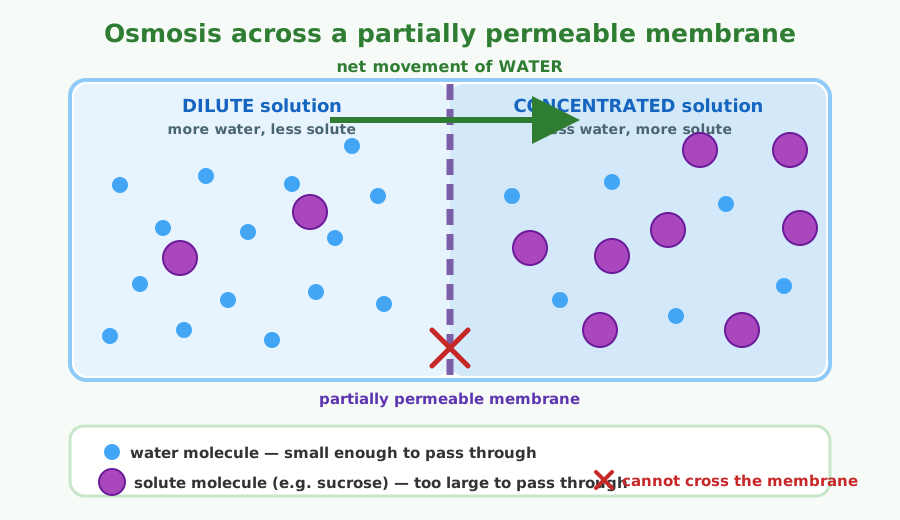
- Converted to starch for storage. Starch is insoluble, so it does not affect the water balance of the cell by osmosis. This is why the starch test is used to show photosynthesis has happened.
- Converted to cellulose to build strong cell walls.
- Converted to lipids (fats and oils) for storage, especially in seeds.
- Combined with nitrate ions absorbed from the soil to make amino acids, which are then built into proteins.
Limiting factors
A limiting factor is the factor in shortest supply — the one currently holding the rate of photosynthesis back. Increase it and the rate rises; increase anything else and nothing happens.
| Factor | Effect on rate | Why it levels off |
|---|---|---|
| Light intensity | Rate increases as light intensity increases | Eventually another factor (carbon dioxide or temperature) becomes limiting |
| Carbon dioxide concentration | Rate increases as CO2 concentration increases | Levels off when light or temperature becomes limiting |
| Temperature | Rate increases as temperature increases, up to an optimum | Above the optimum the enzymes controlling photosynthesis denature, so the rate falls sharply |
Temperature behaves differently from the other two, and this is worth remembering. Light and carbon dioxide graphs plateau. A temperature graph rises, peaks, then falls, because the reaction is controlled by enzymes and enzymes are denatured by heat.
Chlorophyll level can also limit the rate. A plant short of magnesium cannot make enough chlorophyll, its leaves turn yellow (chlorosis), and photosynthesis slows.
Reading a limiting factor graph
On a graph of rate against light intensity, the steep section shows light intensity is the limiting factor — more light gives more photosynthesis. The flat section shows something else has become limiting. If you are asked "what is limiting the rate at point X?", look at whether the curve is still rising or has flattened.
Greenhouses: limiting factors in practice
Commercial growers use this theory directly. Inside a greenhouse a grower can raise all three factors at once: artificial lighting extends the day, paraffin heaters raise the temperature and release carbon dioxide as they burn, and the glass traps heat. The crop grows faster and can be harvested more often.
The limit is economic rather than biological. Heating and lighting cost money, so growers increase the factors only to the point where the extra yield is worth more than the extra fuel bill.
Required practical: investigating light intensity
The standard experiment uses pondweed such as Elodea or Cabomba, which conveniently releases visible bubbles of oxygen.
- Place a piece of pondweed in a test tube of water containing sodium hydrogencarbonate solution, which supplies carbon dioxide.
- Put a lamp a measured distance from the tube — start at 10 cm.
- Leave the plant for a few minutes to adjust to the new light intensity.
- Count the bubbles of oxygen released in one minute, or collect and measure the gas in a capillary tube for a more accurate result.
- Repeat at increasing distances, for example 20 cm, 30 cm, 40 cm and 50 cm.
- Repeat each distance three times and calculate a mean.
Key control variables: the same piece of pondweed, the same temperature, and the same carbon dioxide concentration throughout.
The temperature problem: a lamp heats the water as well as lighting it, so temperature could change alongside light intensity and ruin the experiment. Place a beaker of water between the lamp and the tube to act as a heat shield, and check the temperature with a thermometer.
Processing the results: light intensity is proportional to 1/d2, where d is the distance from the lamp — the inverse square law. Doubling the distance drops the light intensity to a quarter, not a half.
Testing a leaf for starch
To show a leaf has been photosynthesising, test it for starch:
- Boil the leaf in water to kill it and break down the cell membranes.
- Boil it in ethanol to remove the chlorophyll, so the colour change is visible. Do this using a water bath, not a naked flame — ethanol is highly flammable.
- Dip the leaf in hot water to soften it, as ethanol makes it brittle.
- Add iodine solution. A blue-black colour shows starch is present.
Using a variegated leaf (one with green and white patches) shows that only the green parts containing chlorophyll turn blue-black — neat evidence that chlorophyll is required.
Photosynthesis compared with respiration
| Feature | Photosynthesis | Aerobic respiration |
|---|---|---|
| Purpose | Makes glucose and stores energy | Releases energy from glucose |
| Raw materials | Carbon dioxide and water | Glucose and oxygen |
| Products | Glucose and oxygen | Carbon dioxide and water |
| Energy | Endothermic — takes energy in | Exothermic — gives energy out |
| Where | Chloroplasts | Mitochondria (and cytoplasm) |
| When | Only in the light | All the time, day and night |
| Which organisms | Plants, algae, some bacteria | All living organisms |
Plants respire constantly, including during the day. In bright light photosynthesis runs faster than respiration, so overall the plant takes in carbon dioxide and gives out oxygen. At night only respiration continues, so the plant takes in oxygen and gives out carbon dioxide. The point where the two rates are exactly equal, and there is no net gas exchange, is called the compensation point.
Exam tips
- Write "light" and "chlorophyll" above the arrow, not as reactants in the equation.
- If a question asks why a rate graph has levelled off, name the factor that has become limiting — do not just say "it stopped increasing".
- Remember that temperature graphs fall after the optimum because enzymes denature. Use the word "denature", not "killed".
- Glucose is converted to starch for storage because starch is insoluble and does not affect osmosis.
- Plants respire 24 hours a day. A question asking why a plant gives out carbon dioxide at night is testing exactly this.
- In the pondweed practical, always mention the heat shield when asked how to control temperature.
Frequently asked questions about photosynthesis
What is the word equation for photosynthesis?
Carbon dioxide + water → glucose + oxygen, in the presence of light and chlorophyll. The balanced symbol equation is 6CO2 + 6H2O → C6H12O6 + 6O2.
Where does photosynthesis take place in a plant?
In the chloroplasts, which are found mainly in the palisade mesophyll cells near the upper surface of the leaf. Chloroplasts contain chlorophyll, the pigment that absorbs the light energy. Root cells have no chloroplasts because they receive no light.
Is photosynthesis the same as respiration?
No, they are opposite processes. Photosynthesis builds glucose and stores energy, using carbon dioxide and water. Respiration breaks glucose down to release energy, producing carbon dioxide and water. Plants do both, but photosynthesis only happens in the light while respiration happens all the time.
Why do plants look green?
Chlorophyll absorbs red and blue light strongly but reflects green light. The green light bounces back to your eyes, so the leaf appears green.
What are the three main limiting factors of photosynthesis?
Light intensity, carbon dioxide concentration and temperature. Whichever is in shortest supply limits the rate. Chlorophyll levels can also be limiting if the plant is short of magnesium.
Why does the rate of photosynthesis fall at high temperatures?
Photosynthesis is controlled by enzymes. Above the optimum temperature the enzymes denature — their active sites change shape and they can no longer catalyse the reaction — so the rate drops sharply rather than levelling off.
Why is glucose converted into starch?
Starch is insoluble, so it can be stored in large amounts without affecting the movement of water into and out of the cell by osmosis. Soluble glucose would lower the water potential of the cell and draw water in.
Do plants photosynthesise at night?
No. Photosynthesis needs light, so it stops in darkness. Respiration continues day and night, which is why a plant releases carbon dioxide at night.
Why is photosynthesis important for other organisms?
It is the starting point of nearly every food chain, producing the glucose that all consumers ultimately depend on. It also releases the oxygen that aerobic organisms need for respiration, and removes carbon dioxide from the atmosphere.