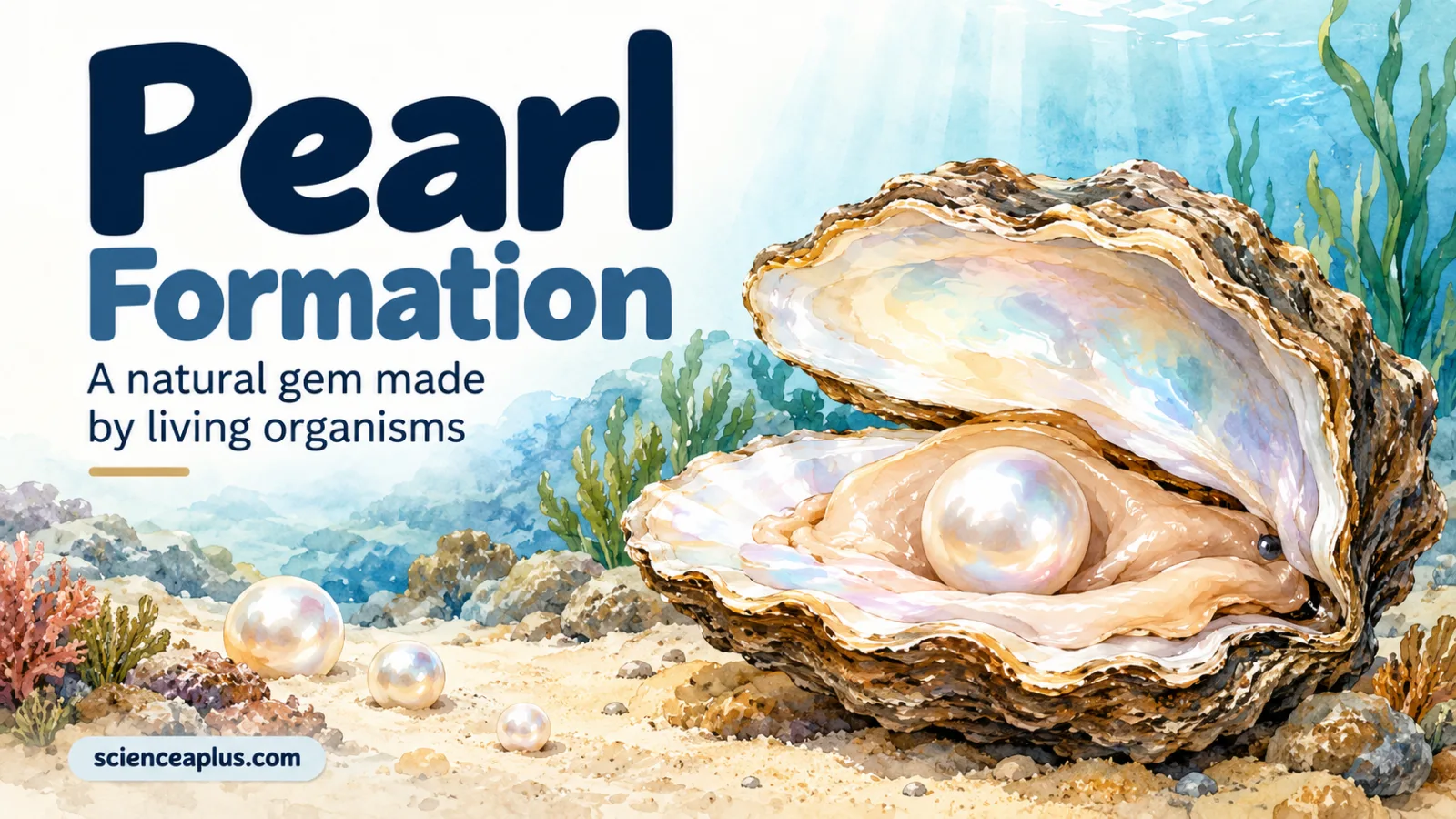
A pearl is a tiny, living-made treasure: a ball of shimmering crystal built by a soft-bodied animal, one thin layer at a time. Pearl formation begins when something irritates or injures a mollusc, and cells from its own outer skin end up in the wrong place. Those cells form a pouch, the pouch secretes shiny layers of nacre, and years later you have a pearl.
If you have ever wondered how are pearls formed, whether they really start from sand, or what separates natural pearls from cultured pearls, this guide answers all of it. We will look at the animals involved, the cells and chemistry behind the shine, how people learned to farm pearls, and how to look after them.
Which animals make pearls?
Pearls are made by molluscs, and most of them come from bivalves, the group with two hinged shells. Two kinds of bivalve matter most: saltwater pearl oysters and freshwater mussels. A few gastropods (animals with a single, coiled shell) can also produce pearls.
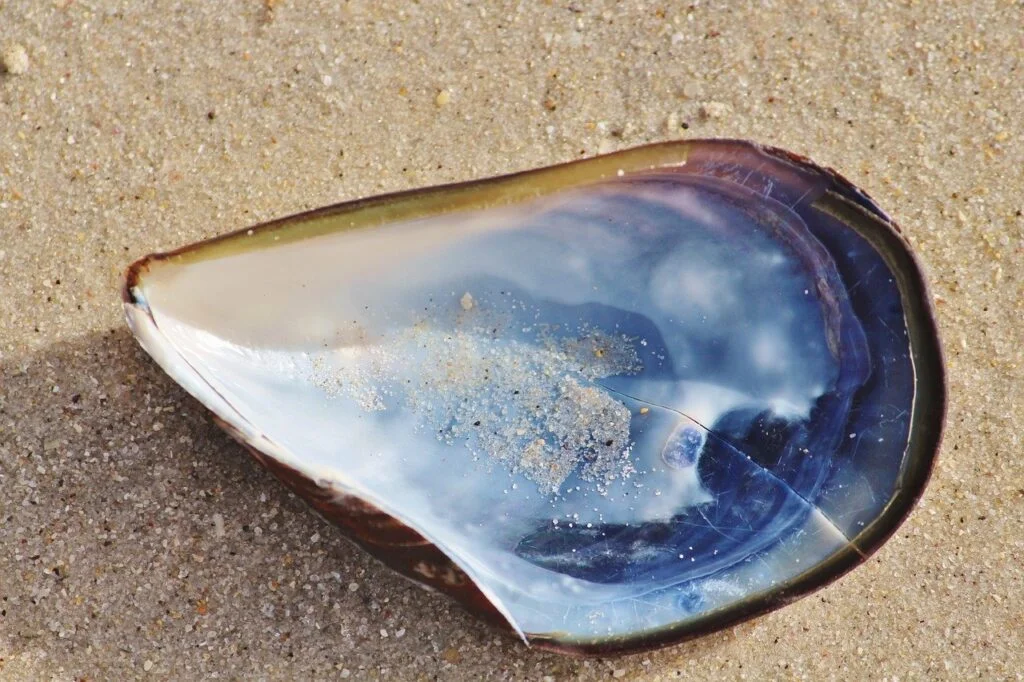
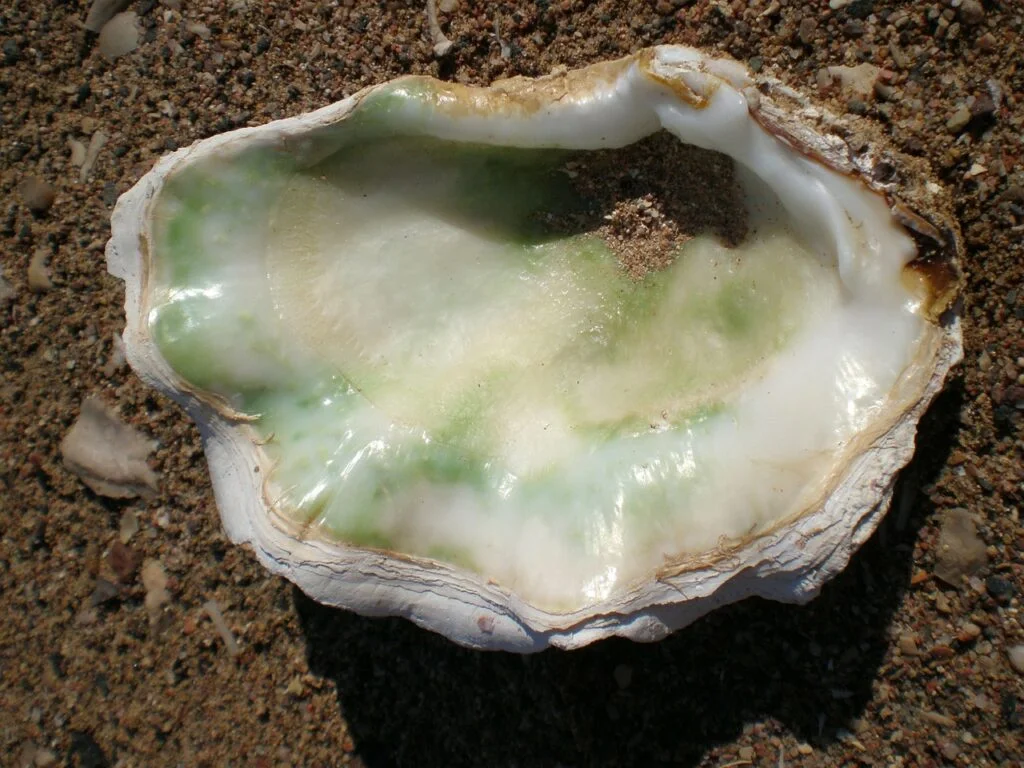
The oysters that produce jewellery pearls belong to the genus Pinctada, in the family Pteriidae. They are not the same animals as the edible oysters on a restaurant menu, which belong to the family Ostreidae and rarely make gem-quality pearls. Freshwater pearls come from mussels in the family Unionidae, such as Hyriopsis.
| Animal | Water | Pearl type |
|---|---|---|
| Pearl oysters (Pinctada) | Salt water | Nacreous pearls: Akoya, South Sea and Tahitian |
| Freshwater mussels (Unionidae, e.g. Hyriopsis) | Fresh water | Nacreous pearls in many shapes and colours |
| Queen conch (a gastropod) | Salt water | Pink, non-nacreous pearls |
| Abalone (a gastropod) | Salt water | Abalone pearls |
| Edible oysters (Ostreidae) | Salt water | Rarely gem quality |
What links them all is the phylum they belong to. If you want to see how clams, snails, squid and octopuses fit into the same family tree, read our guide to the characteristics of the phylum Mollusca.
Not every pearl shines. Pearls from the queen conch lack nacre, so they have a soft, silky glow rather than the rainbow lustre of an oyster pearl. We will come back to why in the next part of this guide.
How are pearls formed?
Natural pearl formation follows the same basic recipe in every species. Here it is, step by step.
- An intruder or injury. A parasite, such as a burrowing worm or a trematode larva, or some damage to the shell or soft body, disturbs the mollusc.
- Mantle cells are displaced. The disturbance pushes a small piece of the mantle epithelium, the outer skin cells of the animal, into its own tissue.
- A pearl sac forms. The displaced cells multiply and wrap into a closed pouch around whatever is inside, called the pearl sac.
- Nacre is laid down. The cells of the sac secrete nacre, the same material that lines the inside of the shell, in thin layers around the object.
- Growth over years. Layer after layer builds up slowly. The pearl gets bigger and its surface smoother as the animal keeps secreting.
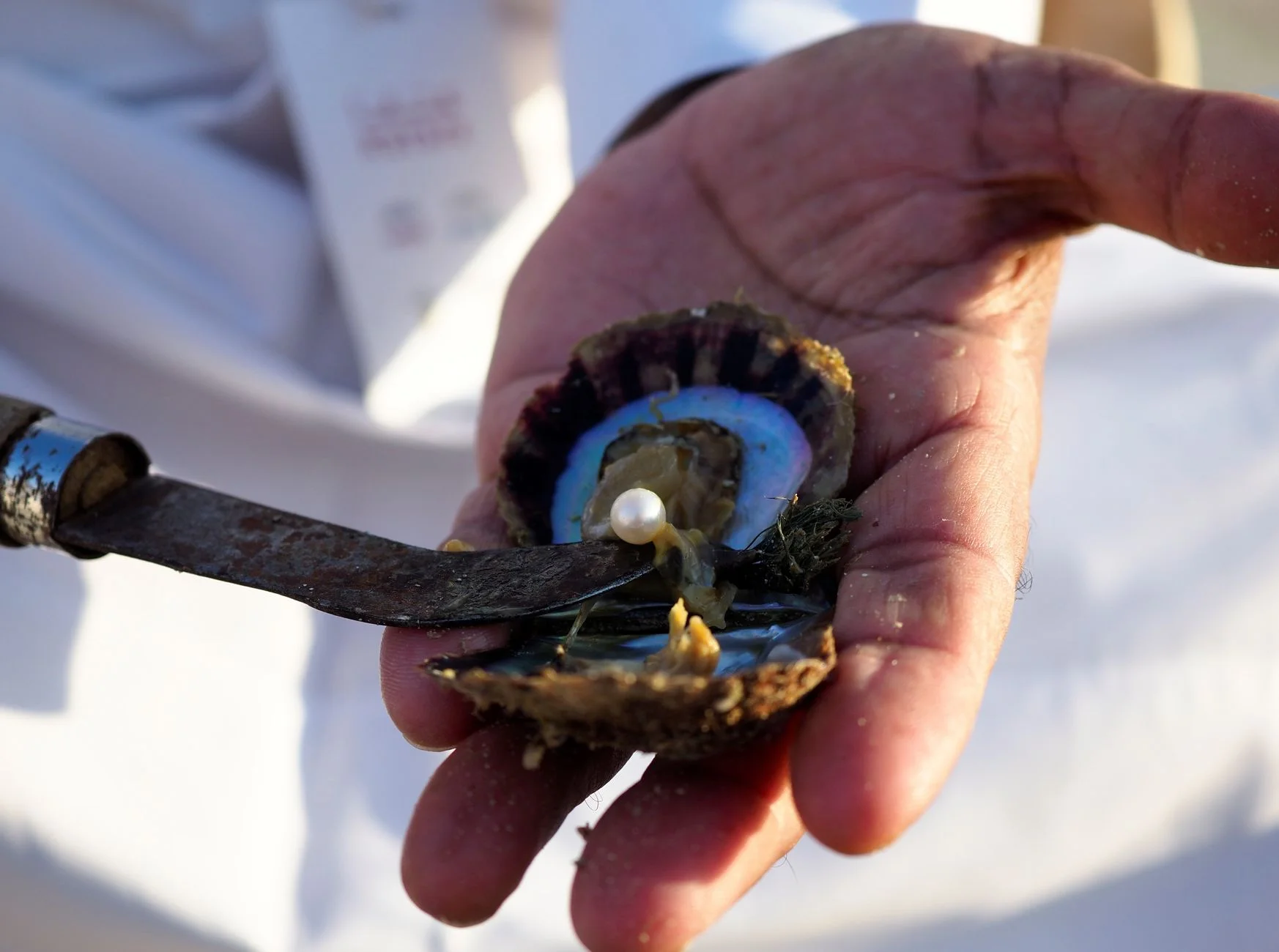
- A pearl is born. Eventually a finished pearl sits inside the soft tissue, ready to be found by a diver, or, in today’s farms, harvested by a technician.
The mantle and the pearl sac
To understand pearl formation you need to know about the mantle. This is the soft tissue that lines the inside of a mollusc’s shell. Its normal job is to make the shell, including the shiny inner layer of nacre that we call mother-of-pearl.
A pearl is what happens when a little piece of that tissue ends up in the wrong place. Inside the body, the displaced cells still behave like mantle cells, so they do what mantle cells do: they make nacre. The pearl sac is made of living cells, and nacre is the product it secretes, so the sac stays alive while the pearl grows.
This also answers a common question: are pearls alive? The pearl itself is not. It is a mineral-and-protein structure, a bit like a shell or a tooth. The sac that builds it, though, is living tissue.
Biologically, a pearl is essentially a shell-making accident that the animal keeps building on. That is why a pearl has the same shimmering inner surface as the shell of the animal that made it.
So the next time someone tells you that a pearl is just an oyster’s way of coping with a bit of grit, you can politely explain that it is closer to a self-grown tissue pouch that has gone rogue and started making shell.
Whether a pearl is natural or cultured, the cell biology above stays the same. The difference is who starts the process: chance, in natural pearls, or a skilled technician, in cultured pearls. We will meet both properly in the sections ahead, starting with what nacre actually is and why it shines.
What is nacre? The science of lustre
Nacre (say “NAY-ker”) is the shimmering material that gives a pearl its glow. It is also called mother-of-pearl, and it lines the inside of the shell of many molluscs. The same soft tissue that builds that shiny lining, the mantle, is the tissue that builds a pearl. A pearl is simply nacre laid down in layers around a centre.
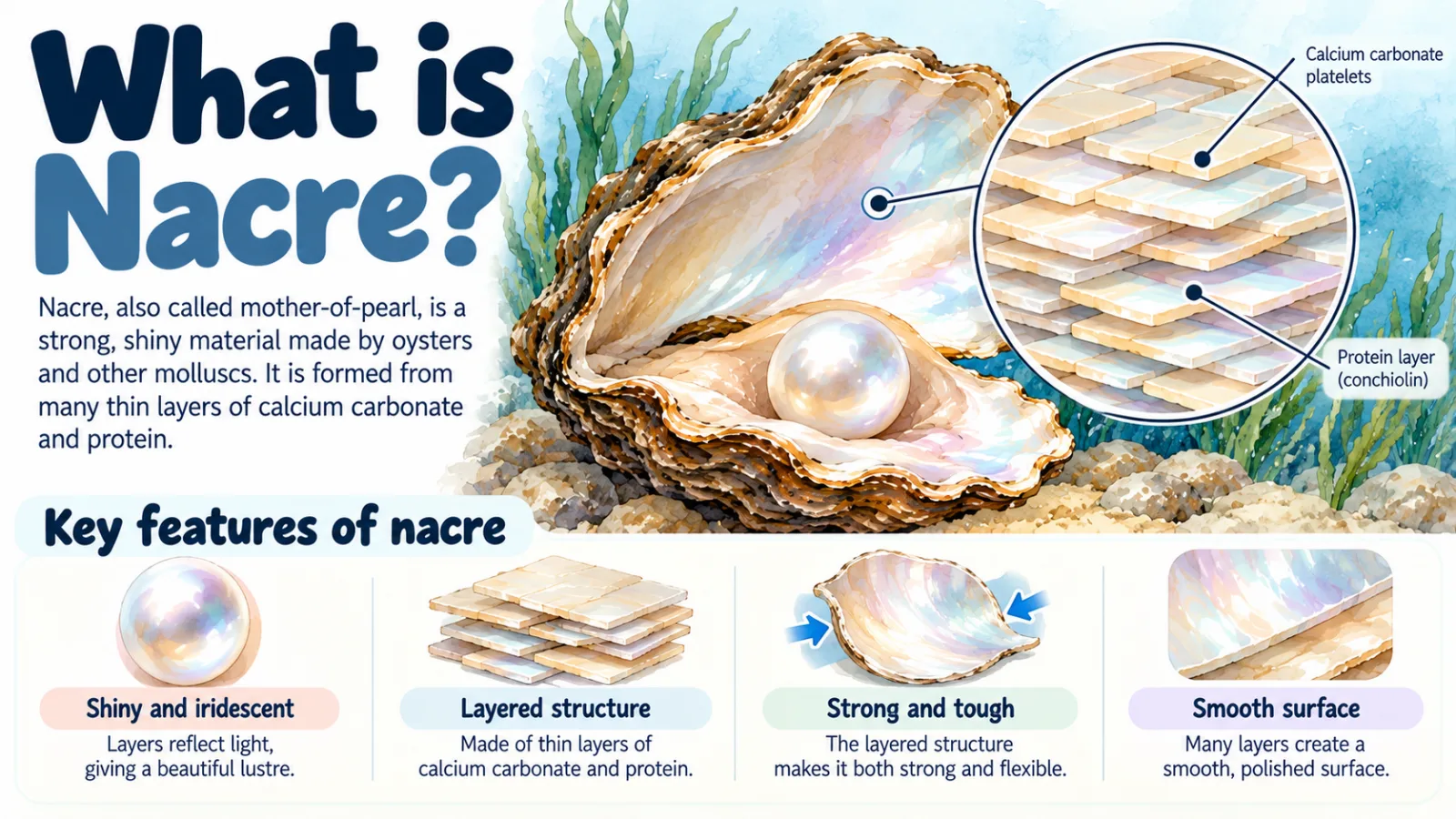
Chemically, nacre is mostly calcium carbonate with some protein and water. In round figures, a pearl is about 82–86 % calcium carbonate, about 10–14 % conchiolin and 2–4 % water. That makes it very different from a mineral gem such as a diamond, because a pearl is made by a living animal rather than by heat and pressure underground.
Brick-and-mortar structure
Under a powerful microscope, nacre looks like a tiny brick wall. The “bricks” are flat, six-sided platelets of aragonite, a crystal form of calcium carbonate (CaCO₃). Each platelet is only about 0.3–0.5 µm thick, which is hundreds of times thinner than a human hair.
The “mortar” is a thin organic layer called conchiolin. It is made of proteins plus chitin, and it glues the platelets together. Aragonite on its own is hard but brittle. Together with the flexible conchiolin, it forms a material that is tougher than aragonite alone, because cracks have trouble crossing all the layers.
CaCO₃ (aragonite platelets) + conchiolin (protein and chitin) = nacre
Corals also use calcium carbonate to build their hard skeletons, so pearls and reefs share some chemistry. If you want to see how a different animal turns seawater minerals into stone, read our guide to corals.
Why pearls shine
A pearl’s glow is not a pigment. It is a trick of light. Each thin layer of nacre reflects a little of the light that hits it, and the light that passes through bounces back from the layers underneath. These reflected waves meet and interfere with one another. Some colours are strengthened and others cancelled, a process called thin-film interference.
Because there are so many layers, the effect repeats again and again. The result is the soft, deep glow that gemmologists call lustre, or “orient” when it shows a faint rainbow sheen. Thicker, more regular nacre usually gives a sharper, brighter shine. Non-nacreous pearls, such as those from queen conchs, lack this layered structure, so they have a porcelain-like surface instead of the pearly glow.
How many layers are in a pearl? Try it with the calculator below. Enter a thickness of nacre and see how many platelet layers of 0.3–0.5 µm that would take.
Natural pearls: rare treasures from the sea
Natural pearls form with no human help at all. A mollusc in the wild is injured or irritated, for example by a parasite, and its tissue builds a pearl sac around the problem. Out of the vast number of shellfish in the sea, very few ever make a pearl, and fewer still make one with good shape and lustre. That rarity is why natural pearls have been prized for so long.
The age of pearl diving
For centuries, people searched for natural pearls by diving to the sea floor and collecting shells by hand. Two of the most famous pearl fisheries were the Persian Gulf, including the waters around Bahrain, and the Gulf of Mannar between Sri Lanka and India. Whole island economies were built around the pearling season, from the divers to the boat crews and the merchants.
This trade collapsed in the 1930s. Cultured pearls, which could be produced in large numbers on farms, flooded the market, and the discovery of oil gave Gulf economies another source of income. Today the vast majority of pearls sold are cultured, and natural pearls are rare and very valuable.
Shapes of natural pearls
Natural pearls grow however the pearl sac and the mollusc allow, so their shapes vary a great deal. Jewellers describe them with a small set of terms:
- Round and near-round: the most sought-after shapes, and the hardest to find in nature.
- Oval, button and drop: symmetrical but not spherical, popular in earrings and pendants.
- Baroque: irregular, flowing shapes with their own character.
- Blister pearls: pearls that grow attached to the inside of the shell rather than floating free in the tissue.
Cultured pearls come in the same range of shapes, plus keshi pearls, which are non-beaded by-products of the culturing process and are made entirely of nacre. Next, we look at how people learned to start the pearl-making process on purpose.
Cultured pearls: pearl formation with a human helper
Cultured pearls form by exactly the same biology as natural pearls. The only difference is the starting point: instead of waiting for a parasite or an injury, a person deliberately places the trigger inside the mollusc. The animal then does all the real work, building nacre around it layer by layer.
Today the vast majority of pearls sold are cultured. Natural pearls are rare and very valuable, which is why most jewellery pearls come from farms.
A short history of cultured pearls
Kokichi Mikimoto produced his first cultured (half) pearls in 1893 and patented his method in 1908. Round cultured pearls reached the market in the early 1920s. Tokichi Nishikawa and Tatsuhei Mise also developed the round-pearl technique, so the breakthrough was not the work of one person alone.
The timing mattered. The natural pearl industries of the Persian Gulf and the Gulf of Mannar collapsed in the 1930s as cultured pearls (and the discovery of oil) changed the local economies.
How bead-nucleated pearls are grown
Most saltwater cultured pearls, such as Akoya and South Sea pearls, are bead-nucleated. The process needs a skilled technician and follows these steps:
- A round bead, usually cut from freshwater mussel shell, is prepared.
- A small piece of mantle tissue (a graft) is taken from a donor oyster.
- The technician implants the bead and the graft together into the gonad of a host oyster.
- The graft cells grow into a pearl sac around the bead, just as displaced cells do in a natural pearl.
- The pearl sac secretes nacre, so the oyster slowly coats the bead with nacre.
- After months or years in the water, the pearl is harvested.
The pearl sac is made of living cells, and nacre is what it produces. The bead is only the foundation, which is why a thicker nacre coating gives a better pearl.
Freshwater tissue-nucleated pearls
Most freshwater pearls, mainly from China, are tissue-nucleated. Only grafts of mantle tissue are used and no bead is added, so these pearls are almost all nacre. Because the mussels (Hyriopsis) are large, one mussel can grow many pearls at once, often dozens.
Freshwater pearls come in many shapes and colours, and they take from months to several years to grow.
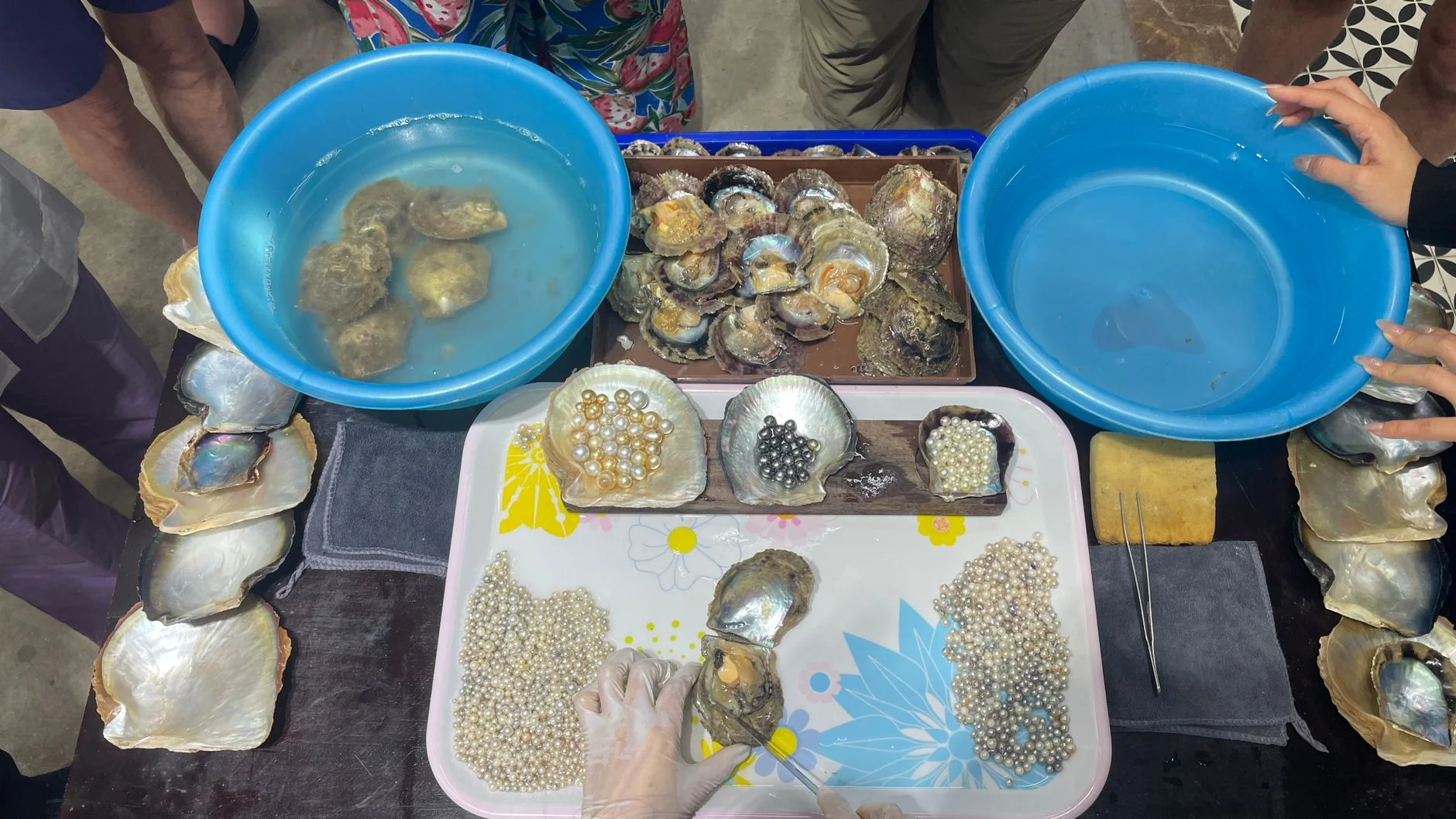
Pearl farms depend on clean water. Oysters filter large volumes of water, so they take part in ocean food chains and food webs as filter feeders. When farming is well managed, it can even support reef conservation.
Natural vs cultured pearls: what is the difference?
A natural pearl and a cultured pearl are both genuine pearls, made by a living mollusc. The difference lies in what started them and what is at the centre. Imitation pearls are a different matter altogether, since they are glass or plastic coated with “pearl essence”.
| Feature | Natural pearl | Cultured pearl |
|---|---|---|
| What starts it | A parasite or damage, by chance | A technician implants a graft (and usually a bead) |
| Made by | A mollusc | A mollusc |
| Pearl sac | Forms from displaced mantle cells | Forms from the grafted mantle cells |
| Inside | Concentric growth rings of nacre | Usually a bead nucleus (none in tissue-nucleated pearls) |
| Rarity | Rare | The vast majority of pearls sold |
| Value | Very valuable | Varies widely with quality |
| Identification | Needs a gemmological lab | Needs a gemmological lab |
Telling the two apart by eye is not possible. Only a gemmological lab can do it reliably.
How do labs tell natural and cultured pearls apart? (2 marks)
They use X-radiography. A bead-cultured pearl shows the bead nucleus inside it, whereas a natural pearl shows concentric growth rings.
You may have heard of the tooth test for spotting imitations. A real pearl feels gritty against the teeth, while an imitation feels smooth. It is only a rough guide, and a lab can confirm the result.
Types of cultured pearls
Cultured pearls are grouped by the mollusc that grows them. Each type differs in size, colour and growing time. Tap each card to check what you remember.
Whatever the type, shapes include round, near-round, oval, button, drop and baroque (irregular). Keshi pearls are by-products of culturing and are all nacre. Blister pearls are attached to the shell, and a mabe is an assembled cultured blister pearl.
The growing time is a big reason for the differences in price, because a larger pearl needs more years of nacre building.
What makes a pearl valuable?
Two pearls can look similar at arm’s length and still differ hugely in price. Gemmologists at the GIA judge pearls using seven value factors. Each one comes back to how the pearl formed: what the mollusc was, how long the nacre had to build up, and how smoothly it grew.
| Value factor | What it means | Link to pearl formation |
|---|---|---|
| Size | Diameter in millimetres | Larger pearls need bigger oysters and more time; South Sea pearls typically measure 8–18 mm |
| Shape | Round, near-round, oval, button, drop or baroque | Perfectly round pearls are harder to grow, so they are usually prized |
| Colour | Body colour plus any overtone | Set by the mollusc species: Tahitian pearls are naturally dark, Akoya pearls white or cream |
| Lustre | How sharp and bright the reflections are | Comes from thin, even nacre layers that interfere with light |
| Surface quality | Spots, bumps, pits or scratches | Flaws record irregular growth in the pearl sac |
| Nacre quality | Thickness and condition of the nacre | A thin coat over a bead can look dull or wear through |
| Matching | How well pearls in a necklace or pair resemble each other | Each pearl grows separately, so a matched strand takes time to assemble |
Pearls are also unusual among gems because nobody cuts or polishes them. The mollusc does all the finishing, so lustre and surface quality are fixed by biology. Gold is judged mainly on purity and weight, as you can read in our guide to gold, the precious metal. A pearl has no such single measure, so graders weigh all seven factors together.
Caring for pearls: the chemistry of acid damage
Pearls are tough for their size because of the brick-and-mortar nacre, but they are soft. They rate only 2.5–4.5 on the Mohs scale, so a ring, a zip or even grit in a handbag can scratch them. They are also made mostly of calcium carbonate, and that is their real weakness.
Calcium carbonate reacts with acids. Vinegar contains ethanoic (acetic) acid, so a pearl dropped in vinegar slowly fizzes as the nacre dissolves and carbon dioxide escapes. The word equation is: calcium carbonate + ethanoic acid → calcium ethanoate + water + carbon dioxide. In symbols:
CaCO₃ + 2CH₃COOH → Ca(CH₃COO)₂ + H₂O + CO₂
This is the same reaction you meet when acid attacks limestone or chalk. Lemon juice, perfume, hairspray and sweat can all harm the surface in a similar way, dulling the lustre that thin-film interference creates. If you want to revise the chemistry behind this, read acids and bases explained.
Test yourself: pearl formation quiz
Key points to remember
Frequently asked questions about pearl formation
Do pearls come from sand?
Almost never. Molluscs expel sand easily, so a grain is rarely the trigger. Pearls usually start when a parasite or damage pushes a piece of the mollusc’s own mantle tissue inward. Those cells form a pearl sac that secretes nacre in layers around whatever is inside.
What is nacre?
Nacre, also called mother-of-pearl, is the shiny material that lines many mollusc shells and coats pearls. It is made of tiny hexagonal aragonite platelets, a form of calcium carbonate, bound by a thin organic layer called conchiolin. This brick-and-mortar structure makes it tough and iridescent.
How long does a pearl take to form?
It depends on the type. Akoya pearls typically take 10–24 months, Tahitian pearls about 18–24 months, and South Sea pearls 2–4 years. Freshwater pearls take from months to several years. Generally, longer growth means thicker nacre, which usually improves durability and lustre.
Which animals make pearls?
Mostly bivalve molluscs. Saltwater pearl oysters of the genus Pinctada and freshwater mussels such as Hyriopsis make the pearls used in jewellery. Edible oysters rarely make gem-quality pearls. Some gastropods also make pearls, including queen conch and abalone, though conch pearls have no nacre shine.
What is the difference between natural and cultured pearls?
Both form by the same biology: a pearl sac secretes nacre. In a natural pearl this happens by chance. In a cultured pearl, people start the process by implanting a graft of mantle tissue, usually with a bead. Today most pearls sold are cultured, while natural pearls are rare and valuable.
Are pearls alive?
A finished pearl is not alive. It is a mineral-and-protein structure of nacre. However, it is produced by a pearl sac made of living cells inside a living mollusc. The animal keeps adding layers while the pearl grows, and growth stops once the pearl is removed.
Does vinegar dissolve pearls?
Yes. Pearls are mostly calcium carbonate, which reacts with the ethanoic acid in vinegar to form a calcium salt, water and carbon dioxide. The surface dulls and erodes. Lemon juice, perfume, hairspray and sweat can also damage pearls, so keep them away from acids.
How can you tell real pearls from fake ones?
The tooth test is a rough guide: a real pearl feels slightly gritty against your teeth, while imitation glass or plastic feels smooth. It is not conclusive. A gemmological lab can confirm, using X-radiography to separate natural from cultured and to identify imitations.
What makes a pearl valuable?
GIA uses seven value factors: size, shape, colour, lustre, surface quality, nacre quality and matching. Large, round pearls with a bright lustre, clean surface and thick nacre are generally worth most. Natural pearls are rarer still, and their rarity adds considerably to their value.
What are the main types of cultured pearl?
The four main types are Akoya (white or cream, typically under 9 mm), South Sea (white, silver or golden, typically 8–18 mm), Tahitian (naturally dark, from French Polynesia) and freshwater (mainly from China, in many shapes and colours). Each comes from a different oyster or mussel species.