Key points at a glance
- An acid releases hydrogen ions (H+) when dissolved in water. A base accepts them; a base that dissolves in water is called an alkali and releases hydroxide ions (OH-).
- The pH scale runs from 0 to 14. Below 7 is acidic, exactly 7 is neutral, above 7 is alkaline. One pH unit is a tenfold change in hydrogen ion concentration.
- Strong and weak describe how completely an acid ionises. Concentrated and dilute describe how much acid there is in a given volume of water. They are not the same thing.
- Neutralisation is always the same reaction underneath: H+(aq) + OH-(aq) → H2O(l).
- The three reactions to know: acid + metal → salt + hydrogen; acid + base → salt + water; acid + carbonate → salt + water + carbon dioxide.
- The acid decides the second half of the salt's name: hydrochloric gives chlorides, sulfuric gives sulfates, nitric gives nitrates.
Acids and bases are chemical opposites. An acid produces hydrogen ions in water, a base removes them, and when the two meet they cancel each other out to make a salt and water. Almost everything else in this topic – the pH scale, indicator colours, salt names, titrations – is a consequence of that single idea.
What is an acid?
An acid is a compound that releases hydrogen ions (H+) when it dissolves in water. That single feature is what every acidic property comes from: the sour taste, the effect on indicators, the fizzing with metals and carbonates. Acids and bases react together to form salts and water.
Acids can be found in a wide range of natural and man-made materials, such as fruits, batteries, stomach acid, and industrial chemicals. Numerous acids are also employed in chemical reactions to make fertilizers, polymers, and other items. Our lesson on the uses of acids, bases and salts covers where they turn up in industry and at home.
Depending on how readily they release H+ ions in aqueous solution, acids are classed as strong acids and weak acids.
Strong acids
Strong acids are those that release H+ ions through full ionisation in aqueous medium. This means that essentially all of these acid molecules break down into H+ ions and the corresponding negative ions in water. In an aqueous solution of the strong acid hydrochloric acid, for instance, there are only H+ ions and Cl- ions, and no free HCl molecules left.
Examples for strong acids
- Hydrochloric acid (HCl)
- Nitric acid (HNO3)
- Sulfuric acid (H2SO4)
- Perchloric acid (HClO4)
- Hydrobromic acid (HBr)
- Hydroiodic acid (HI)
- Chloric acid (HClO3)
The three you will meet constantly in the laboratory are hydrochloric, sulfuric and nitric acid.
Weak acids
Weak acids are acids that release H+ ions in aqueous media by incomplete or partial ionisation. Only a fraction of the molecules split into ions; the rest stay in solution as whole, un-ionised molecules. The ionisation is reversible, which is why it is written with a two-way arrow.
Examples for weak acids:
- Ethanoic acid, also called acetic acid (CH3COOH) – the acid in vinegar
- Carbonic acid (H2CO3) – formed when carbon dioxide dissolves in water
- Citric acid – found in lemons and other citrus fruit
- Phosphoric acid (H3PO4)
Strong and weak are not the same as concentrated and dilute
This is the single most commonly muddled pair of ideas in the whole topic, and examiners test it deliberately.
| Pair of terms | What it actually describes | Can be changed by |
|---|---|---|
| Strong vs weak | What proportion of the acid molecules ionise in water. A fixed property of that particular acid. | Nothing you do – hydrochloric acid is always strong, ethanoic acid is always weak |
| Concentrated vs dilute | How many moles of acid there are in each cubic decimetre of solution. | Adding water, or adding more acid |
The consequence is that all four combinations exist. You can have a dilute strong acid (the bench hydrochloric acid in a school laboratory) and a concentrated weak acid (glacial ethanoic acid). A very dilute solution of a strong acid can have a higher pH – be less acidic – than a concentrated solution of a weak one.
Two things follow that are worth memorising. Compared with a weak acid at the same concentration, a strong acid has a lower pH, reacts faster with metals and carbonates, and is a better conductor of electricity, because it contains more ions. It does not, however, produce more hydrogen or more salt overall – the total amount of product depends on how many moles of acid there are, not on how strong it is.
The pH scale
The pH scale measures how acidic or alkaline a solution is. It normally runs from 0 to 14, although values slightly outside that range are possible for very concentrated solutions.
| Approximate pH | Description | Everyday example |
|---|---|---|
| 0–2 | Strongly acidic | Stomach acid, battery acid |
| 2–4 | Acidic | Lemon juice, vinegar |
| 5–6 | Weakly acidic | Rainwater with dissolved carbon dioxide, black coffee |
| 7 | Neutral | Pure water at room temperature |
| 8–9 | Weakly alkaline | Sodium hydrogencarbonate solution, seawater |
| 10–12 | Alkaline | Milk of magnesia, household ammonia |
| 13–14 | Strongly alkaline | Sodium hydroxide solution, oven cleaner |
Two points about the scale itself. First, it is logarithmic: each step of one pH unit is a tenfold change in hydrogen ion concentration, so pH 3 has ten times the H+ concentration of pH 4 and a hundred times that of pH 5. Second, a low pH means a high hydrogen ion concentration, which feels backwards until you have used it a few times.
A common error is to say that a particular acid "has a pH of 1". Pure hydrochloric acid does not have a pH at all until it is dissolved, and the pH it then shows depends entirely on how concentrated the solution is. Strength and pH are related but they are not the same measurement.
Indicators and their colours
An indicator is a dye that changes colour depending on the pH of the solution. Learn these four; they cover almost every question asked.
| Indicator | In acid | In neutral solution | In alkali |
|---|---|---|---|
| Litmus | Red | Purple | Blue |
| Methyl orange | Red | Orange | Yellow |
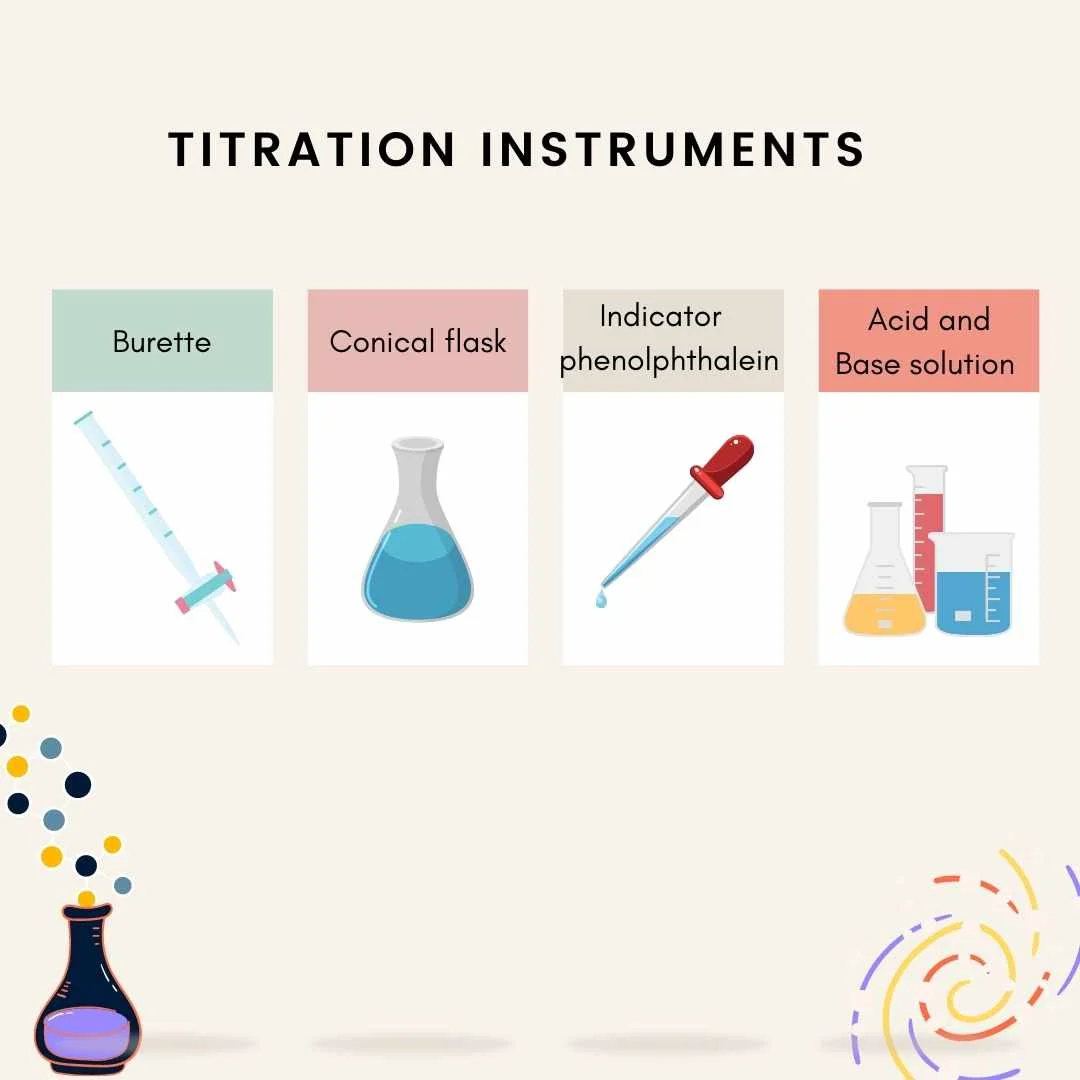
| Phenolphthalein | Colourless | Colourless | Pink |
| Universal indicator | Red, orange or yellow | Green | Blue or purple |
Universal indicator is a mixture of dyes, which is why it gives a range of colours and can be used to estimate a pH value rather than just answering acid-or-alkali. The single-colour indicators such as phenolphthalein change sharply at one point, which is exactly what you want for a titration. There is more on this in our notes on chemical indicators used in the laboratory.
A pH meter or pH probe gives a numerical reading rather than a colour, so it is more accurate and it works on coloured solutions where an indicator would be impossible to read.
How acids ionize in the aqueous medium?
Hydrochloric acid ionize in the aqueous medium
HCl(aq) → H+(aq) + Cl-(aq)
Sulphuric acid ionize in the aqueous medium
H2SO4(aq) → 2H+(aq) + SO42-(aq)
Nitric acid ionize in the aqueous medium
HNO3(aq) → H+(aq) + NO3-(aq)
A weak acid ionises only partly
Ethanoic acid is written with a reversible arrow, because at any moment most of it is still whole molecules:
CH3COOH(aq) ⇌ H+(aq) + CH3COO-(aq)
Properties of acids
- Acids taste sour – think of lime juice or vinegar. Never taste anything in a laboratory. Dilute acids are irritants; concentrated acids are corrosive and will burn skin.
- Acids turn blue litmus paper red. This is the basic test for identifying an acid.
- Dilute acids react with metals above hydrogen in the reactivity series to give the metal salt and hydrogen gas. Copper, silver and gold sit below hydrogen and do not react with dilute acids at all.
- Acids react with carbonates and hydrogencarbonates to give carbon dioxide, which is the fizzing you see with limestone or with baking powder.
- Acids react with bases to give a salt and water.
- Most acids on a laboratory shelf are supplied concentrated. Diluting them with water produces a dilute acid of the concentration you need. Always add the acid to the water, never the other way round.
Reaction of magnesium with hydrochloric acid
Word equation: magnesium + hydrochloric acid → magnesium chloride + hydrogen
Mg(s) + 2HCl(aq) → MgCl2(aq) + H2(g)
The gas given off gives a squeaky pop with a lighted splint – the test for hydrogen.
Carbon dioxide prepared from calcium carbonate
Word equation: calcium carbonate + hydrochloric acid → calcium chloride + water + carbon dioxide
CaCO3(s) + 2HCl(aq) → CaCl2(aq) + H2O(l) + CO2(g)
The gas turns limewater milky – the test for carbon dioxide.
Acid–base reaction
Word equation: sulfuric acid + sodium hydroxide → sodium sulfate + water
H2SO4(aq) + 2NaOH(aq) → Na2SO4(aq) + 2H2O(l)
What is a base, and what is an alkali?
A base is a substance that neutralises an acid by accepting hydrogen ions from it. Metal oxides, metal hydroxides and metal carbonates are all bases.
An alkali is a base that dissolves in water. Dissolving is what lets it release hydroxide ions (OH-) into solution and give a pH above 7. So every alkali is a base, but not every base is an alkali – copper(II) oxide neutralises acid perfectly well but is insoluble, so it is a base and not an alkali. Getting this distinction right is worth an easy mark.
The ion involved is the hydroxide ion, OH-. It is not called a hydroxyl ion; hydroxyl is the name of the –OH group inside an organic molecule such as ethanol.
Strong bases
Strong bases are bases that ionise completely in aqueous solution.
Examples of strong bases
- Sodium hydroxide (NaOH)
- Potassium hydroxide (KOH)
- Calcium hydroxide (Ca(OH)2)
- Barium hydroxide (Ba(OH)2)
- Lithium hydroxide (LiOH)
How strong bases ionize in aqueous solution
NaOH(aq) → Na+(aq) + OH-(aq)
KOH(aq) → K+(aq) + OH-(aq)
Weak bases
Bases that only partially ionise when dissolved in water are called weak bases.
Examples of weak bases
- Ammonia (NH3)
- Methylamine (CH3NH2)
- Ethylamine (C2H5NH2)
- Aniline (C6H5NH2)
Properties of bases and alkalis
- A base is a proton acceptor: it takes H+ ions from an acid to form a salt and water.
- Alkalis turn red litmus paper blue, and turn phenolphthalein pink.
- Alkali solutions feel soapy or slippery on the skin, because they react with the fats in it. Concentrated alkalis are corrosive and are particularly dangerous to eyes.
- Bases react with acids to give a salt and water in the reaction called neutralisation.
- Alkalis react with ammonium salts on warming to release ammonia gas, which turns damp red litmus paper blue.
- Common bases include sodium hydroxide, calcium hydroxide, magnesium oxide and ammonia. Bases turn up in household products such as soaps, oven cleaners, and the antacid tablets used for indigestion.
2NaOH(aq) + H2SO4(aq) → Na2SO4(aq) + 2H2O(l)
Neutralisation
Whatever acid and whatever base you start with, the reaction happening underneath is always the same:
H+(aq) + OH-(aq) → H2O(l)
The hydrogen ion from the acid and the hydroxide ion from the alkali combine to make water. Everything else – the metal ion from the base and the negative ion from the acid – is left in solution as the salt. That is why the general pattern holds for every case:
- acid + metal oxide → salt + water
- acid + metal hydroxide → salt + water
- acid + metal carbonate → salt + water + carbon dioxide
- acid + ammonia → ammonium salt (no water is formed here)
Neutralisation is exothermic – the temperature of the mixture rises as it happens. Everyday uses include treating acidic soil with lime, treating indigestion with antacids, and neutralising acidic industrial waste before it is released.
Naming the salt
The metal comes from the base and the rest of the name comes from the acid. Once you know that, salt naming is mechanical.
| Acid used | Salt produced | Example |
|---|---|---|
| Hydrochloric acid, HCl | Chloride | Sodium chloride, NaCl |
| Sulfuric acid, H2SO4 | Sulfate | Copper(II) sulfate, CuSO4 |
| Nitric acid, HNO3 | Nitrate | Potassium nitrate, KNO3 |
| Phosphoric acid, H3PO4 | Phosphate | Sodium phosphate, Na3PO4 |
| Ethanoic acid, CH3COOH | Ethanoate | Sodium ethanoate, CH3COONa |
Once you have the name, our lesson on how to write a chemical formula shows how to turn it into a formula using the charges on the two ions.
Worked example 1
Name the salt made when nitric acid reacts with copper(II) oxide, and write the word equation.
- The base is copper(II) oxide, so the metal part of the salt is copper(II).
- The acid is nitric acid, so the second part is nitrate.
- The salt is copper(II) nitrate.
- A metal oxide plus an acid gives a salt and water: copper(II) oxide + nitric acid → copper(II) nitrate + water.
Worked example 2
Write the balanced symbol equation for sulfuric acid reacting with calcium carbonate.
- Identify the pattern: acid + carbonate → salt + water + carbon dioxide.
- Name the salt: sulfuric acid gives a sulfate, and the metal is calcium, so it is calcium sulfate.
- Work out the formulae: calcium is Ca2+ and sulfate is SO42-, so calcium sulfate is CaSO4.
- Write it out and balance: H2SO4 + CaCO3 → CaSO4 + H2O + CO2. Check each element – it already balances.
Practice questions
- Explain the difference between a base and an alkali.
- Solution A is 0.1 mol/dm3 hydrochloric acid and solution B is 0.1 mol/dm3 ethanoic acid. Which has the lower pH, and why?
- Name the salt formed when hydrochloric acid reacts with zinc oxide.
- A solution turns universal indicator green and phenolphthalein colourless. What can you say about it?
- Give the ionic equation for neutralisation and state whether the reaction is exothermic or endothermic.
Answers: 1. A base neutralises an acid; an alkali is a base that is soluble in water, so all alkalis are bases but not all bases are alkalis. 2. Hydrochloric acid, because it is a strong acid and ionises completely, so at the same concentration it contains a higher concentration of H+ ions. 3. Zinc chloride. 4. It is neutral, pH 7 – green universal indicator confirms this, and phenolphthalein tells you it is not alkaline. 5. H+(aq) + OH-(aq) → H2O(l); the reaction is exothermic.
Exam tips
- Never write that an acid "has a pH of 1" as though pH were a fixed property. Say a solution of that acid has a low pH, and mention the concentration.
- Use hydroxide ion, not hydroxyl. Hydroxyl is an organic chemistry term and will not be credited here.
- Write "the acid ionises completely" for a strong acid and "ionises only partially" for a weak one. "Breaks up more" is too vague to score.
- Learn which gas test goes with which reaction: hydrogen gives a squeaky pop with a lighted splint; carbon dioxide turns limewater milky.
- When a question asks you to name a salt, take the metal from the base and the ending from the acid. Do not guess from the appearance of the solution.
- Neutralisation gives salt and water. Leaving the water out of the equation is one of the most common ways to lose an easy mark.
Frequently asked questions about acids and bases
What is the difference between a base and an alkali?
A base is any substance that neutralises an acid, including insoluble ones such as copper(II) oxide. An alkali is a base that dissolves in water and therefore releases hydroxide ions into solution. Every alkali is a base, but not every base is an alkali.
What is the difference between a strong acid and a concentrated acid?
Strong describes how completely the acid ionises in water, which is a fixed property of that acid. Concentrated describes how much acid is dissolved in a given volume, which you can change by adding water. A dilute strong acid and a concentrated weak acid are both perfectly possible.
What does the pH scale actually measure?
It measures the concentration of hydrogen ions in a solution. The scale is logarithmic, so a change of one pH unit is a tenfold change in H+ concentration. Below 7 is acidic, 7 is neutral and above 7 is alkaline.
What colour is litmus in acid and in alkali?
Litmus is red in acidic solutions and blue in alkaline solutions, and stays purple in a neutral one. Remembering that blue litmus turns red in acid, and red litmus turns blue in alkali, covers both versions of the question.
What is the ionic equation for neutralisation?
H+(aq) + OH-(aq) → H2O(l). This is the same for every acid and every alkali. The metal ion and the acid's negative ion take no part; they are spectator ions that stay in solution as the salt.
How do you name the salt made in a neutralisation reaction?
The first part of the name comes from the metal in the base and the second part from the acid. Hydrochloric acid gives chlorides, sulfuric acid gives sulfates and nitric acid gives nitrates. So sodium hydroxide with sulfuric acid gives sodium sulfate.
Why does a strong acid react faster than a weak acid of the same concentration?
Because it ionises completely, so it contains a much higher concentration of hydrogen ions. More H+ ions means more successful collisions per second, so magnesium fizzes faster and the temperature rises faster. The total amount of hydrogen produced is unchanged, because that depends on the number of moles of acid.
Which metals react with dilute acids?
Metals above hydrogen in the reactivity series, such as magnesium, zinc and iron, react to give a salt and hydrogen gas. Copper, silver and gold are below hydrogen and do not react with dilute acids. The more reactive the metal, the faster the fizzing.
Is neutralisation exothermic or endothermic?
Exothermic. Energy is released as the hydrogen and hydroxide ions combine to form water, so the temperature of the mixture rises. This temperature rise can even be used to find the point at which exactly the right amount of alkali has been added.