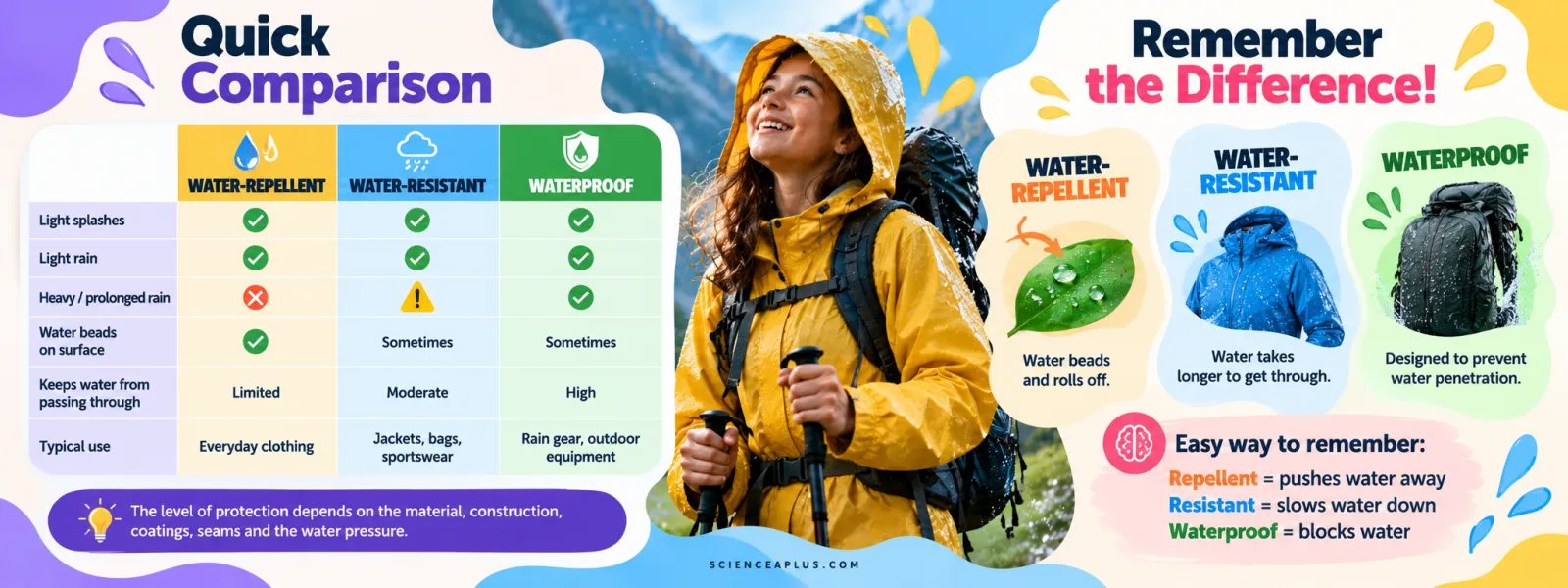
Waterproof, water-resistant and water-repellent describe three different levels of protection. A water-repellent surface makes water bead up and roll off. A water-resistant material slows water down but lets it through in time. A waterproof product blocks liquid water completely, but only up to the pressure, depth or time it was tested for.
The catch is that none of these words has a single legal definition for clothing or gadgets, so two brands can print the same word and mean different things. The trustworthy part of any label is the number beside it: an IP code on a phone, a depth in metres on a watch, or a hydrostatic head in millimetres on a jacket. This guide explains what each word and each number really means, and the physics behind them.
Waterproof vs water-resistant vs water-repellent at a glance
Think of the three terms as answers to one question: what happens when water meets this material? Water-repellent pushes it away at the surface. Water-resistant holds it back for a while. Waterproof keeps it out completely, within tested limits. The table puts the waterproof vs water-resistant vs water-repellent comparison side by side.
| Term | What it means | How it is made | Good for | Number to look for |
|---|---|---|---|---|
| Water-repellent | Water beads and rolls off the surface | A water-hating surface finish, usually a DWR (durable water repellent) coating | Showers, splashes, drizzle | None — there is no standard test number on most labels |
| Water-resistant | Water is slowed down, but gets in eventually | Tight weave, light coatings, rubber seals and gaskets | Light rain, short splashes, hand-washing (watches) | Watch depth in metres or bar; fabric hydrostatic head below waterproof level |
| Waterproof | Liquid water is blocked up to a tested limit | Membrane or coating plus sealed seams; sealed cases for electronics | Heavy or all-day rain, immersion (if rated) | IP67 / IP68 for devices; about 1,500 mm hydrostatic head or more for fabric |
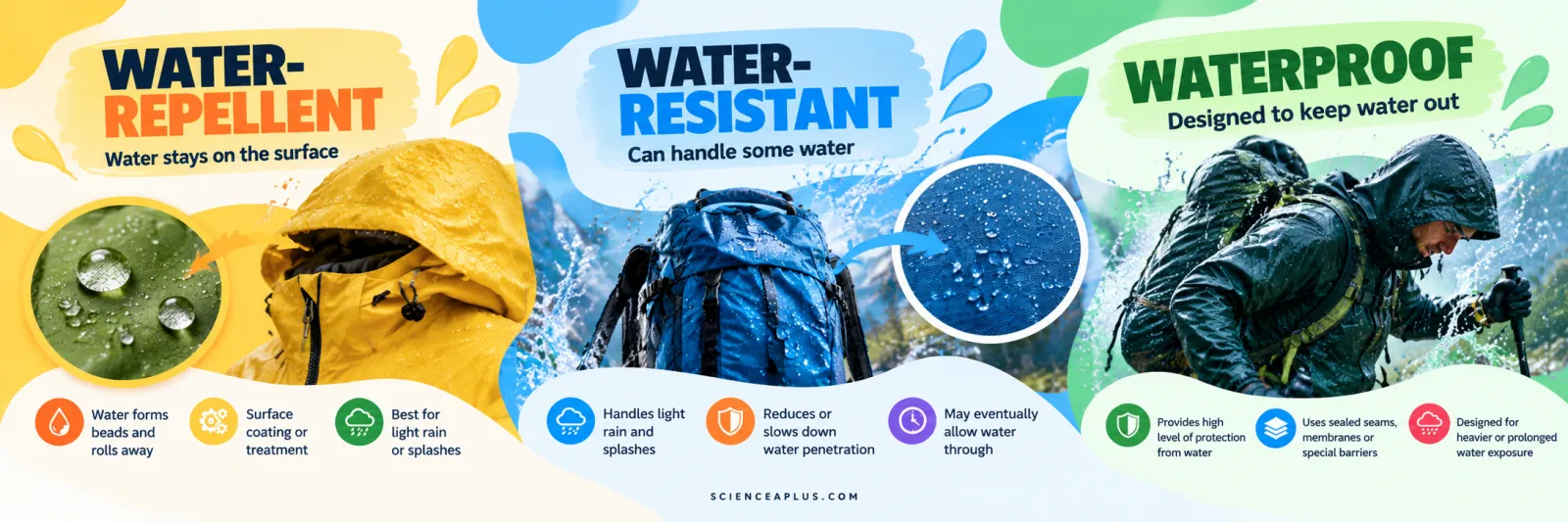
Notice that water-repellent and waterproof are not opposites. A good waterproof jacket is usually both: a waterproof layer inside to stop rain getting through, and a water-repellent finish outside so that rain beads off instead of soaking the outer fabric.
What does water-repellent mean?
A water-repellent surface makes water gather into round droplets that roll away rather than spreading out and soaking in. Scientists call this kind of surface hydrophobic, from the Greek for "water-fearing". Water molecules attract each other strongly, and a hydrophobic surface attracts them only weakly, so the water pulls itself into a bead.
You can measure how water-repellent a surface is with the contact angle: the angle between the surface and the edge of a sitting droplet. A surface is called hydrophobic when the contact angle is more than 90°. Above about 150° it is called superhydrophobic, and drops barely touch it at all.
Nature got there first. The lotus leaf has a contact angle of about 160°. Its surface is covered in tiny wax-coated bumps on two scales, micro and nano, so a drop rests on the tips of the bumps with air trapped underneath. When the leaf tilts, the drops roll off and pick up dirt on the way. This self-cleaning trick is called the lotus effect, and it is the model for many water-repellent coatings. Droplets on leaves are not always rain, either: some plants push water out through their own leaf edges, as explained in our guide to transpiration and guttation.
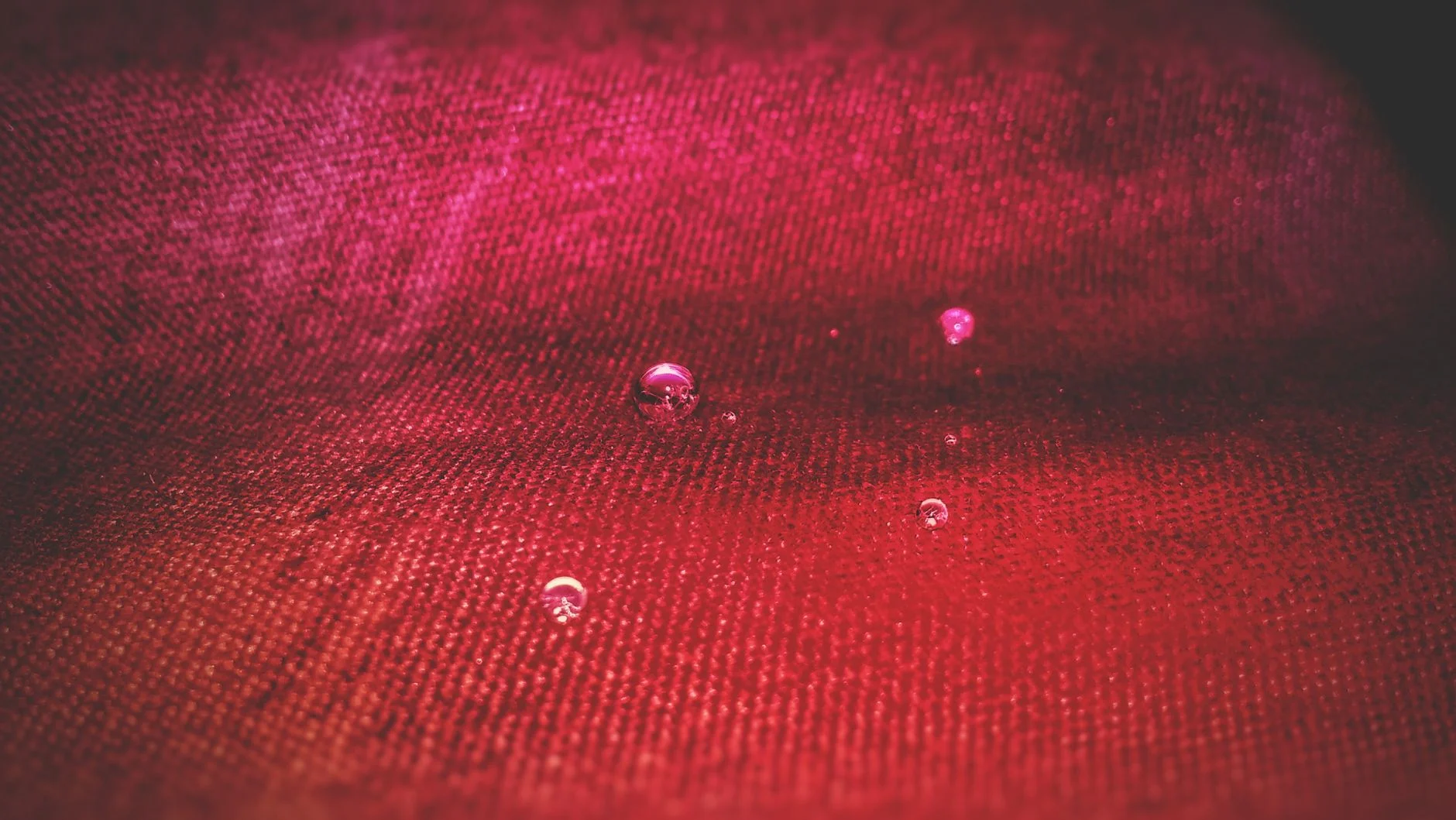
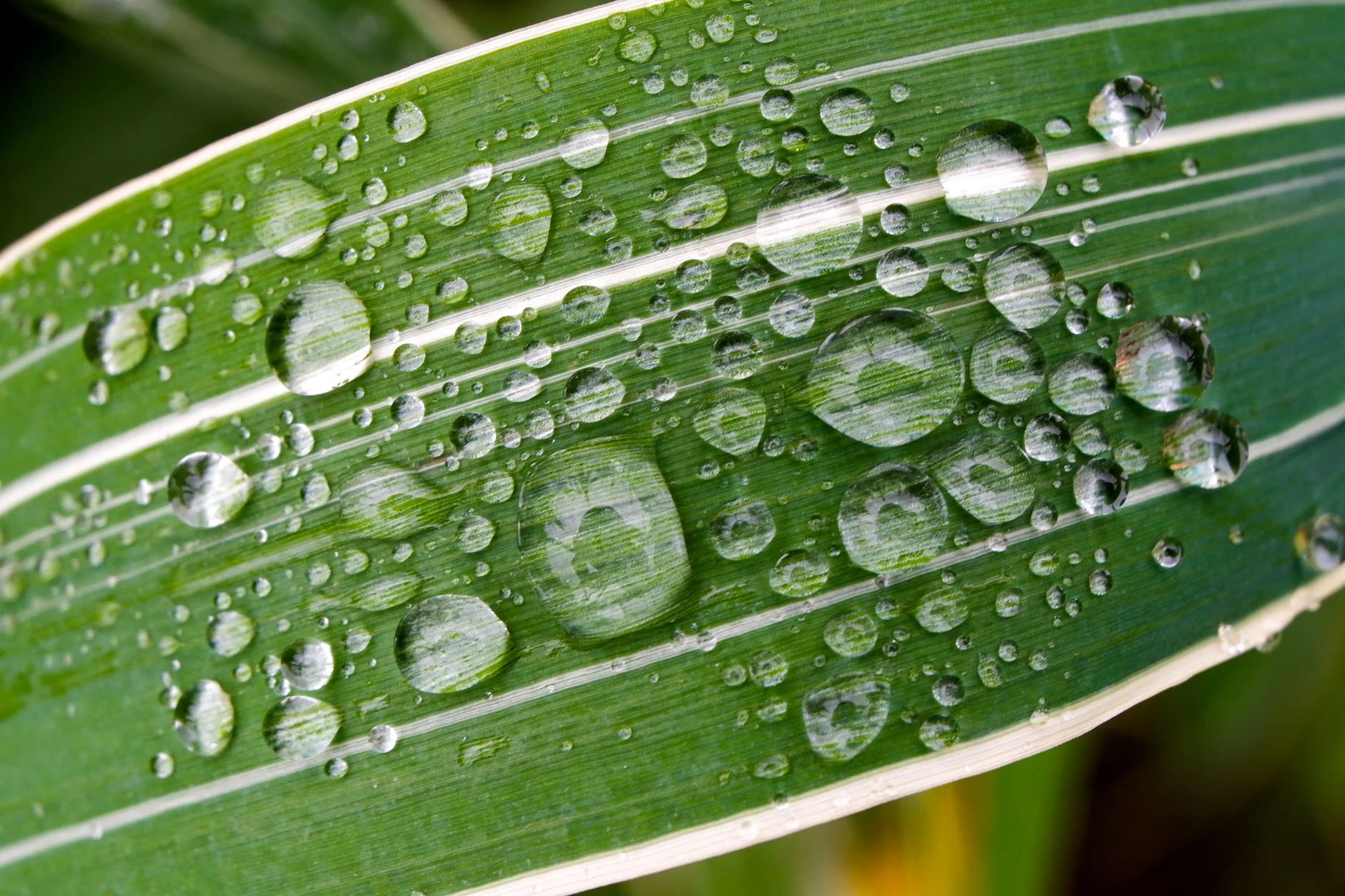
On clothing, water repellency usually comes from a DWR finish, a thin chemical treatment on the outer fabric. It keeps the fabric from filling up with water, which matters because a soaked outer layer feels cold and heavy and stops a jacket from breathing. A breathable jacket needs to let water vapour from your sweat escape, and it cannot do that through a layer of liquid water.
The weakness of water repellency is that it lives only on the surface. Washing, rubbing from rucksack straps, dirt, body oils and sun cream all wear DWR down. When that happens the fabric starts to darken in patches as it soaks up rain, which outdoor brands call wetting out.
What does water-resistant mean?
Water-resistant means a product can slow water down but cannot stop it for ever. With enough time or enough pressure, water will find a way through.
In fabrics, resistance usually comes from a very tight weave. Synthetic fibres such as nylon and polyester can be woven so densely that rain takes a while to push between the threads, especially with a light coating on top. A water-resistant windproof top or school coat is fine for a walk to the bus stop in drizzle, but in a long downpour it will slowly soak through, starting at the shoulders where rucksack straps press the wet fabric against you.
In watches, bags and gadgets, water resistance comes from rubber seals, gaskets, tight-fitting cases and glued joints. These keep out splashes and rain. They are not designed to cope with water forced in under pressure, such as a jet from a tap, a dive into a pool or a hot shower where heat and soap attack the seals.
Two things decide whether water-resistant gear stays dry:
- Time — a short shower is fine; hours of rain are not.
- Pressure — water pressed hard against the material, for example by kneeling on wet ground or by moving quickly through water, gets through much faster.
That is why the most useful water-resistant products tell you how much pressure they were tested to. Watches show it in metres or bar, and fabrics show it in millimetres of water. Both numbers are explained later in this guide.
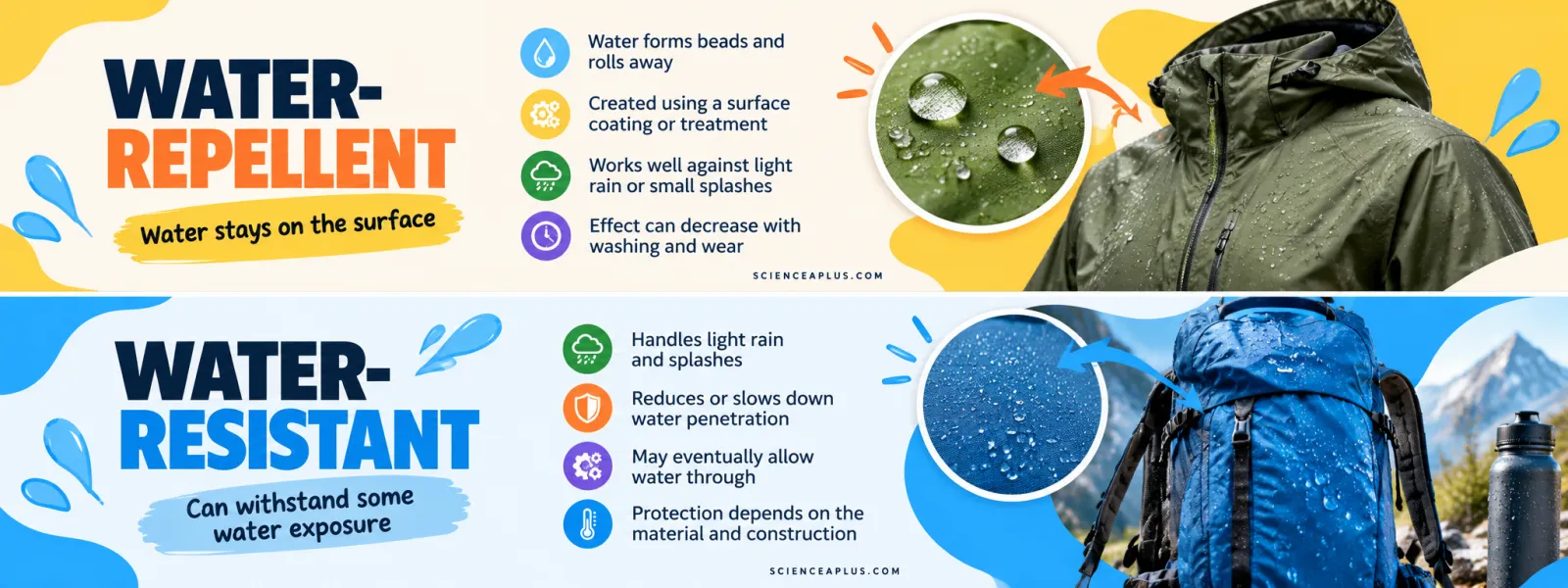
So far the pattern is clear: repellency is about the surface, resistance is about slowing water down, and neither promises to keep you dry in heavy rain. For that you need something properly waterproof, which is where the testing gets serious.
What does waterproof really mean?
Waterproof means liquid water cannot get through, up to the limit the product was tested for. That last part matters. A waterproof jacket is tested against a certain water pressure, a waterproof phone against a certain depth for a certain time. Go beyond those conditions and even "waterproof" gear can leak.
A waterproof jacket usually has three layers working together:
- An outer fabric with a water-repellent (DWR) finish so rain beads off.
- A waterproof membrane or coating bonded to the inside of that fabric. This is the layer that actually stops the rain.
- Sealed or taped seams. Every stitch hole is a tiny gap, so waterproof garments cover the seams with waterproof tape.
Many membranes are also breathable. Some, such as expanded PTFE, contain microscopic pores that are too small for liquid water droplets to pass through but large enough for water vapour from sweat to escape; others are solid polyurethane layers that pass vapour by absorbing and releasing it. Breathability has a cost, though: the more waterproof a fabric is made, the less breathable it usually becomes. A heavy plastic poncho is very waterproof and not breathable at all, which is why you can end up damp on the inside from your own sweat.
Nothing stays waterproof for ever. Membranes can crack, seam tape can peel, and the seals in phones and watches harden as they age. Apple's own wording for its phones is a useful reminder: "Splash, water, and dust resistance are not permanent conditions. Resistance might decrease as a result of normal wear." That is why phone makers say "water-resistant" in their small print, even when the device has a high waterproof rating.
Why does water damage electronics?
Surprisingly, perfectly pure water is a poor conductor of electricity. Its molecules are held together by covalent bonds and have no overall charge, so very few charged particles are free to carry a current. The problem is that real water is never pure. Tap water, rain, sweat and sea water all contain dissolved salts that split into ions, and ions do carry charge. As our guide to distilled water explains, it is these dissolved substances that make everyday water conduct.
Once that conducting water bridges two parts of a circuit, current can flow where it should not, which is a short circuit. Even after the device dries out, the water leaves salts behind and starts corrosion on metal contacts. Sea water is especially damaging because it carries so much dissolved salt. This is why electronics are tested so carefully, and why their ratings follow a strict international code.
IP ratings explained (IEC 60529)
For electronics and electrical equipment, the clearest answer to "how waterproof is it?" is the IP code, set out in the international standard IEC 60529. IP is usually read as "Ingress Protection", although the standard itself calls it "International Protection". The code is two letters followed by two digits, for example IP68:
- The first digit (0–6) shows protection against solids, from fingers down to fine dust.
- The second digit (0–9) shows protection against water, from dripping water to high-pressure, high-temperature jets.
- An X in place of a digit (as in IPX7) means that test was not done or not reported. It does not mean "no protection".
First digit: protection against solids
| Digit | Protected against |
|---|---|
| 0 | No protection |
| 1 | Solid objects larger than 50 mm, such as the back of a hand |
| 2 | Objects larger than 12.5 mm, such as fingers |
| 3 | Objects larger than 2.5 mm, such as tools and thick wires |
| 4 | Objects larger than 1 mm, such as most wires and slender screws |
| 5 | Dust-protected: some dust may get in, but not enough to stop it working |
| 6 | Dust-tight: no dust gets in (tested in a vacuum chamber for up to 8 hours) |
Second digit: protection against water
| Digit | Protected against | What the test involves |
|---|---|---|
| 0 | No protection | — |
| 1 | Dripping water | Drops falling vertically for 10 minutes |
| 2 | Dripping water when tilted | Drops with the device tilted up to 15° |
| 3 | Spraying water | Spray up to 60° from vertical |
| 4 | Splashing water | Splashes from any direction |
| 5 | Water jets | 6.3 mm nozzle, 12.5 litres per minute, from 3 m |
| 6 | Powerful water jets | 12.5 mm nozzle, 100 litres per minute |
| 7 | Temporary immersion | Up to 1 m deep for 30 minutes |
| 8 | Continuous immersion | Deeper than 1 m, under conditions stated by the manufacturer |
| 9 | High-pressure, high-temperature jets | Water at 80 °C, used for vehicles and wash-down equipment |
Here is a trap many people fall into: the water digits are not cumulative above 6. Immersion tests (7 and 8) and jet tests (5 and 6) are different, so an IPX7 speaker has not necessarily passed the IPX5 jet test. Products that pass both are labelled with both, such as IPX5/IPX7.
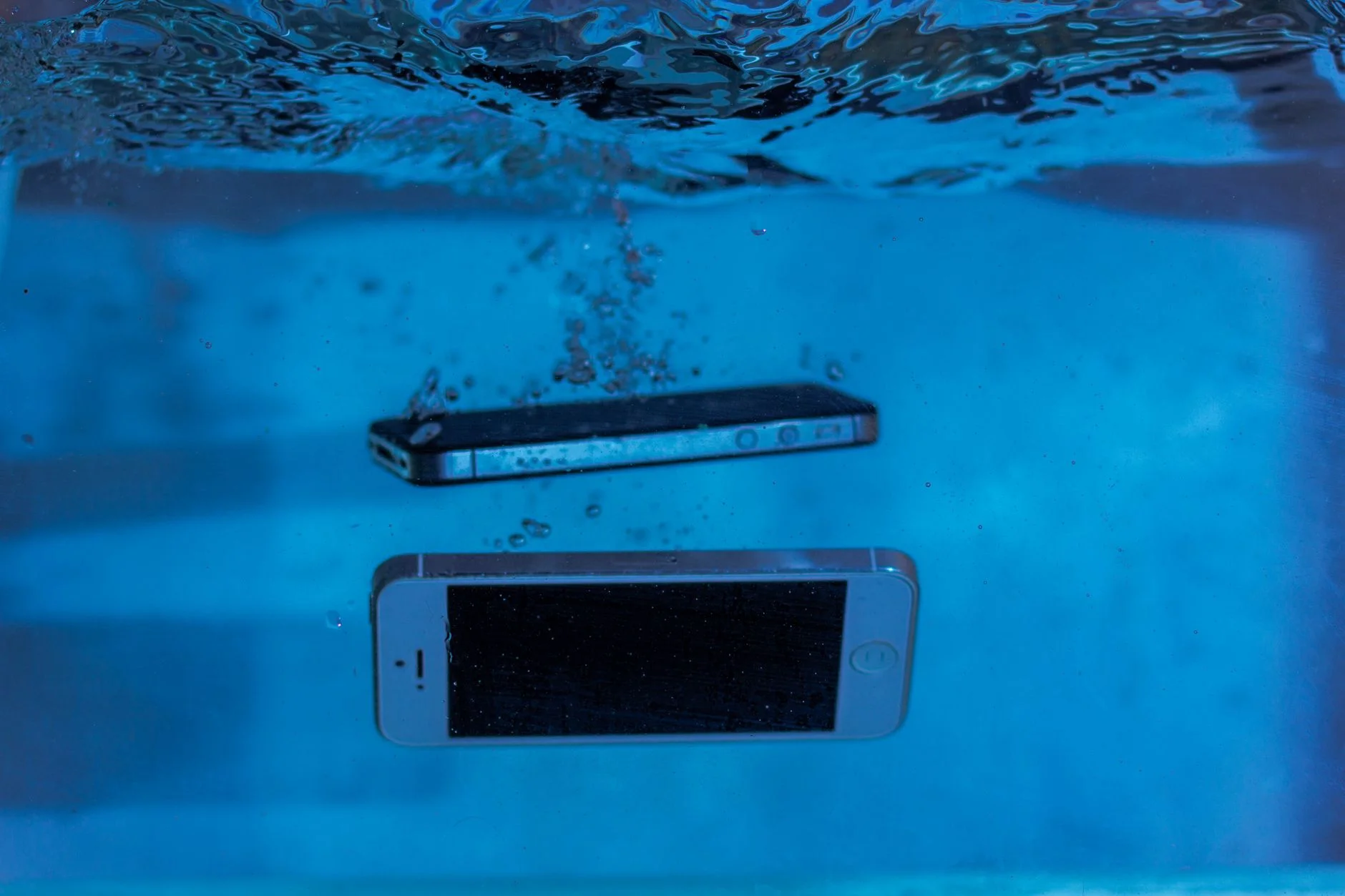
Take a real example. The iPhone 17 is rated IP68, to a maximum depth of 6 m for up to 30 minutes. The 6 tells you it is dust-tight. The 8 tells you it survived immersion, and because IPX8 conditions are set by the manufacturer, Apple states the depth and time it used. Those tests are done in fresh water in a laboratory, not in salty sea water, chlorinated pools or soapy baths, and liquid damage is not covered by the warranty.
A camera is rated IP67. What does this tell you? (2 marks)
The 6 means it is dust-tight, so no dust can get in. The 7 means it is protected against temporary immersion in water up to 1 m deep for 30 minutes.
A speaker is rated IPX7. Is it safe to clean it with a powerful hose? Explain. (2 marks)
Not necessarily. The X means it was not tested for dust, and the 7 covers immersion only. Ratings above 6 are not cumulative, so it has not been shown to survive water jets (IPX5 or IPX6).
Water-resistant watches: what do 30 m, 50 m and 100 m mean?
Watches use their own system. Everyday water-resistant watches are covered by the international standard ISO 22810:2010, which replaced the older ISO 2281. To carry a water-resistant marking, a watch has to pass several tests, including sitting about 10 cm under water for at least an hour and a condensation test that shows whether any moisture got inside the case.
The figure on the back, such as "50 m", "5 bar" or "5 ATM", causes more confusion than anything else on a watch. It does not mean you can safely take the watch 50 m underwater. It is the test pressure, written as the depth of still water that would create that pressure in a laboratory. Real life is rougher: diving in, swimming strokes, waves and jets from a shower all add pressure, while heat, soap and age weaken the seals.
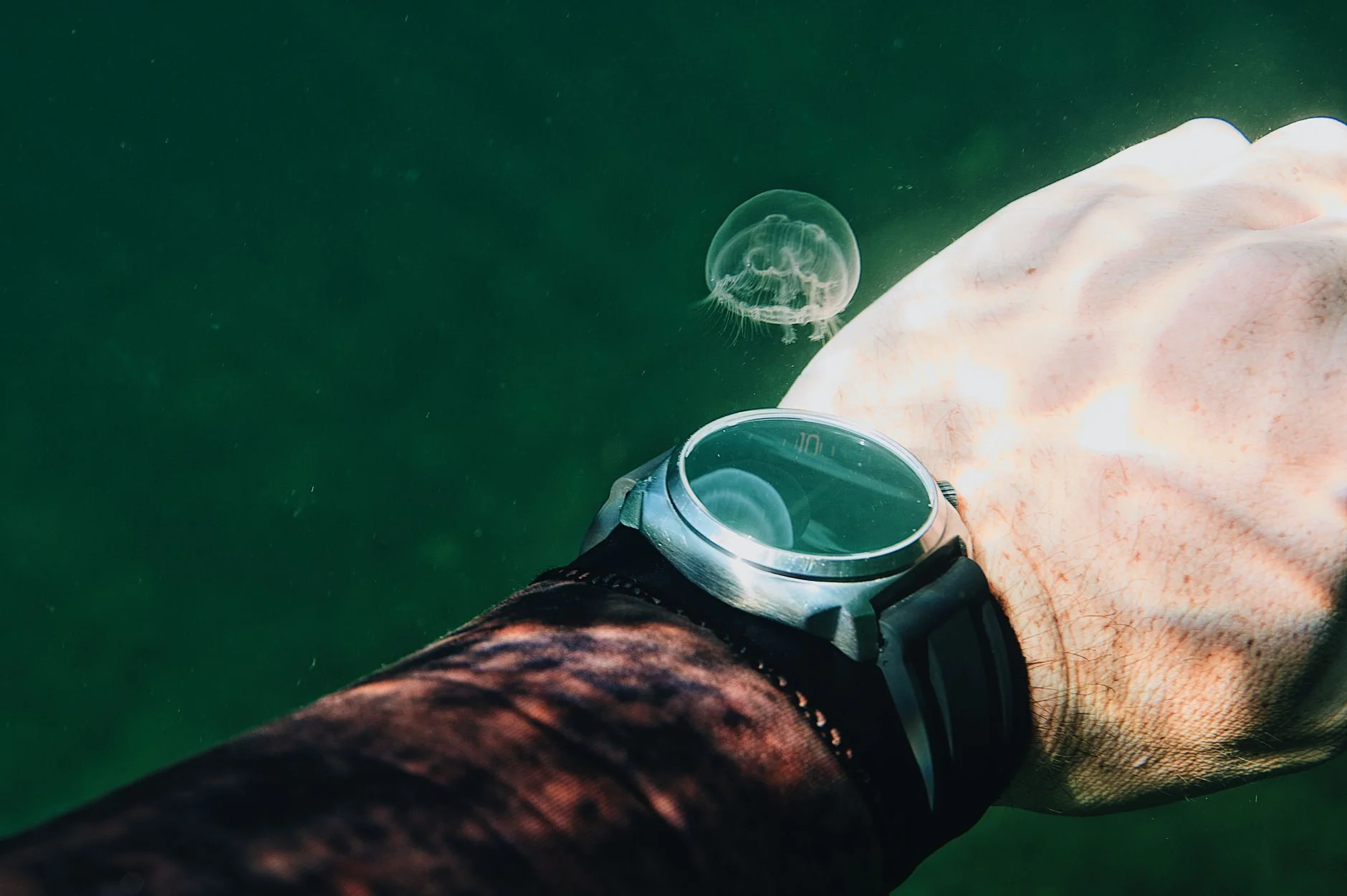
Water pressure rises steadily with depth, by about 1 bar for every 10 m of water. So 3 bar ≈ 30 m, 5 bar ≈ 50 m and 10 bar ≈ 100 m. Watchmakers give guidance for each marking. The table shows typical guidance; always check your own watch's manual, because brands differ.
| Marking | Test pressure | Typical guidance |
|---|---|---|
| 30 m / 3 ATM | ≈ 3 bar | Everyday wear, rain and splashes. Not for showering, swimming or diving. |
| 50 m / 5 ATM | ≈ 5 bar | Showering, bathing, shallow-water swimming and snorkelling. Not for diving. |
| 100 m / 10 ATM | ≈ 10 bar | Swimming, snorkelling, surfing and water sports. Not for diving. |
| 200 m / 20 ATM | ≈ 20 bar | Serious water sports and skin diving. |
| DIVER'S 100 m or more | Tested to 125% of rating | Scuba diving (ISO 6425 divers' watch). |
Try the same calculation for any depth or any fabric rating with the calculator below. Enter a depth in metres, or a hydrostatic head in millimetres (explained in the next section), and see the pressure it represents.
What makes a dive watch? ISO 6425
A true diving watch follows a stricter standard, ISO 6425. It must be rated to at least 100 m and is tested at 125% of its rated pressure, so a 200 m dive watch has to survive the pressure of 250 m. The extra margin allows for ageing seals, the slightly higher density of sea water and the sudden pressure changes of real diving.
ISO 6425 also asks for things that have nothing to do with water: the watch must be readable in total darkness, must have a way of timing a dive (usually a bezel that only turns one way), and must pass tests for shocks, magnetism and sudden temperature changes. Only then can the dial carry the word "DIVER'S". A smartwatch rated "WR50", such as most Apple Watch models, is a water-resistant watch under ISO 22810: fine for shallow swimming, not for scuba diving.
Salt water deserves special care. It is denser than fresh water and full of dissolved salt, as our page on the salinity of oceans explains, and dried salt crystals can damage seals and push-buttons. Pool water brings chlorine, which can also dry out rubber gaskets over time; it is one of the trade-offs covered in our look at saltwater pools. Rinse a watch in fresh water after the sea or the pool, and never press its buttons underwater unless the manual says you can.
How waterproof fabric is tested: hydrostatic head
For jackets, trousers and tents the key number is the hydrostatic head (HH), measured in millimetres. In the test, a piece of fabric is clamped under a tall tube and water is added to the tube. As the water column gets taller, it presses harder on the fabric. The hydrostatic head is the height of the column, in mm, at the moment water starts to seep through. Laboratories follow standard methods such as ISO 811.
A rating of 10,000 mm means the fabric held back a column of water 10 m tall. Every 1,000 mm of water is a pressure of about 9.8 kPa, roughly a tenth of normal air pressure. In the UK, fabric is often described as waterproof from about 1,500 mm, but there is no single worldwide threshold, and outdoor brands aim much higher.
| Hydrostatic head (jacket) | Typical use |
|---|---|
| About 1,500 mm | Often treated by brands as the starting point for "waterproof" |
| 10,000 mm | Light use and trail running; may struggle under rucksack straps |
| 20,000 mm | Most three-season hiking |
| 30,000 mm | Mountaineering and severe conditions |
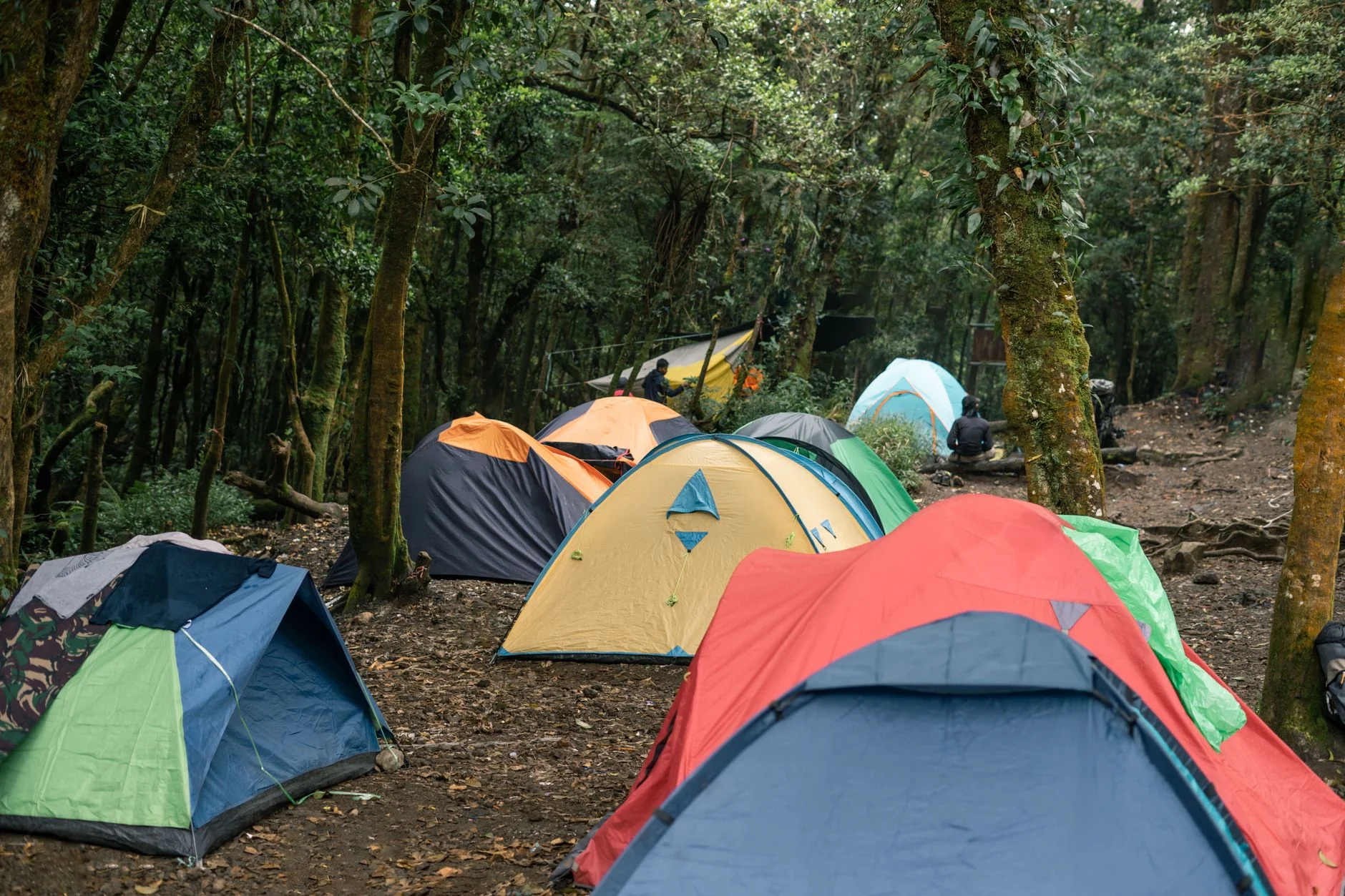
Why would anyone need a fabric that can hold back a 20 m column of water when rain falls gently? Because pressure depends on force and area. When you kneel on wet ground, sit on a soaked bench or carry a heavy rucksack, your weight presses on a small area of fabric and squeezes water through it. That is also why tent groundsheets need higher ratings than the flysheet above them.
| Tent flysheet rating | Suitable for |
|---|---|
| Under 1,200 mm | Light showers only |
| 1,200–2,000 mm | Heavy rain |
| Over 2,000 mm | Heavy rain with strong winds |
| Groundsheet: 3,000 mm or more | Recommended because you lie and kneel on it |
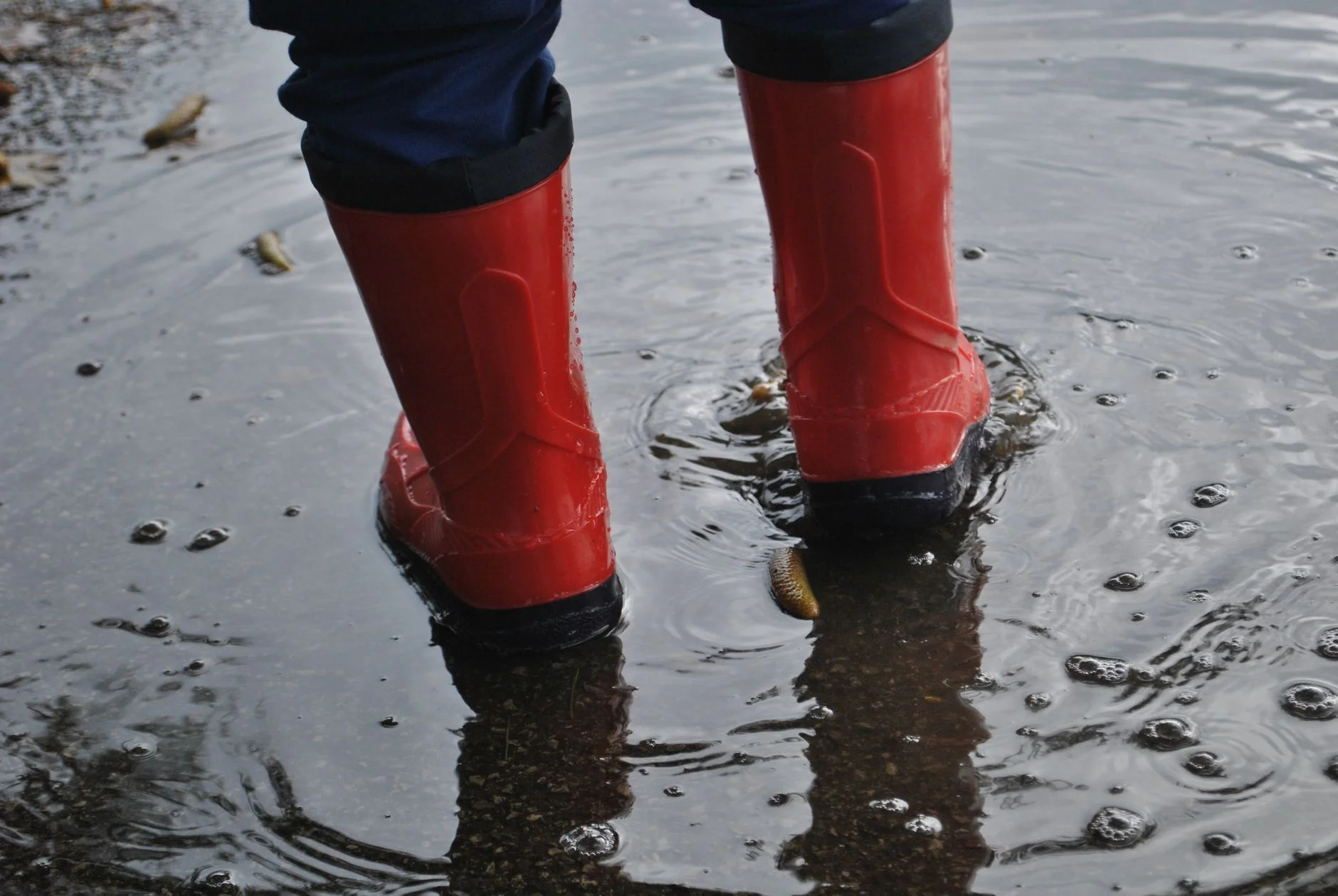

Work and safety rainwear in Europe uses another label, EN 343, which was replaced in 2025 by EN ISO 24232 with the same content and classes. The garment label shows a class from 1 to 4 for water penetration, where class 4 is the most waterproof and class 1 starts at 8,000 Pa (about 800 mm) on unwashed fabric. A second number from 1 to 4 shows breathability, and an optional "R" means the whole garment has been tested in a rain tower.
DWR, PFAS and "forever chemicals": what changed in 2026
For decades the best water-repellent finishes were made with PFAS (per- and polyfluoroalkyl substances). Their carbon–fluorine bonds make a surface that repels both water and oil, so rain, mud and grease all bead off. The same strong bonds are the problem: PFAS hardly break down in the environment, which is why they are nicknamed "forever chemicals".
Because they last so long, PFAS released from factories, washing machines and old clothes end up in rivers, soil and drinking water, and some can build up inside living things over time. Our guide to bioaccumulation and biomagnification explains how persistent chemicals concentrate in food chains. PFAS have become one of the major concerns in water pollution, and governments have started to act. Here is where the rules stood on 5 October 2026:
- California, USA — PFAS have been banned in most new clothing and textiles since 1 January 2025. The allowed limit tightens on 1 January 2027, and a temporary exemption for outdoor clothing made for severe wet conditions ends on 1 January 2028.
- France — a ban on PFAS in clothing textiles (with some exceptions), cosmetics and ski wax has applied since 1 January 2026.
- Denmark — since 1 July 2026, clothing, footwear and waterproofing sprays for consumers may not contain PFAS above a set fluorine limit.
- European Union — a restriction on one PFAS group, PFHxA and related substances, applies to clothing, footwear and accessories sold to the public from 10 October 2026.
- EU-wide ban on all PFAS — still only a proposal. The European Chemicals Agency's scientific committees are due to finish their opinions by the end of 2026; after that, the European Commission and member states decide.
- United Kingdom — the government published its first PFAS Plan on 3 February 2026. It says the Health and Safety Executive will consider restrictions, including for textiles, but there is no UK ban on PFAS in clothing yet.
The outdoor industry has been changing ahead of the law. Many brands now use PFAS-free DWR finishes based on other water-repelling chemicals. These bead rain well but do not repel oil, so they may need washing and re-proofing more often. Membranes are changing too. The classic Gore-Tex membrane is made of expanded PTFE, a fluoropolymer, but in 2022 Gore introduced a PFAS-free membrane made of expanded polyethylene (ePE) and has since used it in more products.
Waterproof gear also links to the wider debate about synthetic materials. Most jackets are made from plastics such as nylon and polyester, and the disadvantages of plastics apply to them too. The greenest jacket is usually the one you already own, kept working for longer.
How to keep your gear waterproof
Most "my waterproof jacket leaks" problems are really a worn-out DWR finish. The fabric wets out, feels cold and clammy, and sweat can no longer escape. A clean and a re-proof often brings the jacket back. Tick off the steps as you go:
- Check the care label first and follow it if it disagrees with any step here.
- Close all zips and fasteners, and empty the pockets.
- Machine wash warm with a small amount of liquid detergent; no fabric softener, which clogs the fabric.
- Rinse well so no detergent is left behind.
- Tumble dry on a warm setting for about 20 minutes if the label allows; heat helps reactivate the DWR.
- Test with a splash of water: if it no longer beads, apply a wash-in or spray-on re-proofer.
- Check seams, seam tape and zips for peeling or cracks before your next trip.
For watches and phones: keep crowns and ports closed, rinse off salt or chlorinated water, avoid saunas and hot showers, and have a watch's seals checked when the battery is changed.
Frequently asked questions about waterproof, water-resistant and water-repellent
Is water-resistant the same as waterproof?
No. Water-resistant products slow water down and cope with splashes or light rain, but water eventually gets in with enough time or pressure. Waterproof products block liquid water completely up to a tested limit, such as IP68 for a phone or a hydrostatic head of 1,500 mm or more for fabric.
Which is better, water-resistant or water-repellent?
Neither word is officially ranked, and brands use them differently. Water-repellent describes a surface that makes water bead and roll off, while water-resistant describes material that slows water down. For real protection, ignore the word and compare test numbers such as hydrostatic head, an IP code or a watch's depth rating.
What does IP68 mean?
IP68 is a rating under the standard IEC 60529. The 6 means the device is dust-tight. The 8 means it survived continuous immersion deeper than 1 m, under conditions the manufacturer states. For example, the iPhone 17 is rated IP68 to a maximum depth of 6 m for up to 30 minutes in laboratory tests.
What does IPX7 mean?
IPX7 means a device is protected against temporary immersion in water up to 1 m deep for 30 minutes. The X means it was not rated for dust. Because water ratings are not cumulative above 6, an IPX7 device has not necessarily passed the water jet tests needed for IPX5 or IPX6.
Can I swim with a 50 m water-resistant watch?
Usually yes, for shallow swimming. A 50 m (5 ATM) marking is a laboratory test pressure, not a diving depth, and typical guidance allows showering, bathing, shallow-water swimming and snorkelling, but not diving. Check the manual, keep the crown closed, and rinse the watch in fresh water after the sea or a pool.
What does 5 ATM mean on a watch?
5 ATM means the watch was tested at a pressure of about 5 atmospheres, roughly 5 bar. Water adds about 1 bar for every 10 m of depth, so this equals still water about 50 m deep. Under ISO 22810 the marking shows the test pressure only; it does not mean the watch is suitable for diving.
How many mm of hydrostatic head is waterproof?
Many retailers and outdoor brands treat about 1,500 mm hydrostatic head as the minimum for “waterproof”, but there is no single official threshold. Outdoor jackets usually go much higher: around 10,000 mm for light use, 20,000 mm for most hiking and 30,000 mm for mountaineering. Tent groundsheets are usually recommended at 3,000 mm or more.
What is DWR on a jacket?
DWR stands for durable water repellent. It is a thin finish on the outer fabric of a jacket that makes rain bead up and roll off, so the fabric does not soak through and the jacket can keep breathing. DWR wears off with use and washing, but warm tumble drying and re-proofing can restore it.
Are PFAS still used in waterproof clothing?
Less and less. Many brands have switched to PFAS-free finishes and membranes. As of October 2026, France and Denmark ban PFAS in most consumer clothing, the EU restricts PFHxA in clothing from 10 October 2026, and California's ban covers most textiles. An EU-wide ban on all PFAS is still being assessed.