Key points at a glance
- A covalent bond is a shared pair of electrons between two atoms. It forms between non-metal atoms.
- Atoms share so that each one ends up with a full outer shell – the electron arrangement of the nearest noble gas.
- One shared pair is a single bond, two shared pairs a double bond, three a triple bond. More shared pairs means a shorter, stronger bond.
- Simple molecular substances such as water and methane have low melting points, because melting them only breaks the weak forces between molecules, not the covalent bonds themselves.
- Giant covalent structures such as diamond, graphite and silicon dioxide have very high melting points, because melting them means breaking millions of strong covalent bonds.
- A bond between two different non-metals is usually polar: the electrons are pulled closer to the more electronegative atom.
A covalent bond is what holds a molecule together. Instead of one atom handing electrons over to another, as happens in ionic bonding, both atoms contribute electrons to a shared pair that belongs to both of them at once. That single idea explains the structure of water, methane, oxygen, diamond and every plastic you have ever handled.
Covalent Bonds definition
Another method of forming bonds between atoms is electron sharing. The atoms acquire the noble gas configuration by sharing electrons in this manner. A covalent bond is the joining of atoms by sharing electrons between two atoms.
Both nuclei are positively charged and the shared pair of electrons sits between them. Each nucleus is attracted to that shared pair, and it is this electrostatic attraction between the two nuclei and the shared pair of electrons that is the bond. Writing it that way, rather than just "the atoms share electrons", is what full-mark definitions look like.
How to draw a dot-and-cross diagram
A dot-and-cross diagram shows where each electron in the bond came from. Electrons from one atom are drawn as dots, electrons from the other as crosses. They are identical in reality – the two symbols are purely a bookkeeping device for you and the examiner. Follow the same five steps every time.
- Find the number of outer electrons from the group number in the periodic table. Group 1 has 1, group 4 has 4, group 6 has 6, group 7 has 7.
- Work out how many more each atom needs for a full outer shell: 8 for most atoms, but only 2 for hydrogen, which is aiming for the helium arrangement.
- Decide how many atoms are needed. Oxygen needs two more electrons and hydrogen can supply one each, so water is H2O.
- Draw the overlap. Sketch two circles that overlap, and put each shared pair – one dot and one cross – in the overlapping region. Everything else goes in the non-overlapping part.
- Check every atom. Count the electrons around each atom, including the shared ones. Every atom should now have a full outer shell. If one does not, you have the wrong formula.
Working out the outer-shell numbers is much easier once you are comfortable with electronic configuration.
Single, double and triple bonds
The number of shared pairs between two atoms is not a matter of choice – it is decided by how many electrons each atom still needs.
| Type of bond | Shared pairs | Electrons shared | Example | Drawn as |
|---|---|---|---|---|
| Single | 1 | 2 | H–H in hydrogen, H–O in water | One line |
| Double | 2 | 4 | O=O in oxygen, C=O in carbon dioxide | Two lines |
| Triple | 3 | 6 | N≡N in nitrogen | Three lines |
The more pairs that are shared, the shorter and stronger the bond becomes. The triple bond in nitrogen is exceptionally strong, which is why nitrogen gas is so unreactive that it makes up most of the air without taking part in anything.
Formation of homoatomic molecules and heteroatomic molecules
Homoatomic molecules
The sharing of electrons between atoms of the same type produces homoatomic molecules. Because both atoms are of the same element, these are elements, not compounds.
Examples for homoatomic molecules
- Oxygen (O2)
- Hydrogen (H2)
- Fluorine (F2)
- Nitrogen (N2)
Heteroatomic molecules
The sharing of electrons between atoms of different elements results in the formation of heteroatomic molecules. Because more than one element is present, these are compounds.
Examples for heteroatomic molecules
methane (CH4), water (H2O), ammonia (NH3)
Examples of compounds that have covalent bonds
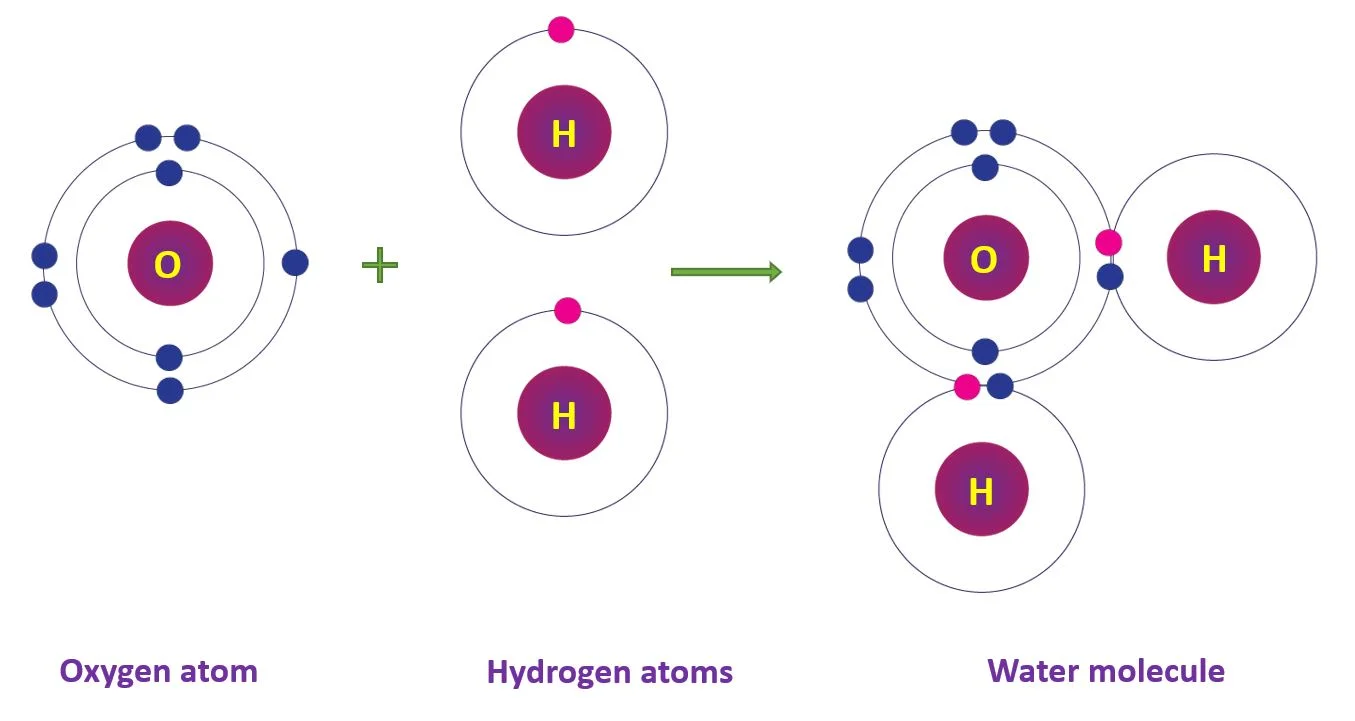
Covalent Bonds in Water molecule
The oxygen atom's electronic configuration is 2, 6. An oxygen atom shares two pairs of electrons with two hydrogen atoms, resulting in the formation of two single bonds and the formation of the water (H2O) molecule. Oxygen ends up with eight outer electrons and each hydrogen with two.
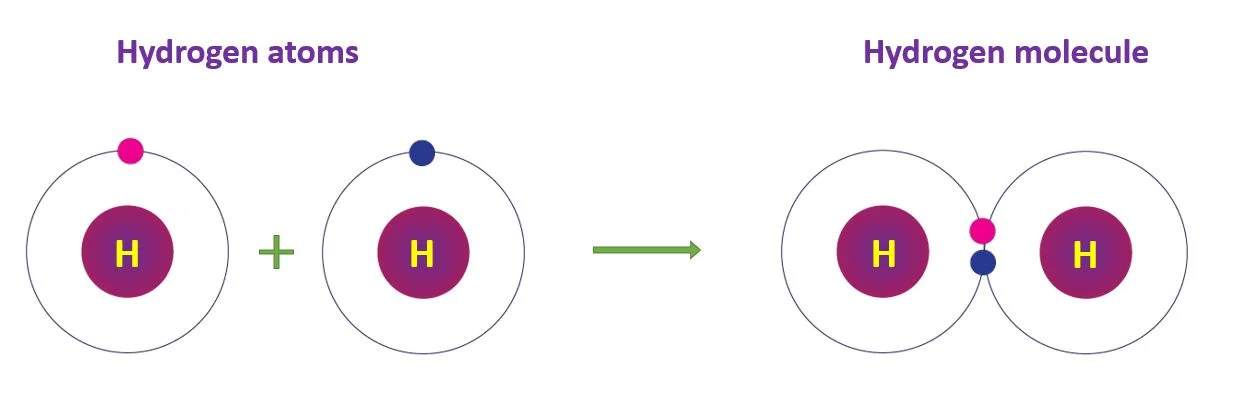
Covalent Bonds in Hydrogen molecule
One electron exists in a hydrogen atom. Two hydrogen atoms share their electrons, resulting in the stable configuration of helium. This results in the hydrogen molecule (H2), which is formed when two hydrogen atoms form a covalent bond.
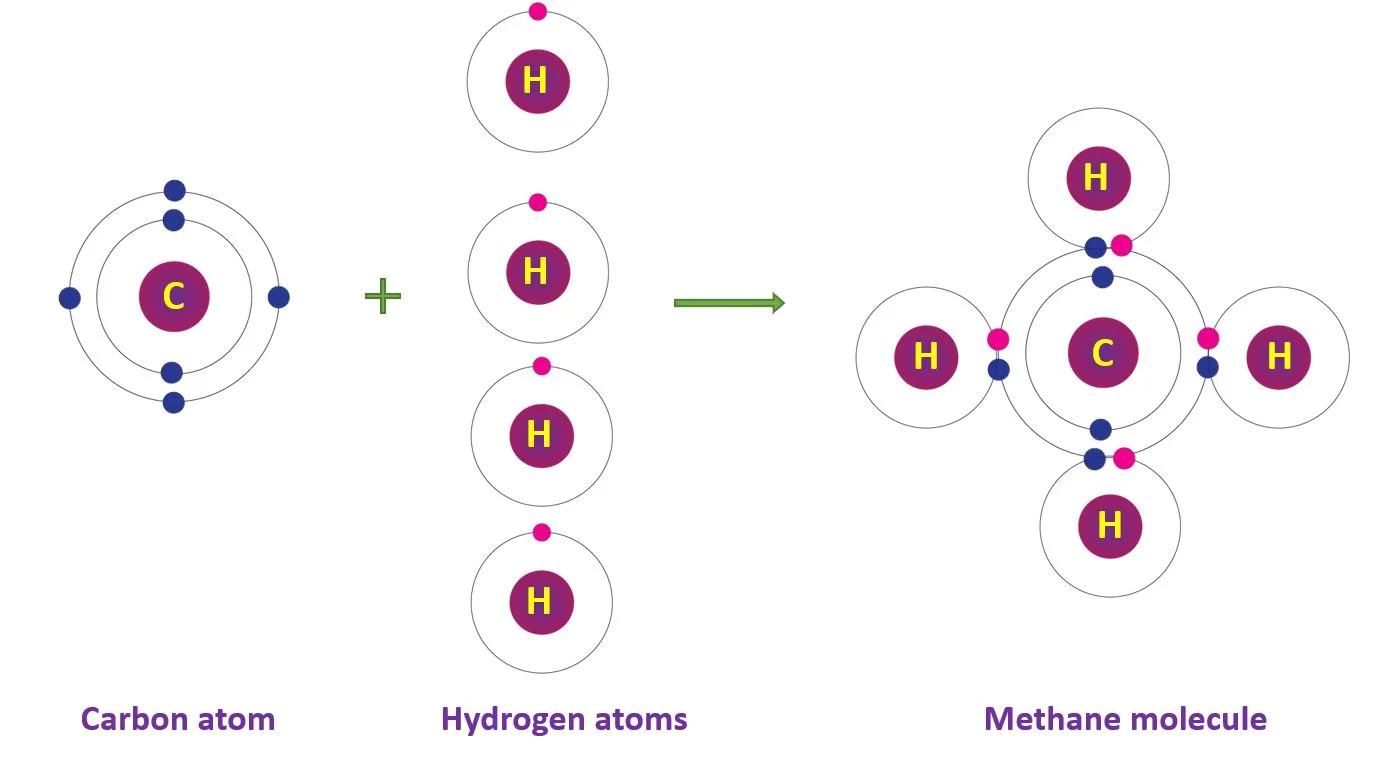
Covalent Bonds in Methane molecule
The carbon atom's electronic configuration is 2, 4. A carbon atom shares four pairs of electrons with four hydrogen atoms, forming four single bonds and giving the methane molecule (CH4). Carbon then has eight outer electrons and each hydrogen has two.
Covalent Bonds in Fluorine molecule
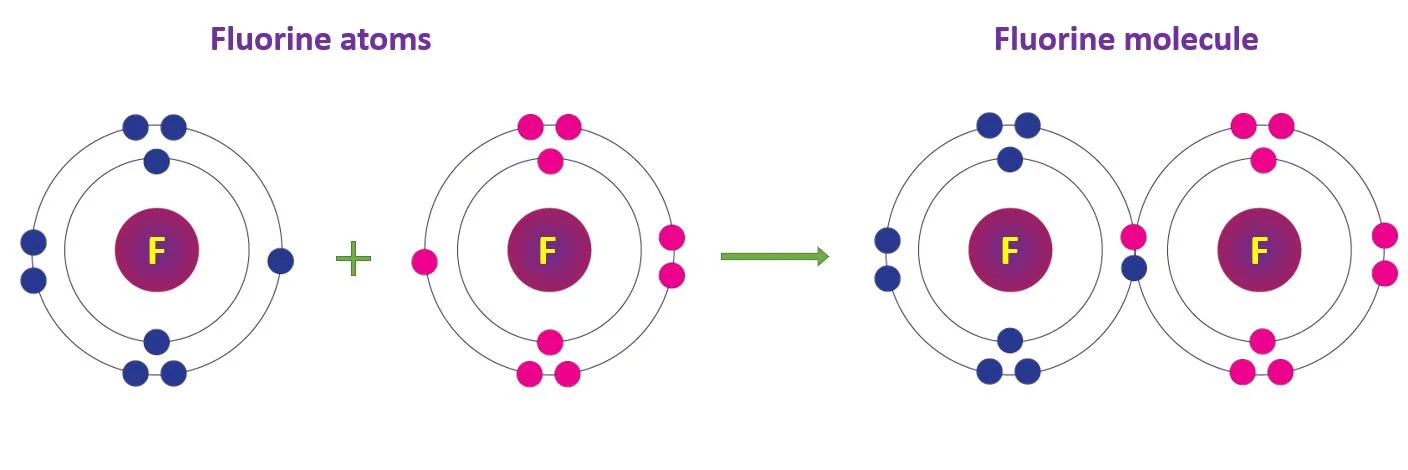
A fluorine atom has an electronic configuration of 2, 7. Two fluorine atoms achieve the stable electronic configuration by sharing a pair of electrons. As a result, two fluorine atoms are covalently bonded to form a fluorine molecule.
Covalent Bonds in Ammonia molecule
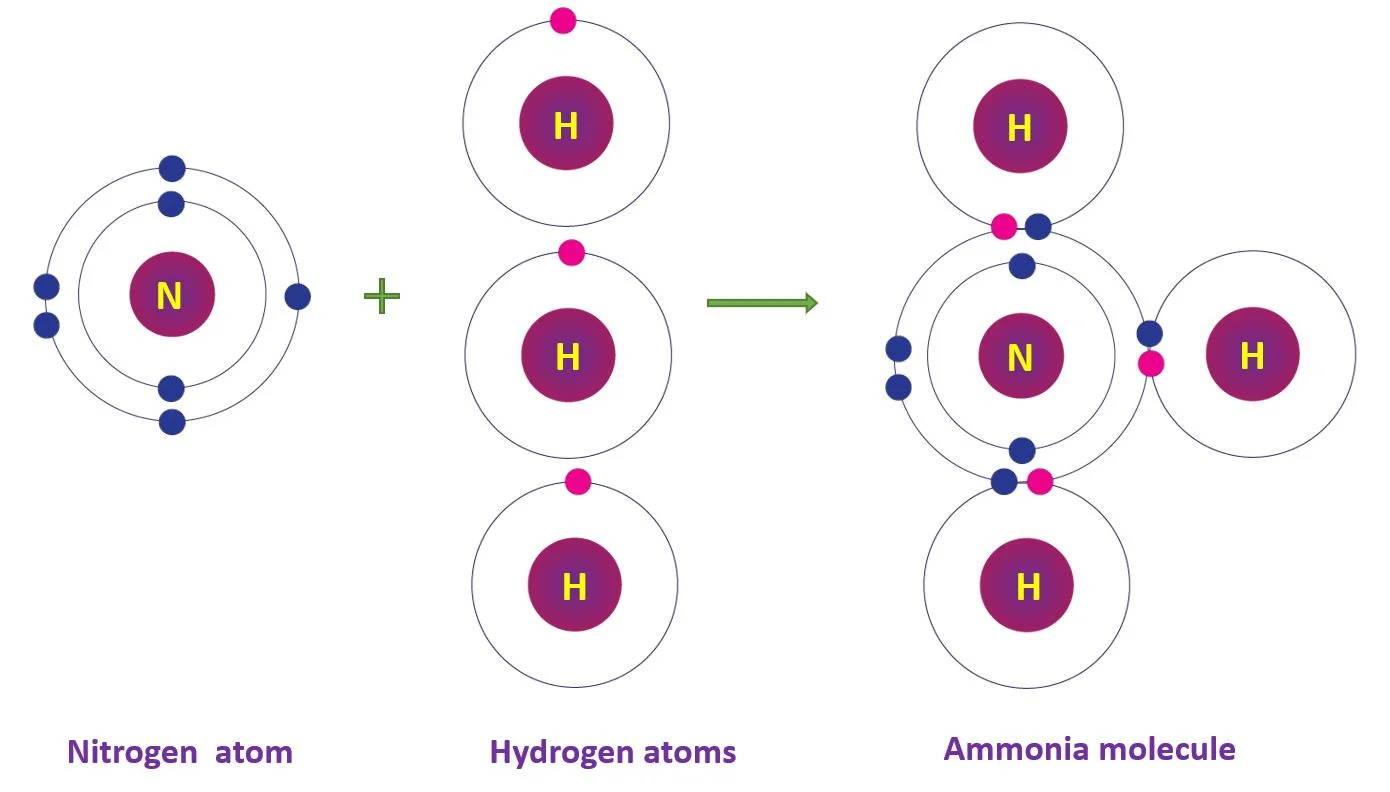
The nitrogen atom has an electronic configuration of 2, 5. Three hydrogen atoms share three electron pairs with one nitrogen atom. As a result, an ammonia (NH3) molecule with three single bonds is formed. Nitrogen is left with one pair of outer electrons that is not shared, called a lone pair.
Covalent Bonds in Carbon tetrachloride molecule
A carbon atom's electronic configuration is 2, 4. A chlorine atom's electronic configuration is 2, 8, 7. A carbon atom and four chlorine atoms share four pairs of electrons to form the carbon tetrachloride (CCl4) molecule.
Covalent Bonds in Hydrogen chloride molecule
A chlorine atom's electronic configuration is 2, 8, 7. A chlorine atom and a hydrogen atom share a pair of electrons to form the hydrogen chloride (HCl) molecule.
Covalent Bonds in Nitrogen molecule
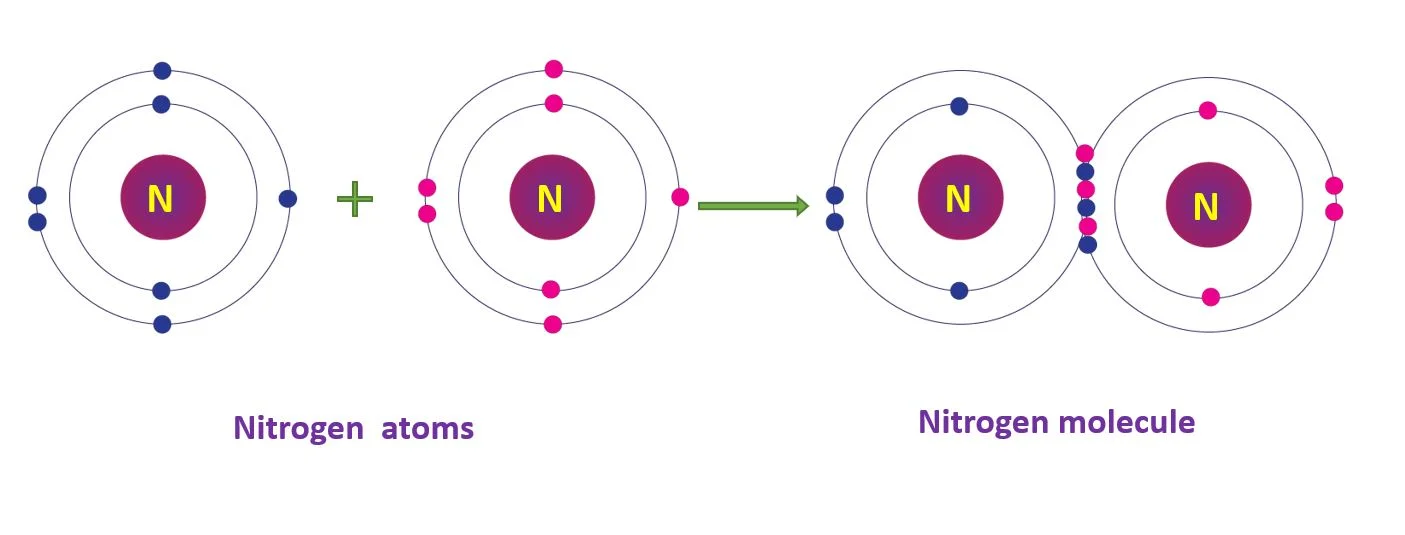
A nitrogen atom's electronic configuration is 2, 5, so it needs three more electrons. By sharing three pairs of electrons, two nitrogen atoms form a nitrogen (N2) molecule. The bond is called a triple bond because three pairs of electrons are shared.
Covalent Bonds in Oxygen molecule
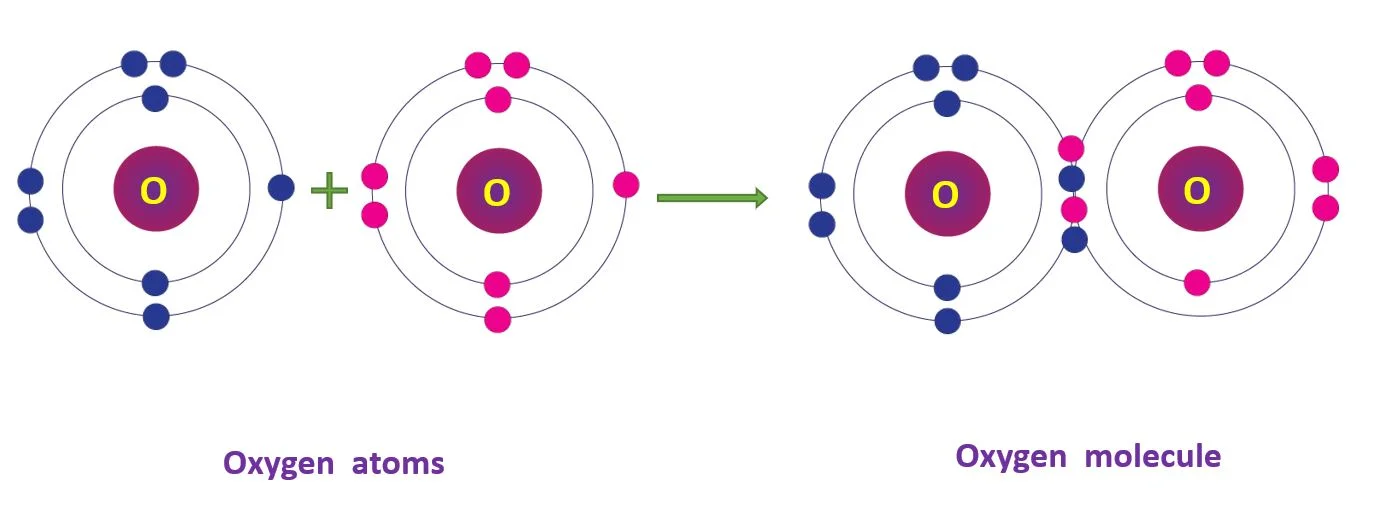
The electronic configuration of the oxygen atom is 2, 6, so it needs two more electrons. Two oxygen atoms share two pairs of electrons when forming the oxygen (O2) molecule. Because two pairs of electrons are shared, the bond is referred to as a double bond.
Simple molecular substances and why they melt so easily
Water, methane, ammonia, oxygen and carbon dioxide are all simple molecular substances: small, separate molecules with a fixed number of atoms in each.
These substances have low melting and boiling points, and it is worth being very precise about why. Melting or boiling them does not break any covalent bonds. The molecules themselves survive intact; all that has to be overcome are the much weaker intermolecular forces holding one whole molecule to the next. Because those forces are weak, only a little energy is needed, so the substance melts at a low temperature.
Larger molecules have stronger intermolecular forces, which is why boiling point rises as you go down a series of similar molecules – from methane, a gas, up to the long-chain hydrocarbons that are thick liquids.
Simple molecular substances also do not conduct electricity. The molecules are electrically neutral overall, and there are no free electrons and no ions to carry a charge, whether the substance is solid, liquid or dissolved.
Atomic Lattice
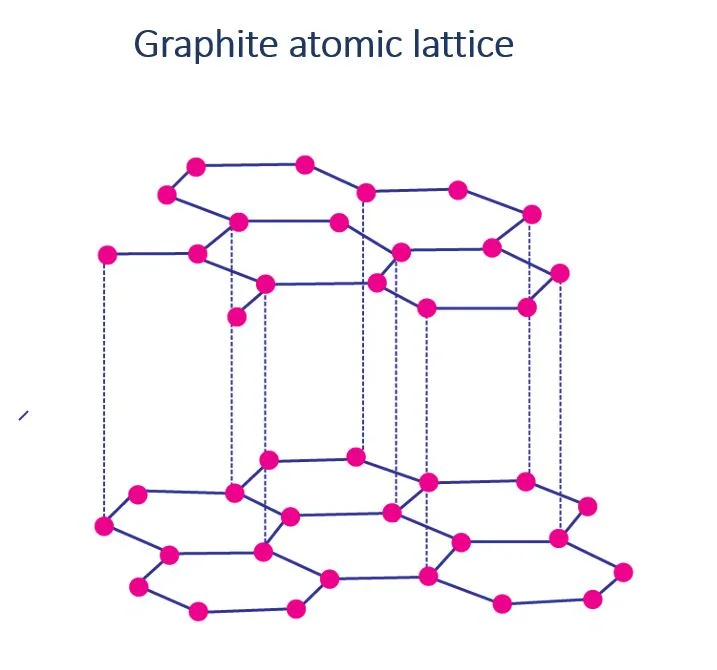
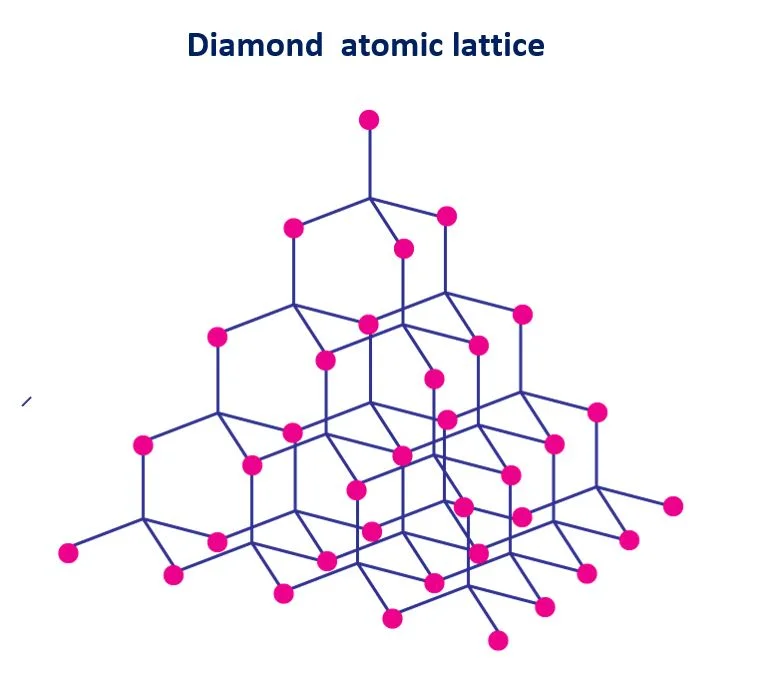
Atoms in some elements are organized as a lattice. Atomic lattices are lattices in which the atoms are covalently bonded; they are also called giant covalent structures or macromolecular structures. Carbon occurs naturally in two atomic lattices: graphite and diamond. They are known as allotropic carbon forms. The way the carbon atoms form covalent bonds with one another differs between these two forms.
Simple molecular covalent compounds have low melting and boiling points. Diamond and graphite, on the other hand, have very high melting and boiling points, because melting them means breaking millions of strong covalent bonds throughout the whole lattice rather than merely separating molecules.
Forms of carbon atomic lattice
Graphite atomic lattice
Graphite is made up of layers of carbon atoms in which each carbon atom is joined by single covalent bonds to three other carbon atoms, forming flat sheets of hexagons. These layers are stacked on top of one another and are held together only by weak forces, so one layer slides easily over another. That is why graphite feels slippery and is used as a lubricant and in pencil leads.
Because each carbon atom uses only three of its four outer electrons for bonding, the fourth electron is delocalised and free to move along the layers. Graphite is therefore one of the very few non-metals that conducts electricity, which is why it is used to make the inert electrodes in electrolysis.
Diamond atomic lattice
Every carbon atom in diamond forms four single covalent bonds with four other carbon atoms in a rigid three-dimensional lattice. There are no layers, nothing can slide, and every one of carbon's four outer electrons is used in bonding, so there are no delocalised electrons.
The consequences follow directly from the structure: diamond is extremely hard – the hardest naturally occurring mineral – which is why it is used in cutting tools and drill tips; it has a very high melting point; and it does not conduct electricity, unlike graphite.
Silicon dioxide
Silicon dioxide, SiO2, is the main component of sand and quartz and is the third giant covalent structure commonly asked about. Each silicon atom is covalently bonded to four oxygen atoms and each oxygen atom to two silicon atoms, giving a structure very similar in arrangement to diamond. It is therefore hard, has a high melting point, is insoluble in water and does not conduct electricity.
Simple molecular compared with giant covalent
| Property | Simple molecular (water, methane, iodine) | Giant covalent (diamond, graphite, silicon dioxide) |
|---|---|---|
| Structure | Small separate molecules | Millions of atoms bonded in one continuous lattice |
| Melting and boiling point | Low | Very high |
| What is overcome on melting | Weak intermolecular forces only | Strong covalent bonds throughout the lattice |
| State at room temperature | Often gas or liquid | Always solid |
| Electrical conductivity | None | None, except graphite |
| Hardness | Soft or not applicable | Very hard, except graphite which is soft |
| Solubility in water | Varies; many are insoluble | Insoluble |
Covalent bonding compared with ionic bonding
| Feature | Covalent bonding | Ionic bonding |
|---|---|---|
| Which atoms | Non-metal with non-metal | Metal with non-metal |
| What happens to the electrons | Shared between the two atoms | Transferred from the metal to the non-metal |
| Particles formed | Neutral molecules, or a giant lattice of atoms | Positive and negative ions in a giant lattice |
| Conducts when molten or dissolved | No | Yes, because the ions become free to move |
| Typical melting point | Low for simple molecular, very high for giant covalent | High |
There is more detail, including worked "explain why" answers, in our lesson on the properties of ionic and covalent compounds.
Polar vs nonpolar covalent bonds
Covalent bonds are chemical bonds formed by the sharing of electrons between two atoms. Depending on the electronegativity difference between the two atoms in a covalent bond, the bond can be polar or nonpolar. Electronegativity is simply a measure of how strongly an atom pulls on a shared pair of electrons.
In a nonpolar covalent bond, the electrons are shared equally between the two atoms, and there is no separation of charge. This occurs when the two atoms have similar electronegativities, such as in the bond between two atoms of the same element, as in H2 or O2.
Examples of polar covalent bonds
In a polar covalent bond, the electrons are shared unequally between the two atoms, resulting in a separation of charge. This occurs when the two atoms have different electronegativities, such as in the bond between hydrogen and oxygen in water (H2O). The oxygen atom has a higher electronegativity and therefore attracts the shared electrons more strongly, creating a partial negative charge on the oxygen atom and a partial positive charge on the hydrogen atoms. These partial charges are written as δ− and δ+.
Polar covalent bonds
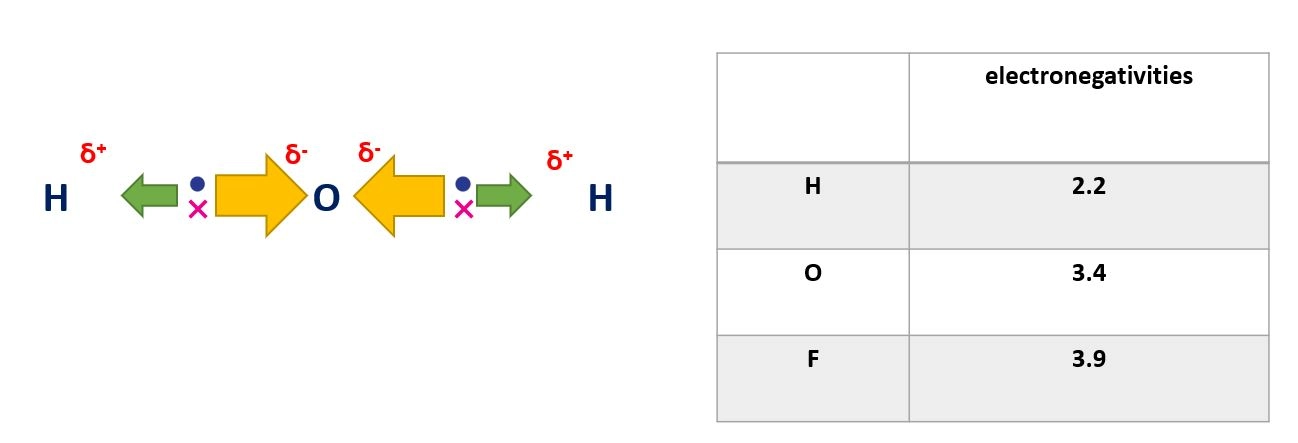
Polar covalent bonds of water in a diagram
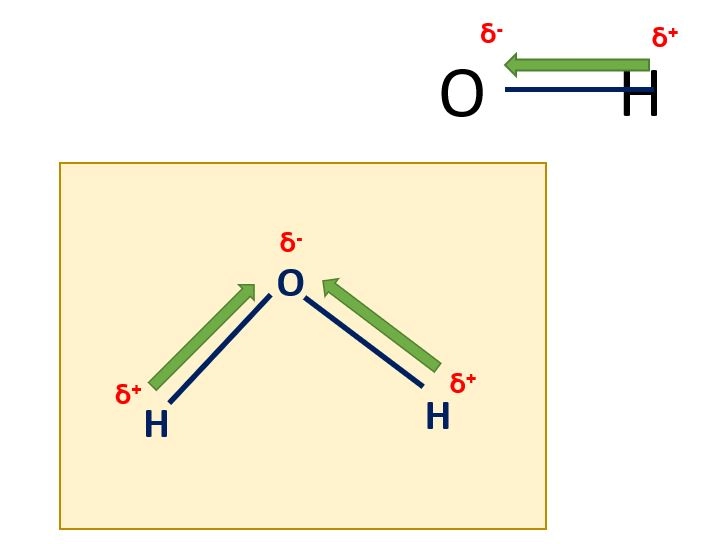
Polar covalent bonds in a diagram
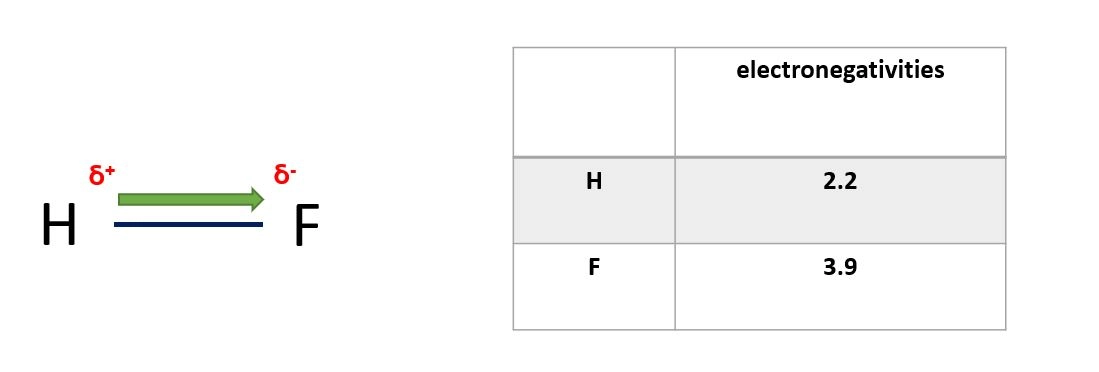
Properties of polar covalent bonds
The polarity of a covalent bond has significant consequences for the substance's properties. Compared with a nonpolar molecule of a similar size, a polar molecule generally has a higher boiling point, because the partial charges attract neighbouring molecules and make the intermolecular forces stronger. Size matters too, so the comparison is only fair between molecules of roughly equal mass.
Polarity also affects solubility. Polar molecules tend to dissolve in polar solvents such as water, while nonpolar molecules tend to dissolve better in nonpolar solvents. This is the origin of the rule of thumb that "like dissolves like", and it is why oil and water do not mix.
How many covalent bonds can carbon form
Carbon can form up to four covalent bonds. This is because carbon has four valence electrons in its outermost shell, which are available for bonding. By sharing these electrons with other atoms, carbon can form stable covalent compounds. In organic chemistry, carbon is the backbone of many important molecules, such as hydrocarbons, carbohydrates, proteins, and nucleic acids. The ability of carbon to form four covalent bonds, including bonds to other carbon atoms, is the key factor behind the diversity and complexity of organic molecules.
Exam tips
- Define a covalent bond as a shared pair of electrons. "Atoms sharing electrons" is vaguer and often loses the mark; naming the electrostatic attraction between the nuclei and the shared pair gains it.
- When explaining a low melting point, say clearly that the intermolecular forces are weak, not that "the covalent bonds are weak". Covalent bonds are strong; they are simply not the thing being broken.
- In a dot-and-cross diagram, show only the outer shell electrons unless the question asks otherwise, and make sure each shared pair has one dot and one cross.
- Graphite conducts because each carbon uses only three of its four outer electrons for bonding, leaving one delocalised electron per atom. Diamond does not conduct because all four are used.
- Do not describe graphite's layers as being held by "weak covalent bonds". There are no bonds between the layers – only weak forces of attraction.
- Covalent substances never conduct when molten or dissolved. If a question says a substance conducts when melted, it is ionic.
Frequently asked questions about covalent bonds
What is a covalent bond in simple terms?
A covalent bond is a shared pair of electrons between two atoms. Both nuclei are attracted to the shared pair, and that attraction holds the atoms together. Covalent bonds form between non-metal atoms, and the sharing lets each atom reach a full outer shell.
Why do atoms form covalent bonds?
Because a full outer shell is a more stable, lower-energy arrangement than an incomplete one. Non-metal atoms are all short of electrons, so neither can simply take from the other. Sharing lets both atoms count the same electrons towards their own outer shell.
What is the difference between a single, double and triple bond?
A single bond is one shared pair of electrons, a double bond is two shared pairs and a triple bond is three. Oxygen has a double bond and nitrogen a triple bond. The more pairs shared, the shorter and stronger the bond.
Why do simple covalent substances have low melting points?
Because melting them does not break the covalent bonds at all. Only the weak intermolecular forces between whole molecules have to be overcome, and that takes very little energy. The molecules themselves stay intact in the liquid and the gas.
Why does graphite conduct electricity but diamond does not?
In graphite each carbon atom bonds to only three others, so its fourth outer electron is delocalised and free to move through the layers and carry a current. In diamond every carbon atom bonds to four others, using all four outer electrons, so no electrons are free to move.
Why is diamond so hard?
Every carbon atom is joined to four others by strong covalent bonds in a rigid three-dimensional lattice, with no layers and nothing able to slide. Deforming diamond means breaking covalent bonds, which takes an enormous amount of energy.
What is the difference between covalent and ionic bonding?
Covalent bonding involves sharing electrons between non-metal atoms to form molecules or a giant lattice of atoms. Ionic bonding involves transferring electrons from a metal to a non-metal, producing charged ions held in a giant lattice. Ionic compounds conduct when molten or dissolved; covalent ones do not.
What makes a covalent bond polar?
A difference in electronegativity between the two atoms. The more electronegative atom pulls the shared pair closer, so it takes a small negative charge while the other takes a small positive charge. A bond between two atoms of the same element is nonpolar, because the pull is equal.
Do covalent compounds conduct electricity?
Almost never. Molecules are neutral and there are no free electrons or ions to carry a charge, in the solid, the liquid or in solution. Graphite is the main exception, because of its delocalised electrons.