Which animals have stripes? Far more than the zebra and the tiger. This guide covers 25 animals with stripes, from mammals and reptiles to fish, insects and a spider, and explains what each pattern does for the animal wearing it. Every entry gives the scientific name, size, where it lives and its conservation status, so you can compare them side by side.
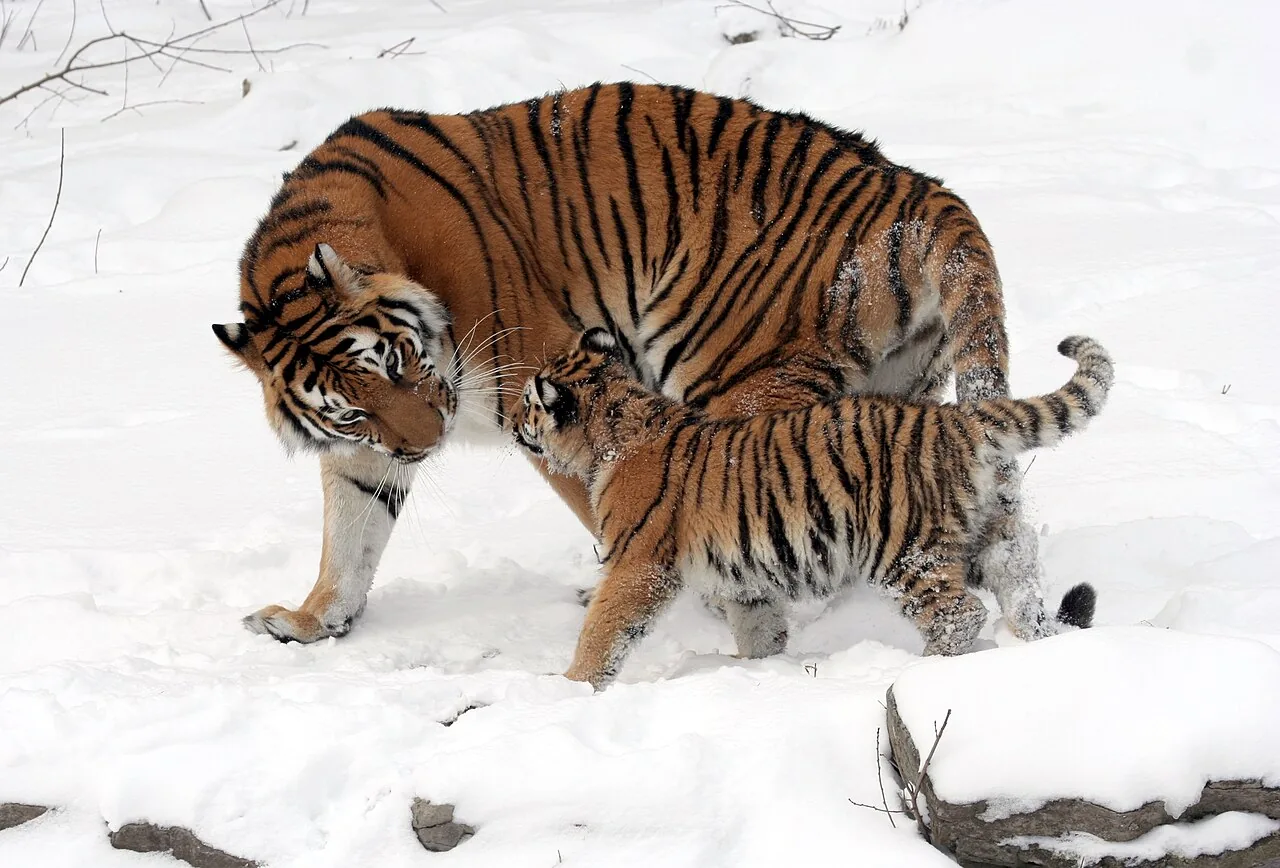
Why do animals have stripes?
Stripes look simple, but they solve several different problems. Scientists have tested some of these ideas and are still debating others, so it helps to know which jobs a stripe pattern can do.
- Disruptive camouflage. Dark and light bands break up an animal's outline so it is harder to pick out against grass, branches or dappled light. Tigers are a good example, and okapis are thought to be another.
- Warning colours. Bold black and yellow bands advertise that an animal is venomous, toxic or smelly. The banded krait, the poison dart frog and the skunk all use this idea, known as aposematism.
- Confusing biting insects. In a 2019 study of zebras and horses, flies approached both animals, but they landed far less often on striped coats. The researchers think stripes evolved mainly as protection against biting flies.
- Recognition and signalling. A ring-tailed lemur's tail works like a flag in a moving troop, and a badger's face stripes are easy to spot even at night.
- Mimicry. Some harmless animals copy the stripes of dangerous ones. The dark form of the female tiger swallowtail copies a toxic butterfly.
Stripes also help scientists. A tiger's pattern is unique to the individual, so researchers use camera-trap photographs to identify and count wild tigers. To learn more about how colour helps animals hide, read our guide to camouflage in biology.
Animals with stripes at a glance
This table lists all 25 striped animals in this article. The conservation status comes from the IUCN Red List as reported in the sources we checked, so it may change as assessments are updated.
| # | Animal | Stripe colours | Where it lives | IUCN status |
|---|---|---|---|---|
| 1 | Tiger | Black on orange | Asia | Endangered |
| 2 | Sumatran tiger | Black on dark orange | Sumatra | Critically Endangered |
| 3 | Plains zebra | Black and white | Eastern and southern Africa | Near Threatened |
| 4 | Grévy's zebra | Narrow black and white | Kenya, Ethiopia | Endangered |
| 5 | Okapi | Black and white on the legs | DR Congo | Endangered |
| 6 | Bongo | White on chestnut | African forests | Near Threatened |
| 7 | Malayan tapir (calf) | White on brown | South-East Asia | Endangered |
| 8 | Striped hyena | Dark on grey-brown | Africa, Asia | Near Threatened |
| 9 | Aardwolf | Black on yellowish | Eastern and southern Africa | Least Concern |
| 10 | European badger | Black and white face | Europe, including the UK | Least Concern |
| 11 | Striped skunk | White on black | North America | Least Concern |
| 12 | Eastern chipmunk | Dark and pale brown | Eastern North America | Least Concern |
| 13 | Ring-tailed lemur | Black and white tail rings | Madagascar | Endangered |
| 14 | Raccoon | Dark and pale tail rings | North America (introduced elsewhere) | Least Concern |
| 15 | Tiger salamander | Yellow on black | North America | Least Concern |
| 16 | Red-eared slider | Yellow and green | Southern USA, introduced worldwide | Not rated here |
| 17 | Banded krait | Black and yellow | South and South-East Asia | Least Concern |
| 18 | Banded sea krait | Black on blue-grey | Indian and Pacific Oceans | Least Concern |
| 19 | Yellow-banded poison dart frog | Yellow and black | Northern South America | Least Concern |
| 20 | Ocellaris clownfish | White on orange | Indo-Pacific reefs | Least Concern |
| 21 | Emperor angelfish | Blue and yellow | Indo-Pacific reefs | Least Concern |
| 22 | Zebrafish | Blue and silver or gold | South Asia | Least Concern |
| 23 | African tigerfish | Thin black lines on silver | African rivers and lakes | Least Concern |
| 24 | Tiger swallowtail | Black on yellow | Eastern North America | Not rated here |
| 25 | Wasp spider | Yellow, white and black | Europe and beyond | Not rated here |
1. Tiger: the biggest striped cat
The tiger (Panthera tigris) is the largest of the big cats and the animal most people picture first when they think of striped animals. Its black stripes sit on orange fur with a white belly, and no two tigers have the same pattern. Male Bengal tigers weigh about 200–260 kg.
The stripes help the tiger hunt. Deer and other hoofed prey are thought to see orange fur as a dull green or grey, so the tiger blends into forest and tall grass, and the vertical stripes break up its outline. Tigers eat mainly large and medium hoofed mammals such as sambar deer, gaur and wild boar.

The tiger is Endangered on the IUCN Red List. A 2021 assessment gave an estimate of roughly 3,726 to 5,578 wild tigers, and tigers now live in less than 7% of the area they once roamed. Many tigers survive in scattered patches across the Indian subcontinent, Indochina, Sumatra, north-east China and the Russian Far East. You can read more about threats like these in our article on the extinction crisis.
2. Sumatran tiger: stripes that break into spots

The Sumatran tiger lives only on the Indonesian island of Sumatra. It is the smallest living tiger: males weigh about 100–140 kg and females about 75–110 kg, compared with 200–260 kg for male Bengal tigers. Biologists think living on an island has made it smaller.
Its coat is darker, and its stripes are thicker and more numerous than those of other tigers. Many stripes break up into rows of spots near their ends. Males also have a thick ruff of fur around the neck.
It is listed as Critically Endangered. A 2017 survey estimated around 618 tigers (give or take 290) across the whole island. Sumatran tigers prefer lowland and hill forest and avoid heavily settled land, so cutting down forest threatens them directly.
3. Plains zebra: the classic black and white stripes
The plains zebra (Equus quagga) is the zebra you see on most safari programmes. It stands about 127–140 cm at the shoulder, and males weigh roughly 220–322 kg. Plains zebras graze on grass across the savannas of eastern and southern Africa and number about 500,000, which is why they are listed as Near Threatened rather than Endangered.
They live in harems made up of one stallion, several mares and their young. Several harems may gather into herds of hundreds during migrations. A foal weighs 30–35 kg at birth and can stand almost at once, which matters when predators are close. Its coat is brown and white at first, and the brown darkens with age.
So why do zebras have stripes?
Researchers Tim Caro and Martin How dressed zebras and horses in black, white and striped coats on a British horse farm and filmed the flies around them. Flies were as drawn to zebras as to horses from a distance, but they landed on striped coats much less often. The team suggests that stripes disrupt a fly's landing at close range. This biting-fly explanation is currently the best-supported idea, although scientists are still testing others.
4. Grévy's zebra: the narrowest stripes


Grévy's zebra (Equus grevyi) is the largest wild member of the horse family. Adults measure 1.45–1.6 m at the withers and weigh about 350–450 kg. Its stripes are the narrowest of any zebra and run all the way down to the hooves, but its belly is plain white. It lives mostly in northern Kenya, with a few groups in Ethiopia.
The species is named after Jules Grévy, President of France. In 1882 the Ethiopian emperor Menelik II sent a zebra to Grévy as a gift, and the French zoologist Émile Oustalet described the species that same year.
It is Endangered, with about 2,250 left in the wild in 2020. Where its range overlaps the plains zebra's, the two species can produce fertile hybrids. Compare the two zebras in the photos above: the plains zebra has broad bands, while Grévy's has fine, closely packed lines. For another animal that suffers from a shrinking range, see how adaptations help animals survive in tough habitats.
5. Okapi: the "zebra giraffe" of the Congo

The okapi (Okapia johnstoni) looks like a mix of a zebra and a deer, but it is neither. It is the giraffe's closest living relative, and the two are the only living members of the family Giraffidae. Their common ancestor lived about 11.5 million years ago. Science only described the okapi in 1901.
The okapi has a dark chocolate-brown body and bold black-and-white stripes on its legs and rump. In the dim understorey of a rainforest, this pattern is thought to work as camouflage, and may also help calves follow their mother. An adult stands about 1.5 m at the shoulder, weighs 200–350 kg and has a tongue about 46 cm long, which it uses to strip leaves and groom itself.
Okapis live in the north-east of the Democratic Republic of Congo. They are Endangered and are extinct in Uganda, where the last record dates from the late 1970s. Their forest home also shelters many other species, as you can read in our guide to biodiversity in jungle ecosystems.
6. Bongo: a forest antelope with white stripes

The bongo (Tragelaphus eurycerus) is a large forest antelope with a chestnut coat marked by 10 to 15 narrow white-yellow stripes. The count is rarely equal on the two sides of the body. Males weigh roughly 220–405 kg and stand about 1.1–1.3 m at the shoulder. Both sexes carry heavy spiralled horns of about 75–99 cm, which stay for life.
Bongos are shy and mostly active at night. They browse leaves, shrubs, bark and roots, and they visit salt licks. They have even been recorded eating burnt wood after storms to get minerals. Calves hide for a week or more at traditional calving grounds.
The species as a whole is Near Threatened, but the mountain bongo of central Kenya is Critically Endangered, with as few as 100 to 140 animals reported in the wild.
7. Malayan tapir: stripes only when young
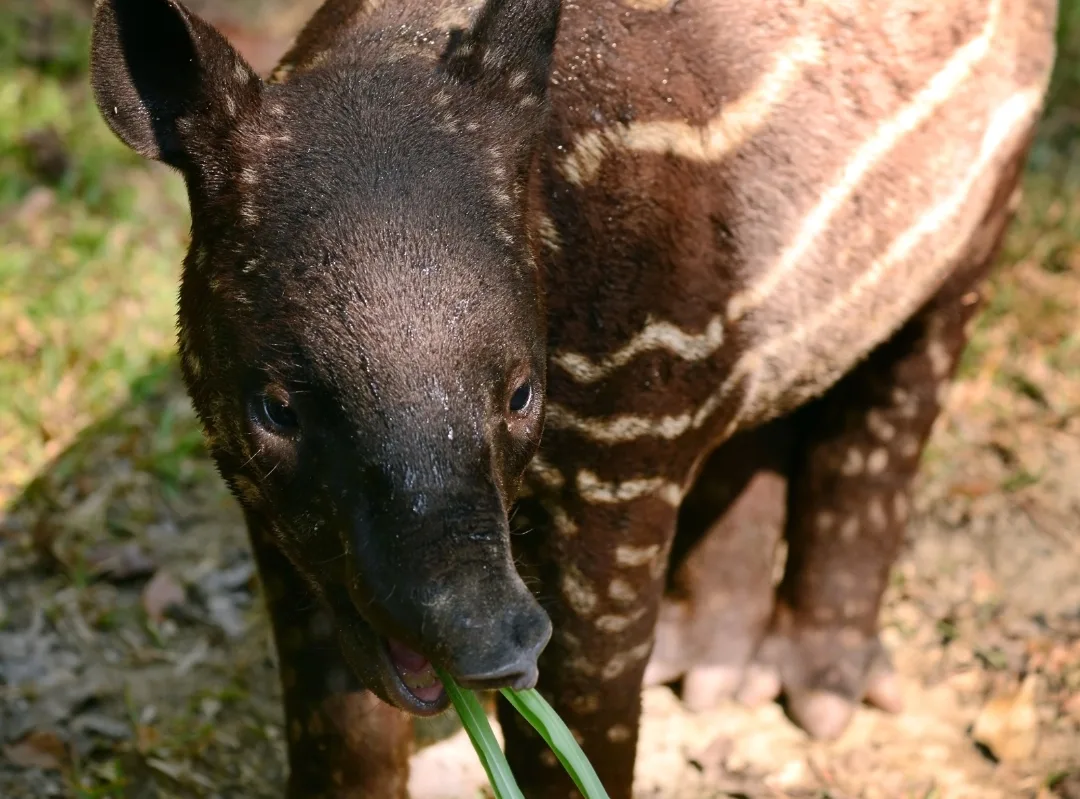
The Malayan tapir (Tapirus indicus) is a surprise on a list of striped animals, because adults are not striped at all. An adult has a black front half and a pale back half, which breaks up its shape in forest shadows. Calves are different: they are dark brown with white stripes and spots. This pattern fades to the adult coat between four and seven months after birth.
It is the largest tapir, weighing typically 250–320 kg and sometimes up to 540 kg. It lives in lowland rainforests in Sumatra, Peninsular Malaysia, Myanmar and Thailand and eats only plants, taking tender shoots and leaves from more than 115 species. Pregnancy lasts about 390 days, and usually only one calf is born.
With fewer than 2,500 mature individuals, it is Endangered.
8. Striped hyena: faint bars and a bristly mane
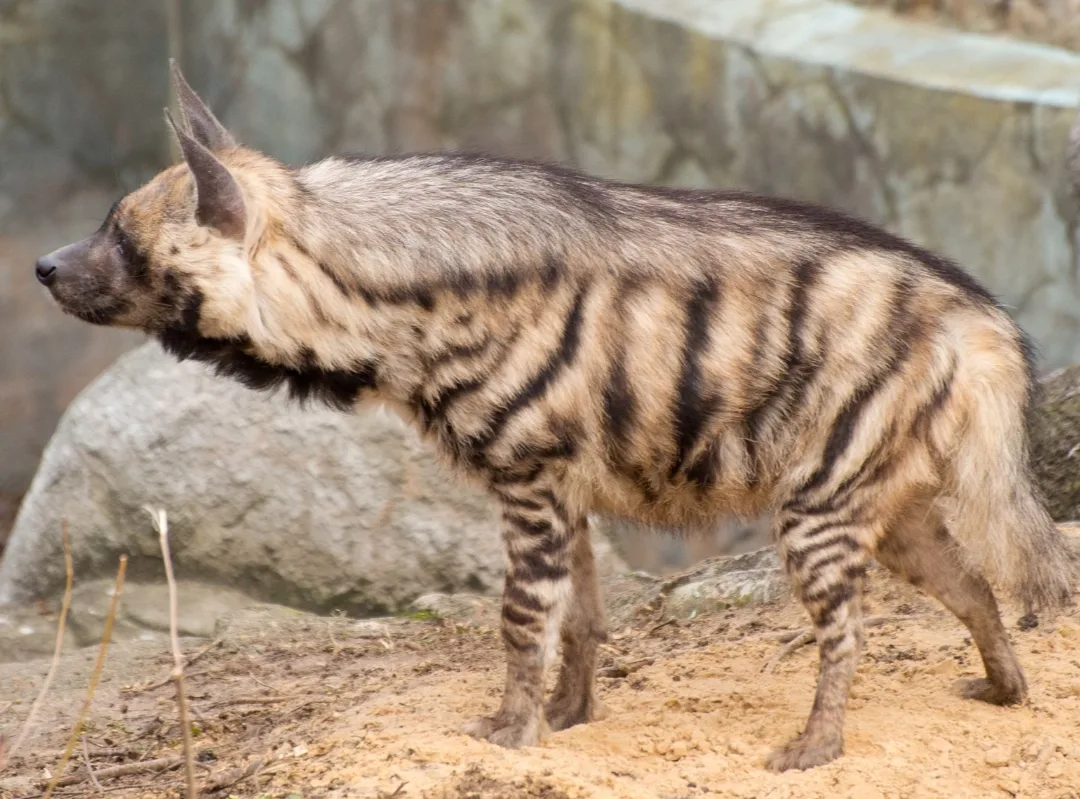
The striped hyena (Hyaena hyaena) has a grey-brown coat with dark vertical bars on the flanks and darker bands on the thighs and legs. A long crest of hair runs from the head to the tail, and the hairs can be about 22 cm long in winter. They stand on end when the animal feels threatened, which makes the hyena look bigger.
It weighs about 35 kg on average and is the smallest of the bone-cracking hyenas. It is a nocturnal scavenger: it eats carcasses in different stages of decay, as well as bones and marrow, and occasionally kills small prey such as hares, rodents, reptiles and birds. It leaves its den only in full darkness.
The species lives in northern and eastern Africa, the Arabian Peninsula, the Middle East and the Indian subcontinent, but its range is patchy. With fewer than 10,000 mature individuals it is Near Threatened. The tidy-up role of scavengers matters in every ecosystem, because they remove dead animals that would otherwise rot.
9. Aardwolf: a striped hyena that eats termites
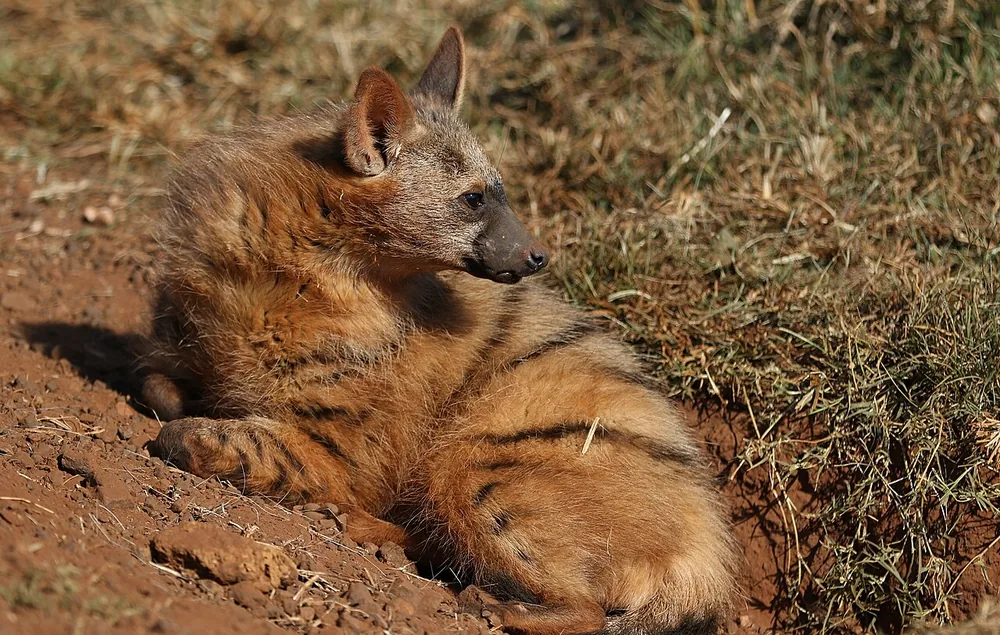
The aardwolf (Proteles cristata) means "earth wolf", but it is a member of the hyena family. It is the smallest living hyaenid, at only 7–10 kg. Black vertical stripes mark its yellowish coat, with stripes on the legs, and it also has a long mane. Early scientists thought it only copied the striped hyena's look, so they gave it a family of its own. Molecular studies now place it inside Hyaenidae.
Instead of bones, it eats termites, up to about 250,000 in a single night according to one source. It is shy and nocturnal, and spends the day in a burrow. It lives in two separate groups, one in eastern Africa and one in southern Africa. Its status is Least Concern.
10. European badger: the face-striped neighbour
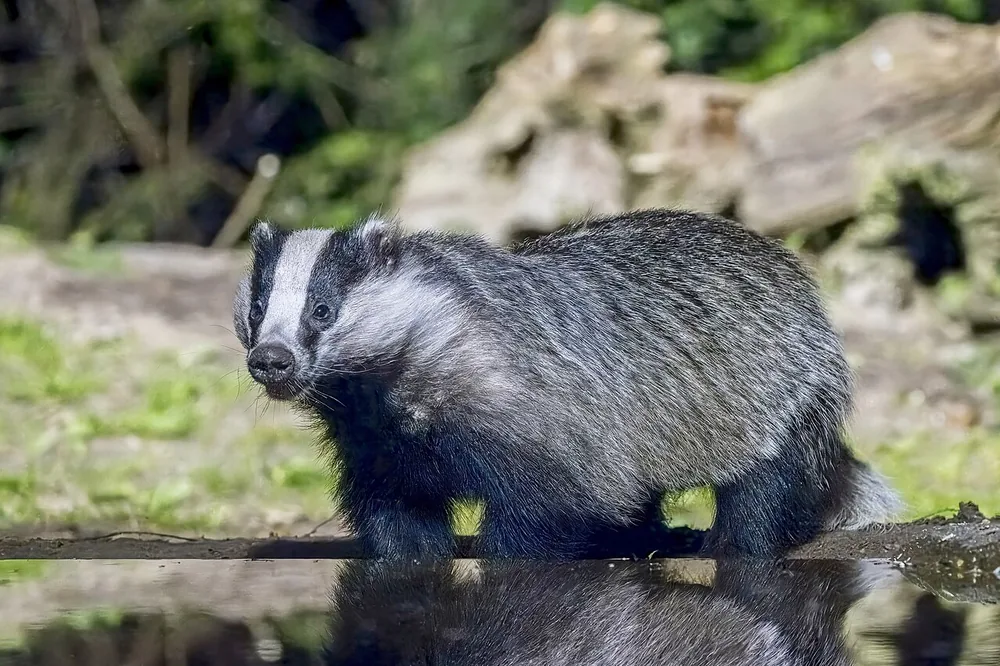
The European badger (Meles meles) is the only badger in the UK, so most British people simply call it "the badger". Two black bands run from the upper lip to the base of the ears, and a wide white band covers the nose and forehead. The pale stripe stands out against the dark, which is why badgers are easy to recognise even in a torch beam at night.
Adults are 60–90 cm long and weigh about 7–13 kg in spring and 15–17 kg in autumn. They are omnivores, and earthworms are their most important food. Badgers live in a complex burrow system called a sett. Several families may use one sett for decades. They are the most social badgers, usually forming groups of about six adults.
The species is Least Concern. In the UK, the Protection of Badgers Act 1992 makes it an offence to kill or be cruel to badgers or to interfere with a sett.
11. Striped skunk: a white stripe with a warning
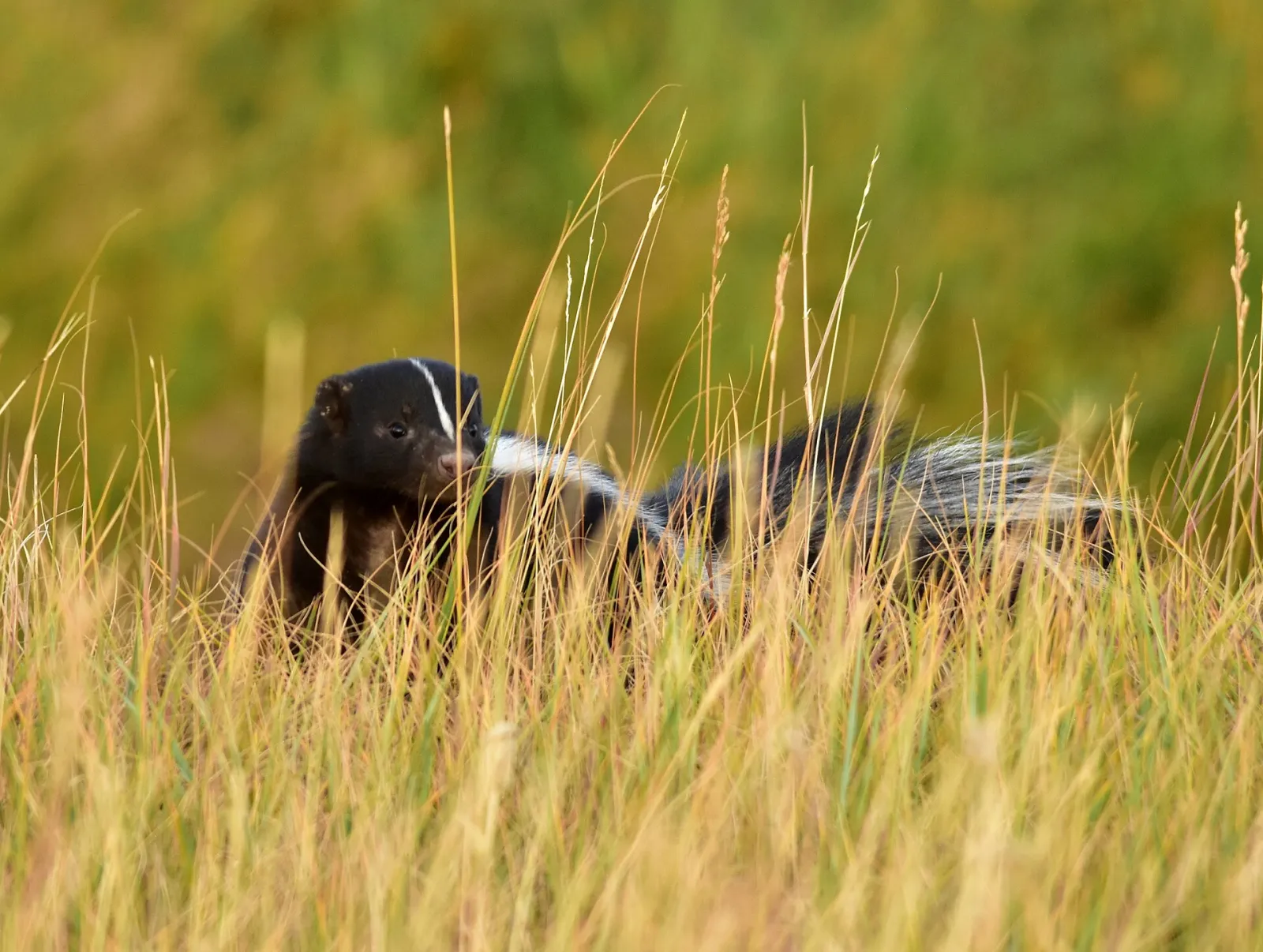
The striped skunk (Mephitis mephitis) is usually black with a white stripe that starts on the head, splits at the shoulders and runs along both flanks to the tail. It measures about 52–77 cm in total and weighs 1.8–4.5 kg. Colours vary, and brown or cream skunks do occur.
This high-contrast pattern is a warning that works with the skunk's chemical defence. Each of its two scent glands holds about 15 mL of oily yellow musk, a mixture of thiols (sulfur compounds). The skunk can spray it several metres, and it causes a burning sensation if it gets in the eyes.
Skunks live across much of North America and mainly eat insects such as grasshoppers, beetles and caterpillars. Their status is Least Concern.
Guess the striped animal
Tap each card to check your answer.
12. Eastern chipmunk: stripes from head to rump
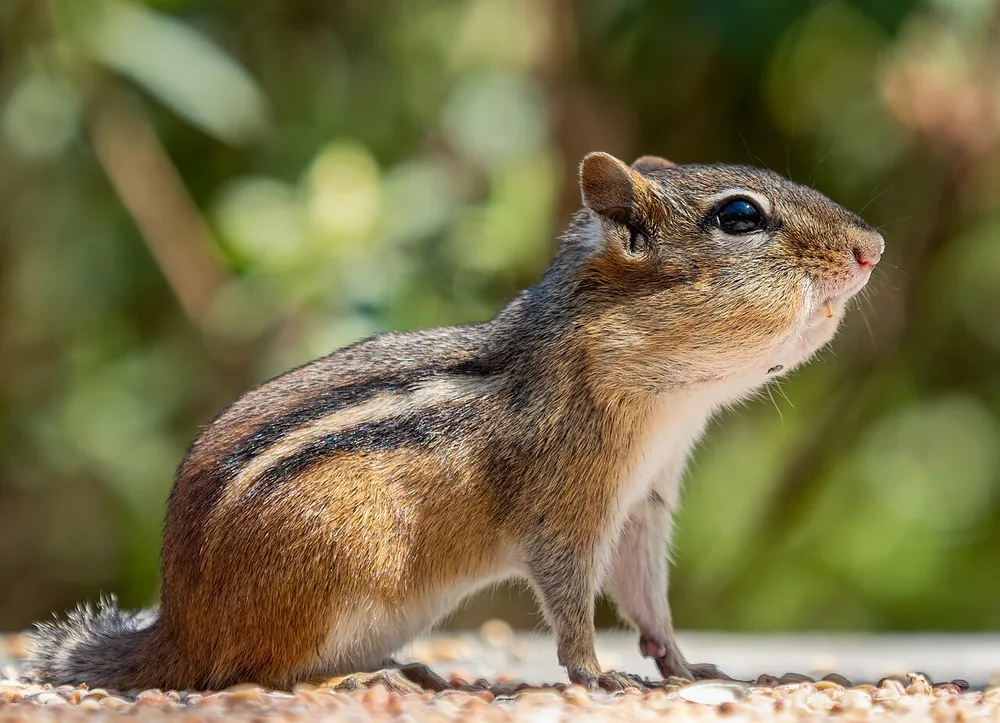

The eastern chipmunk (Tamias striatus) is a small rodent about 30 cm long including its tail, weighing 66–150 g. Five dark brown stripes alternate with lighter ones along its back. It lives in deciduous woodland and urban parks in eastern North America and likes rocks, brush and log piles.
Chipmunks forage by day for seeds, nuts, fruit, mushrooms, insects, worms and bird eggs, and they carry food in their cheek pouches. They dig underground nests with long tunnels, often with several entrances, and hide them with leaves and sticks. In winter they may hibernate for long periods. If you want to know how animals survive cold months, see our article on why animals hibernate. The eastern chipmunk is Least Concern.
13. Ring-tailed lemur: a striped flag on the move

The ring-tailed lemur (Lemur catta) has one of the most recognisable tails in the animal kingdom. It carries 12 or 13 white rings and 13 or 14 black rings, and it always ends in a black tip. The tail is 56–63 cm long, which is longer than the animal's body, and the whole lemur weighs only about 2.2 kg.
It lives in southern and south-western Madagascar in troops of 6 to 25 animals. Females are dominant over males in every situation, including feeding. Males also hold "stink fights": they rub scent from glands on their forearms and chest onto their tails, then wave the tails at rivals. Ring-tailed lemurs eat mostly fruit and leaves, and tamarind can make up to half of their diet when it is available.
The species is Endangered, listed in 2014, and only around 2,000 were estimated to remain in the wild in 2017.
14. Raccoon: a mask and a ringed tail

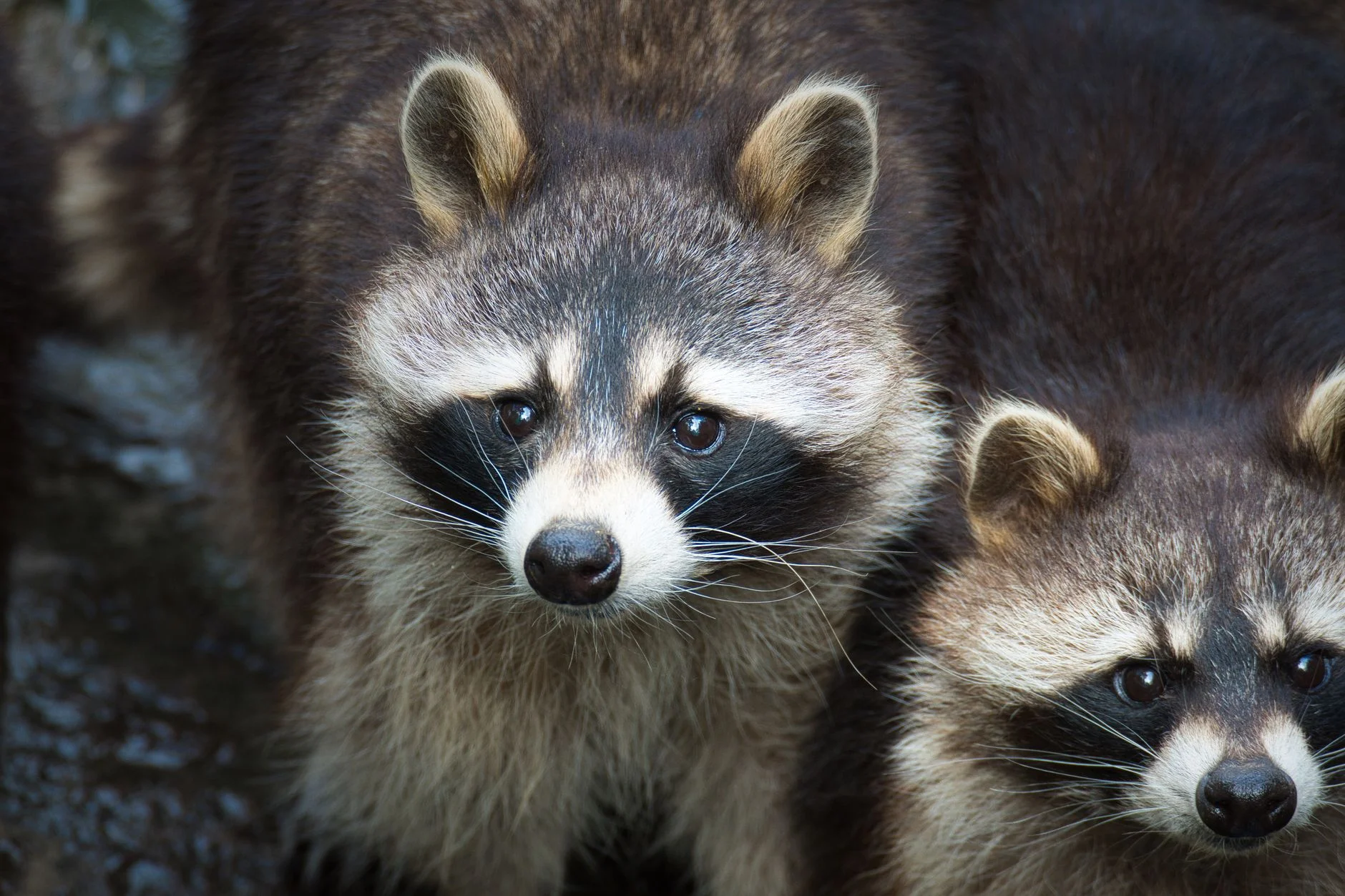
The raccoon (Procyon lotor) has two striking markings: a dark "bandit mask" across its eyes and alternating dark and light rings on its bushy tail. The mask may reduce glare and help raccoons read each other's expressions. Adults weigh about 5–12 kg.
Raccoons are mostly nocturnal, and their very sensitive front paws let them identify objects by touch. They eat roughly 40% invertebrates, 33% plants and 27% vertebrates. They are native to North America, but escapes and releases created wild populations in central Europe, the Caucasus and Japan. Since 2016, the EU has listed the raccoon as an Invasive Alien Species of Union Concern. The raccoon itself is Least Concern. White raccoons are a different story, and you can read about them in our guide to albino animals.
15. Tiger salamander: yellow bars underground
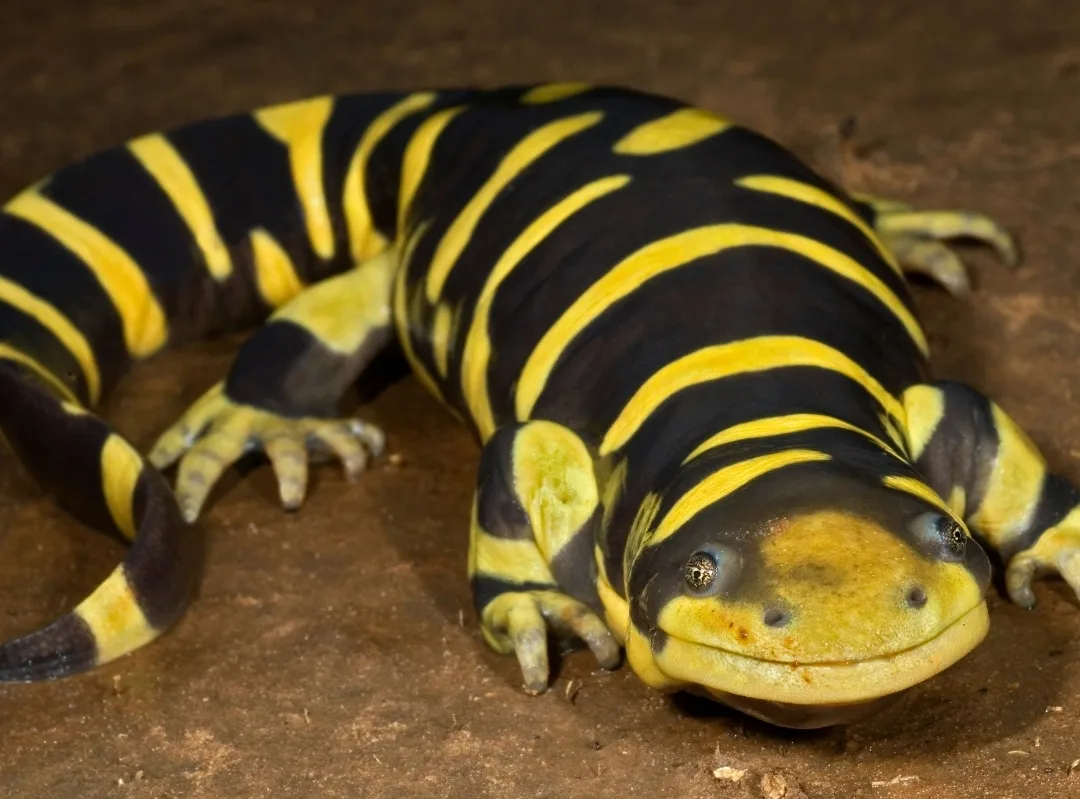
The tiger salamander (Ambystoma tigrinum group) is dark brown or black with yellowish bars or blotches. The photograph shows a barred individual, but the pattern varies a lot between animals and regions. It is usually 15–20 cm long and the longest on record measured 33 cm.
Despite its range, it is rarely seen. Adults spend most of their lives in burrows, and some have been found more than 60 cm below ground. They eat insects, snails, slugs, worms and, sometimes, smaller salamanders. Tiger salamanders live for about 12–15 years. The Mexican axolotl is a relative. The tiger salamander is the widest-ranging salamander in North America and is Least Concern.
16. Red-eared slider: stripes on the head and a red patch
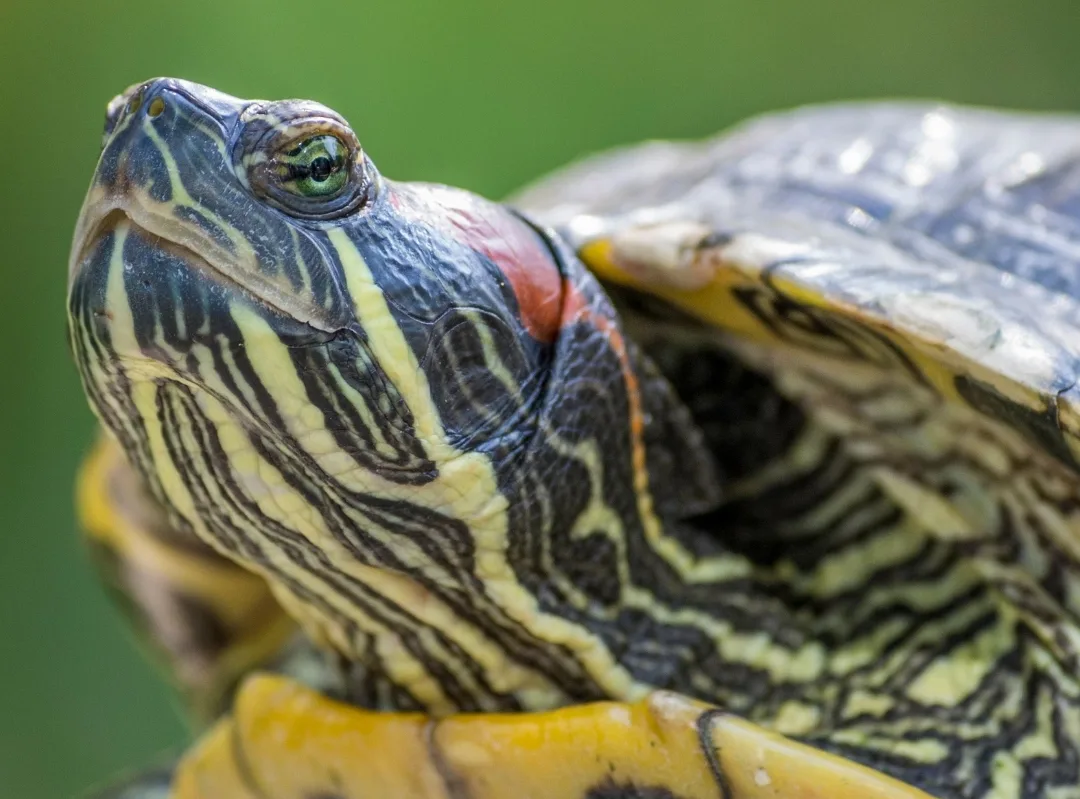
The red-eared slider (Trachemys scripta elegans) is a freshwater turtle with a red stripe behind each eye. Its head, legs and tail are green with fine, irregular yellow lines, and its shell has stripes and markings that help with camouflage. The shell is usually 15–20 cm long, although some exceed 40 cm. Sliders live for 20–30 years.
Being cold-blooded, sliders leave the water to bask in the sun and warm up. They are native to the central and southern United States and northern Mexico. Pet owners have released many, and the species now lives wild on six continents. It is on the IUCN-linked list of the 100 most invasive species, and the European Union has banned imports.
17. Banded krait: black and yellow venom warning
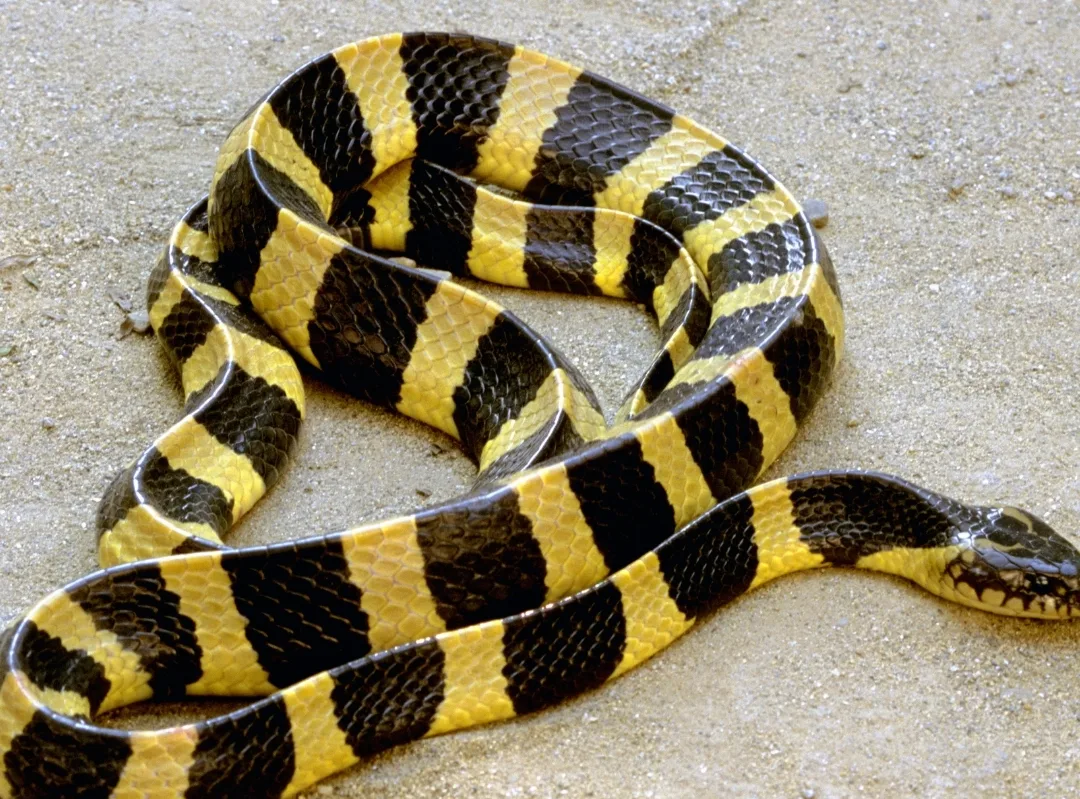
The banded krait (Bungarus fasciatus) wears alternating black and yellow crossbands that go all the way around its body. This is a classic warning pattern. It is usually about 1.8 m long, and the longest measured was 2.25 m. It lives from the Indian subcontinent through South-East Asia to southern China.
Its venom is mainly neurotoxic and can be lethal to humans. Even so, the snake is shy and sluggish. When harassed it often hides its head under its coils instead of biting. It hunts mainly at night and eats other snakes, as well as fish, frogs and skinks. The status is Least Concern. For more on venomous snakes of one region, read about venomous snakes in Sri Lanka.
18. Banded sea krait: a snake that comes ashore
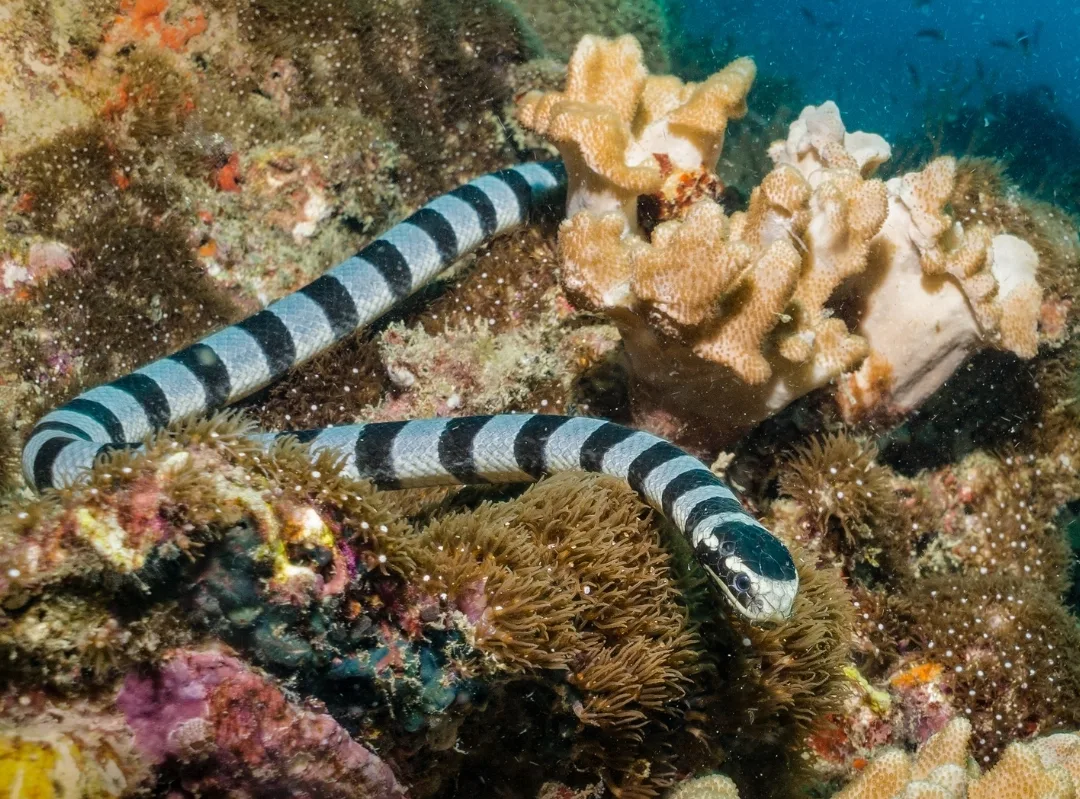
The banded sea krait (Laticauda colubrina), also called the yellow-lipped sea krait, has black rings on a bluish-grey body and a yellowish belly. Females are much longer than males, averaging about 1.4 m against roughly 87 cm.
It is semi-aquatic. Adults spend about half of their time on land and half in the sea. They come ashore to digest, shed their skin and breed, and they hunt mainly eels. The venom is a strong neurotoxin, but the snake is not aggressive and generally avoids people. Bites usually happen when someone grabs it, for example while untangling it from a fishing net. It lives from the eastern Indian Ocean to the western Pacific and is Least Concern. Our guide to ocean food chains shows where eels and sea snakes fit.
19. Yellow-banded poison dart frog: the bumblebee frog
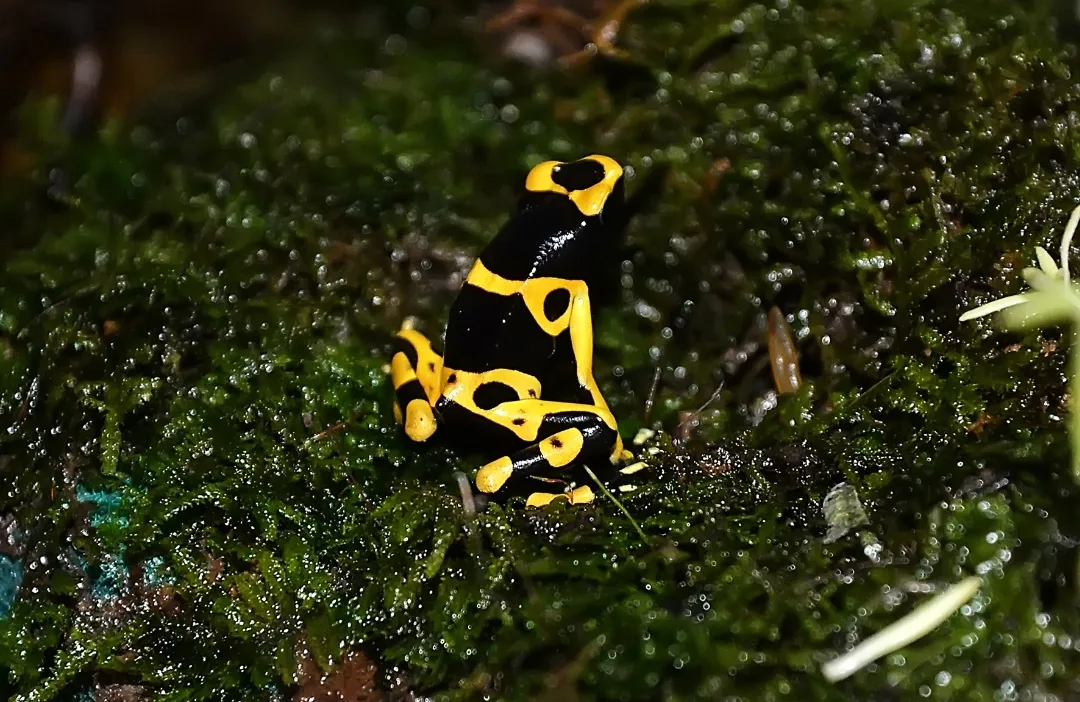
The yellow-banded poison dart frog (Dendrobates leucomelas), also called the bumblebee poison frog, is a tiny frog of only 3–5 cm that weighs about 3 g. It is bright yellow with broad black bands or spots, and some forms are orange. It lives in humid forests near fresh water in northern South America, mainly Venezuela, plus parts of Guyana, Brazil and the far east of Colombia. It does not live in Central America.
The bold colours warn predators that the skin is toxic. The frog does not make its toxins from scratch: it gets them from the arthropods it eats. The species is Least Concern, but it is listed on CITES Appendix II, which controls trade.
Reptiles and amphibians: quick questions
Why are banded kraits and poison dart frogs both black and yellow? (2 marks)
Bright contrasting colours act as warning colouration. Predators learn that animals with this pattern are venomous or toxic and avoid them.
How does the poison dart frog get its toxins? (1 mark)
It gets them from the arthropods it eats, rather than making all of the toxins itself.
Why is the red-eared slider a problem outside North America? (2 marks)
Released pets have formed wild populations that can outcompete native species, so the slider is listed among the world's most invasive animals.
Spotter checklist
Tick off the stripes you can already identify.
- A snake with black and yellow crossbands all the way round: banded krait.
- A freshwater turtle with a red stripe behind its eye: red-eared slider.
- A tail with 13 or 14 black rings: ring-tailed lemur.
- A mask plus a ringed tail: raccoon.
- Five dark stripes on a small woodland rodent: eastern chipmunk.
- A yellow-and-black frog that is only about 4 cm long: bumblebee poison frog.
20. Ocellaris clownfish: three white bands

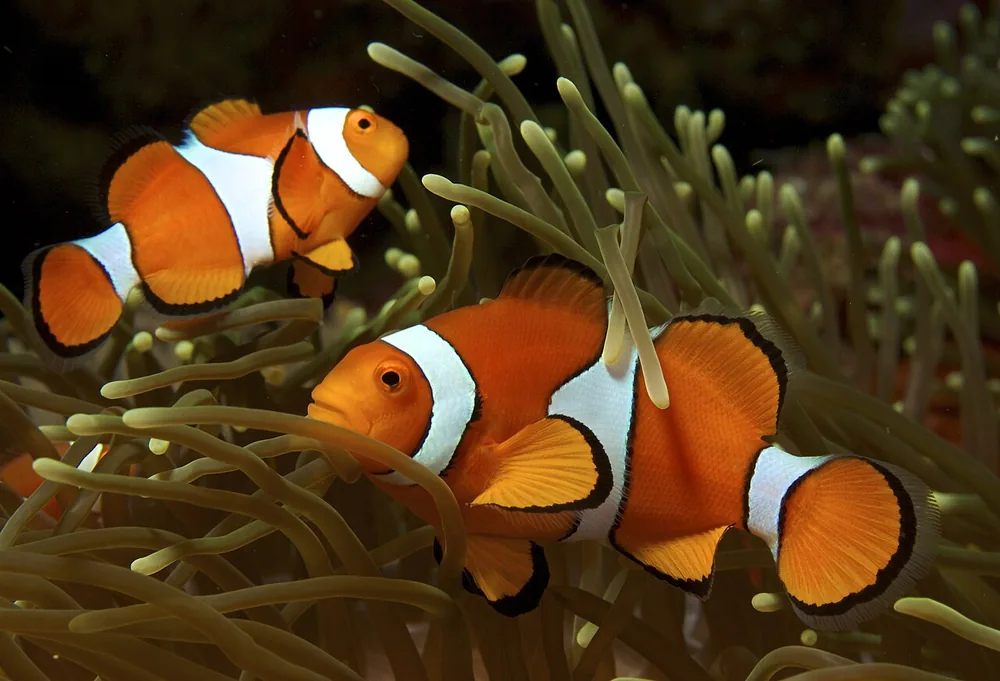
The ocellaris clownfish (Amphiprion ocellaris) is orange with three white bands outlined in black. Marlin and Nemo in the 2003 film Finding Nemo are this species. It grows to about 11 cm and lives on the outer slopes and lagoons of reefs in the eastern Indian Ocean and western Pacific.
The fish shelter among the tentacles of sea anemones, and a protective layer of mucus stops the anemone from stinging them. In return they clean the anemone and drive off fish that eat its tentacles. Clownfish are protandrous hermaphrodites: all start life as males, and the largest fish in the group becomes the female. If she is removed, the dominant male changes sex. The species is Least Concern. A claim that the stripes copy poisonous fish is not supported by the sources we checked, so we have left it out.
21. Emperor angelfish: stripes that change with age
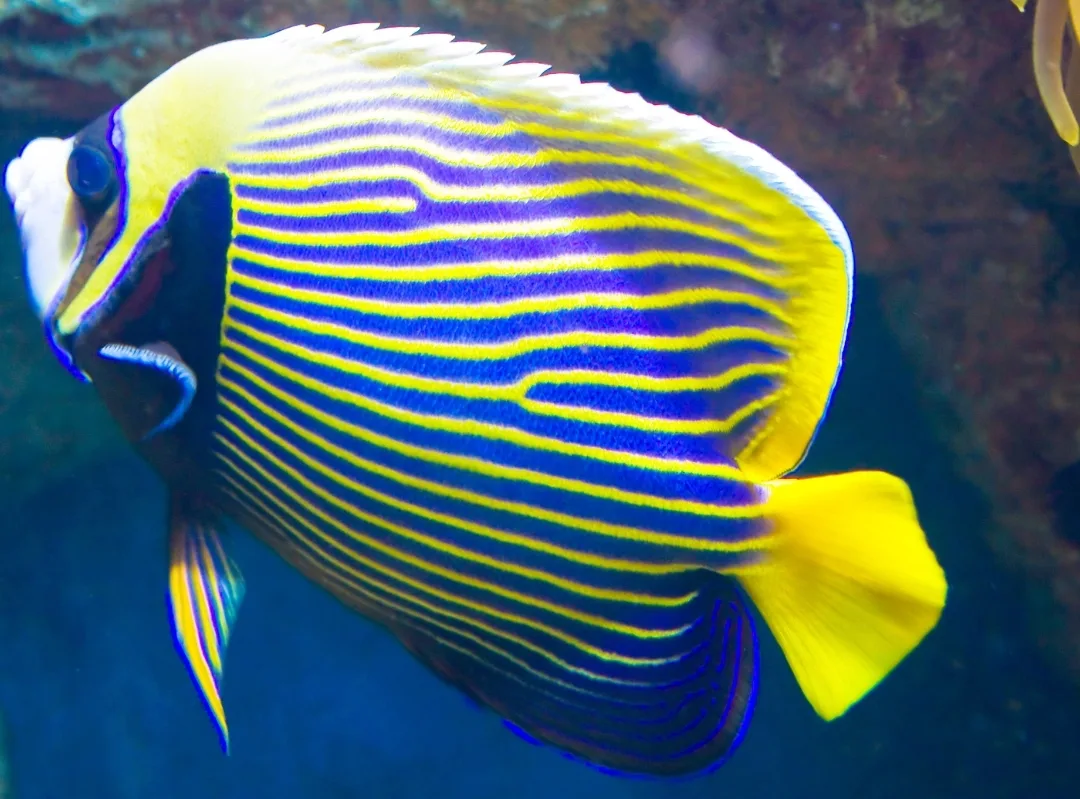
The emperor angelfish (Pomacanthus imperator) grows up to 40 cm and has narrow blue and yellow stripes along its body, a dark mask across the eyes and a yellow tail. It lives on Indo-Pacific reefs from the Red Sea to the Great Barrier Reef, and since 2009 it has also spread to the eastern Mediterranean.
The juvenile looks like a different species. It is dark blue with curved lines of pale blue and white that form circles, and its tail is transparent. It feeds on sponges and tunicates, and juveniles and adults may act as cleaner fish. The emperor angelfish is Least Concern.
22. Zebrafish: stripes that scientists study
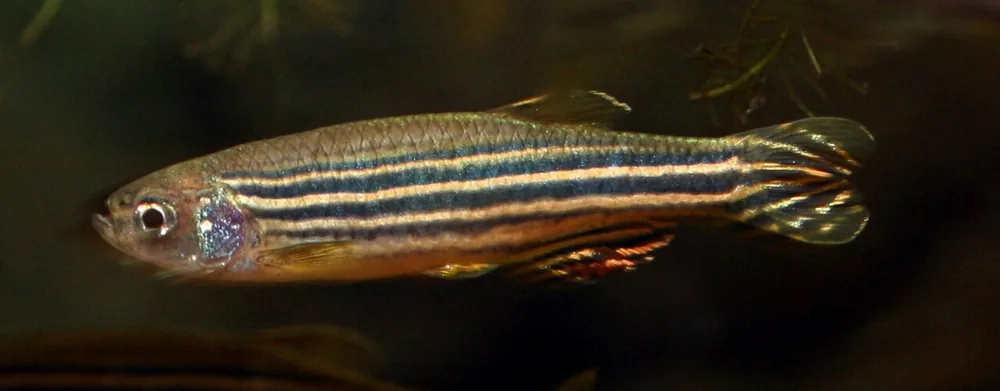
The zebrafish (Danio rerio) is a tiny freshwater fish from South Asia, only 4–5 cm long at most. It has five horizontal blue stripes along each side. Males have gold stripes between the blue ones, and females have silver stripes.
It is one of the most important animals in biology labs. Roughly 70% of human genes have a zebrafish counterpart, and the embryos are almost transparent, so researchers can watch organs develop. It is a useful animal to link with our guide to genetics, DNA and cell division.
How does a zebrafish get its stripes?
Stripes appear when different pigment cells interact. Black cells (melanophores) and yellow cells (xanthophores) repel each other when they meet, but each type needs the other at a longer distance to survive. Short-range repulsion plus long-range support matches the kind of mathematical pattern model proposed by Alan Turing, although scientists still debate the details, and a third cell type, the iridophores, also plays a role.
Fish with mutations in these cells develop spots or wobbly stripes instead of neat lines, which is how researchers worked out the rules.
23. African tigerfish: stripes along the side
The African tigerfish (Hydrocynus vittatus) is a silvery fish with thin horizontal black lines running along its flanks. It is the stripes that give it its name, but note that they run along the body and not up and down. It reaches about 105 cm in standard length and has eight sharp, conical teeth in each jaw.
It lives in many African river systems, including the Nile, Niger, Congo, Zambezi and Limpopo, and in large lakes such as Tanganyika and Kariba. Most of its food is other fish. At Schroda Dam, tigerfish were even seen leaping from the water to catch swallows in flight, succeeding about a quarter of the time. Anglers prize the fish, and it is Least Concern, although dams, pollution and gillnets threaten local populations.
24. Tiger swallowtail: black stripes on yellow wings

The eastern tiger swallowtail (Papilio glaucus) is a large butterfly from eastern North America. Males are yellow with four black "tiger stripes" on each forewing. The wingspan ranges from about 8 to 14 cm, and females are larger than males.
Females come in two forms. One looks like the male but has a blue band on the hindwing. The other is mostly black or dark grey and mimics the poisonous pipevine swallowtail, so predators leave it alone. This type of copying is called Batesian mimicry. The caterpillar has two large eyespots that make it look like a small snake.
25. Wasp spider: a spider dressed as a wasp

The wasp spider (Argiope bruennichi) has an abdomen banded in yellow, white and black. Females measure about 14–20 mm, while males are only about 4.5 mm long. It lives in central and northern Europe, as well as parts of Asia, Africa and the Azores, and an influx into the UK was reported in 2006.
It spins a spiral orb web low in long grass. The centre of the web has a zigzag band of silk called a stabilimentum. Scientists do not know its exact function, but webs with one may be damaged less by birds. After mating, the female almost always eats the male.
The wasp spider is not the North American black-and-yellow garden spider that older lists of striped animals describe, so check the name before you search for one.
Striped animals compared by purpose
| Main job of the stripes | Examples in this article |
|---|---|
| Camouflage in grass or forest | Tiger, Sumatran tiger, okapi, bongo, tapir calf, chipmunk |
| Warning colours | Banded krait, banded sea krait, poison dart frog, striped skunk" and add wasp spider to the Mimicry row → the wasp spider's pattern is usually described as wasp mimicry, and the entry itself is titled "a spider dressed as a wasp |
| Discouraging biting flies | Zebras |
| Signalling to others of the same species | Ring-tailed lemur, badger, clownfish, emperor angelfish |
| Mimicry | Dark female tiger swallowtail |
Some animals fit several rows. The tiger, for example, is camouflaged for hunting but also uses its pattern as an individual identity for scientists. To compare striped animals with other record-holders, try our lists of the largest animals and the fastest animals. Our guide to families of mammals shows where the tiger, hyena and okapi sit in the mammal family tree, and you can find out how conservation works in conservation in biology.
Frequently asked questions about animals with stripes
What animals have stripes?
Many animals have stripes, including tigers, zebras, okapis, bongos, badgers, skunks, chipmunks, kraits, clownfish, angelfish and wasp spiders. The patterns do different jobs: camouflage for tigers, protection from biting flies for zebras, and warning colours for banded kraits and poison dart frogs.
Why do zebras have stripes?
The best-supported explanation is protection from biting flies. In a 2019 study on a British horse farm, flies landed on zebras and striped coats far less often than on plain horses. Scientists think stripes disrupt a fly's landing, but they continue to test other ideas.
Are tiger stripes unique?
Yes. Each tiger has its own stripe pattern, much like a human fingerprint. Wildlife researchers use camera-trap photographs of a tiger's flank to identify individuals and count them in the wild. The Sumatran tiger has thicker, more numerous stripes than other tigers, and many of its stripes break into spots.
Which striped animals are endangered?
Several are. The tiger, Grévy's zebra, okapi, Malayan tapir and ring-tailed lemur are listed as Endangered, and the Sumatran tiger is Critically Endangered. Plains zebras, bongos and striped hyenas are Near Threatened, so the list of striped animals under pressure is long.
What is the difference between stripes and spots?
Stripes are long lines or bands, while spots are small round marks. Some animals show both. A Sumatran tiger has stripes that break into rows of spots near their ends, and a tapir calf has both white stripes and white spots on its dark coat.
What is the most poisonous striped animal?
Among the animals here, the banded krait and the banded sea krait both have strong neurotoxic venom, and the poison dart frog has toxic skin. Both snakes are shy and rarely bite unless handled. If someone is bitten by any snake, they need urgent medical help.
Which striped animals are black and white?
Plains zebras and Grévy's zebras are the best-known black and white striped animals. The okapi has black-and-white stripes on its legs, a badger has black and white stripes on its face, and the striped skunk and ring-tailed lemur also show black and white in their stripes or rings.
Which striped animals are black and yellow?
Black and yellow stripes usually act as a warning. The banded krait and the yellow-banded poison dart frog are examples, and the tiger salamander is sometimes cited too; the tiger swallowtail's yellow is not a warning (the dark female form is a mimic), and the wasp spider adds white to the yellow and black. Their bright colours warn predators that they could be harmful.
Do all baby animals keep their stripes?
No. A Malayan tapir calf is born with white stripes and spots that fade into the adult black-and-white coat after four to seven months. In contrast, zebras keep their stripes for life, although a foal's first coat is brown and white and the brown darkens with age.