An albino squirrel is a squirrel whose body cannot make normal amounts of melanin, the pigment that colours fur, skin and eyes. The result is white or creamy fur, pale skin and pink or red eyes. It is a genuine rarity, and it is also one of the most misunderstood: many of the "white squirrels" in photographs and famous towns are not albino at all.
This guide sorts out the difference. You will see how albinism works, how to tell it from leucism, which towns are known for their white squirrels, and what life is like for a pale squirrel with so little camouflage.
What is an albino squirrel?
Albinism is an inherited condition. A squirrel with albinism has a change in a gene that controls how melanin is made. With little or no melanin, nothing darkens the fur, so it looks white or cream. The skin of the nose, ears, paws and claws is pale pink for the same reason.
The eyes give the biggest clue. In a normal squirrel, melanin in the iris makes the eye dark. Without it, the iris is almost see-through, so the tiny blood vessels inside the eye show through and make it look pink or red. The eyes are not "glowing"; they are simply unpigmented.
Almost every common squirrel you meet could, in principle, be born albino. Albinism has been recorded in many mammals, from mice and rabbits to deer, and our guide to albino animals covers the general picture. This article stays with squirrels.
What does an albino squirrel look like?
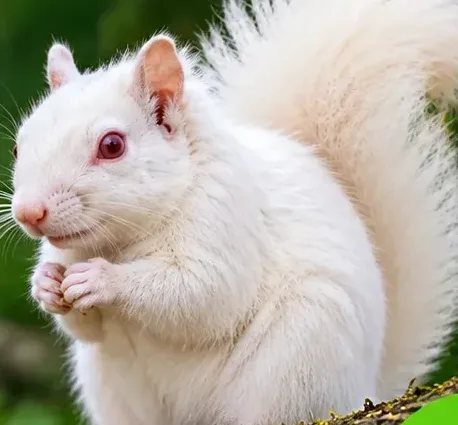
A true albino squirrel has four features that appear together:
- Fur: pure white or cream, including the tail.
- Eyes: pink or red.
- Nose and ears: pale pink skin.
- Claws and paw pads: pale, often pink.
Size, shape and behaviour are normal for the species. An albino eastern grey squirrel still has the same bushy tail, the same sharp claws and the same habit of burying nuts. Only the colour is different.
The science behind white fur
Colour in mammal fur comes mostly from melanin, made inside special cells called melanocytes. Melanin is built step by step by enzymes. If one key enzyme does not work, the whole production line stalls. In many mammals the most common albinism gene codes for an enzyme called tyrosinase, which is needed at an early step.
The chain of events is short: a gene changes, the enzyme works badly or not at all, little melanin is made, and the fur, skin and eyes stay pale.

Notice that nothing here involves the squirrel's food, climate or surroundings. Albinism is decided by genes alone.
What causes albinism in squirrels?
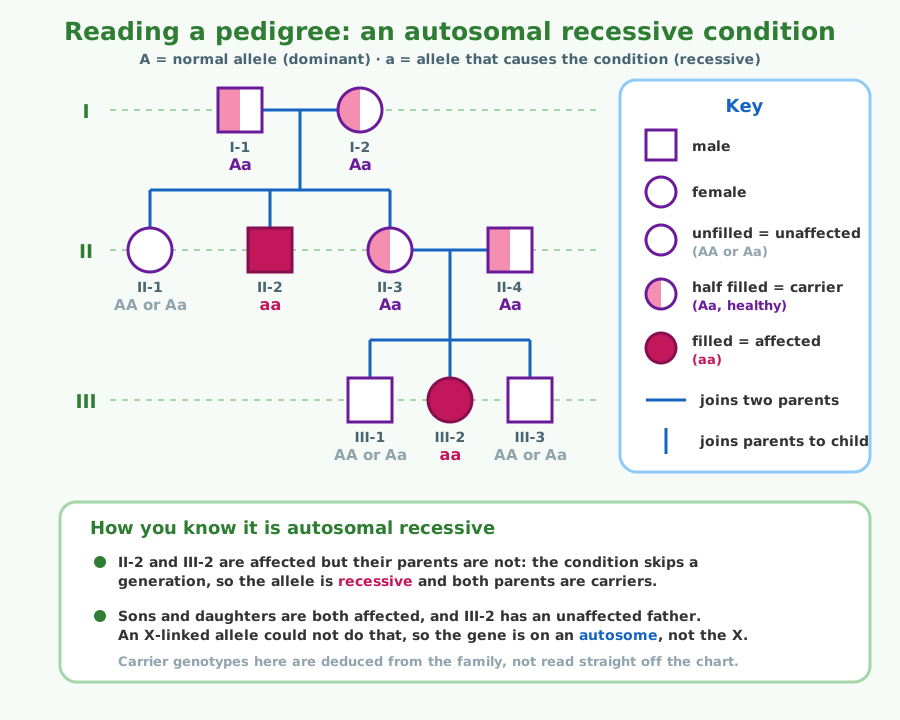
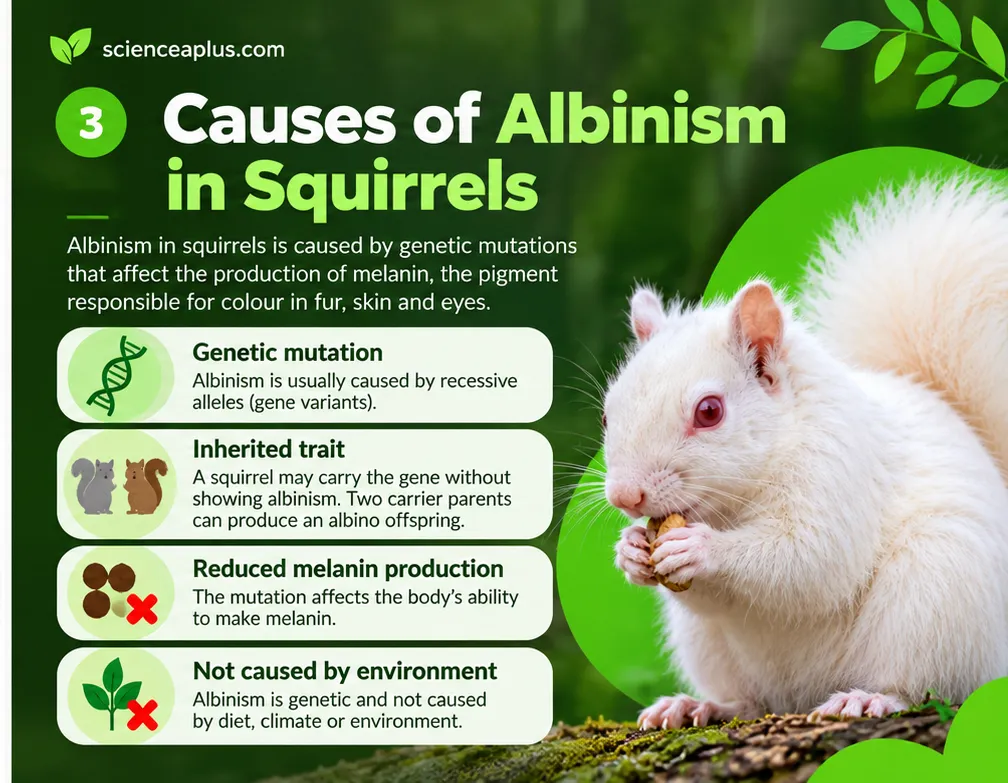
Albinism is usually recessive. Every squirrel has two copies of each gene, one from each parent. To be albino, a squirrel must inherit the changed copy from both parents. A squirrel with only one changed copy has normal colour but is a carrier, and can pass the gene on without ever showing it.
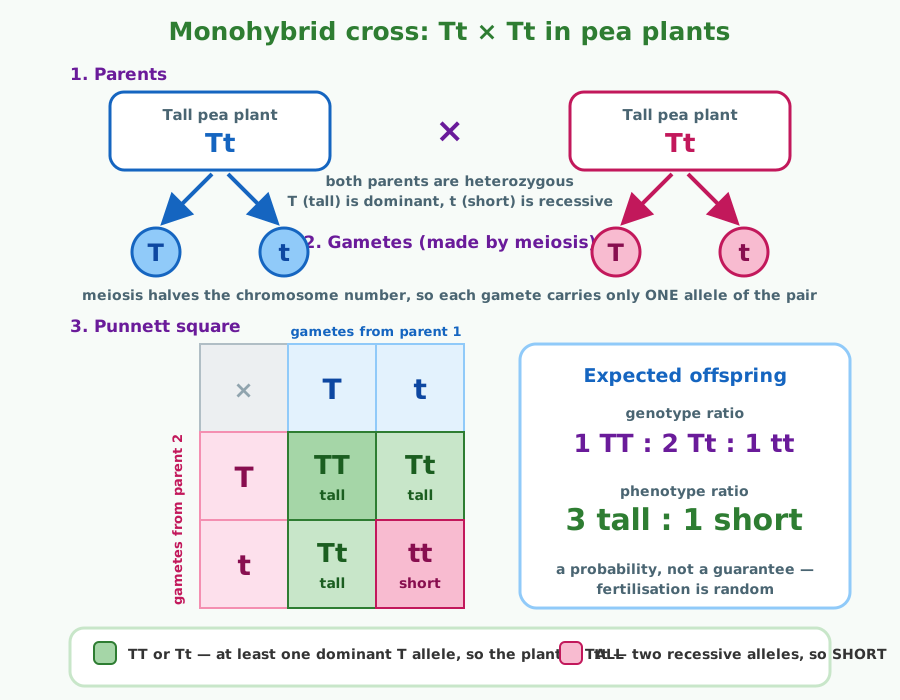
Geneticists write the normal allele as A and the albino allele as a. Here are the three genotypes:
- AA: normal colour, not a carrier.
- Aa: normal colour, carries one albino allele.
- aa: albino.
If you want the full vocabulary of alleles, genotype and phenotype, our article on alleles and inheritance explains it step by step.
Try the cross yourself
When two carriers (Aa × Aa) have babies, each baby has a one in four chance of being albino. That ratio applies separately to every baby, so a litter of four does not have to contain exactly one albino. Use the calculator to test different parent combinations.
Notice that two albino parents (aa × aa) can only have albino babies, while a non-carrier (AA) can never produce an albino baby, even if the other parent is albino. All of those babies would be carriers.
Albino or leucistic? Why the difference matters
This is the point that trips up most people. A white squirrel is not automatically an albino squirrel. The other common cause of white fur is leucism.
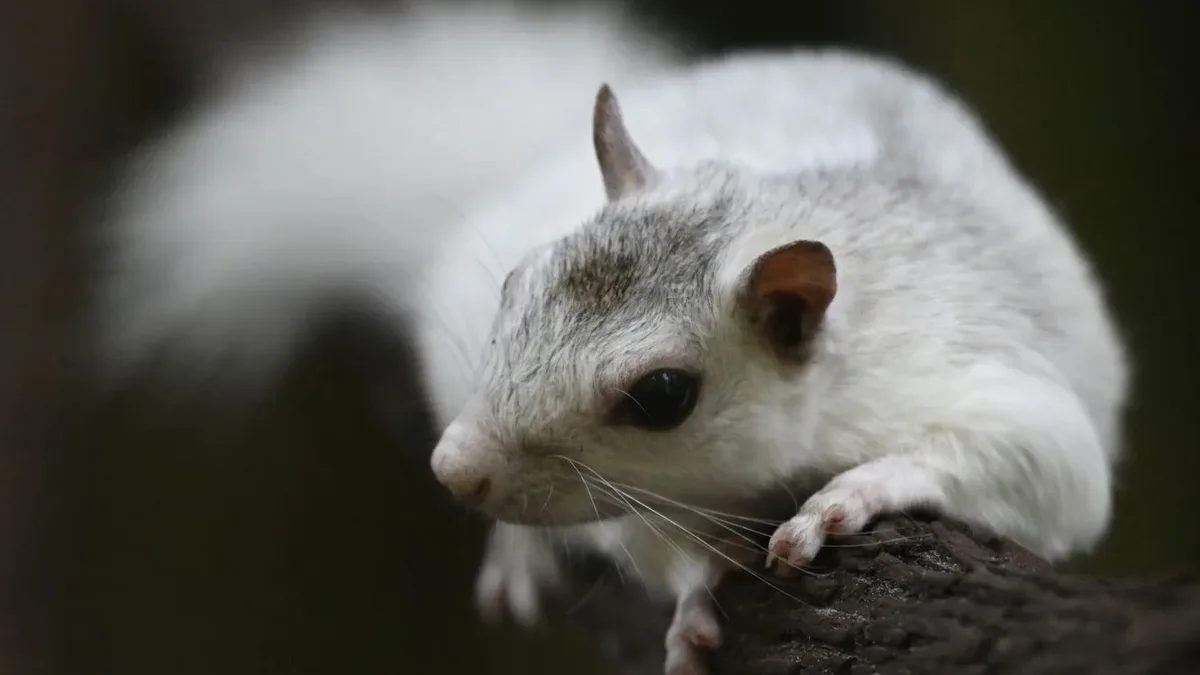
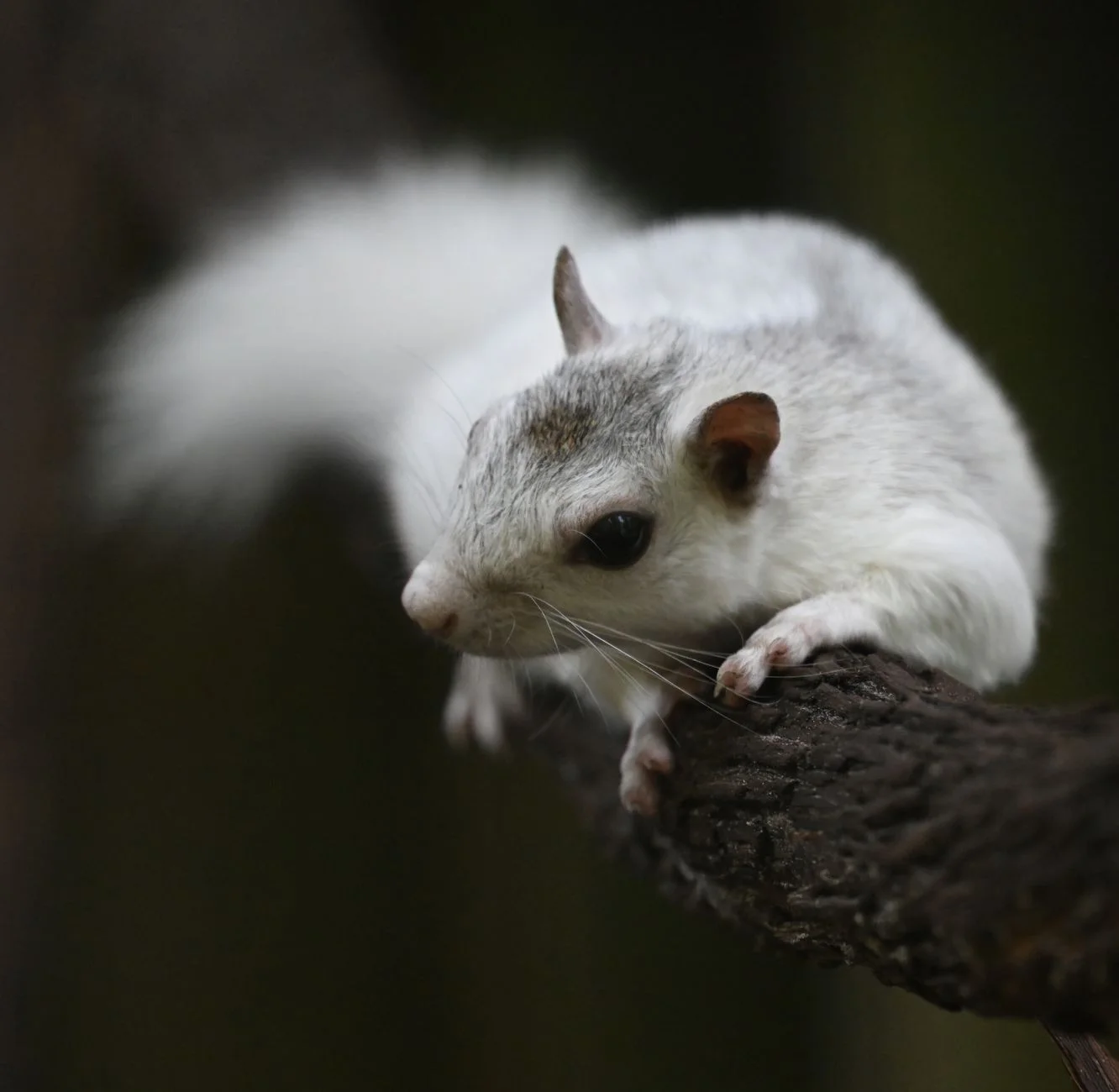
In leucism, pigment cells are missing or fail to reach parts of the body, so the squirrel is pale or patchy. The key difference from albinism is that the pigment problem is not in the melanin-making machinery inside each cell. Leucistic squirrels usually keep dark eyes, and they often keep a grey or darker patch, such as a patch on the head or a stripe down the back.
| Feature | Albino squirrel | Leucistic squirrel |
|---|---|---|
| Fur | White or cream all over | White, pale or patchy; may have grey patches |
| Eyes | Pink or red | Usually dark |
| Skin, nose, claws | Pale pink | May keep some colour |
| Cause | Little or no melanin made | Reduced pigment cells or pigment reaching the skin and fur |
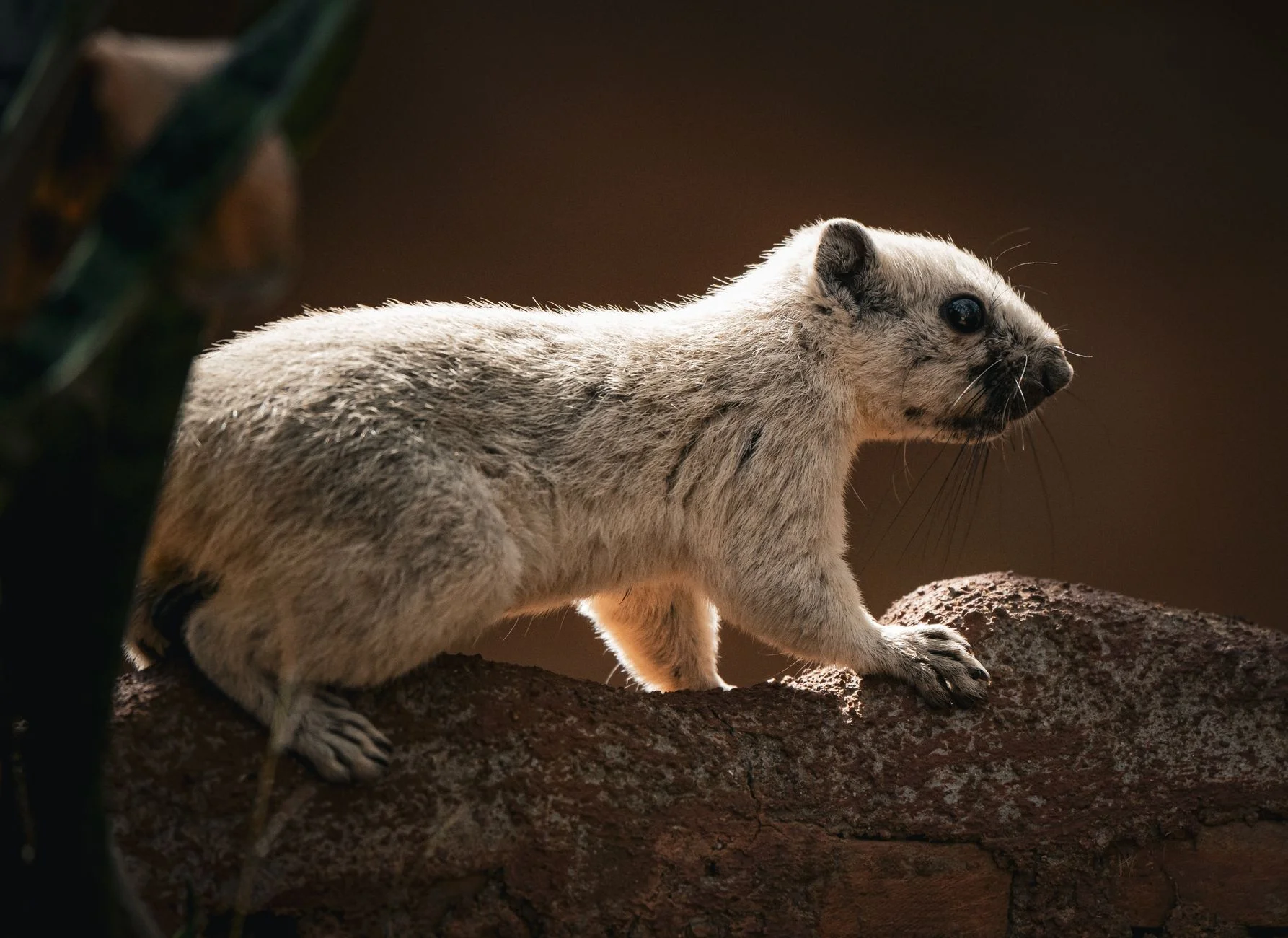
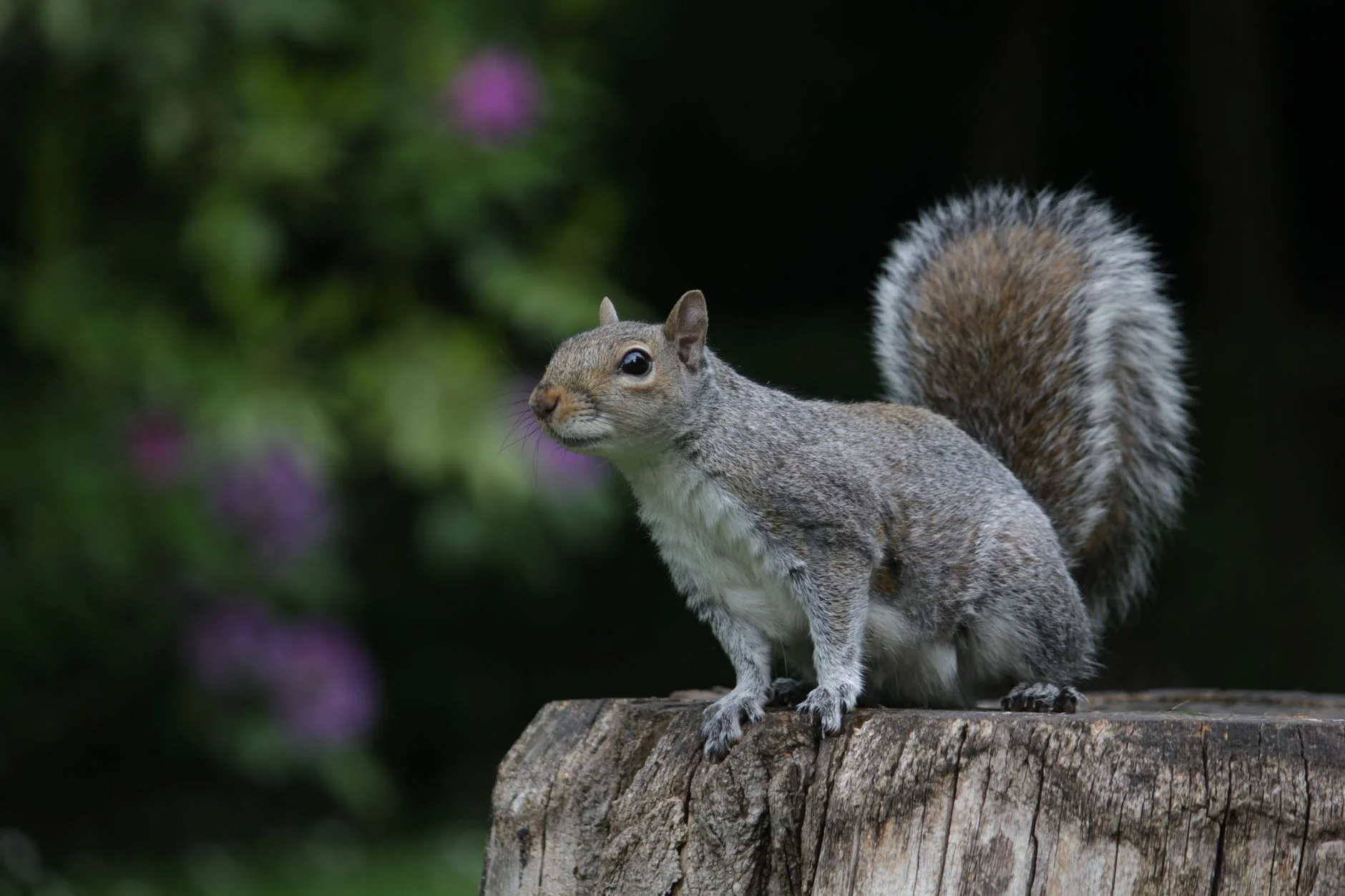
The two photographs below show why eyes matter. Both squirrels look white at a glance, yet both have clearly dark eyes, so neither is albino.
Which squirrels can be white?
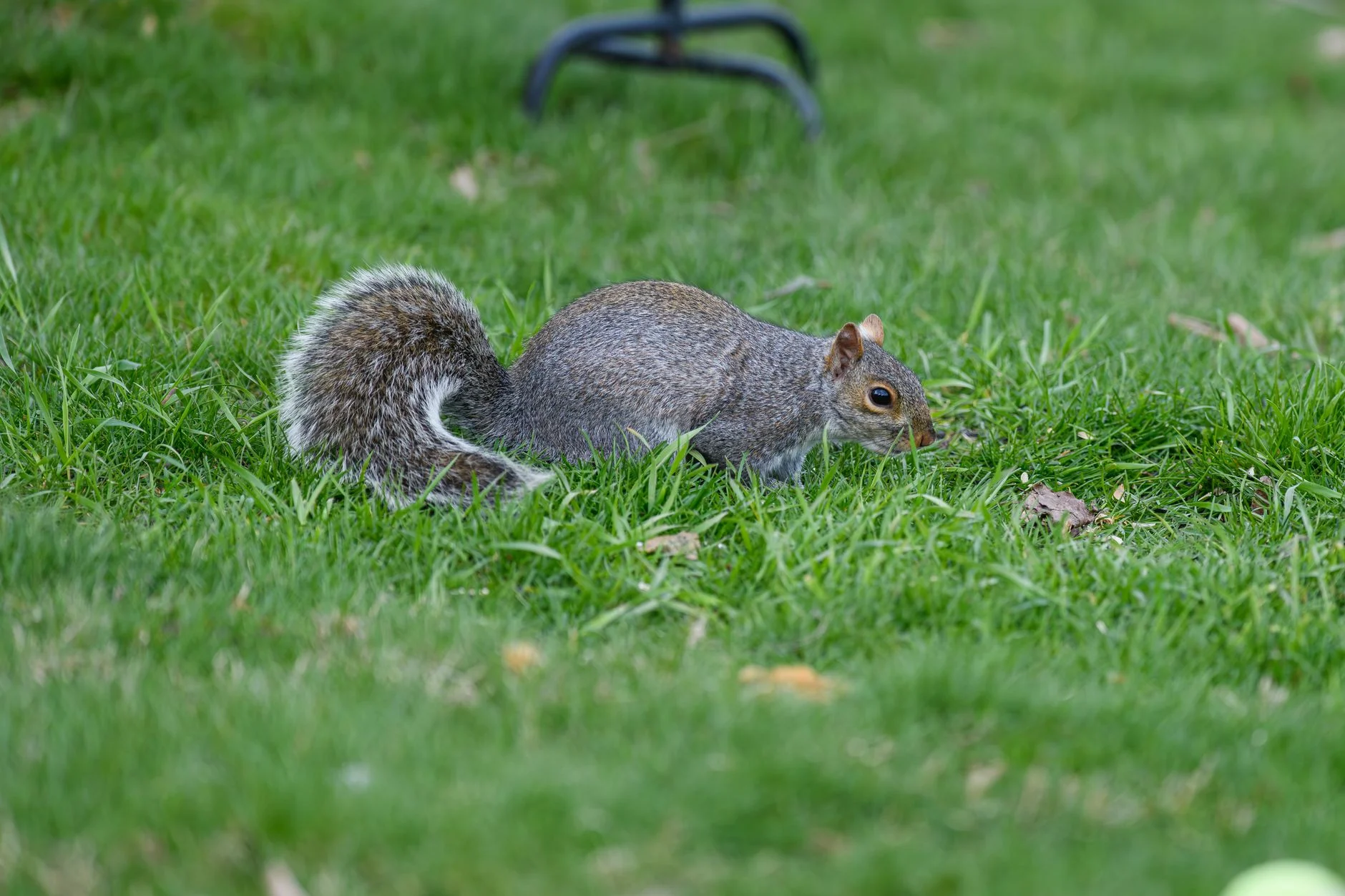
Any squirrel species can produce a pale individual, but most of the white squirrels people photograph are eastern grey squirrels (Sciurus carolinensis), a species native to eastern North America. Normally these squirrels are grey with a white belly and a frosted tail. A few are born black, a few white, and the occasional one is a mix.
The black ones are a useful comparison. Black coat colour in grey squirrels is called melanism, the opposite of albinism, and it has been linked to a change in a gene called MC1R: a deletion of 24 base pairs. Researchers think the change probably arrived in grey squirrels from the related fox squirrel through interbreeding. So one species can be grey, black or white because of different genetic changes.
How rare is an albino squirrel?
Very rare. Because albinism is recessive, two squirrels that both carry the gene must meet and mate before an albino baby can appear, and each baby of such a pair still has only a one in four chance. In a large wild population most carriers never meet each other.
You may see a figure such as "one in 100,000" quoted in news stories. Treat it with caution: it is a popular estimate, not a measured count for every population, and it will differ from place to place. What is certain is that albino squirrels are far less common than leucistic or normal ones.
Where do white squirrels live? Three famous towns
A few places have become well known for their white squirrels. They are useful case studies because each one shows a different kind of white squirrel, and each one shows what happens when people protect a rare colour variant.
Olney, Illinois, USA: albino squirrels
Olney is the best-known home of truly albino squirrels. According to the town's history, in 1902 two men, William Yates Stroup and George W. Ridgely, each caught an albino grey squirrel and displayed them in a saloon. The animals went on to found a colony, and the descendants have lived in the town ever since.
The squirrels have pink eyes and white fur. They are protected by local rules: squirrels have the right of way on city streets, pets are restricted so they cannot harass them, and harming one carries a penalty. Every October, volunteers walk set routes to count them. Reported totals have moved up and down over the years, and published figures vary by source and year, so the count is better thought of as a regular health check than a single fixed number.
Brevard, North Carolina, USA: leucistic squirrels
Brevard has a different story. Family records say that H. H. Mull gave a pair of white squirrels, said to come from a pecan grove in Madison, Florida, to his niece Barbara Ann Mull in 1949. When her family moved in 1951 the squirrels were passed to her grandfather; one escaped and the other was released. They bred with local grey squirrels, and the white colour spread.
These squirrels are not albino. They are leucistic, with dark eyes, and often carry a darker head patch and a stripe down the back. In 1986 the city passed an ordinance making its limits a squirrel sanctuary, where it is unlawful to hunt, kill or trap them. Research associated with the White Squirrel Institute (founded by Robert Glesner in 1997) found that roughly one third of the squirrels inside the city limits were white.
That fraction is high for a rare colour variant. Safe streets, protection and food from people appear to have helped a variant that would struggle in the open woods.
Exeter, Ontario, Canada: another leucistic town
Exeter is a small town in Ontario that has adopted the white squirrel as its mascot, "Willis the White Wonder", and decorates its main street with the image. Like those in Brevard, the Exeter squirrels have dark eyes, usually a grey patch on the head and a stripe along the back, which marks them as leucistic rather than albino. The town celebrates its white squirrels with a yearly festival.
Why do some towns have so many white squirrels?
In the wild, a white squirrel is easy to spot, so predators are more likely to catch it. In a town with protective rules, the balance changes. In Olney, local rules protect the squirrels and restrict pets, and in Brevard the high share of white squirrels may partly reflect protection and human preference. A rare variant that would normally disappear within a few generations survives long enough to breed, and its descendants can become a visible share of the local population.
This is a small-scale example of natural selection being altered by people. The squirrels are no better adapted to the open woodland. The environment around them has simply been made safer.
Why can two normal-coloured squirrels have an albino baby? (2 marks)
Both parents can be carriers (Aa). Each passes on the albino allele (a) to the baby with a probability of one half, so the baby has a one in four chance of being aa, which is albino.
A white squirrel has dark brown eyes. Is it albino? Explain. (2 marks)
No. Albino squirrels have little or no melanin, so their eyes are pink or red. Dark eyes show that melanin is present in the eyes, so the squirrel is more likely leucistic.
Can an albino squirrel survive in the wild?
It can, but the odds are worse than for a normally coloured squirrel. Two problems do most of the damage: the white coat is conspicuous, and the eyes are sensitive to light. Neither makes the squirrel weak. Both make it easier to find and harder to see well.

Problem 1: no camouflage
A grey squirrel's coat matches bark, branches and winter woodland. That is camouflage: colour and pattern that help an animal hide from predators or sneak up on prey. A white squirrel on a dark trunk breaks that rule. Hawks hunt largely by sight, and a bright white shape is the easiest target in the picture.
Foxes and domestic cats are also a threat, and for ground-feeding squirrels the danger is highest when they leave the trees. In the wild, a bright squirrel has fewer second chances.
Problem 2: sensitive eyes
Melanin in the eye helps absorb stray light and also guides how the eye develops. Without it, mammals with albinism commonly have eyes that are very sensitive to bright light and vision that is less sharp than normal. This is well documented in people and in laboratory animals, so it is reasonable to expect wild albino squirrels to be affected in a similar way, although squirrel-specific measurements are scarce.
Squirrels are active by day and depend on sight to judge jumps between branches, spot danger and relocate buried food. A squirrel that squints in bright sun or misjudges a leap has a disadvantage that no amount of luck fully cancels.
What helps a white squirrel?
The adaptations in the infographic above are modest. An albino squirrel can still climb, find food and breed when conditions are suitable. Dense cover, shade, a safe nest and plenty of food all improve its chances. In short, a white squirrel does best where danger is low, which is exactly what protected towns provide. Our article on adaptations in plants and animals shows how features are judged "helpful" or "harmful" only relative to a particular habitat.
Who hunts squirrels?
Squirrels sit in the middle of woodland food chains. They eat seeds, nuts, buds and fungi, and they are eaten by a range of predators. In the UK, the animals that take grey squirrels include foxes, stoats, goshawks and, near houses, domestic cats. In North America, red-tailed hawks, owls, foxes, coyotes and snakes are among the predators.
If you want the bigger picture of how energy moves from seeds to squirrels to hunters, read our guide to food chains and food webs.
Grey and red squirrels in the UK
If you live in Britain, the squirrel in your garden is almost certainly a grey squirrel, and that fits the topic of white squirrels better than you might expect, because almost every white squirrel reported in Britain is a colour variant of the introduced grey squirrel (red squirrels can very rarely be pale too).
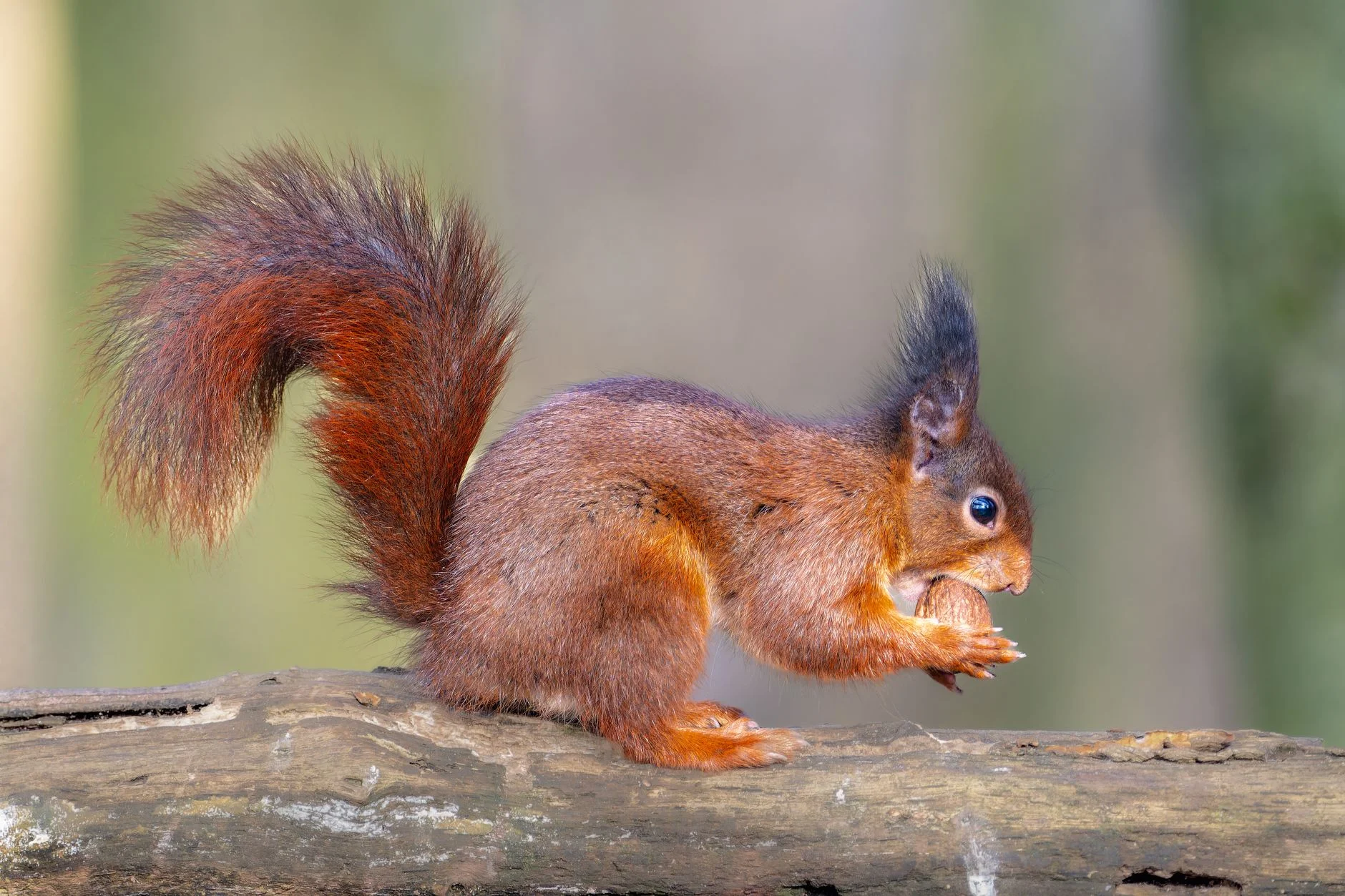
Grey squirrels were brought from North America to sites in Britain and Ireland between 1876 and 1929. They spread widely because they digest acorns more efficiently, store more fat, breed at higher densities and carry squirrelpox, which kills the native red squirrel. Estimates from the Mammal Society put the grey population at over 2.7 million, against about 287,000 red squirrels. Red squirrels are listed as endangered on the Mammal Society's red list for British mammals.
Two things explain the decline of the red squirrel. First, the greys compete for the same seeds and shelter. Second, greys can carry squirrelpox virus, which they usually survive but which is deadly to reds. Competition plus disease together push the smaller species out.
Are white squirrels a threat to reds?
A white grey squirrel is just a grey squirrel with an unusual coat. It competes with reds in the same way, and it carries the same risks. Their colour does not change that. Nor are they a separate species: leucistic and albino squirrels breed with ordinary greys in the same population.
So it is accurate to call a white squirrel in Britain "rare and striking" and equally accurate to call it "an invasive species". Both statements are true, which is why conservation groups treat the colour as a curiosity and the species as a management problem.
Predators to the rescue?
One of the more surprising findings in squirrel ecology comes from Ireland and Scotland. A 2018 study by Emma Sheehy, Xavier Lambin and colleagues found that where pine martens had recovered, grey squirrels declined and red squirrels did better. Pine martens appear to catch greys more easily than reds, probably because greys spend more time on the ground. This is an example of a predator reshaping a food web, and it shows why a "better-adapted" animal can lose out when the surroundings change.
An albino grey squirrel in such an area would have an even harder time, because a white coat does nothing to help it escape a predator that hunts by more than sight.
Explain why an albino squirrel is more likely to be caught by a hawk than a grey squirrel. (2 marks)
It has no melanin, so its fur is white and gives no camouflage against bark or branches. The hawk can see it from further away, so it is caught more often.
Give two reasons grey squirrels have replaced red squirrels in much of Britain. (2 marks)
Greys compete with reds for food and habitat, and greys carry squirrelpox virus, which they tolerate but which kills reds.
How to watch a white squirrel responsibly
Seeing a white squirrel is exciting, and it is tempting to get close. The kindest approach is to stay back and let the animal behave normally. A squirrel that is forced to run, hide or leave its food loses energy it cannot easily spare, and a bright white one is already at a disadvantage.

- Keep a safe distance and watch quietly; do not chase it.
- Do not touch, trap or pick up a wild squirrel. They can bite and scratch.
- Take photographs from a distance, with the flash switched off.
- Avoid hand-feeding. Human food can harm their health and change their behaviour.
- Note the place, date and eye colour, then report unusual sightings to a local wildlife group.
Eye colour is the single most useful detail to record. It lets scientists tell albino from leucistic animals in a sighting, which a photograph of white fur alone cannot do.
White squirrels in stories and culture
Pale animals are easy to turn into local celebrities, and white squirrels are no exception. The towns described earlier have adopted their white squirrels as mascots, put them on signs and organised events around them.
Stories like these are local tradition, not science. What the science shows is that a white coat is the result of a gene variant, and that people have, in a few places, decided to protect it. That decision, rather than any magic, is why those towns have so many.
What scientists learn from albino squirrels
A pale squirrel is a small, visible example of several big ideas in biology:
- Genetics: a single gene change can alter a whole body feature, and recessive traits can hide for generations.
- Pigmentation: studying melanin and the cells that make it explains colour in many animals, including people.
- Natural selection: a trait can be harmful in one environment and tolerated in another, depending on predators and protection.
- Conservation: introduced species, such as the grey squirrel in Britain, can reshape ecosystems.
Other albino animals to read about
Squirrels are only one example. The same genetic principle explains pale animals in very different groups, and each one shows different problems and survival strategies:
- Reptiles: see albino snake facts.
- Birds: read about the albino peacock, and note how it differs from a white peafowl.
- Large mammals: our article on albino deer covers hoofed animals.
- Another woodland mammal: the albino raccoon.
Test yourself: flip the cards
Frequently asked questions about albino squirrels
What is an albino squirrel?
An albino squirrel is a squirrel born with little or no melanin because of an inherited gene change. It has white or cream fur, pale pink skin and pink or red eyes. Apart from colour, it is the same species as its neighbours and behaves like them.
Are white squirrels albino?
Not always. A white squirrel with pink or red eyes is albino, but one with dark eyes is usually leucistic, meaning it has reduced pigment but still makes some. The squirrels in Brevard, North Carolina and Exeter, Ontario are leucistic, while those in Olney, Illinois are albino.
What causes albinism in squirrels?
Albinism is caused by an inherited change in a gene needed to make melanin. It is usually recessive, so a squirrel must inherit the changed allele from both parents. Diet, pollution and climate do not cause it. Carrier parents can look completely normal.
How rare are albino squirrels?
Very rare. Two carriers must mate, and each of their babies has only a one in four chance of being albino. You may see "one in 100,000" quoted, but that is a popular estimate rather than a measured figure, and real frequencies differ between populations.
What colour are the eyes of an albino squirrel?
They are pink or red. With little melanin in the iris, the blood vessels inside the eye show through. A white squirrel with dark brown or black eyes is not albino, which makes eye colour the quickest way to tell the two apart.
Where can you see white squirrels?
Olney in Illinois is famous for albino squirrels, while Brevard in North Carolina and Exeter in Ontario are known for leucistic ones. White grey squirrels also turn up occasionally in other places, including Britain, but sightings are unpredictable and you should never expect one.
Do albino squirrels live as long as normal squirrels?
In the wild they probably do not, because white fur makes them easy for predators to see and bright light can bother their eyes. In protected towns, where predators and traffic are controlled, white squirrels can live much safer lives.
Are there white squirrels in the UK?
Yes, but they are rare. Most British white squirrels are colour variants of the grey squirrel, an introduced North American species, and not a separate kind. Some are albino and some leucistic. The native red squirrel is a different species and is reddish-brown.
Is it safe to touch or feed an albino squirrel?
No. Wild squirrels can bite and scratch, and hand-feeding can harm their health and change how they behave. Watch from a distance, take photographs without flash and leave the animal alone. If one looks injured, contact a local wildlife rescue.
Is an albino squirrel a different species?
No. It belongs to the same species as other squirrels around it, such as the eastern grey squirrel, and can breed with them. Albinism is a variation in one gene, not a new species.