Animals that start with F range from the fin whale, the longest living animal on this list, to the froghopper that leaps 70 cm from a garden leaf. This guide lists 76 animals that start with F, each with a scientific name, a habitat and an IUCN Red List status, and 54 of them have their own photograph.
Quick answer: the best-known animals beginning with F are the fox, frog, flamingo, falcon, fish, fly, ferret, fin whale and firefly. Before this one comes animals that start with E, and after it comes animals that start with G.
Animals that start with F: the full list of 76
Here is every animal in this guide. Statuses come from the IUCN Red List, the global register of how close species are to extinction. One change is very recent: in April 2026 the IUCN moved the Antarctic fur seal from Least Concern to Endangered. “Not assessed” means the IUCN has no global assessment for that animal.
| # | Animal | Scientific name | Group | Habitat | IUCN status |
|---|---|---|---|---|---|
| 1 | Fox (red) | Vulpes vulpes | Mammal | Northern Hemisphere | Least Concern |
| 2 | Fox (Arctic) | Vulpes lagopus | Mammal | Arctic tundra | Least Concern |
| 3 | Fennec fox | Vulpes zerda | Mammal | North African deserts | Least Concern |
| 4 | Fallow deer (European) | Dama dama | Mammal | Woods of Europe | Least Concern |
| 5 | Fossa | Cryptoprocta ferox | Mammal | Madagascar | Vulnerable |
| 6 | Fishing cat | Prionailurus viverrinus | Mammal | Asian wetlands | Vulnerable |
| 7 | Ferret | Mustela furo | Mammal | Domesticated | Domesticated (not assessed) |
| 8 | Fisher | Pekania pennanti | Mammal | North American forests | Least Concern |
| 9 | Flying fox (large) | Pteropus vampyrus | Mammal | Southeast Asian forests | Endangered |
| 10 | Flying squirrel (southern) | Glaucomys volans | Mammal | Eastern North America | Least Concern |
| 11 | Flying lemur (Sunda colugo) | Galeopterus variegatus | Mammal | Southeast Asian forests | Least Concern |
| 12 | Fin whale | Balaenoptera physalus | Mammal | All major oceans | Vulnerable |
| 13 | False killer whale | Pseudorca crassidens | Mammal | Warm oceans | Near Threatened |
| 14 | Fur seal (Antarctic) | Arctocephalus gazella | Mammal | Sub-Antarctic seas | Endangered (April 2026) |
| 15 | Florida manatee | Trichechus manatus latirostris | Mammal | Coastal south-eastern USA | Vulnerable (species level) |
| 16 | Flat-headed cat | Prionailurus planiceps | Mammal | Southeast Asian swamps | Endangered |
| 17 | François’ langur | Trachypithecus francoisi | Mammal | China and Vietnam | Endangered |
| 18 | Four-toed hedgehog | Atelerix albiventris | Mammal | African savannah | Least Concern |
| 19 | Fox squirrel | Sciurus niger | Mammal | North American woods | Least Concern |
| 20 | Field vole | Microtus agrestis | Mammal | European grassland | Least Concern |
| 21 | Fallow deer (Persian) | Dama mesopotamica | Mammal | Iran and Israel | Endangered |
| 22 | Field mouse (wood mouse) | Apodemus sylvaticus | Mammal | European woods and fields | Least Concern |
| 23 | Fat-tailed dunnart | Sminthopsis crassicaudata | Mammal | Southern Australia | Least Concern |
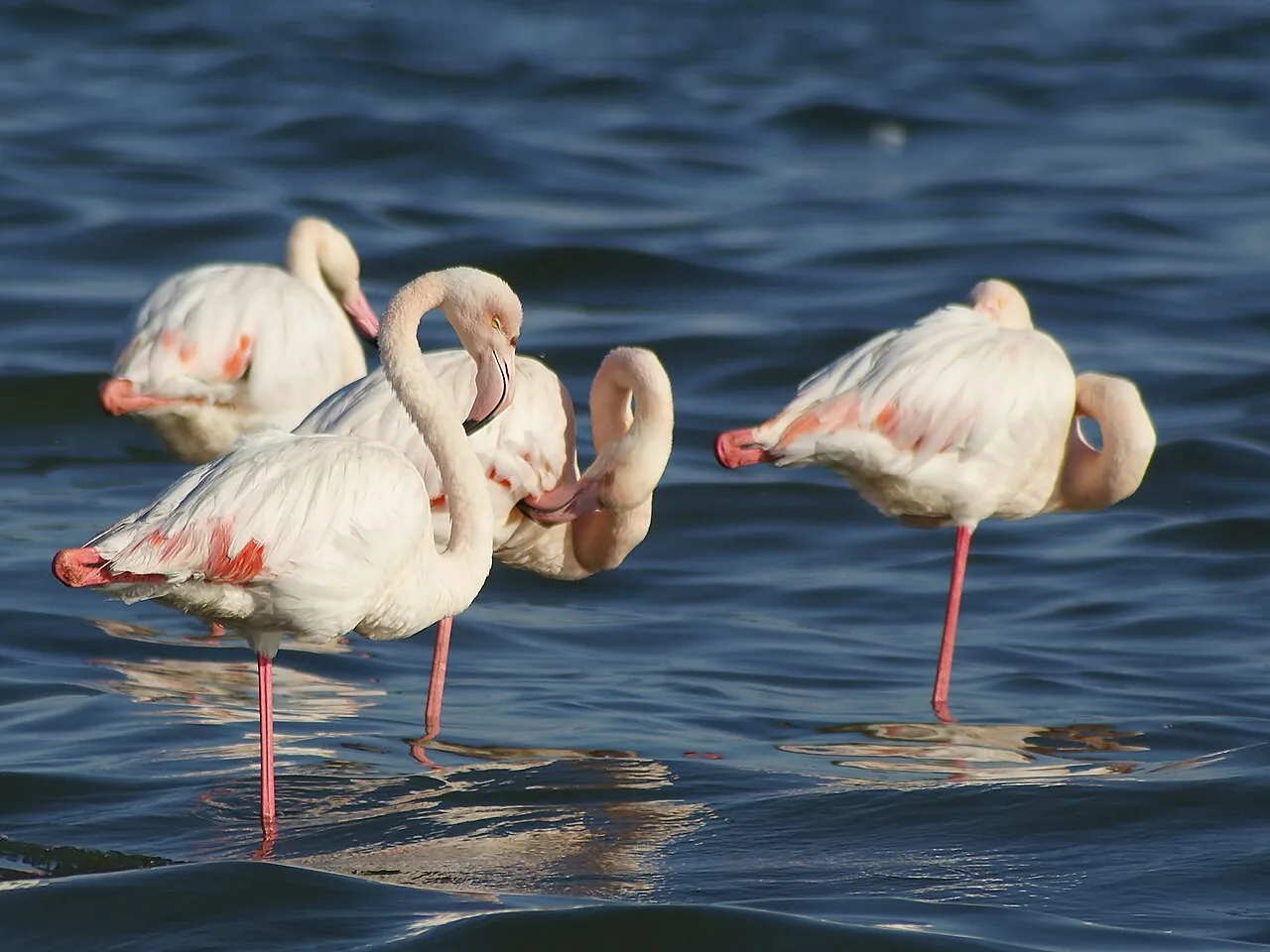
| 24 | Flamingo (greater) | Phoenicopterus roseus | Bird | Salty lakes | Least Concern |
| 25 | Falcon (peregrine) | Falco peregrinus | Bird | Almost worldwide | Least Concern |
| 26 | Frigatebird (magnificent) | Fregata magnificens | Bird | American coasts | Least Concern |
| 27 | Fairy penguin (little penguin) | Eudyptula minor | Bird | Australian coasts | Least Concern |
| 28 | Fulmar (northern) | Fulmarus glacialis | Bird | Northern seas | Least Concern |
| 29 | Fieldfare | Turdus pilaris | Bird | Europe and Asia | Least Concern |
| 30 | Firecrest | Regulus ignicapilla | Bird | Woods of Europe | Least Concern |
| 31 | Finch (goldfinch) | Carduelis carduelis | Bird | Europe and Asia | Least Concern |
| 32 | Fairywren (superb) | Malurus cyaneus | Bird | South-eastern Australia | Least Concern |
| 33 | Frogmouth (tawny) | Podargus strigoides | Bird | Australia | Least Concern |
| 34 | Fischer’s lovebird | Agapornis fischeri | Bird | Northern Tanzania | Near Threatened |
| 35 | Flamingo (American) | Phoenicopterus ruber | Bird | Caribbean | Least Concern |
| 36 | Flycatcher (spotted) | Muscicapa striata | Bird | European woods | Least Concern |
| 37 | Field sparrow | Spizella pusilla | Bird | Eastern North America | Least Concern |
| 38 | Frilled lizard | Chlamydosaurus kingii | Reptile | Northern Australia | Least Concern |
| 39 | Freshwater crocodile | Crocodylus johnstoni | Reptile | Northern Australia | Least Concern |
| 40 | Fer-de-lance (terciopelo) | Bothrops asper | Reptile | Central American forests | Least Concern |
| 41 | Fiji crested iguana | Brachylophus vitiensis | Reptile | Fiji | Critically Endangered |
| 42 | Fire salamander | Salamandra salamandra | Amphibian | European forests | Vulnerable |
| 43 | Frog (common) | Rana temporaria | Amphibian | European ponds | Least Concern |
| 44 | Fleischmann’s glass frog | Hyalinobatrachium fleischmanni | Amphibian | Central American streams | Least Concern |
| 45 | Florida softshell turtle | Apalone ferox | Reptile | South-eastern USA | Least Concern |
| 46 | Fat-tailed gecko (African) | Hemitheconyx caudicinctus | Reptile | West African savannah | Least Concern |
| 47 | Fire-bellied toad (oriental) | Bombina orientalis | Amphibian | North-east Asia | Least Concern |
| 48 | Fiji banded iguana | Brachylophus bulabula | Reptile | Fiji | Endangered |
| 49 | Flounder (European) | Platichthys flesus | Fish | European coasts | Least Concern |
| 50 | Flying fish | Family Exocoetidae | Fish | Warm surface oceans | Varies by species |
| 51 | Frogfish (painted) | Antennarius pictus | Fish | Indo-Pacific reefs | Least Concern |
| 52 | Four-eyed fish | Anableps anableps | Fish | South American waters | Least Concern |
| 53 | Flathead catfish | Pylodictis olivaris | Fish | Rivers of North America | Least Concern |
| 54 | Flying gurnard | Dactylopterus volitans | Fish | Warm seabeds | Least Concern |
| 55 | Flamingo tongue snail | Cyphoma gibbosum | Sea snail | Caribbean reefs | Not assessed |
| 56 | Fiddler crab | Family Ocypodidae | Crustacean | Muddy shores | Not assessed |
| 57 | Feather star | Order Comatulida | Echinoderm | Reefs worldwide | Not assessed |
| 58 | Fried egg jellyfish | Cotylorhiza tuberculata | Jellyfish | Mediterranean seas | Not assessed |
| 59 | Frilled shark | Chlamydoselachus anguineus | Fish | Deep ocean | Least Concern |
| 60 | Fangtooth (common) | Anoplogaster cornuta | Fish | Deep ocean worldwide | Least Concern |
| 61 | Firefly (common eastern) | Photinus pyralis | Insect | Eastern North America | Least Concern |
| 62 | Fruit fly (common) | Drosophila melanogaster | Insect | Worldwide | Not assessed |
| 63 | Flea (cat flea) | Ctenocephalides felis | Insect | Worldwide | Not assessed |
| 64 | Fly (housefly) | Musca domestica | Insect | Worldwide | Not assessed |
| 65 | Fire ant (red imported) | Solenopsis invicta | Insect | South America; invasive | Not assessed |
| 66 | Froghopper (common) | Philaenus spumarius | Insect | European gardens | Not assessed |
| 67 | Funnel-web spider (Sydney) | Atrax robustus | Arachnid | Sydney, Australia | Not assessed |
| 68 | Flower chafer (rose chafer) | Cetonia aurata | Insect | European gardens | Not assessed |
| 69 | Fiery skipper | Hylephila phyleus | Insect | The Americas | Not assessed |
| 70 | Fairy shrimp | Order Anostraca | Crustacean | Temporary pools | Not assessed |
| 71 | Flatworm (planarian) | Order Tricladida | Flatworm | Ponds and streams | Not assessed |
| 72 | Falkland Islands wolf (warrah) | Dusicyon australis | Extinct mammal | Falkland Islands | Extinct (IUCN Red List) |
| 73 | Floreana giant tortoise | Chelonoidis niger | Extinct reptile | Galápagos | Extinct (IUCN Red List) |
| 74 | Falcarius | Falcarius utahensis | Extinct dinosaur | Utah, USA | Extinct; known from fossils; not assessed by the IUCN |
| 75 | Fruitadens | Fruitadens haagarorum | Extinct dinosaur | Colorado, USA | Extinct; known from fossils; not assessed by the IUCN |
| 76 | Futalognkosaurus | Futalognkosaurus dukei | Extinct dinosaur | Patagonia, Argentina | Extinct; known from fossils; not assessed by the IUCN |
Animals that start with F by group
There are 23 mammals, 14 birds, 11 reptiles and amphibians, 12 fish and sea animals, 11 insects and other invertebrates, and 5 extinct animals. Each group has its own section below, with the animals in the same order as the table.
Biggest, fastest, smallest and most dangerous animals that start with F
Biggest animals that start with F
The fin whale is the biggest living F animal, at up to about 26–27 m, and the second-longest whale after the blue whale. The Florida manatee reaches 1,655 kg. For the full ranking, see the largest animals in the world. The extinct dinosaur Futalognkosaurus may have been about as long (estimates run to roughly 26–30 m), but the fin whale is far heavier.
Fastest animals that start with F
The fastest is the peregrine falcon. In a hunting dive (a stoop) it is often said to pass 320 km/h, and a trained falcon was clocked at 389 km/h in a 2005 experiment, although the fastest speed confirmed by radar is 184 km/h. Either way, it is the fastest animal on our list. See more in the fastest animals in the planet.
Smallest animals that start with F
The fennec fox is the smallest fox and the fairy penguin the smallest penguin. The firecrest weighs only 4–7 g, and the cat flea is 1–2 mm long.
Best jumper
The common froghopper holds the insect high-jump record of 70 cm, measured in 2003. Its take-off force is about 400 times its body weight, against about 135 times for a flea.
Most dangerous animals that start with F
Some F animals can be dangerous if disturbed, so never handle them. The Sydney funnel-web spider has very toxic venom, although no deaths have been recorded since an antivenom arrived in 1981. The fer-de-lance and red imported fire ant can also be dangerous. After any bite, get medical help straight away.
Rarest animals that start with F
The Fiji crested iguana is the only Critically Endangered animal on the list. Six are Endangered, including the Antarctic fur seal and the large flying fox.
Cutest animals that start with F (our picks)
Cuteness is opinion, but our picks are the fennec fox, Arctic fox, fairy penguin, southern flying squirrel and superb fairywren.
Mammals that start with F
Mammals are warm-blooded animals that feed their young on milk, and there are many families of mammals. Here are fifteen that start with F.
Fox (red)
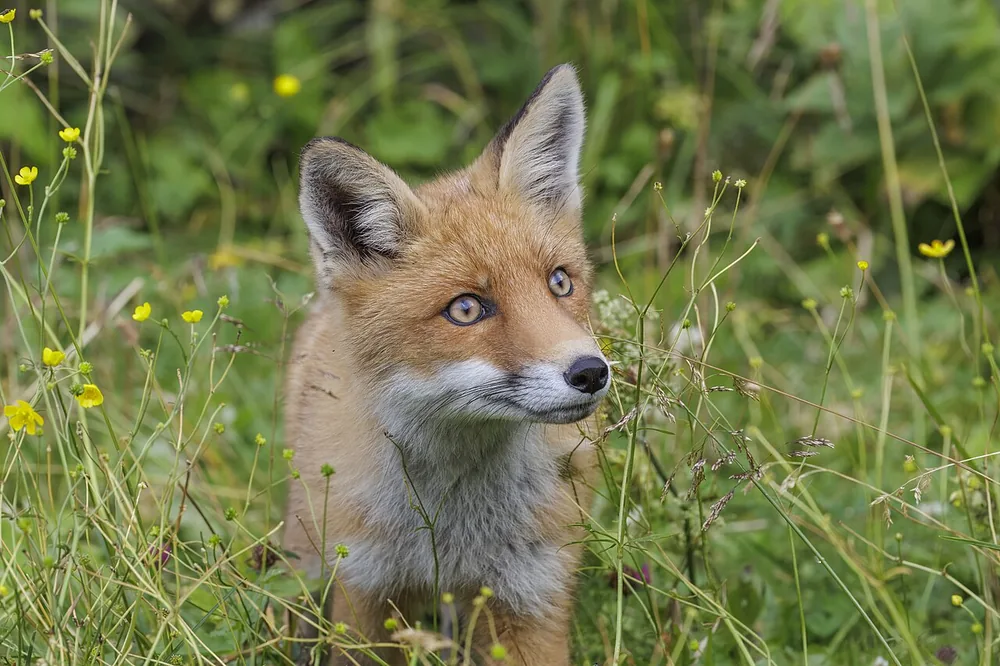
Scientific name: Vulpes vulpes · Group: mammal (dog family) · Lives: Northern Hemisphere, including Britain; introduced to Australia · Size: body 45–90 cm plus a 30–55 cm tail; 2.2–14 kg · Eats: rodents, rabbits, birds, fruit and scraps · IUCN status: Least Concern (2021)
The largest of the true foxes and the most widely distributed member of the order Carnivora. In Australia, where it was introduced, it is on the list of the “world’s 100 worst invasive species”.
Fox (Arctic)
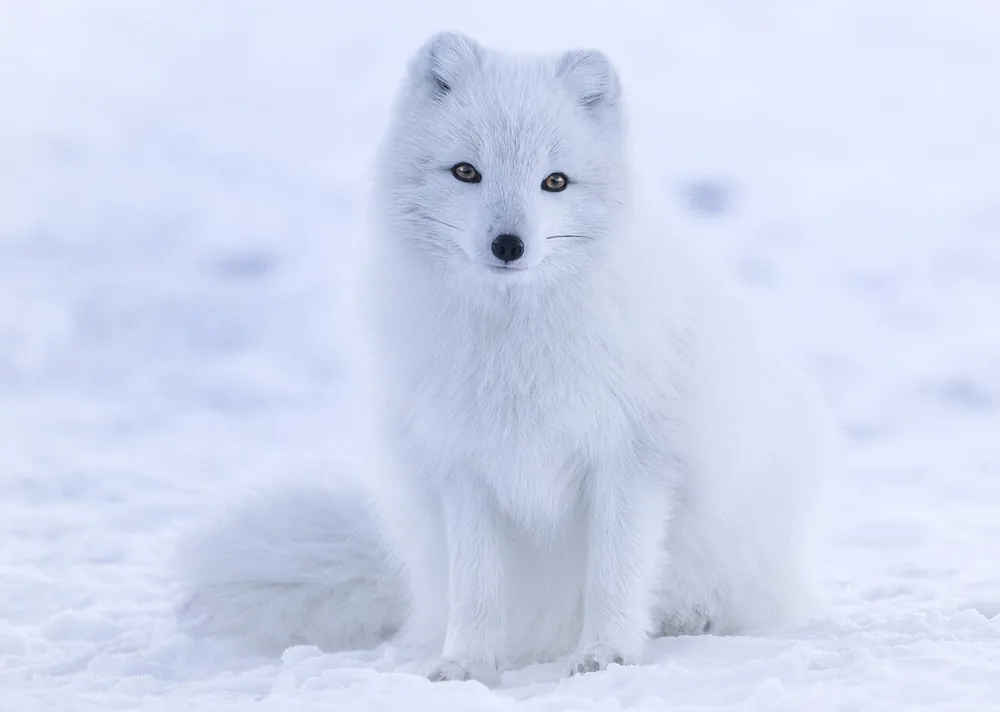
Scientific name: Vulpes lagopus · Group: mammal (dog family) · Lives: Arctic tundra of the Northern Hemisphere · Size: body 46–68 cm; males about 3.5 kg · Eats: lemmings, voles, seal pups, birds, eggs, berries and carrion · IUCN status: Least Concern
The white form is brown in summer and turns entirely white in winter. Blood-flow heat exchange in its legs keeps its footpads above the freezing point of body tissue (−1 °C) on ice. There is a closer look in strawberry leopard vs Arctic fox.
Fennec fox
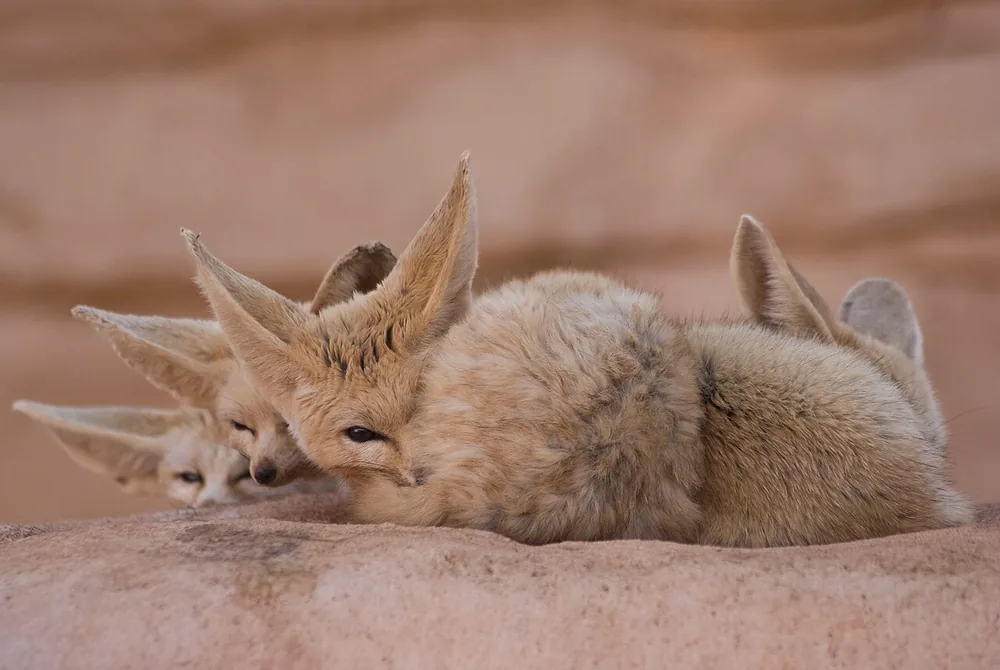
Scientific name: Vulpes zerda · Group: mammal (dog family) · Lives: the Sahara and other deserts of North Africa, east to Sinai · Size: body 34–40 cm; ears 9–10 cm; 1–1.9 kg · Eats: insects, small mammals and birds · IUCN status: Least Concern
The smallest fox and the smallest member of the dog family. Its huge ears release body heat.
Fallow deer (European)
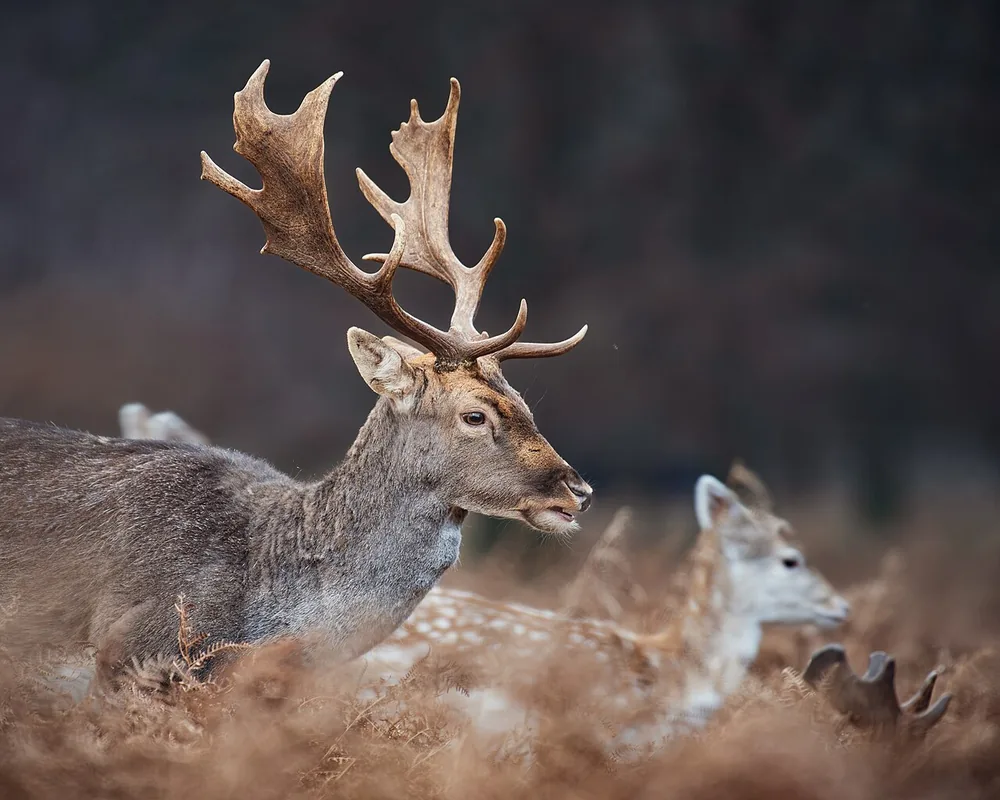
Scientific name: Dama dama · Group: mammal (deer) · Lives: native to Turkey; now widespread in Europe, including Britain · Size: bucks usually 60–100 kg; 85–95 cm at the shoulder · Eats: grass, then acorns in autumn · IUCN status: Least Concern
Bucks have broad, flattened (palmate) antlers. The Romans brought fallow deer to southern England in the 1st century AD, that herd died out, and they were reintroduced before the Norman conquest.
Fossa
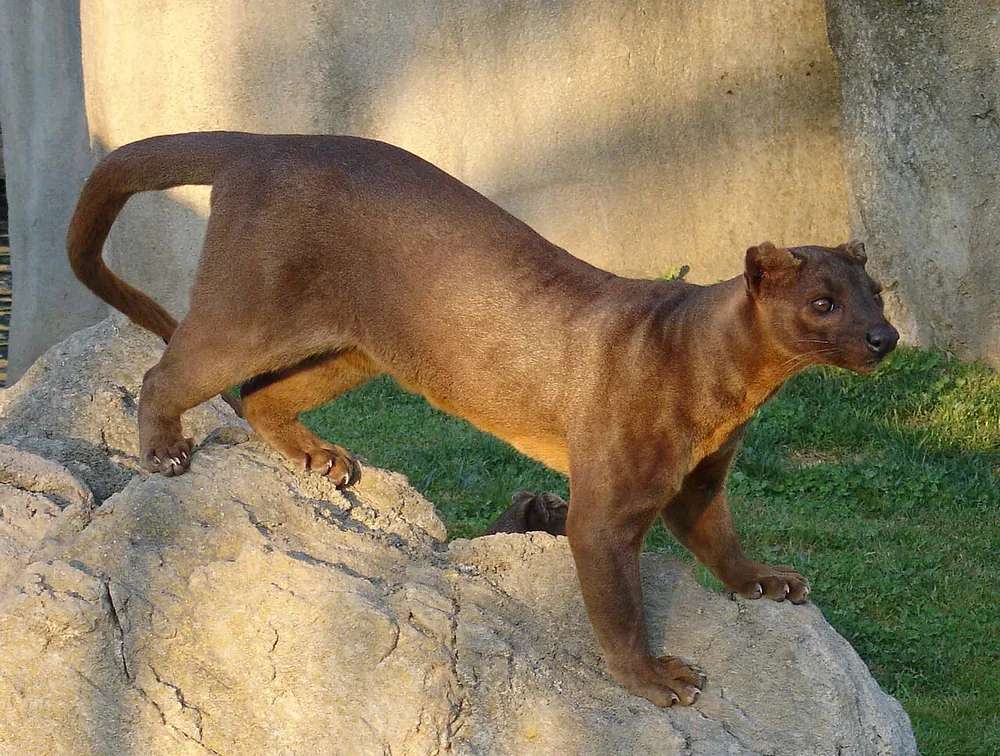
Scientific name: Cryptoprocta ferox · Group: mammal (Malagasy carnivore, not a cat) · Lives: forests of Madagascar only · Size: head and body 70–80 cm; 5.5–8.6 kg · Eats: mostly lemurs (over half its diet) · IUCN status: Vulnerable (2016)
The largest mammal predator on Madagascar. Flexible ankles let it climb down trees head-first.
Fishing cat
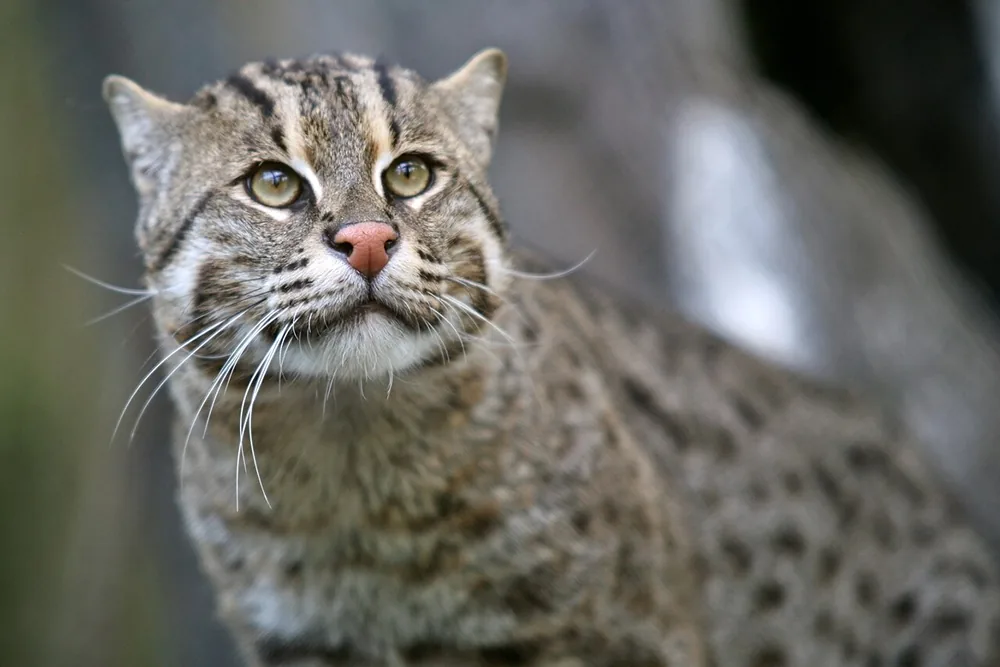
Scientific name: Prionailurus viverrinus · Group: mammal (wild cat) · Lives: wetlands, mangroves and rivers of South and Southeast Asia · Size: 57–78 cm plus a 20–30 cm tail; males 8–17 kg · Eats: mainly fish, also birds, rodents and frogs · IUCN status: Vulnerable
A strong swimmer that can swim underwater, helped by partly webbed paws.
Ferret
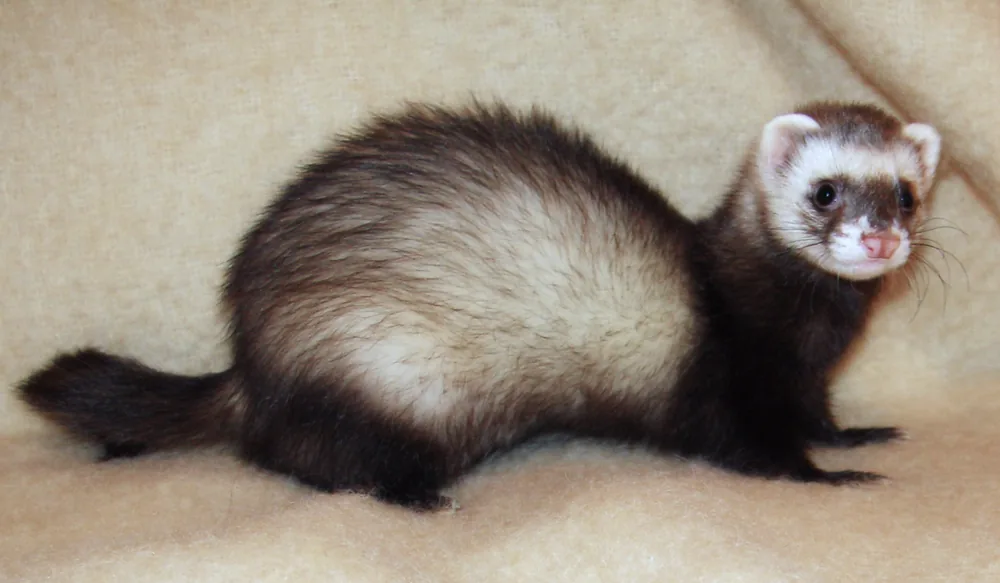
Scientific name: Mustela furo · Group: mammal (weasel family) · Lives: kept as a pet worldwide; most likely descended from the European polecat · Size: about 50 cm including the tail; 0.7–2 kg · Eats: a meat-based diet · IUCN status: Domesticated (not assessed)
Bred for hunting rabbits, a job known as “rabbiting”. A ferret sleeps 14–18 hours a day and is most active at dawn and dusk.
Fisher
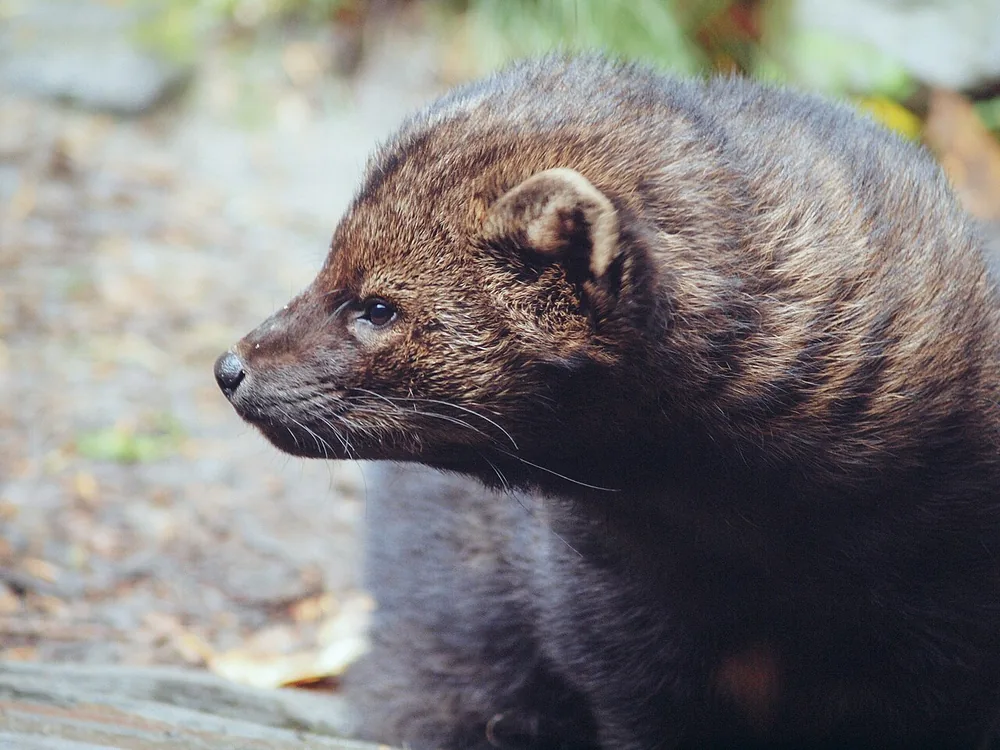
Scientific name: Pekania pennanti · Group: mammal (weasel family) · Lives: forests of Canada and the northern USA · Size: males 90–120 cm in total; 3.5–6 kg · Eats: snowshoe hares and porcupines, plus fruit and insects · IUCN status: Least Concern
Despite the nickname “fisher cat”, it is not a cat, and fish are not its main food. It is one of the few predators able to kill porcupines.
Flying fox (large)
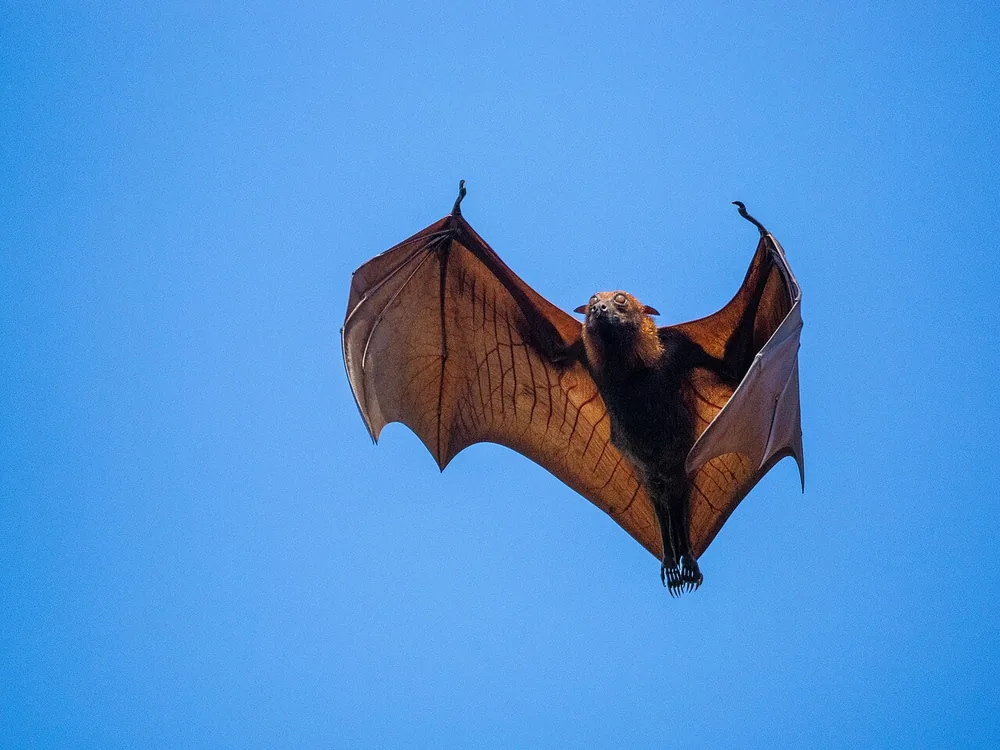
Scientific name: Pteropus vampyrus · Group: mammal (fruit bat) · Lives: forests of Southeast Asia · Size: 0.65–1.1 kg; wingspan up to 1.5 m · Eats: fruit, nectar and flowers only · IUCN status: Endangered (2022)
One of the largest bats in the world. Despite the species name vampyrus it never drinks blood, and it cannot echolocate, so it finds food by sight.
Flying squirrel (southern)
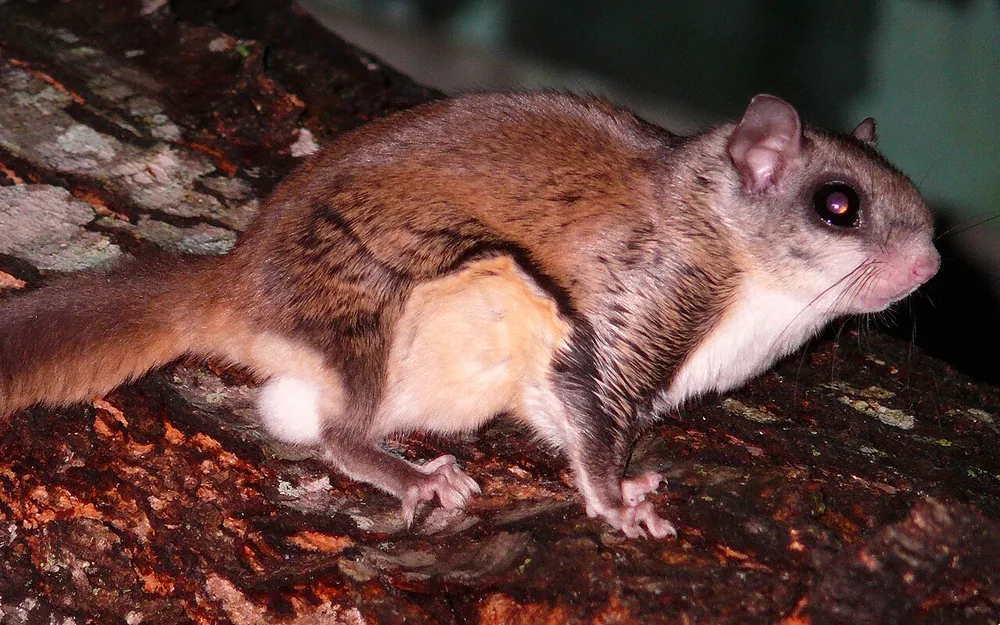
Scientific name: Glaucomys volans · Group: mammal (rodent) · Lives: deciduous woods of the eastern half of North America · Size: 21–26 cm in total · Eats: nuts, acorns, insects and fungi · IUCN status: Least Concern
It does not fly. It glides on a furry membrane called a patagium stretched between its legs, and it stores acorns for winter. For another gliding mammal, meet the sugar glider.
Flying lemur (Sunda colugo)
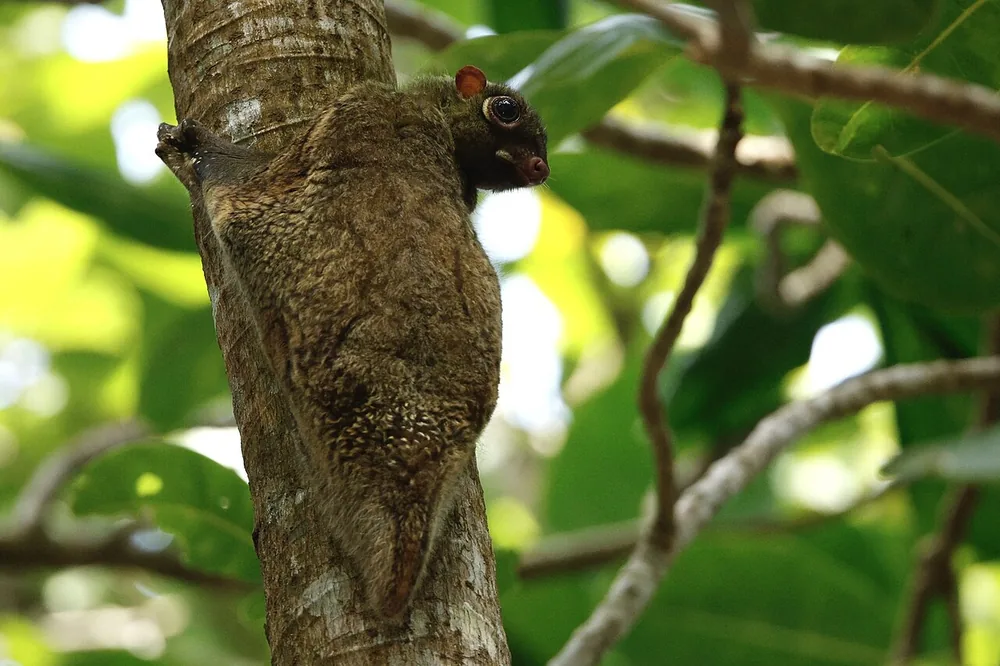
Scientific name: Galeopterus variegatus · Group: mammal (colugo) · Lives: rainforests from Myanmar and Thailand to Indonesia · Size: 33–42 cm; 0.9–1.3 kg · Eats: young leaves, shoots, flowers and fruit · IUCN status: Least Concern
It neither flies nor is a lemur. It glides on a kite-shaped skin membrane and can travel 100 m while losing less than 10 m in height.
Fin whale
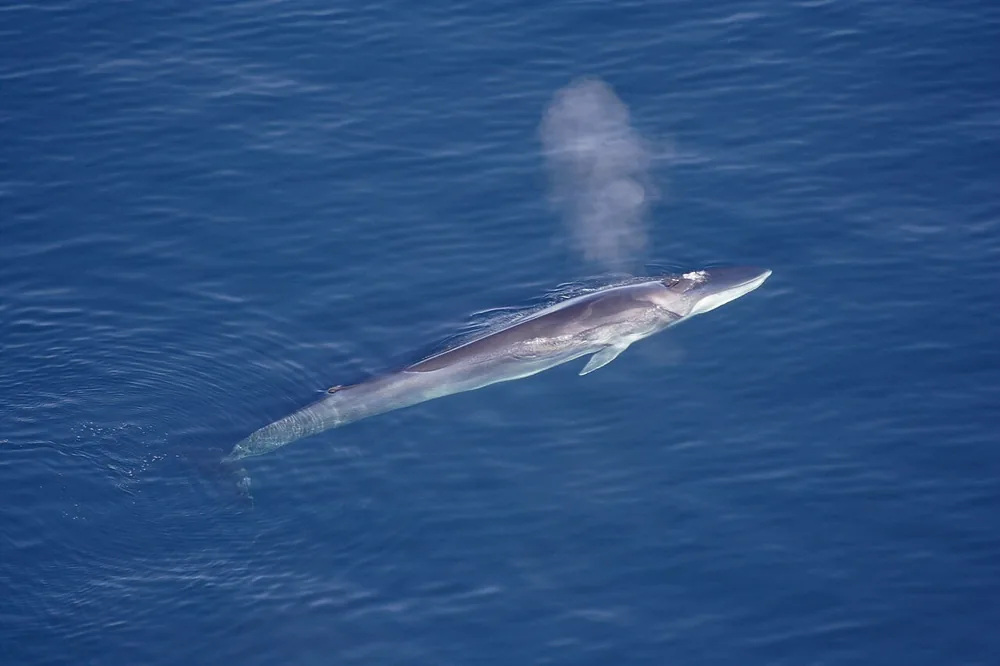
Scientific name: Balaenoptera physalus · Group: mammal (baleen whale) · Lives: all major oceans · Size: the largest reported are about 26–27 m long · Eats: krill, small schooling fish and squid · IUCN status: Vulnerable (2018)
The second-longest whale after the blue whale, and one of the fastest, cruising at 37–41 km/h. Its jaw is coloured differently on each side: the right lower jaw is white and the left is dark.
False killer whale
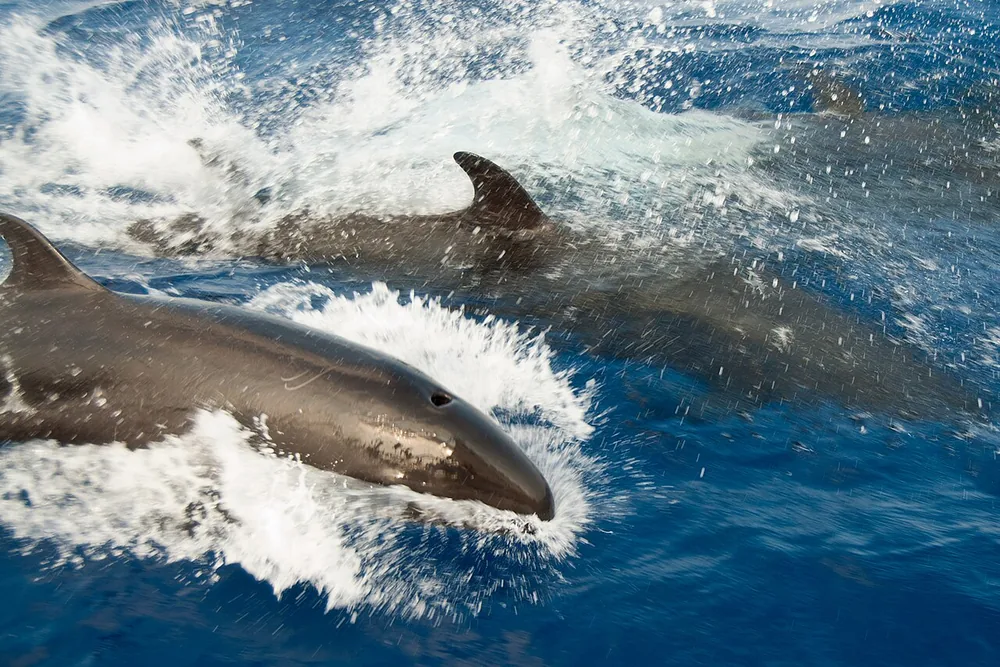
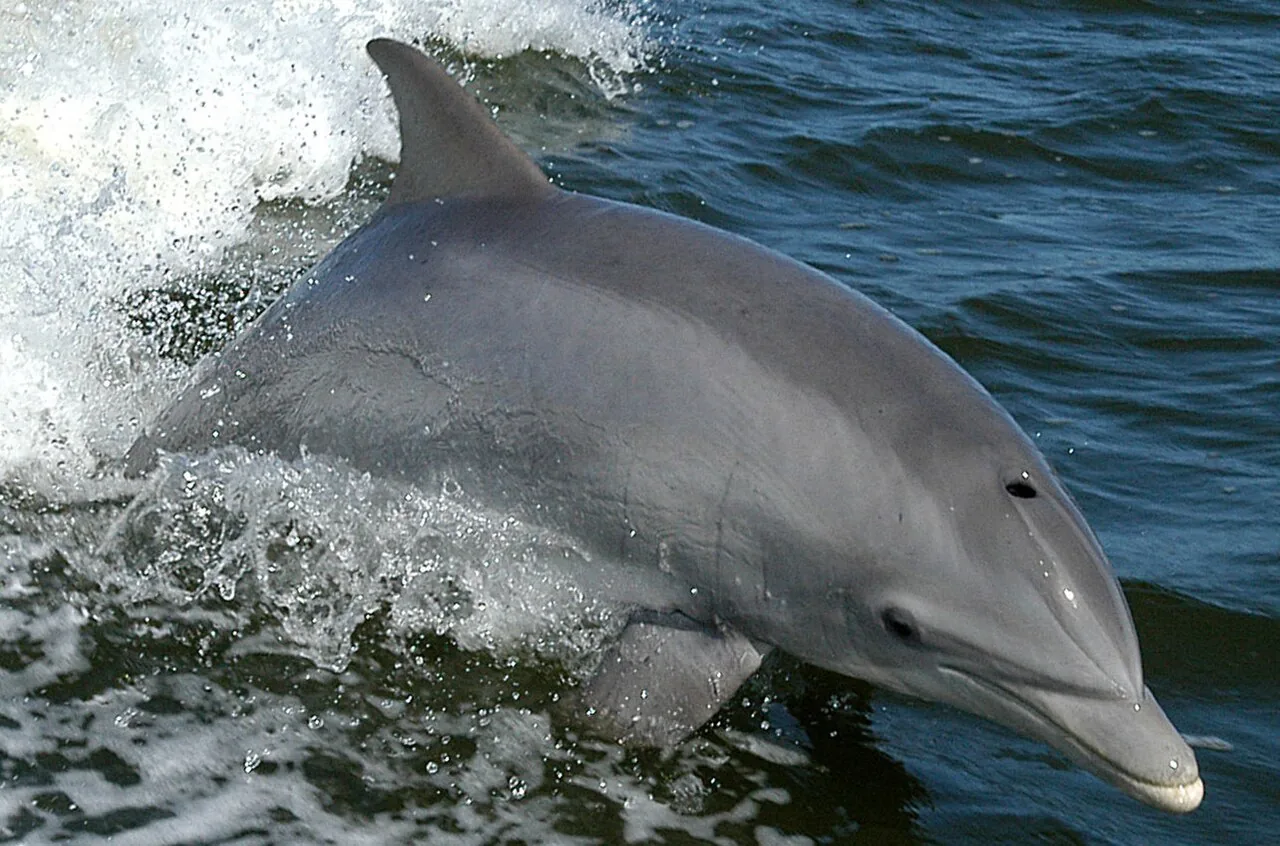
Scientific name: Pseudorca crassidens · Group: mammal (oceanic dolphin, not a true whale) · Lives: oceans worldwide, mainly tropical · Size: males up to 6 m and 2,200 kg · Eats: squid and fish · IUCN status: Near Threatened (2018)
Named for a skull that resembles the orca’s. Pod members share food.
Fur seal (Antarctic)
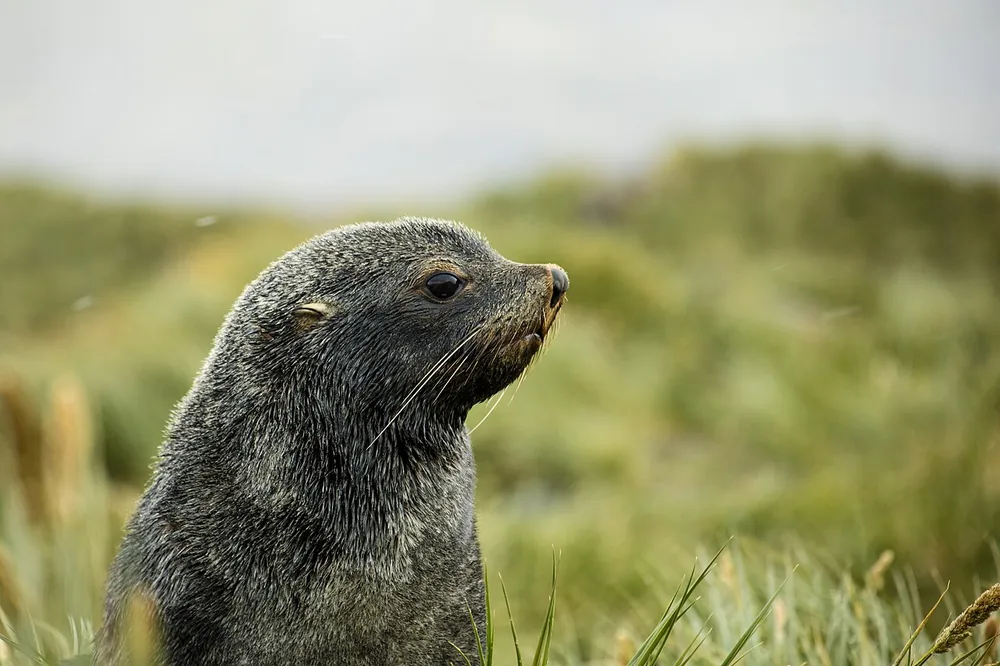
Scientific name: Arctocephalus gazella · Group: mammal (eared seal, in the sea-lion family) · Lives: sub-Antarctic islands; about 95% breed on South Georgia · Size: males up to 2 m and about 133 kg; females 1.4 m and 34 kg · Eats: mainly krill · IUCN status: Endangered (April 2026)
Hunted almost to extinction for its fur in the 19th century, it recovered but is now declining again. Fur seals belong to the same family as the sea lion.
Florida manatee
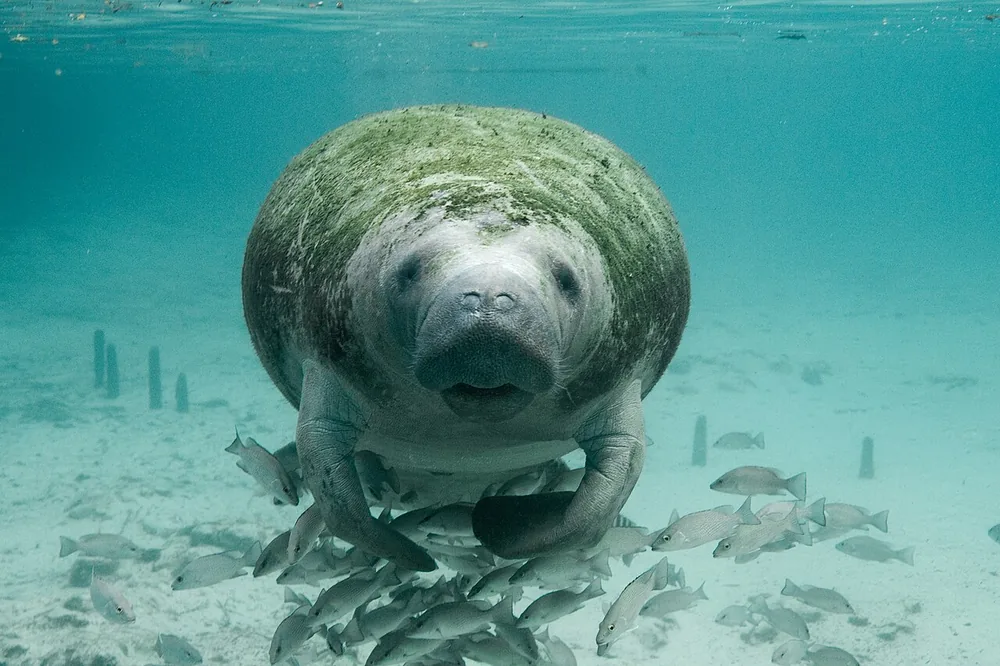
Scientific name: Trichechus manatus latirostris · Group: mammal (sirenian, or “sea cow”) · Lives: warm coasts, rivers and springs of the south-eastern USA · Size: usually 2.7–3.5 m and 200–600 kg; the record is 1,655 kg · Eats: sea grasses and other water plants · IUCN status: Vulnerable (for the species Trichechus manatus as a whole, 2024)
The largest living sirenian. Worn-down molar teeth are replaced from the back of the mouth throughout its life.
Eight more are in the table. The flat-headed cat, François’ langur and Persian fallow deer are Endangered, the field vole and wood mouse are common in Britain, and the fat-tailed dunnart is a tiny Australian marsupial.
Birds that start with F
Birds are warm-blooded animals with feathers. Here are eleven.
Flamingo (greater)
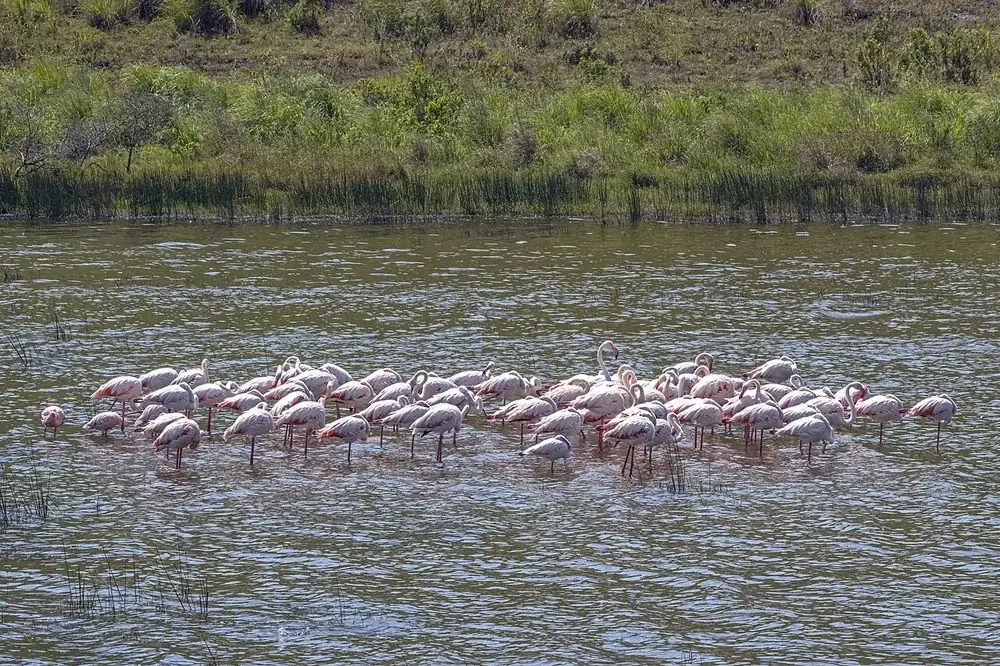
Scientific name: Phoenicopterus roseus · Group: bird · Lives: salty lakes and coasts of Africa, southern Europe and South Asia · Size: 110–150 cm tall; 2–4 kg · Eats: tiny water animals and algae filtered from mud and water · IUCN status: Least Concern (2019)
The largest flamingo. Its pink colour comes from carotenoid pigments in the food it eats. Read more about flamingo birds, and about why birds have different coloured feathers.
Falcon (peregrine)
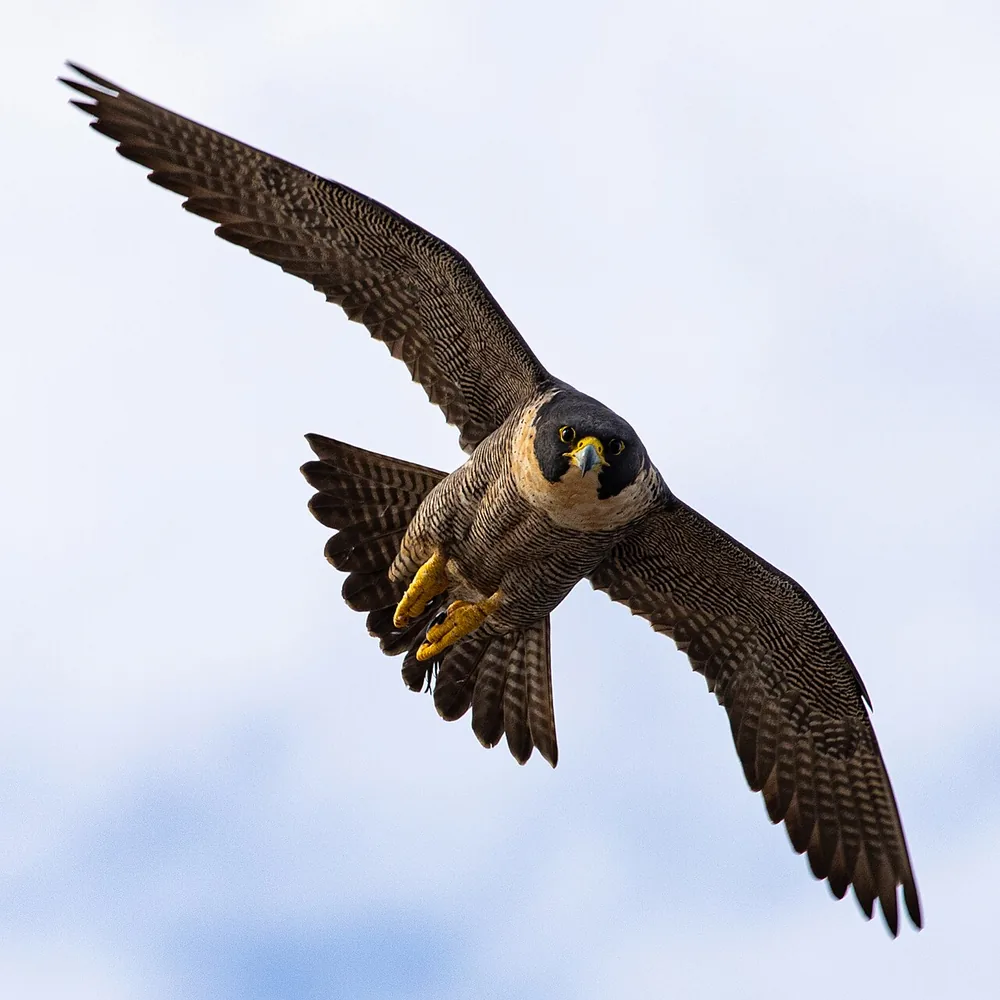
Scientific name: Falco peregrinus · Group: bird of prey · Lives: every continent except Antarctica, including British cliffs and city buildings · Size: crow-sized; females much larger than males · Eats: other birds, caught in flight · IUCN status: Least Concern (2021)
The world’s most widespread bird of prey. In a hunting dive (a stoop) it is often said to pass 320 km/h, and a trained falcon was clocked at 389 km/h in a 2005 experiment, although the fastest speed confirmed by radar is 184 km/h. Either way, it is the fastest animal on our list.
Frigatebird (magnificent)
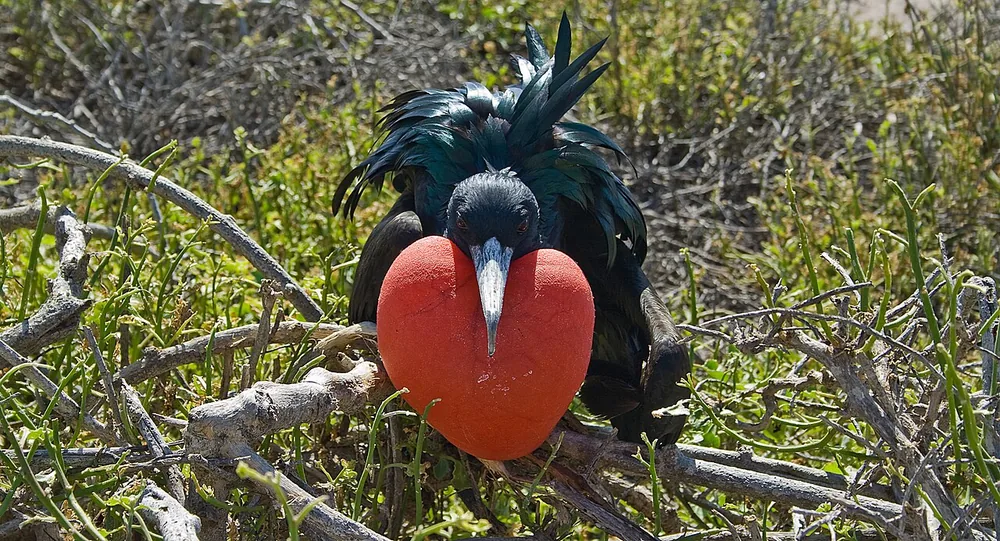
Scientific name: Fregata magnificens · Group: seabird · Lives: tropical coasts of the Americas, the Galápagos and Cape Verde · Size: 89–114 cm long; wingspan 2.17–2.44 m · Eats: fish, often flying fish, snatched from the surface · IUCN status: Least Concern
The largest frigatebird. The male inflates a bright red throat pouch to attract a mate, and it often chases other seabirds until they drop or cough up their food.
Fairy penguin (little penguin)
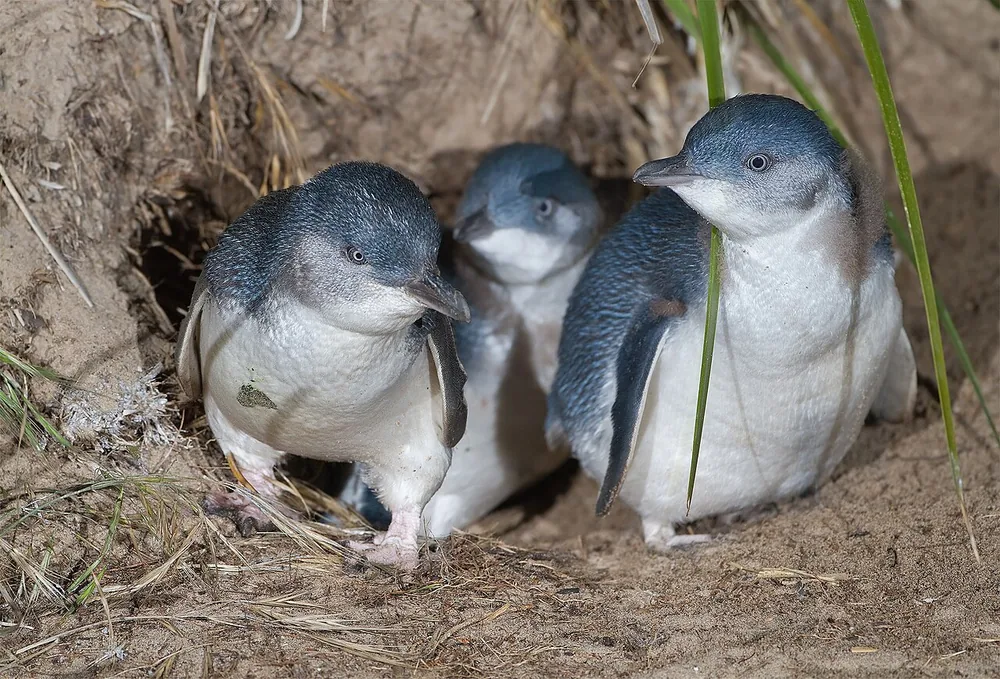
Scientific name: Eudyptula minor · Group: seabird · Lives: coasts of southern Australia and New Zealand · Size: 30–33 cm tall; about 1.5 kg · Eats: small fish and squid · IUCN status: Least Concern (2020)
The smallest penguin in the world. It nests in burrows and comes ashore at dusk, and the nightly “penguin parade” at Phillip Island, Victoria, has drawn visitors since the 1920s.
Fulmar (northern)
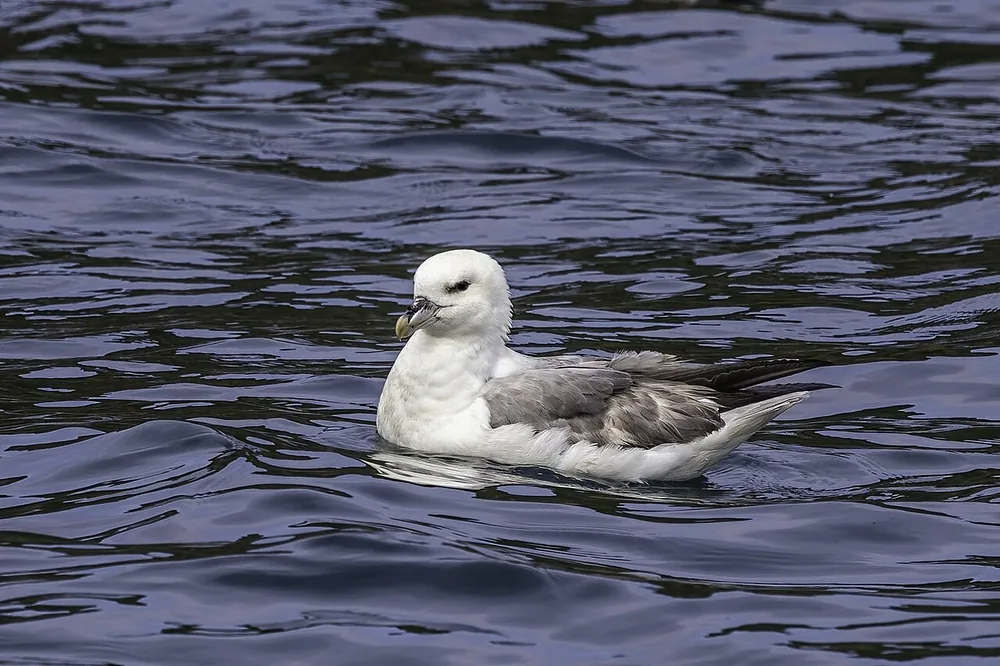
Scientific name: Fulmarus glacialis · Group: seabird (petrel family, not a gull) · Lives: North Atlantic and North Pacific, including British cliffs · Eats: fish, squid, plankton and offal · IUCN status: Least Concern
The name comes from Old Norse for “foul gull”, because it squirts foul-smelling stomach oil at intruders. One in Orkney lived for over 50 years.
Fieldfare
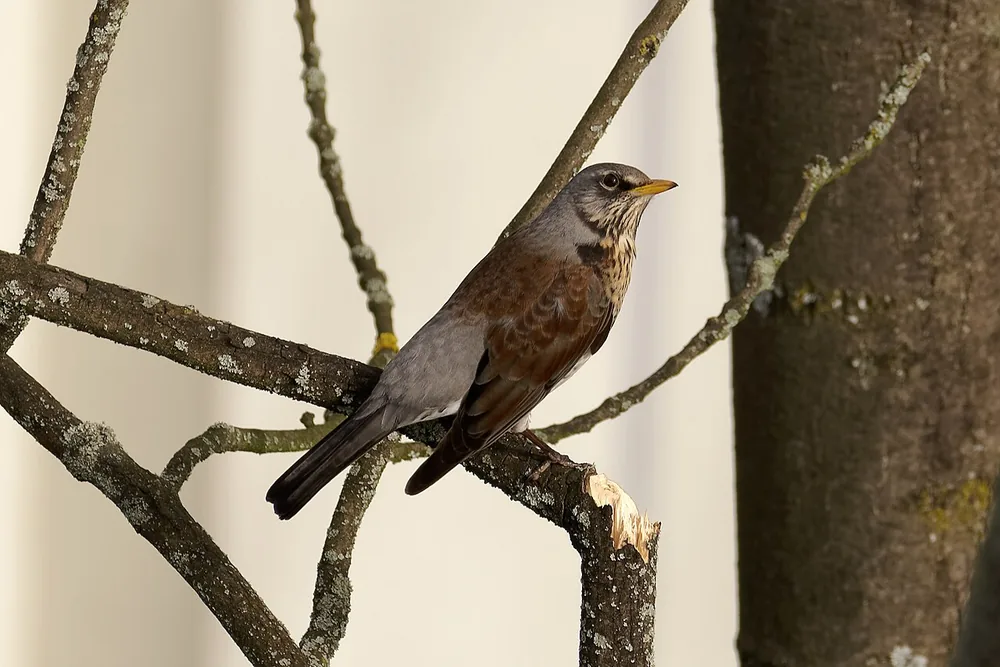
Scientific name: Turdus pilaris · Group: bird (thrush) · Lives: breeds in northern Europe and Asia; winters in the UK · Size: 25 cm; 80–140 g · Eats: worms and insects in summer, berries in winter · IUCN status: Least Concern
A very rare breeder in Britain but a common winter visitor. Adults defend their nests by dropping droppings on predators.
Firecrest
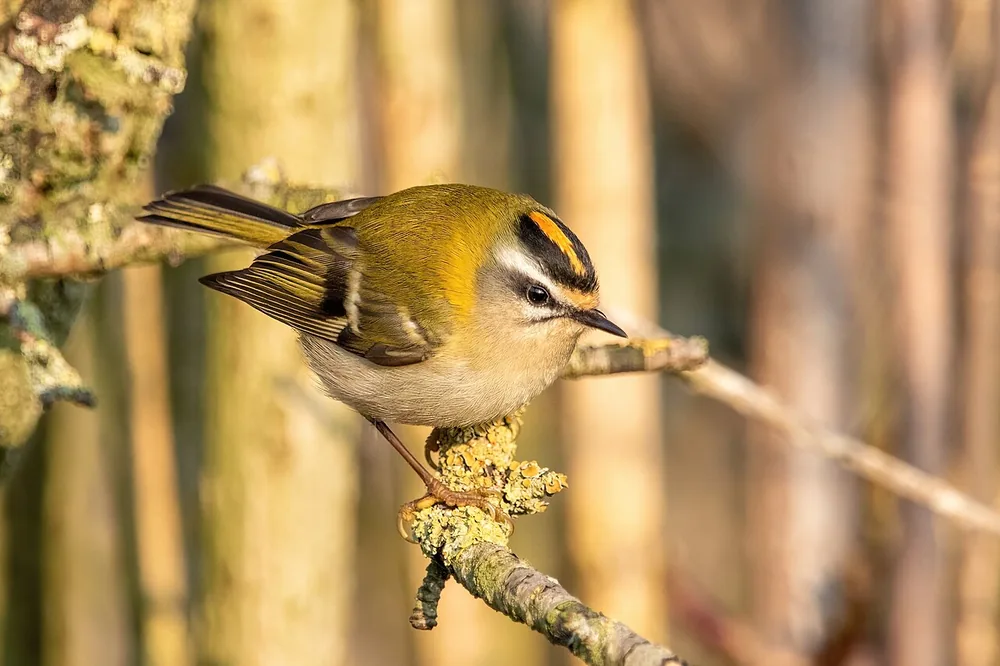
Scientific name: Regulus ignicapilla · Group: bird (kinglet) · Lives: woods of Europe, including southern Britain, and north-west Africa · Size: 9 cm; 4–7 g · Eats: small insects and spiders · IUCN status: Least Concern
One of Europe’s smallest birds. The male’s crown stripe is orange, while the female’s is yellow.
Finch (goldfinch)
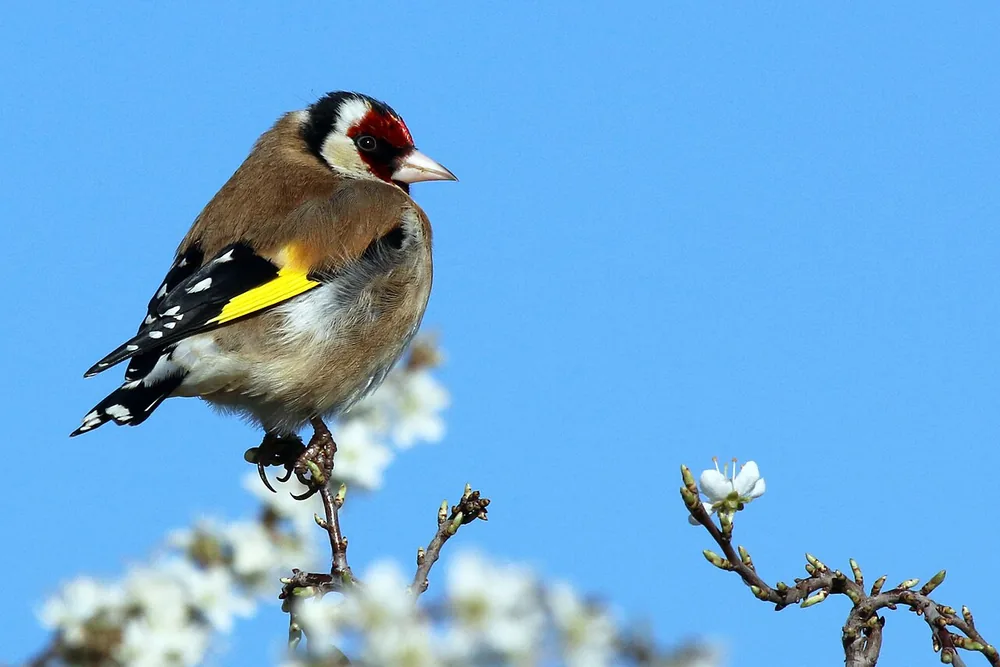
Scientific name: Carduelis carduelis · Group: bird (finch) · Lives: Europe including Britain, North Africa and western Asia · Size: 12–13 cm; 14–19 g · Eats: small seeds such as thistles, teasels and sunflower hearts · IUCN status: Least Concern
It has a red face and a broad yellow wing bar. Its scientific name comes from Carduus, a genus of thistles.
Fairywren (superb)
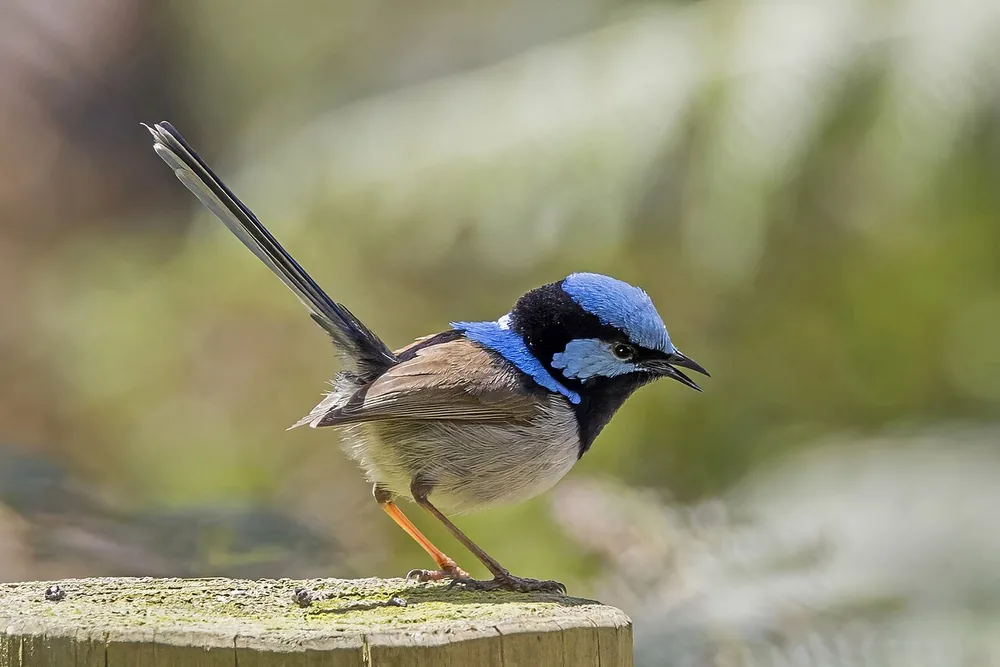
Scientific name: Malurus cyaneus · Group: bird · Lives: south-eastern Australia and Tasmania · Size: 14 cm; 8–13 g · Eats: insects · IUCN status: Least Concern
Breeding males are bright blue and black, and they pluck yellow petals to show to females. Mothers teach their chicks a “password” call that helps them spot cuckoo chicks.
Frogmouth (tawny)
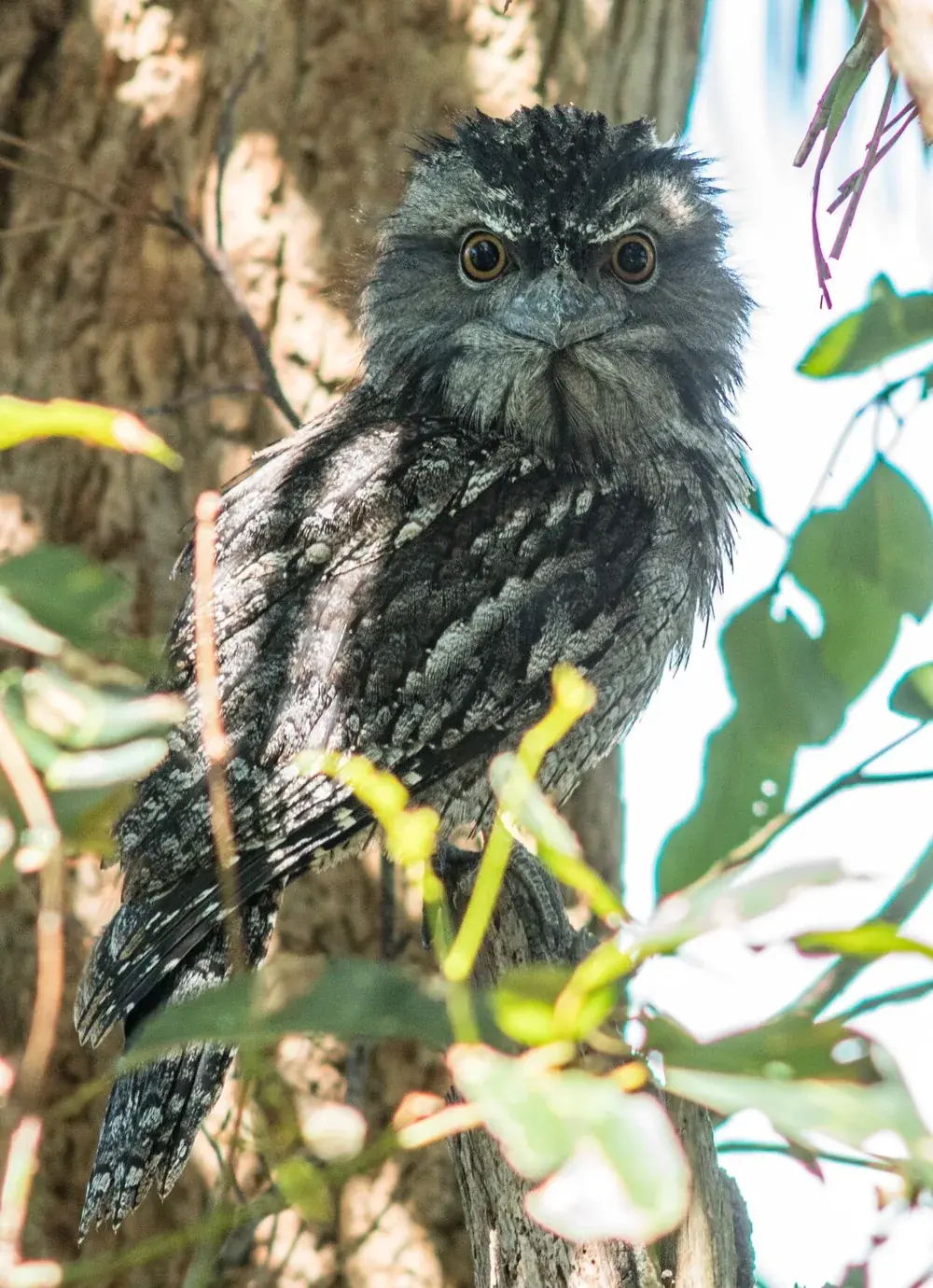
Scientific name: Podargus strigoides · Group: bird (often mistaken for an owl, but not one) · Lives: mainland Australia and Tasmania, including city parks · Size: 34–53 cm · Eats: insects and other small animals · IUCN status: Least Concern
By day it sits very still with its head tilted up and looks like a broken branch. This is camouflage at work.
Fischer’s lovebird
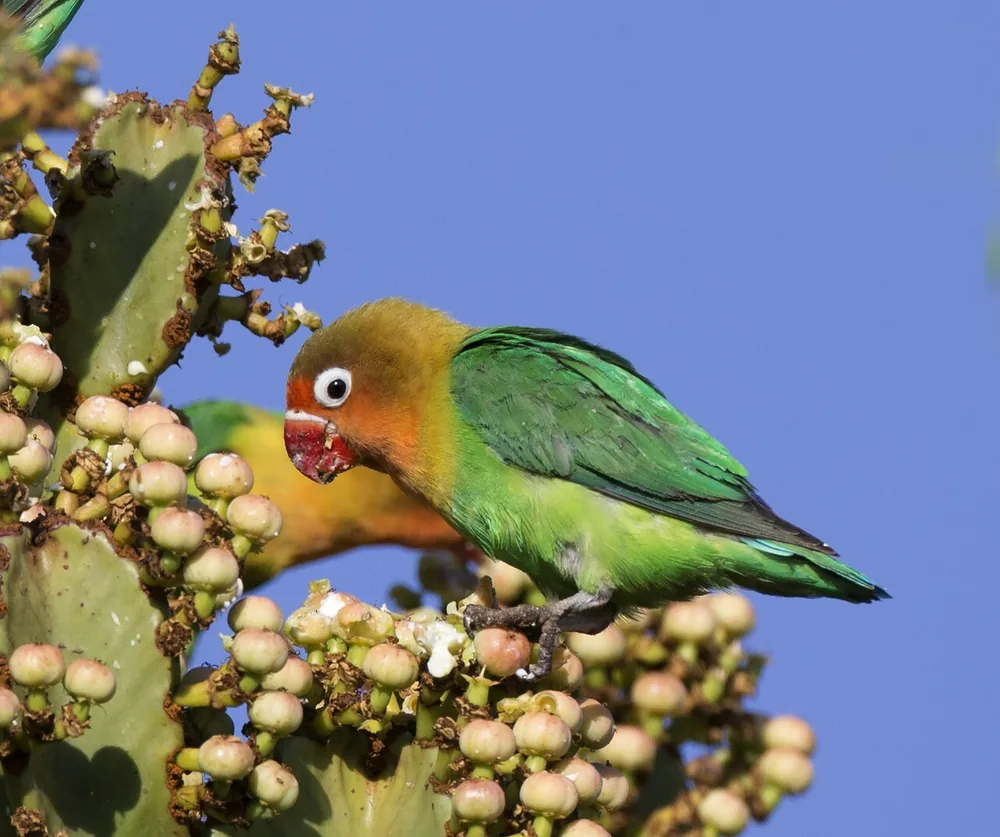
Scientific name: Agapornis fischeri · Group: bird (parrot) · Lives: a small area of northern Tanzania south of Lake Victoria · Size: 14 cm; 43–58 g · Eats: seeds · IUCN status: Near Threatened (2018)
Named after the explorer Gustav Fischer. Trapping for the pet trade cut its numbers, and exports were suspended in 1992.
Three more are in the table: the American flamingo, spotted flycatcher and field sparrow.
Reptiles and amphibians that start with F
Reptiles and amphibians are cold-blooded. To see how snake venom works elsewhere, read about venomous snakes in Sri Lanka. Here are seven.
Frilled lizard
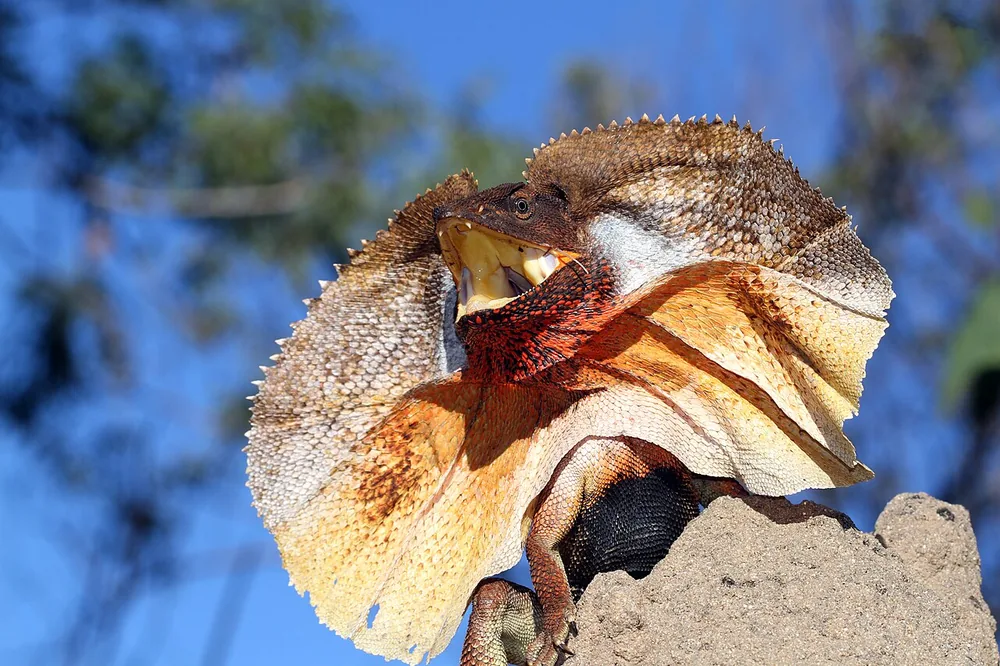
Scientific name: Chlamydosaurus kingii · Group: reptile (dragon lizard) · Lives: woodland of northern Australia and southern New Guinea · Size: up to 90 cm from head to tail; up to 600 g · Eats: insects and small animals · IUCN status: Least Concern
It mostly lives in trees. When threatened it spreads a red, orange and yellow frill, gapes and hisses, and it can rush after prey running on its two back legs.
Freshwater crocodile
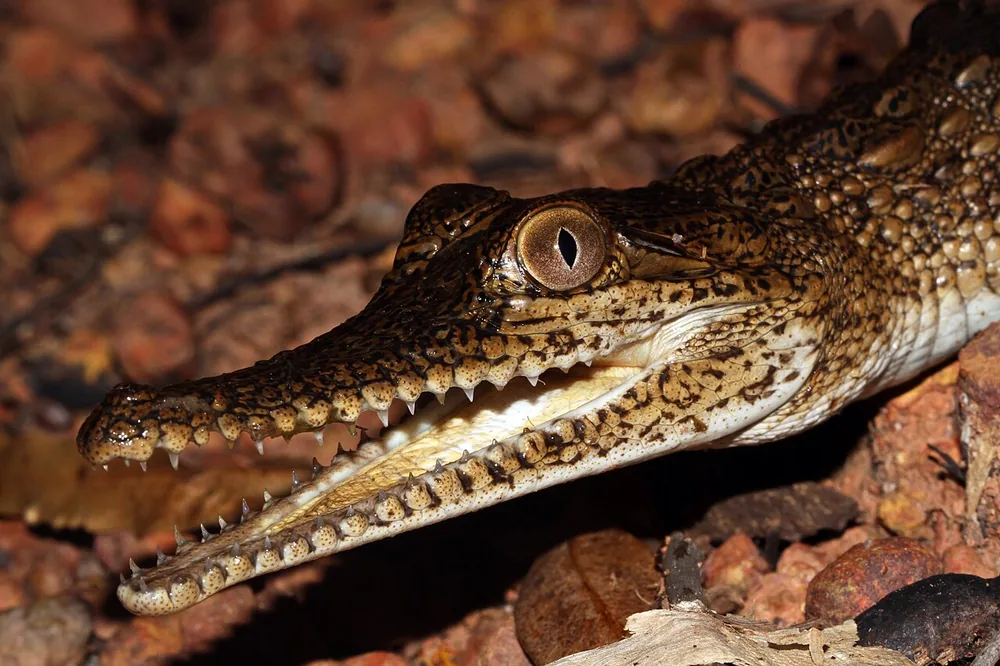
Scientific name: Crocodylus johnstoni · Group: reptile · Lives: rivers, billabongs and gorges of northern Australia · Size: males 2.3–3 m; about 70 kg · Eats: mostly insects, then fish · IUCN status: Least Concern (2017)
A sit-and-wait hunter. Unlike the saltwater crocodile it is not a man-eater, and it bites only in self-defence.
Fer-de-lance (terciopelo)
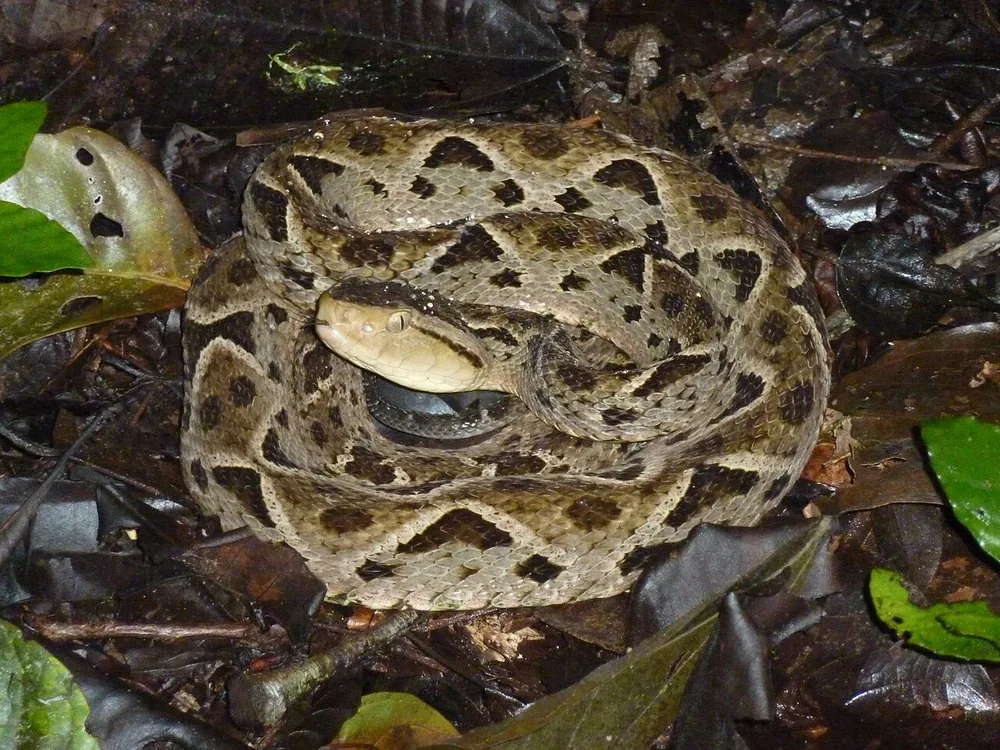
Scientific name: Bothrops asper · Group: reptile (pit viper) · Lives: lowland forests from Mexico to north-western South America · Size: often 1.2–1.8 m; rarely 2.5 m; up to 6 kg · Eats: rodents, frogs and birds · IUCN status: Least Concern (2021)
Responsible for the most venomous snakebites in its range, mainly because it lives near people and farms. Like all snakes it avoids people and bites when cornered. The name “fer-de-lance” is used loosely for several Bothrops species.
Fiji crested iguana
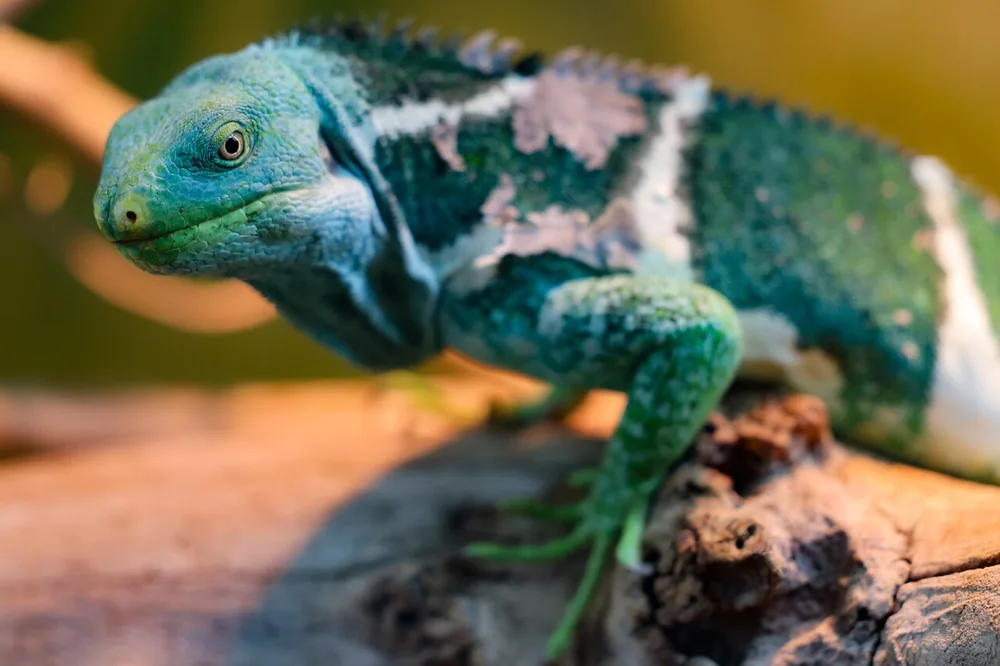
Scientific name: Brachylophus vitiensis · Group: reptile (iguana) · Lives: dry forest on a few north-western islands of Fiji · Size: up to 75 cm; up to 300 g · IUCN status: Critically Endangered (2012)
It was scientifically described in 1981 from a population on one island. A colleague of the describer later spotted one in footage from the 1980 film The Blue Lagoon, which was filmed in Fiji and revealed its wider range. The photo shows an animal at Melbourne Zoo.
Fire salamander
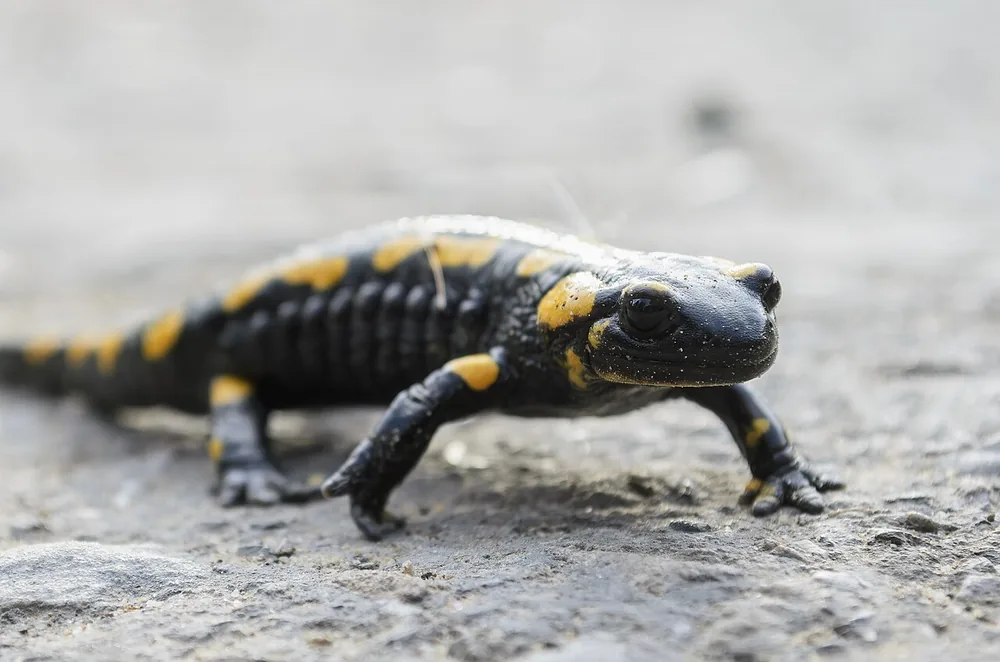
Scientific name: Salamandra salamandra · Group: amphibian · Lives: damp forests of central and southern Europe (not Britain) · Eats: insects, worms and slugs · IUCN status: Vulnerable (2023)
Its yellow-on-black warning colours tell predators to keep away. The female gives birth to larvae in water, and one lived more than 50 years in a German museum. The “Bsal” fungus threatens the species.
Frog (common)
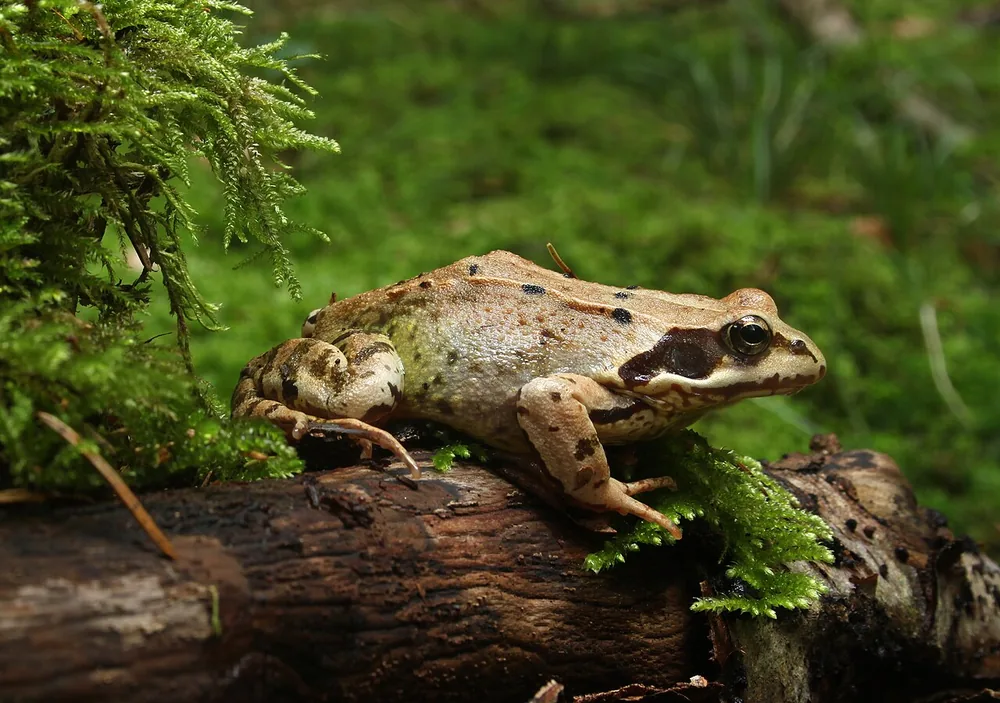
Scientific name: Rana temporaria · Group: amphibian · Lives: most of Europe, including Britain and Ireland, east to the Urals · Eats: insects, slugs and worms · IUCN status: Least Concern
It lays its spawn in clumps (toads lay strings) in ponds, mostly in spring. Its colour varies from olive to brown, yellow or even red.
Fleischmann’s glass frog
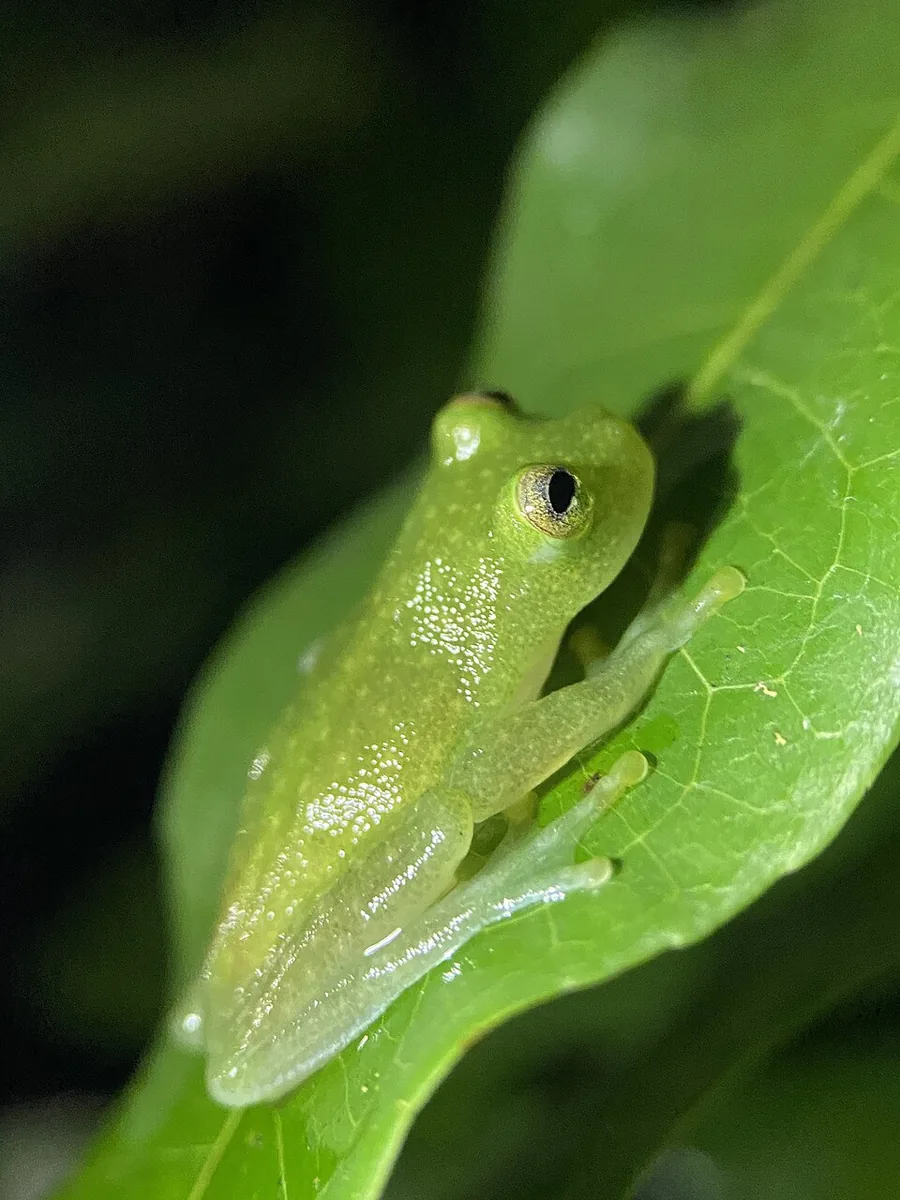
Scientific name: Hyalinobatrachium fleischmanni · Group: amphibian · Lives: streamside forest from Mexico to northern South America · Size: 19–32 mm · Eats: insects · IUCN status: Least Concern (2020)
Translucent belly skin shows some of its internal organs. The male guards the 18–30 eggs on leaves above the water until the tadpoles drop into the stream.
Four more are in the table, including the Fiji banded iguana.
Fish and sea animals that start with F
Dive deeper with 10 amazing marine fish. Here are ten that start with F.
Flounder (European)
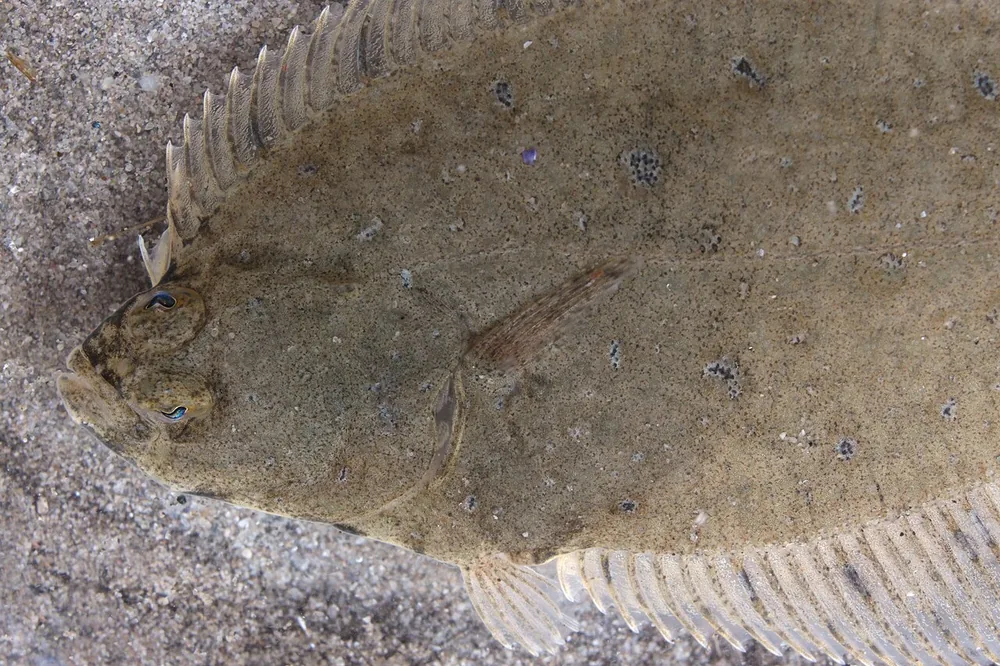
Scientific name: Platichthys flesus · Group: fish (flatfish) · Lives: coasts and estuaries of Europe, including Britain · Size: usually about 30 cm; up to 60 cm · Eats: worms, shellfish and small fish · IUCN status: Least Concern
It starts life like a normal fish, then one eye moves across so that both are on one side, usually the right. It changes colour to match the seabed.
Flying fish
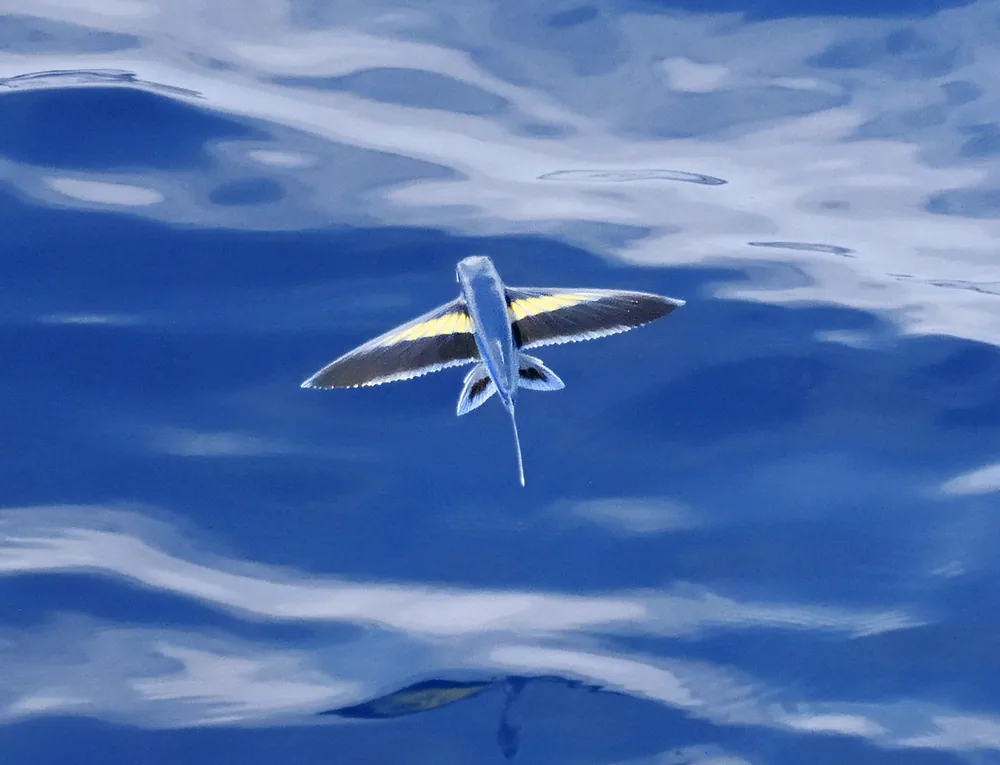
Scientific name: Exocoetidae (about 64 species; the photo shows Abe’s flying fish, Cheilopogon abei) · Group: fish · Lives: the top 200 m of warm oceans worldwide · Eats: plankton · IUCN status: Varies by species
It leaps out of the sea and glides on wing-like fins to escape predators. Glides are typically about 50 m but can reach 400 m using updrafts from waves.
Frogfish (painted)
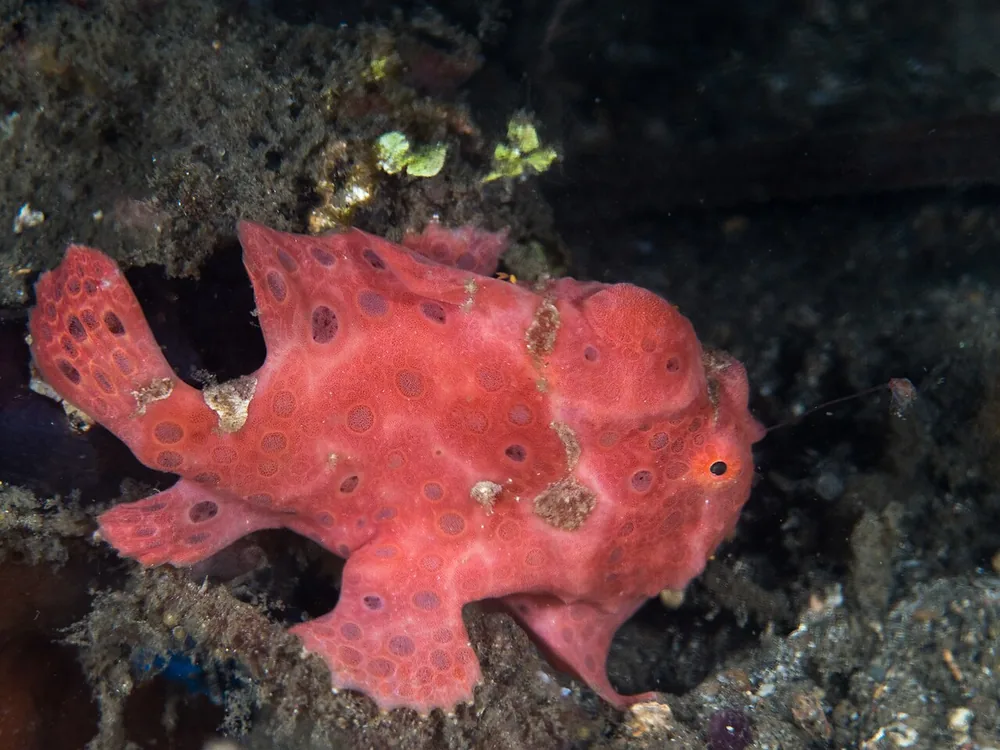
Scientific name: Antennarius pictus · Group: fish (anglerfish group) · Lives: Indo-Pacific reefs · Size: up to 30 cm · Eats: fish and crustaceans · IUCN status: Least Concern
Its first fin spine is a “fishing rod” with a lure that looks like a tiny fish. Its huge mouth can swallow prey as big as itself.
Four-eyed fish
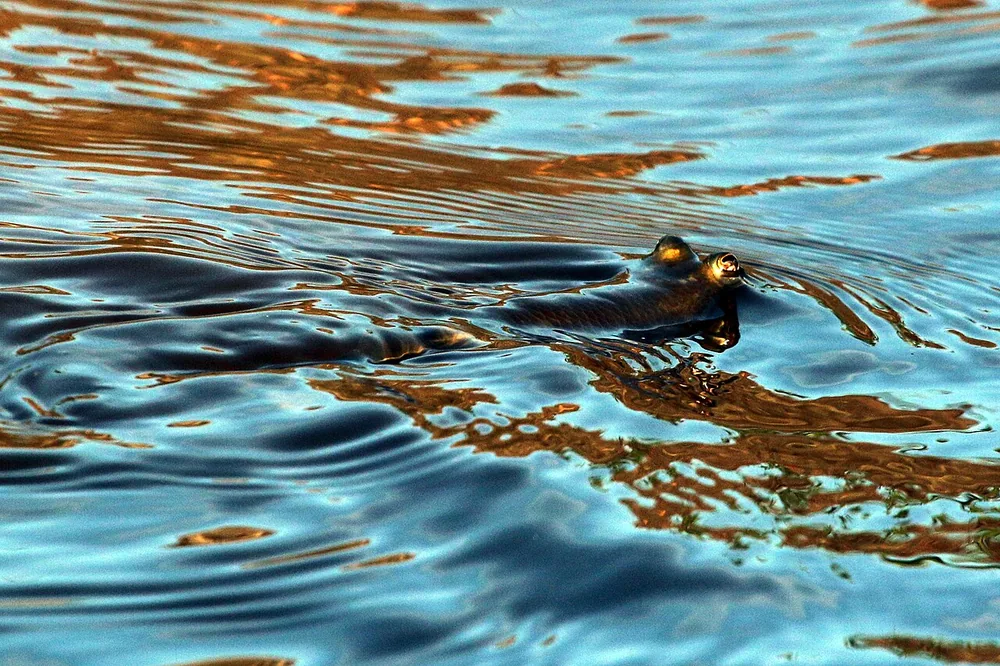
Scientific name: Anableps anableps · Group: fish · Lives: fresh and brackish water of northern South America and Trinidad · Size: up to about 24.5 cm · Eats: insects and small animals at the surface · IUCN status: Least Concern (2022)
It has only two eyes. Each is split by a band of tissue into two halves with two pupils, so it sees above and below the water at the same time.
Flathead catfish
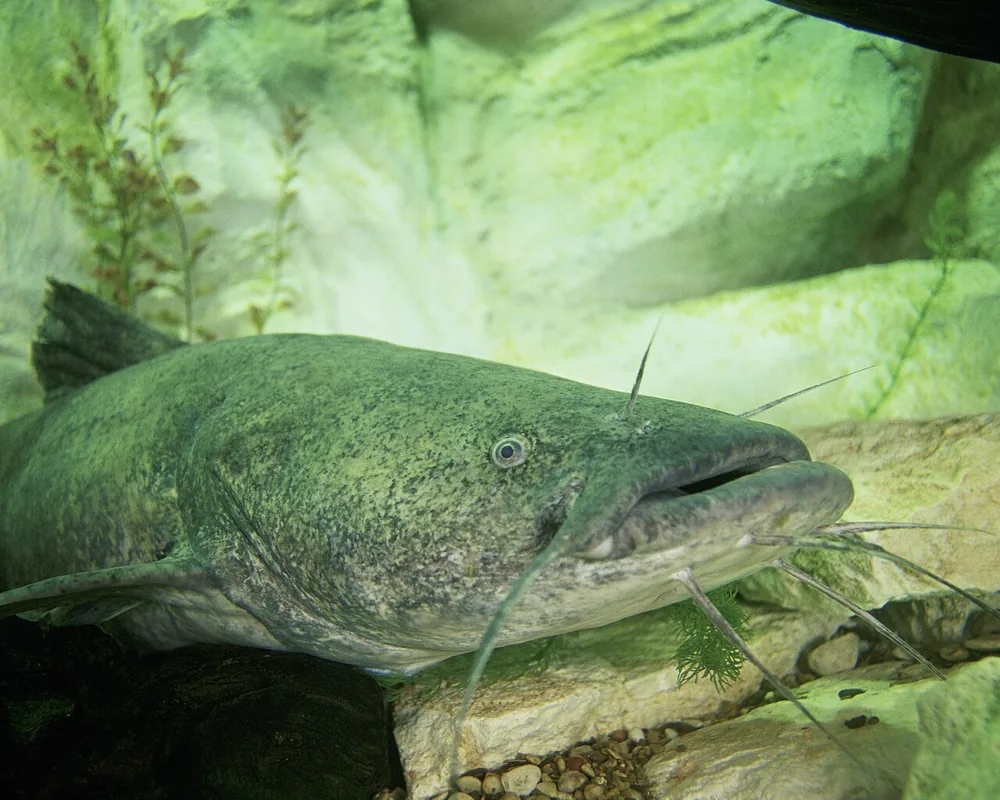
Scientific name: Pylodictis olivaris · Group: fish · Lives: rivers from the Great Lakes to northern Mexico (invasive elsewhere) · Size: usually 38–114 cm; the record is 155 cm and 55.79 kg (Kansas, 1998) · Eats: live prey: fish, crayfish, insects and worms · IUCN status: Least Concern
The second-largest North American catfish. It can live for 28 years.
Flying gurnard
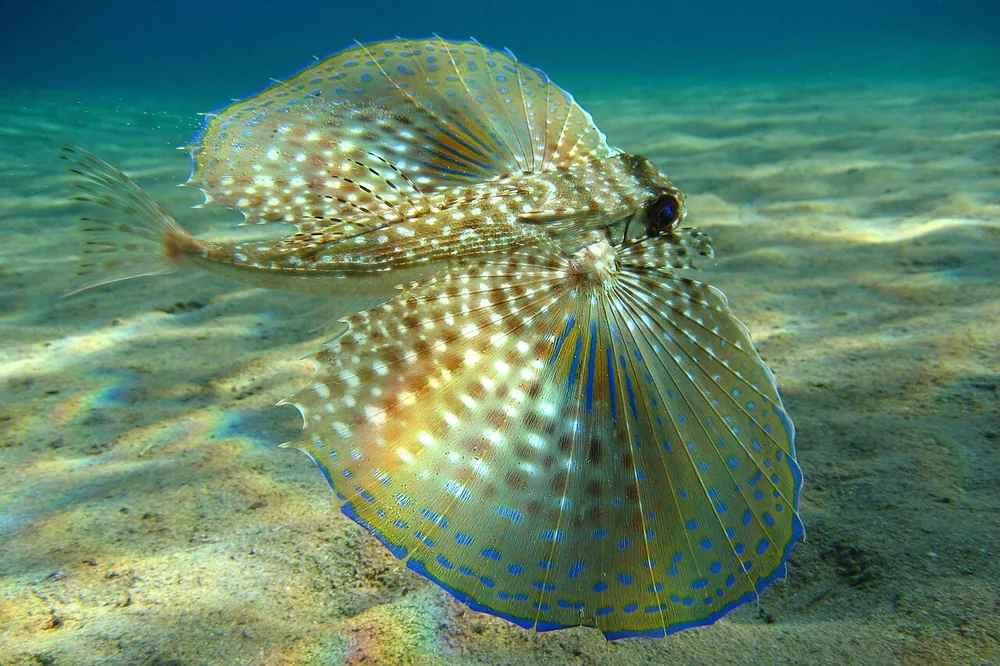
Scientific name: Dactylopterus volitans · Group: fish · Lives: warm Atlantic and Mediterranean seabeds · Size: up to 50 cm; 1.8 kg · Eats: crustaceans and small animals dug from the sand · IUCN status: Least Concern (2015)
When alarmed it spreads huge fan-like fins, its “wings”, and it uses its fins to dig in the seabed. Despite the name, it does not fly.
Flamingo tongue snail
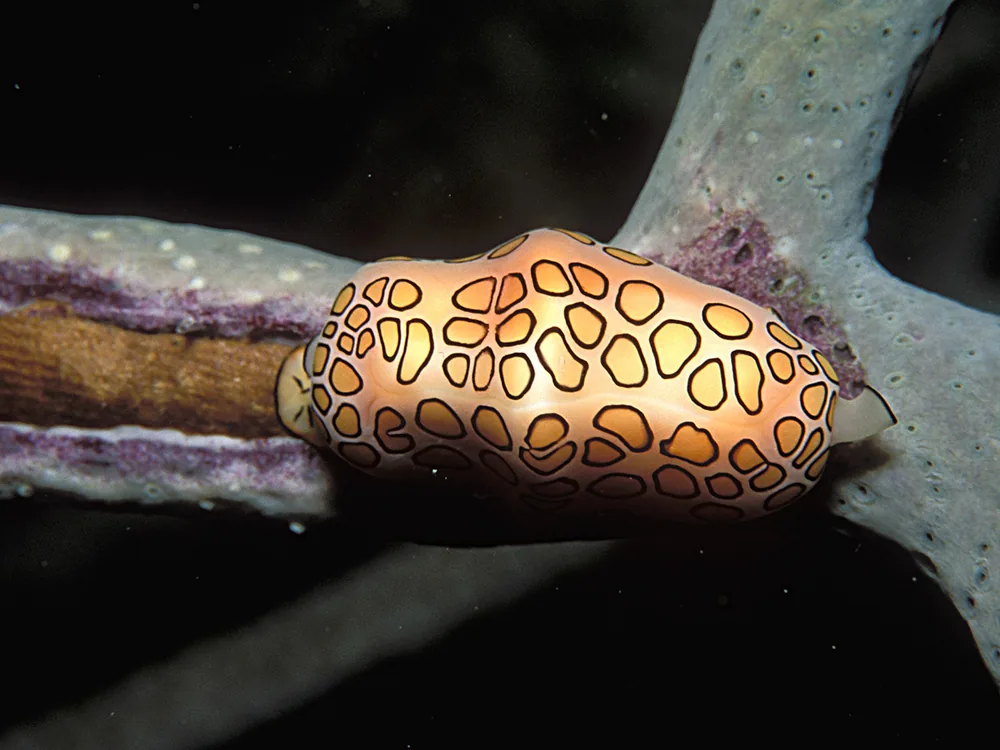
Scientific name: Cyphoma gibbosum · Group: mollusc (sea snail) · Lives: Caribbean and western Atlantic reefs · Size: shell 25–35 mm · Eats: sea fans (soft corals) · IUCN status: Not assessed
The bright orange, black-ringed pattern is on its living skin (the mantle), not the shell. Collected shells are plain, and over-collecting has made the snails uncommon at busy dive sites.
Fiddler crab
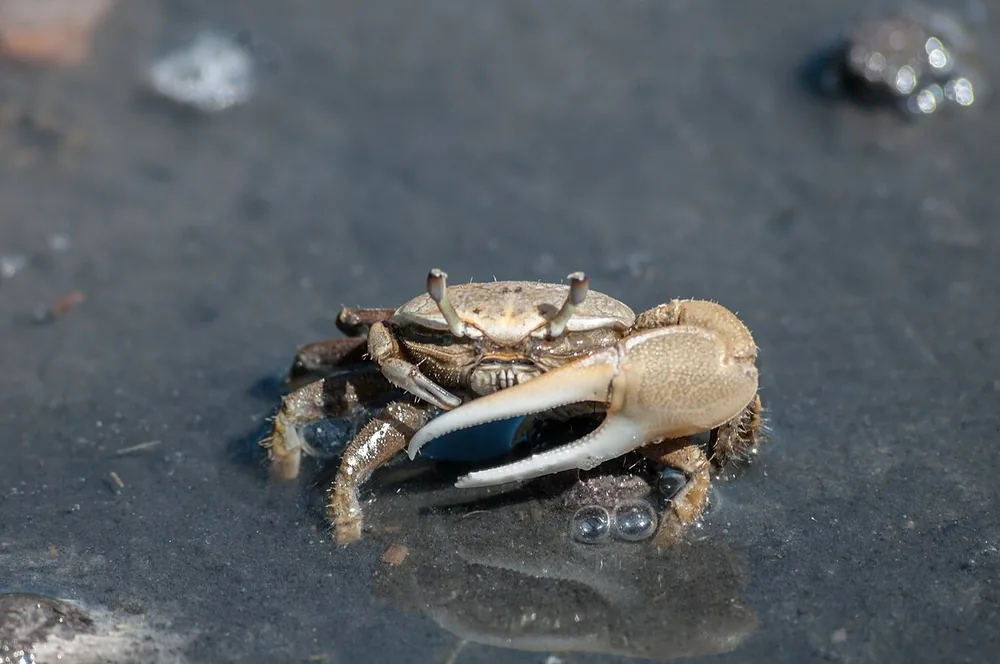
Scientific name: Ocypodidae (about 100 species; the photo shows a male of the genus Uca in the broad sense) · Group: crustacean · Lives: muddy shores, mangroves and salt marshes of warm coasts · Size: up to about 5 cm across · Eats: tiny food particles in mud · IUCN status: Not assessed
Males have one giant claw that they wave to attract females and in fights. A lost claw regrows after moulting.
Feather star
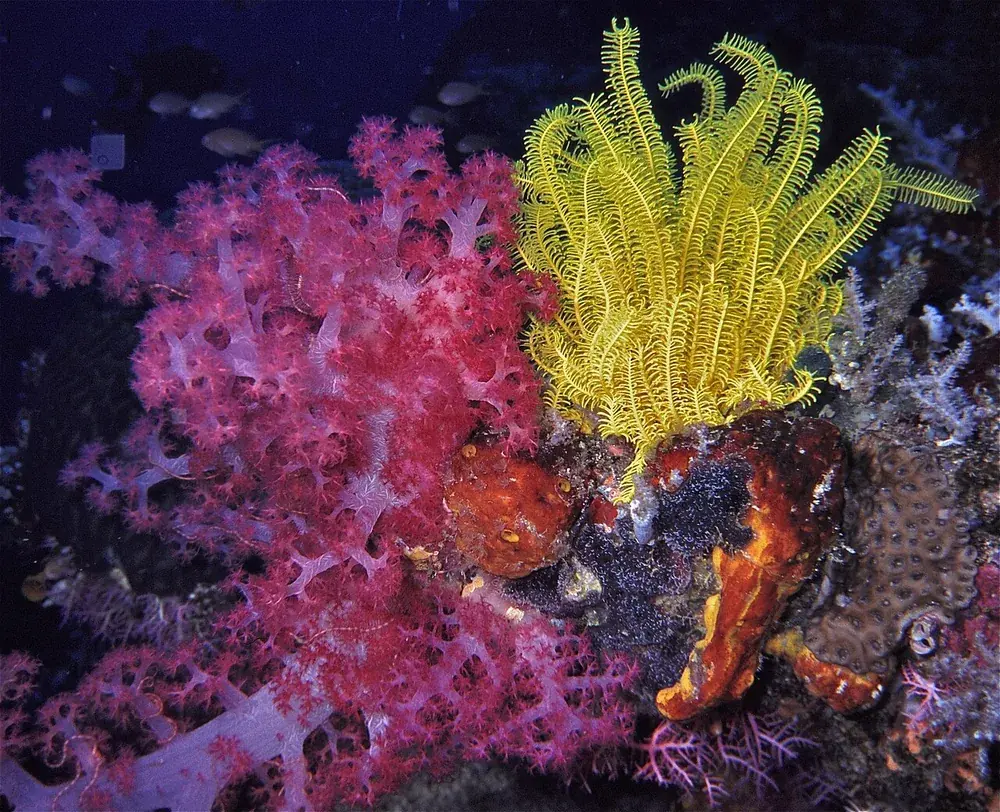
Scientific name: Order Comatulida (the photo shows the variable bushy feather star, Comaster schlegelii) · Group: echinoderm (a crinoid, related to starfish) · Lives: reefs and seabeds worldwide; the photo is from Indonesia · Eats: plankton caught on feathery arms · IUCN status: Not assessed
Young feather stars are fixed to the seabed by a stalk, but adults are free and can move. In C. schlegelii a lost arm can be replaced by two. They are part of the ocean food web as plankton feeders.
Fried egg jellyfish
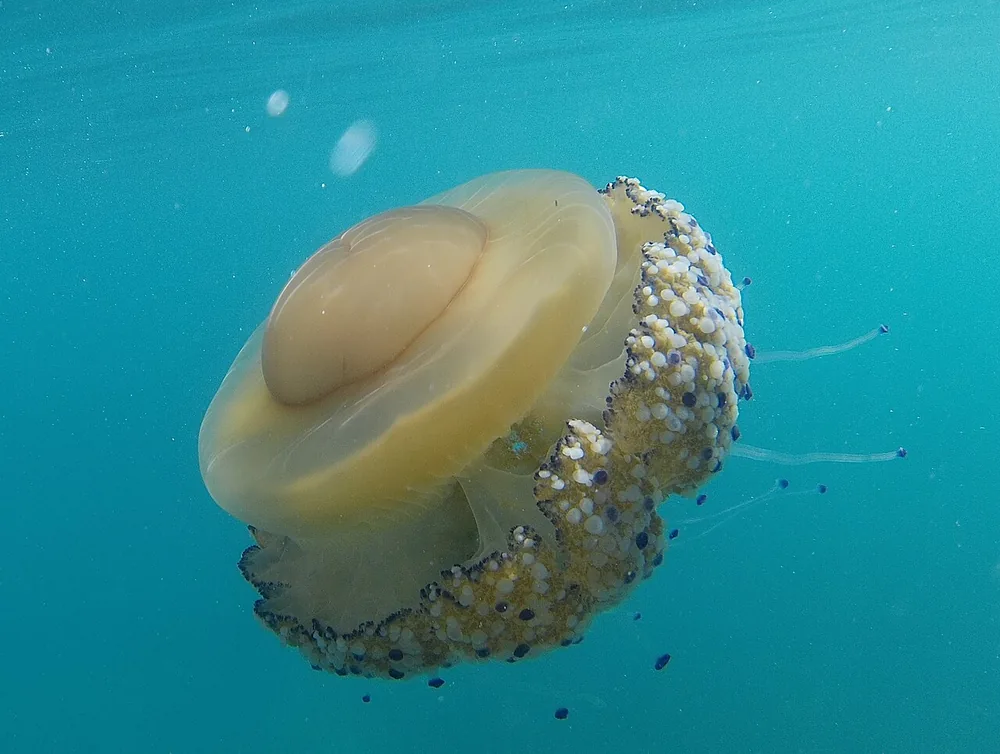
Scientific name: Cotylorhiza tuberculata · Group: cnidarian (jellyfish) · Lives: Mediterranean, Aegean and Adriatic seas · Size: up to 40 cm across; usually under 17 cm · Eats: plankton · IUCN status: Not assessed
It looks like a fried egg from above, and its sting has little or no effect on people. Huge blooms appear in summer.
The frilled shark and common fangtooth are in the table.
Insects and other invertebrates that start with F
Invertebrates have no backbone, as insects are animals, or not explains, and you can learn the differences between vertebrates and invertebrates. Here are eight.
Firefly (common eastern)
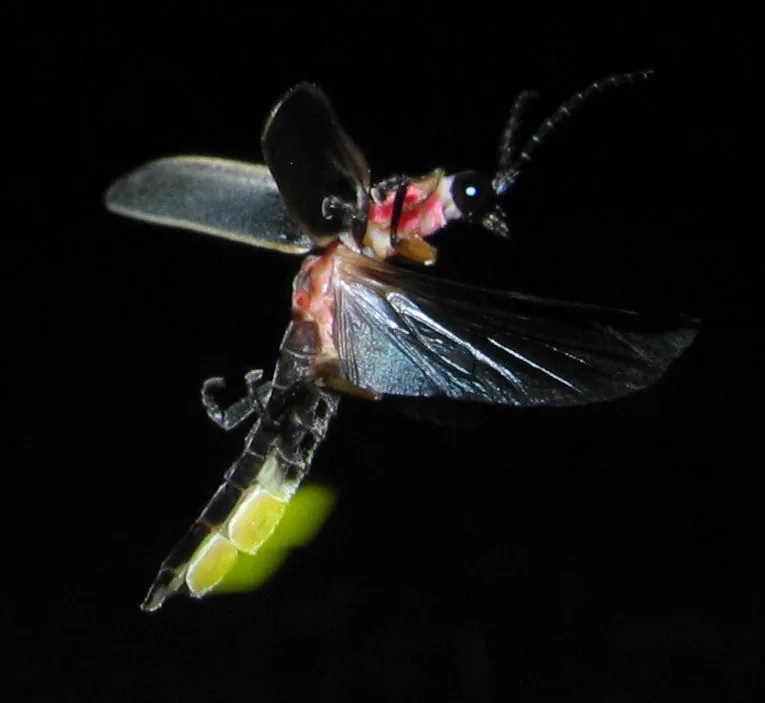
Scientific name: Photinus pyralis · Group: insect (a beetle, not a fly) · Lives: meadows and gardens east of the Rocky Mountains, North America · Size: 9–19 mm · IUCN status: Least Concern (2021)
The most common firefly in North America. Males fly in a J-shaped path, flashing on the upswing, and females answer from the grass. The light comes from an organ in its abdomen.
Fruit fly (common)
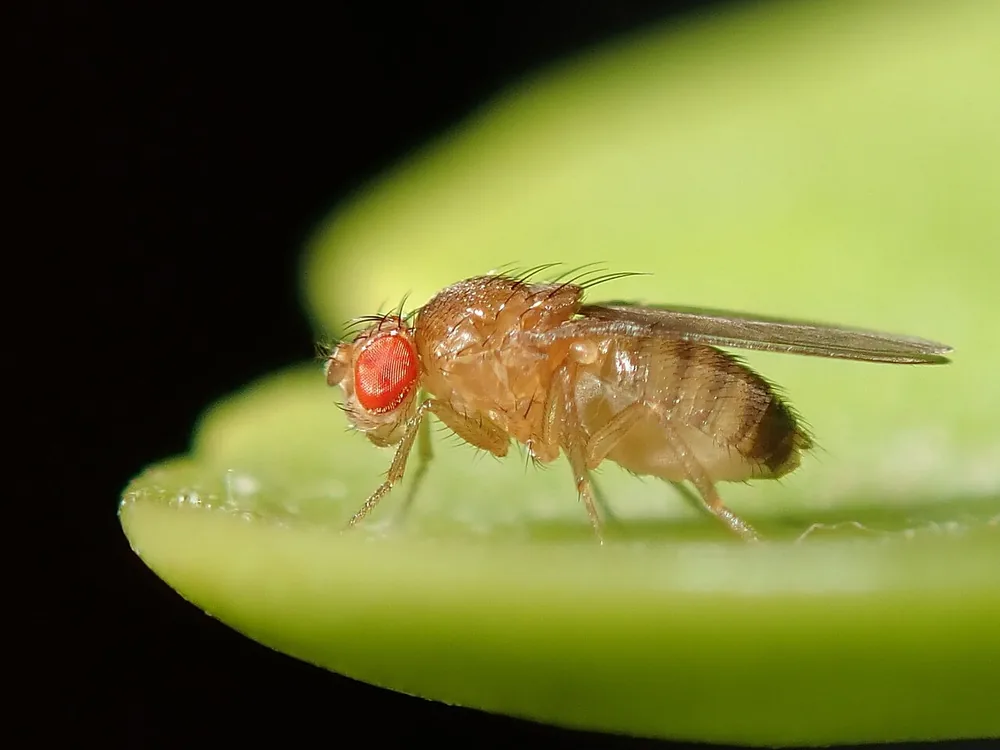
Scientific name: Drosophila melanogaster · Group: insect · Lives: worldwide, around fruit and people · Eats: rotting fruit and yeast · IUCN status: Not assessed
A key animal in genetics research: six Nobel Prizes (as of 2017) went to scientists who studied it. In 1947 it flew into space.
Flea (cat flea)
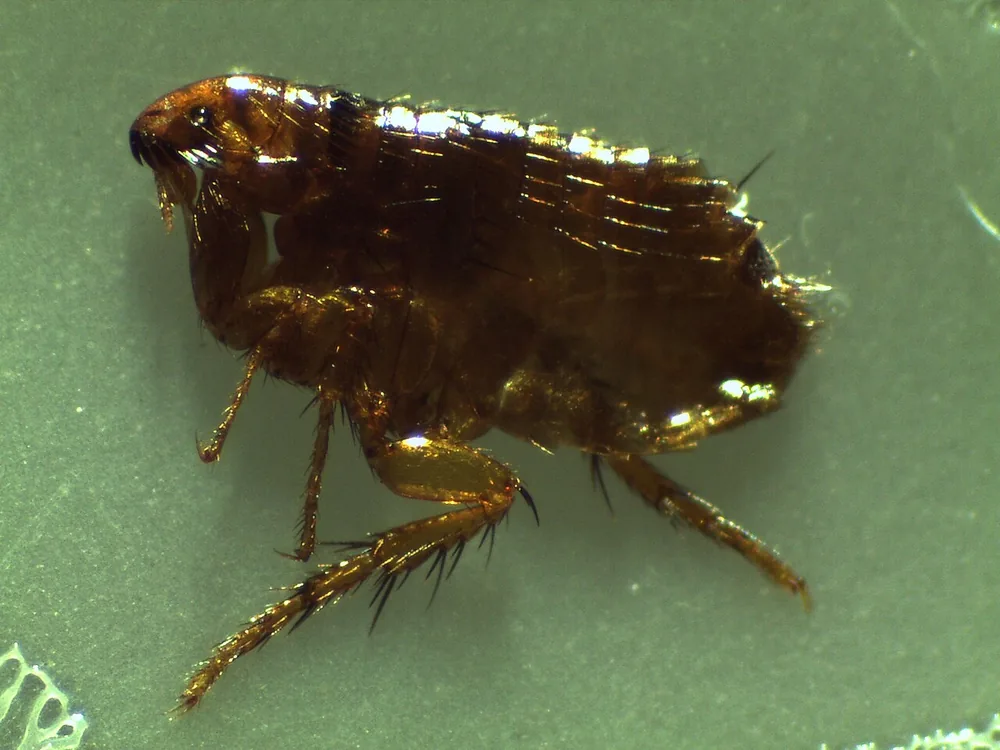
Scientific name: Ctenocephalides felis · Group: insect (parasite) · Lives: worldwide, on cats and dogs · Size: adults 1–2 mm · Eats: blood · IUCN status: Not assessed
Over 90% of fleas on pet cats and dogs are cat fleas. Its take-off force is about 135 times its body weight.
Fly (housefly)
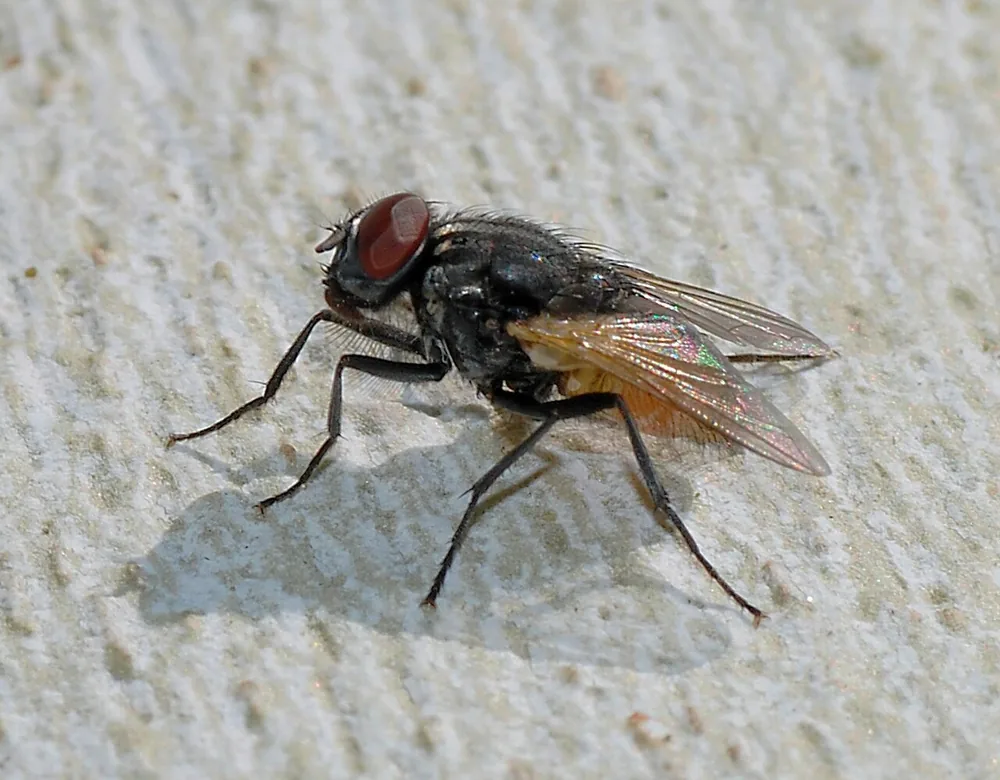
Scientific name: Musca domestica · Group: insect · Lives: worldwide, with people · Size: 6–7 mm; wingspan 13–15 mm · Eats: liquid food, sugars and rotting matter · IUCN status: Not assessed
It tastes with its feet, because taste organs sit on its legs, which is why it rubs its legs together.
Fire ant (red imported)
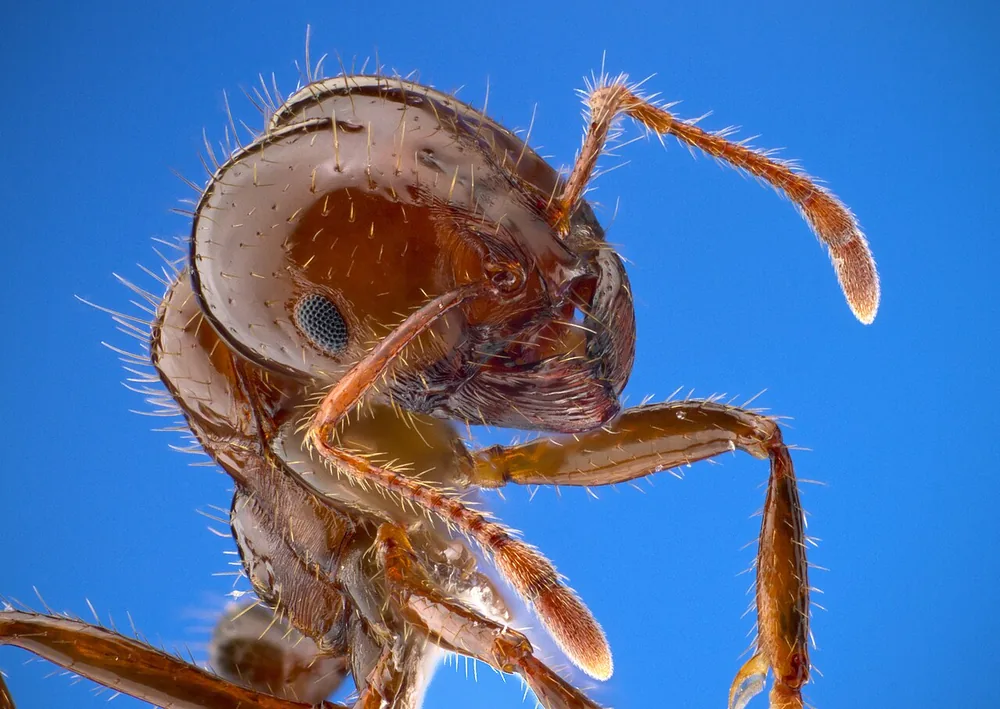
Scientific name: Solenopsis invicta · Group: insect · Lives: native to South America; invasive in the USA and Australia · Size: workers 2.4–6 mm · Eats: insects and other small animals, and seeds · IUCN status: Not assessed
Named for its burning sting. When floods come, colonies link their bodies into floating rafts, and more than 14 million people are stung each year in the USA.
Froghopper (common)
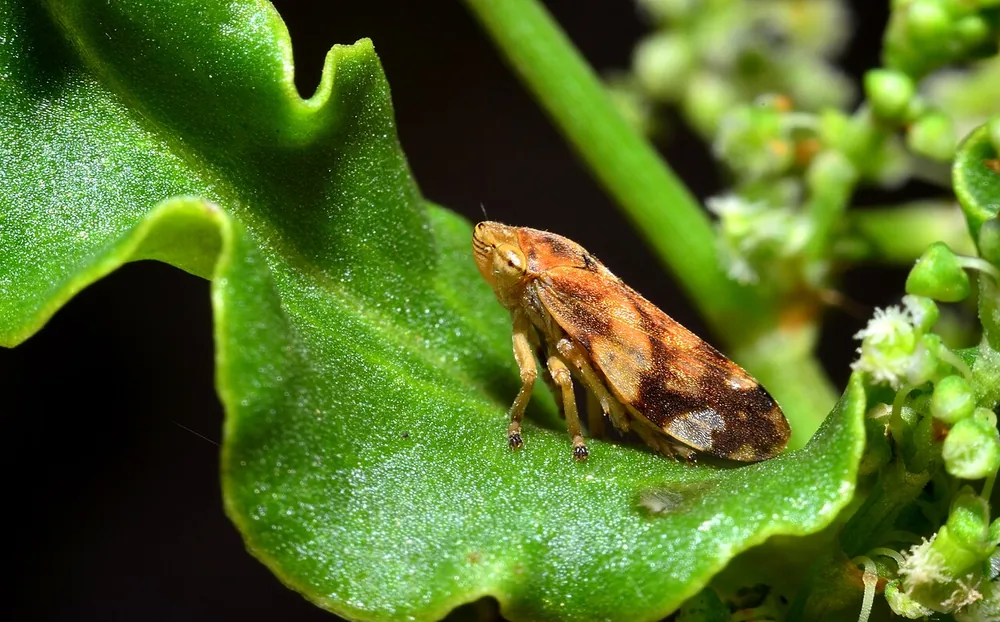
Scientific name: Philaenus spumarius · Group: insect (spittlebug) · Lives: meadows and gardens of Europe, including Britain, and beyond · Eats: plant sap (nymphs) · IUCN status: Not assessed
Nymphs hide in the frothy “cuckoo spit” seen on plants in spring. Adults hold the insect high-jump record, 70 cm.
Funnel-web spider (Sydney)
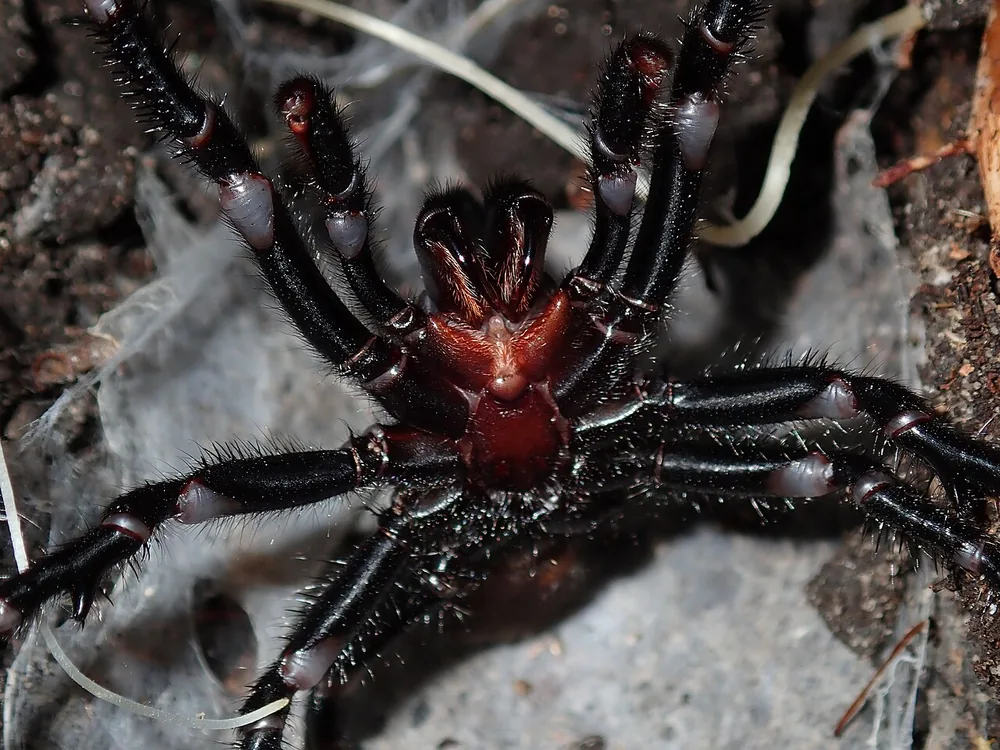
Scientific name: Atrax robustus · Group: arachnid (not an insect) · Lives: usually within about 100 km of Sydney, Australia · Size: body 1–5 cm · Eats: insects and other small animals · IUCN status: Not assessed
Its venom is especially toxic to humans and other primates, and wandering males are the ones most often met. Since an antivenom became available in 1981 there have been no recorded deaths from its bite.
Flower chafer (rose chafer)
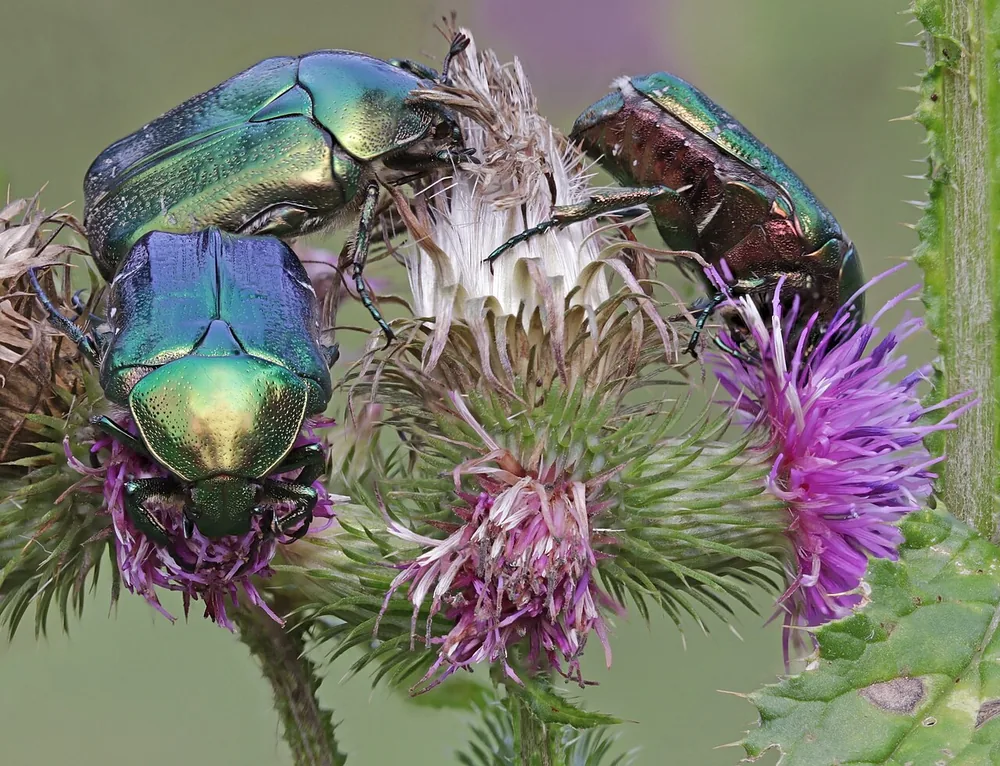
Scientific name: Cetonia aurata · Group: insect (beetle) · Lives: Europe, including southern Britain · Size: about 20 mm · Eats: adults visit flowers; larvae live in compost and rotting wood · IUCN status: Not assessed
Its metallic green is structural colour, made by light reflection rather than pigment. It flies with its wing cases closed.
Three more are in the table: the fiery skipper, fairy shrimp and flatworms (planarians), which can regrow a whole body from a fragment.
Extinct animals that start with F
Extinct animals have died out for good, and the extinction crisis continues today. Here are three of the five.
Falkland Islands wolf (warrah)
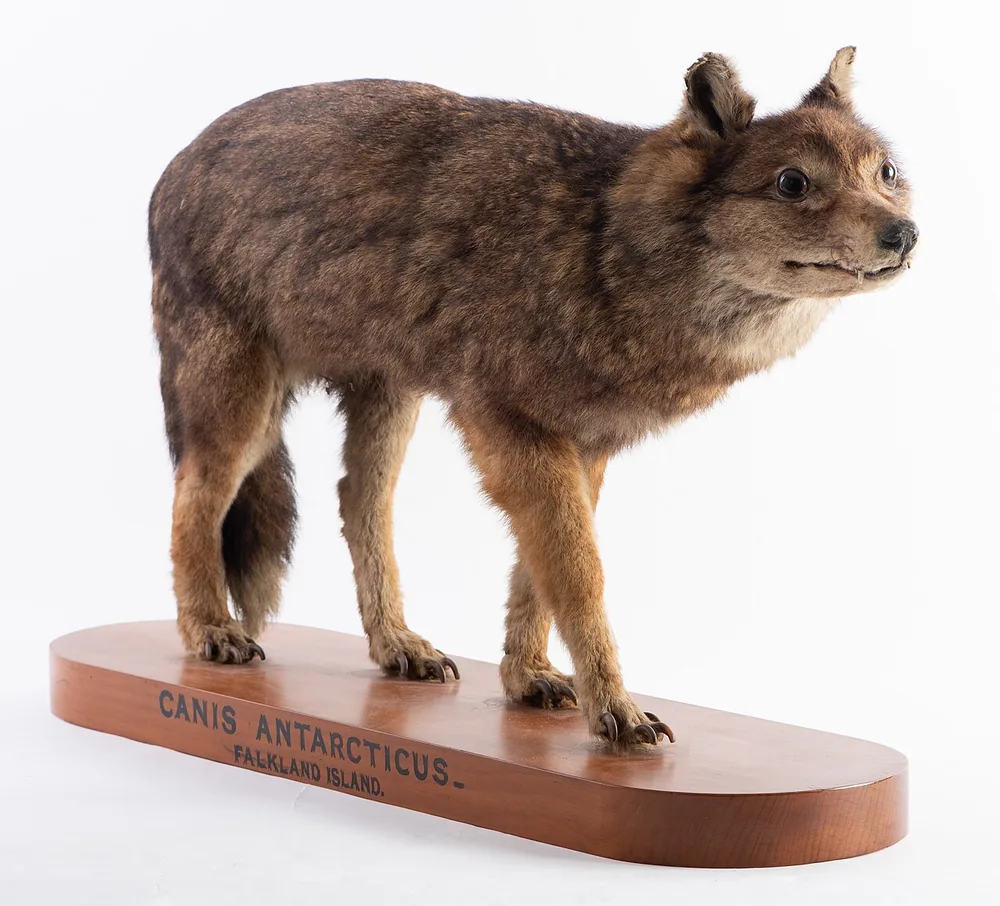
Scientific name: Dusicyon australis · Group: extinct mammal (dog family) · Lives: the Falkland Islands · Eats: probably seabirds, eggs, seal pups and shore scavenging · IUCN status: Extinct (IUCN Red List); it died out in 1876
The only native land mammal of the Falklands. Charles Darwin found it tame in 1833 and predicted it would soon vanish “like the dodo”. It was hunted for fur and poisoned by sheep farmers. The photo shows a preserved specimen.
Falcarius
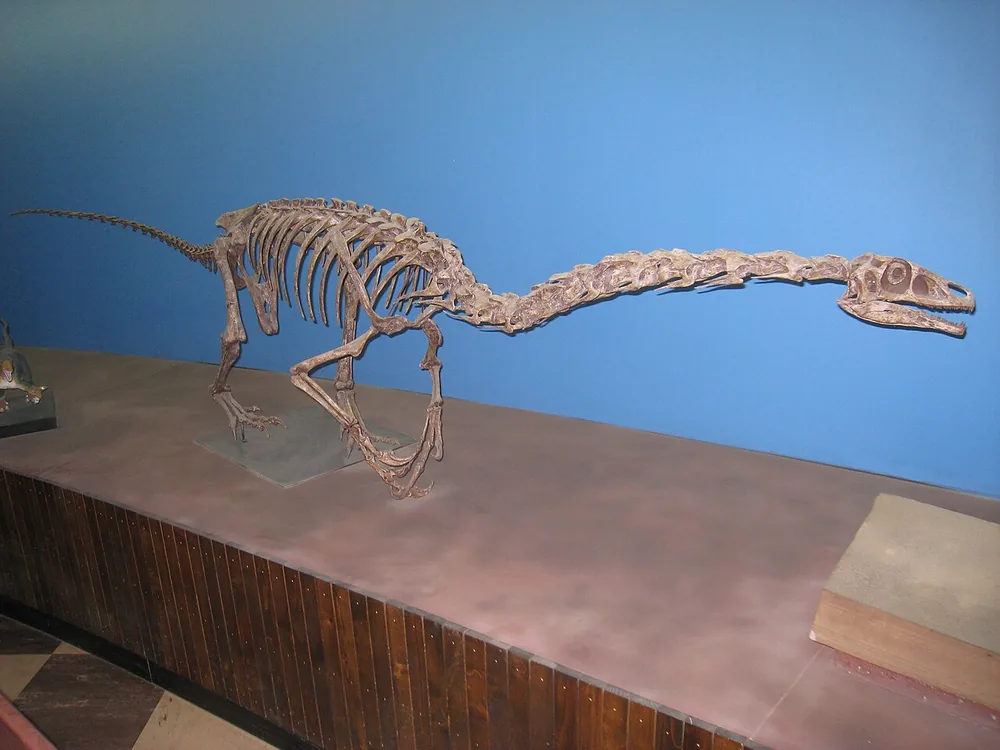
Scientific name: Falcarius utahensis · Group: extinct dinosaur (an early therizinosaur, a plant-eating theropod) · Lives: Utah, USA, in the Early Cretaceous · Size: about 4 m long; walked on two legs · Eats: plants · IUCN status: Extinct; known from fossils; not assessed by the IUCN
The name means “sickle cutter”, after its claws. It was named in 2005.
Fruitadens
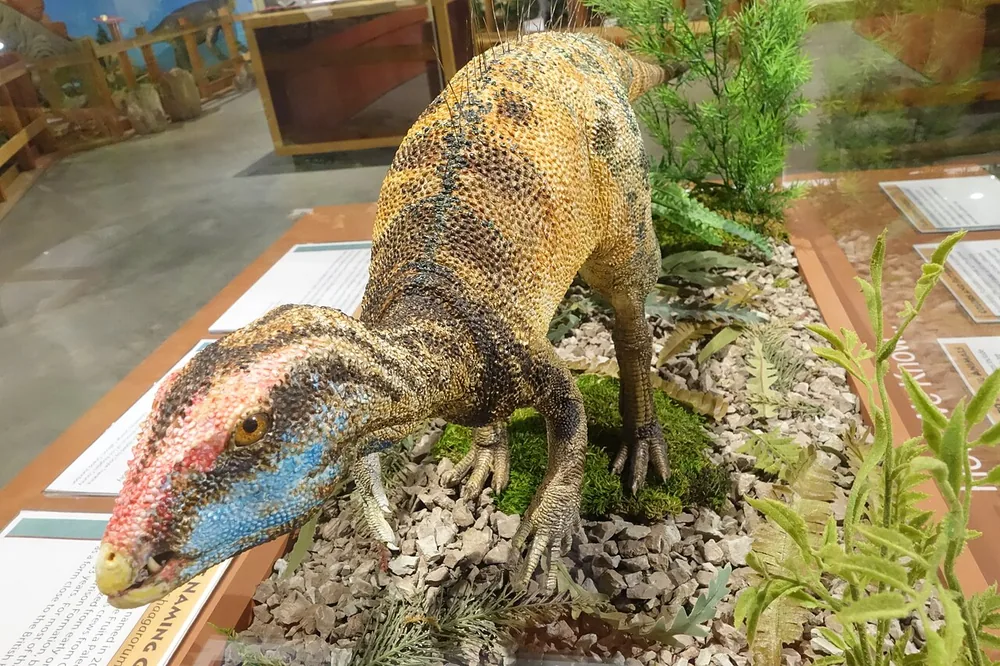
Scientific name: Fruitadens haagarorum · Group: extinct dinosaur (a heterodontosaurid) · Lives: Colorado, USA, in the Late Jurassic, about 150 million years ago · Size: young adults 65–75 cm long; 0.5–0.75 kg · Eats: probably plants and small animals (an omnivore) · IUCN status: Extinct; known from fossils; not assessed by the IUCN
One of the smallest known plant-hipped dinosaurs. The name means “Fruita teeth”, after Fruita, Colorado. The photo shows a museum model.
The Floreana giant tortoise is listed as Extinct by the IUCN, and the original tortoises were gone from Floreana Island by about 1850. In February 2026, 158 tortoises aged 12 to 14, bred to carry Floreana ancestry, were released there. The table also lists the giant titanosaur Futalognkosaurus. For more prehistoric giants, see a list of all the dinosaurs.
Animals that start with F for kids
Parents and teachers can read one line each aloud. If you are working through the alphabet, start with animals that start with A and learn about animals and their habitats.
- Fox. A wild animal with a bushy tail.
- Frog. It starts life as a tadpole.
- Flamingo. A tall pink bird.
- Falcon. A bird that dives to catch prey.
- Fish. It lives in water.
- Fly. An insect with two wings.
- Ferret. A long, furry pet.
- Firefly. A beetle that glows.
- Fennec fox. A tiny fox with huge ears.
- Flying squirrel. It glides from tree to tree.
Can you guess the animal from the clue? Tap a card to flip it.
Try this British spotting challenge. Your ticks are remembered in your browser.
- Fox, at dusk
- Fallow deer, in a deer park
- Fieldfare, in a winter hedgerow
- Goldfinch, on thistles
- Firecrest, in woodland (hard to spot)
- Common frog, or its frogspawn
- Froghopper “cuckoo spit” in spring
- Rose chafer, on a sunny flower
- Fulmar, on a sea cliff
- Housefly, indoors
Fun facts about animals that start with F
- In 1947 fruit flies became the first animals launched into space.
- A housefly tastes with its feet.
- The flamingo tongue snail’s pattern is on its skin, not its shell.
- The fennec fox is the smallest fox in the world.
- A film helped scientists find the Fiji crested iguana.
Key points
- This guide lists 76 animals that start with F, 54 of them with photos.
- The fin whale is the biggest living animal on the list, and the peregrine falcon is the fastest.
- The Fiji crested iguana is the only Critically Endangered animal here.
- The Antarctic fur seal became Endangered in April 2026.
- Flying lemurs and flying squirrels glide rather than fly.
- Breeds such as the French Bulldog are not counted.
Frequently asked questions about animals that start with F
What animal starts with F?
Many animals start with F, including the fox, frog, flamingo, falcon, ferret, fin whale, firefly and fly. This guide lists 76, with photographs for 54 of them.
What is the biggest animal that starts with F?
The fin whale is the biggest living animal that starts with F, with the largest reported about 26–27 m long. The extinct dinosaur Futalognkosaurus may have been about as long (estimates run to roughly 26–30 m), but the fin whale is far heavier.
What is the fastest animal that starts with F?
The peregrine falcon is the fastest. In a dive it is often said to pass 320 km/h, and a trained falcon was clocked at 389 km/h in 2005, although the fastest speed confirmed by radar is 184 km/h.
What is the smallest animal that starts with F?
On this list the cat flea, at 1–2 mm, is the smallest. The smallest bird is the firecrest at 4–7 g, and the fennec fox is the smallest fox.
What sea animals start with F?
Sea animals that start with F include the fin whale, Antarctic fur seal, flounder, flying fish, frogfish, flying gurnard, fiddler crab, feather star, fried egg jellyfish and frilled shark.
What birds start with F?
Birds that start with F include the flamingo, falcon, frigatebird, fairy penguin, fulmar, fieldfare, firecrest, goldfinch, fairywren, frogmouth and Fischer’s lovebird.
What is the rarest animal that starts with F?
The Fiji crested iguana is the only Critically Endangered animal here. Several are Endangered, including the Antarctic fur seal, large flying fox and flat-headed cat.
What is the most dangerous animal that starts with F?
The Sydney funnel-web spider has very toxic venom, though no deaths have been recorded since an antivenom arrived in 1981. The fer-de-lance and fire ant can also be dangerous. Seek medical help after a bite.
What pets start with F?
Pets that start with F include the ferret, Fischer’s lovebird, finches, the French Bulldog, the Flat-Coated Retriever and the Flemish Giant rabbit. Check local rules before keeping any animal.
What three- and four-letter animals start with F?
Three-letter animals that start with F are the fox and the fly. Four-letter ones include the frog, flea and fish. A fawn is a young deer rather than a species.