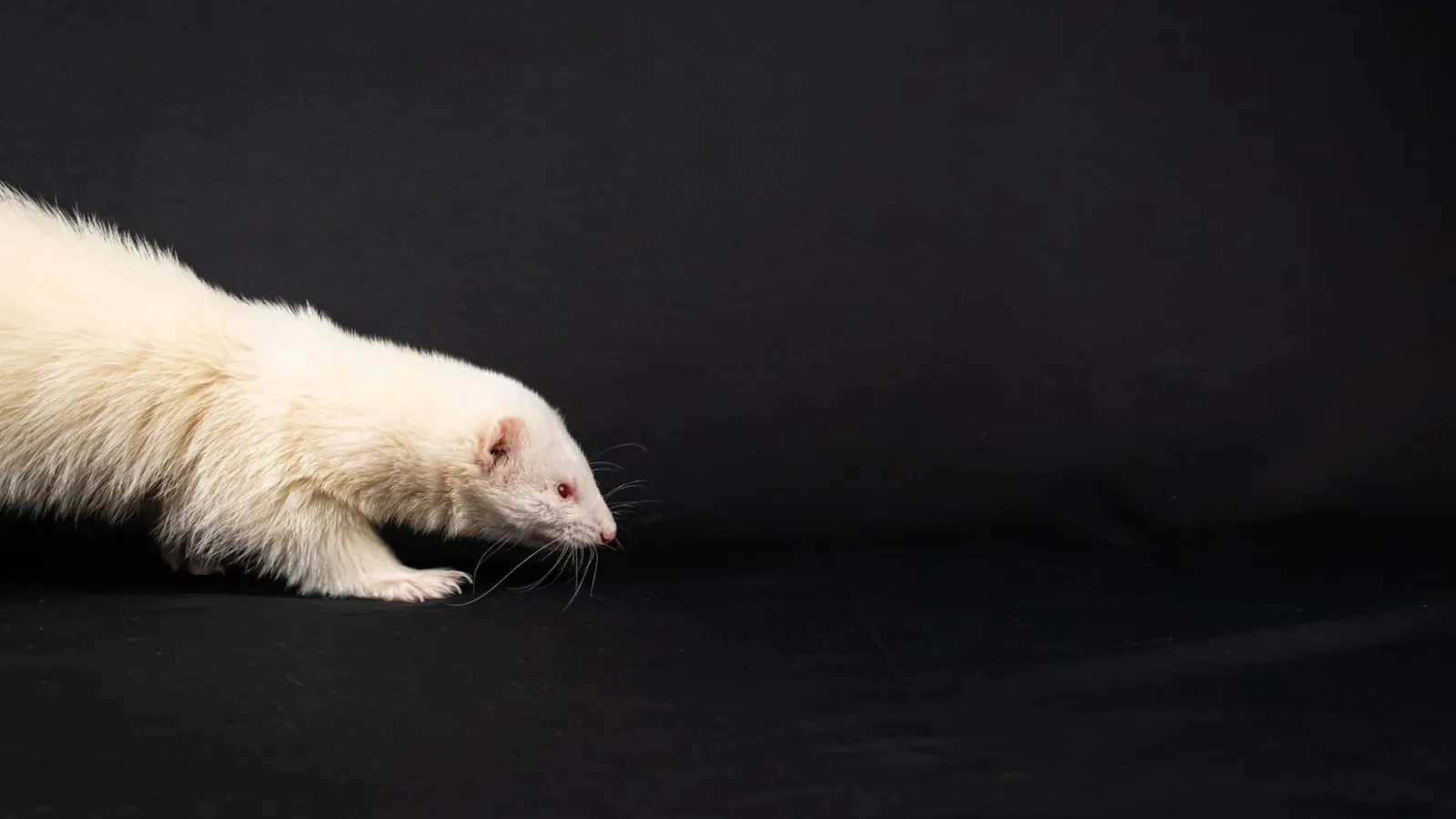
Albino animals are animals born with little or no melanin, the dark pigment that colours skin, fur, feathers, scales and eyes. Albinism is inherited: an animal is albino when it receives a faulty copy of a pigment gene from both parents. The result is a white or very pale body, pale or pink eyes and, often, poor eyesight.
This guide covers everything about albino animals: what causes albinism, how it is passed on, how it differs from leucism and isabellinism, why albino animals struggle in the wild, how rare they really are, and the famous individuals – from Snowflake the gorilla to Migaloo the white whale – that made headlines.
What is albinism in animals?
Albinism in animals is an inherited condition in which the body cannot make normal amounts of melanin. It is found in mammals, birds, reptiles, amphibians and fish, and the same condition occurs in humans, where doctors call it oculocutaneous albinism (“oculo” = eye, “cutaneous” = skin).
Melanin is made by special cells called melanocytes. Inside them, melanin is built up in tiny packets called melanosomes, which are then passed into growing hairs, feathers or skin cells. Animals use two main kinds of melanin:
- Eumelanin – black and dark brown. It gives crows their black feathers and gorillas their dark skin.
- Phaeomelanin – red, orange and yellow-brown. It gives foxes their ginger fur.
Most coat colours are a mixture of the two. In a true albino, both kinds are missing or almost missing, because the same early steps are needed to make either type. That is why an albino fox is not just less ginger – it is white.
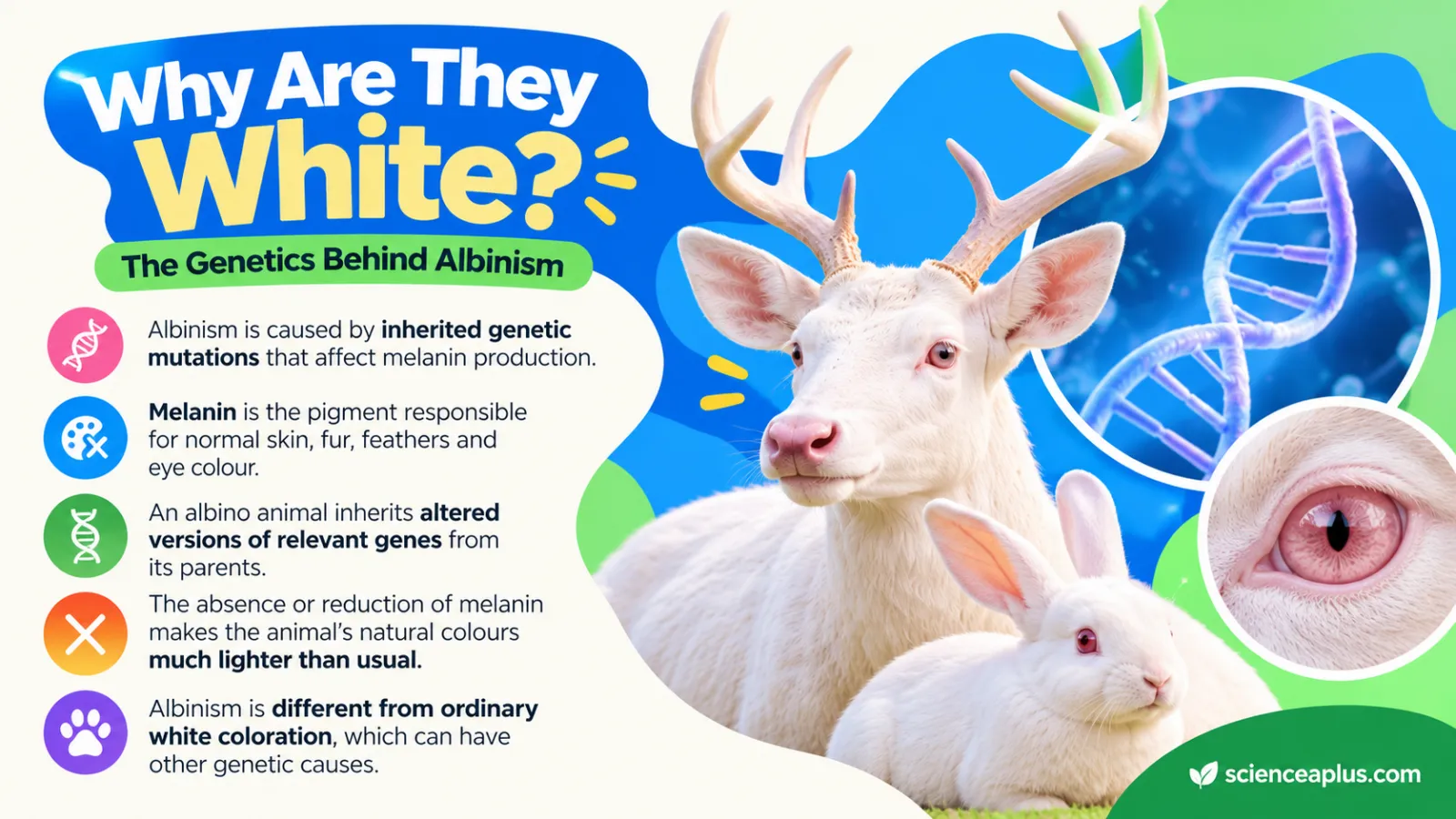
Melanin is not only about looks. It soaks up harmful ultraviolet (UV) light, protecting the skin and eyes, and it is needed while the eye is developing in the embryo. Those jobs explain most of the problems albino animals face, which we look at later in this guide.
What causes albinism?
The short answer to “what causes albinism?” is a change (mutation) in one of the genes that controls melanin production. The most famous of these genes is TYR, which carries the instructions for an enzyme called tyrosinase.
Tyrosinase works at the very start of melanin production. It takes an amino acid called tyrosine – one of the building blocks of proteins – and converts it into DOPA and then dopaquinone. Every later step depends on that first reaction.
tyrosine → (tyrosinase) → DOPA → dopaquinone → … → melanin
If the TYR gene is faulty, the animal makes no working tyrosinase, or only a weak version. With the first step blocked, the melanocytes are present but cannot produce pigment. The animal’s cells are “switched on” for colour, but the production line is broken at the first machine.
TYR is not the only gene involved. Scientists have found several genes that can cause albinism, and in humans they are numbered as different types. The same genes are found in other mammals, which is why the same names keep appearing in animal studies:
| Type | Gene | What the gene does | Animal example |
|---|---|---|---|
| OCA1 | TYR | Makes tyrosinase, the enzyme that starts melanin production | Migaloo the humpback whale |
| OCA2 | OCA2 | Makes a protein that helps melanosomes work properly | Blind Mexican cavefish |
| OCA3 | TYRP1 | Makes a protein that helps produce and stabilise eumelanin | (rarer type) |
| OCA4 | SLC45A2 | Makes a transport protein needed inside melanosomes | Snowflake the gorilla |
So albinism is not one single mutation. It is a group of conditions with the same end result: a body that cannot make enough melanin. Changes in the DNA sequence of a gene alter the protein it codes for, and a protein with the wrong shape cannot do its job.
How is albinism inherited?
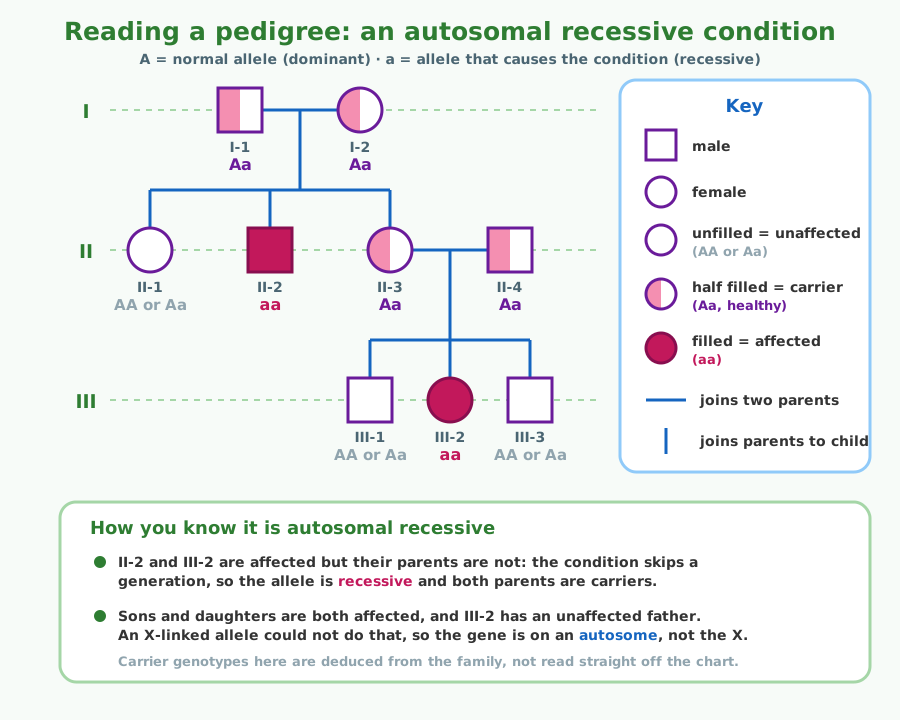
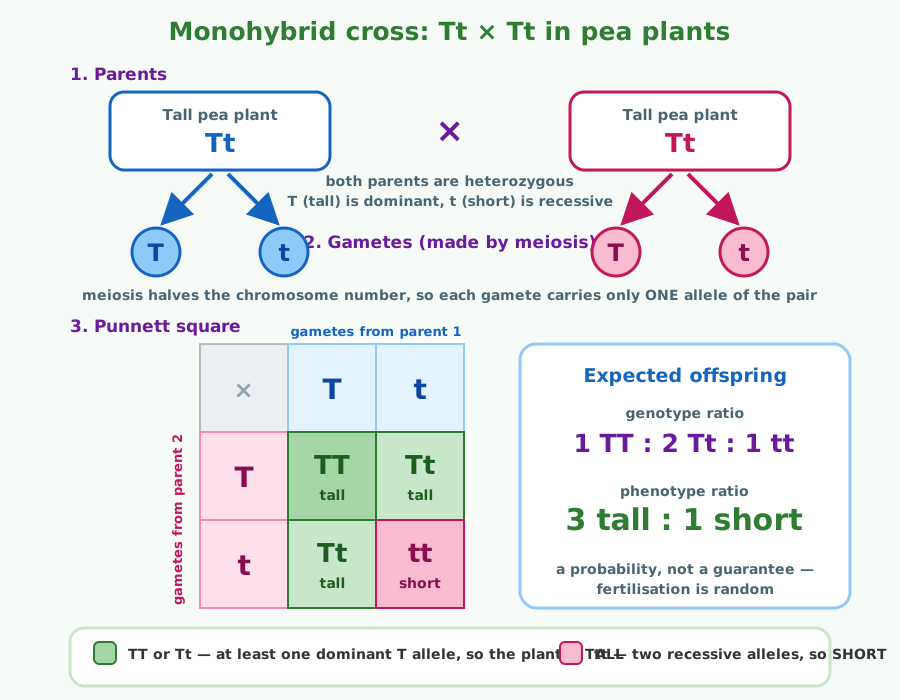
Albinism is a classic example of a recessive trait. Every animal carries two copies of each gene, one from each parent. A working copy is dominant: one working copy makes enough tyrosinase for normal colour. Only an animal with two faulty copies is albino.
Using A for the working allele and a for the faulty one:
- AA – normal colour, does not carry albinism.
- Aa – normal colour, but a carrier. It can pass the faulty allele to its young.
- aa – albino.
This is why albino animals can appear “out of nowhere”. Two normally coloured parents that are both carriers (Aa × Aa) have, for each baby, a 1 in 4 chance of an albino (aa), a 1 in 2 chance of a carrier (Aa) and a 1 in 4 chance of a non-carrier (AA). If you want a refresher on genotypes and Punnett squares, see our guide to alleles and inheritance.
Try it yourself with the cross calculator below: pick the genotypes of the two parents and see the chance that each baby will be albino.
Because two carriers are needed, albinism shows up more often when close relatives breed. Relatives share many of the same alleles, so a rare faulty allele is more likely to meet itself. That is exactly what happened with Snowflake the gorilla, whose parents were probably uncle and niece. Small, isolated populations – for example on islands – show the same effect. The way carriers pass on recessive conditions is also explained in our article on inherited diseases and carriers.
Two normally coloured rabbits have an albino baby. What are the parents’ genotypes, and what is the chance their next baby is albino? (3 marks)
Both parents must be carriers, Aa, because the albino baby (aa) received one recessive allele from each and neither parent is albino. A Punnett square for Aa × Aa gives AA : Aa : aa in the ratio 1 : 2 : 1, so the chance of another albino baby is 1 in 4 (25%) – every baby has the same chance.
Albinism vs leucism vs isabellinism
Not every white animal is albino. Biologists recognise several different colour aberrations, and three are often mixed up: albinism, leucism and isabellinism. The easiest clue is usually the eyes.
- Albinism – the animal has pigment cells, but they cannot make melanin because of a faulty enzyme or protein. No melanin anywhere, including the eyes.
- Leucism – an inherited absence of pigment cells in the skin, fur or feathers. Leucism can be total (an all-white animal) or partial (white patches). The eyes get their pigment from a different set of cells, so they keep their normal dark colour.
- Isabellinism – a kind of “dilution”. Melanin is still made, but much less of it, so dark colours fade to a washed-out greyish-yellow or pale fawn. It has been recorded in several penguin species, which look sandy instead of black and white.
| Feature | Albinism | Leucism | Isabellinism |
|---|---|---|---|
| Cause | Pigment cells cannot make melanin | Pigment cells missing | Melanin reduced, not absent |
| Colour | All white (or yellow/orange from non-melanin pigments) | All white or white patches | Pale, sandy or fawn all over |
| Eyes | Pink, red or very pale | Normal dark colour | Usually normal or slightly paler |
| Eyesight | Usually poor | Normal | Usually normal |
| Example | Albino hedgehog, Snowflake the gorilla | White peacock, white lion | Isabelline penguins |
Ornithologists add a few more terms. Bird experts also describe “ino” birds, which still make melanin but in a form that has lost its dark quality. They can look white with reddish eyes, yet they see much better than true albinos. That is a reminder that spotting a white animal with pale eyes is a good clue – but only a genetic test proves albinism.
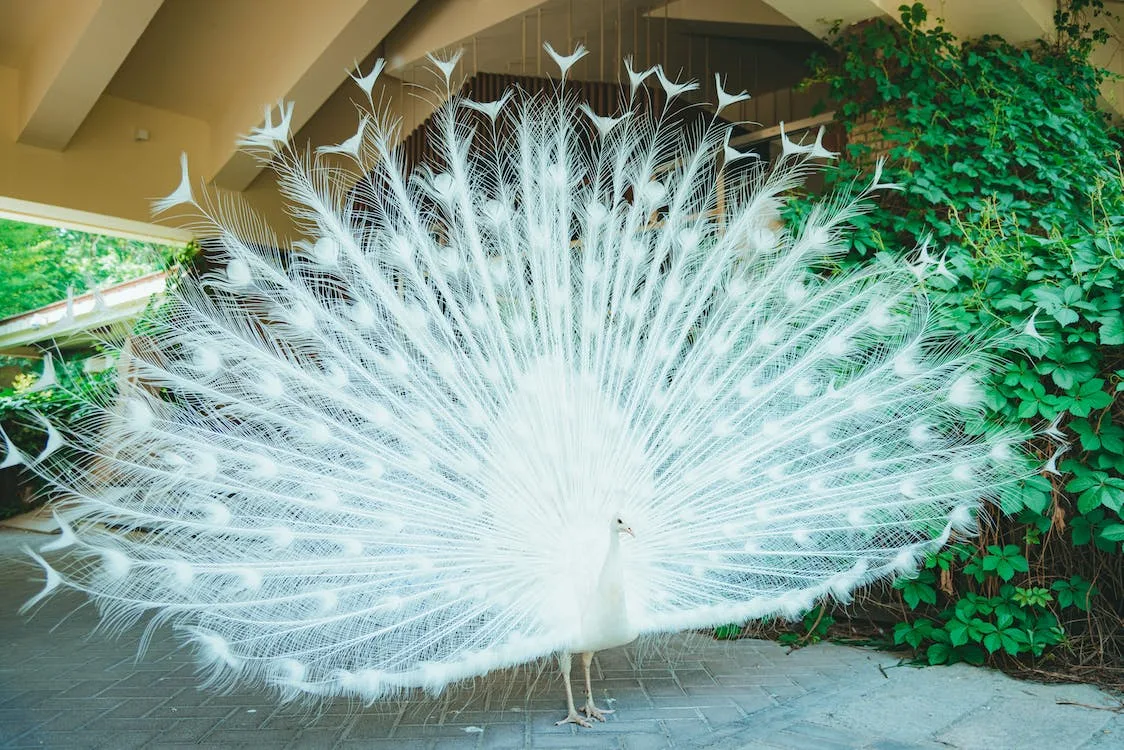
The white peacocks you see strutting around parks and stately homes are a good example. Most of them are a leucistic colour form with dark or blue eyes, bred for centuries because people like the look. True albino peafowl with red eyes are far rarer. Our page on white and albino peacocks has more photos of these birds.
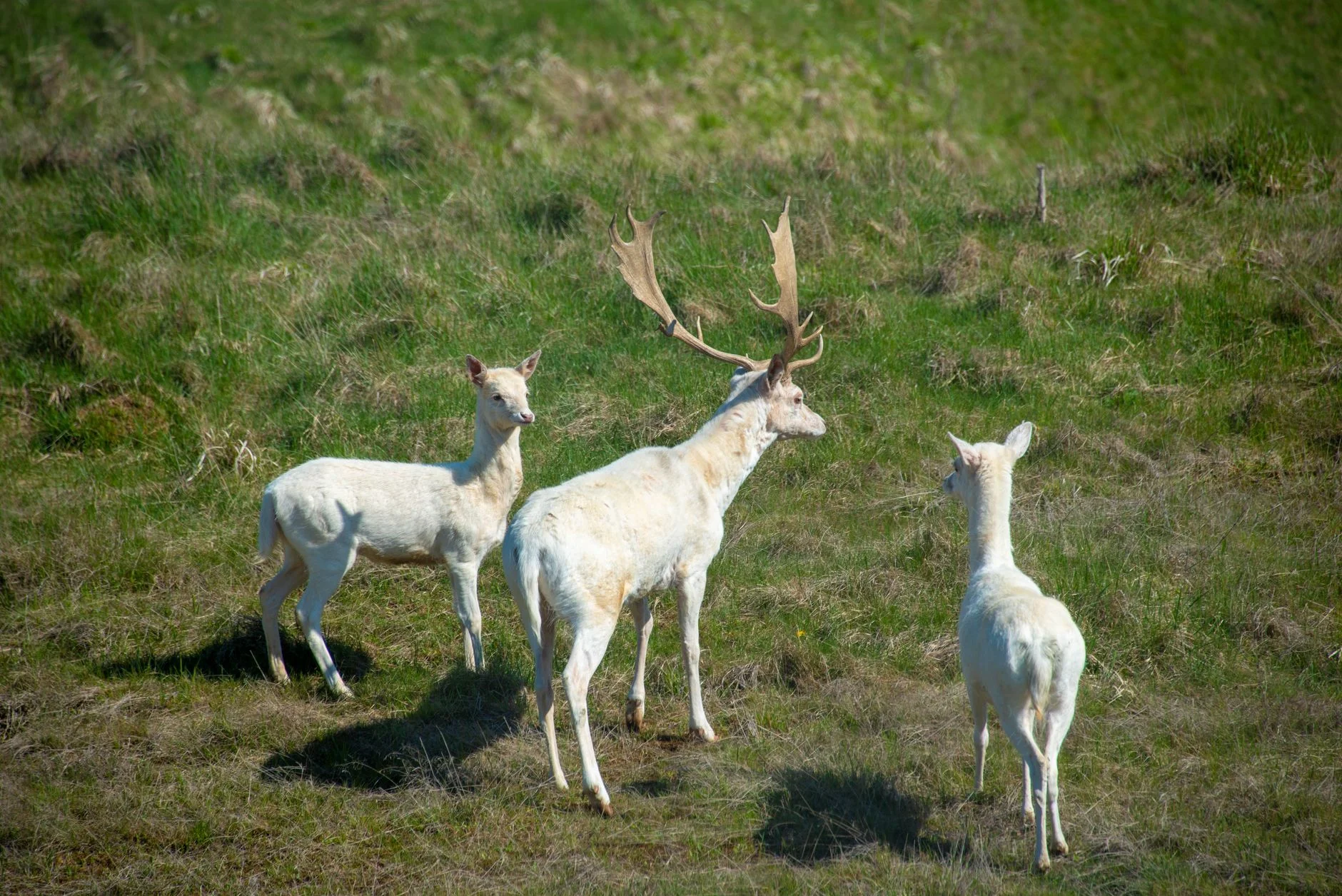
Deer show the difference well. Herds of white fallow deer are kept in many parks and usually have dark eyes, so they are not albino. A truly albino deer – pink eyes, pink nose, pale hooves – is very rare in the wild. If you want to see the difference, our collection of albino deer pictures shows several examples.
Why do albino animals have pink or red eyes?
The iris – the coloured ring of the eye – normally contains a lot of melanin. In an albino animal the iris has little or none, so it is partly see-through. What you see is the red of the blood vessels inside the eye, showing through tissue that would normally hide them. That gives the classic pink or red albino eye.
Older websites claim the colour is light “reflecting off the retina”. The real reason is simpler: without pigment, nothing covers up the blood supply. It is the same reason albino animals often have pink noses, ears and paws.

Not every albino animal has red eyes, though. The colour you see depends on how much pigment is left, how thick the iris is and the lighting. Snowflake the gorilla had light blue eyes, and Migaloo the whale has brown-looking eyes even though his genes show he is albino. So “pink eyes” is a strong clue, but not a rule. In some types of albinism a little melanin is still made, which can darken the eyes as the animal grows.
Why are some albino animals yellow or orange?
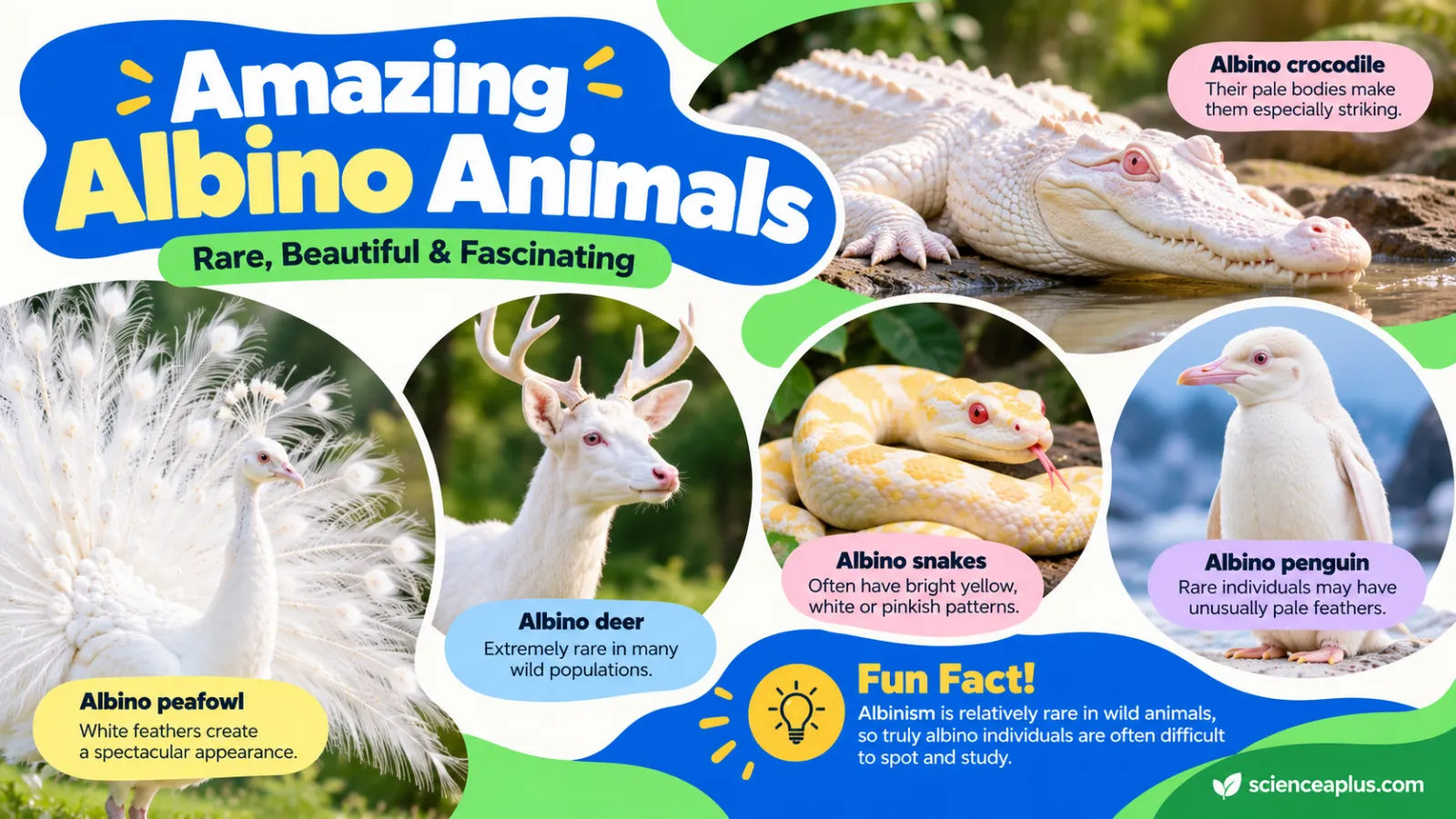
Melanin is not the only pigment in nature. Reptiles, amphibians and fish have extra colour cells that hold yellow, orange and red pigments, and birds can get yellow and red carotenoids from their food. Albinism removes the black and brown, but leaves these other colours behind.
That is why the most popular pet snakes – albino Burmese pythons, albino corn snakes – are not white but bright yellow, orange or pink on white. Reptile keepers often call them “amelanistic”, meaning “without melanin”, which describes them more accurately. You can read more about these reptiles in our page of albino snake facts.
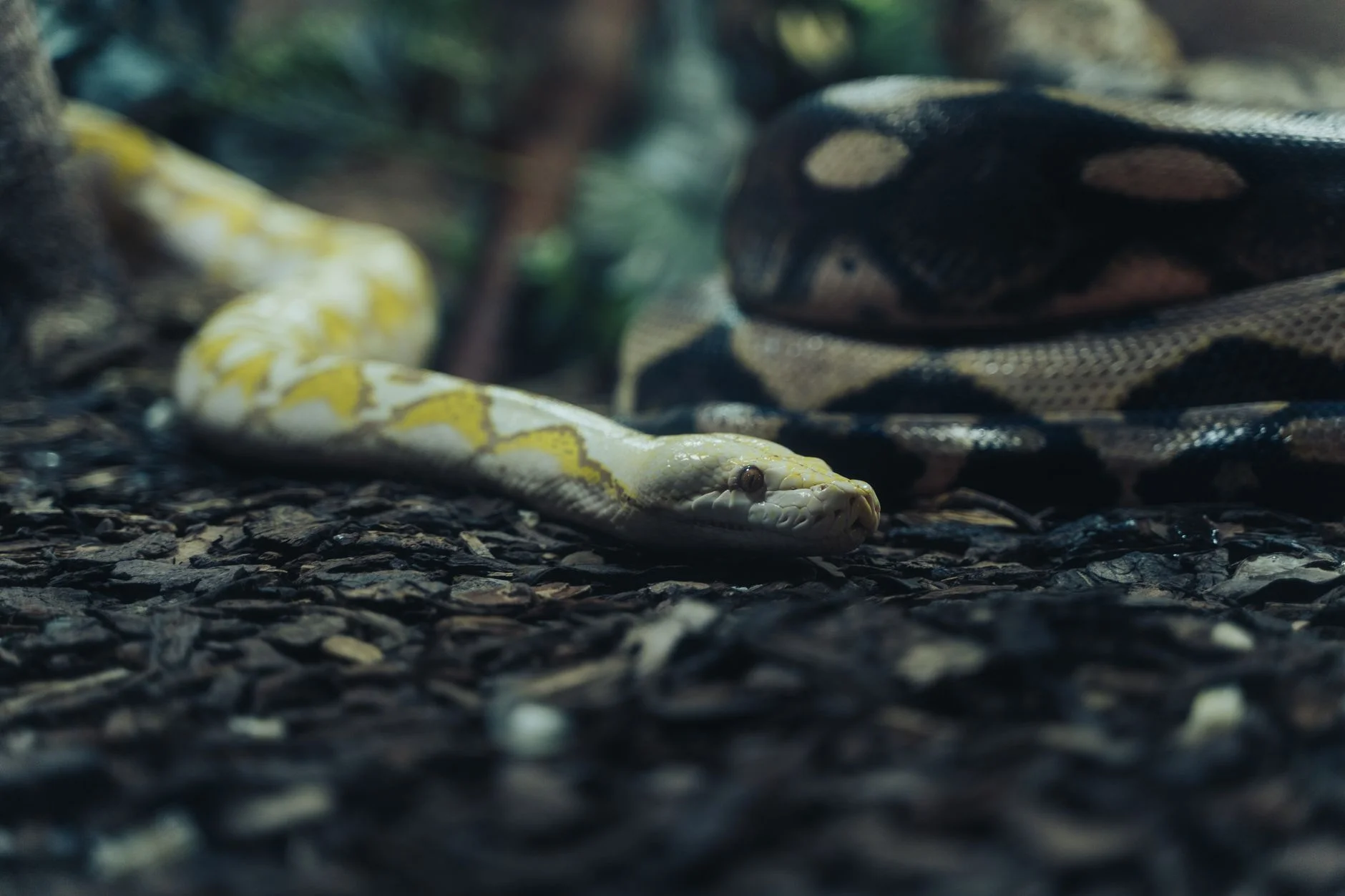
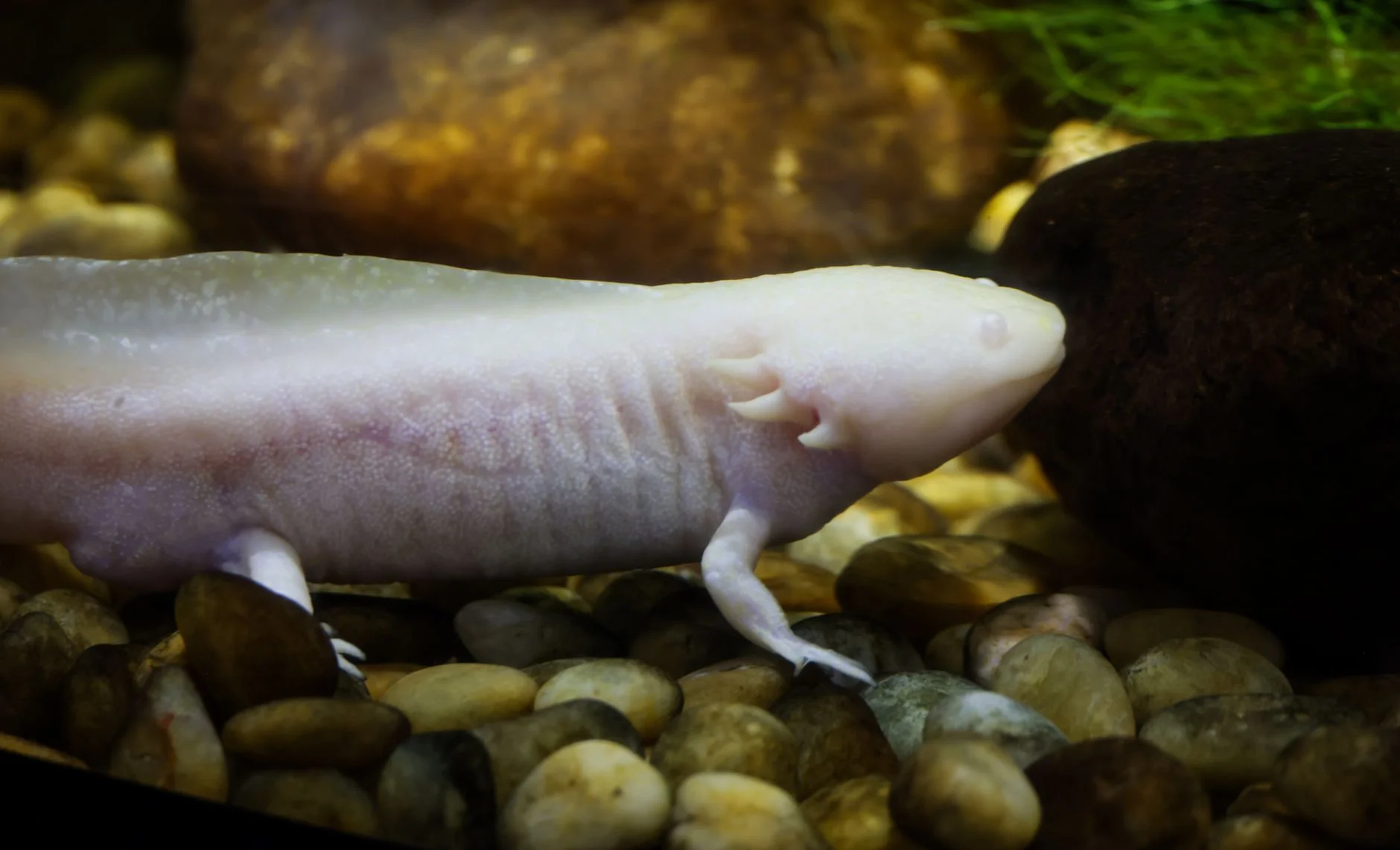
The same thing happens in albino fish and amphibians. Albino axolotls, for example, look pink-white, and the “golden albino” variety bred by keepers is a warm yellow. In each case the animal is a true albino – it simply has other colours that melanin used to hide.
Challenges of being an albino animal
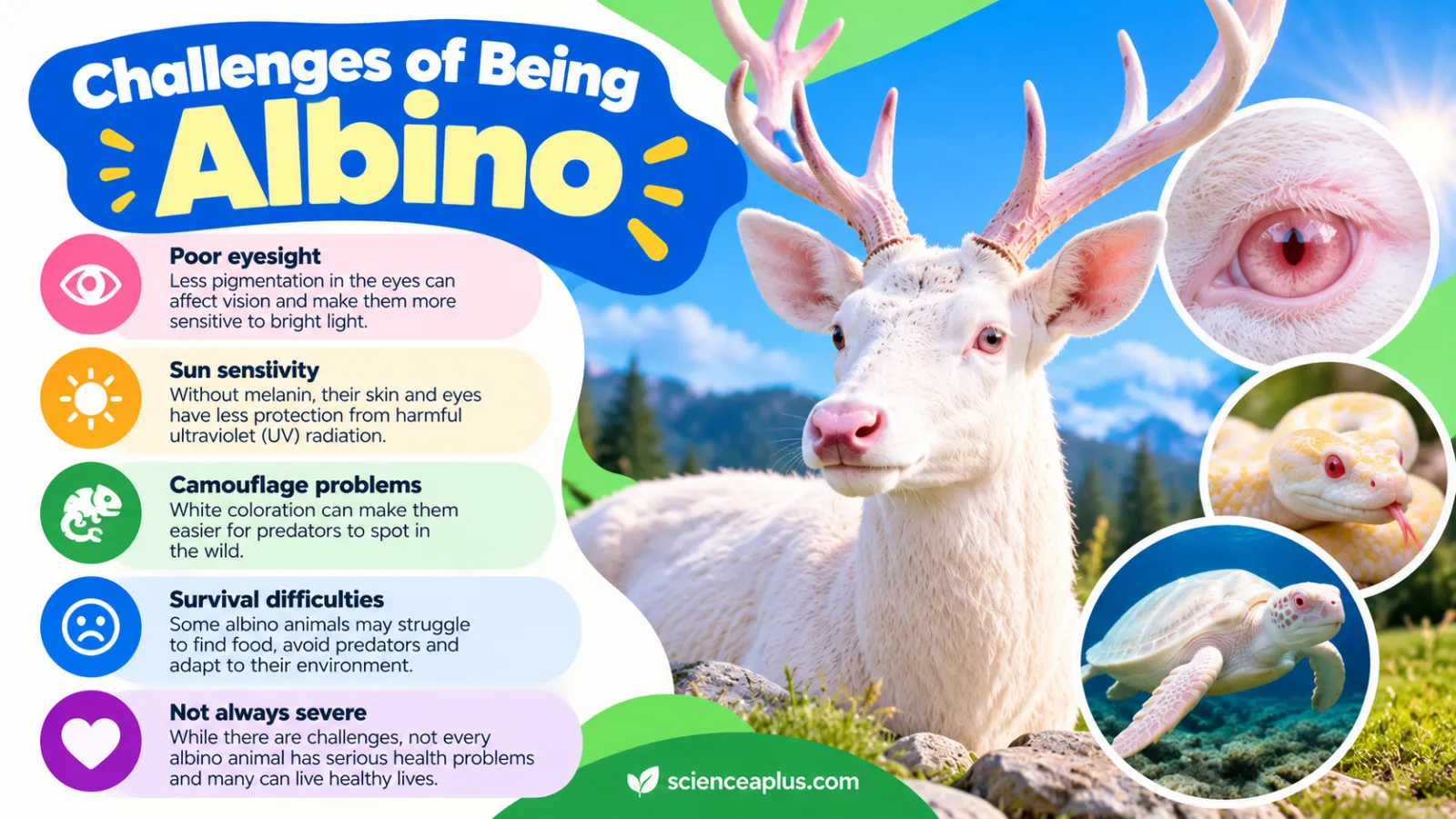
Do albino animals survive in the wild? Some do, but the odds are stacked against them. With their poor eyesight, most albino birds are thought not to survive to adulthood in the wild. The problems fall into four groups.
1. Poor eyesight
This is the problem people usually forget. Melanin is needed while the eye is forming in the embryo. Without it, the fovea – the small central patch of the retina that gives sharp vision – does not develop properly, and some of the nerve fibres running from the eye to the brain take the wrong route. The result is blurry vision that glasses could never fully correct.
In humans, albinism is linked to reduced sharpness of vision, nystagmus (involuntary flicking movements of the eyes), squint and strong sensitivity to bright light. Albino animals have the same eye anatomy problems. Snowflake the gorilla was strongly sensitive to light and blinked about 20 times a minute even in soft, diffuse light.
For a wild animal, poor eyesight is serious. A hawk that cannot judge distance misses its prey. A rabbit that cannot see a fox until it is close loses its head start. Bright light makes things worse, so albino animals may avoid sunny open ground – the very places where many feed.
2. No protection from the Sun
Melanin acts like a built-in sunscreen, absorbing ultraviolet light before it damages cells. Without it, the skin burns more easily and damage to DNA builds up over the years, raising the risk of skin cancer. Snowflake lived at Barcelona Zoo for 37 years and was eventually put to sleep because of skin cancer.
Animals with thick fur or feathers are partly shielded, but bare skin around the eyes, nose, ears and feet is exposed. Animals that bask, such as reptiles, or that surface in bright sunlight, such as whales, are especially at risk.
3. No camouflage
Most animals are coloured to blend in with their surroundings. A brown mouse on soil, a grey heron by a river or a striped tiger in long grass are hard to see. An albino stands out like a torch. You can read how colour helps animals hide in our guide to camouflage in biology.
Being easy to spot works both ways. Prey animals are found more easily by predators. Predators are spotted by their prey, so they catch less food. Young animals, which are already the most likely to be eaten, are hit hardest. That is one reason sightings of adult albino animals in the wild are so rare – many never reach adulthood.
4. Problems finding a mate
Many animals choose partners by colour and pattern. Birds in particular use plumage to recognise their own species and to judge a mate’s quality. An albino may simply not look “right”. The National Wildlife Federation reported that albino penguins almost never find mates and are often pecked by other penguins, and that many albino birds have brittle feathers that wear out quickly.
When albinism matters less
The problems above all depend on light. Take light away and albinism becomes much less of a handicap. The best example is the blind Mexican cavefish. Its ancestors lived in rivers, but some populations moved into dark caves. Over many generations, several cave populations became albino through mutations in the OCA2 gene. In total darkness, colour and eyesight are no use, so losing them costs almost nothing. This is a good example of how a feature that is harmful in one place can be neutral in another – one of the key ideas behind adaptations in plants and animals.
Albinism also matters less where animals are protected from predators. Pet and laboratory animals such as albino rats, mice, rabbits, ferrets and axolotls can live full lives because they are fed, sheltered and kept out of strong sunlight. Many of the albino animals you see in photos live in zoos, aquariums or homes, not in the wild.
Some wild albinos do cope well, especially in towns. Parks with plenty of food and few predators allow pale squirrels to survive. Our albino squirrel page shows some of these striking animals.
How rare are albino animals?
You will often read that “1 in 10,000” animals is albino. That number does come from somewhere – the National Wildlife Federation quoted mammal experts estimating that about one in 10,000 mammal births is a true albino – but it is only a rough estimate, and the real figure changes hugely from species to species and from place to place. Here are some measured examples:
| Group | Estimated frequency of albinism | Source |
|---|---|---|
| Mammals (general) | About 1 in 10,000 births (rough estimate) | National Wildlife Federation, 2000 |
| Wild birds, Southern California | 17 of more than 30,000 birds (about 1 in 1,800) showed any albinism | National Wildlife Federation, 2000 |
| Bush rats, Australia | About 1 in 3,300 | Watchorn et al., Ecology and Evolution, 2023 |
| Long-haired rats, Australia | About 1 in 1,700 | Watchorn et al., 2023 |
| Desert mice, Australia | About 1 in 1,250 | Watchorn et al., 2023 |
| Rakali (water rats), Barrow Island | About 1 in 50 (≈2%) | Watchorn et al., 2023 |
| Humans, African populations | About 1 in 4,000–7,000 | MedlinePlus (US National Library of Medicine) |
| Humans, European populations | About 1 in 12,000–15,000 | MedlinePlus |
The Barrow Island result stands out. Barrow Island is cut off from mainland Australia, and its small, isolated population has low genetic diversity – so rare recessive alleles meet each other far more often. This is the same effect as inbreeding, on the scale of a whole island.
There is another catch. Most counts are of animals that are seen or caught. Because albinos are more likely to die young, a count of adults will be lower than the true number born. On the other hand, white animals are eye-catching, so people are more likely to report them. Both effects make wild albino numbers hard to pin down.
Albinism has been recorded in a huge range of animals – in North America alone, in more than 300 bird species, as well as in mammals from deer to raccoons, and in snakes and fish – see our page on the albino raccoon for one well-known example.
Famous albino animals
A handful of albino animals have become celebrities, with fan clubs, news reports and even their own laws. Their stories also taught scientists a lot about albinism.
Snowflake, the only known albino gorilla
Snowflake (Copito de Nieve in Spanish) was a western lowland gorilla captured in Río Muni, then Spanish Guinea and now Equatorial Guinea, in October 1966, when he was about two years old. He spent the rest of his life at Barcelona Zoo, where he became a mascot for the city and appeared on the cover of National Geographic.
Snowflake had white fur, pink skin and light blue eyes, and he was very sensitive to light. He fathered 22 young with three females; none was albino, but all were carriers. He was put to sleep because of complications from skin cancer on 24 November 2003, aged around 38 or 39. In 2013 scientists sequenced his genome and found the cause: a mutation in the SLC45A2 gene (albinism type 4), inherited from both parents, who were probably uncle and niece. Albinism has also been seen in other primates – see our page on albino monkeys.
Migaloo, the white humpback whale
Migaloo is an all-white male humpback whale first seen off Byron Bay, Australia, on 28 June 1991. His name comes from an Aboriginal word for “white fella”. Because his eyes look brown rather than pink, many people thought he was leucistic. Then, in 2012, a genetic study found he carries two copies of a broken tyrosinase gene – making him a true albino.
Migaloo’s current status is uncertain. His last confirmed, photographed sighting was in 2020. There have been exciting but unconfirmed reports since, including a white humpback off Kaikōura, New Zealand, in October 2025 and sightings off the New South Wales coast in June 2026, but none has been proven to be him. Long gaps are not unusual for whales, which can change migration routes. To protect him and other white whales, Queensland law gives whales that are more than 90% white a 500 m no-approach zone for boats (610 m for aircraft).
Siale, the albino humpback calf
Migaloo is not the only one. In 2024 a white female humpback calf was born in Tonga and named Siale, after a fragrant white Tongan flower. Photos showed red eyes, confirming albinism. In November 2025 she was tracked heading north along the New South Wales coast when humpbacks should have been travelling south to their Antarctic feeding grounds, and scientists said she looked thin.
Claude, the albino alligator
Claude hatched in 1995 on an alligator farm in Louisiana and moved to the California Academy of Sciences in San Francisco in 2008. Visitors loved him for 17 years. He died in December 2025, aged 30, of liver cancer. In the wild, a white baby alligator would struggle to hide from predators or to stay out of the sun. If you are not sure how alligators differ from their cousins, read our guide to crocodiles vs alligators.


Albino animals in research
Albinism is easy to see, which makes it very useful to scientists. When researchers want to test whether a gene-editing tool works in a new species, they often “switch off” the tyrosinase gene. If the babies are born white, the edit worked.
- 2019: scientists at the University of Georgia produced the first gene-edited reptiles – albino brown anole lizards – by knocking out the tyrosinase gene with CRISPR.
- 2021: a team at RIKEN in Japan produced the first gene-edited marsupials, albino grey short-tailed opossums, again by disabling the tyrosinase gene.
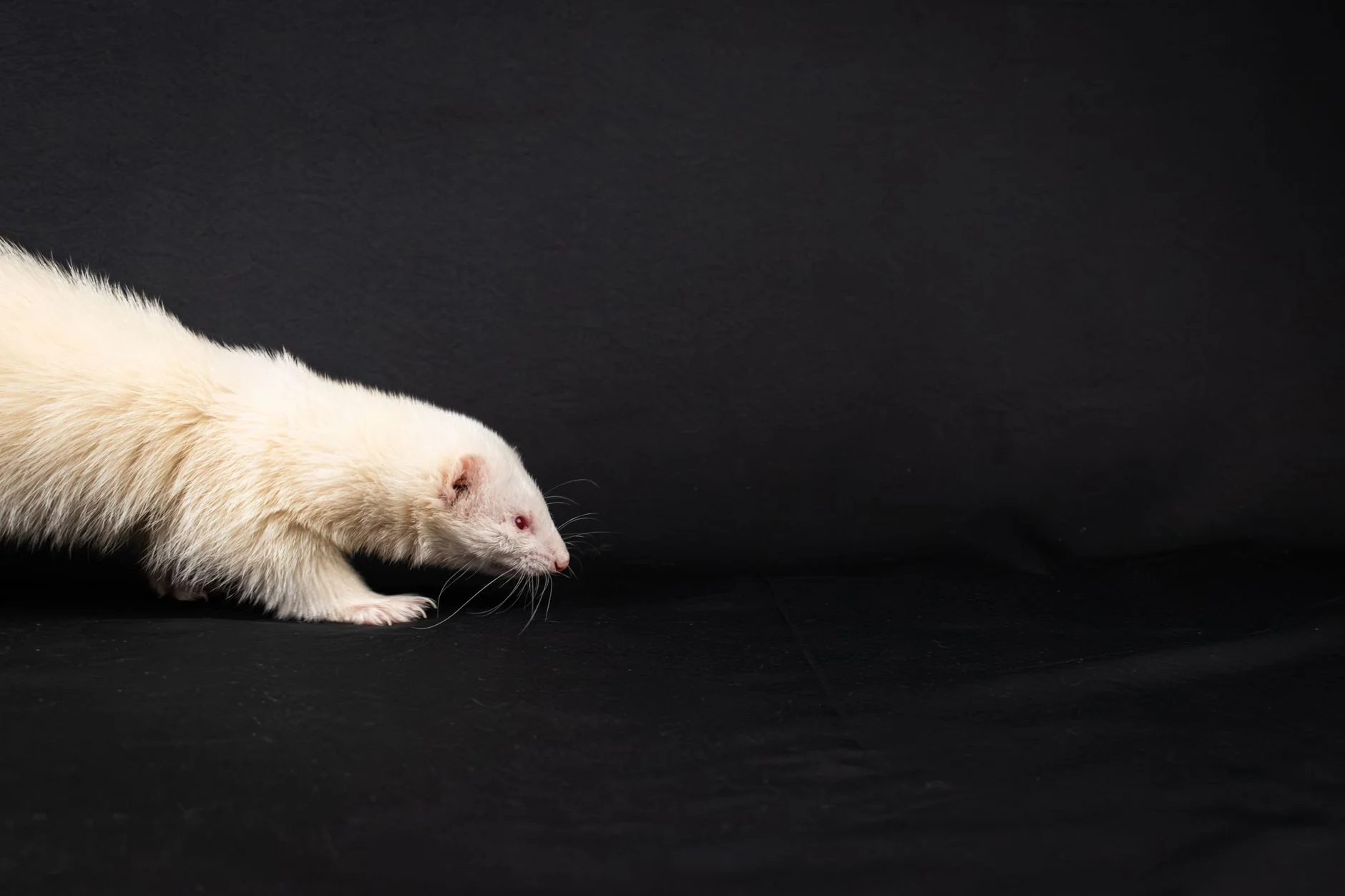
Albino laboratory rats and mice, and pet animals such as albino rabbits and ferrets, come from long lines bred in captivity. Their owners need to remember their eyes: albino pets are best kept away from strong, direct sunlight.
Protecting albino animals
An albino animal is not a separate species, so it does not have its own conservation status. The best way to help albino animals is to protect the whole population and its habitat. Good rules of thumb:
- Keep your distance – crowds and boats chasing a rare white animal stress it and can drive it from feeding areas.
- Never try to catch or feed a wild albino animal, however tempting.
- Report sightings with a photo, date and place to a local wildlife or bird-recording group.
- Support habitat protection: albinism is rare, but every albino animal depends on a healthy population of its own species.
Record-breakers come in all forms – if you enjoy unusual animals, our guide to the largest animals in the world covers the giants, including the humpback’s bigger relative, the blue whale.
Frequently asked questions about albino animals
What causes albinism in animals?
Albinism is caused by an inherited mutation in a gene needed to make melanin, most often the TYR gene, which codes for the enzyme tyrosinase. Without working tyrosinase the animal’s pigment cells cannot turn the amino acid tyrosine into melanin, so its skin, fur, feathers or scales and eyes are left white or very pale.
Is albinism dominant or recessive?
Albinism is recessive. An animal must inherit two faulty copies of the gene, one from each parent, to be albino. Animals with one faulty copy are carriers: they look completely normal but can pass the allele on. Two carrier parents have a 1 in 4 chance of an albino baby each time.
What is the difference between albinism and leucism?
In albinism the pigment cells are present but cannot make melanin, so the whole body and the eyes lack pigment and the eyes look pink, red or very pale. In leucism the pigment cells are missing from the skin, fur or feathers, so the animal is white or patchy but keeps normal dark eyes.
What is isabellinism?
Isabellinism is a type of pigment dilution in which an animal still makes melanin, but much less than normal. Dark areas fade to a washed-out greyish-yellow or pale fawn colour instead of disappearing completely. It is best known in penguins, where isabelline birds look sandy-brown instead of black and white.
Why do albino animals have red eyes?
Albino animals often have pink or red eyes because their irises lack melanin and are partly see-through. The colour comes from blood vessels inside the eye showing through. Not every albino has red eyes, though: Snowflake the gorilla had light blue eyes and Migaloo the whale has brown-looking eyes.
How rare are albino animals?
Albino animals are rare, but the rate varies widely. Mammal experts quoted by the National Wildlife Federation estimate roughly 1 in 10,000 mammal births. A 2023 Australian study found about 1 in 3,300 bush rats were albino, yet on isolated Barrow Island about 1 in 50 (≈2%) rakali were, because of low genetic diversity.
Do albino animals survive in the wild?
Some do, but survival is hard. Albino animals usually have poor eyesight, burn easily in sunlight and lack camouflage, so predators find them and they find less food. Many struggle to attract mates. Albinos survive best where light, predators or colour matter less, such as dark caves, protected parks or captivity.
Is Migaloo the white whale still alive?
Nobody knows for certain. Migaloo, an albino male humpback first seen off Byron Bay in 1991, was last confirmed by photograph in 2020. Unconfirmed reports of a white humpback came from New Zealand in 2025 and New South Wales in 2026, so he may still be alive, but none has been proven.
Was Snowflake the only albino gorilla?
Snowflake is the only albino gorilla ever known. He was captured in Equatorial Guinea in 1966 and lived at Barcelona Zoo until he was put to sleep because of skin cancer in 2003. A 2013 genome study showed his albinism came from an SLC45A2 mutation inherited from both parents, who were probably closely related.