
Is the internet dead? No. The "Dead Internet Theory" is a conspiracy theory claiming that most online activity is now bots and automated content, with real people squeezed out. The measurable parts are real: bots make up roughly half of web traffic and AI-written content is growing fast. But the claim that humans have been replaced, or that someone planned it, has no solid evidence behind it.
What is the Dead Internet Theory?
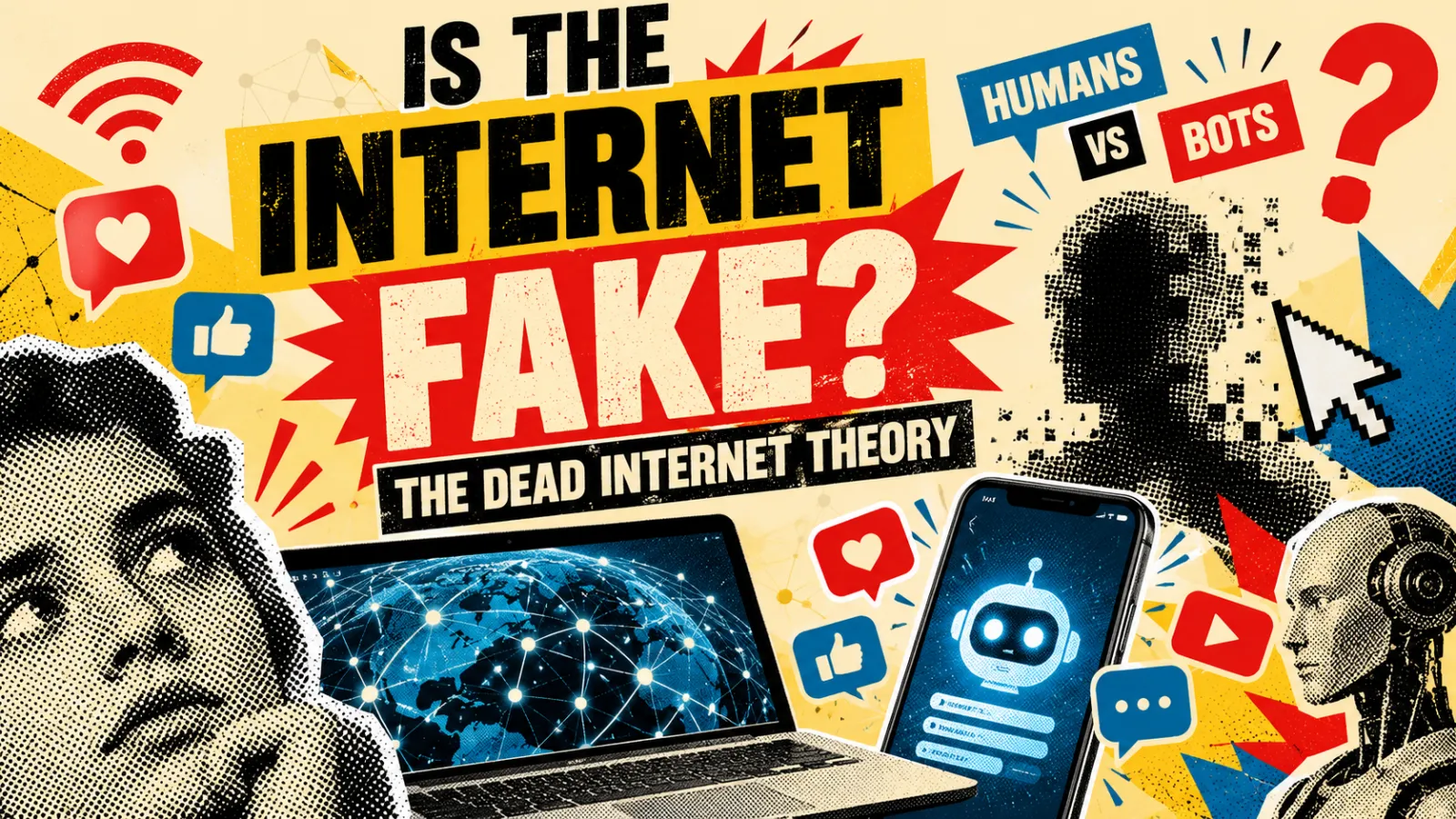
The Dead Internet Theory says that the internet, or at least the social web, "died" at some point in the past decade and is now filled mainly with bot accounts, auto-generated posts and content curated by algorithms. In this picture, the comments, likes and viral posts you see are mostly not made by people, so you are talking to machines without knowing it.
Notice that this is really two separate ideas packed into one name. The first is an observation: automation and algorithms have a huge influence on what we see online. The second is an accusation: that governments, companies or some other group are doing this on purpose to control or manipulate the population. The first has plenty of supporting data. The second is the part that makes it a conspiracy theory, and it is the part that is not backed by evidence.

This article keeps the two apart. We will look at what believers claim, where the idea came from, which parts can be measured, and what scientists and security researchers have actually found. If you are studying how networks work, our guide to computer networks gives the background for how traffic reaches websites in the first place.
Where did the Dead Internet Theory come from?
Nobody can point to a single starting moment, because the idea grew in anonymous online communities that leave little academic record. According to Wikipedia's summary of the research, the earliest posts are thought to have appeared on the imageboard Wizardchan. The idea then spread in 2021 through a long forum post titled "Dead Internet Theory: Most Of The Internet Is Fake", written by a user calling themselves "IlluminatiPirate" on the Agora Road's Macintosh Cafe forum.
That post leaned on an earlier article in New York magazine, published in 2018, called "How Much of the Internet Is Fake? Turns Out, a Lot of It, Actually". The magazine piece was about real fraud: fake clicks, fake views and fake accounts used to make advertising look more valuable than it was. The forum post took that real problem and went much further, claiming that the US government was running an AI-powered campaign to deceive the whole world. That final claim is the "thesis" of the original post, and no evidence for it has been produced.
The theory reached a wider audience in 2021, when The Atlantic published "Maybe You Missed It, but the Internet 'Died' Five Years Ago". The article treated the idea as a feeling worth discussing rather than a proven fact. It quoted the researcher Caroline Busta, who called the conspiracy part a "paranoid fantasy" while agreeing with the broader worry about bots and the state of the web.
Weak and strong versions of the theory
Researchers who have studied the idea describe it on a scale. A 2025 book chapter on disinformation research, summarised on Wikipedia, separates a "weak" version from a "strong" one. The weak version says a group of powerful people use bots to steer public conversation. The strong version goes much further: it says society collapsed after some catastrophe, and an entity (aliens or a super-intelligent AI, in the wildest tellings) keeps everyone connected to hide it. Neither has any credible evidence behind it.
A third form is more modest. In 2026, the computer scientist Hal Berghel described a "leaner" version "stripped of paranoia, prejudice, politics and polemic". It focuses only on a few observable things: algorithmically generated content, the by-products of generative AI, the difficulty some people have telling human and machine text apart, and the mistrust and misinformation that follow. This leaner version is far easier to defend, because it makes no claim about who is behind it or that humans have vanished.
Why does the Dead Internet Theory feel true?
Even people who reject the conspiracy often say the web "feels emptier" than it used to. There are several real reasons for that feeling, and it helps to separate them from the theory.

- Repetitive posts. Platforms reward whatever gets clicks, so the same jokes, templates and trends are copied thousands of times. Copying looks robotic even when people did it.
- Odd engagement. Strange posts can collect huge numbers of likes and comments. In 2024, AI-made pictures on Facebook, including the widely shared "Shrimp Jesus" images, picked up thousands of comments saying "Amen", which looked like automated or mass-copied replies.
- Algorithmic feeds. What you see is chosen by ranking systems, not by a simple timeline of people you follow. That means two users can have very different experiences and both feel "something is off".
- Search results full of filler. In 2024 Google said its results were being flooded with sites that "feel like they were created for search engines instead of people", and acknowledged that generative AI had helped content like this spread.
- Bots admitted by the platforms themselves. A relaunch of the news site Digg in January 2026 was shut down two months later, with the owners citing an "unprecedented bot problem".
The social side of this topic is also covered in our essay on the importance and disadvantages of social media, which is useful reading for exam essays on online life.
What the numbers say: how much of the internet is bots?
The strongest real-world fact behind the theory comes from the security company Imperva, now part of Thales. Each year it publishes a Bad Bot Report built from traffic across its customers' websites. The 2025 edition, covering traffic in 2024, found that automated traffic accounted for 51% of all web traffic, just over half. Human activity was about 49%. Later industry measurements suggest that bots still make up more than half of traffic.
| Report | Data year | Automated traffic | Note |
|---|---|---|---|
| Imperva 2024 report | 2023 data (report published 2024) | 49.6% | Rise partly linked to AI models scraping the web |
| Imperva 2025 report | 2024 data | 51% | Bad bots about 37% of all traffic |
At first glance, "more than half of traffic is bots" sounds like proof that the internet is dead. But read the figure carefully, because it measures something narrower than the theory claims.
Bot traffic is not the same as bot content or bot people
- Traffic is not posts. A bot can load a page thousands of times without writing a single comment. Traffic counts requests, not who is speaking on social media.
- Not all bots are bad. Search engine crawlers, uptime monitors and accessibility tools are bots too. The report separates "bad bots", which Imperva put at about 37% of all traffic in its 2025 report, from automated traffic overall.
- Machines have always talked to machines. Software updates, app refreshes and data feeds all run without anyone clicking. A bot-heavy web does not mean fewer human conversations.
- The sample is limited. The figures come from Imperva's network, not from every site on Earth.

So the honest reading is this: by volume of requests, automation now slightly outweighs humans on the sites Imperva measures. That fits the "leaner" version of the theory. It does not show that people have been replaced, and it says nothing about a plan.
How much online content is written by AI?
This is where growth really is dramatic. After ChatGPT became public in late 2022, anyone could produce articles, product reviews and social posts in seconds. A 2025 analysis by the SEO company Graphite (a company study, not peer-reviewed; a later update revised its estimates slightly lower) looked at 43,000 web addresses from the Common Crawl archive and used an AI detector to classify articles. It found that the number of AI-generated articles published online passed human-written ones in November 2024.
Two details in that study matter for a balanced view. First, the AI share rose to roughly 39% within a year of ChatGPT's launch and then stayed relatively stable over the following 12 months, rather than climbing towards 100%. Second, those AI articles largely did not show up in Google results or in ChatGPT answers, which suggests search systems are filtering much of it out. The study is from a company, not a peer-reviewed journal, and AI detectors are imperfect: this one wrongly flagged 4.2% of articles written before ChatGPT existed.
If you want to see what AI writing tools can and cannot do, read our overview of AI in writing assistance.
Spam, SEO farms and fake engagement
Not all of the "dead" feeling comes from AI. Spam is as old as email, and several long-running businesses make money from fake attention.

- SEO farms. Websites built to rank in search engines, not to help readers. They stuff pages with keywords and copy from each other. Generative AI makes them far cheaper to run, which is exactly what Google described in 2024.
- Click and view fraud. The 2018 New York magazine article that inspired the original forum post was about fake traffic and fake views used to make adverts look more valuable.
- Engagement bots. Accounts that like, share or follow so that a post looks popular. Platforms use popularity as a signal, so fake popularity can push a post in front of real people.
- Streaming fraud. In June 2025 the music service Deezer estimated that as much as 70% of streams of AI-generated tracks on its platform were fraudulent.
- Scams. Fake accounts are often used to build trust before asking for money or passwords. Our guide on how to prevent a phishing scam explains how to recognise these tricks.
All of these are real, documented problems. None of them requires a secret government plan. They are explained more simply by incentives: where attention equals money, people and companies build tools to manufacture attention.
When platforms and executives admit there are bots
The theory gets extra attention when well-known figures comment on it. In September 2025, OpenAI's chief executive Sam Altman wrote on X that he had never taken the dead internet theory very seriously, but that there seemed to be many accounts run by language models. In January 2025, a Meta executive, Connor Hayes, said the company expected AI characters to exist on its platforms "in the same way that accounts do", with bios and profile pictures. The accounts that appeared were quickly removed.
These are statements about growing AI activity, which supports the leaner version of the theory. They are not statements that the web is controlled by bots, and the companies involved still depend on real human users to make money.

Imperva reports that automated traffic was 51% of web traffic in 2024. Give two reasons why this does not prove most internet users are bots. (2 marks)
Traffic counts requests to websites, not people or posts. Automated traffic includes useful bots such as search engine crawlers. The data also comes from one company's network. Any two of these gain the marks.
Why might a sample of 43,000 web addresses analysed by an AI detector not give a perfect measure of AI-written content? (2 marks)
Detectors make errors (the detector in the Graphite analysis wrongly flagged 4.2% of pre-ChatGPT articles), and a sample may not represent the whole web.
Model collapse: can AI poison its own supply of data?
One of the most interesting scientific questions linked to the theory is what happens when AI learns from the internet and the internet fills with AI. In July 2024 the journal Nature published a paper by Ilia Shumailov and colleagues (Shumailov, Shumaylov, Zhao, Papernot, Anderson and Gal) called "AI models collapse when trained on recursively generated data" (Nature, volume 631, pages 755–759).
The researchers repeatedly trained models on text or images created by earlier models. They found that indiscriminate use of model-generated content in training causes irreversible defects in the resulting models, in which the "tails" of the original content distribution disappear. In plain English, the rare, unusual and minority examples vanish first, and the output becomes blander and more repetitive. They named this effect model collapse and showed it in large language models and in two simpler kinds of model.
The authors described an early stage, where the model loses information about the rare cases while still seeming to work fine, and a late stage, where it loses most of its performance and confuses concepts. They also argued that data about genuine human interactions will become increasingly valuable as AI text fills the web.

Is model collapse a looming disaster?
Not necessarily. Other researchers have disagreed with the worst-case reading. They found that if AI-generated data piles up alongside the original human data rather than replacing it, collapse is avoided. Developers can also filter or label AI-generated text. So the real-world effect is still debated, and it is wrong to treat the 2024 paper as proof that the internet is doomed.
What the paper does support is a modest idea: genuine human writing, photos and data are valuable, and that is an argument against a "dead" internet, not for one. AI companies need real people to keep producing new material.
So why is the internet not dead?
The best evidence against the "dead" claim is how many humans are online. The International Telecommunication Union (ITU), the United Nations agency for information technology, publishes global figures every year. In its Measuring digital development: Facts and Figures 2025, it reports that almost three-quarters of the world's population are now online, which is about 6 billion people. About 2.2 billion people remain offline, most of them in low- and middle-income countries.
That matters for two reasons. First, billions of real people are connecting through phones and computers for messaging, banking, learning and work, none of which is bot activity. Second, the ITU says progress is slowing, with most of the remaining offline population in poorer countries, so the picture is one of a still-growing human audience. A web "emptied of humans" does not match those numbers.
Theory versus evidence
| Claim | What the evidence shows | Verdict |
|---|---|---|
| Bots make up a large share of web traffic | Imperva: 51% in 2024 data | Supported, with caveats |
| AI-written content is growing | Graphite: AI articles passed human articles in Nov 2024, then levelled off | Supported, from one company study |
| Fake engagement exists | Click fraud, fake streams, bot accounts documented | Supported |
| Most internet users are bots | ITU counts about 6 billion human users | Not supported |
| Governments run it as a plan | No credible evidence offered | Unproven conspiracy claim |

How to spot bots and AI-generated content
You cannot be sure about any single post, and AI detectors make mistakes, so use clues together. Treat them as reasons to slow down, not as proof.
- Check the source: is it a reliable, trusted website?
- Question the account: new, empty, or full of generic comments?
- Look for original information: can you find the first source?
- Be aware of AI content: odd details in images, vague text?
- Do not confuse viral with true: popular is not the same as accurate.
Signs of a fake account
- A profile created very recently with thousands of posts, or a long list of followers who also look empty.
- A stock-style or AI-made profile photo, and a bio full of generic phrases.
- Posting at all hours, with very similar replies on many different topics.
- Pushing links or asking for money, passwords or personal details. For help here see why critical thinking is important.
Signs that text or images may be AI-generated
- Smooth, generic wording that says little and never gives a source.
- Confident statements with no names, dates or links to check.
- Images with odd details such as extra fingers, garbled text or objects that merge into each other.
- Many near-identical pages on a site, all targeting similar search phrases.
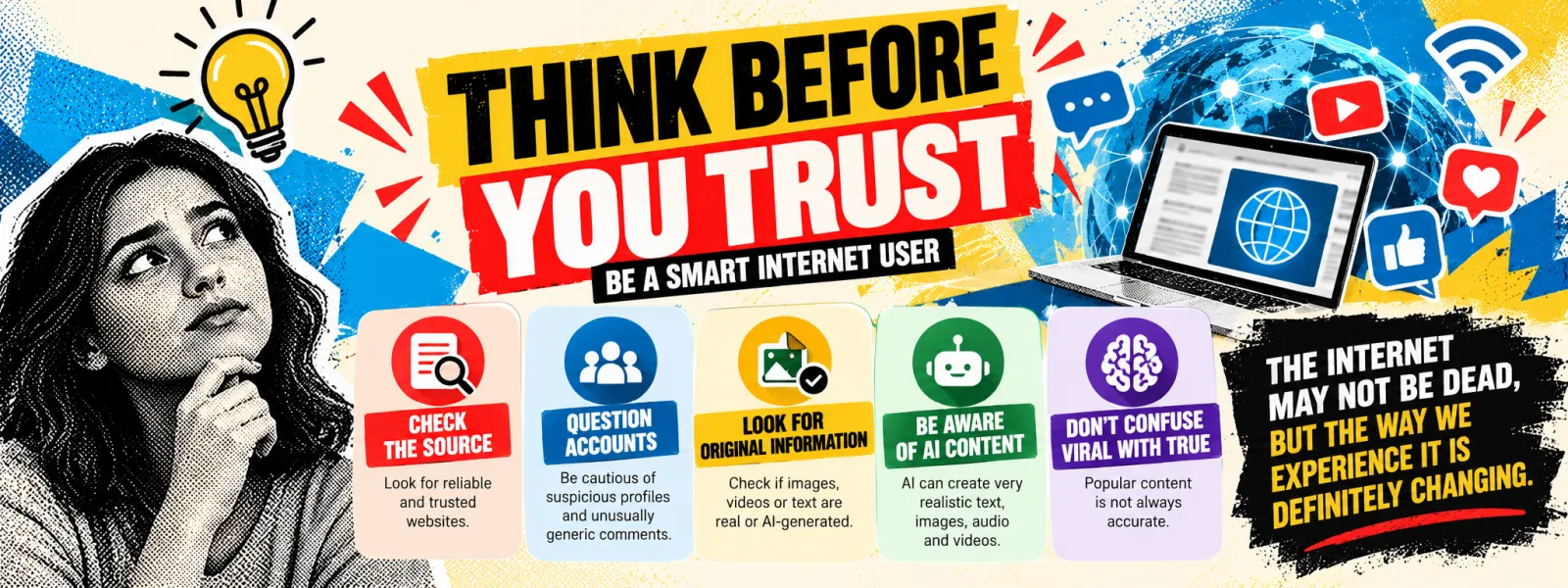
A clue is only useful if you test it. A real person can have a new account, and a bot can have a convincing photo. Look for patterns across several posts, search for the original source of a claim, and check whether a trusted organisation reports the same thing.
What is the real problem, and what can you do?
If the theory is wrong about humans disappearing, is there still something to worry about? Yes, but it is a different problem. The risk is not that nobody is left. It is that it is getting harder to know who or what you are dealing with, and that cheap automation can bury useful information under filler.
The ideas below are the ones most often discussed by researchers and commentators, and they are good topics for computing or citizenship essays.
- Labelling. Platforms could mark AI-generated posts and automated accounts so that people can tell what they are reading.
- Detection tools. Software can spot patterns in text, images and behaviour, though it makes mistakes both ways. Even the Graphite analysis's detector wrongly flagged 4.2% of pre-ChatGPT articles.
- Verification. Some services want proof that an account belongs to a real person. This raises privacy questions, because proving you are human can mean sharing more about yourself.
- Better search ranking. Search engines can demote pages made mainly for ranking. Google's 2024 comments show that it sees this as its job.
- Media literacy. Teaching people to check sources is the most reliable defence, because it works whatever technology is used. Our articles on critical thinking and science education explain the skills involved.
Will jobs and skills change?
Automation affects careers as well as feeds. If you are wondering how to prepare, our guide on how to make your career AI-proof looks at skills that are harder to automate. Students taking computing courses can also use the IGCSE computer science overview to see where topics like networks and data fit.
The balanced verdict
The Dead Internet Theory works because it is built on a true core: bots, spam and AI-generated content are real and growing. It fails where it makes two extra claims, that humans have already been replaced and that someone coordinated it. The best-supported summary is the one on our infographic: automation and AI-generated content are real, algorithms strongly shape what we see, and fake accounts exist, but there is no solid evidence that the internet is controlled by bots or that real human interaction has ended.
The internet is changing, and the way we experience it is changing too. That is a reason to learn how to check what you read, not a reason to believe a conspiracy.
Frequently asked questions about the Dead Internet Theory
What is the Dead Internet Theory?
It is a conspiracy theory claiming that most online activity is now produced by bots and algorithms rather than people. The strong version also says governments or companies did this on purpose. The idea that bots and AI content are growing is measurable, but the claim of a coordinated takeover has no credible evidence.
Is the internet really dead?
No. The ITU reports that almost three-quarters of the world's population, about 6 billion people, use the internet. Bots and AI-generated content are a growing part of it, but humans are still online in huge numbers. "Dead" is a dramatic way of describing a real change in how content is made.
Who started the Dead Internet Theory?
No single person can be named for certain. Early posts are thought to have appeared on the imageboard Wizardchan, and a 2021 post by a user called "IlluminatiPirate" on the Agora Road forum spread the idea. The Atlantic then wrote about it in 2021.
What percentage of the internet is bots?
Imperva's 2025 Bad Bot Report found that automated traffic was 51% of web traffic in 2024, just over half. This counts requests to websites on Imperva's network, including useful bots like search crawlers. It does not mean that 51% of posts or users are bots.
Is most online content written by AI?
Not clearly. A 2025 analysis by the SEO company Graphite of 43,000 web addresses (a company study, not peer-reviewed; a later update revised its estimates slightly lower) found AI-generated articles passed human-written ones in November 2024, but the share then levelled off. It is one company's study using a detector that makes errors, and such articles largely did not appear in Google or ChatGPT answers.
What is model collapse?
Model collapse is the loss of quality when AI models are trained on content made by earlier models. A 2024 Nature paper by Shumailov and colleagues showed that rare examples disappear first and outputs become blander. Some researchers say collapse can be avoided if human data is kept alongside AI data.
How can I tell if an account is a bot?
Look for several clues together: a very new account with lots of posts, a generic or AI-made photo, repetitive replies on many topics, odd posting hours, and links or requests for money. No single sign is proof, because real people sometimes look the same, so check the original source of any claim.
How can I tell if a text or image is AI-generated?
Look for generic wording, missing sources, and images with garbled text or strange hands. AI detectors can help but they make mistakes in both directions. A better habit is to check where information comes from and whether trusted organisations report the same thing.
Is the Dead Internet Theory true?
Parts are true and parts are not. Bots, fake accounts and AI-generated content exist and have grown. There is no evidence that humans have been replaced or that the web is controlled by a hidden plan. Researchers describe a "leaner" version that drops the conspiracy and keeps the observable trends.
Why does the internet feel fake?
Algorithms push whatever gets clicks, so similar posts get repeated. Search results contain filler made for ranking, fake engagement makes some posts look more popular than they are, and AI images can go viral. Together these make the web feel less human even though billions of people still use it.