Why is motivation important at work? Motivation sets how much effort people put in, what they aim at and how long they keep going when a job gets hard. In Gallup's survey data for 2025, only 20% of employees worldwide were engaged at work, and Gallup estimates that low engagement costs the global economy about $10 trillion a year. This guide sticks to what research can actually support, and it dates every figure.

What is motivation at work?
Psychologists describe motivation by three features: direction (what you choose to work on), intensity (how hard you try) and persistence (how long you keep going). A person can be skilled and well paid and still score low on all three, which is why managers care about it.
Three words get mixed up in articles on this topic, so it helps to separate them.
- Motivation is the drive to act on a task or goal.
- Job satisfaction is how positively you feel about your job.
- Engagement is a measured state of involvement and enthusiasm. Gallup's surveys count someone as engaged if they are highly involved in, and enthusiastic about, their work and workplace.
They overlap, but they are not the same. Someone can be satisfied and coasting, or stressed and still highly driven. When you read a statistic, check which of the three it measures.
Motivation also is not one thing. A common older claim says it has "three main components" and splits into "intrinsic–extrinsic" and "autonomous–dependent" types. That is not a recognised model. The best-supported modern picture, self-determination theory, treats motivation as a spectrum from controlled to autonomous, and we cover it in the next section of this guide. If you work in the public sector, our separate guide on motivation in public-sector innovation looks at that setting in detail.
Workplace motivation by the numbers: Gallup 2026
Gallup publishes the largest regular survey of engagement. Its State of the Global Workplace report, released in 2026, uses data collected during 2025 from 263,810 respondents (141,444 of them employed) in 140+ countries and territories. These are the headline figures.
| Measure | Figure | Year of data |
|---|---|---|
| Employees engaged worldwide | 20% (down from 21% in 2024 and a high of 23% in 2022 and 2023) | 2025 |
| Not engaged | 64% | 2025 |
| Actively disengaged | 16% | 2025 |
| Region with lowest engagement | Europe, 12% | 2025 |
| US and Canada | 31% | 2025 |
| Managers engaged | 22% (down 9 points since 2022) | 2025 |
| Employees thriving (life evaluation, Gallup Life Ladder) | 34% of employees (56% struggling, 9% suffering) | 2025 |
| Estimated cost of low engagement | About $10 trillion, around 9% of global GDP | 2025 |

Engagement also differed by where people worked. Fully remote employees were 30% engaged, hybrid 25%, on-site workers who could work remotely 24%, and on-site workers whose jobs cannot be done remotely 17%.
Even so, the direction is clear. In 2025, fewer than one worker in four said they were fully engaged. That means most workplaces have a large amount of untapped effort and interest, and motivation research tries to explain how to reach it.
What is high motivation linked with?
Two large analyses help here. Both show links, not proof of cause, but they are better than anecdotes.
Gallup's 2024 meta-analysis pooled 736 studies across 347 organisations in 53 industries, covering 183,806 business or work units and 3,354,784 employees. Teams in the top quarter for engagement had 23% higher profitability than teams in the bottom quarter. Engagement was related to all 11 outcomes studied, including lower turnover and lower absenteeism. Because the study is observational, it cannot show that engagement caused the profit gap. Well-run teams may simply be more engaged.

A separate meta-analysis by Judge, Thoresen, Bono and Patton (2001) combined 312 samples, with about 54,000 people. It found an average corrected correlation of about .30 between job satisfaction and job performance. In plain terms, that is a real but moderate link. Satisfied people tend to perform somewhat better on average, but plenty of satisfied workers perform poorly and plenty of dissatisfied ones perform well.

So why is motivation important at work, if the links are only moderate? Because it is one of the few factors that a manager and a team can change cheaply, and because the other end of the scale is costly. Low motivation shows up as people leaving, taking time off or doing the minimum, and the following sections of this guide explain which theories have survived scrutiny and how to use them. For a wider view of what psychology says about thriving, our positive psychology facts are a good companion read.
Self-determination theory: what drives motivation at work
Self-determination theory (SDT) is the most widely tested modern framework. It was developed by the psychologists Edward Deci and Richard Ryan and set out in a well-known 2000 paper in American Psychologist. Its central claim is that people have three basic psychological needs, and that work which meets them produces better-quality motivation.
- Autonomy: feeling that you have a say in how and why you do something, rather than being pushed.
- Competence: feeling that you are good at what you do and are getting better.
- Relatedness: feeling connected to, and valued by, the people you work with.

SDT also replaces the simple "intrinsic or extrinsic" split with a spectrum. At one end is controlled motivation, where you act because of pressure, guilt or reward. At the other is autonomous motivation, which includes real interest in the task and also things you have come to accept as your own, such as caring about a patient's recovery even when the paperwork is dull.
Gagné and Deci (2005), writing in the Journal of Organizational Behavior, applied the theory to workplaces. They argued that autonomous motivation helps with interesting, complex tasks and also with duller tasks that need discipline. That is a useful point for managers: not every job can be made exciting, but most can be made more understandable and more self-directed.

Do rewards kill motivation?
Many articles say that pay and bonuses destroy motivation. The evidence is more careful than that. In 1999, Deci, Koestner and Ryan published a meta-analysis of 128 experiments in Psychological Bulletin. They found that expected tangible rewards, such as money or prizes offered for doing, finishing or doing well at a task, reduced people's later free-choice interest in that task. The effect sizes were d = −0.40, −0.36 and −0.28 for engagement-, completion- and performance-contingent rewards. Verbal rewards, such as sincere positive feedback, maintained or raised interest.
The studies mostly looked at tasks that people already found interesting. The results are still debated by other researchers. They do not show that pay is unimportant. People need a fair wage, and a rewards system that feels controlling is the risky part, not the existence of pay.
A practical summary for workplaces is this. Pay people fairly so that money stops being the main issue. Then use feedback, trust and meaningful goals to build the motivation that money cannot buy.
Herzberg's two-factor theory
Frederick Herzberg's two-factor theory is probably the most famous idea in workplace motivation. It comes from The Motivation to Work (1959), based on interviews with 203 engineers and accountants in the Pittsburgh area. Using the critical incident technique, he asked them to describe times when they felt especially good or especially bad about their jobs.
Herzberg concluded that two different sets of factors were at work.
| Type | Examples | What they do, according to Herzberg |
|---|---|---|
| Hygiene factors | Pay, job security, working conditions, company policy, supervision | If poor, cause dissatisfaction. Fixing them removes complaints but does not on its own make people enthusiastic. |
| Motivators | Achievement, recognition, the work itself, responsibility, advancement | When present, produce satisfaction and drive. |
The insight many managers take from this is that "no complaints" is not the same as "motivated". A tidy office and a fair salary stop people being angry. They do not by themselves create pride in the work.
The theory has real weaknesses. Critics argue that the neat split between satisfiers and dissatisfiers is partly an artefact of the interview method, because people tend to credit good events to themselves and blame bad ones on their surroundings. Replications have given mixed results, and the theory ignores individual differences. Modern researchers treat it as a useful rule of thumb that matches later findings about autonomy and competence, not as a law.
Notice how well it fits with SDT. Herzberg's "motivators" such as achievement, responsibility and the work itself are close to competence and autonomy, and his "hygiene" factors are the basic conditions that must be right first. Our guide on growth mindset in teamwork shows how the same ideas apply to group work in school.
Maslow's hierarchy at work: popular, but weakly supported
Abraham Maslow's "A Theory of Human Motivation" (1943) listed five groups of needs: physiological, safety, love and belonging, esteem, and self-actualisation. Almost every management course shows them as a pyramid. Maslow did not draw that pyramid. It was added later, in a 1960 article by the consultant Charles McDermid.
Maslow also did not say that one level must be 100% complete before the next appears. He described needs as being met in decreasing percentages as you move up. The strict "staircase" version is what the evidence challenges.
- A 1976 review by Wahba and Bridwell found little evidence for the specific ranking of needs.
- Tay and Diener (2011) analysed Gallup World Poll data from 123 countries. Meeting a wide range of needs, including basic needs, safety, social support, respect, mastery and autonomy, was linked to wellbeing everywhere. However, the order in which needs were met had little bearing on how much they contributed to wellbeing.
What survives is a sensible reminder for employers: people need security, belonging, respect and a chance to grow, and ignoring any of them costs motivation. That list overlaps with the three needs in self-determination theory, which has the stronger research behind it.
Goal-setting theory: the best-evidenced motivation tool
If one theory deserves the most trust in a workplace, it is probably goal-setting theory. Edwin Locke and Gary Latham summarised 35 years of research in American Psychologist in 2002. Their core finding is that specific, difficult goals lead to higher performance than easy goals or vague instructions such as "do your best".

Goals work through four routes: they focus attention, increase effort, raise persistence and encourage people to find better strategies. The effect depends on conditions.
- Commitment: people must accept the goal. Commitment is higher when people understand why a goal matters, and when they have some say in it.
- Feedback: without information on progress, people cannot adjust their effort.
- Ability and resources: a hard goal is not helpful if someone lacks the skills or tools to reach it.
- Task complexity: on new and complex tasks, goals that focus only on results can push people to cut corners, so goals about learning and strategy work better.
Why might a "do your best" target be less motivating than a specific one? (2 marks)
It gives no clear standard, so people can judge their own effort leniently (1). A specific, challenging goal tells them exactly what to aim at and lets them check progress (1).
Name two conditions that must be present for a difficult goal to improve performance. (2 marks)
Any two of: commitment to the goal, feedback on progress, enough ability or resources, and (for complex tasks) a focus on learning strategies.
For individuals, the same principle applies. Setting targets you can accept and measure is easier than it sounds, and our guides on having realistic goals and achieving goals with minimum stress explain how to do it without burning out.
What the UK evidence says: the CIPD Good Work Index
The Chartered Institute of Personnel and Development (CIPD) runs an annual survey of job quality in the UK. The most recent edition with figures we have checked is the 2025 report, the eighth wave, based on 5,017 UK workers surveyed between 8 January and 12 February 2025. We quote only 2025 figures; check the CIPD site for later editions.

The 2025 findings that matter most for motivation are about managers and workload.
- About a quarter of workers, an estimated 8.5 million people, said work harmed their health: 25% said their mental health and 24% their physical health.
- The strongest factors linked to unhealthy work were excessive workloads, excessive pressure, poor relationships with colleagues and poor line management.
- 69% of workers said their line manager was open and approachable on issues such as mental health, up from 63% in 2023.
- Only 60% said managers had the training and information they needed to manage well, and 59% said they had the time.
- In the same survey, workers whose mental health was harmed by work were far less satisfied (37% vs 93%) and less willing to go the extra mile (39% vs 69%).

This matches the theories above. A manager who explains the reasons for tasks, gives feedback and trusts people supports autonomy, competence and relatedness. A manager with no time or training cannot do any of that, however much goodwill they have. The CIPD data are correlations from a survey, so they show where problems cluster, not exactly what fixes them.
How to raise motivation at work, using the evidence
Put the theories together and a few practical rules appear. None of them is a trick. They are conditions that research links with better-quality motivation, so they work best when used consistently over months, not as a one-off morale event.
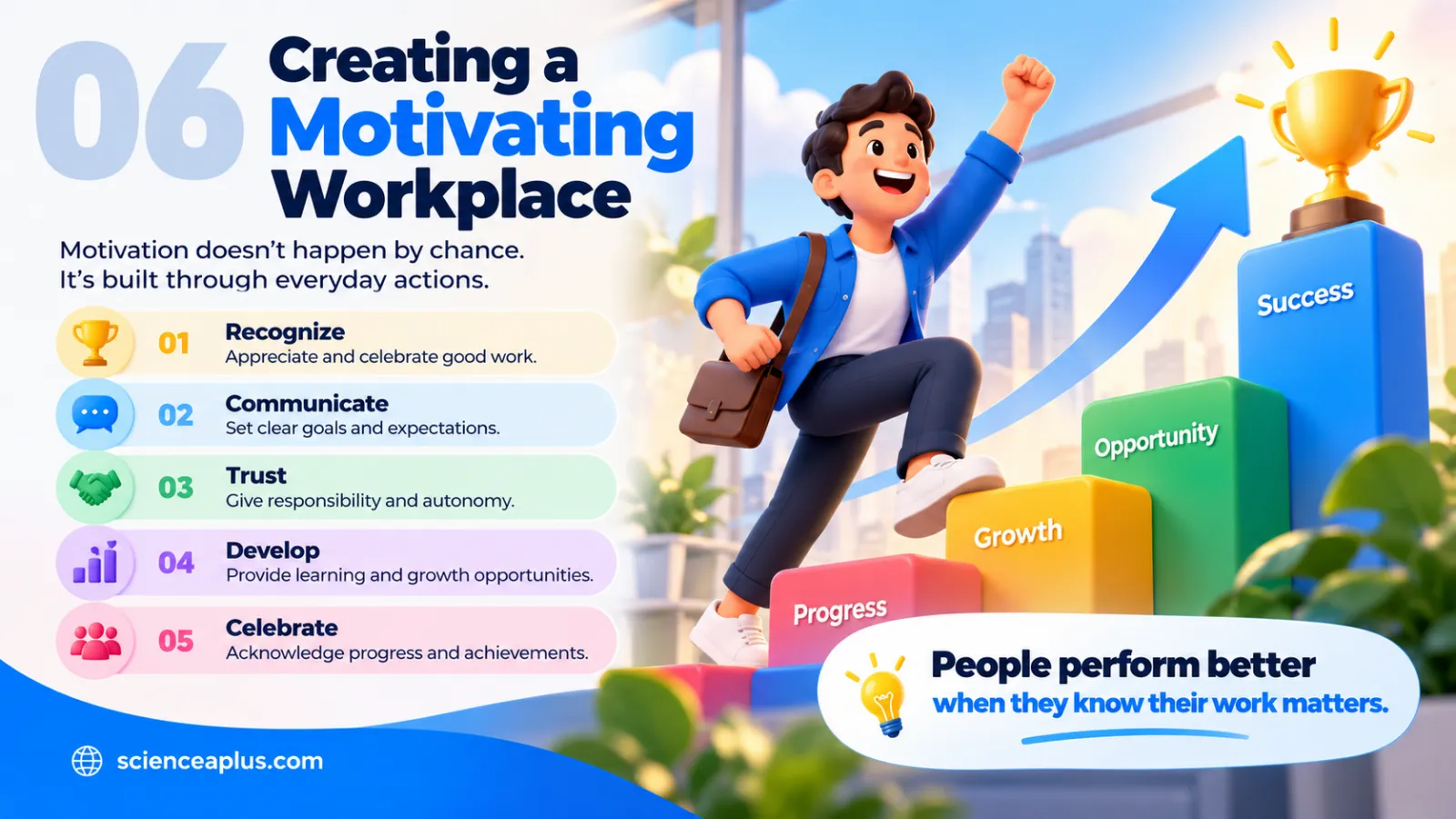
- Pay fairly and fix the basics first. Herzberg's hygiene factors and the CIPD findings on workload both say that unfair pay, poor conditions and constant overload drain motivation. No amount of praise fixes an unmanageable workload.
- Give people clear, specific, challenging goals. Locke and Latham's findings point to goals that people understand, accept and can measure.
- Give regular feedback. Feedback tells people how they are doing and, when it is honest and informative, supports the feeling of competence. Sincere verbal praise was the reward type that kept interest up in the 1999 meta-analysis.
- Build in autonomy. Explain why a task matters and let people choose how to do it where possible.
- Support growth and belonging. Training, new responsibilities and a team where people feel respected cover competence and relatedness.

Here is a short checklist a manager or team member can use. The ticks are saved in your browser.
- Does everyone know their top two or three goals, in specific terms?
- Has each person had feedback on their progress in the last month?
- Do people have a say in how they do their work, where it is practical?
- Is workload realistic, and do people know who to ask if it is not?
- Does each person have a chance to learn something new this year?
- Is good work noticed, specifically and sincerely?
Common obstacles to motivation, and what to do about them
Unclear goals
When people do not know what they are meant to achieve, effort has no direction. Locke and Latham's work suggests the fix is a specific target, agreed with the person, with a way to see progress. A weekly five-minute check-in often does more than a long annual review.
Poor communication
Communication works in both directions. Managers need to listen as well as brief, and the CIPD links poor line management with unhealthy work, so approachability matters.
Personal pressures
Money worries and health problems affect work. In the CIPD's 2025 survey, workers whose mental health was harmed by work were far less satisfied (37% vs 93%) and less willing to go the extra mile (39% vs 69%). A manager cannot solve these problems, but flexibility and a willingness to listen can stop a bad patch turning into disengagement. Persistent low mood is a health matter, and a GP is the right first contact.
A culture that punishes mistakes
If people expect blame for errors, they avoid risks and stop suggesting ideas. Teams do better when mistakes are treated as information. This claim is a common-sense reading of the competence and relatedness needs, not a separate statistic, so treat it as a principle rather than a measured result.
For individuals who struggle to start, our practical guides on what to do when you have no motivation to work, how to stop procrastinating and living with less stress are good next steps.
Frequently asked questions about motivation at work
Why is motivation important in the workplace?
Motivation decides how much effort people give, what they focus on and how long they persist. Gallup found only 20% of employees worldwide were engaged in 2025, and its meta-analysis links high engagement with lower turnover and absenteeism. The evidence is correlational, but the pattern is consistent.
What are the main theories of motivation at work?
The four best known are self-determination theory (autonomy, competence, relatedness), Herzberg's two-factor theory (hygiene factors and motivators), Maslow's hierarchy of needs and goal-setting theory. Self-determination and goal-setting theory have the strongest research support. Maslow's strict ordering has the weakest.
What is the difference between intrinsic and extrinsic motivation?
Intrinsic motivation comes from interest or enjoyment in the task itself. Extrinsic motivation comes from outcomes such as pay, praise or avoiding punishment. Self-determination theory treats them as a spectrum, because extrinsic reasons can become your own once you understand and accept them.
Does money motivate employees?
Fair pay matters, and unfair pay breeds resentment. However, a 1999 meta-analysis of 128 experiments found that expected tangible rewards tended to reduce interest in already-interesting tasks. Money works best as a fair baseline, with feedback, trust and meaningful goals supplying the rest.
Is Herzberg's two-factor theory still valid?
It is still taught because the idea is useful: removing irritations is not the same as creating enthusiasm. Critics say the sharp separation of satisfiers and dissatisfiers partly reflects his interview method, and replications are mixed. Treat it as a rule of thumb rather than a proven law.
Is Maslow's hierarchy of needs proven?
Not in its strict form. A 1976 review found little evidence for the specific ranking, and a 2011 analysis of Gallup World Poll data from 123 countries found that all the needs mattered for wellbeing but the order in which they were met had little effect. The needs themselves remain a useful checklist.
How does goal setting improve motivation?
Locke and Latham found that specific, difficult goals produce better performance than easy goals or "do your best". Goals focus attention, raise effort and persistence, and prompt better strategies. They work best when people accept the goal, get feedback and have the skills and resources to succeed.
What percentage of employees are engaged at work?
Gallup's State of the Global Workplace 2026 report, using data from 2025, found 20% of employees engaged worldwide, 64% not engaged and 16% actively disengaged. Regional engagement ranged from 12% in Europe to 31% in the United States and Canada.
How can managers improve employee motivation?
Evidence points to fair pay and a manageable workload, clear and challenging goals, regular honest feedback, real choice over how work is done, and chances to learn. The CIPD links poor line management with unhealthy work, so good management matters.
What causes low motivation at work?
Common causes include unclear goals, excessive workload and pressure, poor relationships with colleagues, weak line management, unfair pay and a lack of any say in the work. The CIPD's 2025 survey identified workload, pressure, colleague relationships and line management as the strongest factors tied to unhealthy work.