How do you manage stress? You cannot remove every source of pressure, but you can change how your body and mind respond to it. The NHS suggests talking to someone, trying breathing exercises, planning ahead, being active and looking after your sleep. This guide explains what stress is, how to tell healthy stress from the long-term kind, and which everyday habits and UK services can help.
What is stress?
The NHS describes stress as a reaction to mental or emotional pressure, often with a feeling of losing control. It adds that "most people feel stressed sometimes and some people find stress helpful or even motivating". Stress is not a personality flaw, and it is not the same as being weak. It is a normal response that every human body is built to produce.
The body's alarm system is called the fight-or-flight response. When your brain picks up something challenging, such as an exam, a near-miss on the road or an angry message, it signals the adrenal glands to release hormones. Adrenaline acts quickly: your heart beats faster, your blood pressure rises and more energy reaches your muscles. Cortisol follows more slowly and helps make glucose available in the blood.
The nerves and hormones that run this system are the same ones you meet in biology lessons. If you want the science behind it, see the guides to human nervous coordination and to the hypothalamic and pituitary hormones.
This response was useful for our ancestors, who needed to run or fight. Today the triggers are more often deadlines, money worries or arguments, and you cannot sprint away from an inbox. The hormones are still released, but the energy they provide has nowhere to go.
Healthy stress and chronic stress
Stress is not always harmful. A little pressure before a performance or a test can sharpen your focus and give you energy. The problem begins when the pressure keeps going and you have little chance to recover. This is often called chronic stress: stress that continues for weeks or months.
| Short-term (often helpful) | Long-term (chronic) | |
|---|---|---|
| How long it lasts | Minutes to hours, then settles | Weeks or months, with little break |
| Typical feeling | Alert, motivated, focused | Overwhelmed, worn out, on edge |
| Body | Faster heartbeat that settles again | Headaches, muscle tension, stomach problems, poor sleep |
| What helps | A pause, a breath, a short walk | Changing the situation where possible, support, healthy routines, advice from a GP |
Stress is not a medical diagnosis in itself, and this article does not diagnose anything. It can, however, affect how you feel and behave, and it often sits alongside other problems such as poor sleep, low mood or anxiety. If you are worried about how you feel, speak to a GP.
What causes stress?
The NHS lists common causes including pressure at work, unemployment, relationship difficulties, money problems, illness and grief. Big life events can also be stressful even when they are positive, such as buying a home or having a baby. For students, schoolwork, exams and friendships add to the list.
Daily habits also feed the pressure. Poor routines, too little sleep and too little sleep can make small problems feel larger. The graphic below shows the usual suspects and, underneath, the habits that help.
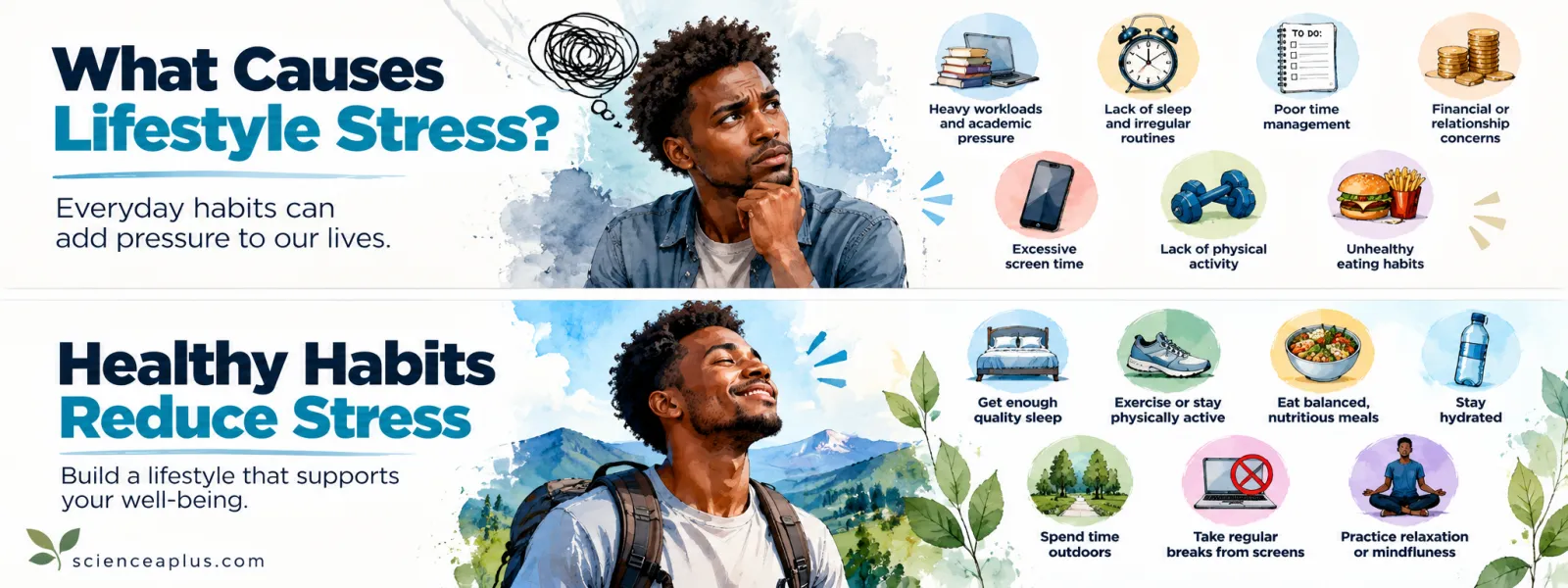
Notice that many causes overlap. A heavy workload leads to late nights, late nights lead to poor sleep, and poor sleep makes the next day's pressure harder to handle. That loop is why changing one small habit, such as a regular bedtime, can sometimes ease several things at once.
Signs of stress to look out for
Stress shows up differently in different people. According to the NHS, signs can be physical, mental or behavioural:
- Physical: headaches, dizziness, muscle tension, stomach problems, chest pain or a faster heartbeat.
- Mental: trouble concentrating or making decisions, feeling overwhelmed, constant worry or forgetfulness.
- In behaviour: irritability, changes in sleep or appetite, avoiding things, or drinking or smoking more.
Many of these signs also have other causes. Chest pain in particular should never be assumed to be stress, so get it checked by a doctor or call NHS 111 for advice.
Why does your heart beat faster when you feel stressed?
Adrenaline released during the fight-or-flight response makes the heart beat faster and raises blood pressure, so that more blood and energy can reach the muscles.
Stress at work and study in Britain
Stress is very common in working life. The Health and Safety Executive (HSE) publishes yearly figures based on the Labour Force Survey, in which people report ill health they think was caused or made worse by work. In its 2025 report, covering the year 2024/25, the HSE estimated that:
- 964,000 workers in Great Britain had work-related stress, depression or anxiety, a rate of 2,770 per 100,000 workers, which was higher than the year before.
- 409,000 of those were new cases.
- 22.1 million working days were lost, an average of 22.9 days for each case.
- Stress, depression and anxiety made up 52% of all work-related ill health and 62% of the working days lost to it.
The HSE's causes data is older (a Labour Force Survey average for 2009/10 to 2011/12), but it still reports the main reasons people give as workload (tight deadlines, too much work or too much pressure or responsibility), with a lack of managerial support, violence and bullying, organisational change and role uncertainty also cited. Over the three years to 2024/25, the highest rates were found in public administration and defence, human health and social work, and education.
The same ideas apply to school and college. A heavy timetable, tight deadlines and unclear expectations are the student version of workload and role uncertainty. The next sections show what you can do about them.
Healthy habits that help you manage stress
Four basic habits do much of the work: how you breathe, how you move, how you sleep and how you eat. None of them is a cure, and none needs special equipment. They work best when they become routine, because the body copes better with pressure when it is rested, fed and active.
1. Slow breathing
When you feel stressed, your breathing becomes quick and shallow. Slowing it down is one of the simplest ways to feel calmer, and you can do it anywhere. Every Mind Matters, the NHS mental health site, says that pausing for a few minutes to breathe can help you feel calmer.

The NHS breathing exercise for stress goes like this:
- Get comfortable. You can stand, sit with your back supported or lie down. Loosen any clothes that restrict your breathing.
- Let your breath flow deep down into your belly, as far as is comfortable, without forcing it.
- Breathe in gently through your nose, counting steadily up to 5. You may not reach 5 at first, and that is fine.
- Breathe out gently through your mouth, counting to 5 again.
- Keep going for at least 5 minutes, and repeat it regularly.
2. Regular physical activity
Every Mind Matters says regular exercise helps to burn off nervous energy, which fits the fight-or-flight picture: the body prepares to move, so moving gives that energy somewhere to go. Many people also find that exercise gives them a break from their worries, though this is general advice rather than an NHS claim.
For adults aged 19 to 64, the NHS recommends at least 150 minutes of moderate-intensity activity a week, or 75 minutes of vigorous activity, plus strengthening exercises for all the major muscle groups on at least two days a week. It suggests spreading activity over four or five days, or doing some every day. Brisk walking counts as moderate activity.
A 30-minute brisk walk on five days a week reaches 150 minutes, so you do not need a gym membership to make a start. Younger people have their own guidelines, so check the NHS pages for your age group.


If you struggle to get going, start small and pick something you enjoy. Our guide on how to motivate yourself to exercise has practical ideas for building the habit.
3. Enough sleep
Stress can make it harder to sleep, and poor sleep makes stress harder to cope with. The NHS says most healthy adults need around 7 to 9 hours a night, although the exact amount differs from person to person. Younger people need different amounts, so check the guidance for your age.

NHS advice for better sleep includes:
- Going to bed and getting up at regular times.
- Keeping your bedroom quiet, dark and a comfortable temperature.
- Avoiding caffeine (including tea, coffee and some fizzy drinks) and alcohol in the hours before bed (Every Mind Matters suggests around six hours; NHS pages vary).
- Avoiding exercise in the four hours before bed, and winding down first.
Our articles on sleep hygiene and mental health and the effects of sleep deprivation cover the topic in more depth. If sleep problems carry on regularly, the NHS advises speaking to a GP.
4. Eating and drinking regularly
The NHS lists changes in appetite as a common sign of stress, so it is worth noticing whether your eating habits have shifted. Regular meals, plenty of water and a balanced mix of food groups are a sensible base.
For more detail, read about why we need a balanced diet. If you reach for sweet snacks when you feel under pressure, how to reduce sugar cravings offers some ideas.
Look after small things every day
People often wait until they are exhausted before they change anything. A better approach is to treat these habits like brushing your teeth: small, regular and not dramatic. Choose one habit from this section, try it for a week, and notice whether you feel any different before adding another.
- I went for a walk or did some activity today.
- I took five minutes to breathe slowly.
- I ate at regular times and drank some water.
- I switched off screens before going to bed.
- I spent a little time with someone I like.
Tick the boxes as you go; your ticks are remembered in your browser on this device.
Time management and stress
Feeling that you have too much to do and too little time is one of the most common sources of pressure for students and workers alike. The NHS lists time management among its suggestions for coping with stress, and Every Mind Matters adds two practical ideas: plan ahead for events you know will be stressful, and break large tasks into smaller, manageable pieces.
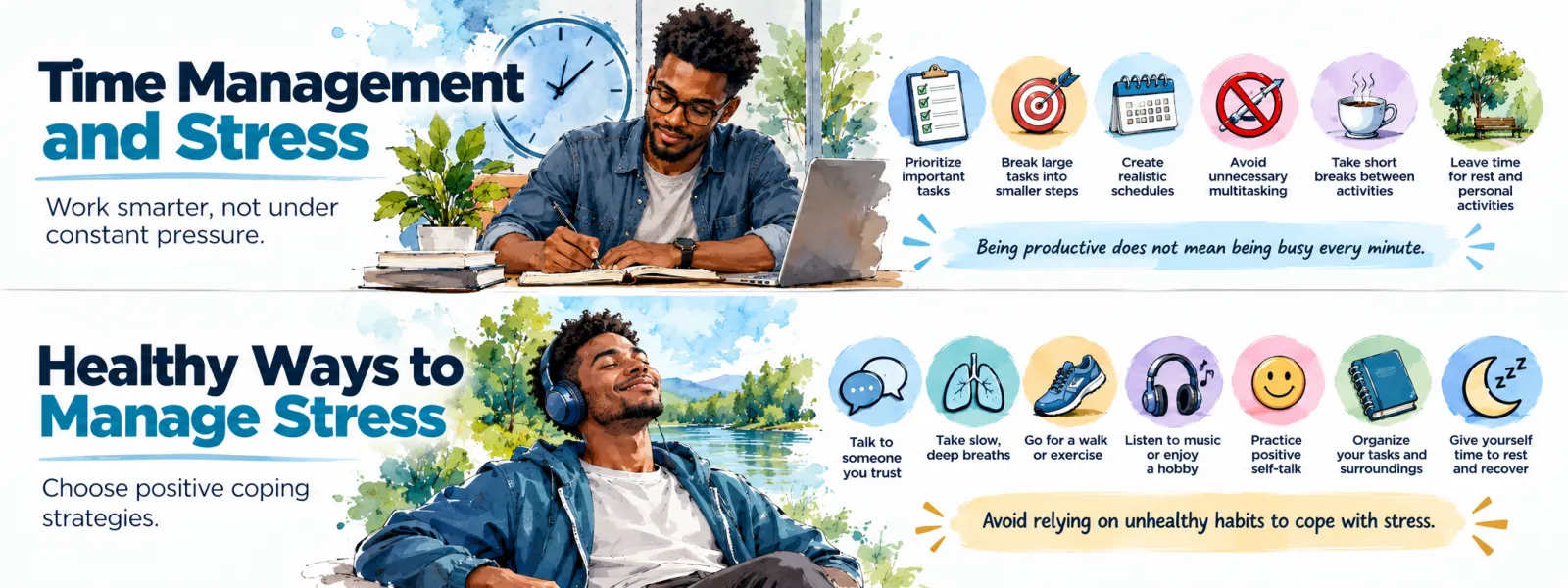
The graphic above turns those ideas into a short routine. Here is how to use it in practice:
- Decide what matters most. Write down everything you need to do, then pick the two or three tasks that must happen today. Everything else can wait or be dropped.
- Break big jobs into steps. "Revise biology" is vague and daunting. "Make a one-page summary of the nervous system" is a task you can finish in one sitting.
- Make a schedule you can keep. A plan that is packed from morning to night will fall apart by Tuesday. Leave gaps for travel, meals and things that go wrong.
- Do one thing at a time. Switching between tasks and notifications makes everything take longer and can feel more tiring than the work itself.
- Take short breaks. Stand up, drink some water or look out of a window between tasks.
- Protect free time. Rest and hobbies are part of the plan, not a reward you earn only after everything else is finished.
Students will find extra study ideas in how to practise and remember what you study and study tips for kinesthetic learners. For a wider look at goals and pressure, see achieving goals with minimum stress.
Being productive does not mean being busy every minute. Rested people often work more clearly than tired ones, and a long list of tasks done badly helps nobody.
Talking to people you trust
Talking is on every list of stress advice, including the NHS page, which suggests talking to friends, family or professionals. Saying a worry out loud can make it feel smaller and more manageable, and the other person may see a solution you have missed. You do not need to have solved the problem first; "I've had a hard week" is a good place to start.

Support does not always mean a deep conversation. Spending time with people you like, whether that is a walk, a meal or a game, reminds you that your life is bigger than the thing you are worrying about. If you feel you cannot talk to anyone close to you, there are free helplines listed in the section on getting help later in this guide.
Other ways to ease the load
Write it down
Putting thoughts on paper can stop them going round in your head. Every Mind Matters suggests a simple version: each day, list three things you are grateful for. It is a small habit that shifts your attention to what is going well, and it takes about a minute. You could also write down your to-do list before bed, so it is not waiting for you at 2 a.m.
Get outdoors and take screen breaks
Time outside, even a short walk in a park, combines gentle exercise with a change of scene. Taking regular breaks from screens gives your eyes and your attention a rest, and switching off before bed supports sleep. Some people also find that switching off notifications for part of the day eases the sense that they must respond to everything immediately; this is general advice rather than an NHS claim.
Do something you enjoy
Music, drawing, cooking, a team sport or a game with friends all count. Hobbies give your mind something else to work on, and they are a reminder that you are more than your to-do list. The activity does not have to be productive or impressive.
Practise being kind to yourself
Many people talk to themselves more harshly than they would ever talk to a friend. Cognitive behavioural therapy (CBT) techniques, which Every Mind Matters recommends, include noticing unhelpful thoughts such as "I always fail" and asking whether they are really true. If you can, replace them with something fairer, such as "This is hard, and I am doing my best."
Which coping habits help, and which do not?
Under pressure it is tempting to reach for whatever makes you feel better quickly. Some options help in the long run and others only delay the problem.
| Usually helpful | Usually unhelpful |
|---|---|
| Talking to someone you trust | Keeping everything to yourself |
| Slow breathing | Using alcohol, cigarettes, gambling or drugs to cope (the NHS advises against this) |
| A walk or other exercise | Avoiding the task completely |
| Regular sleep and meals | Staying up late to catch up |
| Breaking tasks into steps | Doing several things at once |
The right-hand column is not about blame. These habits feel natural when you are overwhelmed. The aim is to notice them and gradually swap in something from the left-hand column.
Balance is the goal
The picture below pulls the ideas together. Work or study, exercise, sleep, healthy food, relationships and relaxation all sit in a circle, with "balance" in the middle. No single habit protects you from stress, but together they make you more resilient.
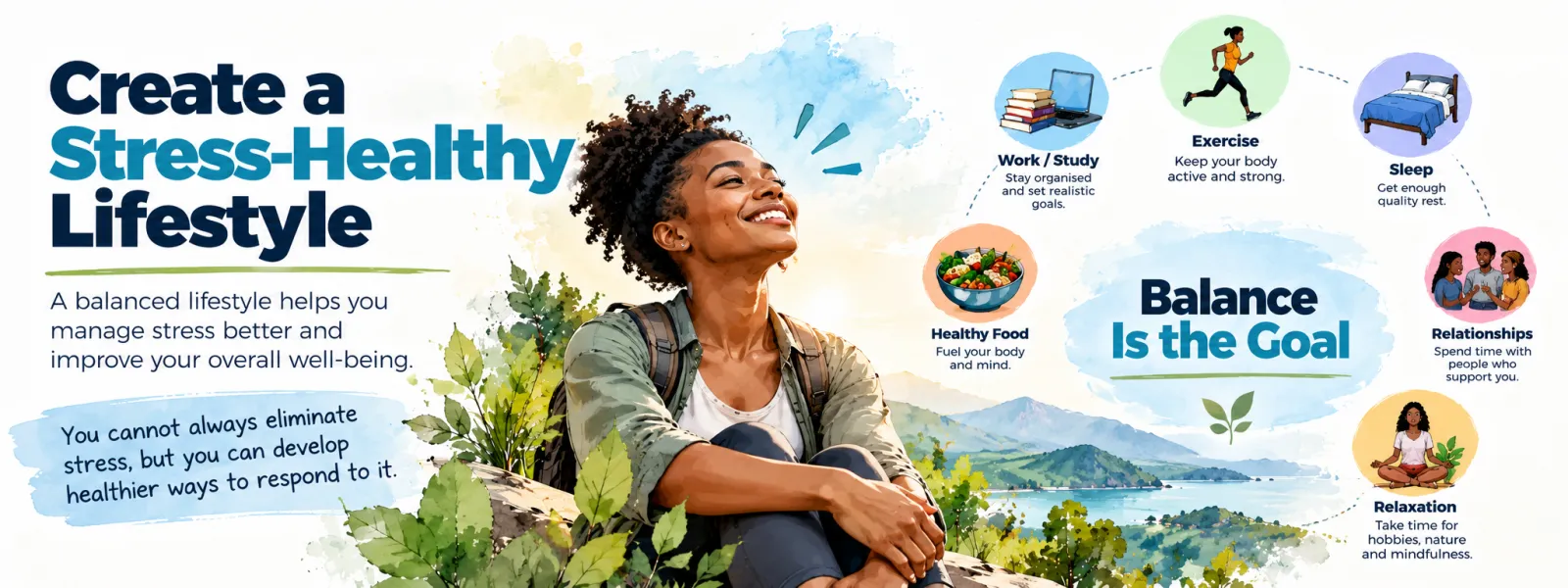
Notice the blue note on the left of the picture: you cannot always eliminate stress, but you can develop healthier ways to respond to it. That is a more realistic target than a stress-free life.
When to get help for stress
Self-help works for everyday pressure, but it is not meant to be a substitute for support. Asking for help early is a sensible step, and nobody needs to wait until things are at breaking point. The NHS says to see a GP if you are struggling to cope with stress, if the things you are trying yourself are not helping, or if you would prefer a referral from a GP.
Where to get support in the UK
| Service | What it offers |
|---|---|
| Your GP | Can talk through how you feel, check for other causes and discuss options such as talking therapies |
| NHS talking therapies (England) | You can refer yourself for anxiety and depression without a GP referral if you are registered with a GP and aged 18 or over (16 or over in some areas) |
| NHS 111 (111.nhs.uk) | Advice and help for urgent problems that are not emergencies |
| Samaritans: call 116 123 | Someone to talk to; free, from any phone, day or night, 365 days a year |
| Shout: text 85258 | Free, confidential, 24/7 text support for anyone in the UK |
| Mind | Information on managing stress and building resilience |
| 999 or A&E | For an emergency, including if you or someone else is in immediate danger or has harmed themselves |
How to support a friend who is stressed
You do not need to be an expert to help. Listening is often the most useful thing you can do. Ask how they are, give them time to answer, and avoid rushing to fix things or telling them to "just relax". Offer small, practical help, such as a walk, a study session together or a cup of tea, and encourage them to speak to a GP or a helpline if they are struggling. If you are worried about their safety, do not keep it to yourself: tell a trusted adult or call NHS 111 or 999 as appropriate.
A gentle seven-day starter plan
Changing everything at once rarely works. Try one small habit a day for a week and see which ones you like. Tick them off as you go.
- Day 1: do the NHS breathing exercise for five minutes.
- Day 2: go for a brisk walk of 20 to 30 minutes.
- Day 3: write down three things you are grateful for.
- Day 4: break one big task into three small steps and do the first.
- Day 5: switch screens off 30 minutes before bed.
- Day 6: talk to or spend time with someone you like.
- Day 7: plan next week, including a gap for rest.
Students who are juggling lessons, part-time work and revision may also like our guides on balancing sleep and work and, for night and early shifts, sleep hygiene for shift workers.
Test yourself
Explain the difference between short-term stress and chronic stress. (2 marks)
Short-term stress lasts a short time and settles afterwards, and it can be helpful because it increases alertness. Chronic stress carries on for weeks or months with little recovery and is more likely to affect sleep, mood and the body.
Suggest two healthy ways to manage stress and one unhealthy way to avoid. (3 marks)
Healthy: slow breathing, regular exercise, talking to someone, good sleep or breaking tasks into steps (any two). Unhealthy: using alcohol, cigarettes, gambling or drugs to cope.
Frequently asked questions about managing stress
What is stress?
Stress is the body's reaction to mental or emotional pressure, often with a feeling of losing control. Most people feel stressed sometimes. A little can be motivating, but stress that carries on for a long time can affect sleep, mood and general health.
What is the fight-or-flight response?
Fight-or-flight is the body's automatic response to a threat or challenge. The brain signals the adrenal glands to release adrenaline, which speeds the heart and boosts energy to the muscles, and cortisol, which follows more slowly and makes glucose available. It prepares you to act quickly.
What is the difference between healthy stress and chronic stress?
Healthy stress is short-lived and settles once the challenge has passed, and it can help you focus. Chronic stress carries on for weeks or months with little recovery. It is more likely to cause tiredness, poor sleep, headaches and low mood, and it is worth discussing with a GP.
What are the signs of stress?
The NHS lists physical signs such as headaches, dizziness, muscle tension and stomach problems, mental signs such as trouble concentrating and constant worry, and changes in behaviour such as irritability or poor sleep. These can have other causes, so see a GP if you are unsure.
How can I reduce stress quickly?
Try the NHS breathing exercise: breathe into your belly, in through your nose for a count of 5 and out through your mouth for 5, for at least five minutes. A short walk, a glass of water or talking to someone can also help in the moment.
Does exercise help with stress?
Every Mind Matters says regular exercise helps to burn off nervous energy. The NHS advises adults to aim for at least 150 minutes of moderate activity a week, or 75 minutes of vigorous activity, plus strength work on two days. Any activity you enjoy is a good start.
How much sleep do I need to cope with stress?
The NHS says most healthy adults need around 7 to 9 hours of sleep a night, though it varies. Regular bed and wake times, a quiet dark room and avoiding caffeine in the hours before bed can help. See a GP if sleep problems continue.
When should I see a GP about stress?
See a GP if you are struggling to cope, if the things you are trying yourself are not helping, or if you would prefer a referral. In England adults can also refer themselves to NHS talking therapies for anxiety and depression without seeing a GP.
Where can I get urgent help with stress?
For urgent but non-emergency advice, use NHS 111 or 111.nhs.uk. Samaritans (116 123) is free, any time, and Shout (text 85258) is free and available 24/7. In an emergency, or if you or someone else is in immediate danger, call 999 or go to A&E.
Can I really have a stress-free life?
No one can avoid stress completely, and some stress is helpful. A more realistic aim is to manage stress: spot it early, build habits such as exercise, sleep and talking, and ask for support when you need it. The goal is balance rather than zero stress.