Positive psychology is the scientific study of what helps people and communities flourish, not just what goes wrong in their lives. It was launched as a named field in 1998, when Martin Seligman made it the theme of his term as president of the American Psychological Association. This guide sets out the real positive psychology facts: the main models, the best-known studies, and the criticisms that have changed the field.
What is positive psychology?
For most of the twentieth century, psychology spent much of its effort on illness: depression, anxiety, trauma and how to treat them. Positive psychology asks a complementary question. What do people who are doing well have in common, and can anything we learn be used to help others?
In 2000, Seligman and Mihaly Csikszentmihalyi set out the agenda in an article called “Positive psychology: An introduction” in the journal American Psychologist. They argued that psychology should study positive experiences, positive traits and positive institutions as seriously as it studies disorders.
The key word is complementary. Positive psychologists do not claim that suffering is unimportant or that therapy is unnecessary. They want to add to the science, not replace it.

Today the field covers several areas that you will meet in this article:
- Positive emotions such as joy, gratitude, interest and pride.
- Character strengths such as curiosity, kindness and perseverance.
- Engagement, including the absorbed state called flow.
- Relationships and meaning, and how they relate to wellbeing.
- Interventions: short, practical activities that researchers test to see whether they raise wellbeing.
A short history of positive psychology
The story has an odd starting point. In 1967, Seligman and Steven Maier published experiments on dogs that had received shocks they could not escape. Many of the dogs later failed to escape shocks they could have avoided. The pattern became known as learned helplessness, and it shaped later research on depression.
Seligman later asked the reverse question: if helplessness can be learned, what about optimism and resilience? When he was elected president of the American Psychological Association, he chose that question as his theme in 1998.
Here are the main milestones, using dates that are easy to check.
| Year | Milestone |
|---|---|
| 1967 | Seligman and Maier publish their learned helplessness experiments. |
| 1975 | Csikszentmihalyi introduces flow in the book Beyond Boredom and Anxiety. |
| 1998 | Seligman makes positive psychology the theme of his APA presidency. |
| 2000 | Seligman and Csikszentmihalyi publish the field’s founding article. |
| 2004 | Peterson and Seligman publish Character Strengths and Virtues. |
| 2011 | Seligman presents the PERMA model in Flourish. |
| 2013 | Brown, Sokal and Friedman publish their critique of the “critical positivity ratio”. |
Positive psychology vs positive thinking
People often mix these up, and the difference matters. Positive thinking is a personal attitude: look on the bright side and avoid gloomy thoughts. It is not a field of science, and nobody tests it by default.
Positive psychology is a research field. It forms hypotheses, collects data and publishes results, including results that disappoint its own supporters. Good positive psychology also studies negative emotions, because pain, grief and anger are part of a normal life.
A fair summary is that positive thinking is a habit, while positive psychology is a body of evidence that you can read, question and test. That is the same logic as the scientific method in psychology: claims are only as strong as the evidence behind them.
And humanistic psychology?
Humanistic psychology, associated with thinkers such as Carl Rogers and Abraham Maslow, also cares about growth and fulfilment. The main difference is method. Positive psychology puts most weight on measurement and controlled studies, while humanistic psychology has traditionally given more weight to personal experience and the individual’s own viewpoint.
“Positive” means different things in psychology
The word “positive” trips up many students, because psychology uses it in at least three different ways. Do not confuse them in an exam.
| Term | What “positive” means | Example |
|---|---|---|
| Positive psychology | Focused on strengths and wellbeing | Studying what helps people flourish |
| Positive reinforcement | Something is added after a behaviour, making it more likely | Praise after finishing homework |
| Positive punishment | Something unpleasant is added after a behaviour, making it less likely | An extra chore after breaking a rule |
| Positive correlation | Two variables rise together | More revision time linked to higher test scores |
Is positive punishment the same as a positive emotion? Explain. (2 marks)
No. Positive punishment means adding an unpleasant consequence to make a behaviour less likely. A positive emotion, such as joy or gratitude, is a pleasant feeling. The word “positive” has different meanings in the two terms.
What positive psychology is not
Three misunderstandings come up again and again.
- It is not a cure for mental illness. It supplements, rather than replaces, professional care. If low mood or anxiety is affecting daily life, speak to a GP or refer yourself to NHS Talking Therapies; if you need urgent help, use NHS 111. Sleep and routine matter too, as in our guide to sleep hygiene and mental health.
- It is not “be happy all the time”. Emotions such as sadness and anger carry information, and cultures differ in how people show them; see display rules of emotion.
- It is not settled science. Some of its famous claims have been criticised or partly withdrawn. Part 4 explains which ones.

The PERMA model: five building blocks of wellbeing
In his 2011 book Flourish, Seligman proposed that a flourishing life has five measurable ingredients. The acronym PERMA stands for Positive emotion, Engagement, Relationships, Meaning and Accomplishment.
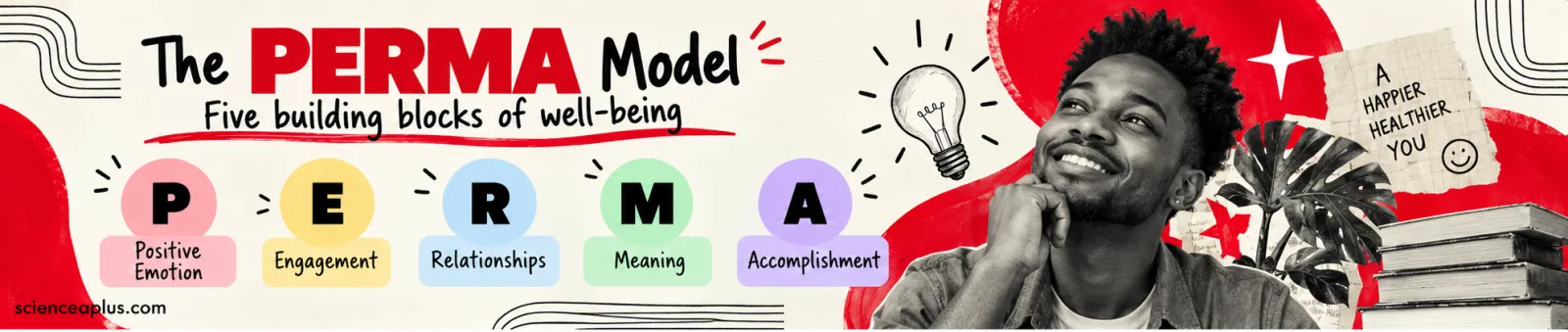
The model was a development of an earlier idea from Seligman, who had described three kinds of “happy life”: a pleasant life, an engaged life and a meaningful life. In Flourish he kept positive emotion, engagement and meaning, and added two more: relationships and accomplishment.
| Letter | Element | What it means in plain English |
|---|---|---|
| P | Positive emotion | Feeling things like joy, interest, gratitude and calm |
| E | Engagement | Being absorbed in what you are doing, as in flow |
| R | Relationships | Having close, supportive connections with other people |
| M | Meaning | Feeling part of something bigger than yourself |
| A | Accomplishment | Working towards goals and achieving them |
It is worth noticing what PERMA is not. It is not a law of nature or a proven recipe. It is a framework: a list of things that researchers can measure and ask people about. Like any framework, it is open to debate.
Relationships and friendship
The R in PERMA fits everyday experience. Time with friends and family is among the most common answers people give when asked what makes life good. If you want to explore this theme, read essays on friendship and its importance.

VIA character strengths: 24 traits in six groups
A second pillar of the field is the classification of character. In 2004, Christopher Peterson and Martin Seligman published Character Strengths and Virtues. They reviewed philosophy, religion and psychology across many cultures, and identified six core virtues underlying 24 measurable character strengths. The system is often called the VIA classification, from “Values in Action”.
It was meant as a positive counterpart to the manuals that list mental disorders. Instead of cataloguing what can go wrong, it catalogues what can go right. The 2005 review by Seligman and colleagues also reported cross-cultural findings suggesting that these strengths are surprisingly widespread.
| Virtue | Strengths in this group |
|---|---|
| Wisdom and knowledge | Creativity, curiosity, judgement, love of learning, perspective |
| Courage | Bravery, perseverance, honesty, zest |
| Humanity | Love, kindness, social intelligence |
| Justice | Teamwork, fairness, leadership |
| Temperance | Forgiveness, humility, prudence, self-regulation |
| Transcendence | Appreciation of beauty and excellence, gratitude, hope, humour, spirituality |
Count them and you get 5 + 4 + 3 + 3 + 4 + 5 = 24. Everyone has all 24 to some degree. The idea of signature strengths is that each person tends to have a few that feel most natural and energising.
The practical use is simple. Pick a strength you rate highly, then find a new way to use it this week. Seligman and colleagues tested exactly this in 2005, and Part 3 explains how it went. Cultivating strengths also links to a growth mindset in teamwork, where skills are treated as things you can build.
Flow: when you lose track of time
Csikszentmihalyi, a Hungarian-American psychologist, became interested in why some people become so absorbed in an activity that they forget food, sleep and time. He first described the idea of flow in his 1975 book Beyond Boredom and Anxiety, after studying artists who worked for hours without stopping. His 1990 book Flow: The Psychology of Optimal Experience brought it to a wide audience.

Flow researchers describe a state with features like these:
- Intense concentration on the present moment.
- Clear goals and immediate feedback on how you are doing.
- A sense of control over the activity.
- Loss of self-consciousness, and a distorted sense of time.
- An activity that feels rewarding in itself.
The challenge-skill balance
The central claim is about balance. Flow is most likely when the challenge of a task matches your skills. If the challenge is far too high, you feel anxious. If your skill is far too high, you feel bored. The sweet spot sits between the two, and it moves as you improve, which is why a guitarist keeps learning harder pieces.
| Challenge | Skill | Likely feeling |
|---|---|---|
| High | Low | Anxiety |
| Low | High | Boredom |
| High | High | Flow |
How is flow measured?
One well-known method is the Experience Sampling Method. Participants carry a device that signals them at random moments, and each time they note what they are doing and how they feel. This catches experiences as they happen instead of relying on memory. Researchers also use questionnaires such as the Flow State Scale.
A student finds a maths task far too hard and feels anxious. Using flow theory, suggest one change. (2 marks)
Reduce the challenge or build up skill, for example by starting with easier questions, then moving up gradually. Flow theory says the best match is when challenge and skill are balanced.
Can you train happiness? Studies of positive interventions
The big practical question in positive psychology is whether short activities, called positive psychology interventions, can raise wellbeing. Researchers test them the way other scientists test a new medicine: by comparing a group who do the activity with a group who do something else. Here are the best-known studies.
Gratitude: Emmons and McCullough (2003)
Robert Emmons and Michael McCullough, writing in the Journal of Personality and Social Psychology, compared people who regularly listed things they were grateful for with people who listed other things, such as everyday events. Those in the gratitude group reported more positive feelings than the comparison groups. Their paper, “Counting blessings versus burdens”, became one of the most cited studies in the area.

Seligman and colleagues (2005): six groups, one placebo
In 2005, Seligman, Tracy Steen, Nansook Park and Christopher Peterson reported an internet-based study in American Psychologist. It used six groups with random assignment. Five groups tried a happiness exercise, and one group did a control activity, so the researchers could see whether the exercises did better than a placebo.
The result was mixed, which is typical of honest science. Three of the five exercises lastingly increased happiness and decreased depressive symptoms, while the other two did not. The two best-known were:
- The gratitude visit. Participants wrote a letter of thanks to someone who had been kind to them and delivered it in person. The boost in happiness was large but faded after about a month.
- Three good things. Each day for a week, participants wrote down three things that went well and why. Benefits were smaller at first, but lasted for around six months.
The third lasting exercise was using a signature strength in a new way each day for a week.
- Day 1: write three good things and why they happened
- Day 3: include one that involved another person
- Day 5: include one small thing you usually overlook
- Day 7: re-read your list and note any pattern
Kindness studies
A 2006 study by Otake and colleagues asked 119 Japanese women to count their own acts of kindness for one week. Compared with a control group, subjective happiness increased. In 2016, Nelson and colleagues ran a six-week experiment with 473 people. Those asked to do acts of kindness for others or for the world showed bigger gains in flourishing than those asked to do kind acts for themselves or neutral tasks.

These results fit everyday experience. Small acts such as sending encouraging words for a friend cost little and combine two PERMA elements: positive emotion and relationships. Remember, though, that single studies are only a start. The next section shows what happens when many studies are combined.
What do the meta-analyses say?
A meta-analysis pools the results of many studies to estimate an overall effect. Three are widely cited in positive psychology.
| Meta-analysis | What it covered | Main finding |
|---|---|---|
| Sin and Lyubomirsky (2009) | 51 interventions, 4,266 people | Interventions significantly improved wellbeing (mean r = .29) and reduced depressive symptoms (mean r = .31) |
| Bolier and colleagues (2013) | 39 studies, 6,139 participants | Small effects: standardised difference 0.34 for subjective wellbeing, 0.20 for psychological wellbeing and 0.23 for depression |
| Carr and colleagues (2020) | Systematic review and meta-analysis in The Journal of Positive Psychology | Examined the effectiveness of positive psychology interventions |
Read the two main rows together. Both found real benefits on average. But Bolier’s team described the effects as small, found indications of publication bias, and noted that study quality varied considerably. In their analysis, the apparent effect on depression was bigger in lower-quality studies.
So the honest summary is that positive activities seem to help people a little on average, and some people more than others. They are not miracle cures.
Broaden-and-build: why positive emotions might matter
Barbara Fredrickson’s broaden-and-build theory, published in American Psychologist in 2001, offers an explanation for why positive emotions could be useful rather than just pleasant. It makes two claims:
- Broaden. Positive emotions such as joy and interest widen attention and encourage you to explore new thoughts and actions.
- Build. Over time, that exploring builds lasting resources: skills, friendships, knowledge and resilience.
Negative emotions such as fear tend to narrow attention to deal with an immediate threat, which is useful in danger. Fredrickson also proposed an “undoing” effect: in her experiments, people who watched films that produced joy or contentment recovered from the cardiovascular effects of stress faster than people who watched neutral or sad films.
Limits of the theory
The theory has been tested a great deal, but not every result fits. A 2010 study by Gable and Harmon-Jones reported that some highly motivating positive emotions, such as desire for a reward, narrow attention rather than broaden it. So the “broaden” mechanism does not apply to every positive emotion.
Exercise is one everyday way to produce positive mood and build habits, and our guide on how to motivate yourself to exercise covers practical steps. Social influences matter too, as shown in positive and negative peer pressure.
Explain the “broaden” and “build” parts of Fredrickson’s theory. (3 marks)
Broaden: positive emotions widen attention and encourage exploring new ideas and actions. Build: repeated exploring builds lasting resources such as skills, social bonds and resilience, which help people later.
The happiness-and-sadness theme is also explored in an essay on happiness and sadness, which is useful if you need a balanced writing example.
Critiques: when positive psychology got it wrong
A science is only trustworthy if it can correct its own mistakes. Positive psychology has had some very public corrections, and learning about them is a lesson in how to read scientific claims.
The “critical positivity ratio” (2.9013)
In 2005, Barbara Fredrickson and Marcial Losada published a paper in American Psychologist claiming that people flourish when they experience about 2.9013 positive emotions for every negative one. The precision caught attention: it was reported in books and talks as a tipping point between languishing and flourishing.
In 2013, Nicholas Brown, physicist Alan Sokal and psychologist Harris Friedman challenged it in the same journal. They found no theoretical or empirical justification for using differential equations from fluid dynamics to describe emotions over time, and said the equations contained numerous fundamental conceptual and mathematical errors. They concluded that the claim of a critical minimum ratio of 2.9013 was “entirely unfounded”.
Fredrickson’s reply, also published in 2013, accepted that Losada’s mathematical modelling was questionable. A formal correction followed in the journal. She argued, however, that evidence still supports the idea that, within bounds, higher positivity ratios predict flourishing mental health and other benefits. So the precise number and its maths were withdrawn, while the broader question of whether positive and negative emotions balance matters is still being studied.
The “happiness pie”: 50%, 10%, 40%
Another popular claim comes from a 2005 paper by Sonja Lyubomirsky, Kennon Sheldon and David Schkade. It described happiness as roughly 50% genetic, 10% life circumstances and 40% intentional activity, a split often drawn as a pie chart in books and talks.
In 2019, Nicholas Brown and Julia Rohrer re-examined the argument in the Journal of Happiness Studies. They found several deficiencies in the chain of arguments, concluded that there is little empirical evidence for the variance decomposition, and noted that even if it were valid it would not necessarily show how much an individual can change their own happiness. In other words, “40% of your happiness is in your control” is not a safe thing to say.
Small effects and publication bias
As Part 3 showed, the meta-analyses found real but small average benefits, with signs of publication bias. Add the mixed support for broaden-and-build, and a careful reader should treat positive psychology as a promising field with some strong results and some weaker ones, not as a finished set of life rules.
How to use positive psychology sensibly
You do not need to accept every claim to benefit from the better-supported ideas. These suggestions follow the evidence discussed above.
- Try one small activity (three good things, a thank-you letter, counting kind acts) for a week, then judge for yourself.
- Treat strengths tests as prompts for reflection, not labels.
- Look for tasks that stretch you without overwhelming you, to give flow a chance.
- Make time for people. Relationships are a core element of PERMA.
- Be wary of anyone who sells a precise formula for happiness.
Plan realistic goals and manage pressure, too: see achieving goals with minimum stress and a stress-free life for everyone.
Test yourself on positive psychology
Frequently asked questions about positive psychology
What is positive psychology in simple terms?
Positive psychology is the scientific study of what helps people and communities thrive. Instead of concentrating only on mental illness, it studies things like positive emotions, strengths, relationships and meaning, and tests activities that might improve wellbeing. It complements, rather than replaces, traditional psychology and treatment.
Who founded positive psychology?
Martin Seligman is usually called its founder, because he made it the theme of his American Psychological Association presidency in 1998. In 2000, he and Mihaly Csikszentmihalyi published the founding article “Positive psychology: An introduction”. Many of the ideas, including flow, had earlier roots.
What is the PERMA model?
PERMA is Seligman’s 2011 framework for wellbeing. It stands for Positive emotion, Engagement, Relationships, Meaning and Accomplishment. The idea is that a flourishing life usually includes all five elements, which can each be measured, though it is a framework to guide research rather than a proven formula.
What are the 24 character strengths?
The VIA classification by Peterson and Seligman (2004) lists 24 strengths in six virtue groups: wisdom and knowledge, courage, humanity, justice, temperance and transcendence. Examples include curiosity, bravery, kindness, fairness, self-regulation and gratitude. Everyone has all of them to some degree.
What is flow in psychology?
Flow is a state of deep absorption in an activity, with intense concentration, clear goals, a sense of control and a distorted sense of time. Mihaly Csikszentmihalyi’s theory says it is most likely when the challenge of a task matches your skill, neither too hard nor too easy.
Do gratitude exercises really work?
Experiments such as Emmons and McCullough (2003) and Seligman’s 2005 study found that gratitude activities raised happiness, at least for a time. Later meta-analyses found small average effects overall, with signs of publication bias. They are worth trying but are not a cure for illness.
What was the critical positivity ratio?
It was a claim by Fredrickson and Losada (2005) that flourishing needs about 2.9013 positive emotions per negative one. In 2013, Brown, Sokal and Friedman showed the mathematics was unfounded, and the journal formally corrected the paper. The precise number is no longer accepted.
Is the 40% happiness pie true?
The idea that 50% of happiness is genetic, 10% circumstances and 40% intentional activity comes from a 2005 paper. A 2019 re-examination by Brown and Rohrer found little empirical evidence for that split, so it is safer not to treat the 40% figure as a fact about any person.
What is the difference between positive psychology and positive thinking?
Positive thinking is a personal attitude of looking on the bright side. Positive psychology is a research field that forms hypotheses, runs studies and publishes results, including disappointing ones. It also studies negative emotions, because they are a normal part of life.
Does positive psychology replace therapy?
No. Positive activities may help some people feel better, but they do not replace professional care. If low mood or anxiety lasts or affects daily life, speak to a GP or refer yourself to NHS Talking Therapies; for urgent help, contact NHS 111. In the UK, Samaritans are available free on 116 123.