Key points at a glance
- Electrolysis is the breaking down of an ionic compound using electricity. The compound must be molten or dissolved in water, because the ions have to be free to move.
- The cathode is the negative electrode. Positive ions (cations) move to it and gain electrons – they are reduced.
- The anode is the positive electrode. Negative ions (anions) move to it and lose electrons – they are oxidised.
- For a molten ionic compound the answer is always simple: the metal forms at the cathode and the non-metal at the anode.
- For a solution you must also think about the H+ and OH- ions from the water. Hydrogen forms at the cathode unless the metal is less reactive than hydrogen; oxygen forms at the anode unless a halide ion is present in high concentration.
- Electrolysis is how aluminium is extracted, how chlorine, hydrogen and sodium hydroxide are made from brine, and how objects are electroplated.
Electrolysis is a process in which an electrical current is used to drive a non-spontaneous chemical reaction. It is a powerful tool for transforming chemicals and creating new products.
Electrolytic processes are the chemical transformations caused by passing electricity through a solution or liquid that conducts electricity.
The Electrolysis Process
In electrolysis, a chemical reaction is driven by an external electrical current. The process typically involves two electrodes immersed in an electrolyte solution. The electrodes are connected to a power source, which provides the electrical energy necessary to drive the reaction. The electrodes are made of different materials depending on the reaction being carried out. For example, in the electrolysis of water both electrodes are made of an inert material such as platinum or graphite, so that the electrodes take no part in the reaction themselves. Electrodes made of a reactive metal are used only where the metal is meant to be part of the reaction, as in the purification of copper.
The electrolyte solution is made up of ions that can conduct electricity. When an electrical current is applied to the electrodes, the positive ions are attracted to the negative electrode (cathode), while the negative ions are attracted to the positive electrode (anode). As the ions move towards the electrodes, they gain or lose electrons, depending on their charge. This causes chemical reactions to occur at the electrodes, leading to the formation of new products.
The words you have to get right
Most marks lost in electrolysis questions are lost on vocabulary rather than chemistry. Learn this table before anything else.
| Term | What it means | What happens there |
|---|---|---|
| Electrolyte | The molten or dissolved ionic compound being broken down | Carries the current by letting ions move |
| Electrode | A conducting rod dipped into the electrolyte | Where electrons enter or leave the electrolyte |
| Cathode | The negative electrode | Positive ions gain electrons – reduction |
| Anode | The positive electrode | Negative ions lose electrons – oxidation |
| Cation | A positive ion, such as Na+, Cu2+, H+ | Travels to the cathode |
| Anion | A negative ion, such as Cl-, Br-, OH- | Travels to the anode |
| Inert electrode | Graphite or platinum | Conducts but takes no part in the reaction |
Two memory hooks that examiners will not mind you using: PANIC – Positive is Anode, Negative Is Cathode. And OIL RIG – Oxidation Is Loss of electrons, Reduction Is Gain of electrons.
What is an electrolyte?
Electrolytes are liquids or solutions that conduct electricity.
An electrolyte is a substance that conducts electricity when dissolved in a solvent, such as water. Electrolytes are typically in the form of ions, which are atoms or molecules that have gained or lost one or more electrons, giving them a net positive or negative charge. Common electrolytes include sodium, potassium, calcium, and chloride ions.
In a solution containing electrolytes, the ions are free to move around and carry electric charge, allowing the solution to conduct electricity.
Why a solid ionic compound will not work
This is one of the most frequently asked one-mark questions on the topic. Solid sodium chloride contains exactly the same ions as molten sodium chloride, but it does not conduct electricity. The ions are locked in fixed positions in the giant ionic lattice, so they cannot move to the electrodes. Melting the compound, or dissolving it in water, breaks the lattice apart and frees the ions. You can read more about lattice structure in our lesson on the properties of ionic and covalent compounds.
Examples for electrolytes
Aqueous solutions of ionic compounds
- Aqueous sodium chloride
- Aqueous copper sulphate
Molten (fused) liquids of ionic compounds
- Fused sodium chloride
Solutions of acids
- Aqueous hydrochloric acid
- Aqueous sulphuric acid
Solutions of bases
- Aqueous sodium hydroxide
Electrolysis of molten ionic compounds
Molten compounds are the easy case, because the only ions present are the ones from the compound itself. There is no water, so there are no H+ or OH- ions to compete. The rule is simply:
- Cathode: the metal ion gains electrons and the metal is deposited.
- Anode: the non-metal ion loses electrons and the non-metal is released.
Molten lead(II) bromide, PbBr2
This is the classic school demonstration, because lead(II) bromide melts at a temperature a Bunsen burner can reach. Grey molten lead collects at the cathode and orange-brown bromine vapour is given off at the anode.
- Write the ions present: Pb2+ and Br-.
- Send the positive ion to the cathode and add electrons until the charge is cancelled: Pb2+ + 2e- → Pb
- Send the negative ion to the anode and take electrons away. Bromine is diatomic, so you need two bromide ions: 2Br- → Br2 + 2e-
- Check that the electrons balance across the two half-equations. Two in, two out – correct.
Overall: PbBr2(l) → Pb(l) + Br2(g)
Molten zinc chloride, ZnCl2
Exactly the same method. The ions are Zn2+ and Cl-, so:
- Cathode: Zn2+ + 2e- → Zn
- Anode: 2Cl- → Cl2 + 2e-
- Overall: ZnCl2(l) → Zn(l) + Cl2(g)
Notice that the zinc half-equation needs two electrons because the ion carries a 2+ charge, while the chloride half-equation needs two chloride ions because chlorine is diatomic. Those are two different reasons for the same number, and mixing them up is a common slip.
Explain electrolysis of fused sodium chloride using carbon electrodes
Fused simply means melted. Solid sodium chloride melts at a high temperature, and once molten it separates into sodium ions (Na+) and chloride ions (Cl-) that are free to move. Carbon (graphite) electrodes are used because graphite conducts electricity, withstands the temperature, and is inert – it takes no part in the reaction.
The sodium ions migrate to the negative electrode (cathode), while the chloride ions migrate to the positive electrode (anode). Industrially, sodium is made this way in a cell that also contains a second salt to lower the melting point and save energy; at GCSE and IGCSE you are only asked about the pure molten sodium chloride case shown below.
Electrolysis of fused sodium chloride apparatus
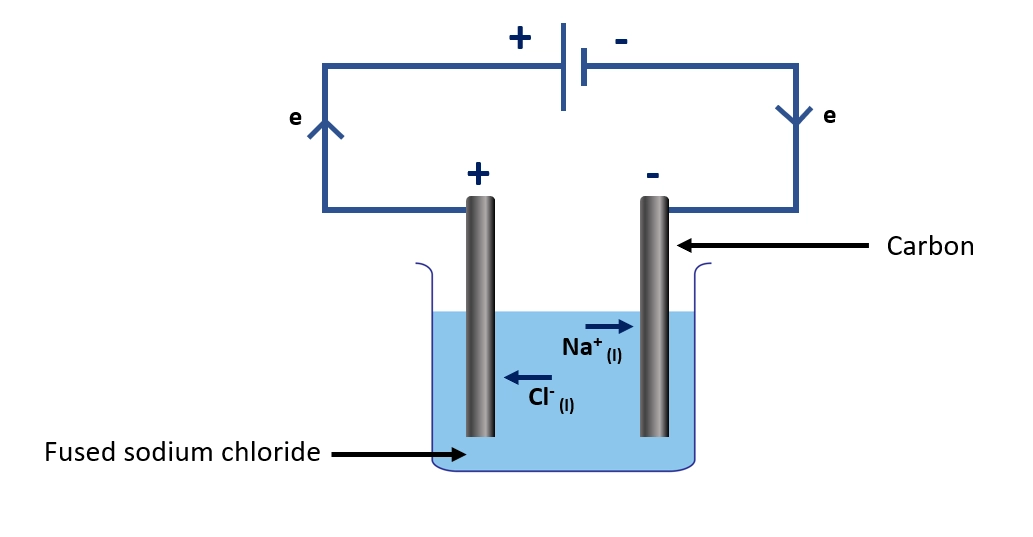
Reaction occurring at the negative electrode (cathode):
At the cathode, the sodium ions gain electrons and are reduced to form sodium metal (Na):
Na+(l) + e- → Na(l)
Reaction occurring at the positive electrode (anode):
At the anode, the chloride ions lose electrons and are oxidised to form chlorine gas (Cl2):
2Cl-(l) → Cl2(g) + 2e-
Overall electrolytic reaction:
The overall electrolytic reaction can be written as:
2NaCl(l) → 2Na(l) + Cl2(g)
This shows that the electrolysis of fused sodium chloride using carbon electrodes produces metallic sodium and chlorine gas as the main products.
The production of metallic sodium through this process is important in many industrial applications, such as the manufacture of sodium compounds and organic synthesis. However, the process requires high temperatures and a great deal of electricity, which makes it expensive.
Electrolysis of solutions: the decision rules
As soon as water is involved, the picture changes. Water itself produces a small number of H+ and OH- ions, so there are now four ions competing rather than two. Only one ion is discharged at each electrode, and you can work out which one from two rules.
| Electrode | Ions arriving | Rule | Product |
|---|---|---|---|
| Cathode (−) | The metal ion and H+ | The less reactive element is discharged | Hydrogen, unless the metal is less reactive than hydrogen (copper, silver, gold), in which case the metal is deposited |
| Anode (+) | The non-metal ion and OH- | A halide ion wins if it is present in a reasonable concentration | Chlorine, bromine or iodine if a halide is present; otherwise oxygen from the hydroxide ions |
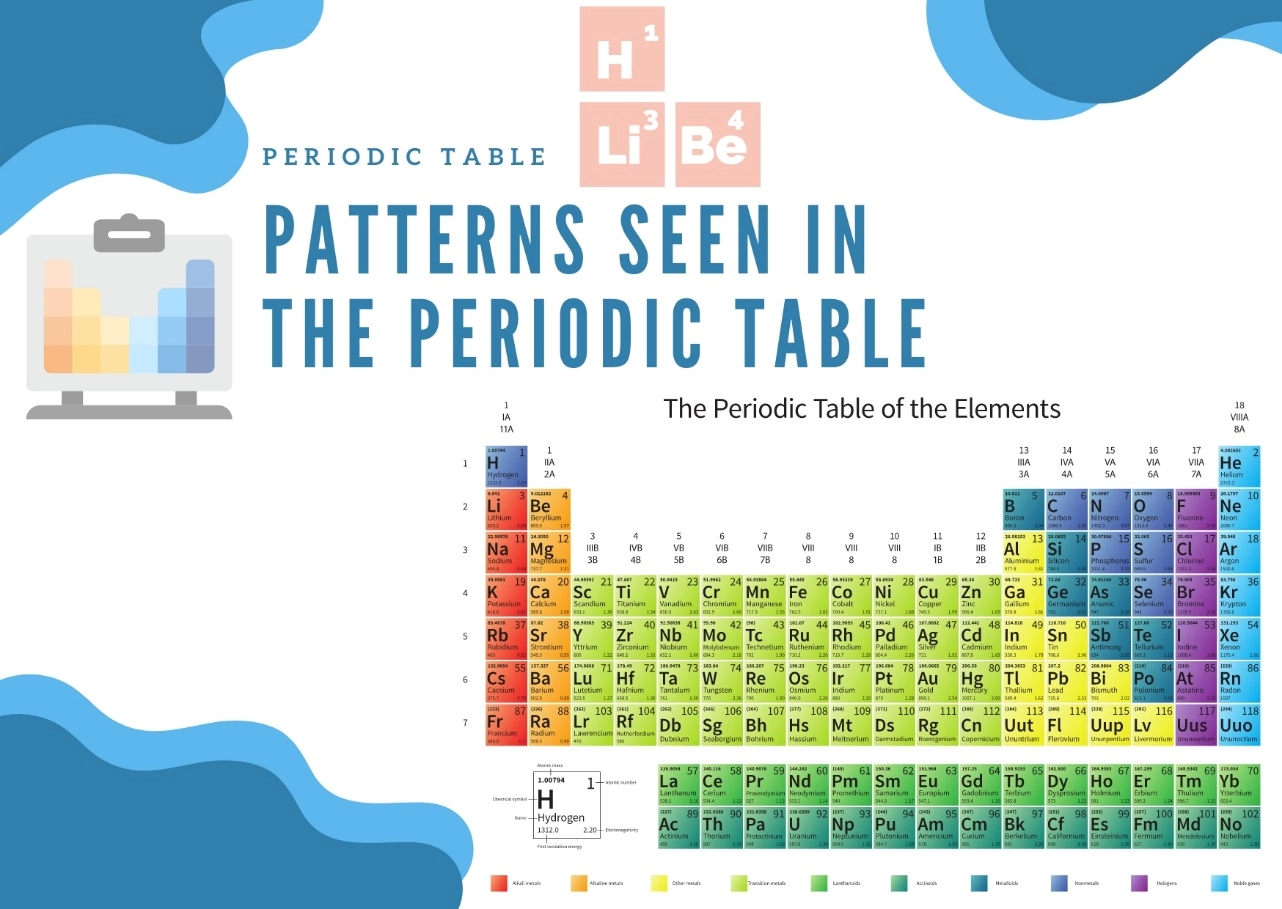
The reactivity order you need for the cathode rule is the same one used elsewhere in chemistry – see our notes on the reactivity of metals. Potassium, sodium, calcium, magnesium and aluminium all sit above hydrogen, so their ions stay in solution and hydrogen bubbles off instead. Copper, silver and gold sit below hydrogen, so those metals plate out on the cathode.
One extra detail for the anode: concentration matters. A concentrated chloride solution gives chlorine, but a very dilute one gives oxygen, because there are then too few chloride ions to compete with the hydroxide ions. If a question specifies "dilute", read it as a hint.
Explain electrolysis of aqueous sodium chloride
Electrolysis of aqueous sodium chloride (NaCl) is the electrolysis of a solution of NaCl in water. Concentrated sodium chloride solution is called brine, and electrolysing it is one of the most important industrial processes in the world: it is where chlorine, hydrogen and sodium hydroxide come from.
During the electrolysis process, two electrodes, typically made of inert materials such as platinum or carbon, are placed in the solution and connected to a power source. The solution contains sodium ions (Na+) and chloride ions (Cl-) from the salt, plus hydrogen ions (H+) and hydroxide ions (OH-) from the water. The positive ions migrate to the negative electrode (cathode), while the negative ions migrate to the positive electrode (anode).
Electrolysis of aqueous sodium chloride apparatus
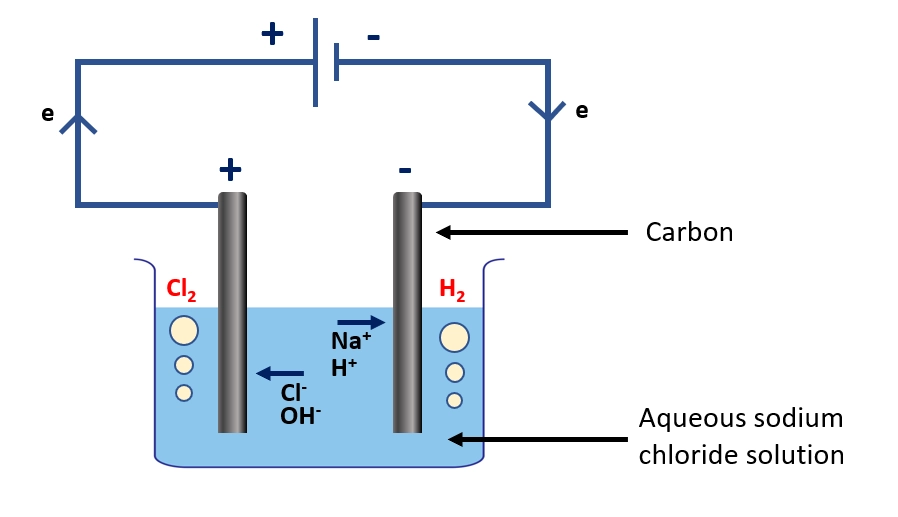
Reaction occurring at the negative electrode (cathode):
Na+ and H+ ions in the solution move towards the negative electrode. As hydrogen is below sodium in the reactivity series, it is the H+ ions that are reduced here, and sodium ions simply stay in solution.
2H+(aq) + 2e- → H2(g)
The gas collected at the cathode gives a squeaky pop with a lighted splint, which is the standard test for hydrogen.
Reaction occurring at the positive electrode (anode):
At the anode, the chloride ions lose electrons and are oxidised to form chlorine gas (Cl2). This happens because the solution is concentrated in chloride ions.
2Cl-(aq) → Cl2(g) + 2e-
The gas collected at the anode is pale green, smells sharp, and bleaches damp litmus paper – the test for chlorine.
What is left in the solution
This is the part students most often miss. The H+ ions have been removed as hydrogen and the Cl- ions have been removed as chlorine, so what remains dissolved in the water is Na+ and OH- – in other words sodium hydroxide solution. The liquid left in the cell turns universal indicator purple.
Overall electrolytic reaction
2NaCl(aq) + 2H2O(l) → 2NaOH(aq) + H2(g) + Cl2(g)
All three products are useful: chlorine for water treatment, bleach and PVC; hydrogen for making ammonia and for margarine manufacture; sodium hydroxide for soaps, detergents and paper. This industry is known as the chlor-alkali industry.
Explain electrolysis of an aqueous copper sulphate solution
Electrolysis of an aqueous copper sulfate (CuSO4) solution is a process in which a solution of CuSO4 in water is electrolyzed. This process is commonly used in the purification and electroplating of copper.
During the electrolysis process, two electrodes, typically made of inert materials such as platinum or graphite, are placed in the solution and connected to a power source. The CuSO4 dissociates into copper ions (Cu2+) and sulfate ions (SO42-) in the solution. The copper ions migrate to the negative electrode (cathode), while the sulfate ions migrate to the positive electrode (anode).
Electrolysis of an aqueous copper sulphate solution apparatus
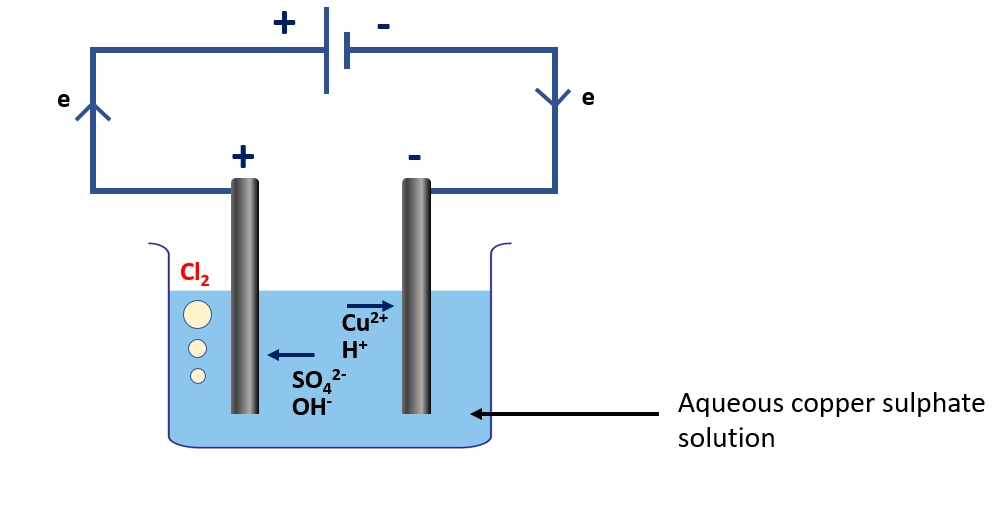
Reaction occurring at the negative electrode (cathode):
At the cathode, the copper ions gain electrons and are reduced to form solid copper metal (Cu). Copper is less reactive than hydrogen, so it is the copper that is deposited and not hydrogen gas:
Cu2+(aq) + 2e- → Cu(s)
Reaction occurring at the positive electrode (anode):
At the anode the sulfate ions are not discharged – they are too stable. It is the hydroxide ions from the water that lose electrons and are oxidised to form oxygen gas (O2) and water:
4OH-(aq) → O2(g) + 2H2O(l) + 4e-
Overall electrolytic reaction:
The overall electrolytic reaction can be written as:
2CuSO4(aq) + 2H2O(l) → 2Cu(s) + O2(g) + 2H2SO4(aq)
So with inert electrodes the products are copper at the cathode and oxygen at the anode, and the solution left behind turns from blue to colourless as the copper ions are used up and sulfuric acid builds up. The sulfate ions themselves are spectators – they stay in solution unchanged.
Numerous industrial applications, such as the production of electrical wires, plumbing fixtures, and other copper-based products, rely on the products of this process. This process can also be used to purify copper of impurities and electroplate copper onto other surfaces.
Inert electrodes and active electrodes
Everything above assumed inert electrodes made of graphite or platinum, which conduct the current but take no chemical part in the reaction. Swapping them for electrodes made of the metal being deposited changes the result completely, and this is the basis of copper purification.
Purifying copper with copper electrodes
Impure copper is used as the anode and a thin sheet of pure copper as the cathode, in a copper(II) sulfate electrolyte.
- At the anode the copper atoms dissolve into the solution: Cu(s) → Cu2+(aq) + 2e-. The anode gets thinner.
- At the cathode those copper ions are deposited as pure copper: Cu2+(aq) + 2e- → Cu(s). The cathode gets thicker.
- The impurities do not dissolve. They drop off the anode and collect underneath it as anode sludge, which often contains valuable silver and gold.
- The concentration of the solution stays roughly constant, because copper enters it at the same rate as it leaves.
Extracting aluminium by electrolysis
Aluminium is too reactive to be extracted by heating its ore with carbon, so it has to be obtained by electrolysis. The ore is bauxite, which is purified to give aluminium oxide, Al2O3.
Aluminium oxide melts at over 2,000 °C, which would be ruinously expensive to maintain. It is therefore dissolved in molten cryolite, an aluminium compound that melts at a much lower temperature, so the cell can run far cooler and use less energy.
- Cathode (the carbon lining of the cell): Al3+ + 3e- → Al. Molten aluminium collects at the bottom and is tapped off.
- Anode (carbon blocks): 2O2- → O2 + 4e-. Oxygen is released.
The carbon anodes have to be replaced regularly. At the high working temperature the oxygen released attacks the hot carbon and burns it away as carbon dioxide, so the blocks gradually wear down. That replacement cost, plus the enormous electricity bill, is why recycling aluminium is so much cheaper than extracting it.
Applications of Electrolysis
Electrolysis has numerous applications in industry, research, and everyday life. Here are some commonly seen applications:
Production of Metals:
Electrolysis is commonly used in the production of metals such as aluminum, magnesium, and copper. In these processes, the metal ions are reduced at the cathode, forming a pure metal. For example, in the electrolysis of aluminium oxide, aluminium ions are reduced at the cathode to form aluminium metal, while oxygen gas is evolved at the anode.
Electroplating:
Electroplating is a process in which a thin layer of metal is deposited onto a surface using electrolysis. This process is used to create decorative coatings, prevent corrosion, and improve wear resistance. In the electrolysis of copper sulfate solution, for instance, copper ions are reduced at the cathode to form a thin layer of copper metal on the plating object's surface.
To electroplate an object, three things must be true: the object being plated is the cathode, the plating metal is the anode, and the electrolyte contains ions of the plating metal. To silver-plate a spoon, the spoon is the cathode, a bar of silver is the anode, and the electrolyte is a silver salt solution. Our separate lesson on electrolysis and electroplating works through the set-up in more detail.
Chlor-Alkali Industry:
The chlor-alkali industry produces chlorine gas, hydrogen gas, and sodium hydroxide via electrolysis. In this process, a brine solution (sodium chloride) is electrolyzed, producing chlorine gas at the anode, hydrogen gas at the cathode, and sodium hydroxide in the solution.
Electrolytic Cells:
An electrolytic cell is a device that uses electrical energy to drive a chemical reaction that would not happen on its own. Do not confuse it with the opposite kind of cell. A battery or a fuel cell is a chemical (galvanic) cell: it does the reverse job, converting chemical energy into electrical energy from a reaction that happens spontaneously – in a fuel cell, the reaction of hydrogen with oxygen. In an electrolytic cell energy goes in; in a chemical cell energy comes out.
Explain electrolysis of acidulated water
Electrolysis of acidulated water is a process in which water (H2O) containing a small amount of acid, typically sulfuric acid (H2SO4), is electrolyzed. The acid is added because pure water contains too few ions to conduct properly; the acid supplies extra ions without changing the products. This process is used in many industrial applications, such as the production of hydrogen gas and oxygen gas.
During the electrolysis process, two electrodes composed of inert substances such as platinum or graphite are placed in acidulated water and connected to a power source. Water produces hydrogen ions (H+) and hydroxide ions (OH-) in the solution. The hydrogen ions migrate to the negative electrode (cathode), while the hydroxide ions migrate to the positive electrode (anode).
Electrolysis of acidulated water apparatus
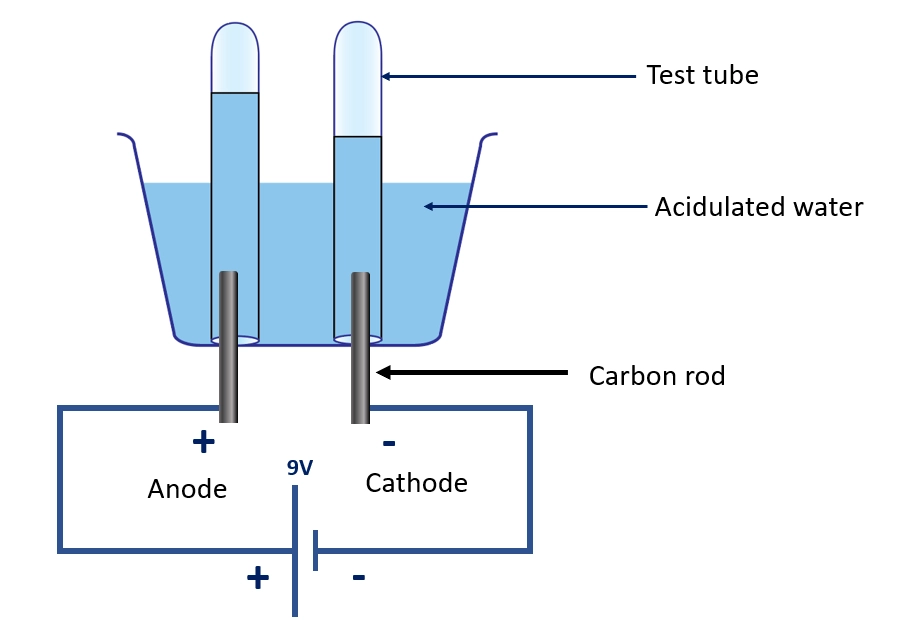
Reaction occurring at the negative electrode (cathode):
At the cathode, the hydrogen ions gain electrons and are reduced to form hydrogen gas (H2):
2H+(aq) + 2e- → H2(g)
Reaction occurring at the positive electrode (anode):
At the anode, the hydroxide ions lose electrons and are oxidised to form oxygen gas (O2) and water (H2O):
4OH-(aq) → O2(g) + 2H2O(l) + 4e-
Overall electrolytic reaction:
The overall electrolytic reaction can be written as:
2H2O(l) → 2H2(g) + O2(g)
This demonstrates that the main products of electrolysis of acidulated water are hydrogen gas and oxygen gas. Because two electrons are needed per hydrogen molecule and four per oxygen molecule, you always collect twice the volume of hydrogen as oxygen. Seeing one test tube fill to double the level of the other is a good check that the experiment is working.
Worked example: writing any half-equation
Question: molten magnesium chloride, MgCl2, is electrolysed with inert electrodes. Give the half-equation at each electrode and name the products.
- List the ions. Magnesium chloride contains Mg2+ and Cl-.
- Send each ion to the right electrode. Mg2+ is positive, so it goes to the cathode. Cl- is negative, so it goes to the anode.
- At the cathode, add electrons. Mg2+ carries a 2+ charge, so it needs two: Mg2+ + 2e- → Mg
- At the anode, remove electrons. Chlorine is diatomic, so start with two chloride ions: 2Cl- → Cl2 + 2e-
- Check the charges balance on each side. Cathode: (2+) + (2−) = 0, and Mg is neutral. Anode: (2−) on the left, and Cl2 plus (2−) on the right. Both balance.
Answer: magnesium metal at the cathode, chlorine gas at the anode.
Practice questions
- Why must an ionic compound be molten or dissolved before it can be electrolysed?
- Give the half-equation at the cathode when molten aluminium oxide is electrolysed.
- Dilute sulfuric acid is electrolysed with inert electrodes. Name the gas at each electrode and state the ratio of their volumes.
- Concentrated potassium bromide solution is electrolysed. Predict the product at each electrode and explain the anode product.
- Copper(II) sulfate solution is electrolysed with copper electrodes rather than graphite. What happens to the mass of each electrode?
Answers: 1. In a solid the ions are held in fixed positions in the lattice and cannot move to the electrodes; melting or dissolving frees them. 2. Al3+ + 3e- → Al. 3. Hydrogen at the cathode and oxygen at the anode, in a volume ratio of 2:1 hydrogen to oxygen. 4. Hydrogen at the cathode, because potassium is more reactive than hydrogen; bromine at the anode, because a halide ion in a concentrated solution is discharged in preference to hydroxide. 5. The anode loses mass as copper dissolves; the cathode gains mass as copper is deposited.
Exam tips
- Write "the ions are free to move", not "the ions move faster". A solid ionic compound does not conduct because its ions are fixed in the lattice, not because they are slow.
- Always show the charge on the electron as e- in a half-equation, and check that the charges balance on both sides. A half-equation with unbalanced charge scores nothing.
- Say the metal is discharged or deposited at the cathode. "Made" and "produced" are vaguer and can lose the mark.
- For an aqueous solution, name the ion you rejected as well as the one that reacted – "hydrogen is discharged rather than sodium, because sodium is more reactive" is a two-mark answer where "hydrogen" alone is one.
- Reduction happens at the cathode and oxidation at the anode, in every electrolysis, no exceptions. Learn it as a fixed pair.
- In the aluminium extraction question, the expected reason for replacing the anodes is that the oxygen produced reacts with the hot carbon to form carbon dioxide.
Frequently asked questions about electrolysis
What is electrolysis in simple terms?
Electrolysis is using electricity to break an ionic compound down into the elements it is made from. The compound must be molten or dissolved in water so that its ions are free to move. Positive ions travel to the negative electrode and negative ions travel to the positive electrode, where they gain or lose electrons.
What is the difference between the anode and the cathode?
The cathode is the negative electrode. Positive ions move to it, gain electrons and are reduced. The anode is the positive electrode. Negative ions move to it, lose electrons and are oxidised. A useful memory aid is PANIC: Positive is Anode, Negative Is Cathode.
Why can't solid ionic compounds be electrolysed?
In a solid, the ions are locked in fixed positions in the giant ionic lattice. They cannot travel to the electrodes, so no current flows and no reaction happens. Melting the compound or dissolving it in water breaks the lattice apart and lets the ions move.
What is produced at the cathode in an aqueous solution?
Hydrogen gas, unless the metal in the compound is less reactive than hydrogen. Copper, silver and gold sit below hydrogen in the reactivity series, so those metals are deposited instead. For sodium, potassium, calcium, magnesium or aluminium compounds, you get hydrogen.
Why is chlorine produced at the anode with brine but oxygen with copper sulfate?
Brine contains chloride ions, and a halide ion in a concentrated solution is discharged in preference to hydroxide. Copper sulfate contains sulfate ions, which are too stable to be discharged, so the hydroxide ions from the water are oxidised to oxygen instead.
What are the three products of electrolysing brine?
Hydrogen at the cathode, chlorine at the anode, and sodium hydroxide solution left in the cell. The hydrogen and chloride ions are removed as gases, leaving sodium ions and hydroxide ions dissolved in the water. All three products are industrially valuable.
Why is cryolite used in the extraction of aluminium?
Aluminium oxide on its own melts at over 2,000 °C. Dissolving it in molten cryolite allows the cell to operate at a much lower temperature, which saves a very large amount of energy and money.
How do you write a half-equation for electrolysis?
Write the ion, then add electrons to the left at the cathode or take electrons from the left at the anode, until the charges balance. For example Pb2+ + 2e- → Pb at the cathode, and 2Br- → Br2 + 2e- at the anode. Remember that gases such as chlorine, bromine, hydrogen and oxygen are diatomic.
Is electrolysis a redox reaction?
Yes. Reduction (gain of electrons) always happens at the cathode and oxidation (loss of electrons) always happens at the anode, so both halves of a redox reaction take place in the same cell. This is why the working is written as two separate half-equations.