Key points at a glance
- Ionic compounds form between a metal and a non-metal. Electrons are transferred, and the ions are held in a giant lattice by strong electrostatic attraction.
- Covalent compounds form between non-metals. Electrons are shared, giving either small separate molecules or a giant covalent lattice.
- Ionic compounds have high melting points; simple molecular covalent compounds have low ones. Giant covalent structures such as diamond are the exception – theirs are very high.
- Ionic compounds conduct only when molten or dissolved, because that is when the ions become free to move. Solid ionic compounds do not conduct.
- A covalent bond is not a weak bond. Simple molecular substances melt easily because only the weak forces between molecules are broken, never the covalent bonds themselves.
- Every property in this topic is explained by the structure and by what has to be overcome. Learn the reason, not just the fact.
Ionic and covalent compounds behave completely differently – one melts at hundreds of degrees and conducts when molten, the other often boils away below 100 °C and never conducts at all. Both differences come from the same source: what the particles are, and what holds them together. This lesson works through each property and, more importantly, the reason behind it, because "explain why" is how these marks are actually awarded.
The two structures side by side
| Property | Ionic compound | Simple molecular covalent compound | Why |
|---|---|---|---|
| Particles present | Positive and negative ions | Neutral molecules | Electrons are transferred in one and shared in the other |
| Melting and boiling point | High | Low | Melting an ionic lattice breaks strong electrostatic attractions; melting a molecular solid breaks only weak intermolecular forces |
| State at room temperature | Always solid | Often gas or liquid | Follows directly from the melting point |
| Conducts as a solid | No | No | Ions are fixed in the lattice; molecules carry no charge |
| Conducts when molten or dissolved | Yes | No | Melting or dissolving frees the ions to move and carry charge |
| Solubility in water | Many are soluble | Varies; many are insoluble | Polar water molecules can pull ions out of the lattice |
| Hardness | Hard but brittle | Soft, where solid at all | The ionic lattice is rigid, but shifting it puts like charges together and it shatters |
Characteristics of Ionic Compounds
- Ionic compounds are made up of ions that have opposite charges, one positive and one negative.
- At room temperature they are almost always crystalline solids, because the ions pack into a regular repeating giant lattice.
- They have high melting points and high boiling points.
- They conduct electricity when molten or dissolved in water, but not as a solid.
- Many ionic compounds dissolve in water, but by no means all of them. Silver chloride, barium sulfate and calcium carbonate are all ionic and all essentially insoluble.
- They are hard but brittle: hitting an ionic crystal makes it split cleanly rather than bend.
Characteristics of Covalent Compounds
- They are usually made of molecules, each containing a small, fixed number of atoms.
- Many are gases or liquids at room temperature, and those that are solids are usually soft with low melting points. The exceptions are the giant covalent structures such as diamond and silicon dioxide.
- The melting and boiling points of simple molecular compounds are low, because only weak intermolecular forces have to be overcome. Giant covalent lattices, by contrast, have extremely high melting points.
- Most covalent compounds do not conduct electricity when dissolved in water, because they produce no ions. The important exception is a covalent compound that reacts with water to form ions – hydrogen chloride is covalent as a gas, but dissolving it gives hydrochloric acid, which conducts well.
- Some covalent compounds dissolve readily in water (sugar, ethanol, ammonia) while others do not (oil, methane). Polarity is what decides.
Differences between ionic and covalent bonds
Nature of the bond:
Covalent bonds are created between two nonmetals, whereas ionic bonds are generated between a metal and a nonmetal when the metal is present.
Type of atoms involved:
Ionic bonds are formed between atoms with a large difference in electronegativity, while covalent bonds are formed between atoms with a small difference in electronegativity.
Transfer or sharing of electrons:
Electrons are transferred from the metal atom to the nonmetal atom in an ionic bond, resulting in a positively charged cation and a negatively charged anion. Electrons are shared between two nonmetal atoms in a covalent link.
Strength of the bond:
Be careful here, because this is a very common misconception. A covalent bond is not a weak bond – an individual covalent bond is about as strong as an ionic bond, and often stronger. The reason simple covalent substances melt and boil so easily is that melting them does not break the covalent bonds at all: it only has to overcome the weak intermolecular forces that hold one whole molecule to the next. In an ionic compound there are no separate molecules, so melting means pulling apart the whole giant lattice of strong ionic attractions, which takes far more energy. Where covalent bonding does form a giant lattice, as in diamond or silicon dioxide, the melting point is extremely high.
Melting and boiling points:
Ionic compounds tend to have high melting and boiling points, as they are held together by strong electrostatic forces throughout a giant lattice. Simple molecular covalent compounds tend to have lower melting and boiling points, as their molecules are held to one another by weaker intermolecular forces.
Solubility:
Ionic compounds tend to be soluble in water and other polar solvents, as the ions are attracted to the partial charges of the solvent molecules. Covalent compounds tend to be less soluble in water and more soluble in nonpolar solvents, as they are attracted to similar nonpolar molecules.
Electrical conductivity:
When dissolved in water or melted, ionic substances conduct electricity because the ions are free to move and carry electrical charge. Covalent compounds do not conduct electricity in general because they have no free ions and no free electrons.
Differences between ionic and covalent bonds in a table
| Property | Ionic Bond | Covalent Bond |
|---|---|---|
| Type of elements | Metal and nonmetal | Nonmetal and nonmetal |
| Electron sharing | Electrons are transferred from metal to nonmetal | Electrons are shared between nonmetal and nonmetal |
| Electronegativity | Large difference between the two elements | Small difference between the two elements |
| What has to be overcome to melt it | Strong electrostatic attraction throughout a giant ionic lattice | Weak intermolecular forces between whole molecules – the covalent bonds themselves stay intact |
| Melting point | High | Low for simple molecular substances, very high for giant covalent structures |
| Solubility | Many are soluble in water and polar solvents | Often more soluble in nonpolar solvents |
| State of matter | Solid at room temperature | Solid, liquid or gas at room temperature |
Ionic bonds involve the transfer of electrons from a metal to a nonmetal, resulting in the formation of a cation (positive ion) and an anion (negative ion) that are attracted to each other due to their opposite charges. Covalent bonds involve the sharing of electrons between two nonmetals, resulting in the formation of a molecule.
At room temperature, ionic compounds are normally solids, whereas covalent compounds can exist as solids, liquids, or gases. Water and other polar solvents dissolve many ionic compounds, whereas nonpolar covalent substances dissolve better in nonpolar solvents. The difference in electronegativity between the two elements is substantially greater in ionic bonding than in covalent bonding.
Melting point: the reason behind the property
A very high melting point is evidence of a giant structure, and a very low one is evidence of separate molecules. That inference is worth more marks than any number you could memorise.
In an ionic compound such as sodium chloride, every Na+ ion is surrounded by Cl- ions and every Cl- ion by Na+ ions, throughout the whole crystal. To melt it, enough energy must be supplied to overcome all of those electrostatic attractions at once. That is why the melting point runs into the hundreds of degrees.
The strength of the attraction, and therefore the melting point, depends on the charges on the ions. Magnesium oxide contains Mg2+ and O2- ions, both doubly charged, so the attraction is much stronger than in sodium chloride with its singly charged ions – and magnesium oxide melts at a correspondingly higher temperature. This is a favourite comparison question.
Electrical conductivity: the reason behind the property
To conduct electricity a substance needs charged particles that are free to move. That is the whole rule. Work through it case by case and the table below writes itself.
| Substance | As a solid | When molten | Dissolved in water |
|---|---|---|---|
| Ionic compound | No – ions held in fixed positions | Yes – ions free to move | Yes – ions free to move |
| Simple molecular covalent | No | No | Usually no |
| Giant covalent (diamond, silicon dioxide) | No – no free electrons | No | Insoluble |
| Graphite | Yes – one delocalised electron per carbon atom | – | Insoluble |
| Metal | Yes – sea of delocalised electrons | Yes | – |
The fact that molten and dissolved ionic compounds conduct is what makes electrolysis possible in the first place.
Solubility: the reason behind the property
Water molecules are polar: the oxygen end carries a small negative charge and the hydrogen ends a small positive charge. When an ionic solid is placed in water, those partial charges attract the ions at the surface of the crystal, pull them away from the lattice, and surround them. The solid dissolves.
Whether this happens depends on a balance. If the attraction between the water molecules and the ions is strong enough to beat the attraction holding the ions in the lattice, the compound dissolves. If the lattice attraction wins, it does not, which is why compounds of doubly and triply charged ions – barium sulfate, calcium carbonate – are so often insoluble.
Covalent substances follow the "like dissolves like" pattern. Polar molecules such as sugar and ethanol dissolve well in water, because they can form similar attractions with it. Nonpolar molecules such as the hydrocarbons in oil cannot, so they separate out into a layer instead.
Worked "explain why" answers
These four questions cover most of what is asked. Notice that each answer names the structure, names the force, and then draws the conclusion – three steps, usually three marks.
Why does sodium chloride have a high melting point?
Sodium chloride has a giant ionic lattice of Na+ and Cl- ions. There are strong electrostatic forces of attraction between the oppositely charged ions, acting in all directions throughout the lattice. A large amount of energy is needed to overcome these forces, so the melting point is high.
Why does solid sodium chloride not conduct electricity, but molten sodium chloride does?
In the solid, the ions are held in fixed positions in the lattice and cannot move, so no charge can flow. When the compound melts, the lattice breaks down and the ions become free to move, so they can carry charge through the liquid.
Why is the melting point of magnesium oxide higher than that of sodium chloride?
Magnesium oxide contains Mg2+ and O2- ions, which carry double the charge of the Na+ and Cl- ions in sodium chloride. The higher charges produce a stronger electrostatic attraction between the ions, so more energy is needed to separate them.
Why does water have a much lower boiling point than sodium chloride?
Water is a simple molecular substance. Boiling it separates whole H2O molecules from one another, which only requires the weak intermolecular forces to be overcome; the strong covalent bonds inside each molecule are not broken. Sodium chloride has a giant ionic lattice, so boiling it means overcoming strong electrostatic attractions between millions of ions.
Examples for ionic compounds
Ionic compounds are formed between a metal and a nonmetal, and they are typically solid, crystalline structures that have high melting and boiling points. Here are some examples of ionic compounds:
Sodium chloride (NaCl): also known as table salt, is an ionic compound formed from the reaction of sodium (a metal) and chlorine (a nonmetal). It has a cubic crystal structure and is highly soluble in water.
Magnesium oxide (MgO): is an ionic compound formed from the reaction of magnesium (a metal) and oxygen (a nonmetal). It has a crystal structure similar to rock salt and is commonly used as a refractory material because of its very high melting point.
Calcium carbonate (CaCO3): is an ionic compound found in minerals such as limestone and marble. It is used as a dietary supplement and in the manufacturing of cement, plastics, and paper. It is essentially insoluble in water, which is a useful reminder that not every ionic compound dissolves.
Potassium nitrate (KNO3): is an ionic compound that is commonly used in fertilizers, food preservation, and as an oxidizing agent in fireworks.
Ammonium chloride (NH4Cl): is an ionic compound formed from the reaction of ammonia (NH3) with hydrochloric acid (HCl). Both of those are compounds rather than elements, and this is the exception to the metal + non-metal rule: the positive ion here is the ammonium ion, NH4+, which is a group of non-metal atoms carrying a positive charge. It is used as a food additive, in the manufacturing of dry cell batteries, and in the textile industry.
Iron(III) oxide (Fe2O3): is an ionic compound and the main component of rust. Rust itself is hydrated iron(III) oxide, formed when iron reacts with oxygen in the presence of water.
Barium sulfate (BaSO4): is an ionic compound that is commonly used as a contrast agent in X-ray imaging. It is safe to swallow for that purpose precisely because it is so insoluble that almost none of the toxic barium is absorbed.
Sodium hydrogencarbonate (NaHCO3): is an ionic compound commonly known as baking soda or sodium bicarbonate. It is used as a raising agent in baking, in some fire extinguishers, and in the treatment of acid indigestion.
Examples for covalent compounds
Water (H2O) – a compound made of two hydrogen atoms and one oxygen atom that are covalently bonded.
Carbon dioxide (CO2) – a compound made of one carbon atom and two oxygen atoms, joined by two double bonds.
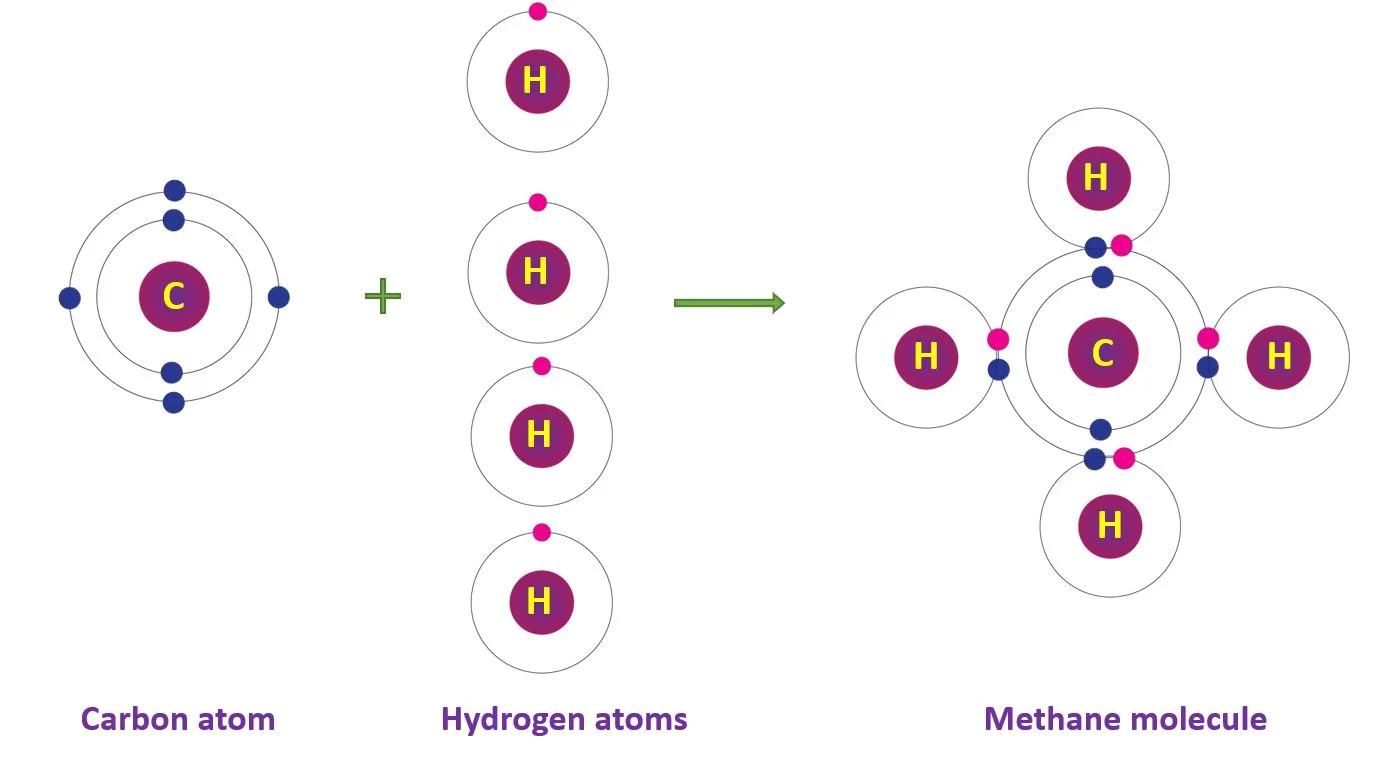
Methane (CH4) – a compound made of one carbon atom and four hydrogen atoms that are covalently bonded.
Nitrogen gas (N2) – two nitrogen atoms joined by a covalent bond. Note that N2 is an element, not a compound, because both atoms are of the same element. A compound must contain atoms of more than one element.
Sulfuric acid (H2SO4) – a compound made of two hydrogen atoms, one sulfur atom, and four oxygen atoms that are covalently bonded.
Ethanol (C2H5OH) – a compound made of two carbon atoms, six hydrogen atoms, and one oxygen atom that are covalently bonded.
Chlorine gas (Cl2) – two chlorine atoms joined by a covalent bond. Like nitrogen, Cl2 is an element rather than a compound.
Practice questions
- A white solid melts at 801 °C, does not conduct as a solid, and does conduct when molten. What type of bonding does it have, and how do you know?
- Explain why magnesium chloride conducts electricity when dissolved in water but paraffin wax does not.
- Diamond and iodine are both covalent. Why does diamond melt at over 3,000 °C while iodine sublimes gently on a warm bench?
- Why is an ionic crystal hard but brittle?
- Hydrogen chloride is a covalent gas, yet its solution in water conducts electricity well. Explain.
Answers: 1. Ionic. The very high melting point shows a giant lattice, and the fact that it conducts only when molten shows the charge carriers are ions rather than electrons. 2. Magnesium chloride is ionic, so dissolving it releases free-moving Mg2+ and Cl- ions that carry charge; paraffin wax is simple molecular, so its particles are uncharged and it produces no ions. 3. Diamond is a giant covalent lattice, so melting means breaking millions of strong covalent bonds; iodine is simple molecular, so only weak intermolecular forces between I2 molecules need to be overcome. 4. The ions are held in fixed positions by strong attractions in all directions, which makes it hard; but if a layer is pushed sideways, ions of the same charge come next to each other, repel, and the crystal splits. 5. It reacts with water to form H+ and Cl- ions, and those free-moving ions carry the charge.
Exam tips
- Never write that "covalent bonds are weak". Say the intermolecular forces are weak. Examiners specifically look for this distinction and refuse the mark without it.
- For any conductivity question, the phrase that scores is "the ions are free to move" – not "the electricity can get through".
- Use the word lattice when describing an ionic solid, and say the attractions act in all directions throughout it.
- If a question gives you data, use it: a high melting point plus conduction when molten means ionic; a low melting point and no conduction means simple molecular; a very high melting point and no conduction means giant covalent.
- Do not say ionic compounds are "always soluble". Say many are soluble in water, and be ready to name an insoluble one such as calcium carbonate.
- "Explain why" wants a chain of reasoning. Name the structure, name the force being overcome, then state the consequence.
Frequently asked questions about ionic and covalent compounds
What is the main difference between ionic and covalent compounds?
In an ionic compound, electrons are transferred from a metal to a non-metal, producing charged ions held in a giant lattice. In a covalent compound, electrons are shared between non-metal atoms, producing neutral molecules or a giant lattice of atoms. Almost every difference in their properties follows from that.
Why do ionic compounds have high melting points?
Because they are giant lattices held together by strong electrostatic attraction between oppositely charged ions, acting in all directions. Melting requires enough energy to overcome all of those attractions, which means a very high temperature.
Why do ionic compounds conduct electricity only when molten or dissolved?
Conduction needs charged particles that are free to move. In the solid the ions are locked in fixed positions in the lattice. Melting or dissolving breaks the lattice apart so the ions can move and carry charge.
Are covalent bonds weaker than ionic bonds?
No. An individual covalent bond is comparable in strength to an ionic bond and is often stronger. Simple molecular substances melt easily because melting only separates whole molecules from one another by breaking weak intermolecular forces, leaving the covalent bonds untouched.
Do all ionic compounds dissolve in water?
No. Many do, but silver chloride, barium sulfate and calcium carbonate are all ionic and essentially insoluble. Whether a compound dissolves depends on whether the attraction between water molecules and the ions can beat the attraction holding the lattice together.
Why is diamond a covalent substance with such a high melting point?
Diamond is a giant covalent structure, not a simple molecular one. Every carbon atom is bonded to four others by strong covalent bonds throughout the whole crystal, so melting it means breaking millions of covalent bonds rather than separating molecules.
How can you tell whether an unknown substance is ionic or covalent?
Look at its melting point and its conductivity. A high melting point with conduction when molten or dissolved points to ionic bonding. A low melting point with no conduction at all points to a simple molecular covalent substance. A very high melting point with no conduction points to a giant covalent structure.
Why is an ionic compound brittle?
Because the lattice depends on positive and negative ions alternating. If one layer of ions is pushed sideways relative to the next, ions of the same charge end up next to one another, repel strongly, and the crystal splits cleanly along that plane.
Can a compound contain both ionic and covalent bonding?
Yes. Ammonium chloride is a good example: the atoms inside the ammonium ion are joined covalently, but the ammonium ion and the chloride ion are held together ionically. The same is true of compounds containing sulfate, nitrate or carbonate ions.