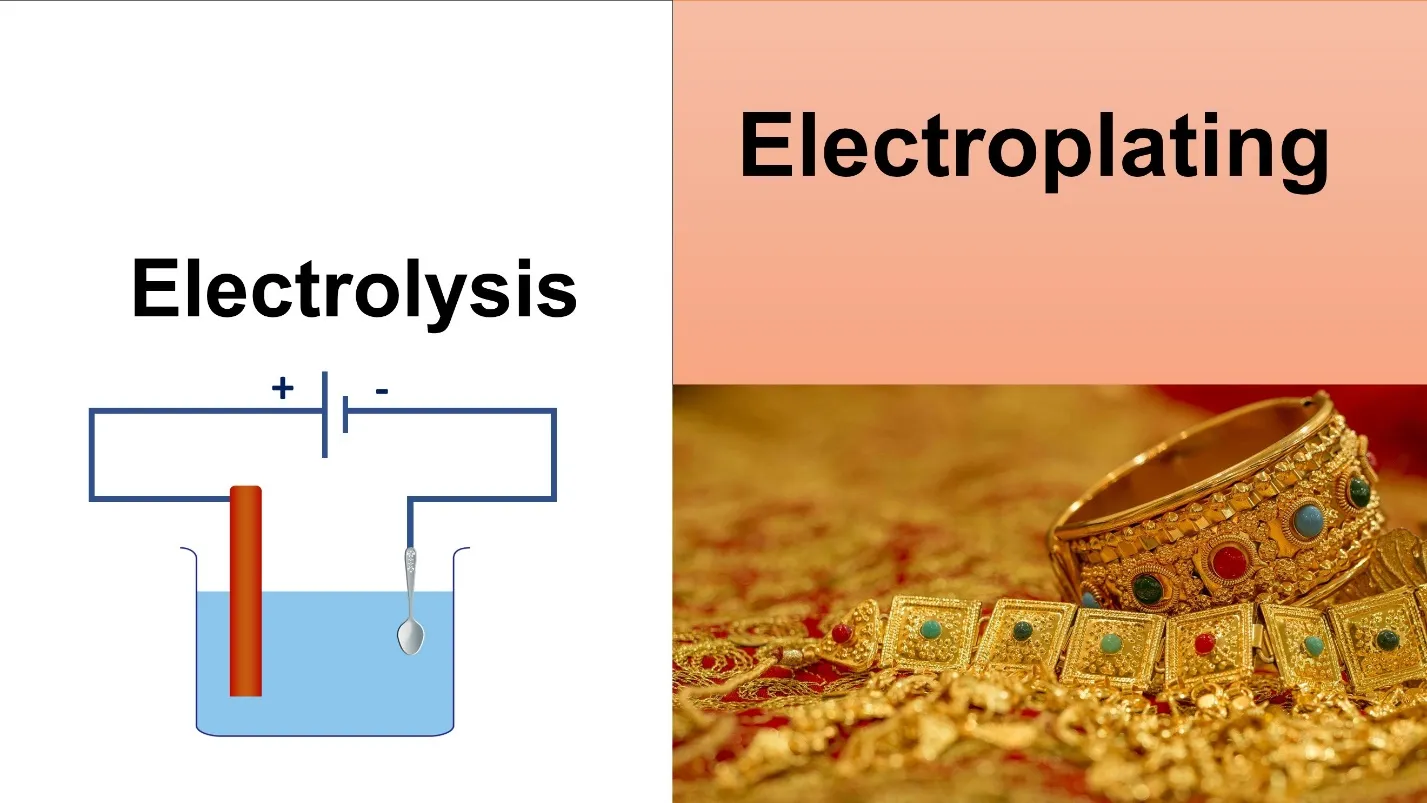
An electroplating experiment is one of the most satisfying practicals in school chemistry: you connect a spoon to a battery, lower it into blue copper sulfate solution, and watch a thin layer of copper form on its surface. This article covers electrolysis and electroplating from the ground up, with the full method, risk assessment, half-equations, evaluation and 12 worked calculations.
What is electrolysis?
Electrolysis is a chemical change caused by passing an electric current through an electrolyte. An electrolyte is an ionic compound that is either molten or dissolved in water, so that its ions are free to move. A direct current (DC) supply, such as a battery or a low-voltage power pack, pushes the ions towards the electrodes, where they are turned into new substances.
The electrolyte has to be melted or dissolved because the ions in a solid ionic crystal are locked in place and cannot carry charge. If you want to revise why, read our guide to the properties of ionic and covalent compounds. Pure water and sugar solution are poor electrolytes for the same reason: they contain almost no free ions.
Every electrolysis cell has two electrodes, which are the solid conductors dipping into the electrolyte:
- The anode is the positive electrode. Negative ions (anions) are attracted to it, and oxidation happens there: particles lose electrons.
- The cathode is the negative electrode. Positive ions (cations) are attracted to it, and reduction happens there: particles gain electrons.
A handy memory aid is OIL RIG: Oxidation Is Loss of electrons, Reduction Is Gain. In the wires, electrons travel from the anode round the circuit to the cathode, pushed by the supply. In the solution, charge is carried by the moving ions, not by electrons.
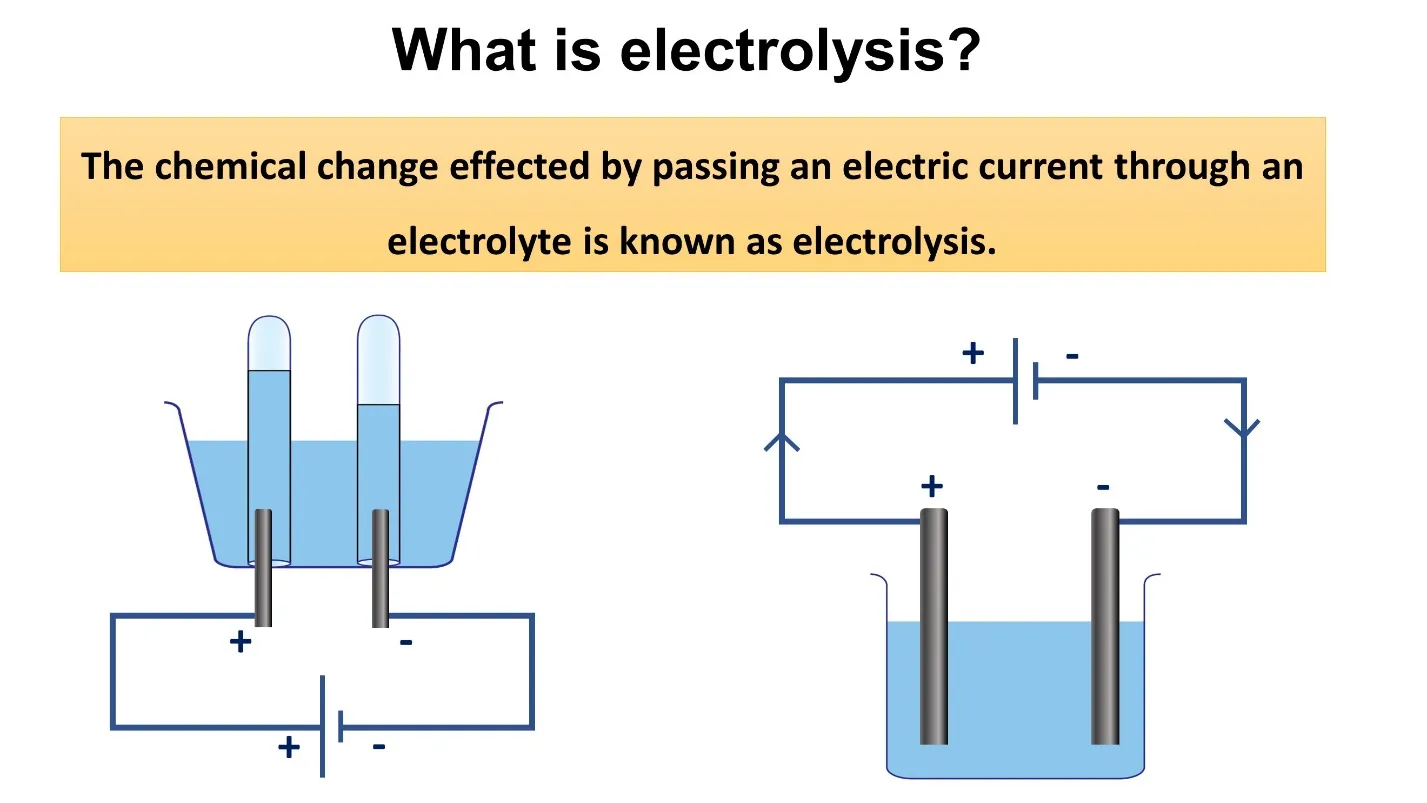
The diagram on the right shows a basic electrolytic cell: a beaker, a positive and a negative electrode, and a cell that drives the current. Notice that the arrows point from the anode to the positive terminal and from the negative terminal to the cathode. They show the direction in which electrons flow. Conventional current is defined the opposite way round the external circuit, so be careful when an exam diagram asks for “the direction of current”.
Electrolysis of water
The diagram on the left shows water being electrolysed. Hydrogen gas forms at the cathode and oxygen gas forms at the anode, and the tube over the negative electrode collects twice as much gas as the tube over the positive one. The overall equation explains the 2 : 1 ratio:
2H₂O(l) → 2H₂(g) + O₂(g)
Pure water conducts so poorly that a little dilute acid or salt is normally added to carry the current. For a deeper look at the theory, including molten salts, see our full guide: what is electrolysis?
Electrolysis vs electroplating: what is the difference?
Electroplating is electrolysis, but with a particular purpose and a particular arrangement of electrodes. Students often mix them up, so this comparison is worth learning.
| Electrolysis (in general) | Electroplating | |
|---|---|---|
| Purpose | Break down a compound into elements, or extract a metal | Coat an object with a thin layer of metal |
| Cathode (−) | Whatever electrode the cations reach | The object to be plated |
| Anode (+) | Often inert (graphite or platinum) | Usually the plating metal, which dissolves |
| Electrolyte | Molten or dissolved ionic compound | A solution containing ions of the plating metal |
| Example | Water into hydrogen and oxygen | Copper-plating a spoon in copper(II) sulfate |
What is electroplating?
Electroplating means using electrolysis to coat an object with a thin layer of another metal. The object to be plated is made the cathode, the plating metal is the anode, and the electrolyte is a solution that contains ions of the plating metal. For copper plating, that solution is copper(II) sulfate.
Why bother? There are three main reasons:
- Protection. A coating can reduce corrosion. Iron and steel rust, which is a chemical change you can explore in is iron rusting a chemical change?, and a layer of a more resistant metal helps to keep air and water away.
- Appearance. A shiny layer of chromium, nickel, silver or gold makes an object look better.
- Cost. A cheap metal core with a thin skin of an expensive or attractive metal costs much less than a solid object made entirely of the expensive metal.
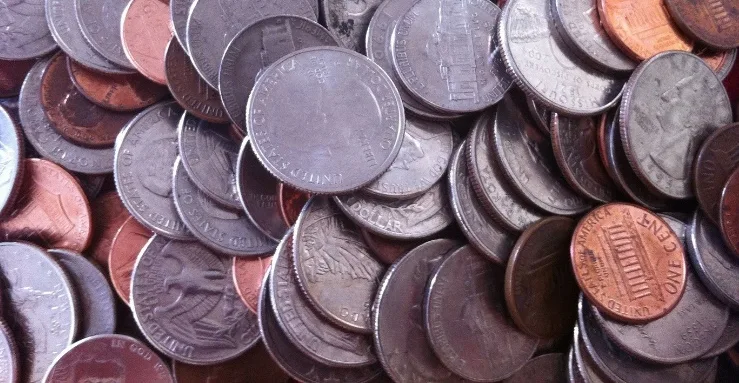
Coins are a good everyday example. Since 1992, UK 1p and 2p coins have been made of a mild steel core that is electroplated with copper. That is why a magnet sticks to them, and the change was made because of rising metal prices. The copper-coloured US one-cent coin in the photograph is copper-plated zinc (97.5% zinc, 2.5% copper) and has been since 1982. The US Mint struck its final circulating pennies on 12 November 2025, because each one cost nearly four cents to make. Pennies remain legal tender. The silver-coloured coins in the picture are not plated.
How electroplating works: three rules
You can work out any electroplating set-up from three rules. Learn them and you can answer most exam questions on the topic.
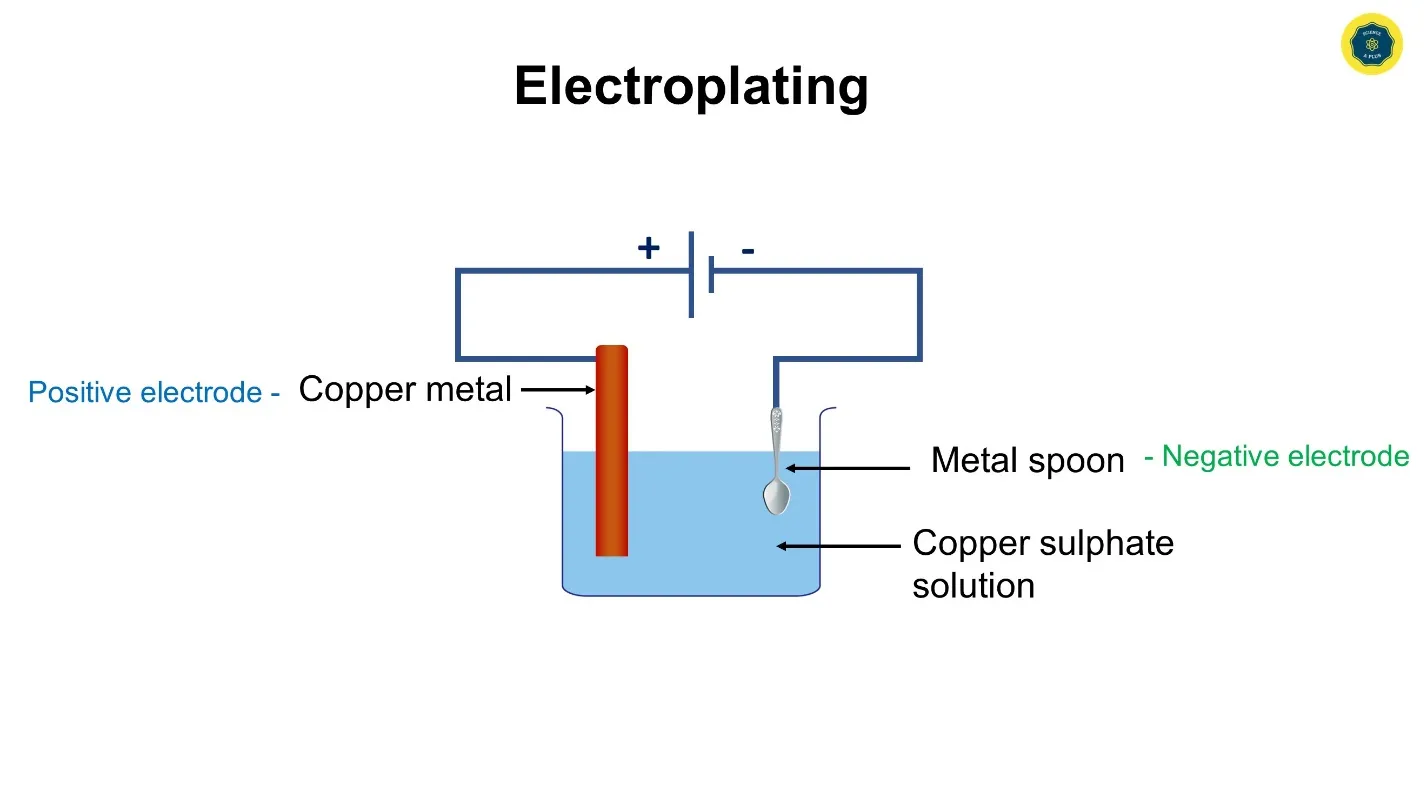
- The object to be plated is the cathode, connected to the negative terminal.
- The plating metal is the anode, connected to the positive terminal.
- The electrolyte is a solution containing ions of the plating metal.
When the current flows, copper ions in the solution are attracted to the negative spoon. Each Cu²⁺ ion picks up two electrons and becomes a copper atom on the surface. At the same time, atoms of the copper anode give up electrons and dissolve as new Cu²⁺ ions, replacing the ones that were used. The two half-equations are:
Cathode (reduction): Cu²⁺(aq) + 2e⁻ → Cu(s)
Anode (oxidation): Cu(s) → Cu²⁺(aq) + 2e⁻
Notice that the anode equation is simply the cathode equation reversed. We come back to the consequences of that in the explanation section later in this article.
Key terms: flip the cards
Electroplating experiment: copper-plating a spoon
Aim: to copper-plate a metal spoon by electrolysis of copper(II) sulfate solution, and to investigate how the mass of copper deposited depends on the current and the time.
This is the classic copper electroplating practical. The version below follows the set-up in our photographs, with a few extras (an ammeter and a balance) so that you can collect proper quantitative results. Read the risk assessment before you touch any apparatus.
Apparatus and chemicals
Tick each item as you collect it. Your ticks are remembered in your browser, so you can come back to the list at the bench.
- 250 cm³ beaker
- Copper strip (the anode, positive electrode)
- Metal spoon to plate (the cathode, negative electrode)
- About 150 cm³ of copper(II) sulfate solution, around 0.5 mol/dm³ (see our guide to making a standard solution if you need to prepare it)
- Two 1.5 V D-size cells in a holder, connected in series (about 3 V), or a low-voltage DC power pack set to no more than 6 V
- Connecting wires with crocodile clips
- Emery paper (fine sandpaper) for cleaning
- Top-pan balance (two decimal places or better)
- Stopwatch or timer
- Optional: ammeter and variable resistor, to control and measure the current
- Distilled water in a wash bottle, and paper towels
- Eye protection
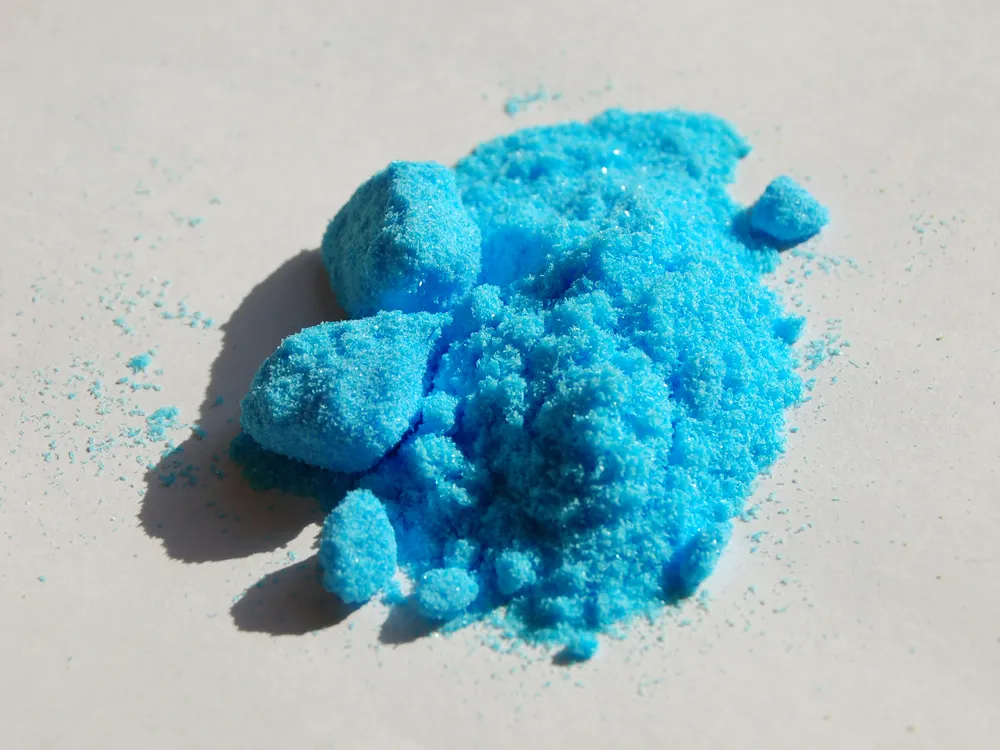
The blue electrolyte is made by dissolving copper(II) sulfate crystals in water. The crystals in the photograph are the pentahydrate, CuSO₄·5H₂O. They look harmless, but the solid and its solutions are classed as hazardous, so the next step matters.
Risk assessment
The hazard information below follows the CLEAPSS student safety sheet on copper and its compounds. Always follow your teacher’s own risk assessment, which will match your school’s equipment and concentrations.
| Hazard | Risk | Control measure |
|---|---|---|
| Copper(II) sulfate solution (about 0.5 mol/dm³) | Causes serious eye damage; irritates skin | Wear eye protection; use the lowest concentration that works; wash splashes off skin |
| Copper(II) sulfate solid | Harmful if swallowed; serious eye damage; very toxic to aquatic life; dust | Avoid raising dust; no eating or drinking in the lab; wash hands afterwards |
| Disposal | Toxic to aquatic life if it reaches drains | Do not pour down the sink; collect the solution for disposal as your teacher directs |
| Sharp edges on the copper strip | Cuts to fingers | Handle with care; smooth any sharp corners |
| Electricity | Shock or overheating wires | Low-voltage DC only (cells or a pack set to 6 V or less); never use the mains; switch off before changing the circuit |
| Propanone (if used for drying) | Highly flammable vapour | Teacher use only; no naked flames; ventilated room |
Method
Work through the steps in order and tick them off as you go.
- Put on eye protection. Rub the part of the spoon that will go into the solution with emery paper until it is clean and bright, then rinse it with distilled water and dry it. Grease or tarnish will stop the copper sticking.
- Weigh the dry spoon and record its mass. Weigh the copper strip too and record it.
- Pour copper sulfate solution into the beaker until it is about half full.
- Use a crocodile clip to connect the copper strip to the positive terminal of the supply, and another clip to connect the spoon to the negative terminal. If you are using an ammeter, put it in series in the circuit.
- Complete the circuit and lower both electrodes into the solution at the same time. Putting them in together matters: a steel spoon left in the solution before the current flows can react with the copper ions and be coated by displacement instead.
- Keep the electrodes apart, on opposite sides of the beaker, and make sure they never touch each other.
- Start the timer. Note the current from the ammeter at the start and again at the end. Run the cell for between 5 and 20 minutes.
- Switch off, lift the spoon out and rinse it gently in distilled water. Do not rub it.
- Let the spoon dry completely (a warm place is fine; propanone is only for teacher use), then reweigh it. Reweigh the copper strip as well.
- Record every reading in your results table. If time allows, repeat with a different current, keeping everything else the same.
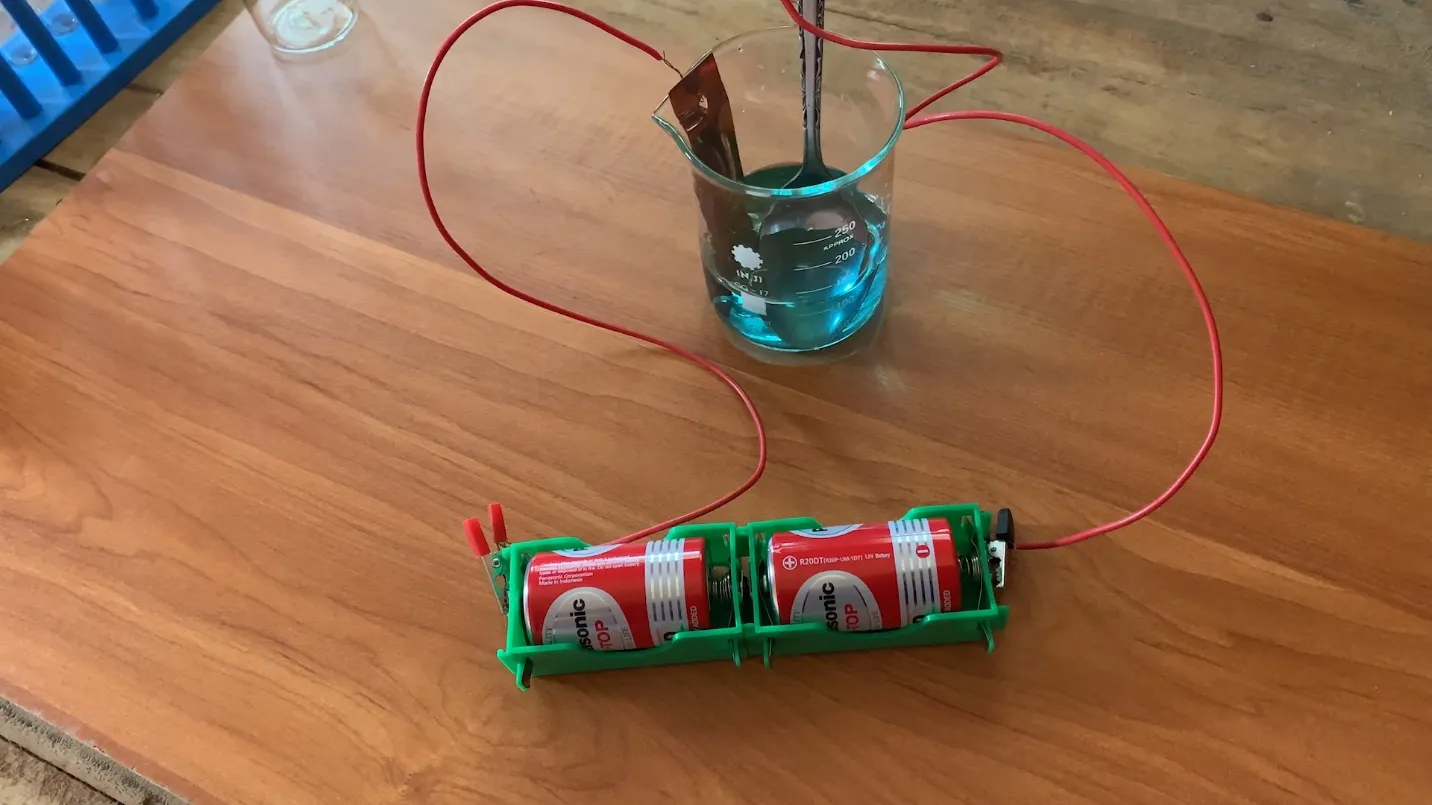
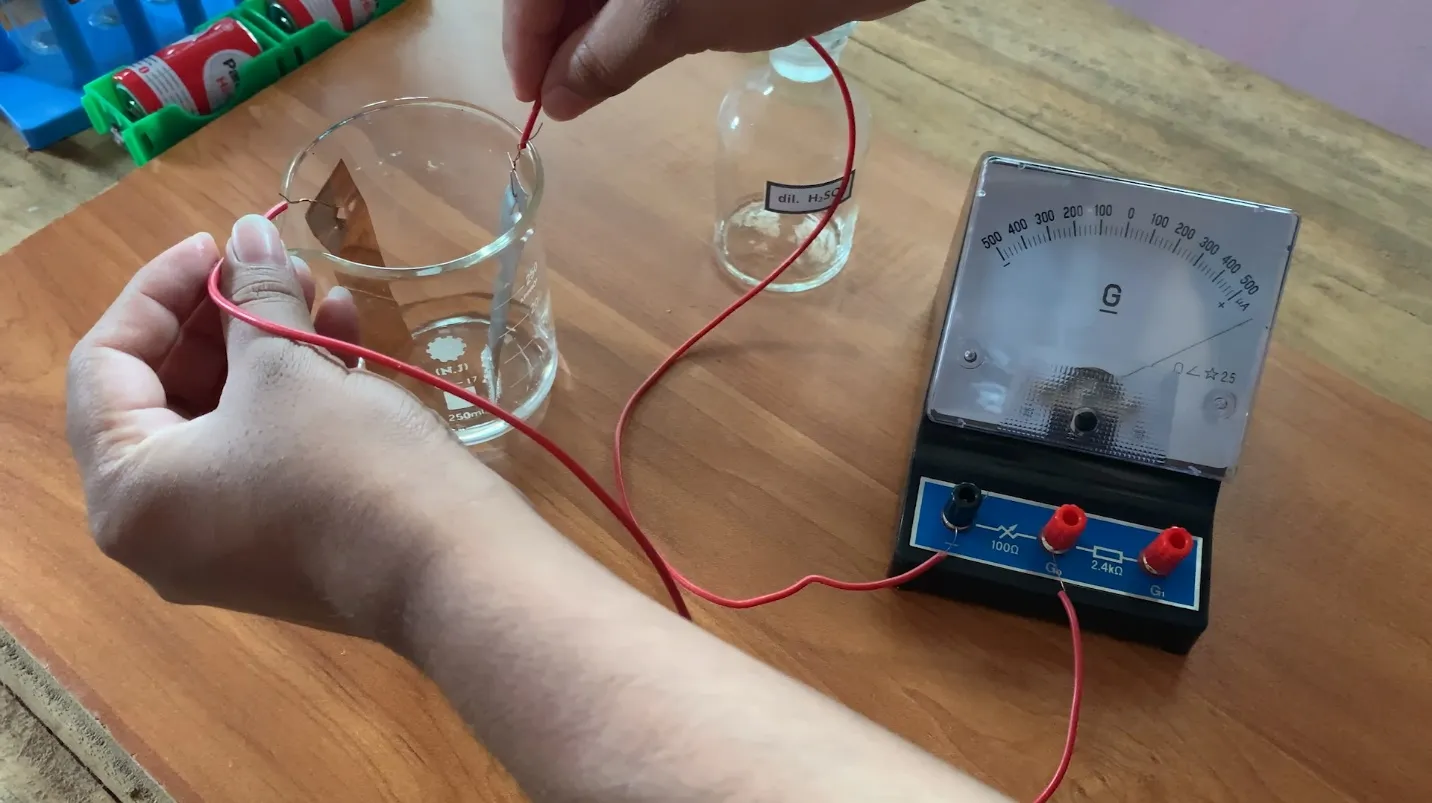
In our set-up the copper strip is wired to the positive end of two D cells in a green holder, and the spoon is wired to the negative end. Both dip into the 250 cm³ beaker of blue solution on the wooden bench. If you want to check which way current is drawn in circuit diagrams, our direction of current practical is a useful companion. The cells in this practical supply energy to push charge round. A simple cell does the reverse job: it turns chemical energy into electricity, whereas electrolysis uses electricity to cause a chemical change.
Variables
- Independent variable: the current (or the time, if you keep the current fixed).
- Dependent variable: the mass of copper deposited on the spoon, found from the change in its mass.
- Control variables: concentration and volume of the solution, temperature, the area of spoon in the liquid, the distance between the electrodes, and how carefully the spoon was cleaned.
Observations and results
What should you see? Within a few minutes the part of the spoon under the solution becomes coated with a copper-coloured layer. The copper strip slowly gets thinner and duller. The blue colour of the solution stays about the same. With copper electrodes at a low current, you should not see any bubbles of gas.
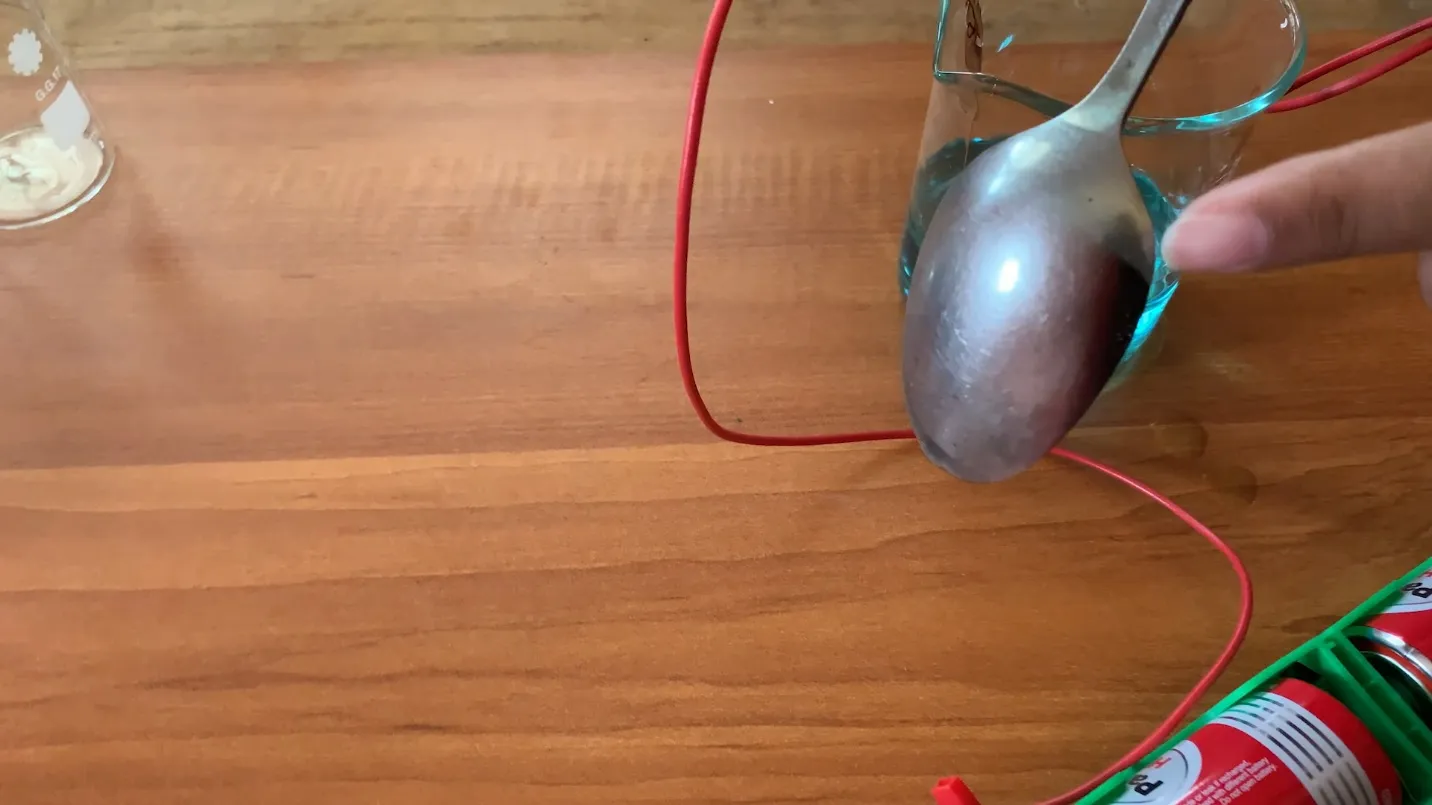
In our photograph the layer looks dark, almost black, rather than bright salmon-pink. That is a clue about the current. A dark, slightly powdery deposit is typical of a fast, uncontrolled current, and a much lower current gives a smoother, better-attached layer. We explain this properly in the next section, and it is a good point to include in an evaluation.
Here is a results table to copy into your notebook. The row labelled “predicted” is calculated from the current and time using Q = I × t, as in the maths questions later in this article.
| Current / A | Time / min | Mass of spoon before / g | Mass of spoon after / g | Mass gained / g | Mass of copper anode lost / g |
|---|---|---|---|---|---|
| — | — | — | — | — | — |
| — | — | — | — | — | — |
| — | — | — | — | — | — |
| Predicted mass (from Q = I × t): — | |||||
Fill in the table with your own readings. Plot a graph of mass gained against current if you have several runs: because the mass deposited is directly proportional to the current for a fixed time, you should get a straight line through the origin.
Explain why the two electrodes must not touch each other. (1 mark)
If they touch, the current flows straight from one electrode to the other instead of through the solution (a short circuit), so no copper is deposited on the spoon.
Why should both electrodes go into the solution at the same moment as the circuit is completed? (2 marks)
A steel spoon is above copper in the reactivity series, so if it sits in the solution without a current it can displace copper by a chemical reaction: Fe + Cu²⁺ → Fe²⁺ + Cu. That coating is poorly attached and not controlled by the current, so the experiment would no longer be a fair test of electroplating.
Explaining the results: electrolysis of copper sulfate with copper electrodes
Copper sulfate solution contains copper(II) ions (Cu²⁺), sulfate ions (SO₄²⁻) and the ions of water. When the current flows, the positive copper ions are attracted to the negative spoon. There, each Cu²⁺ ion gains two electrons and becomes a copper atom, which sticks to the surface:
Cathode: Cu²⁺(aq) + 2e⁻ → Cu(s) (reduction)
At the positive copper strip, copper atoms lose electrons and go into solution as ions:
Anode: Cu(s) → Cu²⁺(aq) + 2e⁻ (oxidation)
These two reactions explain every observation in the practical.
- The spoon gains mass because copper atoms are deposited on it.
- The anode loses mass because copper atoms are dissolving from it. With copper electrodes the mass gained by the cathode equals the mass lost by the anode.
- The blue colour stays about the same because Cu²⁺ ions enter the solution at the anode as fast as they leave it at the cathode.
- No gas appears at a low current, because copper is the only thing being oxidised and reduced.
It also explains why the mass deposited depends on the current. A bigger current means more electrons per second, so more copper ions are reduced each second. For a fixed time, the mass of copper deposited is directly proportional to the current.
What changes if the anode is graphite?
Now suppose you replace the copper strip with an inert graphite rod. Copper is still deposited at the cathode, but the anode no longer supplies copper ions. Instead, oxygen gas forms at the anode. In exam-board notation, the reaction can be written in either of two ways:
2H₂O(l) → O₂(g) + 4H⁺(aq) + 4e⁻
4OH⁻(aq) → O₂(g) + 2H₂O(l) + 4e⁻
The oxygen bubbles relight a glowing splint. Because copper ions are now being removed from the solution and not replaced, the blue colour slowly fades. Comparing the two set-ups is a favourite exam question: copper electrodes give no gas and a constant blue colour, whereas graphite gives oxygen at the anode and a paler solution.
A side-reaction to watch for
If your spoon is made of steel or iron, it sits above copper in the reactivity series. A more reactive metal displaces a less reactive one from its solution, so iron can react with copper ions before any current is applied:
Fe(s) + Cu²⁺(aq) → Fe²⁺(aq) + Cu(s)
That is why the method tells you to connect the circuit first and lower both electrodes in at once. Our guide to reactivity of metals and chemical equations explains how to predict displacement reactions like this one.
Explain why the copper anode loses mass during the experiment. (2 marks)
Copper atoms at the anode lose electrons (oxidation) and become Cu²⁺ ions that dissolve in the solution: Cu → Cu²⁺ + 2e⁻. Atoms leaving the electrode as ions means its mass decreases.
Why does the blue colour of the solution stay about the same when copper electrodes are used? (1 mark)
Copper ions are produced at the anode as fast as they are used up at the cathode, so the concentration of Cu²⁺ stays almost constant.
What makes a good copper plating?
A good plated layer sticks firmly, has an even thickness and looks shiny. Getting there depends on a few simple things:
- A clean surface. Cathodes are cleaned with emery paper before use, because dirt and grease prevent the copper from bonding.
- A low current. At the usual school current, the copper on the cathode is often powdery and uneven. With a much lower current the coating is shiny, impermeable and very difficult to rub off, which is exactly the property real electroplating needs.
- Steady conditions. A constant current and a stable electrolyte give a more even layer.
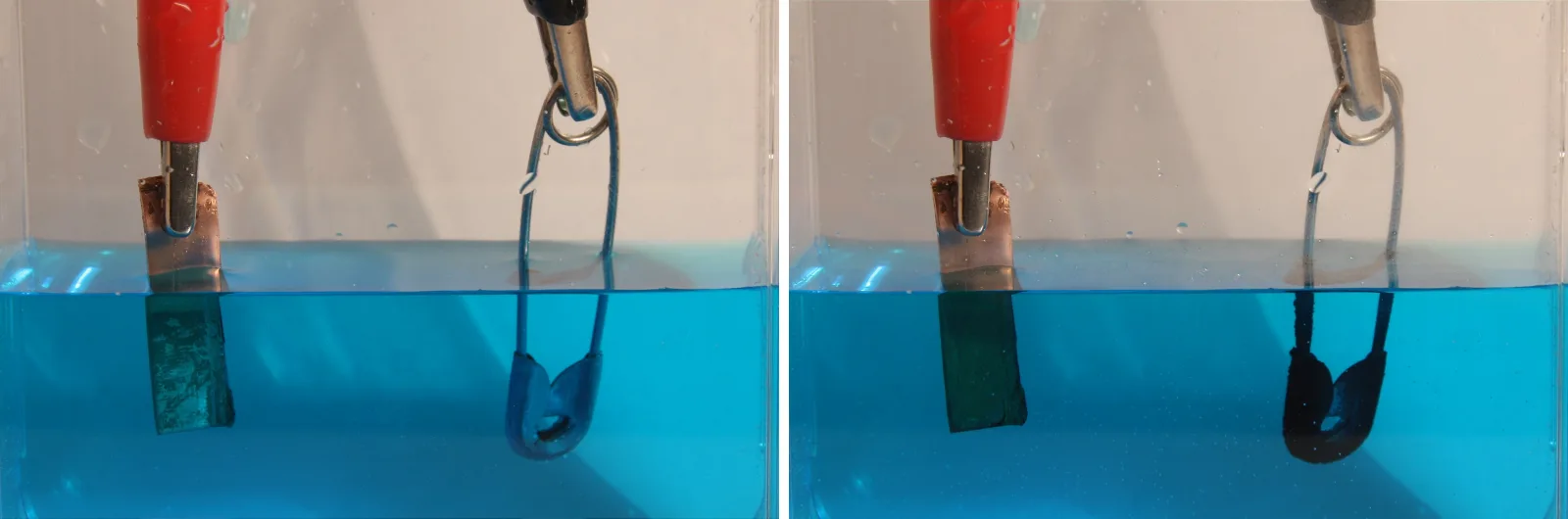
The photograph above shows the same principle on a smaller object. A steel safety pin (negative) and a copper strip (positive, on the left) sit in blue copper sulfate solution. After plating, the pin is coated in a layer of copper.
Evaluation: errors and improvements
Evaluation questions ask you to judge how reliable your results are and to suggest practical improvements. Use the table as a model.
| Source of error | Effect on results | Improvement |
|---|---|---|
| Current falls as the cells run down | Mass deposited is lower than predicted, and the current is not controlled | Use a power pack with an ammeter and variable resistor, and keep the current constant |
| Loose, powdery copper rinsed off or dropped | Mass gained is too low | Use a lower current to get a firmer deposit; rinse gently, do not rub |
| Spoon still wet when weighed | Mass gained is too high | Dry completely before reweighing |
| Grease or tarnish on the spoon | Patchy, poorly attached layer | Clean with emery paper and rinse before starting |
| Short running time | Mass change is very small compared with the balance’s resolution | Run for longer, or use a more sensitive balance |
| Only one trial | No way to spot anomalies | Repeat at least three times and calculate a mean |
Uses of electrolysis and electroplating
The same ideas that coat a spoon in your school laboratory are used on an industrial scale every day.
- Coins. UK 1p and 2p coins are copper-plated steel, as we saw earlier.
- Car parts. Chrome and nickel plating reduce corrosion and give a bright finish on car parts.
- Food cans. Steel cans are coated with a thin layer of tin by electrolytic tinning, which resists corrosion.
- Jewellery. A layer of gold on a cheaper metal gives the look of gold at a much lower cost. Learn more about the metal itself in our article on gold, the precious metal.
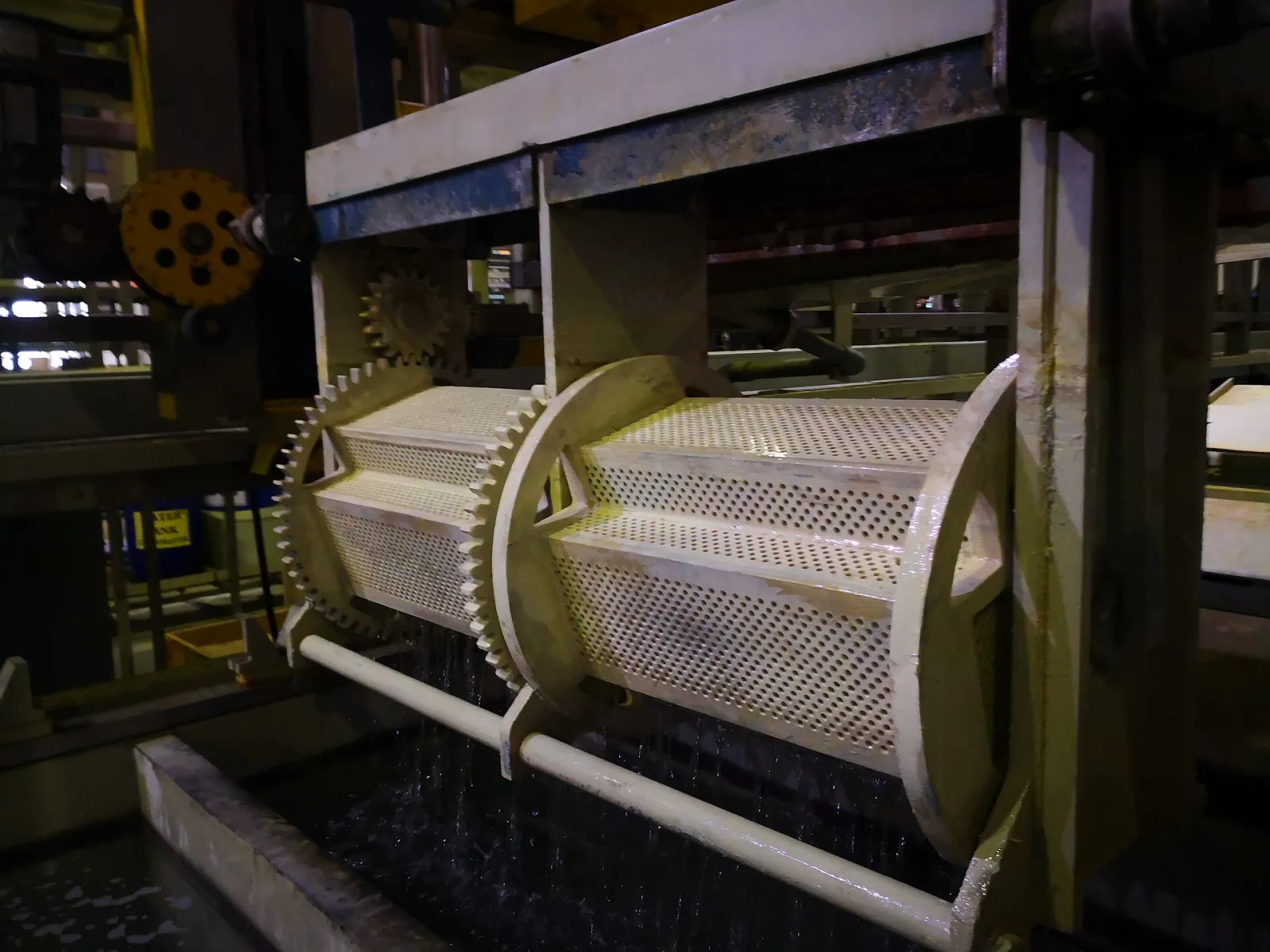
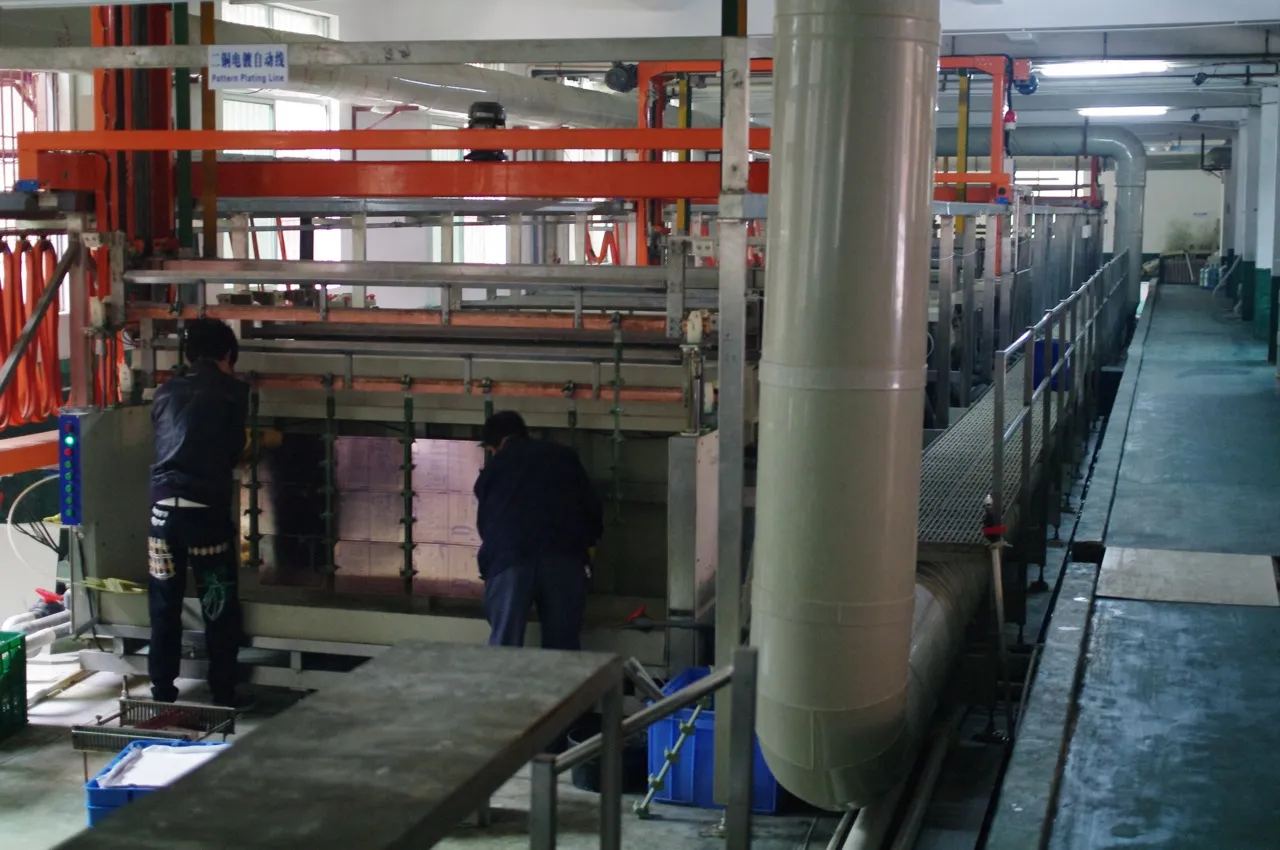
- Electronics. Copper electroplating builds up the copper layers on printed circuit boards.
- Purifying copper. In electrolytic refining, an impure copper anode (roughly 99 to 99.6% copper) dissolves, and pure copper, typically at least 99.95% and often 99.99%, deposits on the cathode. Insoluble impurities fall to the bottom as “anode slime”, which contains silver, gold and other valuable elements that are then recovered.
- Extracting metals. Aluminium is made by electrolysing aluminium oxide dissolved in molten cryolite, which lowers the operating temperature to roughly 900 to 1,000 °C (aluminium oxide alone melts above 2,000 °C). Aluminium forms at the cathode (Al³⁺ + 3e⁻ → Al), oxygen forms at the carbon anodes, which burn away and have to be replaced, and electricity is the main cost. Read more in our aluminium element facts. Sodium is extracted by electrolysis of molten sodium chloride.
- Making chemicals. Electrolysis of brine (sodium chloride solution) produces chlorine at the anode, hydrogen at the cathode and sodium hydroxide solution.
Maths practice questions
Electrolysis calculations follow the same short chain every time: find the charge, convert it into moles of electrons, convert that into moles of metal, then into a mass. Use F = 96 500 C mol⁻¹ and these relative atomic masses: Cu 63.5, Ag 107.9, Ni 58.7. Densities are Cu 8.96 g cm⁻³ and Ni 8.90 g cm⁻³. Tap each question to reveal the full worked solution, and try it on paper first.
Q = I × t (charge in C = current in A × time in s)
moles of electrons = Q ÷ F
moles of metal = moles of electrons ÷ charge on the ion
mass = moles × Ar
thickness = mass ÷ (density × area)
Question 1 (★): A current of 0.50 A flows for 20 minutes. Calculate the charge that has passed.
Convert the time to seconds: t = 20 × 60 = 1200 s.
Q = I × t = 0.50 × 1200 = 600 C.
Question 2 (★): How many moles of electrons are carried by 600 C?
Moles of electrons = Q ÷ F = 600 ÷ 96 500 = 0.0062176…
Answer: 6.22 × 10⁻³ mol (3 s.f.).
Question 3 (★★): Calculate the mass of copper deposited by a current of 0.50 A in 20 minutes (Cu²⁺ + 2e⁻ → Cu).
From the previous two answers, moles of electrons = 6.2176 × 10⁻³ mol.
Two electrons deposit one copper atom, so moles of Cu = 6.2176 × 10⁻³ ÷ 2 = 3.1088 × 10⁻³ mol.
Mass = 3.1088 × 10⁻³ × 63.5 = 0.19741 g.
Answer: 0.197 g (3 s.f.).
Question 4 (★★): Bench cell: two 1.5 V cells drive a current of 0.20 A through the spoon cell for 15 minutes. What mass of copper is deposited on the spoon?
t = 15 × 60 = 900 s; Q = 0.20 × 900 = 180 C.
Moles of electrons = 180 ÷ 96 500 = 1.8653 × 10⁻³ mol.
Moles of Cu = 1.8653 × 10⁻³ ÷ 2 = 9.3264 × 10⁻⁴ mol.
Mass = 9.3264 × 10⁻⁴ × 63.5 = 0.059223 g.
Answer: 0.0592 g (59.2 mg). Note that the 0.20 A is a stated value for the question, not a measured result.
Question 5 (★★): In an experiment with copper electrodes, the cathode gains 0.254 g in 30 minutes. Calculate the average current. What happens to the mass of the anode?
Moles of Cu = 0.254 ÷ 63.5 = 0.00400 mol.
Moles of electrons = 2 × 0.00400 = 0.00800 mol.
Q = 0.00800 × 96 500 = 772 C; t = 30 × 60 = 1800 s.
I = Q ÷ t = 772 ÷ 1800 = 0.42889 A. Answer: 0.429 A (3 s.f.).
The anode loses mass: in the ideal case it loses 0.254 g, the same as the cathode gains.
Question 6 (★★): How long does it take to plate 1.00 g of silver at a current of 0.80 A (Ag⁺ + e⁻ → Ag)?
Moles of Ag = 1.00 ÷ 107.9 = 9.2678 × 10⁻³ mol. One electron per ion, so moles of electrons = 9.2678 × 10⁻³ mol.
Q = 9.2678 × 10⁻³ × 96 500 = 894.35 C.
t = Q ÷ I = 894.35 ÷ 0.80 = 1117.9 s.
Answer: 1120 s, which is about 18.6 minutes (3 s.f.).
Pause here and try the calculator below. It uses the same chain of steps, so you can check your answers to Questions 3, 4 and 9, and then explore what happens to the mass and thickness when you change the current, the time or the metal.
Question 7 (★★★): The 0.197 g of copper from Question 3 spreads evenly over a spoon with an area of 20 cm². How thick is the layer?
Volume = mass ÷ density = 0.19741 ÷ 8.96 = 0.022032 cm³.
Thickness = volume ÷ area = 0.022032 ÷ 20 = 0.0011016 cm.
Answer: 11.0 µm (about 0.011 mm), since 1 cm = 10 000 µm.
Question 8 (★★): Current efficiency. Question 3 predicts 0.197 g of copper, but the dried spoon gained only 0.180 g. Calculate the percentage efficiency and suggest reasons for the difference.
Efficiency = actual ÷ predicted × 100 = 0.180 ÷ 0.19741 × 100 = 91.18.
Answer: 91% (2 s.f.). Using 0.197 g gives 91.4%, which is still 91%.
Reasons: loose, powdery copper fell off or was washed off; some hydrogen may have formed at the cathode instead of copper; weighing errors.
Question 9 (★★★): Nickel plating a car part. A current of 2.0 A flows for 1.0 hour and the part has an area of 150 cm² (Ni²⁺ + 2e⁻ → Ni). Calculate the mass and thickness of nickel.
Q = 2.0 × 3600 = 7200 C.
Moles of electrons = 7200 ÷ 96 500 = 0.074611 mol; moles of Ni = 0.074611 ÷ 2 = 0.037306 mol.
Mass = 0.037306 × 58.7 = 2.1898 g, so 2.19 g.
Volume = 2.1898 ÷ 8.90 = 0.24605 cm³; thickness = 0.24605 ÷ 150 = 0.0016403 cm, so 16.4 µm.
Question 10 (★★★): Two cells are connected in series, so they carry the same current. One cell deposits 0.127 g of copper. What mass of silver is deposited in the other?
Moles of Cu = 0.127 ÷ 63.5 = 0.00200 mol.
Moles of electrons = 2 × 0.00200 = 0.00400 mol (the same in both cells).
Silver needs one electron per atom, so moles of Ag = 0.00400 mol.
Mass = 0.00400 × 107.9 = 0.4316 g. Answer: 0.432 g.
Question 11 (★★): How many electrons pass round the circuit in Question 1 (a charge of 600 C)? The charge on one electron is 1.60 × 10⁻¹⁹ C.
Number of electrons = 600 ÷ 1.60 × 10⁻¹⁹ = 3.75 × 10²¹ electrons.
Check: 6.2176 × 10⁻³ mol × 6.02 × 10²³ = 3.74 × 10²¹. This is the same to rounding, because the Faraday constant equals the Avogadro constant multiplied by the charge on one electron.
Question 12 (★★★): Electrolysis of water, as in the left-hand diagram earlier. A current of 0.50 A flows for 20 minutes. Calculate the volumes of hydrogen and oxygen at room temperature and pressure (1 mol of gas occupies 24 000 cm³). Cathode: 2H⁺ + 2e⁻ → H₂. Anode: 4OH⁻ → O₂ + 2H₂O + 4e⁻.
Moles of electrons = 6.2176 × 10⁻³ mol (from Question 2).
Hydrogen: moles of H₂ = 6.2176 × 10⁻³ ÷ 2 = 3.1088 × 10⁻³ mol; volume = 3.1088 × 10⁻³ × 24 000 = 74.6 cm³.
Oxygen: moles of O₂ = 6.2176 × 10⁻³ ÷ 4 = 1.5544 × 10⁻³ mol; volume = 1.5544 × 10⁻³ × 24 000 = 37.3 cm³.
The volumes are in the ratio 2 : 1, just as the equation predicts.
The same charge-and-moles reasoning applies to other experiments. For example, the lime fruit cell practical uses Q = I × t to work out how much charge a homemade cell delivers.
Common mistakes: forgetting to convert minutes to seconds (the charge comes out 60 times too small); using two electrons for silver; putting the object on the positive terminal; saying electrons flow through the solution (ions carry the charge there).
Once you can answer these confidently, you are ready for the next practical in this series: commonly used chemical indicators in the laboratory.
Frequently asked questions about electrolysis and electroplating
What is electroplating?
Electroplating is the use of electrolysis to coat an object with a thin layer of another metal. The object is the cathode, the plating metal is the anode, and the electrolyte is a solution of the plating metal’s ions. It is used to resist corrosion and to improve appearance.
Which electrode is the object in electroplating?
The object to be plated is always the cathode, which is the negative electrode. It is connected to the negative terminal of the power supply, so that positive metal ions from the solution are attracted to it and are reduced to metal atoms on its surface.
Why is copper sulfate used to copper-plate a spoon?
Copper sulfate dissolves in water to give copper(II) ions, which are the particles that become copper metal at the cathode. An electrolyte for electroplating must contain ions of the metal being deposited, and dissolved copper sulfate also conducts electricity well enough for the experiment.
What is the difference between electrolysis and electroplating?
Electrolysis is the general process of using an electric current to decompose a molten or dissolved ionic compound. Electroplating is a particular use of electrolysis in which a metal object is coated with another metal, using a plating-metal anode and a solution containing its ions.
Why does copper plating turn dark or black?
A dark, powdery layer usually means the current was too high. Copper then deposits as tiny loose particles instead of a smooth layer. Using a much lower current, and cleaning the object first, gives a shiny coating that is firmly attached and very difficult to rub off.
How long does it take to copper-plate a spoon?
A visible copper layer appears within a few minutes, and the thickness grows with current multiplied by time. For example, at 0.20 A for 15 minutes the ideal mass of copper is only about 59 mg, as worked out in Question 4. Longer times and steadier currents give a better coating.
Is copper sulfate dangerous?
Yes, take care. According to CLEAPSS, solutions of about 0.5 mol/dm³ are skin irritants and cause serious eye damage, and the solid is harmful if swallowed and very toxic to aquatic life. Wear eye protection, wash your hands, and do not pour it down the sink.
How do you calculate the mass of metal deposited in electrolysis?
Calculate the charge with Q = I × t, with time in seconds. Divide by 96 500 to get moles of electrons, divide by the charge on the metal ion to get moles of metal, and multiply by the relative atomic mass. For 0.50 A for 20 minutes, copper gives 0.197 g.
What are the main uses of electroplating?
Electroplating is used to protect metals from corrosion and to improve their appearance. Examples include copper-plated steel 1p and 2p coins, chrome and nickel plating on car parts, tin-coated steel food cans, gold-plated jewellery, and the copper layers on printed circuit boards.