Archaeopteryx was a magpie-sized, feathered animal that lived about 150 million years ago in what is now southern Germany. It had wings and flight feathers like a bird, but also sharp teeth, clawed fingers and a long bony tail like a small dinosaur. Today most scientists call it a feathered dinosaur, and many still place it on the very first branch of the bird family tree.
So is Archaeopteryx a bird, a reptile or a dinosaur? The honest answer is a bit of all three, depending on how you define each word. This guide explains the evidence fossil by fossil, from the first feather found in 1861 to a stunning specimen described in 2025.
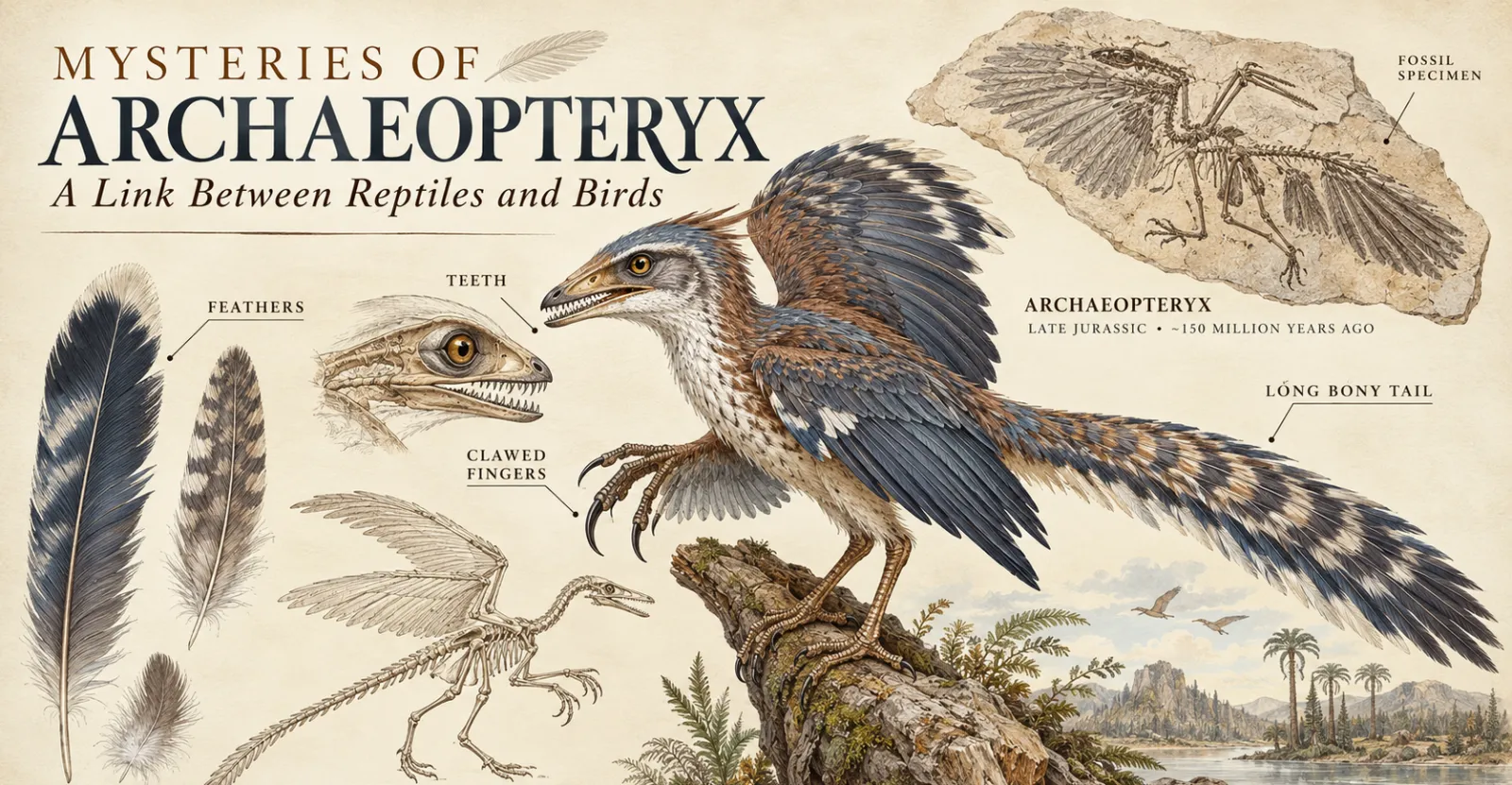
What was Archaeopteryx?
The name comes from two Greek words meaning “ancient” and “feather” or “wing”. It is often shortened to “the first bird”, and for well over a century that is how textbooks described it. The Archaeopteryx fossil record is small but remarkably detailed, and it is still changing how we think about the origin of birds.
The Natural History Museum in London describes it as about 0.5 m long, roughly the size of a magpie. Published estimates give a wingspan of up to about 70 cm and a body mass of around 0.5–1 kg. It was a meat-eater, probably feeding on small animals such as insects, and it was most likely active in daylight.
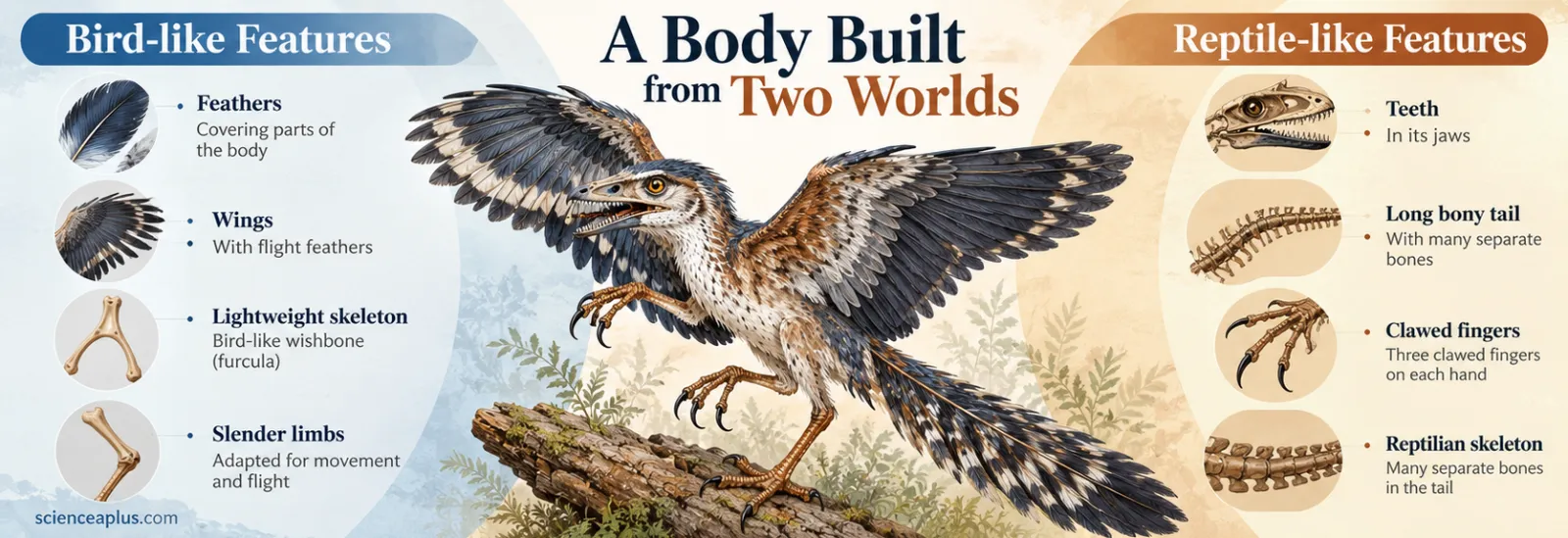
Its body was a patchwork. Here is the quick version before we look at the evidence in detail.
- Like a bird: feathers, including long flight feathers on the arms, and a wishbone (furcula).
- Like a small dinosaur: jaws with sharp teeth, three clawed fingers on each hand and a long tail supported by many separate bones.
An animal with a mixture of features from two different groups is called a transitional fossil. Archaeopteryx is probably the most famous example in the world. If you want a wider look at what living birds share with dinosaurs, see our guide to what birds and dinosaurs have in common.
Where and when did Archaeopteryx live?
Every known Archaeopteryx body fossil comes from limestone quarried near the town of Solnhofen in Bavaria, southern Germany. The rock formed in the Late Jurassic. Different sources date it slightly differently. Studies of the Solnhofen Limestone give about 150.8–148.5 million years ago, while the Natural History Museum gives 149–145 million years ago. A safe round figure is about 150 million years ago.

At that time Europe was not one big landmass. It was an archipelago of islands in a shallow, warm, tropical sea, much closer to the equator than it is today. Fine lime mud settled in quiet lagoons. When animals fell into this mud, it buried them gently and preserved details that are lost almost everywhere else, including delicate feathers and insects.
Geologists call a place with exceptional fossil preservation a Lagerstätte. The Solnhofen limestone is one of the most famous. For centuries the thin, smooth slabs were quarried for building and for printing, which is how workers kept finding fossils.
The same limestone has produced pterosaurs, fish, crustaceans and sea lilies. If you enjoy Mesozoic seas, you may like our article on aquatic monsters of the Jurassic. Archaeopteryx itself lived about 85 million years before the mass extinction that ended the age of the big dinosaurs, a story we cover in the five mass extinctions.
The discovery: a feather, then a skeleton
The story begins in 1860 or 1861, when a single fossil feather was found in the Solnhofen limestone. The German palaeontologist Hermann von Meyer described it in 1861 and gave the animal the name Archaeopteryx lithographica, meaning “ancient wing from the printing stone”. The two halves of the rock are now split between the Bavarian State Collection in Munich (the main slab) and the Museum für Naturkunde in Berlin (the counterslab).
A feather alone proves very little, and scientists have argued about it ever since. In 2019 a laser imaging study reported that its structure did not match other Archaeopteryx feathers, which suggested it came from a different dinosaur. A reply in 2020 disagreed. A 2012 study of its pigment structures concluded that it was probably black.
The same year, 1861, brought the first skeleton, now called the London specimen. It was found near Langenaltheim and bought by the British Museum in 1862 (its natural history collections later became the Natural History Museum), as part of a collection of about 1,750 Solnhofen fossils purchased from a doctor, Karl Häberlein, for £700. It still has feather impressions around its arms and tail, but most of its head and neck are missing. The anatomist Richard Owen described it in 1863.
The second great find came later. A farmer named Jakob Niemeyer found the Berlin specimen in 1874 or 1875 near Eichstätt. It was sold and resold, offered for sale between 1877 and 1881, and finally bought by the Berlin museum for 20,000 Goldmark. The money came from the industrialist Ernst Werner von Siemens. Wilhelm Dames described it in 1884. It was the first specimen with a complete head, and it is still among the most complete ones.
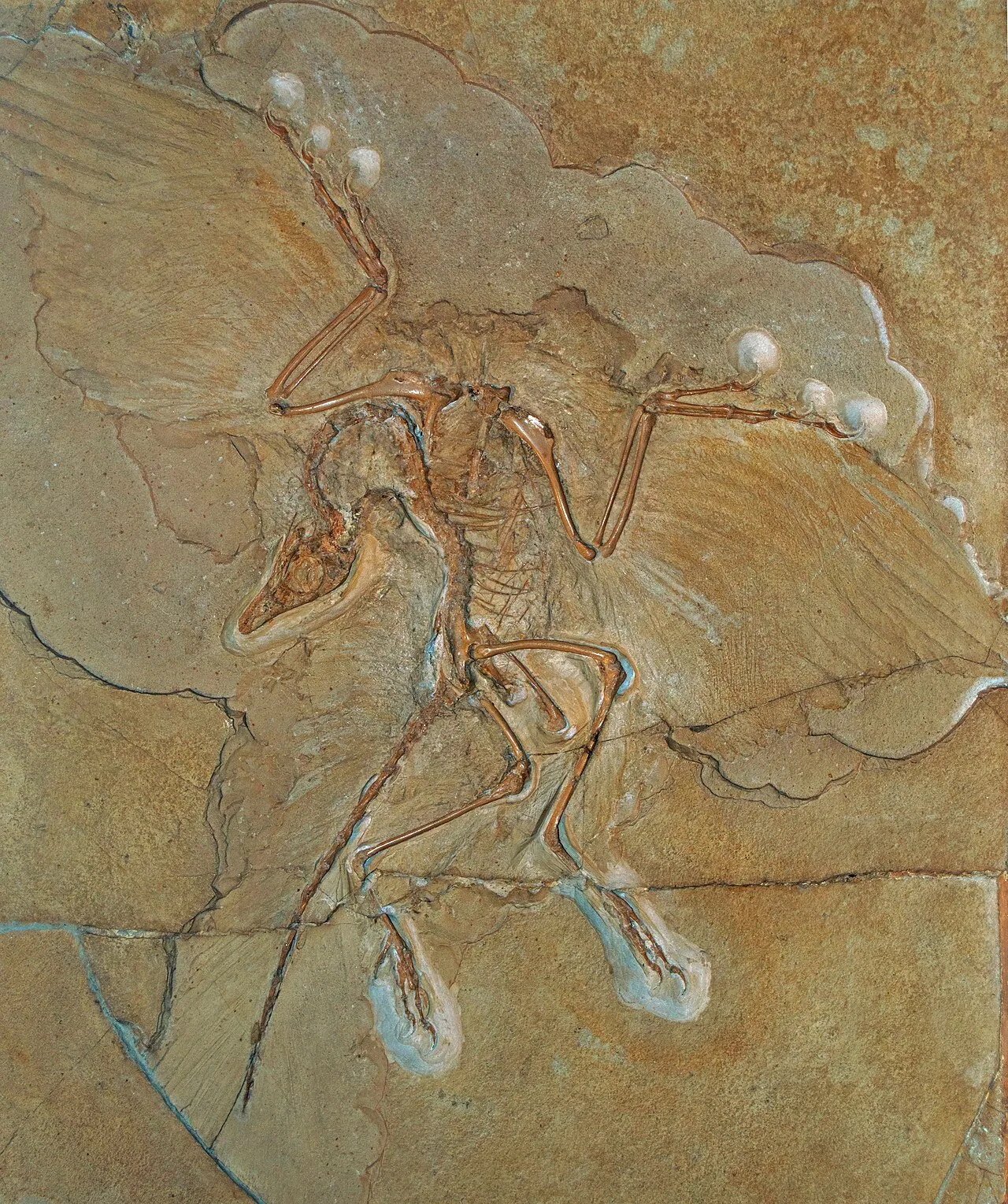
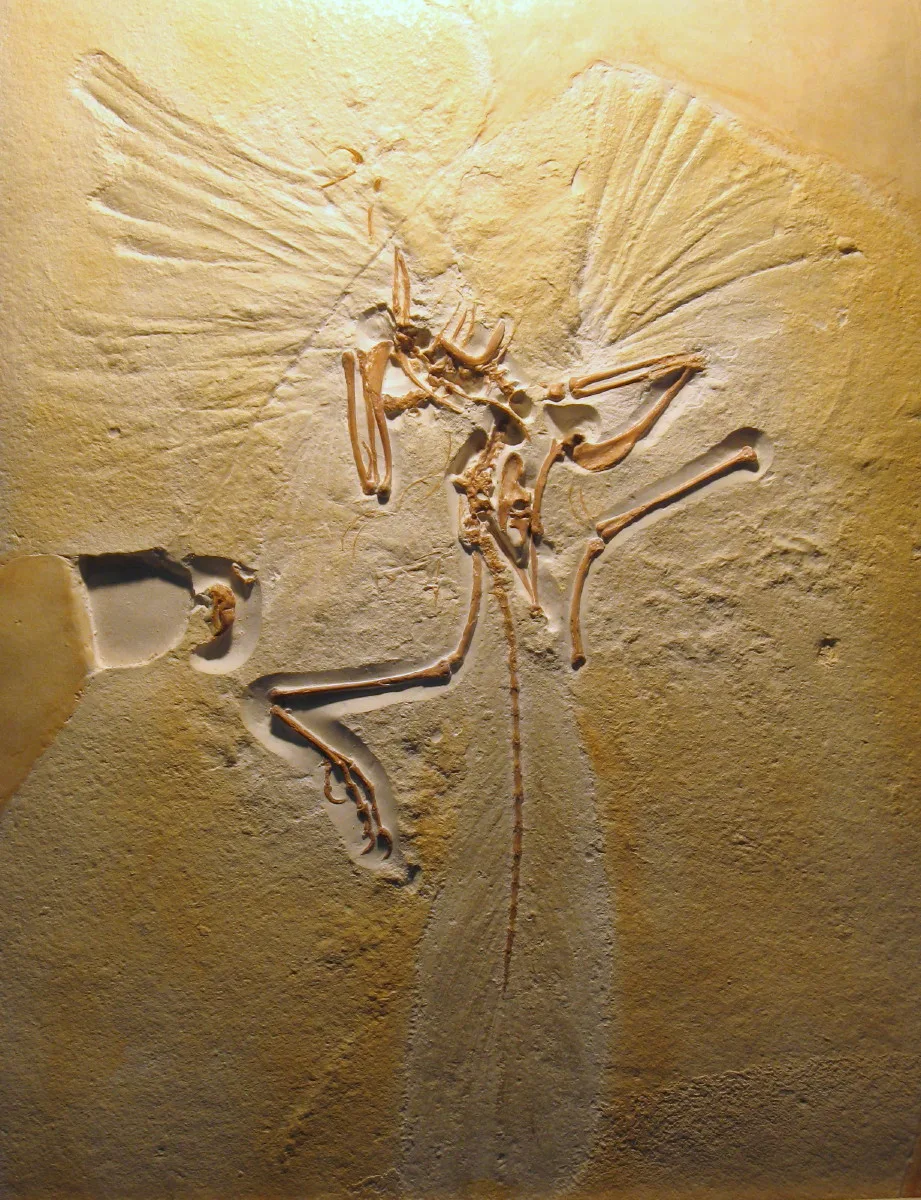
You will sometimes see the Berlin specimen dated to “1877”. That is the year it was first offered for sale, not the year it was found. This is a good example of why you should check dates in more than one source.
Why was the discovery so important?
Charles Darwin published On the Origin of Species in 1859. Only two years later, a fossil appeared that looked exactly like what his theory predicted: an animal with the features of two groups. It was not proof on its own, but it gave supporters of evolution a vivid, solid example. Darwin referred to Archaeopteryx in later editions of his book.
The next section looks at how many Archaeopteryx fossils we now have, and why the latest one, in Chicago, has caused so much excitement.
How many Archaeopteryx fossils are there?
As of October 2026, 14 Archaeopteryx body fossils are usually counted, plus the original 1861 feather. The 14th is the Chicago specimen, which the Field Museum began to display in 2024 and which was formally described in the journal Nature on 14 May 2025. We found no report of a 15th specimen.
That number comes with a warning. Scientists do not all agree on what counts. The Haarlem specimen was found in 1855 and wrongly identified as a flying reptile (a pterosaur) in 1857. John Ostrom corrected this in 1970. In 2017 some researchers argued that it belongs to a separate genus called Ostromia. Another fossil, the Maxberg specimen, has been missing since its owner died in 1991. So “14” is the common count, not a law of nature.
The best-known specimens
| Name | Found | Why it matters | Where it is kept |
|---|---|---|---|
| Feather | 1860 or 1861 | First Archaeopteryx fossil named; probably black | Bavarian State Collection, Munich (main slab); Museum für Naturkunde, Berlin (counterslab) |
| London | 1861 | First skeleton; the reference specimen for the species | Natural History Museum, London |
| Berlin | 1874 or 1875 | First with a complete head; most famous | Museum für Naturkunde, Berlin |
| Haarlem | 1855 | Found first, but misidentified for over a century | Teylers Museum, Haarlem |
| Eichstätt | 1951 | Very detailed head | Jura Museum, Eichstätt |
| Maxberg | 1956 | Torso with feathers; now missing | Unknown (missing since 1991) |
| Solnhofen | probably 1960s (described 1988) | Largest known specimen | Bürgermeister-Müller Museum, Solnhofen |
| Munich | 1992 | Almost complete skeleton | Paläontologisches Museum, Munich |
| Thermopolis | Described 2005 | Best-preserved head and feet | Wyoming Dinosaur Center, USA |
| Chicago | Acquired 2022 | Nearly complete; first to show tertial feathers | Field Museum, Chicago, USA |
The table leaves out several fragments, including the fossil called “chicken wing” (a single wing found in 2000) and the Daiting specimen. Daiting was found in 1990 in a slightly younger rock layer, bought by a collector in 2009 and moved to a museum in Denmark in 2022. The 11th specimen was announced in 2011 and described in 2014. It showed feathers on the upper and lower legs. A 13th, described in January 2025, is a fragment of an arm and shoulder.
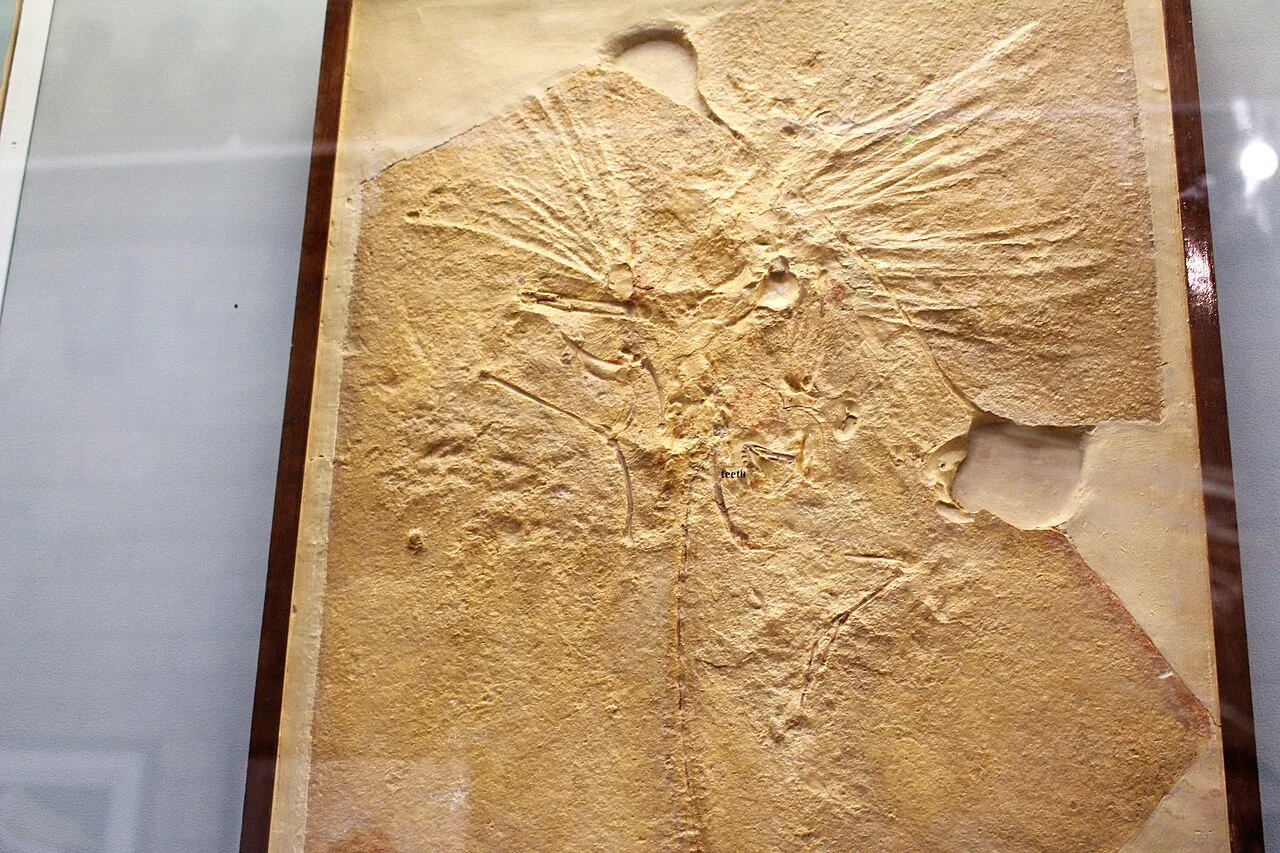
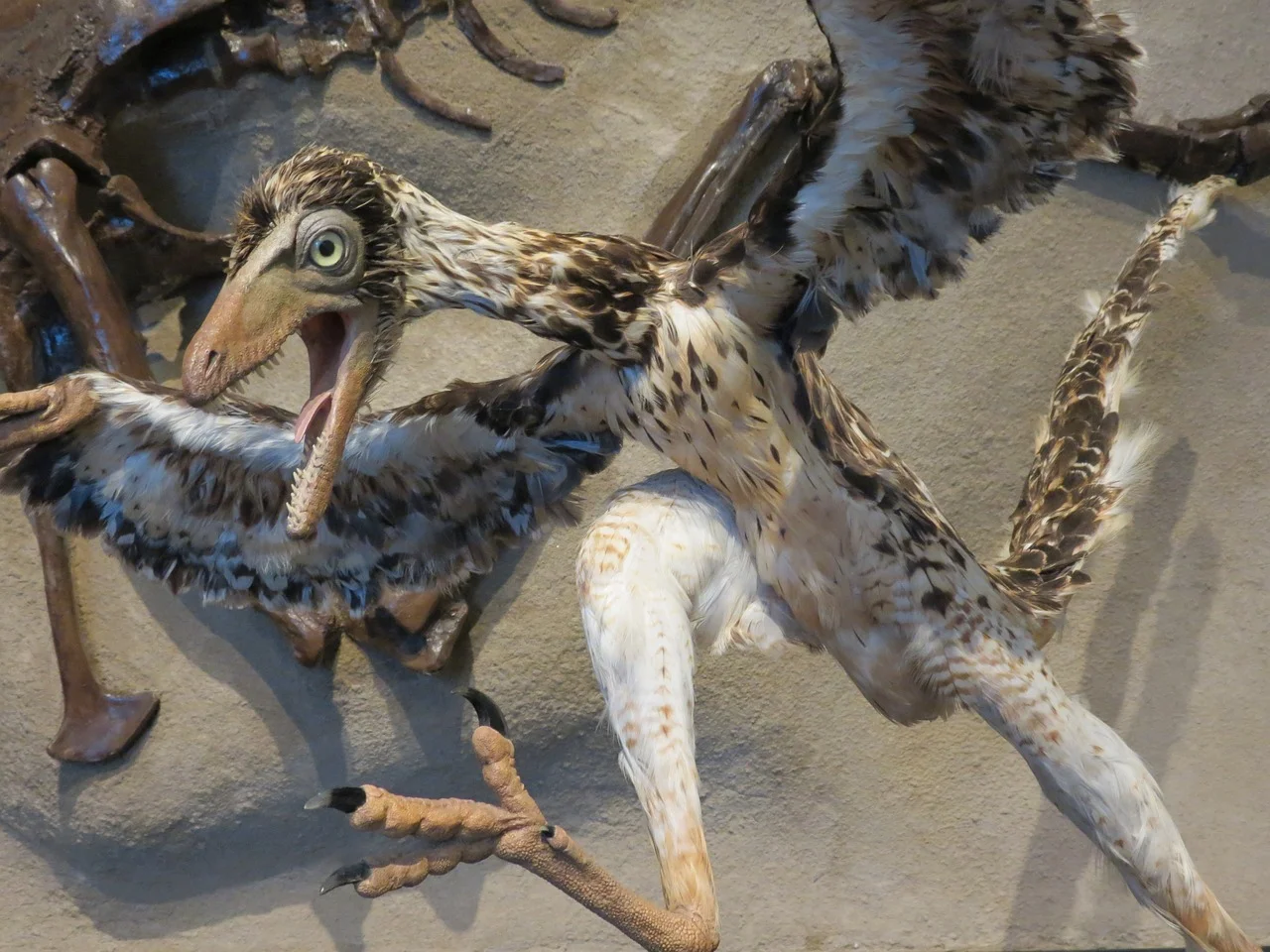
Special fossils worth knowing
The Thermopolis specimen: a hidden “killing claw”
This fossil was described in the journal Science on 2 December 2005. It has the best head and feet of any specimen, and it showed something new. The second toe could be held up and back, away from the ground, like the “killing claw” of small hunting dinosaurs such as the dromaeosaurids. Its first toe was not fully reversed like the grasping toe of a perching bird. That suggests that Archaeopteryx was not built for perching in the way a robin is. It probably spent plenty of time on the ground or climbing tree trunks.
The 12th specimen: almost no feathers
A collector found this fossil in 2010 at Schamhaupten, but it was announced only in 2014 and described in 2018. It is a complete, mostly connected skeleton with a skull. It is one of the few specimens with no preserved feathers, and it comes from a slightly older rock layer than the others. Fossils like this remind us that a missing feather in the rock does not prove the animal had none.
The Chicago specimen: the best yet
The Field Museum in Chicago bought this fossil in 2022. It came from limestone near Solnhofen, was found before 1990 and had been in private hands. The museum’s team, led by chief preparator Akiko Shinya, spent about 1,300 hours removing rock from it, according to Science News.
The result is a nearly complete specimen that has not been crushed flat, which is rare for fossils. Researchers led by Jingmai O’Connor studied it with ultraviolet light and CT scans. Their findings include:
- Tertial feathers. These are long feathers on the upper arm that fill the gap between the body and the wing. Scientists had guessed Archaeopteryx had them, but this was the first time they were actually seen in an Archaeopteryx specimen.
- Soft tissue. UV light made skin and feather traces glow, because the chemistry of Solnhofen fossils fluoresces.
The team concluded that Archaeopteryx could fly in some way, but by modern standards it was a poor flier, and it spent a lot of time on the ground. They also argued that flight evolved more than once among feathered dinosaurs. This is one view in an active debate. We return to it in the flight section.
Check your understanding
Why does the number of Archaeopteryx fossils depend on who is counting? (2 marks)
Scientists disagree about which fossils belong in the genus. The Haarlem specimen was reclassified as a separate genus by some researchers in 2017, and the Maxberg specimen is missing, so the total can be 13 or 14, plus the 1861 feather.
What did the Thermopolis specimen show about Archaeopteryx’s feet? (2 marks)
It had a second toe that could be raised like the “killing claw” of dromaeosaurid dinosaurs, and its first toe was not fully reversed like that of a perching bird.
What new feature did the Chicago specimen reveal? (1 mark)
Tertial feathers, the long feathers on the upper arm that fill the gap between the body and the wing.
Fossil finds like these are the raw material for the classification of animals. For the basics, see our guide to the five groups of vertebrates and our list of all dinosaur species.
A mosaic of features: bird, reptile or dinosaur?
Archaeopteryx is called a mosaic animal, because its body combines features of two groups, like pieces of a picture. The simplest way to organise them is a table.
| Body part | What Archaeopteryx had | Which group does it match? |
|---|---|---|
| Feathers | Flight feathers on arms and tail, shorter feathers on the body and legs | Birds (but some dinosaurs had feathers too) |
| Wishbone | A boomerang-shaped furcula | Birds and some dinosaurs |
| Jaws | Small sharp teeth | Dinosaurs. Modern birds have a toothless beak |
| Hands | Three separate clawed fingers | Dinosaurs. Modern birds have fused hand bones and, in most species, no claws on the wing |
| Tail | Long, with many separate bones and feathers along it | Dinosaurs. Modern birds have a short, fused tail bone |
| Second toe | Could be raised off the ground (the “killing claw”) | Small hunting dinosaurs such as dromaeosaurids |
| Breastbone | No large bony keel; possibly cartilage | Dinosaurs. Strong flying birds have a big keel for flight muscles |
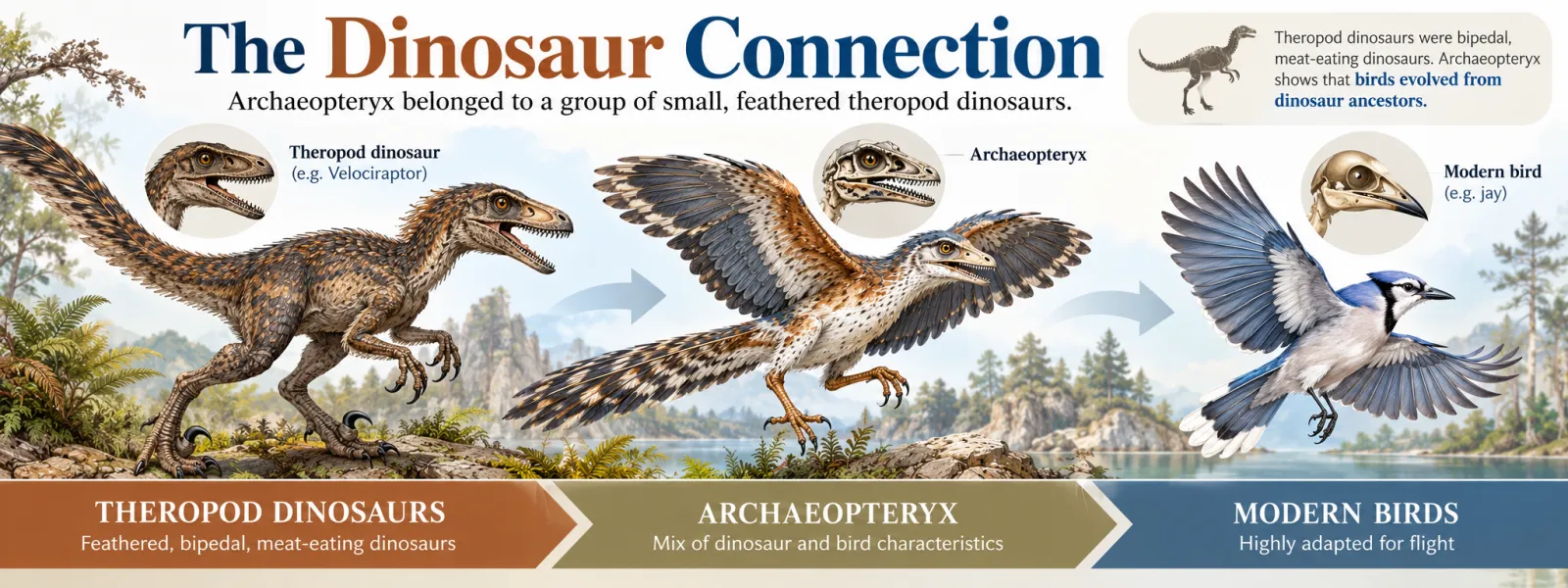
The old “reptile-like” label on pictures of Archaeopteryx is a little misleading. Teeth, claws and a bony tail are indeed features that living reptiles have, but they are best described as dinosaur features. Birds did not leave the dinosaur family. They are living dinosaurs, a special group of small, feathered, meat-eating dinosaurs called theropods that survived the mass extinction.
Many people also ask whether dinosaurs count as reptiles. In the way scientists classify life by ancestry, yes: dinosaurs belong to the reptile group, and so do birds. In everyday speech, “reptile” usually means lizards, snakes, crocodiles and turtles, which is why the question causes confusion.
The skull and teeth
Modern birds have a beak and no teeth. Archaeopteryx had jaws lined with small, sharp, pointed teeth, ideal for catching and holding small prey. The best-preserved heads come from the Berlin and Thermopolis specimens. They look more like a small meat-eating dinosaur than a bird.
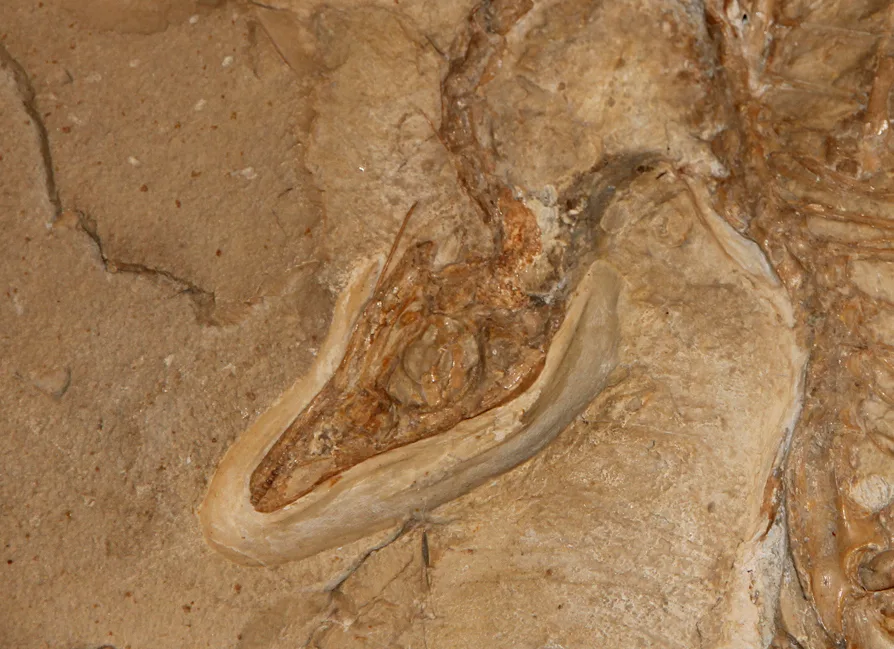
A CT scan of the London specimen’s braincase, published in Nature in 2004, showed that its brain and inner ear were closer to those of birds than to those of other reptiles. The parts for vision took up nearly a third of the brain, and the inner ear suggested good balance and hearing. Later work found that its overall brain size was typical for small dinosaurs of its group, so it was not a bird-sized brain.
Feathers: the clearest bird feature
The big surprise of the Berlin and London fossils was the feathers. The long flight feathers are asymmetrical, meaning the vane (the flat part) is narrower on one side of the central shaft than the other. Asymmetrical flight feathers work like an aerofoil, so this shape is usually linked with flight. It is a feature that living flying birds share.
There is a catch. A study of more than 70 families of living birds found that some flightless birds have a degree of feather asymmetry, and that Archaeopteryx falls inside that range. The amount of asymmetry in Archaeopteryx is more typical of slow fliers than of flightless birds. The feathers are a strong clue, not a guarantee.
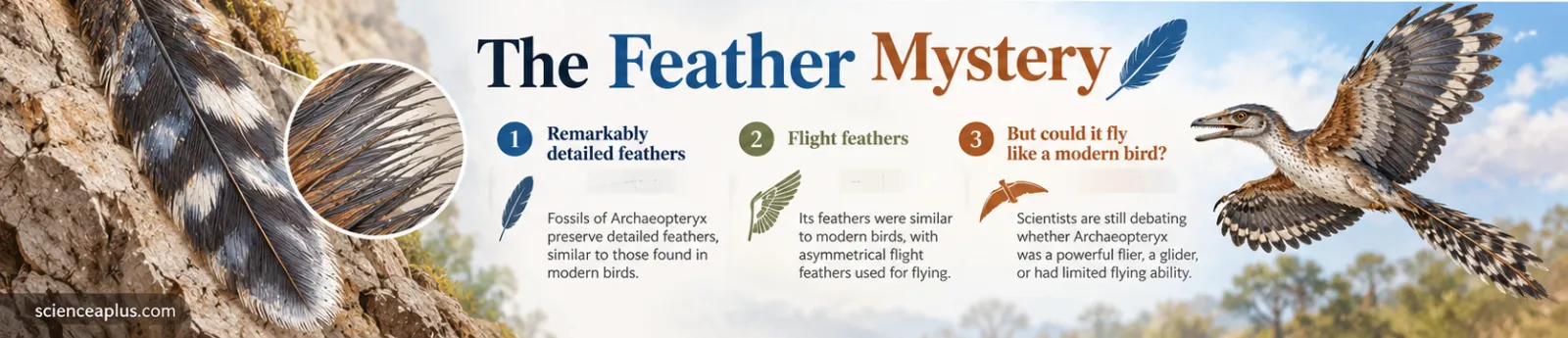
The Berlin specimen also shows “trousers” of feathers on the legs, a patch of tougher feathers along the back and fluffy, down-like feathers elsewhere on the body. The fossils show no clear feathers on the upper neck and head, but this may be because they were lost before burial.
Feather colour is a fascinating question. In 2012 researchers studied the microscopic pigment structures in the isolated 1861 feather and concluded that it was probably black. That does not mean the whole animal was black. Colour studies of a later fossil, Anchiornis, found black and white limb feathers and a red crest. If you are curious about colour in living birds, read why birds have different coloured feathers.
Could Archaeopteryx fly?
This is one of the biggest unanswered questions about Archaeopteryx, and different studies give different answers. Here are the main ideas, with the evidence behind each.
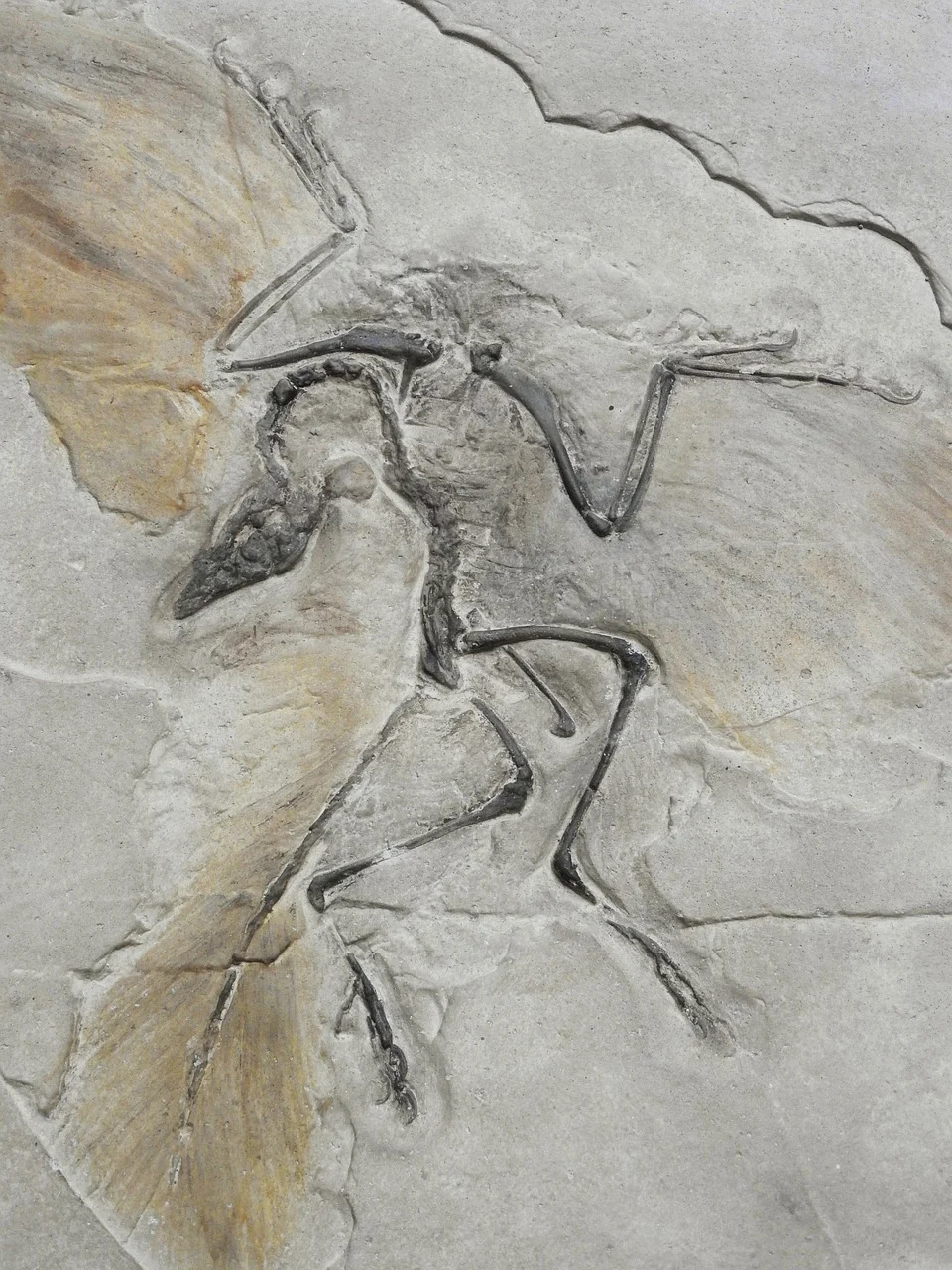
- It was a glider. It lacked a big bony keel for flight muscles, and its shoulder joint faced more sideways than in modern birds, so it may not have been able to raise its wings high above its back.
- It flapped in short bursts. A 2018 bone study found features similar to birds such as pheasants, which flap in short bursts. Its flight stroke may have been different from a modern bird’s.
- It could not flap at all. A 2010 study in Science argued that the central shafts of its feathers were too weak. Other scientists criticised that result, saying the measurements are hard to make on fossils and the body mass was overestimated.
- It was a poor flier by modern standards. The 2025 Chicago study concluded that it could fly using its feathers, including newly found tertials, but not well, and that it spent a lot of time on the ground.
Most researchers now accept that Archaeopteryx could glide and probably flap to some extent, but that it was clumsier than a modern bird. Its wings were large and rounded, like those of crows and pheasants today, which suits flying through trees and bushes. A shape like that gives a low stalling speed and a tight turning circle.
Where it took off from is also debated. The “trees down” idea says that early fliers glided from branches. The “ground up” idea says they ran and flapped. A view that has support today is that Archaeopteryx was at home both in trees and on the ground, like a crow. Features such as the raised second toe and scaly feet seen in Chicago fit an animal that was not specialised for perching.
Feathers, wings and a light skeleton are all adaptations for survival. Our article on adaptations in plants and animals explains how features like these help living things in their habitats.
Darwin, Huxley and the birth of a big idea
Archaeopteryx appeared at exactly the right moment. On the Origin of Species was published in 1859, and many people doubted that one group of animals could change into another. Then, in 1861, the London specimen emerged from the quarries, a fossil with a lizard-like tail and bird-like feathers. Darwin mentioned it in later editions of his book as a sign of how little we then knew about the animals of the past.
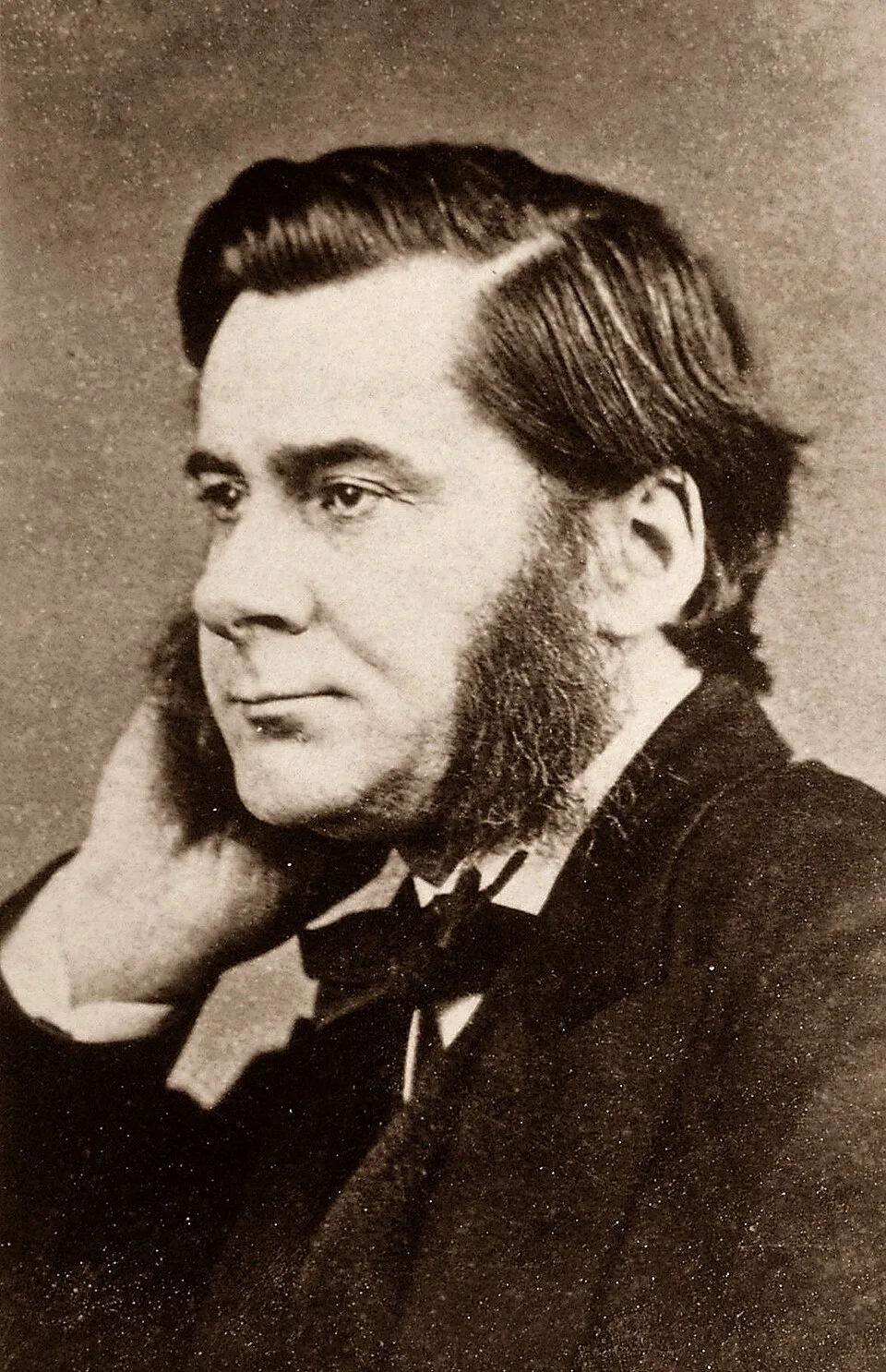
The biologist Thomas Henry Huxley, often called “Darwin’s bulldog”, went further. He compared the bones of birds with those of small meat-eating dinosaurs and argued that they were closely related. His 1870 paper in the Quarterly Journal of the Geological Society was titled “Further evidence of the affinity between the dinosaurian reptiles and birds”. The idea was largely set aside for decades, and revived in the 1970s by the palaeontologist John Ostrom, who found that Archaeopteryx closely resembled a group of small hunting dinosaurs called dromaeosaurids.
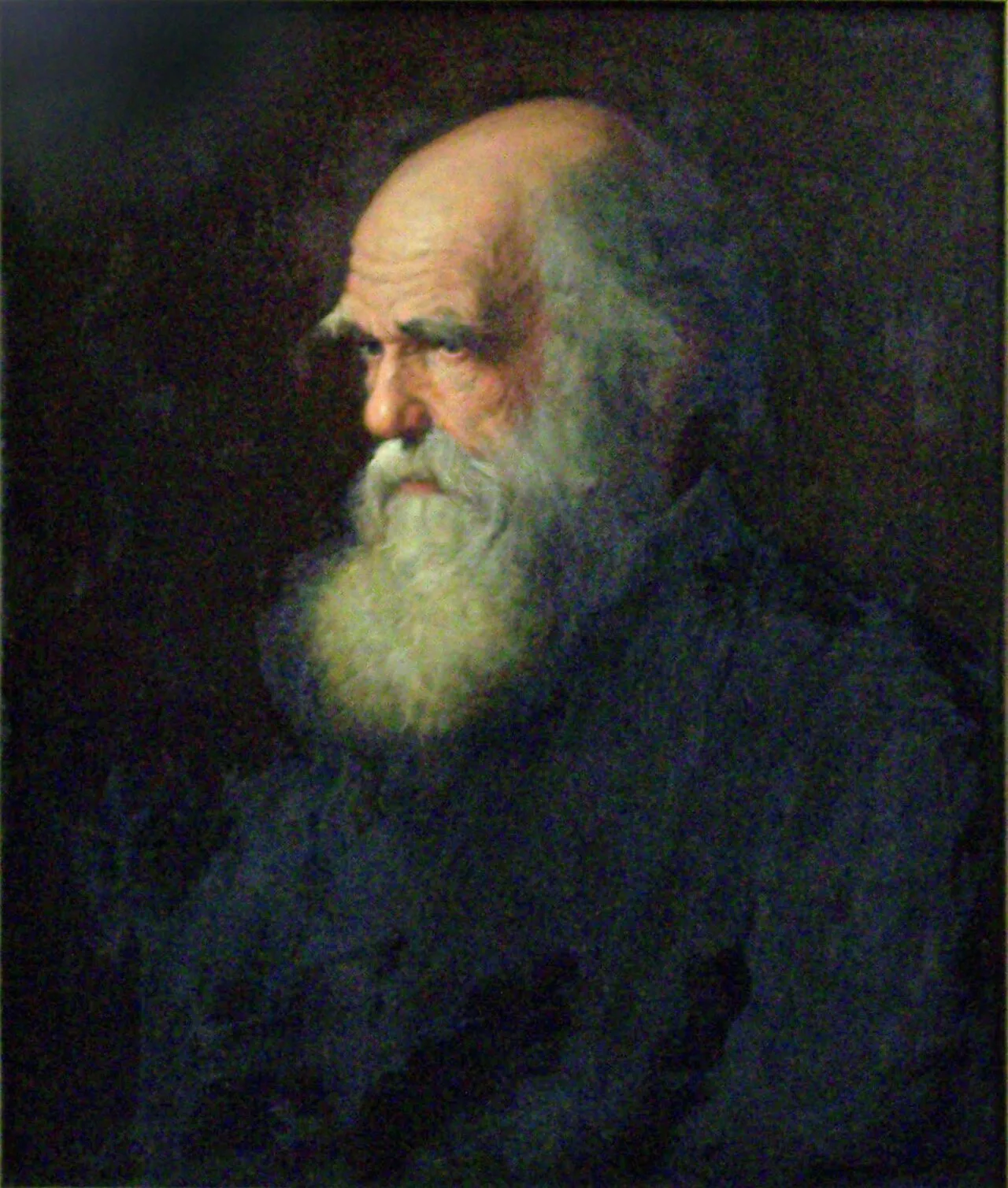
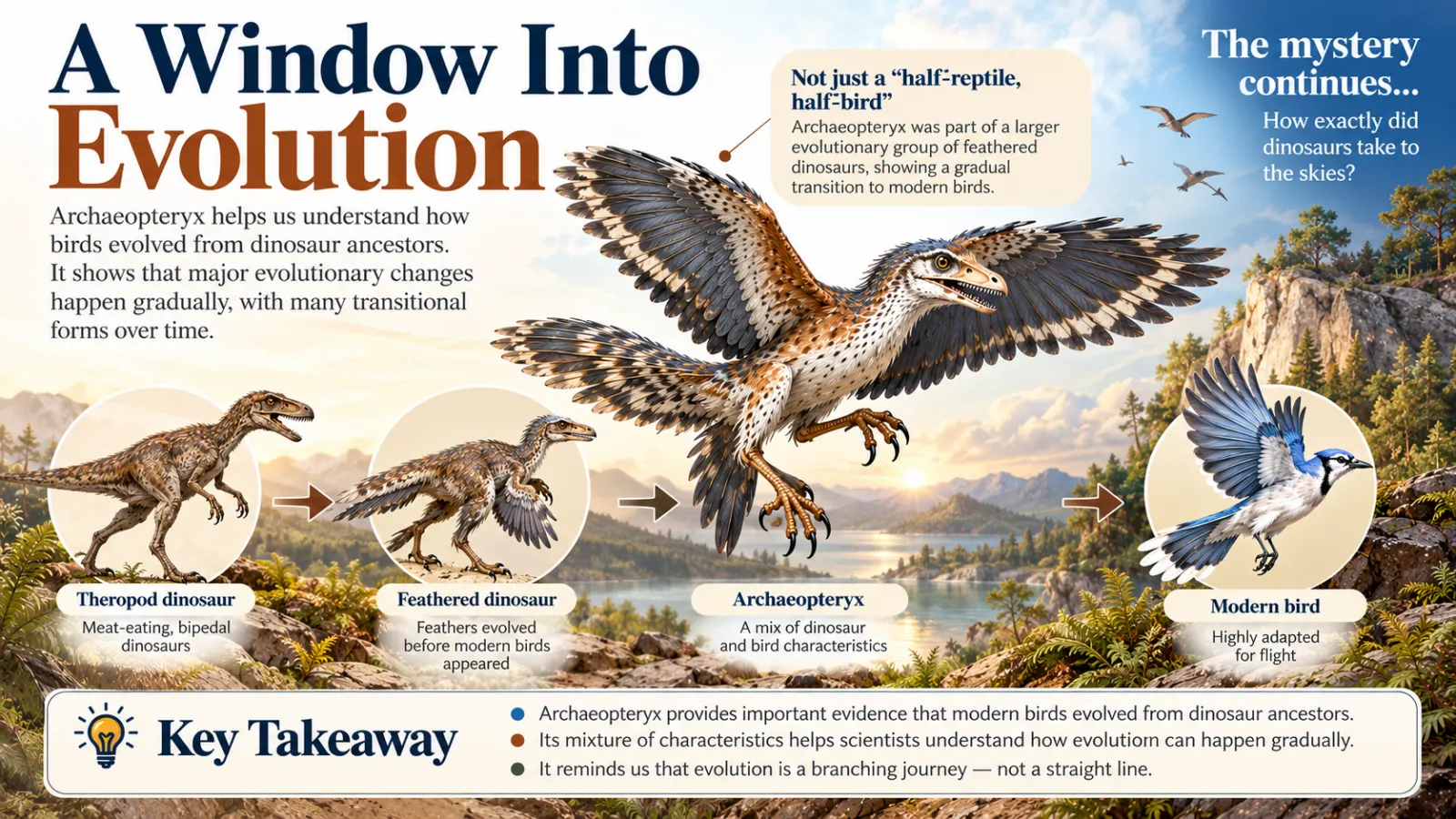
It is worth being careful about what Archaeopteryx proves. Evolution works by branching, not by climbing a ladder. The Archaeopteryx fossils show a species with mixed features, but scientists no longer say that it is the grandparent of modern birds. It is better described as a close relative of the true ancestors, a cousin on a side branch that looks a lot like them.
Feathered dinosaurs make the picture richer
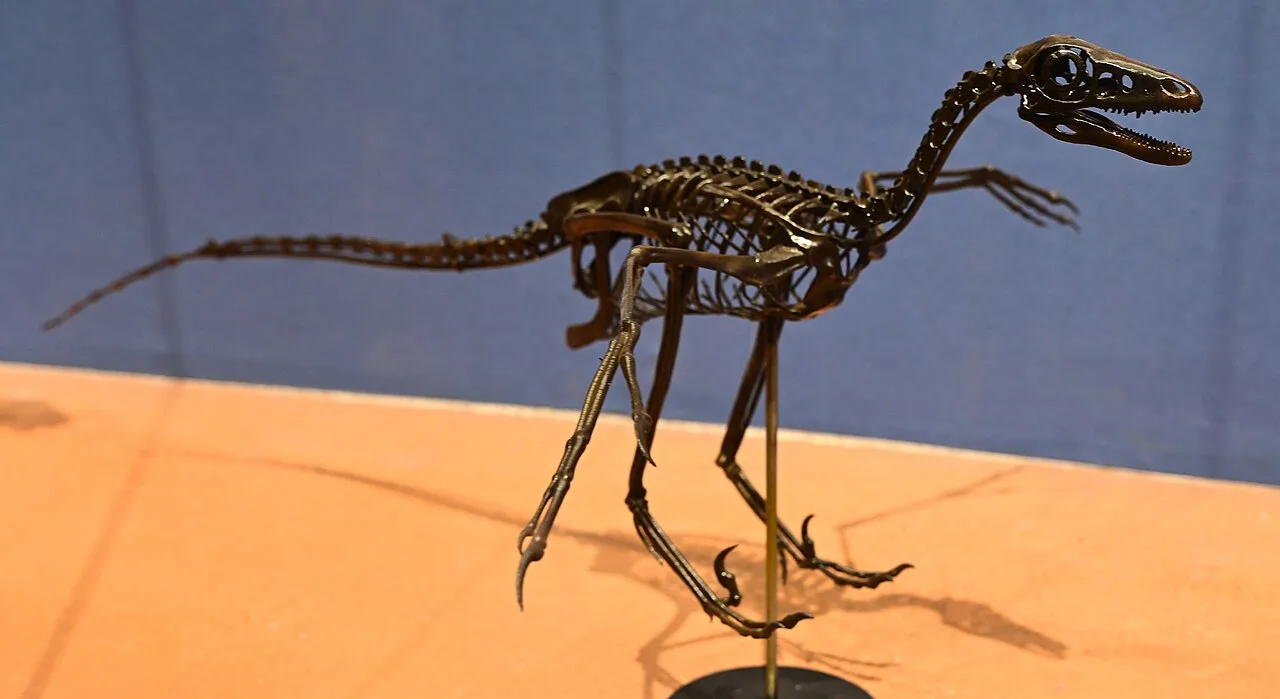
For a long time, Archaeopteryx stood almost alone. Since the 1990s, fossils from China have shown that many small dinosaurs had feathers or feather-like coverings, so feathers are older than flight. The NHM notes that feathers evolved in non-avian dinosaurs long before the earliest birds. Early feathers probably worked as insulation before they were ever used for flight.
Anchiornis: older than Archaeopteryx
Anchiornis was a crow-sized, four-winged dinosaur from the Tiaojishan Formation of Liaoning, China. It lived about 160 million years ago, around 10 million years before Archaeopteryx. Its name means “near bird” in Greek, and its species name, huxleyi, honours Huxley. Hundreds of specimens are known, and some preserve pigment structures. They show black and white feathers on the limbs and a red crest on the head. It had long wing feathers on its arms and legs, but its leg feathers were probably for display, and how well it could fly is uncertain.
An older animal with feathers on both its arms and its legs is awkward for the idea that Archaeopteryx is “the first bird”. Scientists now treat several feathered fossils as relatives of birds, and sometimes as birds themselves.
Xiaotingia and the great debate
In 2011 a team led by Xu Xing described Xiaotingia zhengi from China, in the journal Nature, under the title “An Archaeopteryx-like theropod from China and the origin of Avialae”. Their analysis moved Archaeopteryx off the bird branch and onto the branch of Deinonychosauria, the group that includes Velociraptor and its relatives. That made headlines, because it meant Archaeopteryx might not be a bird at all.
Later studies disagreed. A follow-up analysis put Archaeopteryx back at the base of the birds. Other studies, in 2018 and 2019, again placed it with the deinonychosaurs, but noted that the bird position was only slightly less likely. Scientists say that the answer may depend on new, better fossils.
What is Avialae? How scientists classify Archaeopteryx today
To settle the question of the label, palaeontologists use a group name: Avialae (“bird wings”). It is usually defined as all theropod dinosaurs that are more closely related to modern birds than to the deinonychosaurs. Modern birds (Aves) sit inside Avialae. Archaeopteryx is usually placed at or near the base of the group, which is why many sources still call it “the earliest known avialan”.
The result is easy to remember as a set of nested boxes.
- Archaeopteryx was a dinosaur, a small theropod.
- It was probably an avialan, a member of the bird-line, though some studies disagree.
- It was not a modern bird, because it had teeth, clawed fingers and a long bony tail.
- It is better thought of as a reptile only in the scientific sense in which all dinosaurs and birds are reptiles.
The problem can be summed up like this: it is hard to call Archaeopteryx unambiguously a bird, but it is unambiguously a dinosaur. The title “first bird” depended partly on timing, because it was found in 1861, before most of the other feathered fossils.
For more on how the dinosaur family tree connects to living animals, see the dinosaur in your genome, the Mesozoic food chain and our guide to amazing birds of the world.
Flip cards: Archaeopteryx in a nutshell
Study checklist
- I can name two bird features and two dinosaur features of Archaeopteryx.
- I can say when and where it lived (Late Jurassic, about 150 million years ago, Solnhofen).
- I can explain why it is called a transitional fossil.
- I can describe the London and Berlin specimens and the 2025 Chicago specimen.
- I can explain why scientists still argue about its flight and its exact place in the family tree.
Frequently asked questions about Archaeopteryx
Is Archaeopteryx a bird or a dinosaur?
Archaeopteryx is a dinosaur, a small feathered theropod. Whether it is also a “bird” depends on the definition. Many scientists place it at the base of Avialae, the bird line, while a few studies put it with the deinonychosaurs. It was not a modern bird, because it had teeth, clawed fingers and a long bony tail.
When and where did Archaeopteryx live?
Archaeopteryx lived in the Late Jurassic, about 150 million years ago. Its fossils come from the Solnhofen limestone in Bavaria, southern Germany. At that time the region was a group of islands in a warm, shallow tropical sea, with quiet lagoons where fine lime mud buried dead animals and preserved them in great detail.
How many Archaeopteryx fossils have been found?
Fourteen body fossils are usually counted, plus the original 1861 feather. The latest is the Chicago specimen, described in Nature in May 2025. The total depends on classification, because some researchers place the Haarlem specimen in a different genus, and the Maxberg specimen has been missing since 1991.
Who discovered Archaeopteryx?
No single person discovered it. Quarry workers near Solnhofen found the fossils, and Hermann von Meyer named the animal in 1861 from a feather. A doctor, Karl Häberlein, sold the London specimen, with many other fossils, to the British Museum. A farmer, Jakob Niemeyer, found the Berlin specimen in 1874 or 1875.
Could Archaeopteryx fly?
Probably, but not like a modern bird. It had asymmetrical flight feathers and large, rounded wings, and the 2025 Chicago study concluded that it could fly using its feathers. Other studies suggest gliding or short bursts of flapping. Scientists still debate how well it flew and how it took off.
Why is Archaeopteryx called a transitional fossil?
A transitional fossil shows features of two groups. Archaeopteryx has bird features, such as feathers and a wishbone, and dinosaur features, such as teeth, clawed fingers and a long bony tail. That supports the idea that birds evolved from small feathered dinosaurs, though it is a relative on a side branch, not necessarily an ancestor.
What is the Chicago Archaeopteryx?
It is the 14th known specimen, bought by the Field Museum in 2022 and described in Nature in May 2025. It is nearly complete and was not crushed flat. It was the first Archaeopteryx in which tertial feathers have been seen, and UV light and CT scans revealed soft tissue.
Was Archaeopteryx the first bird?
It was long called the first bird, but that is now uncertain. Anchiornis, a feathered dinosaur from about 160 million years ago, is older, and some analyses count Anchiornis and Xiaotingia as early members of the bird line. Whether any of them are true birds depends on the analysis.
Did Archaeopteryx have feathers?
Yes. Most specimens show impressions of feathers, including long asymmetrical flight feathers on the arms and tail. The Berlin specimen also shows feathers on the legs and fluffy down on the body. A study of the 1861 feather concluded that it was probably black, though the whole animal was probably not black.
Is Archaeopteryx a reptile?
In the scientific sense, yes: birds and dinosaurs both belong to the reptile group because they share a common ancestor with lizards and crocodiles. In everyday speech, “reptile” means lizards, snakes, crocodiles and turtles, so people often call Archaeopteryx reptile-like because of its teeth, claws and tail.