What is solitude? Solitude is time alone that is calm and usually chosen, such as reading, walking or just sitting quietly. The benefits of solitude depend on that choice: researchers find that people who willingly spend time alone tend to gain the most from it. This guide covers what the studies show, how much time alone helps, how to start, and where to get help if being alone stops feeling good.
Solitude vs loneliness: what is the difference?
Many people use "alone" and "lonely" as if they meant the same thing. They do not. The World Health Organization (WHO) Commission on Social Connection (2025) defines loneliness as the painful feeling that arises from a gap between desired and actual social connections. It defines social isolation as the objective lack of sufficient social connections.
Solitude is different again. In research, it usually means being alone and not physically with another person. In one well-known experiment, Nguyen, Ryan and Deci (2018, University of Rochester) went further and asked people to sit alone without communications, stimuli, activities or devices. The key point is that solitude is a state you can choose, while loneliness is a feeling you did not ask for.
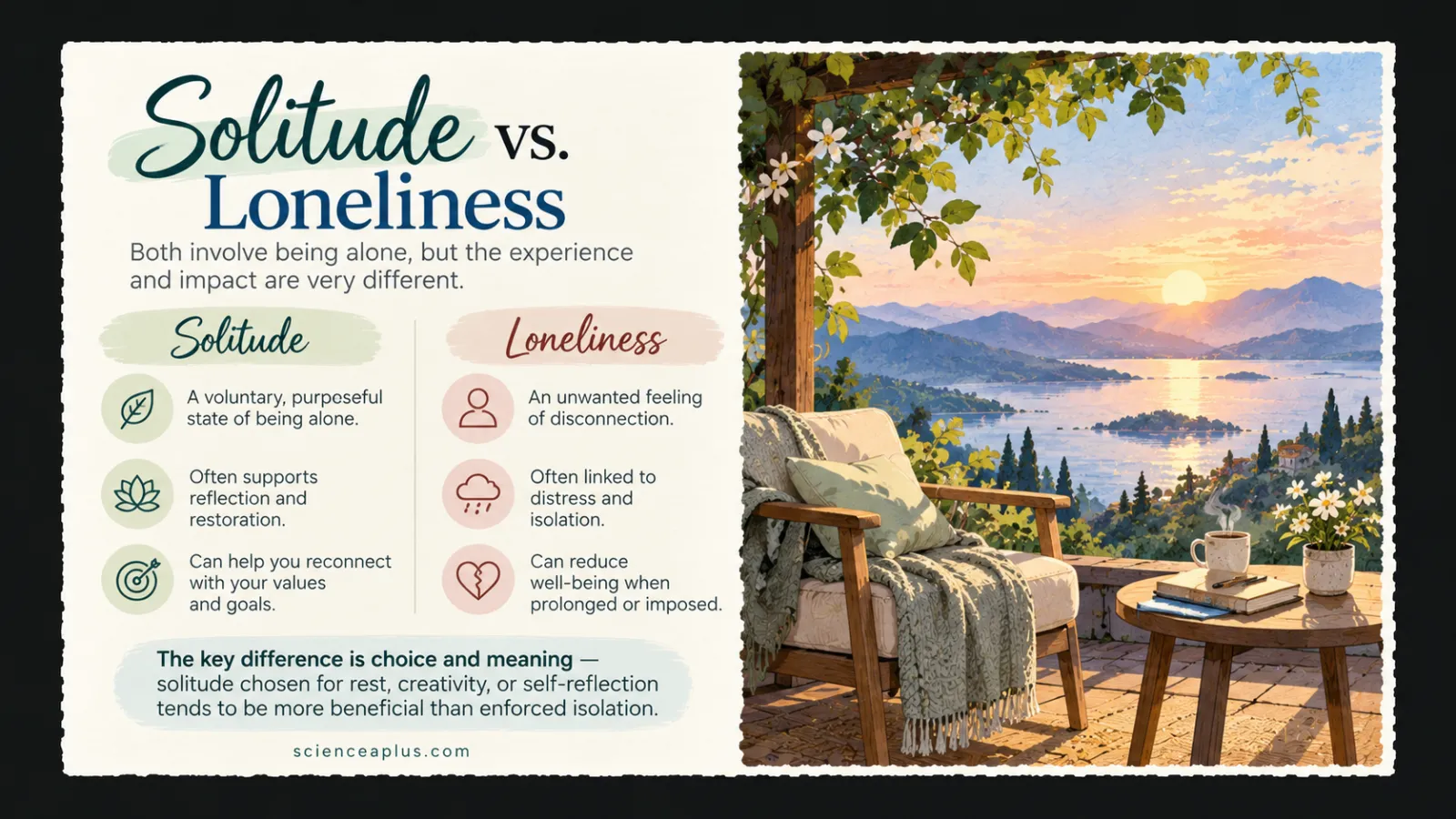
That means you can be alone without being lonely, and you can feel lonely in a crowded room. Loneliness is about how you feel (it is subjective). Isolation is about your situation (it is objective). Solitude is about the way you spend time alone, and whether it was your choice.
| Solitude | Loneliness | Social isolation | |
|---|---|---|---|
| Is it chosen? | Often, yes | No, it is an unwanted feeling | Sometimes, sometimes not |
| Feeling or situation? | A state of being alone | A feeling | A situation (few contacts) |
| Example | Reading alone on a Sunday because you want to | Feeling left out at a busy party | Not seeing anyone for two weeks after moving to a new town |
Why the words matter
For a long time, psychology focused on the harm of loneliness and paid less attention to the possible good of time alone. Long and Averill (2003, Journal for the Theory of Social Behaviour) described solitude as disengagement from the immediate demands of other people. They examined four benefits that people attribute to it: freedom, creativity, intimacy and spirituality.
Keeping the words apart helps you think clearly. If someone says "I need some time alone", they are not necessarily unhappy. If someone says "I feel lonely", the fix is not simply "go and be around people", because loneliness is about the quality of connection, not the headcount.
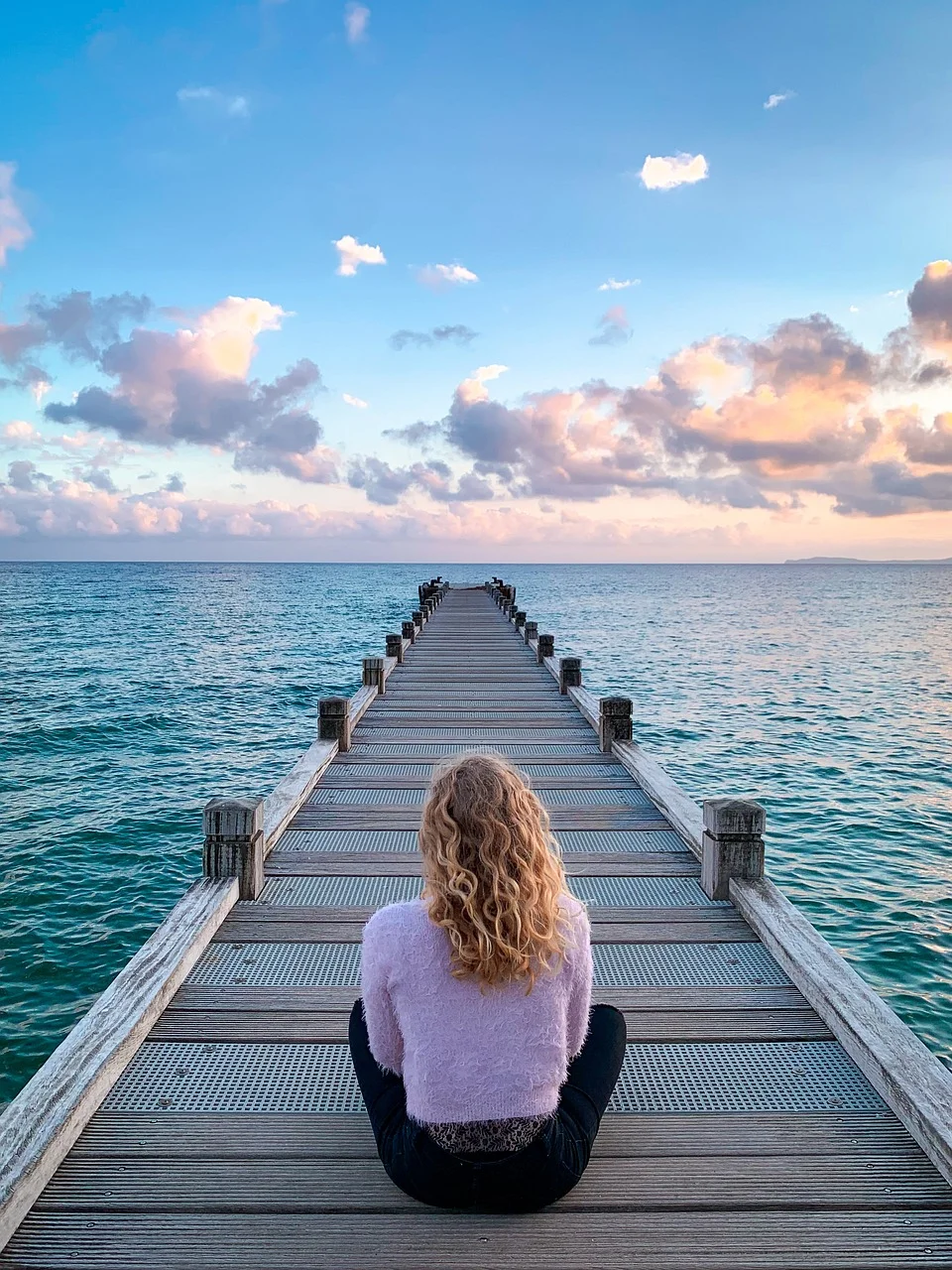
The woman in the photo is sitting on a pier on her own, looking out to sea, and the scene feels calm. It is a stock photo, so we cannot know her situation, but it illustrates the idea: a quiet moment that looks chosen.
Try it: solitude, loneliness or isolation?
Read each situation, decide which word fits best, then tap the card to check your answer.
Why loneliness is a health issue
To understand why chosen solitude matters, it helps to see why unchosen disconnection worries researchers. Holt-Lunstad, Smith and Layton (2010, PLoS Medicine) combined 148 studies with 308,849 participants. People with stronger social relationships had a 50% increased likelihood of survival over the follow-up periods, an effect the authors described as comparable with well-established risk factors for early death.
A later review by Holt-Lunstad and colleagues (2015, Perspectives on Psychological Science) looked at three things separately, after controlling for other factors. Social isolation, loneliness and living alone were linked to a 29%, 26% and 32% increased likelihood of early death respectively. Objective and subjective isolation carried similar risks. These are links found in groups of people, not a prediction for any one person, and they do not prove that loneliness caused the deaths.
The WHO (2025) estimates that about 1 in 6 people worldwide are affected by loneliness, and that loneliness is linked to more than 871,000 deaths a year. That figure is an estimate of associated deaths, not a count of deaths caused. The WHO also reports that 17–21% of 13–29-year-olds said they felt lonely, with the highest rates among teenagers, and that lonely teenagers were 22% more likely to get lower grades or qualifications.
This links to wider ideas about keeping a balanced social life, and to the field of positive psychology, which treats good relationships as one ingredient of well-being. Connection matters, and so does the way you handle time alone.
So is time alone dangerous? Not by itself. The research suggests that why you are alone matters more than the simple fact of being alone. The next part looks at what studies have actually measured when people spend time alone by choice.
Benefits of solitude: what the research shows
The benefits of solitude are real, but they are more modest and more conditional than self-help headlines suggest. Most of the evidence below comes from short studies, diaries and surveys, so it shows links and patterns rather than guarantees.
Calmer, not just happier: the deactivation effect
In a study by Nguyen, Ryan and Deci (2018, Personality and Social Psychology Bulletin), participants sat alone for 15 minutes without their devices. Solitude had what the researchers called a deactivation effect: it reduced high-arousal feelings. That covered negative ones such as anger and anxiety, and also positive ones such as excitement.
The effect appeared when people were alone, not when they were with another person, and reading did not stop it. When people could choose what to think about, their high-energy positive feelings (such as excitement) did not drop. Relaxation and lower stress appeared when people actively chose to be alone. As Richard Ryan of the University of Rochester put it, "When people willingly spend time alone, they reap the greater benefits."
Choice is the secret ingredient
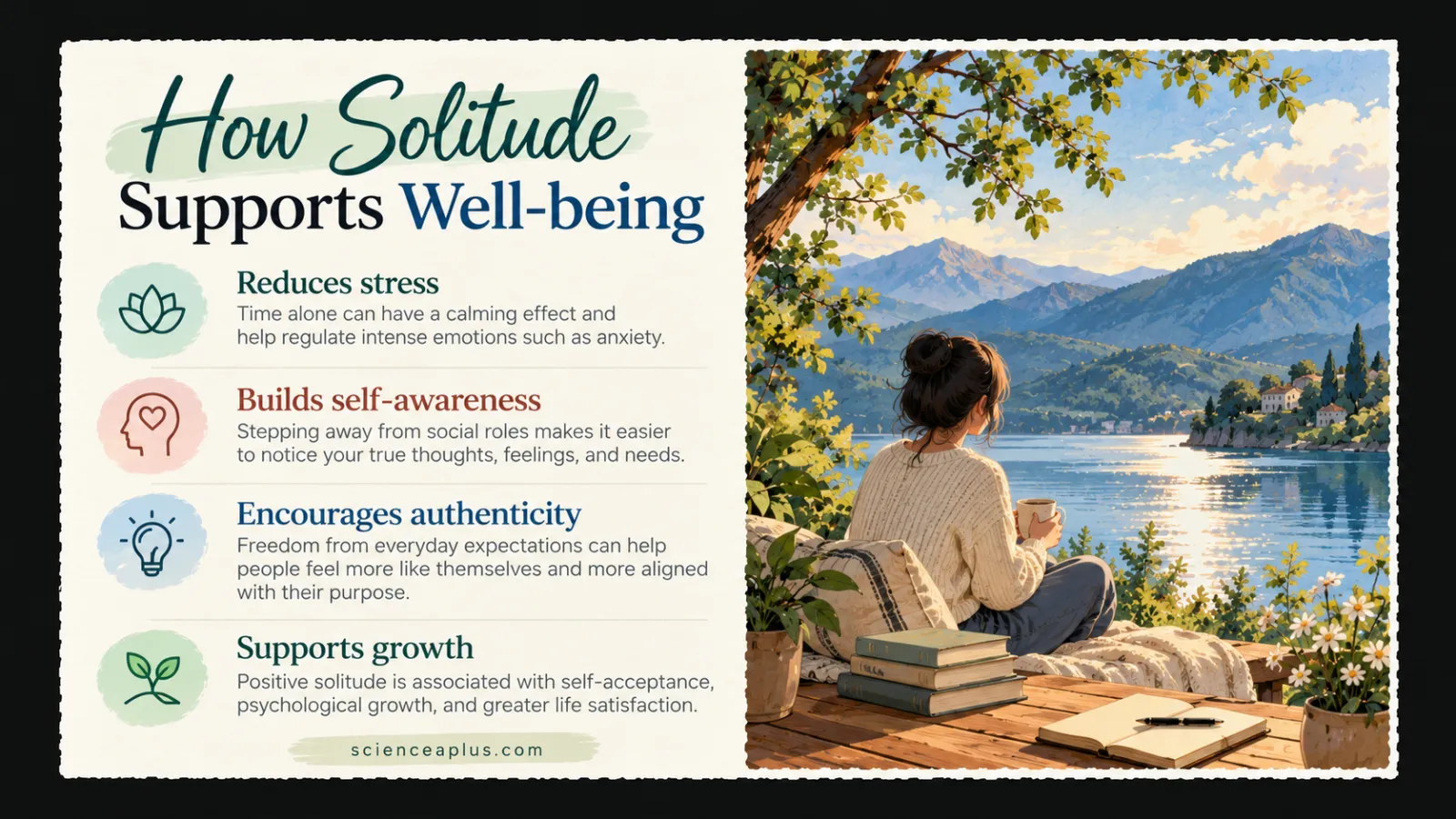
A 21-day diary study by Weinstein, Vuorre, Adams and Nguyen (2023, Scientific Reports) followed 178 participants. The authors found no one-size-fits-all "optimal balance" of alone and social time. On days with more hours alone, people felt lonelier and less satisfied. However, those effects were reduced or cancelled when the solitude was chosen.
The same study found a trade-off with a positive side. More time alone also meant less stress and more autonomy, which means feeling free, authentic and unpressured. Those benefits added up across the study period.
Put the two studies together and a pattern emerges. Why you are alone matters more than how long. Time alone that you choose can feel restful and free. Time alone that you are pushed into, or use to hide, tends to go with feeling worse.
Why sitting with your thoughts feels hard
If 15 minutes of quiet sounds uncomfortable, you are not unusual. Wilson and colleagues (2014, Science) ran 11 studies in which people typically did not enjoy 6–15 minutes alone in a room with nothing to do but think. In one small study, many people chose to give themselves a mild electric shock rather than just sit: 12 of 18 men (67%) and 6 of 24 women (25%) did so at least once. One study included people aged 18–77 and found similar results.
Other researchers (Fox and colleagues, 2014, Frontiers in Psychology) argued that the data do not show that thinking is truly unpleasant. Either way, the finding gives us a useful lesson: sitting with your own thoughts is a skill that can feel odd at first.
Test your understanding with these two exam-style questions. Tap each one to reveal a model answer.
In Nguyen et al. (2018), why did solitude lower excitement as well as anxiety? (2 marks)
Solitude produced a deactivation effect, meaning it reduced high-arousal feelings in both directions, negative (such as anxiety) and positive (such as excitement). When people chose what to think about, high-energy positive feelings did not drop.
Weinstein et al. (2023) found that more hours alone meant more loneliness on that day. What reduced this effect? (1 mark)
When the solitude was chosen (autonomous).
Solitude, daydreaming and the default mode network
Quiet time may also give your brain room to wander. Raichle and colleagues (2001, PNAS) described a "default mode" of brain function: a set of regions that are more active at wakeful rest and quieten during goal-focused tasks. This default mode network (DMN) includes midline regions such as the medial prefrontal cortex and the posterior cingulate cortex.
The DMN is linked with mind-wandering, self-referential thinking (thinking about yourself), remembering the past and imagining the future. For a wider look at how brain regions work together, see this guide to neuroscience and the brain.

What about creativity? Neuroimaging studies link DMN activity, working together with the brain's executive control network, to creative thinking such as coming up with ideas (Beaty and colleagues, 2016, Trends in Cognitive Sciences). Most of this evidence is correlational. In another study, Baird and colleagues (2012, Psychological Science) found that during a break, an undemanding task that allowed mind-wandering improved performance on previously seen "unusual uses" problems more than a demanding task, rest or no break. That is one lab study, and later replications have been mixed.
Solitude for teenagers and students
Time alone is not only for adults. Larson (1997, Child Development) used experience sampling with 483 US pupils aged roughly 10–15. Adolescents spent about one quarter of their waking hours alone. For 12–15-year-olds, solitude had a positive after-effect on mood, and teenagers who spent an intermediate amount of time alone were better adjusted than those who were alone very little or a great deal. Larson described solitude as a "strategic retreat that complements social experience".
Weinstein, Nguyen and Hansen (2021, Frontiers in Psychology) asked 2,035 people, including adolescents aged 13–16, adults aged 35–55 and older adults aged 65 and over, to describe solitude in their own words. Autonomy, meaning self-connection and freedom from pressure, mattered for everyone and more so with age. Older adults felt most peaceful in solitude.
The WHO (2025) also reports that lonely teenagers were 22% more likely to get lower grades or qualifications, which is a reminder that the aim is chosen quiet, not withdrawal. Time alone can also help you work out what you think before a group decides for you, which links to how people handle peer pressure. And reflection is a core habit in self-development for students.


How much time alone is healthy?
There is no research-backed "right amount" of alone time. The 21-day diary study by Weinstein and colleagues (2023) found no one-size-fits-all optimal balance between time alone and time with others. What mattered more was whether the time alone was chosen.
Larson's (1997) study of school pupils points the same way: teenagers who spent an intermediate amount of time alone were better adjusted than those who were alone very little or a great deal. That does not give you a number, but it does suggest a middle path rather than either extreme.
A sensible starting point is the one used in the lab. Nguyen, Ryan and Deci (2018) asked people to sit alone for 15 minutes without devices. Some guides suggest 15–30 minutes. Treat that as a place to begin, not a rule, and adjust it to how you feel.
How can you tell if it is working? These are signs that your alone time is doing you good:
- You feel calmer or clearer afterwards.
- You come back to other people with more energy, not less.
- You chose the time, and you could have chosen differently.
And these are signs that it may not be helping, which we return to later in this article:
- You feel lonelier or lower afterwards.
- You are using time alone to avoid people you would otherwise like to see.
- You would like company but feel unable to ask for it.
Solitude tips: how to start enjoying time alone
If you are wondering how to practise solitude, think of it like any other skill. Start small, make it pleasant, and notice what happens. The infographic below sums up four ideas that this section turns into practical steps.
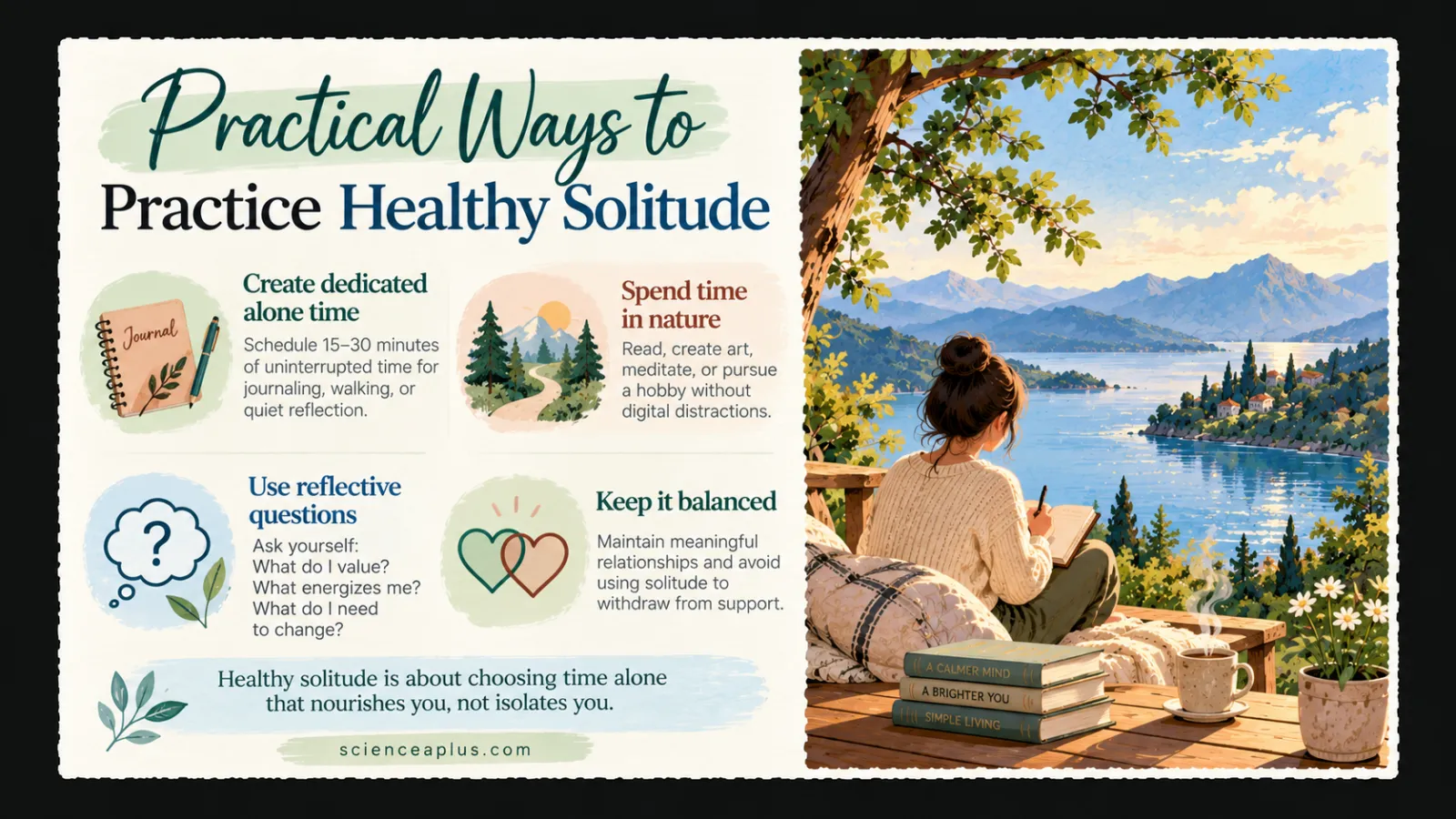
- Book it in. Pick a time that is realistically free, such as after school or before dinner, and treat it as yours.
- Take the phone out of reach. Put it in another room or on Do Not Disturb. The 15-minute lab sessions were device-free.
- Choose an activity, or none. A walk, sketching, stretching, sitting by a window or doing nothing at all all count.
- Keep it short at first. Fifteen minutes is a good opening length.
- Notice how you feel. Rate your mood from 1 to 5 before and after. Over a few weeks, you may spot a pattern.
- Write one line. A sentence is enough to capture what you thought or felt.
- Plan something social too. Solitude works best alongside, not instead of, time with people you like.
Here is the same list as a checklist you can tick off. Your ticks are remembered in your browser.
- Pick a time that is free
- Put your phone in another room or on Do Not Disturb
- Choose an activity, or decide to do nothing
- Set a timer for 15 minutes
- Rate how you feel from 1 to 5 before and after
- Write one line about it
- Plan something social later in the week too
Journalling questions
If you want something to think about during your quiet time, a short journal is a good prompt. Try one of these questions each time:
- What do I value?
- What energises me?
- What do I need to change?
Nguyen and colleagues (2018) found that when people could choose what to think about, their high-energy positive feelings did not drop, so choosing a gentle topic may help.

Nature walks
Green space is one of the easiest settings for solitude. White and colleagues (2019, Scientific Reports) analysed data from 19,806 people in England. Spending at least 120 minutes a week in nature was associated with a higher likelihood of reporting good health and high well-being. The benefits peaked at around 200–300 minutes a week, and it made no difference whether the 120 minutes came in one visit or several shorter ones. This is an association, not proof that nature caused the difference.
For ideas about spending more time outdoors, see this guide on growing up with nature. To see how your own week adds up, enter the length of your usual outing and how many you manage in a week.
Digital solitude: why phone-free time counts
Scrolling is not solitude in the research sense. The people in Nguyen and colleagues' (2018) study sat alone without devices, whereas scrolling means you are still taking in other people's content. A quiet room with a phone in your hand is not the same state as a quiet room without one.
The WHO (2025) lists digital technologies among the possible causes of loneliness and warns about "excessive screen time or negative online interactions". Evidence on cutting back is limited, but one trial is worth knowing. Hunt, Marx, Lipson and Young (2018, Journal of Social and Clinical Psychology) studied 143 University of Pennsylvania undergraduates. One group limited Facebook, Instagram and Snapchat to 10 minutes per platform per day for three weeks. Compared with a group who used them as usual, they showed significant reductions in loneliness and depression. Both groups had less anxiety and fear of missing out, which may have come from simply monitoring their own use. The authors suggested around 30 minutes a day in total may help.
That was a small study of students at one university, so it may not apply to everyone. It does suggest, though, that setting limits can make time alone feel better.
A phone-free wind-down before bed is another easy way to build in quiet time. Our guide to sleep hygiene and mental health covers how evening habits connect with how you feel.
When solitude becomes isolation
Chosen time alone and unwanted disconnection can look the same from the outside, so it helps to check in with yourself. Signs that time alone may be turning into something less healthy include:
- The time alone is no longer your choice, and you would like company but cannot find it.
- You are staying away from people because of anxiety, not because you want quiet. Thomas and Azmitia (2019) linked this kind of "pushed" solitude with loneliness, social anxiety and depressive symptoms.
- You feel lonelier or lower after time alone. In the diary study by Weinstein and colleagues (2023), more hours alone went with feeling lonelier on that day unless the time was chosen.
- Your mood has been low for more than 2 weeks.
None of these is a diagnosis, and having one or two of them does not mean something is wrong with you. They are prompts to talk to someone. If your low mood has lasted more than 2 weeks, or self-help is not working, the NHS advises seeing a GP. The same applies when stress is building up: our guide to a stress-free life has ideas for easing the pressure.
Where to get help with loneliness in the UK
The NHS page on feeling lonely suggests these steps:
- Talk about your feelings with a friend, family member, healthcare professional or counsellor.
- Join a group or class about something you enjoy. You can ask to just watch first.
- Visit places where you can be around other people.
- Ask your GP about social prescribing, where a link worker can find local support and activities.
- Try peer support or volunteering.
- Do things you enjoy, such as walking, exercising or listening to a podcast.
- Set small targets, and try not to compare yourself with others.
- Try not to use alcohol, cigarettes, gambling or drugs to relieve loneliness.
You can refer yourself to NHS Talking Therapies. Organisations the NHS names include Mind, Every Mind Matters, Age UK, The Silver Line and Re-engage. Under-25s can also look at The Mix, and the Campaign to End Loneliness offers ideas and advice, mainly focused on loneliness in later life.
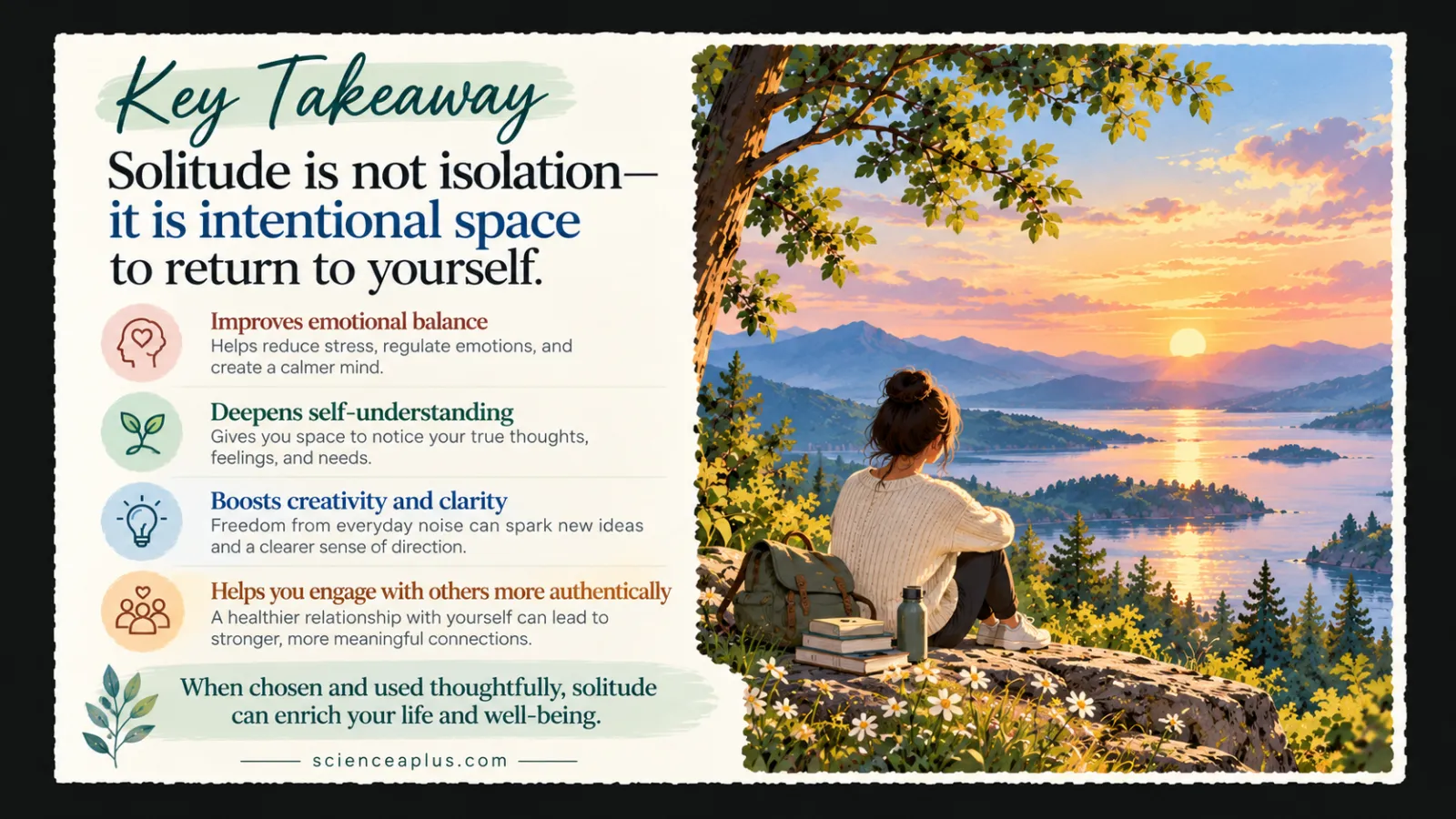
Balance: solitude plus connection
The healthiest picture combines both. Time alone to rest, think and recharge sits alongside people you trust and activities you enjoy. Other parts of daily life also affect how you feel, as this guide to lifestyle choices that improve brain function explains.
Now check what you have learned. Pick an answer for each question, and the quiz will explain it.
Frequently asked questions about solitude
What is the difference between solitude and loneliness?
Solitude is a state of being alone that is often chosen and can be restful. Loneliness is the painful feeling of a gap between the connections you want and the ones you have. You can be alone without being lonely, and you can feel lonely while surrounded by people.
What are the benefits of solitude?
Studies link chosen solitude with calmer feelings, less stress and a stronger sense of autonomy. In one lab study, 15 minutes alone without devices reduced anger, anxiety and excitement. Most evidence comes from short studies and surveys, so the benefits are best described as links, not guarantees.
Is spending time alone good for your mental health?
It can be, when you choose it. A 21-day diary study found that more hours alone meant more loneliness on that day, but this effect was reduced or cancelled when the solitude was chosen. If time alone leaves you feeling low or lonely, talk to someone you trust or your GP.
How much time alone is healthy?
Researchers have found no single optimal amount. A 15-minute device-free session is a sensible starting point, and a study of school pupils found those with an intermediate amount of time alone were better adjusted than those alone very little or a great deal. Judge it by how you feel afterwards.
Is it normal to want to be alone a lot?
Many people value time alone, and adolescents in one US study spent about a quarter of their waking hours on their own. What matters most is the reason. Enjoying quiet is one thing, but if you are avoiding people out of anxiety, consider speaking to a GP.
Why do I feel calmer when I'm alone?
Researchers describe a deactivation effect: in one study, 15 minutes alone without devices lowered high-arousal feelings such as anger and anxiety, and also excitement. Relaxation appeared when people actively chose to be alone. Being away from social demands may explain part of it, though the studies are short.
Does solitude make you more creative?
The evidence is mixed. Brain-scan studies link the default mode network with idea generation, but they show a link, not a cause. One lab study found that a break with an undemanding task improved some creativity problems, while later replications have been mixed. Solitude may help, but it is no guarantee.
Is scrolling on my phone alone the same as solitude?
No. In the research, people sat alone without devices. Scrolling means you are still taking in other people's content, so it is not solitude in that sense. One study of students found that limiting social media to 10 minutes per platform per day for three weeks reduced loneliness and depression.
When should I worry about spending too much time alone?
Take it seriously if your time alone is no longer your choice, you are avoiding people because of anxiety, or you feel lonelier or lower afterwards. The NHS advises seeing a GP if your mood has been low for more than 2 weeks. For urgent help, call NHS 111, and in an emergency call 999.