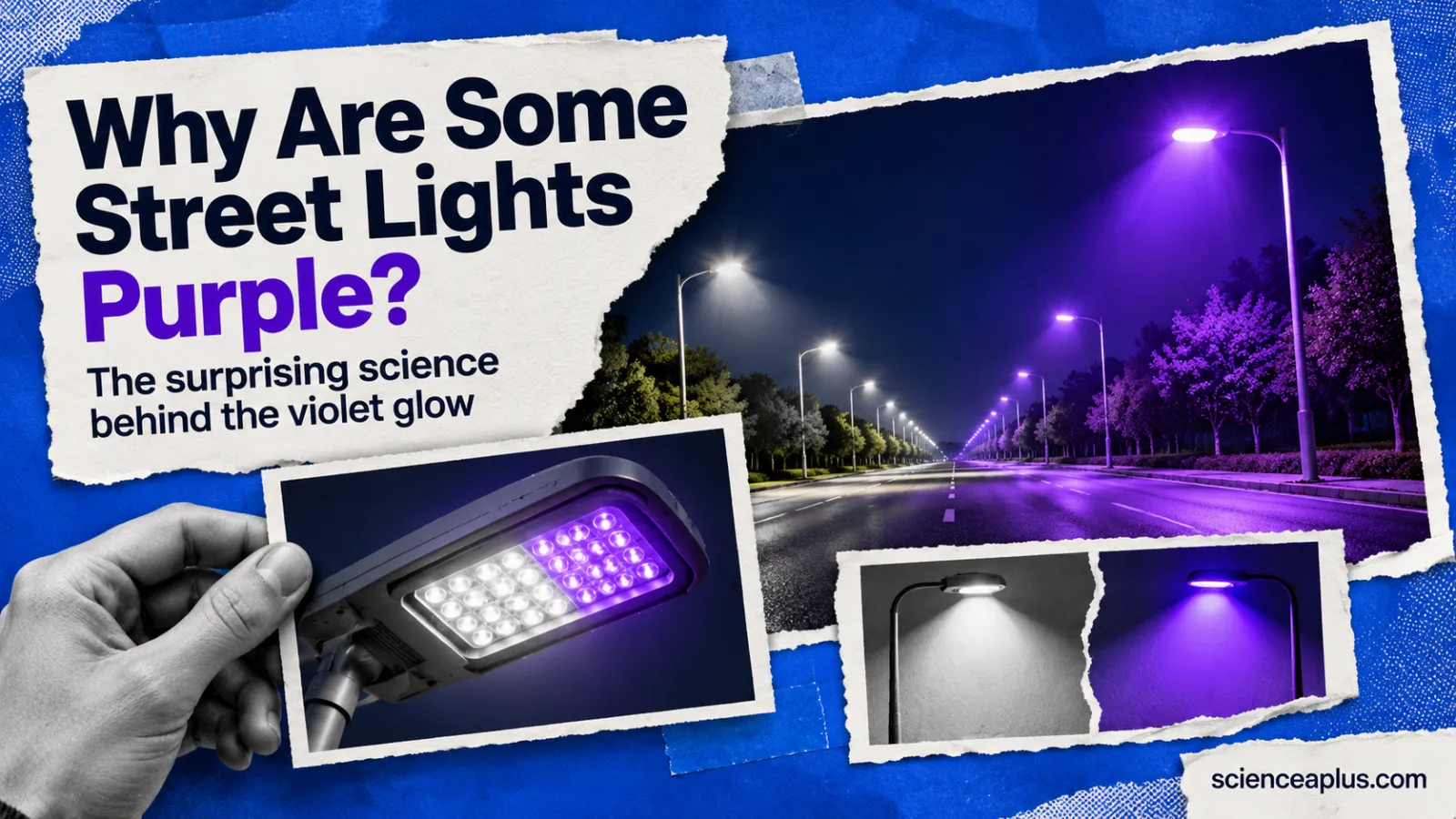
Why are street lights purple? Purple street lights are faulty white LED lights. Each white LED is really a blue LED under a thin yellow phosphor layer; when that layer cracks or peels away, extra blue light escapes and the lamp glows violet-purple. They are not decorative and not deliberate.
People first started noticing them in early 2021. Reports came from Florida, Utah, Texas, Massachusetts, Canada and Ireland, and purple lights have since turned up on UK roads too. If you have ever looked up at a lamp post and wondered what was wrong with it, this article is your field guide: the physics, the evidence and what to do next.
Why are street lights purple? The short answer
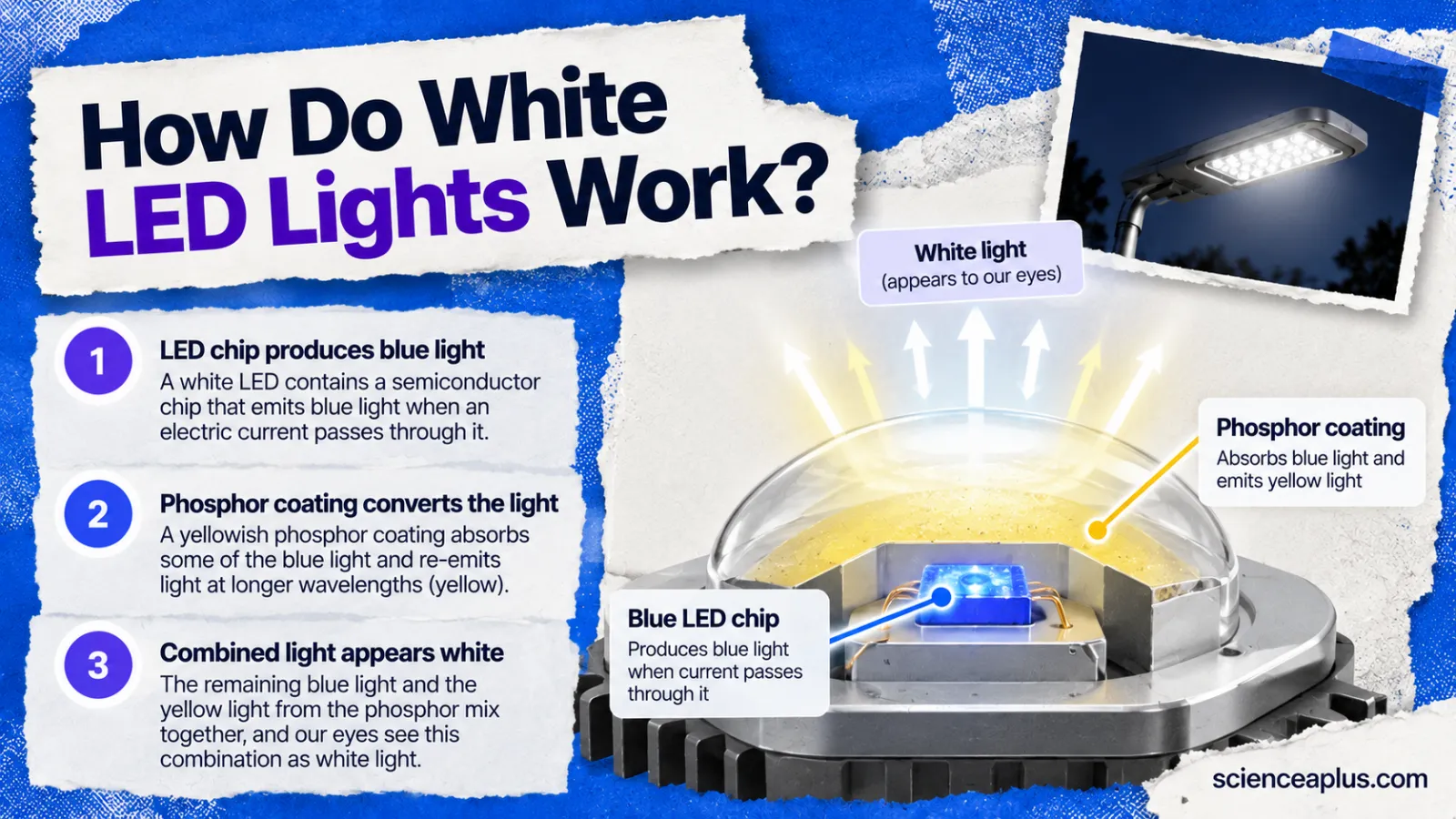
A white LED street light does not make white light directly. A single LED gives out almost one pure colour, and the chip used in these lamps is blue. To turn that into something that looks white, the chip is covered with a thin layer of phosphor, a material that absorbs some of the blue light and gives it back out as yellow light.
Our eyes add the leftover blue and the new yellow together and read the mixture as white. It is a clever trick, and it is the cheap and efficient way to make white street lighting.
The trouble starts when the phosphor layer stops doing its job. Here is the sequence in four steps:
- The blue LED chip lights up when current flows through it.
- The phosphor layer turns part of that blue light into yellow light.
- Blue and yellow together look white to us.
- If the layer cracks, lifts or peels away, less blue is converted. More raw blue light escapes, and the lamp looks blue or purple instead of white.
Lamps that have gone this way are described as having a spectral shift, which simply means that the mix of colours in the light has changed. The word you will see most often for the fault is delamination: the coating coming apart from the chip. We look at it closely later in this article.
From orange sodium lamps to white LEDs
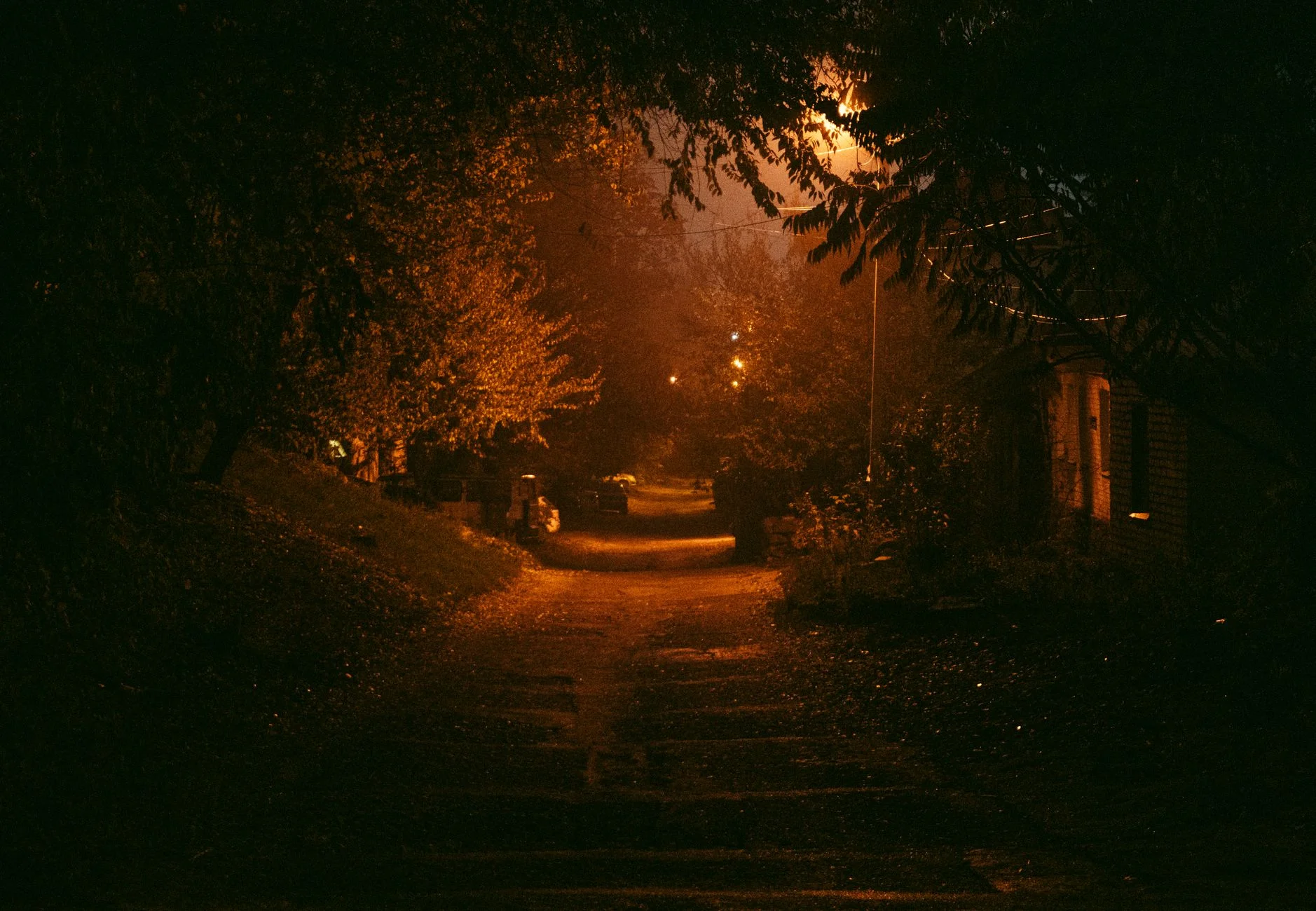
To see why this fault is so noticeable, it helps to remember what street lights used to look like. For decades, many streets glowed a deep orange-yellow. Those lamps were filled with sodium vapour, and sodium atoms give out light mostly near 589 nm, which is a yellow-orange colour. If you want the chemistry behind that, see our guide to sodium.
Low-pressure sodium lamps are almost a single colour, so they make colours hard to tell apart. A red car and a green car can look like two similar shades of grey-brown. High-pressure sodium lamps give a broader spread of colours, but they still show colours poorly.
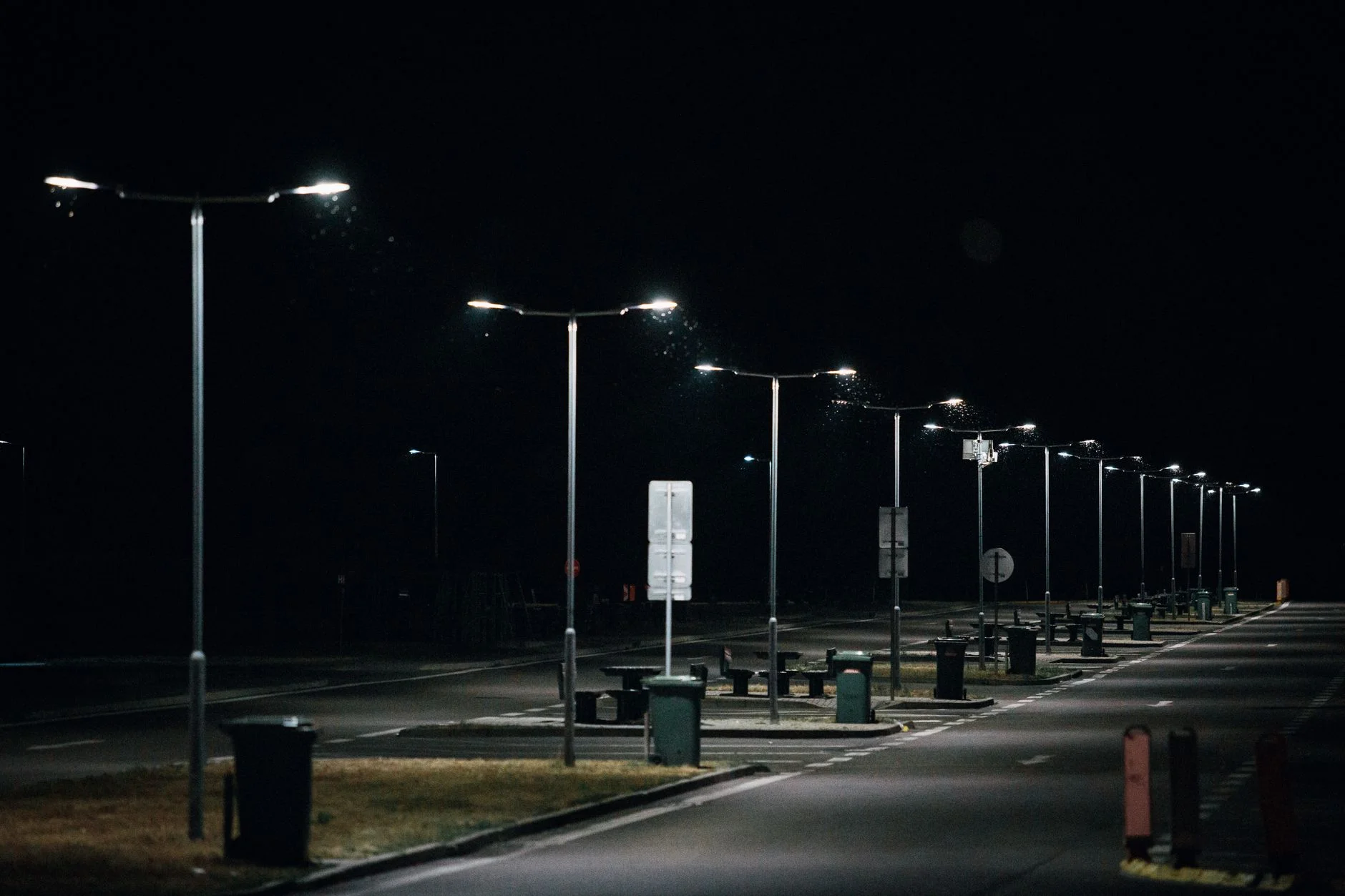
LEDs are among the most energy-efficient lighting technologies available. In the United States, towns began swapping sodium lamps for LEDs about 15 years before 2023. White LED light also lets drivers and pedestrians see colours much more naturally, which helps when you are judging what is going on at night.
The switch saved energy, but it brought a new kind of failure. A sodium lamp tended to fade or go out. A white LED with a damaged phosphor layer carries on working, yet in a very different colour. That is why it is so easy to spot from the pavement.
What colour is light? Wavelength, frequency and energy
To understand the purple glow properly, we need a little physics. Visible light is one small part of the electromagnetic spectrum, covering roughly 380 to 750 nm. A nanometre (nm) is one billionth of a metre. Violet and blue light have short wavelengths, and red light has long wavelengths.
| Colour | Wavelength (nm, approx.) | Where you see it in street lighting |
|---|---|---|
| Violet | 380–450 | The short end of the blue LED’s light |
| Blue | 450–495 | The LED chip itself |
| Green | 495–570 | Part of the spread of the phosphor’s light |
| Yellow | 570–590 | The phosphor layer, and old sodium lamps |
| Orange | 590–620 | Warm sodium glow |
| Red | 620–750 | The far end of the visible spectrum |
All light waves travel at the same speed in a vacuum, so wavelength and frequency are linked by the wave equation:
c = f × λ
Here c is the speed of light, 3.00 × 10⁸ m/s, f is the frequency in hertz and λ is the wavelength in metres. A shorter wavelength therefore means a higher frequency. For 450 nm blue light, f = 3.00 × 10⁸ ÷ (450 × 10−9) = 6.67 × 10¹⁴ Hz. If you find the two quantities easy to mix up, our article on wavelength versus frequency sets them side by side.
Light also arrives in tiny packets called photons, and each photon carries an amount of energy that depends on its frequency:
E = h × f = h × c ÷ λ
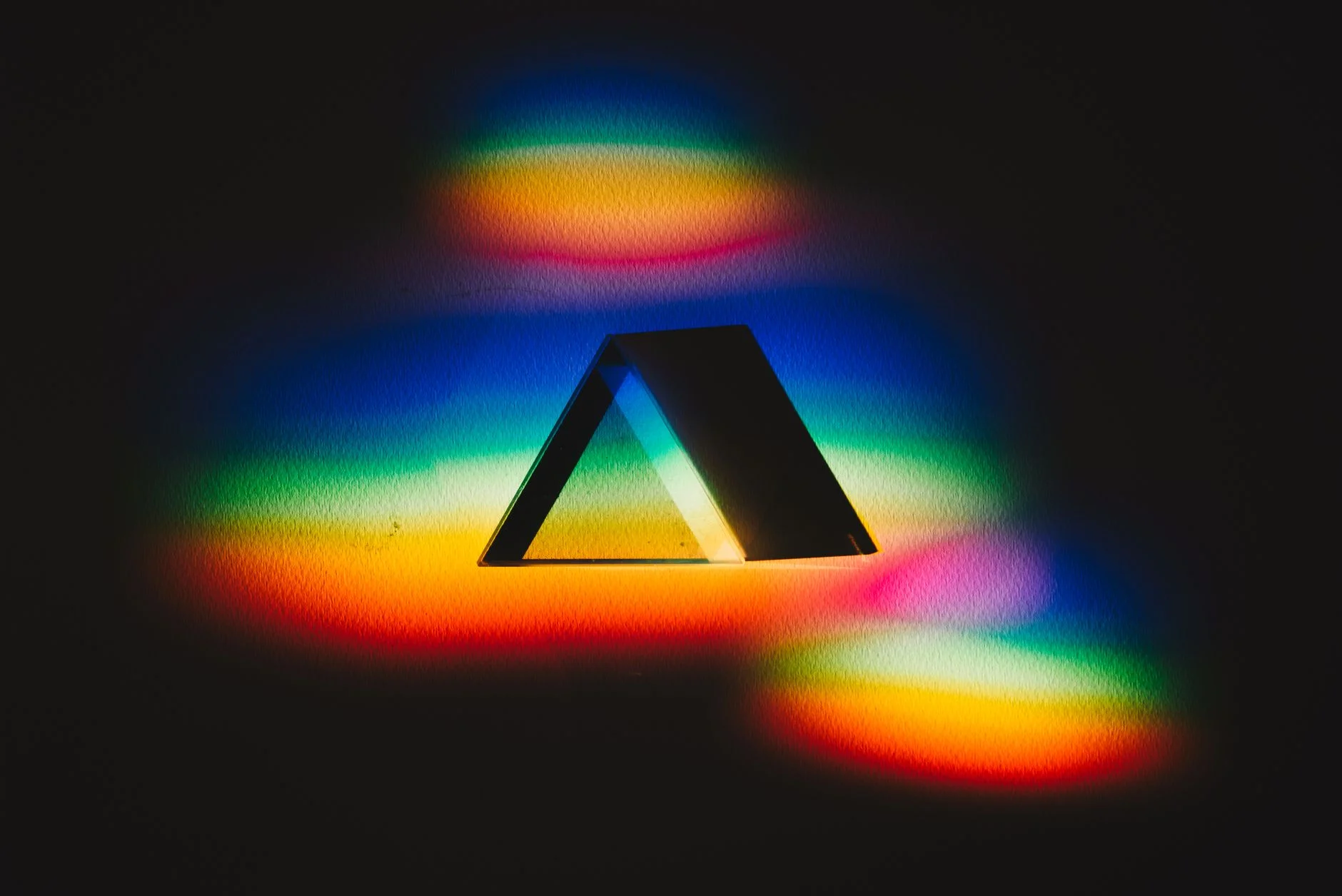
The constant h is the Planck constant, 6.63 × 10⁻³⁴ J s. Because energy is proportional to frequency, shorter wavelength means higher frequency and more energy per photon. A prism shows the effect nicely, because it spreads white light into a rainbow from red (lowest energy) to violet (highest).
This one idea explains the whole story of the purple street light. The chip gives out high-energy blue photons. The phosphor swallows some of them and releases lower-energy yellow photons. When the phosphor fails, the blue photons simply carry on through, and the road below turns purple.
How do white LED street lights make white light?
The US Department of Energy points out that LEDs are not inherently white. A single LED gives out light in a narrow band of wavelengths, so it looks like one colour. Engineers have three main ways to get white light from LEDs:
- Phosphor conversion: a blue LED coated with a phosphor that adds yellow light.
- Colour mixing: separate red, green and blue LEDs whose light is blended together.
- A hybrid: a mixture of the two ideas.
White street lights almost always use phosphor conversion, because it is cheaper and more efficient than three-colour designs. It also means that one small layer of material decides whether the lamp looks white. Understanding that layer is the key to understanding why LED street lights turn purple.
The blue LED chip
An LED is a small piece of semiconductor. When current flows through it, electrons drop to lower energy levels and give out the difference as light. The colour depends on the material and on how big that energy step is. The blue chips in white LEDs are made using gallium nitride.
Red and green LEDs were developed long before blue ones, and blue was the missing piece for efficient white lighting. In 2014 the Nobel Prize in Physics went to Isamu Akasaki, Hiroshi Amano and Shuji Nakamura “for the invention of efficient blue light-emitting diodes which has enabled bright and energy-saving white light sources”.
If this sounds familiar, it is because a solar cell does roughly the reverse job. A solar cell turns light into electricity, while an LED turns electricity into light. Our guide to how solar panels work explains the semiconductor side of that idea.
The yellow phosphor layer
A phosphor is a material that absorbs light and re-emits it at a longer wavelength. In most white LEDs the phosphor is cerium-doped yttrium aluminium garnet, usually written YAG:Ce. It soaks up some of the blue photons and gives out yellow ones.
Why blue plus yellow looks white
Your retina contains three types of cone cell, sensitive mainly to red, green and blue light. Yellow light stimulates the red-sensitive and green-sensitive cones. Add some blue light, and the blue-sensitive cones join in. With all three types active, your brain reads the mixture as white.
The balance matters. If a lamp has less yellow than it should, the mix leans towards blue. That is exactly what happens when the phosphor layer fails: the blue is still there, but the yellow is reduced.
Chip-scale package LEDs
Newer LEDs are often made as chip-scale packages (CSP). In a CSP, the silicone and phosphor layer sits directly on top of the tiny chip, with very little else around it. This makes a very compact light source, and it is the type of LED found in the failed street lights that researchers tested in 2024. We meet that study in the next section of this article.
A street light module contains many LEDs working together. The tested modules each held 20 of them, and researchers found that even a few affected LEDs can shift the colour of a whole module.
Quick check: flip the cards
Test yourself on the key ideas so far. Tap each card to see the answer.
Exam practice: why both blue and yellow?
This kind of question appears in GCSE and IGCSE physics papers in many forms. Try it before you open the answer.
Explain why a white LED street light needs both a blue LED and a phosphor. (3 marks)
LEDs give out light of (almost) one colour, so one LED cannot make white light by itself (1). The blue LED chip gives out blue light, and the phosphor absorbs some of it and re-emits it as yellow light of a longer wavelength (1). The remaining blue and the yellow together stimulate all three types of cone cell in the eye, so the light looks white (1).
A good habit is to check which colour is being made and which is being lost. In a faulty lamp the yellow is reduced, so the blue wins. Keep that in mind as we move on to the fault itself.
Before we do, a note on honesty. The science of a failing phosphor is still being investigated. Some of the details below come from careful laboratory work published in 2024, and some come from reports and statements by utilities and manufacturers. We will say which is which, and we will say where the experts still disagree.
Why LED street lights turn purple: phosphor delamination
Now we can answer the question properly. LED street lights turn purple because the layer that holds the phosphor fails. Manitoba Hydro in Canada described it plainly in November 2022: “It’s a manufacturer defect called ‘delamination.’ … When the phosphor coating comes off, or delaminates, it lets the blue light through.”
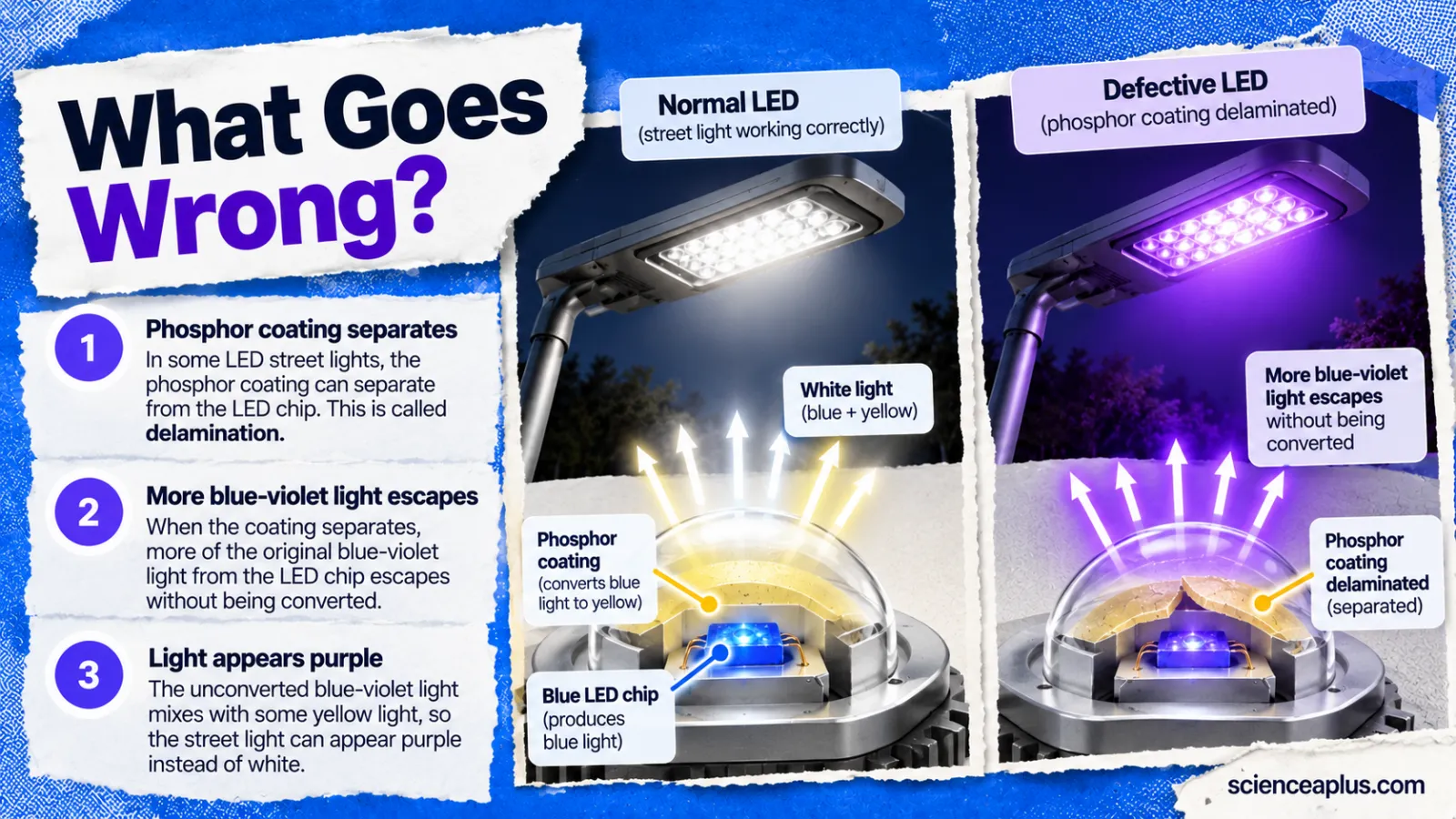
Delamination means a layer separating or lifting away from the surface beneath it, like paint peeling off a wall. In an LED, the phosphor layer cracks, lifts or peels, and the blue light from the chip escapes without being converted.
Acuity Brands, whose American Electric Lighting (AEL) fixtures were named in many reports, called the problem “a spectral shift caused by phosphor displacement”. It said the effect showed up years after installation, in “a small percentage” of its fixtures. The company also said that other manufacturers had seen the same problem, and that it no longer uses the LEDs involved.
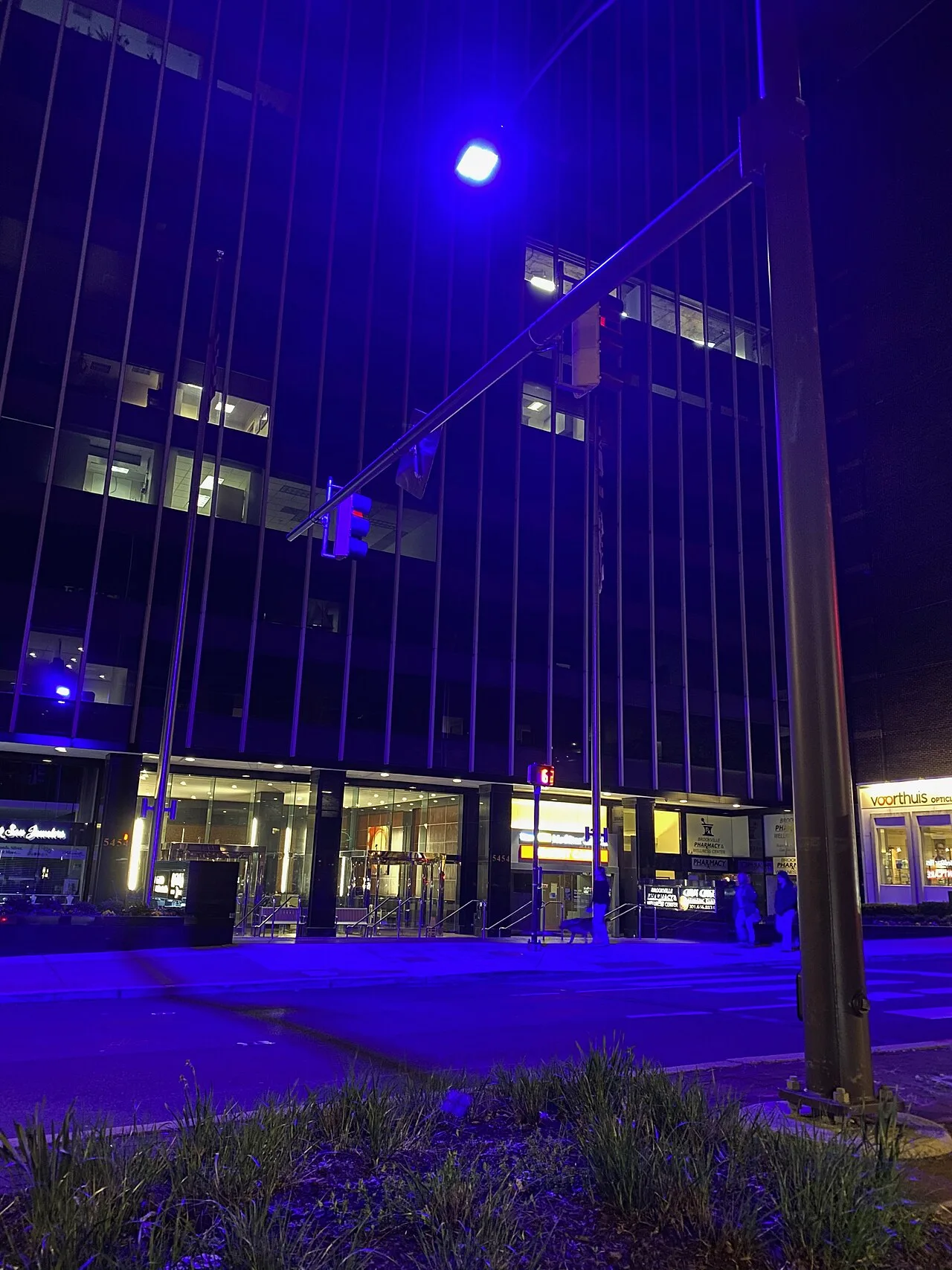
The photo shows what the fault looks like on a real road. Notice that the lamp is still giving out plenty of light. It is simply the wrong colour, which is why such lights are often noticed by passing drivers and reported as purple street lights long before they stop working.
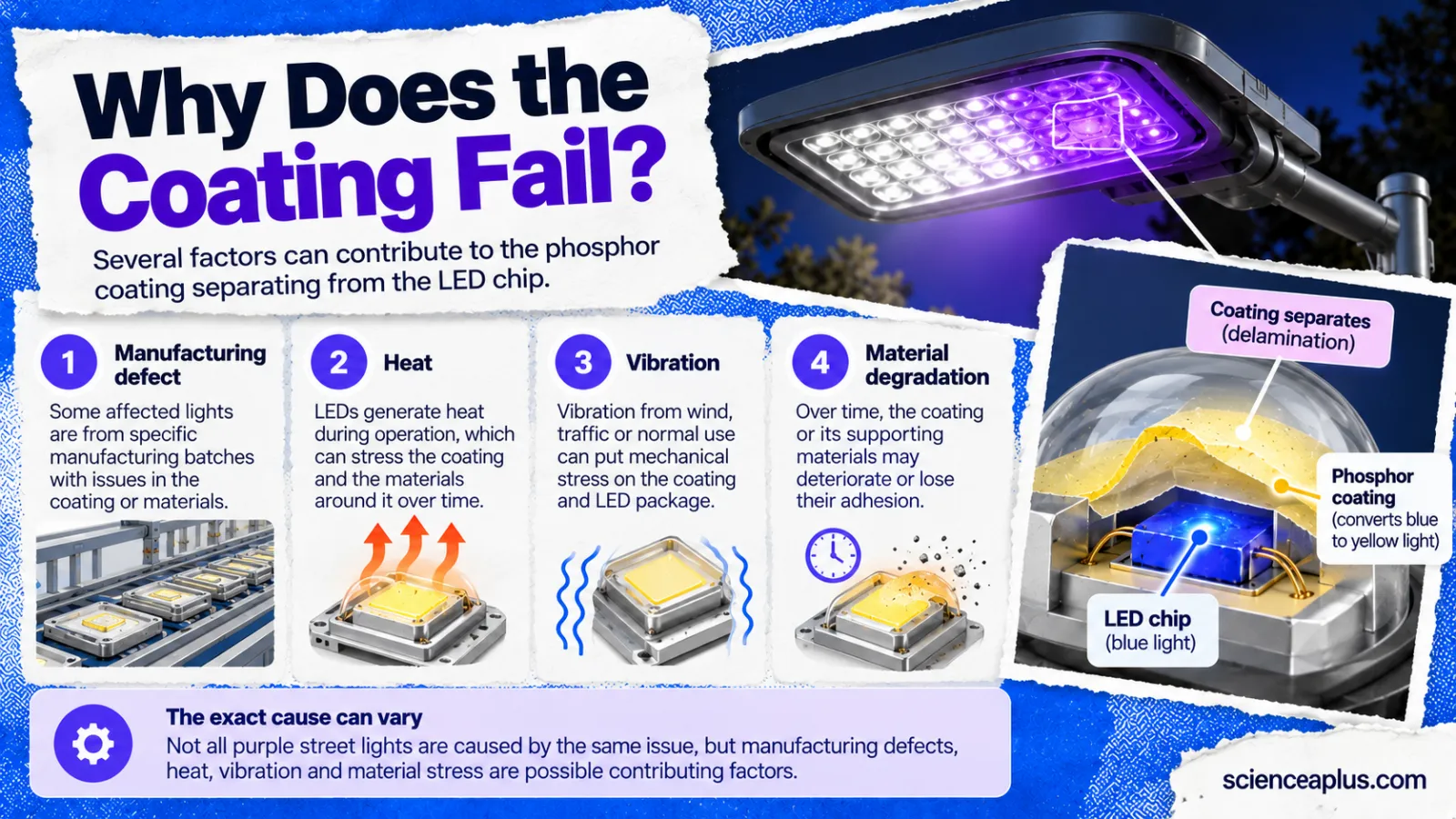
Why does the coating let go?
When the first reports appeared, nobody was sure. In 2023, Scientific American listed several ideas from experts: heat inside the fixture, vibration from traffic, and even gravity pulling on the layer. Ram Seshadri of the University of California, Santa Barbara, thought it was likely “some issue with the manufacturing or some particular LEDs”. He also stressed that phosphor materials themselves “are extremely stable”, so this is not a reason to condemn LED lighting as a whole.
In 2024 the evidence became much sharper. The LED Systems Reliability Consortium (LSRC) presented laboratory findings at an Illuminating Engineering Society webinar on 10 May 2024. Dr Lynn Davis presented work on 28 LED modules, warranty replacements from the North Carolina Department of Transportation that had been installed around 2018. Each module held 20 chip-scale package LEDs.
The researchers found that the weak point was not the phosphor itself but the silicone binder holding it in place. Over time the binder became brittle and lost its grip. Fine cracks grew while the lights were running, and delamination followed. Even a few affected LEDs were enough to shift a whole module’s colour towards royal blue.
Thermal imaging suggested that heat was likely not a significant factor, which goes against one of the favourite explanations from 2023. Optics expert Peter Palomaki put it this way: “It’s not the phosphor itself that’s failing but the binder that’s attaching it to the LED, probably the silicon[e].” He added that failures appear to be “environment-dependent, varying based on light, heat, and moisture.”
It is worth separating two similar words here. Silicon is the element used in computer chips and many solar cells. Silicone is a flexible, rubber-like polymer. Our article on silicon, silicone and silica explains the difference, and in this story the binder is silicone.
Why purple, not just blue?
The escaping light is mostly blue, at around 450 nm. A reduced amount of the phosphor’s longer-wavelength yellow to red light is still being added. Strong blue with a little red-end light is seen as violet or purple, so reports describe the colour as “blue or purple”. The exact shade depends on how much of the coating is left.
Two other faults would look different. A completely dead LED goes dark. A phosphor that has simply aged chemically tends to give an off-white light, not a purple one. A purple glow points to the coating coming away. For more everyday examples of physics hiding in plain sight, see our article on physics in everyday life.
Which street lights were affected?
The manufacturer named most often in reports is American Electric Lighting (AEL), a brand of Acuity Brands, based in Atlanta. Acuity says the problem affected only a small percentage of its fixtures. It does not make the chip-scale LEDs itself, so the failure is at the level of a component inside the fixture. Because other makers may have used similar parts, we cannot say that every purple light, anywhere in the world, comes from one company.
Here is a timeline of what was reported:
| Date | Place | What was reported |
|---|---|---|
| Early 2021 | North America and Ireland | First anecdotal reports of purple street lights |
| November 2022 | Manitoba, Canada | Manitoba Hydro explains the fault as delamination and replaces lights free under warranty |
| February 2023 | Winnipeg, Canada | Replacements delayed by supply problems |
| February 2023 | Fort Worth, Texas | Defective LED lights identified; city says it is a manufacturer’s defect |
| Summer 2023 | Wisconsin | Highway lights installed in 2018 fail in numbers “more than anticipated” |
| May 2024 | Laboratory study | LSRC points to the silicone binder |
| 2024 | Florida | Duke Energy says a manufacturer defect is being addressed and the lights otherwise continue to work |
| 2025 | Florida | Duke says all purple lights reported to it have been replaced or repaired |
| January 2026 | Florida and the UK | Florida still replacing lights; purple-light reports on FixMyStreet |
No reliable total exists for how many lights are affected worldwide, so be wary of any article that gives one.
Was there a recall? Warranties and who pays
We did not find any formal public product recall notice. Instead, replacements have been handled under manufacturer warranty, one city or utility at a time. The details vary:
- Manitoba Hydro said replacements were free because the lights were under warranty.
- In Wisconsin, the state transport department said AEL covered replacement costs under warranty.
- In Fort Worth, the city said it was not paying, because the problem was a manufacturer’s defect.
Acuity’s annual reports show spending on “warranty and recall” rising between 2021 and 2023, and the trade site Inside Lighting links that rise to the purple-light problem. That figure may include other products, so it should not be read as a count of purple lights. In October 2023 Acuity also took a charge relating to money owed by a supplier for warranty obligations on certain outdoor products made and sold in 2017 to 2019.
Warranties on street light fixtures generally run for five to seven years, according to USA Today. It is unclear what happens once those warranties expire, so this remains an open question for councils and utilities.
A council says its purple lamps give “the same amount of light, just a different colour”. Suggest why a road-safety researcher might still be concerned. (2 marks)
The centre of the retina has few blue-sensitive cones, so blue-violet light gives poorer detail vision and makes colours harder to tell apart (1). Losing the phosphor may also dim the lamp below the brightness standard for that road (1).
Are purple street lights dangerous?
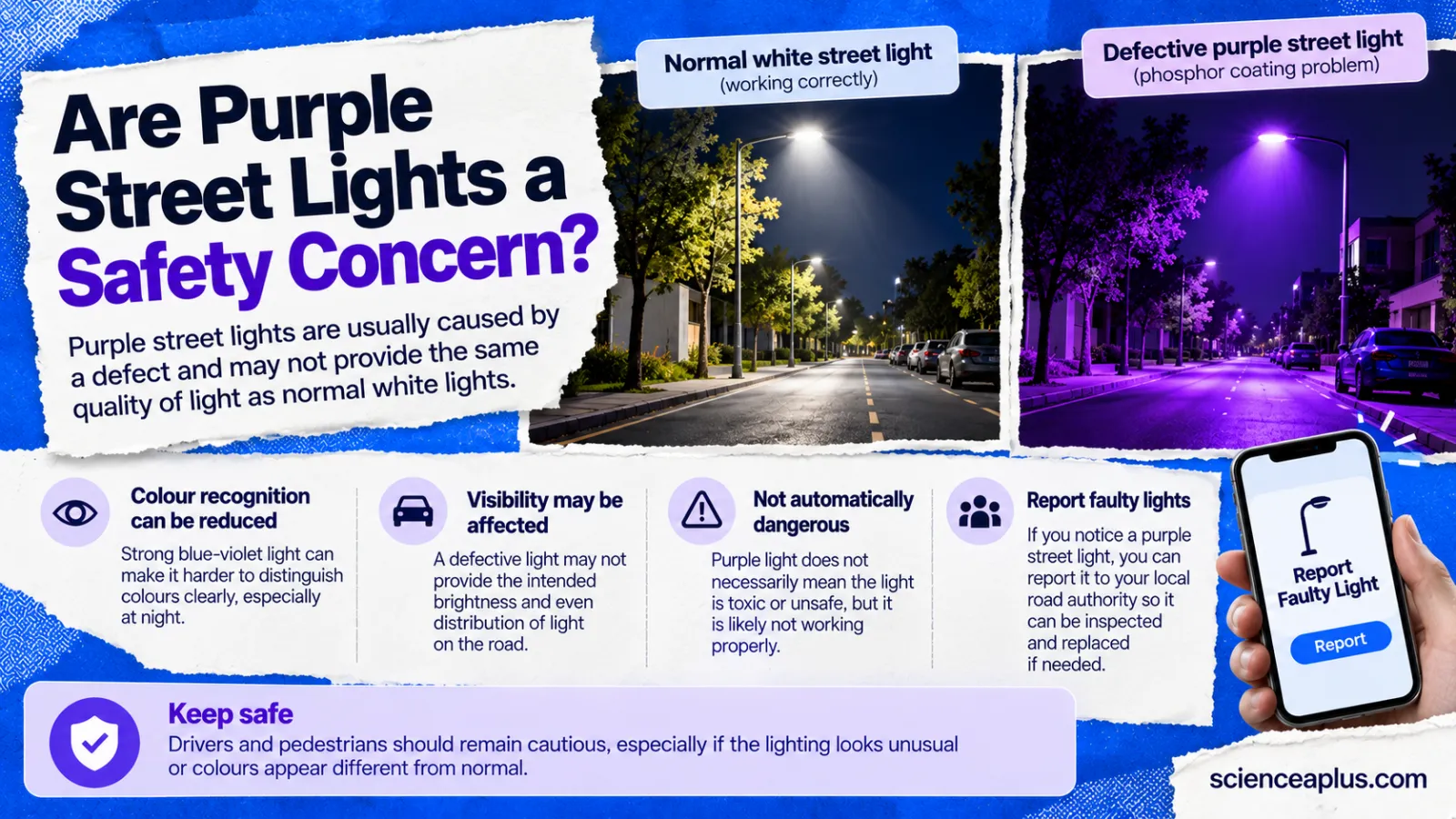
Are purple street lights dangerous? The honest answer is that the people who run the lights and some lighting researchers disagree, so it helps to hear both sides.
Acuity says the affected lights are “in no way harmful or unsafe”. Manitoba Hydro reported “no safety concerns” and says defective lights give the same amount of light in a different colour. Florida Power & Light says the lights are safe and “will not impact visibility”, and the Florida Department of Transportation says they still provide their intended safety benefits.
John Bullough of the Light and Health Research Center at the Icahn School of Medicine at Mount Sinai takes a different view. He thinks purple lights are not good for the safety of drivers and pedestrians, for three reasons:
- A lamp that has lost its phosphor may be dimmer than the brightness standard for that road.
- The centre of the retina has few blue-sensitive cones, so blue-violet light reduces detail vision.
- Colours become hard to tell apart, with things looking blue or black.
The 2024 LSRC study also concluded that the colour shift raises safety concerns, including reduced visibility, difficulty reading signs or traffic signals and possible distraction. Both views are worth holding in mind: a lamp that still lights the road is better than a dark one, but a repaired white lamp is better still.
Some practical tips follow from the research:
- Drivers: slow down on a stretch with purple lighting. Take off sunglasses and blue-light-filtering glasses at night, because, as Bullough says, “at nighttime … we really want to have all the light that we can get.”
- Pedestrians and cyclists: wear something reflective or bright, and use your own lights.
One more piece of context, which is not about the fault. In June 2016 the American Medical Association recommended outdoor lighting of 3000 K or lower, saying that blue-rich LED light can cause glare and suppresses night-time melatonin more than other colours. Our article on the circadian rhythm explains what melatonin does. We have no evidence that purple street lights affect sleep, so please do not read that into the 2016 advice. For blue light from screens at home, see our guide to eye safety from digital devices.
How to report a purple street light
In the UK, street lights are usually looked after by the local council (county, unitary or borough). Motorways and major A-roads in England belong to National Highways. Reporting a purple street light takes a few minutes, and these steps work well:
- Note the exact location: the nearest house number, road name or landmark, and the number on the lamp post if there is one.
- Check who owns the road: the local council for ordinary roads, National Highways for motorways and major A-roads in England.
- Report it on your council’s website, or use FixMyStreet, run by the charity mySociety, which sends reports to the right authority anywhere in the UK.
- Describe it as “LED glowing purple, possible phosphor defect” so the right part is ordered.
- Follow up if nothing happens. For example, Buckinghamshire Council’s street lighting team tells FixMyStreet users it aims to repair faulty lighting within 20 working days, though this can be extended, for example for electricity supply faults.
FixMyStreet does not cover trunk roads run by Traffic Scotland or Traffic Wales, or private roads. In North America the report usually goes to the city or the utility, for example through Manitoba Hydro’s street-light outage form or Duke Energy’s online street-light repair tool.
Are purple street lights still around in 2026?
Yes, purple street lights have not disappeared. Jalopnik wrote in August 2025 that those purple streetlights are “still around”. In January 2026 the Florida station WKMG reported that lights there were still being replaced, and the Florida Power & Light utility said it was swapping them as the required parts became available. In the UK, a resident in Buckinghamshire reported a street light that was “deep purple rather than the colour expected” on FixMyStreet in January 2026.
We found no source announcing that the problem is fully fixed. As of late 2026 there is no sign the problem has fully ended; affected lights are being swapped as they are reported. That is one more reason to report any purple light you see.
Maths practice questions
Use c = 3.00 × 10⁸ m/s, h = 6.63 × 10⁻³⁴ J s and 1 eV = 1.60 × 10⁻¹⁹ J. Give answers to 3 significant figures. Tap a question to reveal the worked solution.
Q1. Calculate the frequency of 450 nm blue light. (2 marks)
f = c ÷ λ = 3.00 × 10⁸ ÷ (450 × 10−9) = 6.67 × 10¹⁴ Hz.
Q2. Calculate the frequency of 580 nm yellow light. (2 marks)
f = c ÷ λ = 3.00 × 10⁸ ÷ (580 × 10−9) = 5.17 × 10¹⁴ Hz.
Q3. Calculate the energy of one 450 nm photon. (2 marks)
E = hc ÷ λ = 6.63 × 10−34 × 3.00 × 108 ÷ (450 × 10−9) = 4.42 × 10⁻¹⁹ J.
Q4. Calculate the energy of a 580 nm photon, and how many times more energy the blue photon has. (3 marks)
E = hc ÷ λ = 3.43 × 10⁻¹⁹ J for the 580 nm photon. Ratio = 4.42 ÷ 3.43 = 1.29 times (the same as 580 ÷ 450).
Q5. Convert both photon energies to electronvolts. (2 marks)
Blue: 4.42 × 10⁻¹⁹ ÷ 1.60 × 10−19 = 2.76 eV. Yellow: 3.43 ÷ 1.60 = 2.14 eV.
Q6. Old sodium lamps give out light at 589 nm. What is its frequency? (2 marks)
f = c ÷ λ = 3.00 × 10⁸ ÷ (589 × 10−9) = 5.09 × 10¹⁴ Hz. (The photon energy is E = 3.38 × 10⁻¹⁹ J, which is 2.11 eV.)
Q7. Stretch: find the energy lost per photon when the phosphor turns a 450 nm photon into a 580 nm one, and give it as a percentage of the blue photon’s energy. (3 marks)
Energy lost = 4.42 × 10⁻¹⁹ − 3.43 × 10−19 = 9.9 × 10⁻²⁰ J (using unrounded values it is 9.91 × 10⁻²⁰ J). Percentage = 9.91 ÷ 44.2 ≈ 22%, which also equals 1 − 450 ÷ 580 = 0.224. This energy is lost as heat in the phosphor.
Q8. Light from an LED has a frequency of 6.00 × 10¹⁴ Hz. Find its wavelength and say what colour it is. (2 marks)
λ = c ÷ f = 3.00 × 10⁸ ÷ 6.00 × 1014 = 5.00 × 10⁻⁷ m = 500 nm. This is bluish-green (cyan); by the table above, 500 nm just falls in green (495–570 nm).
Q9. Stretch: how many 450 nm photons per second carry 1.00 W of light power? (2 marks)
N = P ÷ E = 1.00 ÷ (4.42 × 10⁻¹⁹) = 2.26 × 10¹⁸ photons per second.
Q10. Light travels 8.0 m from a lamp to the road. How long does it take? (2 marks)
t = d ÷ c = 8.0 ÷ (3.00 × 10⁸) = 2.67 × 10⁻⁸ s (about 27 ns).
Frequently asked questions about purple street lights
Why are some street lights purple?
Purple street lights are white LEDs whose phosphor coating has cracked, lifted or peeled away. The chip underneath gives out blue light, and the coating normally turns some of it yellow so the lamp looks white. Without enough coating, extra blue light escapes and the lamp looks violet-purple.
Are purple street lights on purpose?
No. Purple street lights are a fault, not a design choice. Utilities such as Manitoba Hydro call it a manufacturer defect, and councils and utilities replace the affected lights. Claims that they protect wildlife or deter loitering are not supported by evidence.
Are purple street lights dangerous?
Makers and utilities say the lights are not harmful or unsafe. Some lighting researchers disagree, because blue-violet light gives poorer detail and colour vision, and a lamp may be dimmer than the road standard. The sensible approach is to take care on affected roads and report the light.
Who made the purple street lights?
The brand named in many reports is American Electric Lighting, part of Acuity Brands. Acuity said only a small percentage of its fixtures were affected and that other manufacturers had seen the same problem. Researchers in 2024 said several fixture manufacturers may be affected, so no single company explains every case.
Are purple street lights being replaced?
Yes, in many places. Replacements are usually done under manufacturer warranty, one city or utility at a time, and we found no formal public recall notice. Supply delays have slowed some repairs. It is unclear who pays once warranties have expired.
How do I report a purple street light in the UK?
Report it to your local council on its website, or use FixMyStreet, which sends the report to the responsible authority. Give the location and the lamp-post number if there is one. Motorways and major A-roads in England are National Highways’ responsibility, and private roads are not covered.
Why do white LEDs need a phosphor?
An LED gives out light in a narrow band of wavelengths, so it cannot make white light alone. White street lights use a blue LED with a yellow phosphor. The phosphor turns some blue into yellow, and the mixture looks white. This is cheaper and more efficient than mixing red, green and blue LEDs.
Why do purple lights look purple and not blue?
The escaping light is mostly blue, mixed with a reduced amount of the phosphor’s longer-wavelength yellow to red light. Strong blue with a little light from the red end of the spectrum is seen as violet or purple. Reports often describe the colour as blue or purple, depending on how much coating remains.
Are there still purple street lights in 2026?
Yes. Reports were still appearing in 2025 and January 2026, in Florida and on UK FixMyStreet, and lights were still being replaced. We found no announcement that the problem is fully fixed. Affected lights are being swapped as they are reported, so reporting one helps.