A good social media essay does more than list “likes” and “fake news”. It weighs the advantages and disadvantages of social media against evidence, and says clearly where that evidence is strong, where it is weak and where scientists still disagree. This guide gives you the essay content you need, then goes further: the psychology and neuroscience behind why feeds are so hard to put down, what large studies actually found about teenagers’ mental health, and how to write a balanced answer.
Whether you are revising for a GCSE English or PSHE task, writing a school essay, or just curious, the aim is the same: understand social media as a system designed by people, used by people, and studied by scientists.
What are social media?
Social media are online platforms and apps that let people create, share and react to content, and connect with each other. That covers photo and video feeds, short-video apps, group chats and discussion forums. The key feature is that users make most of the content, and other users respond to it with comments, shares and likes.
Two features separate social media from older media such as television. First, the audience can answer back and share instantly. Second, most large platforms use an algorithm: a set of rules, learned from data, that predicts what each person is most likely to watch, like or share, and shows that first. We return to algorithms in the science section below, because they explain a lot about both the benefits and the problems.
Ofcom, the UK communications regulator, publishes a yearly report on children’s media use. Its 2026 report, published on 21 May 2026, found that about 95% of 8 to 17-year-olds use at least one social media or video-sharing platform it asked about. Among those who use social media, most mainly watch, read, follow or like content rather than post: about 65% are in that group, against about 34% who mostly share, comment or post their own.
That simple split matters for the science later. The research suggests that how you use social media (scrolling passively, chatting with close friends, posting, learning a skill) may matter as much as how long you use it.
The importance of social media: five advantages
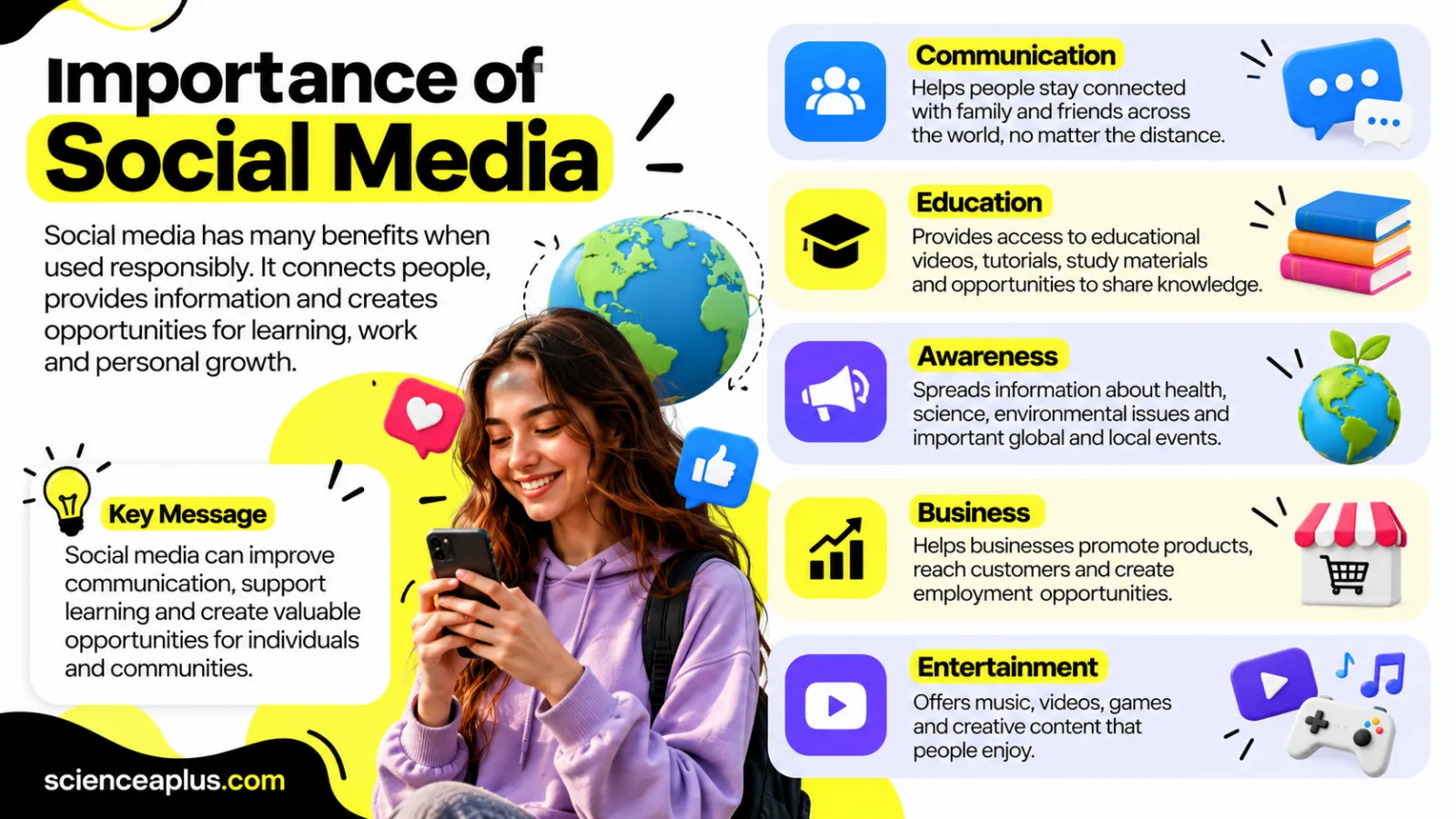
The infographic below summarises five areas where social media is genuinely useful: communication, education, awareness, business and entertainment. Each one has real benefits. Each one also comes with a catch that a strong essay will mention.
1. Communication
Social media helps people stay in touch with family and friends across the world, at almost no cost. For anyone who has moved school, town or country, a group chat or a video call can keep a friendship alive. Online messaging can support close, supportive relationships.
The catch: chatting with close friends is not the same as scrolling through strangers’ highlights.

2. Education
Videos, tutorials, revision channels and online communities give students free access to explanations, often from several different teachers. A student stuck on a chemistry topic can watch three different explanations in ten minutes and keep the one that makes sense.
The catch: anyone can post a “tutorial”, and platforms do not check accuracy. Compare claims with a trusted source, and use proven memory techniques for revision rather than just watching.
3. Awareness
News about health, science, the environment and local events can reach millions of people within hours. Public-health messages, charity appeals and citizen-science projects all use social media for exactly this reason.
The catch is speed. A famous study of about 126,000 stories shared on Twitter found that false stories spread farther, faster and more widely than true ones. We look at that study in detail below, because it is the best evidence for why “awareness” and “misinformation” are two sides of the same coin.
4. Business and employment
Small businesses can promote products, find customers and build a brand with a phone and a free account. Many people now earn a living as creators, designers, tutors or sellers.
The catch: advertising funds most platforms, so feeds are designed to hold your attention.
5. Entertainment
Music, video, games and creative content are a big part of why people use social media, and enjoying yourself is a perfectly good reason. Creative hobbies such as art, music, coding and sport can all be shared, learned and improved online.
The catch: infinite scroll and autoplay remove the moments where you might decide “that’s enough”.
How to use these advantages well
The benefits above are most likely when social media is used actively and with purpose: messaging people you know, learning a skill, joining a community around a hobby, or finding out about an issue and then checking it. They are least likely when use becomes automatic, late at night or driven by a fear of missing out.
That is the thread running through this whole article, and it is why the next two sections look closely at the evidence rather than simply listing pros and cons. A balanced life matters too: see this guide to a balanced social life for ideas that combine online and face-to-face friendships.
Disadvantages of social media: how strong is the evidence?
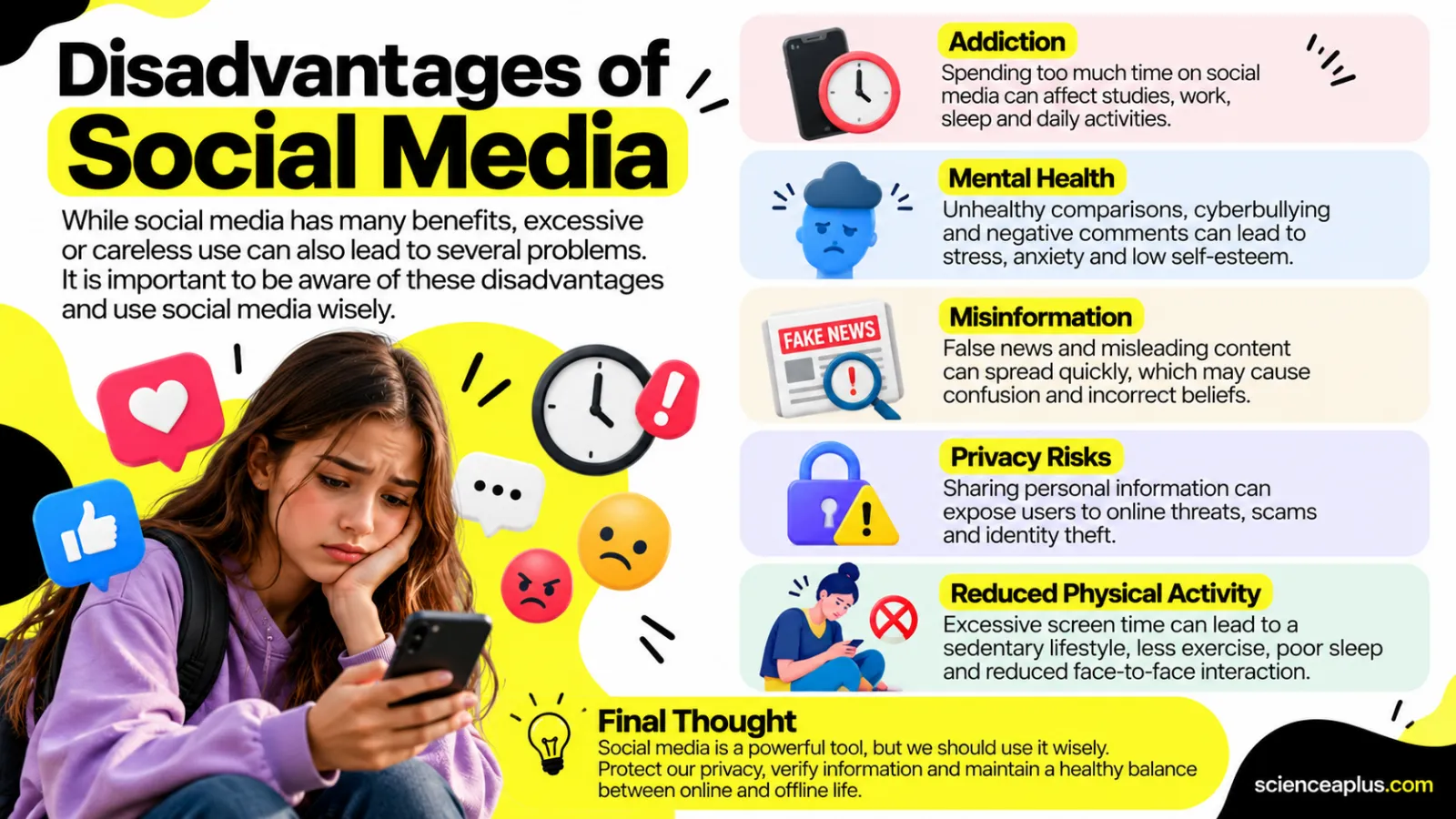
The second infographic lists five common disadvantages of social media: addiction, mental health, misinformation, privacy risks and reduced physical activity. These are real concerns, but a good essay separates what is well supported from what is plausible but unproven. The card’s wording (“can lead to”) describes possible effects, so the text below checks how strong the research is for each one. We also look separately at bullying and pressure, which the card folds into mental health.
1. “Addiction” and time loss
Many people say they lose track of time on their phones. That experience is real, and it can crowd out homework, sleep and hobbies. But scientists are careful with the word addiction. “Social media addiction” is not a formal diagnosis in the main medical manuals (the WHO’s ICD-11 includes gaming disorder, but not social media use disorder). Researchers more often talk about problematic or compulsive use: using an app more than you intended, finding it hard to stop, and feeling worse afterwards.
The reasons it is hard to stop are partly designed in: notifications, streaks, autoplay and the infinite scroll. The science section below explains the reward learning behind this.
2. Mental health
This is the most debated disadvantage, so it needs the most care. Some studies find that heavier social media use goes along with more anxiety, depression and lower self-esteem. Other studies find tiny or no links. The important question is cause and effect.
In 2019 the four UK Chief Medical Officers published a commentary on a University College London review of the research. They said the evidence was “insufficiently conclusive” to set guidelines on how much screen time is optimal, and that the research did not show a causal link between screen-based activities and mental health problems. They noted that an association had been seen, and that cause and effect were not fully understood: for example, children who already have mental health problems may be more likely to spend time on social media. They also said that the lack of proven cause does not mean there is no effect, and recommended a precautionary approach.
Later research has not settled it. A 2019 analysis by Amy Orben and Andrew Przybylski in Nature Human Behaviour, using three large datasets with 355,358 participants in total, found that technology use explained at most 0.4% of the variation in adolescent well-being. The authors argued this was too small to justify policy change on its own. A 2022 “review of reviews” by Patti Valkenburg and colleagues looked at 25 earlier reviews: most described the link between social media use and mental health as weak or inconsistent, while a smaller number called it substantial and harmful.
A small average effect could still hide a larger effect for some individuals, and harm and benefit can both be true depending on the person, the platform and the type of use. For practical advice on mood and sleep together, see this guide to sleep hygiene and mental health.
3. Comparison, cyberbullying and pressure
The slide groups “unhealthy comparisons, cyberbullying and negative comments” under mental health. Cyberbullying is a clear harm: being bullied hurts whether it happens in a corridor or on a screen, and online bullying can follow someone home, to be seen by many people at any time. Ofcom’s 2026 report, as summarised by the Anti-Bullying Alliance, found that about seven in ten 8 to 17-year-olds who use social media or messaging apps feel pressure to be popular online at least some of the time, and about a third feel it all or most of the time.
If you are being bullied online, save the evidence, block and report the account, and tell a trusted adult. Childline offers free confidential support in the UK.
4. Misinformation
False or misleading content can spread quickly and cause confusion and incorrect beliefs. This was seen during the COVID-19 pandemic, when health rumours circulated widely. Ofcom’s separate Children’s Online Experiences research, also published in May 2026, found that 73% of 11 to 17-year-olds had seen harmful content online, and 35% said they met it while scrolling through their feeds. That suggests that what a feed chooses to show can matter as much as what young people go looking for.
Part of the solution is a skill, not a rule: learning to pause, check the source and look for the same claim elsewhere. We turn to the science of why false stories travel so well next, and a skills guide on critical and logical thinking gives a framework you can apply.
5. Privacy risks
Personal information that you post can be copied, shared and kept for a long time, even if you delete it later. Oversharing can expose people to scams and identity theft, and it can reveal where you live, go to school or spend time. The UK CMOs’ advice for families includes a simple rule: when in doubt, don’t upload, and parents and carers should never assume that children are happy for their photos to be shared.
6. Reduced physical activity and face-to-face time
Scrolling is mostly sitting down, and it can replace exercise, outdoor play and conversations in person, although research on how much time is actually displaced is mixed. A clearer problem is sleep, covered in the next section.
If you are worried about your own wellbeing, speak to a GP, a school counsellor or a trusted adult. In the UK, Childline (0800 1111) and the NHS 111 service can also help, and in an emergency you should call 999.
The science behind it: why feeds are hard to put down
Social media apps are built by teams who test constantly what keeps people looking. You do not need to be “weak-willed” to find them sticky. Psychology and neuroscience give several explanations, and some are better supported than others. Here are five ideas that examiners and essay markers like to see, with an honest note about the strength of the evidence for each.
Dopamine and the variable reward loop
Dopamine is a chemical messenger (a neurotransmitter) used by brain circuits involved in motivation and learning. It is often called the “pleasure chemical”, but that is a simplification. Experiments on animals, led by Wolfram Schultz in the 1990s, showed that dopamine neurons respond most strongly to surprise: when a reward is better than expected, they fire more, and the brain learns to repeat the behaviour that led to it. This is called a reward prediction error.
Now think about a feed. You swipe, and sometimes you see something funny, a message from a friend, or a notification with many likes. Often you see nothing special. Because the rewards arrive unpredictably, the pattern resembles what the psychologist B. F. Skinner called a variable-ratio schedule, the same type of pattern used in slot machines.
A fair essay adds a caution. The link between this reasoning and everyday scrolling is an inference from lab science, not a direct measurement of dopamine in people’s brains while they use their phones. It is a useful model, not proof of “addiction”.
The adolescent brain and the “like”
In 2016 a team at the University of California, Los Angeles led by Lauren Sherman scanned 32 teenagers aged 13 to 18 with functional MRI while they used a mock photo-sharing app. The teenagers saw 148 photos, 40 of them their own, each showing a number of likes that the researchers had actually assigned. Photos with many likes produced stronger activity in reward-related brain regions, including the nucleus accumbens, and the teenagers were more likely to like photos that already looked popular.
It is a small experiment: it shows that peer approval online engages reward circuits, not that this harms anyone. For more on how the brain works, see this introduction to neuroscience and the brain.
Social comparison
In 1954 the psychologist Leon Festinger proposed that people judge their own abilities and opinions by comparing themselves with others. Social media puts comparison on constant display, and what you see is selected, edited and filtered. Comparing your everyday life with other people’s best moments can leave you feeling you are falling short. The effect varies a lot between people and types of use, and it is not proven to cause depression on its own.
Sleep, late-night use and blue light
This is the area where the evidence points most consistently in one direction. A 2016 meta-analysis in JAMA Pediatrics by Carter and colleagues combined studies of 125,198 children and adolescents, with an average age of 14.5. Using a media device at bedtime was linked to inadequate sleep, with an odds ratio of 2.17 (95% confidence interval 1.42 to 3.32). That means the odds of short sleep were roughly twice as high in children using devices at bedtime. The authors stressed that most data were self-reported and that causation could not be established.
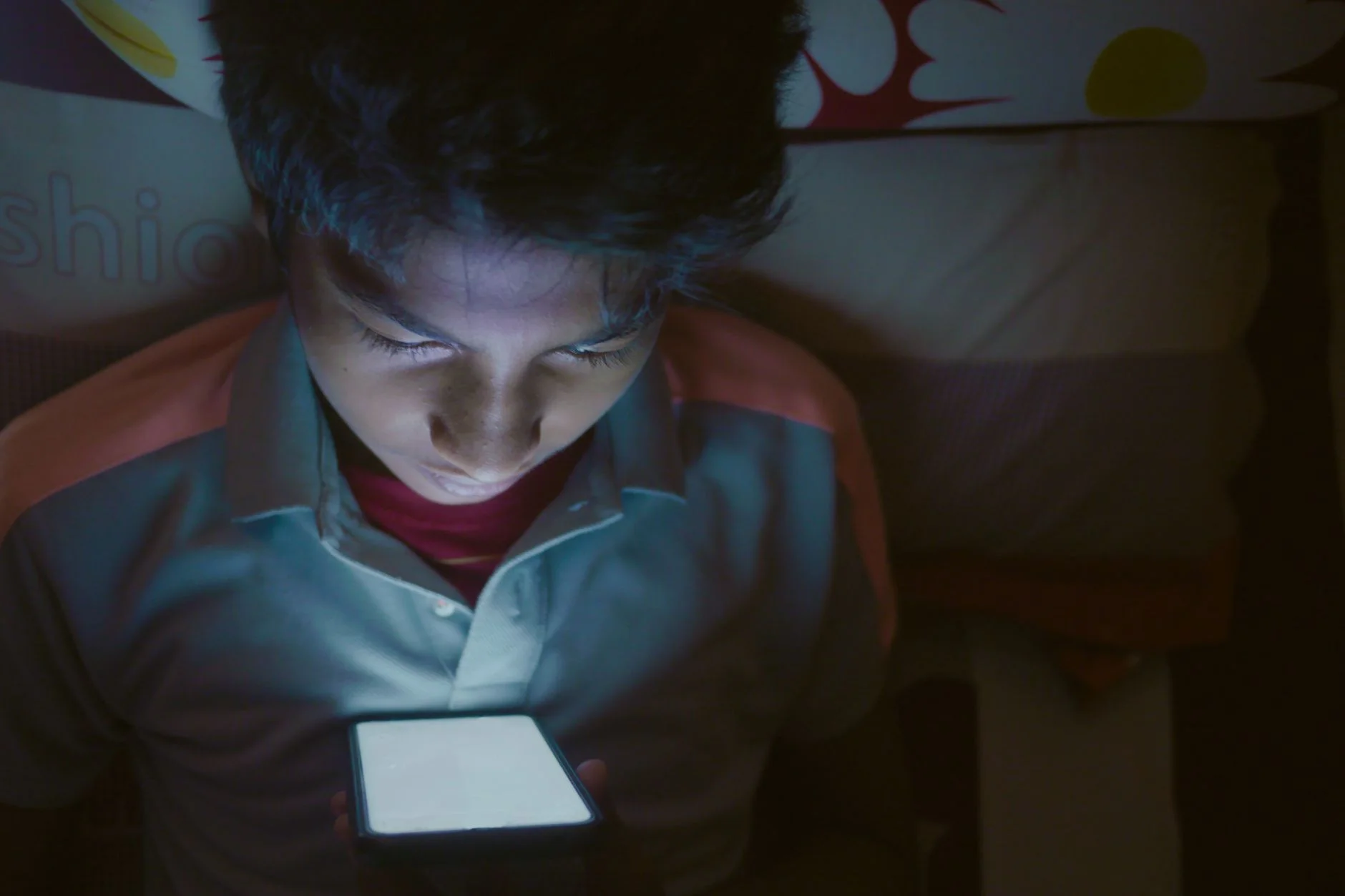
Bright light in the evening can suppress melatonin, the hormone that helps signal night-time to the body, and the NHS advises trying not to use phones, tablets or computers for an hour before bed. But “blue light” is only part of the story. Reviews of blue-light-blocking glasses find small and inconsistent effects on sleep, and a 2023 Cochrane review of blue-light filtering lenses said the effect on sleep-related measures was unclear. Content, notifications and “one more video” probably matter too. Teenagers typically need around 8 to 10 hours of sleep a night (NHS services quote slightly different ranges), and the effects of sleep deprivation include poorer concentration and mood.
Algorithms and misinformation
Most large platforms rank content using engagement signals: what you watch, pause on, like, share and comment on. Posts that provoke strong reactions often score well. In 2018 Soroush Vosoughi, Deb Roy and Sinan Aral published the largest study of its kind in the journal Science. They tracked about 126,000 stories shared by about 3 million people on Twitter, using the verdicts of six independent fact-checking organisations. False stories spread farther, faster, more deeply and more broadly than true ones. Bots shared true and false stories at the same rate, so the difference came from people. The researchers found that false stories were more novel, and they inspired more surprise and disgust, while true stories drew more trust and anticipation. False stories were about 70% more likely to be retweeted, and true stories took about six times as long to reach 1,500 people.
It studied one platform, so it does not describe every platform today. A useful habit is to ask “who made this, what is the evidence, and who benefits if I share it?” Scientists use the same sceptical method, as in the scientific method in psychology.
What happens if you cut back? A real experiment
In 2018 Melissa Hunt and colleagues at the University of Pennsylvania ran a randomised experiment with 143 undergraduates. One group limited Facebook, Instagram and Snapchat to 10 minutes per platform per day for three weeks; the control group used them as usual. The limited group showed significant reductions in loneliness and depression compared with the control group, but there was no change in measures such as social support and self-esteem. Random assignment makes this stronger evidence than a survey, but it was one study of university students over three weeks, so it may not apply to younger teenagers.
Maths practice: screen time and percentages
Numbers about social media are easier to judge when you can work with them. Try these questions, then tap to check your answers. Use the calculator afterwards to work out your own figures.
Imagine 200 pupils who use social media and match Ofcom’s 2026 pattern for 8 to 17-year-olds (about 65% mainly consume content, about 34% mainly share or post it). How many pupils is that in each group? (2 marks)
65% of 200 = 0.65 × 200 = 130 pupils mainly consume content. 34% of 200 = 0.34 × 200 = 68 pupils create content.
A student uses social media for 3.5 hours a day. How many hours is that in a week, and in a 365-day year? How many full days is the yearly total? (3 marks)
Week: 3.5 × 7 = 24.5 hours. Year: 3.5 × 365 = 1,277.5 hours. Days: 1,277.5 ÷ 24 ≈ 53.2 days.
The same student sleeps 9 hours a night. What percentage of their waking day is spent on social media? Give your answer to 1 decimal place. (3 marks)
Waking hours = 24 − 9 = 15. Percentage = 3.5 ÷ 15 × 100 = 23.3%.
A study finds that technology use explains at most 0.4% of the variation in well-being. If total variation were 100 units, how many units are explained, and how many are left to other factors? (2 marks)
0.4% of 100 = 0.4 units explained. The remaining 100 − 0.4 = 99.6 units are due to other factors (or unexplained).
Rules are changing: UK and Australia in 2026
Governments are now acting on the concern, even though the research on cause and effect is not settled. Australia’s minimum-age law for social media accounts came into force on 10 December 2025, and its eSafety regulator reported in January 2026 that platforms had deactivated, removed or restricted about 4.7 million accounts. A March 2026 update found many under-16s still kept access, so enforcement is difficult.
In the UK, the government announced in June 2026 that it would ban social media for under-16s. According to the government fact sheet last updated on 18 September 2026, the first regulations are due before the end of 2026 and the changes should take effect in spring 2027. Messaging services such as WhatsApp and Signal are not intended to be included, and 16 and 17-year-olds would still be able to use social media with some features switched off by default. These are announced plans, not yet in force, so check the latest position before quoting them.
A strong essay can weigh this up: supporters point to precaution, critics to weak evidence of harm, privacy issues with age checks and lost benefits.

How to write a balanced social media essay
- Introduction: define social media, state that you will weigh advantages against disadvantages and give your overall view.
- Advantages: choose two or three (communication, learning, awareness), each with a point, evidence and a limitation.
- Disadvantages: choose two or three (sleep, comparison, misinformation, privacy), each with a point, evidence and a limitation.
- The science: add one study and say whether it shows correlation or cause.
- Conclusion: answer the question. A balanced judgement is that social media is a powerful tool whose effects depend on how, when and how much it is used.
Frequently asked questions about social media essays and effects
What are the main advantages of social media?
The main advantages are communication across distance, free access to learning resources, quick spread of useful information, opportunities for businesses and creators, and entertainment. These benefits are most likely when people use social media actively and with purpose, rather than scrolling passively late at night or comparing themselves with edited images.
What are the main disadvantages of social media?
Common disadvantages include time lost to compulsive scrolling, pressure from comparison and bullying, misinformation, privacy risks and less physical activity. Some are better evidenced than others: the link with poorer sleep is fairly consistent, while the effect on overall mental health appears small on average and is still debated.
Does social media cause depression in teenagers?
Nobody has shown that it does. The UK Chief Medical Officers said in 2019 that research did not present evidence of a causal relationship, though associations exist. Large analyses find small average links, and individuals vary. If you are worried about your mood, speak to a GP, school counsellor or trusted adult.
Is social media addictive?
Social media can be hard to stop using because features such as notifications, streaks and infinite scroll use reward learning. However, social media addiction is not a formal diagnosis in the main medical manuals, so researchers prefer terms such as problematic or compulsive use. Using an app more than you intended is a useful warning sign.
How does social media affect sleep?
Studies link bedtime device use with shorter or poorer sleep, and a meta-analysis of 125,198 children found about twice the odds of inadequate sleep. Light, exciting content and notifications may all play a part. The NHS suggests avoiding screens for an hour before bed, and the CMOs recommend phones outside the bedroom.
Why does fake news spread so fast on social media?
A major 2018 study found false stories spread farther and faster than true ones, and that people, not bots, drove the difference. False stories were more novel and provoked surprise and disgust. Engagement-based ranking can then show more people whatever they react to. Checking the source before sharing helps.
How can I use social media in a healthy way?
Choose active uses like messaging friends and learning skills, switch off non-essential notifications, keep phones out of the bedroom, take screen-free meals and notice how different content makes you feel. Unfollow accounts that leave you feeling worse, and protect your privacy by keeping personal details private.
Is there a ban on social media for under-16s in the UK?
Not yet in force. The UK government announced in June 2026 that it would ban social media for under-16s, with regulations expected before the end of 2026 and changes due in spring 2027. Messaging services are not intended to be included. Most platforms already set a minimum age of 13.