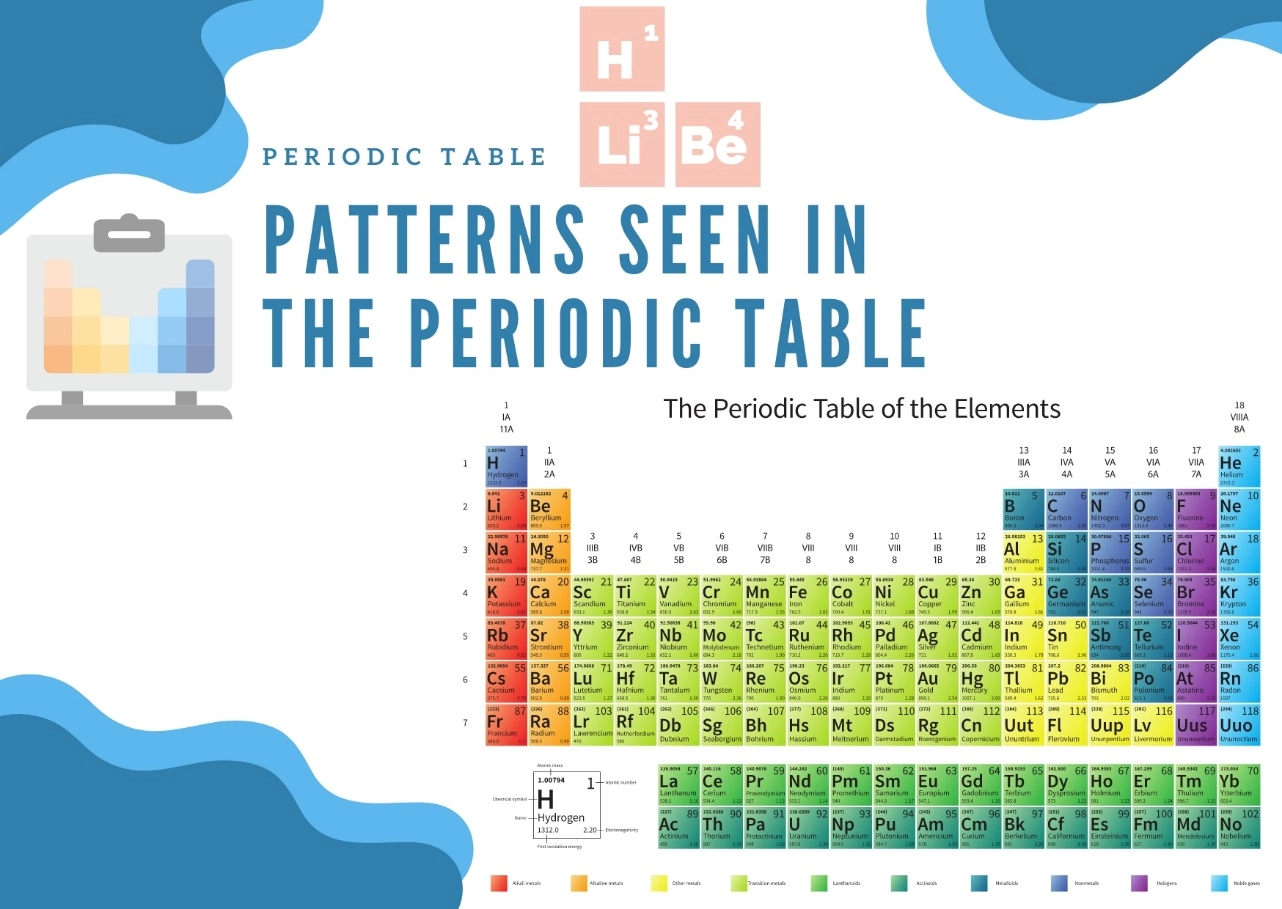
How do you write a chemical formula? Identify the elements in the substance, write their symbols, then work out how many atoms (or ions) of each you need. For a molecule, the name or a model tells you the numbers. For an ionic compound, the ion charges must cancel to zero. Write the numbers as small subscripts, then check your answer.
This guide shows you how to write chemical formulae for both kinds of substance. It covers symbols and subscripts, molecules and their prefixes, ion charges, the swap-and-drop method, brackets for polyatomic ions, and practice questions with answers. It is written for KS3 and GCSE chemistry, whichever exam board you follow.
What is a chemical formula?
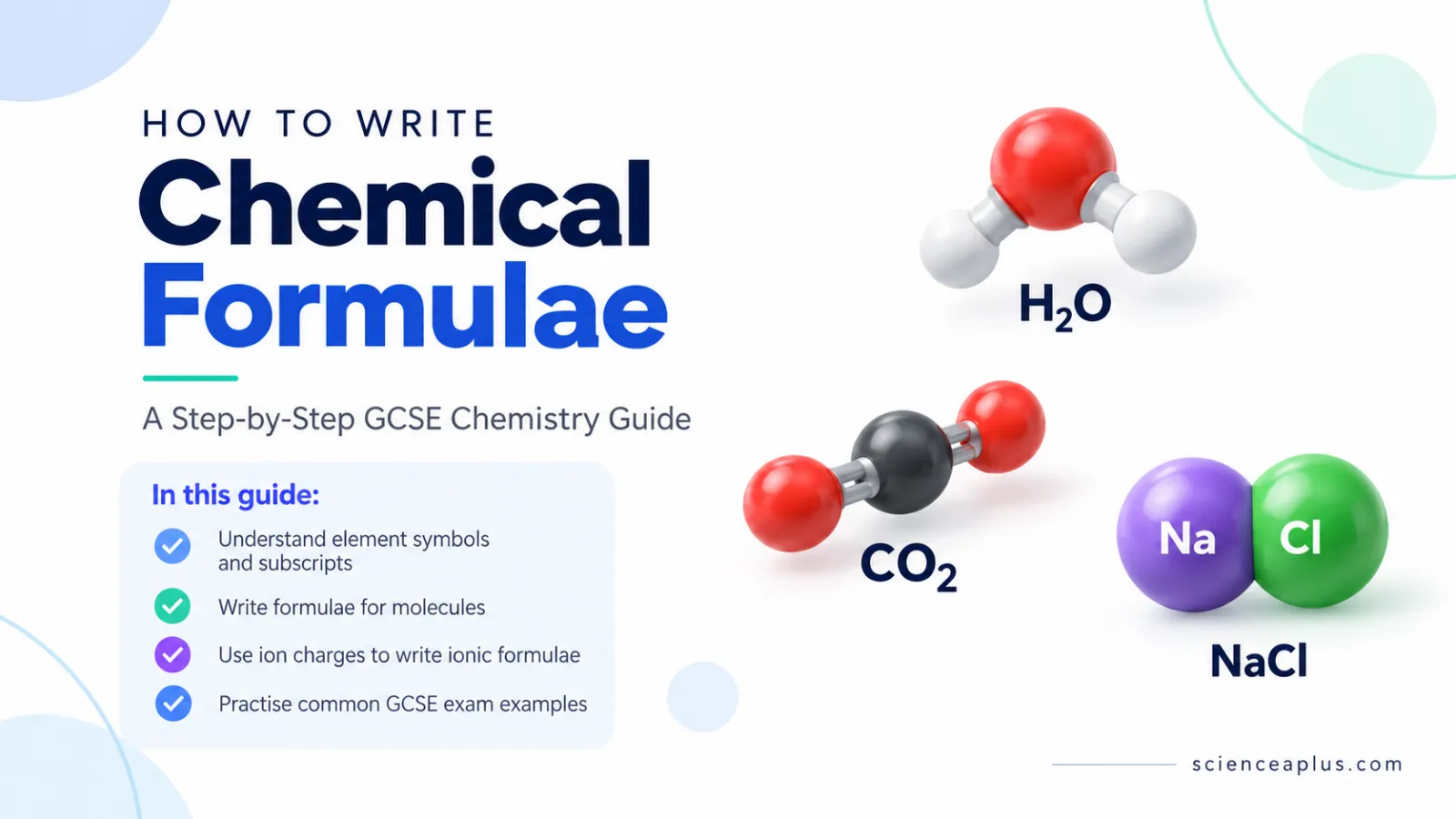
A chemical formula is a short way of showing which elements are in a substance and how many atoms of each are present. Every substance has its own formula. Water is H₂O, carbon dioxide is CO₂ and table salt is NaCl.
The AQA GCSE Chemistry specification puts it this way: there are about 100 different elements, and each atom is represented by a chemical symbol. Compounds contain two or more elements chemically combined in fixed proportions, and they can be "represented by formulae using the symbols of the atoms from which they were formed". That fixed proportion is why a formula never changes for a given compound.
All three major exam boards expect you to do this. OCR asks you to "use chemical symbols to write the formulae of elements and simple covalent and ionic compounds", and Edexcel asks you to deduce the formulae of ionic compounds from the ions they contain. Atoms themselves are explained in our guide to the structure of the atom, so start there if symbols and atomic numbers still feel new.
Symbols: a capital letter, then a small one
Each element has a symbol of one or two letters. The first letter is always a capital. If there is a second letter, it is always lower case: Na for sodium, Cl for chlorine, Mg for magnesium.
This matters more than it looks. Co is the element cobalt, but CO is a compound of carbon and oxygen. NACl is not a formula at all, because there is no element called "NA". Our article on carbon monoxide (CO) shows how a compound with one oxygen atom differs from carbon dioxide, which has two.
Subscripts: how to count atoms in a formula
A subscript is a small number written after and slightly below a symbol. It tells you how many atoms of the element immediately before it are in the formula. In H₂O, the 2 belongs to the hydrogen, so there are two hydrogen atoms and one oxygen atom.
If there is no subscript, there is exactly one atom. A subscript of 1 is never written, so you will never see H₂O₁. To count the atoms, add up all the subscripts and count each unnumbered symbol as 1.
- H₂O: 2 H + 1 O = 3 atoms
- H₂SO₄ (sulfuric acid): 2 H + 1 S + 4 O = 7 atoms
- C₆H₁₂O₆ (glucose): 6 C + 12 H + 6 O = 24 atoms
H₂SO₄ → 2 H + 1 S + 4 O = 7 atoms
Subscripts can also sit outside brackets, as in Ca(OH)₂. That formula has 1 calcium, 2 oxygen and 2 hydrogen atoms, which makes 5 atoms in total. Brackets get their own section later in this article.
Do not confuse a subscript with a big number in front of a formula. In equations, a number in front multiplies the whole formula, whereas a subscript is part of the formula itself. The difference is explained fully in the section on balancing later on.
Formulae of elements and molecules
Most non-metal compounds are made of molecules, in which atoms share pairs of electrons. This is covalent bonding, and our covalent bonds lecture notes explain how it works. A molecular formula simply states how many atoms of each element are joined together in one molecule.
The AQA specification names eight molecules that students should be able to draw as dot-and-cross diagrams, and their formulae are worth learning by heart:
| Substance | Formula |
|---|---|
| Hydrogen | H₂ |
| Chlorine | Cl₂ |
| Oxygen | O₂ |
| Nitrogen | N₂ |
| Hydrogen chloride | HCl |
| Water | H₂O |
| Ammonia | NH₃ |
| Methane | CH₄ |
Notice that some elements are written with a subscript 2. Hydrogen exists as H₂ because its atoms are joined in pairs. Seven elements form these diatomic molecules: H₂, N₂, O₂, F₂, Cl₂, Br₂ and I₂. The halogens in Group 7 "consist of molecules made of pairs of atoms", as AQA puts it.
Valency: why H₂O, NH₃ and CH₄ look the way they do
The numbers in these formulae come from valency, or combining power. IUPAC defines valence as "the maximum number of univalent atoms (originally hydrogen or chlorine atoms) that may combine with an atom of the element". In practice, a hydrogen atom has a valency of 1, oxygen has 2, nitrogen has 3 and carbon has 4.
That is why one oxygen atom joins two hydrogen atoms in H₂O, one nitrogen atom joins three in NH₃, and one carbon atom joins four in CH₄. For the main groups, a quick rule works: in Groups 1 to 4 the valency equals the group number, and in Groups 5 to 7 it is 8 minus the group number. Be careful, though. Valency is not the same as the number of outer electrons: oxygen has six outer electrons but a valency of 2. Some elements, such as iron, also have more than one valency.
Naming molecules with prefixes
The name of a simple molecular compound tells you its formula, because prefixes state the number of atoms of each element.
| Prefix | Number of atoms |
|---|---|
| mono- | 1 |
| di- | 2 |
| tri- | 3 |
| tetra- | 4 |
| penta- | 5 |
| hexa- | 6 |
The rules are simple. The second element takes the ending -ide. The prefix mono- is not used for the first element, and "mono" plus "oxide" becomes "monoxide". Here are some examples:
- CO: carbon monoxide (one carbon, one oxygen)
- CO₂: carbon dioxide (one carbon, two oxygen)
- NO: nitrogen monoxide
- N₂O: dinitrogen monoxide (two nitrogen, one oxygen)
- CCl₄: carbon tetrachloride (one carbon, four chlorine)
Worked example: the chemical formula of carbon dioxide
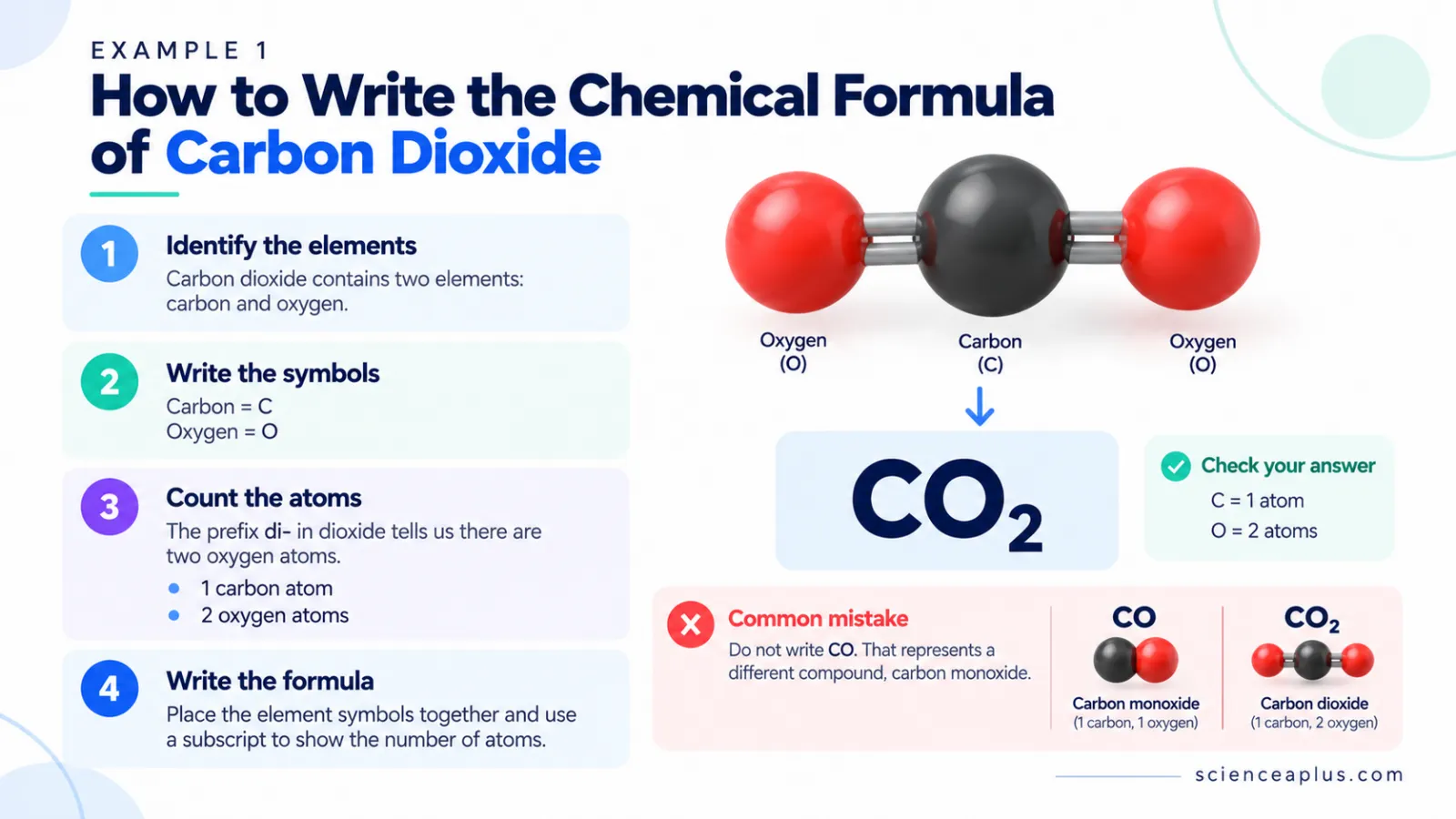
Let us write the formula for carbon dioxide step by step.
- The elements are carbon and oxygen.
- Their symbols are C and O.
- No prefix before carbon means one carbon atom. The prefix di- in "dioxide" means two oxygen atoms.
- Write the formula with a subscript on the oxygen only: CO₂.
The common slip is to write CO, which is carbon monoxide, a different compound. You can compare the two in our articles on carbon dioxide (CO₂) and carbon monoxide above.
Write the formula of dinitrogen monoxide and say how many atoms are in one molecule. (2 marks)
The formula is N₂O. The prefix di- gives two nitrogen atoms and mono- gives one oxygen atom, so one molecule contains 2 + 1 = 3 atoms.
How to write a chemical formula: the 5 steps
Once you know the symbols and subscripts, writing a formula is a short routine. The steps below work for any compound at GCSE.
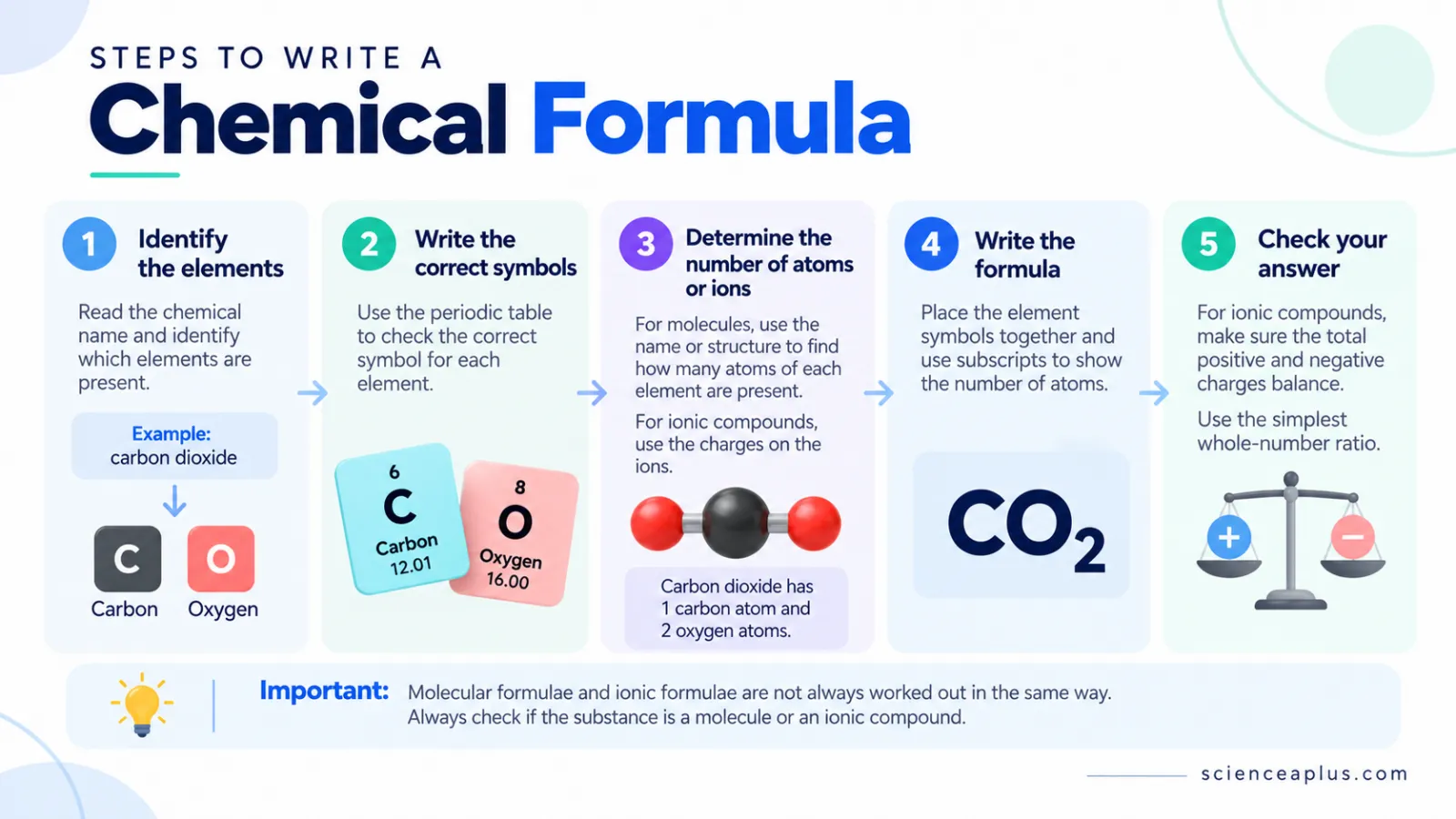
- Identify the elements in the substance from its name.
- Write their symbols, with a capital letter first and a small letter second.
- Find the number of atoms or ions of each. Molecules use the prefixes in the name; ionic compounds use the ion charges.
- Write the formula with the numbers as subscripts, leaving out any 1s.
- Check it. Count the atoms, or add up the charges and make sure they total zero.
The key decision comes before step 3: is the substance a molecule or an ionic compound? A metal joined to a non-metal is usually ionic. Two or more non-metals together are usually molecular. Molecular formulae come from the name and structure, using prefixes, while ionic formulae come from charges. Mixing up the two methods is the most common source of wrong answers.
Ion charges from the periodic table
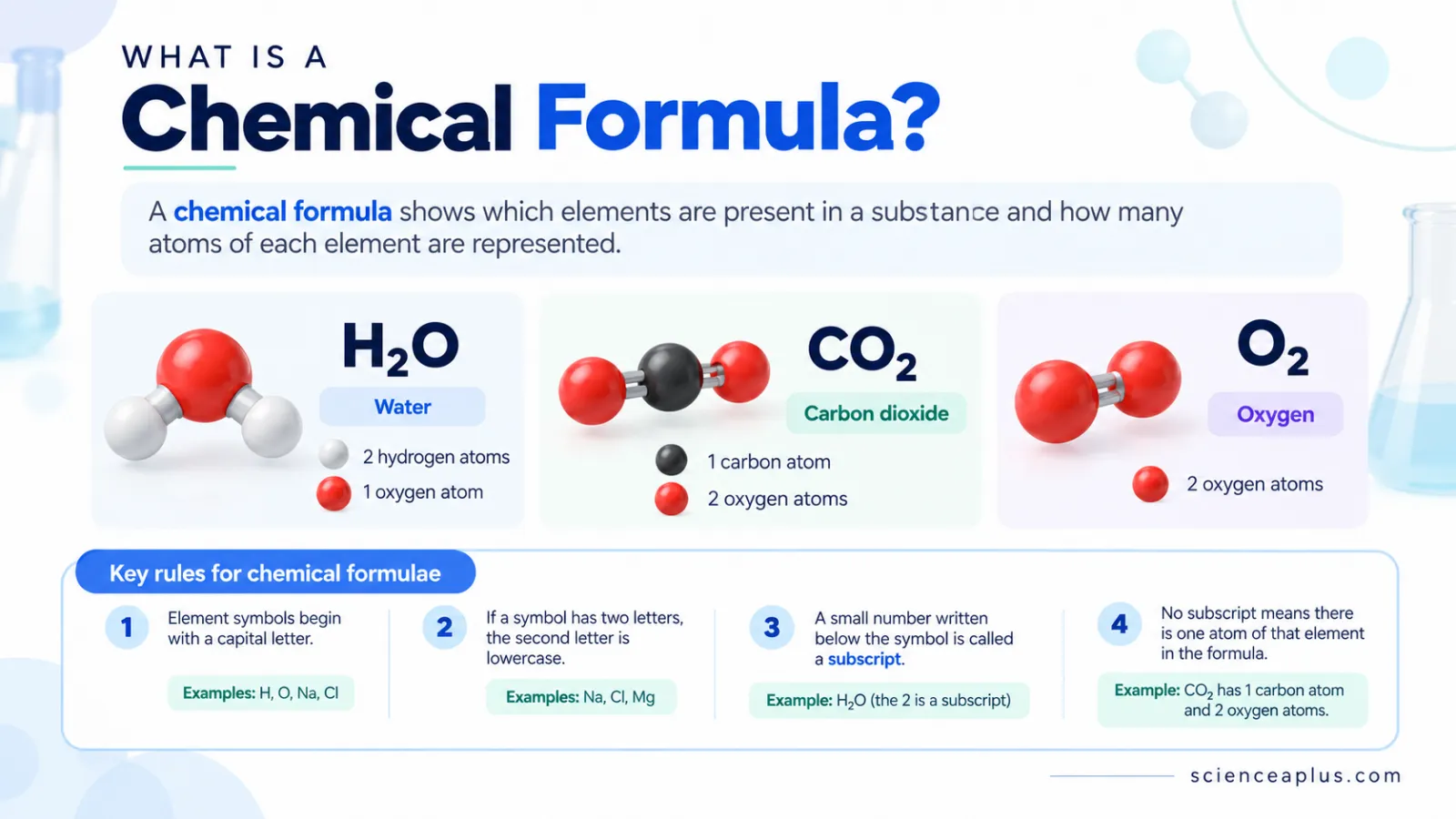
An ion is an atom or group of atoms with a positive or negative charge. Metal atoms lose electrons to form positive ions, and non-metal atoms gain electrons to form negative ions. For Groups 1 and 2 and for the non-metals in Groups 6 and 7, the ions have the electronic structure of a noble gas, and their charge relates to the group number. The reasoning is covered in our lesson on electronic configuration, and the groups themselves in patterns in the periodic table.
You can read most charges straight from the periodic table, which you are given in the OCR exams:
| Group | Ion charge | Examples |
|---|---|---|
| 1 | 1+ | Li⁺, Na⁺, K⁺ |
| 2 | 2+ | Mg²⁺, Ca²⁺, Ba²⁺ |
| 3 (aluminium only) | 3+ | Al³⁺ |
| 5 | 3− | N³⁻ (nitride) |
| 6 | 2− | O²⁻ (oxide), S²⁻ (sulfide) |
| 7 | 1− | F⁻, Cl⁻, Br⁻, I⁻ |
| 0 | no ions | The noble gases do not form ions |
Look at how the pattern works. Sodium is in Group 1, so it forms Na⁺. Oxygen is in Group 6, so it forms O²⁻. Chlorine is in Group 7, so it forms Cl⁻.
Tap the cards below to test yourself on the charge each element forms.
Ions you have to learn
Some charges cannot be read from the group number, so they need to be learned. The common ones are silver Ag⁺, zinc Zn²⁺, copper(II) Cu²⁺, iron(II) Fe²⁺, iron(III) Fe³⁺ and lead Pb²⁺. Many transition metals form ions with different charges, which is why their names include Roman numerals. The numerals are explained in the naming section later in this article.
The swap-and-drop method for ionic formulae
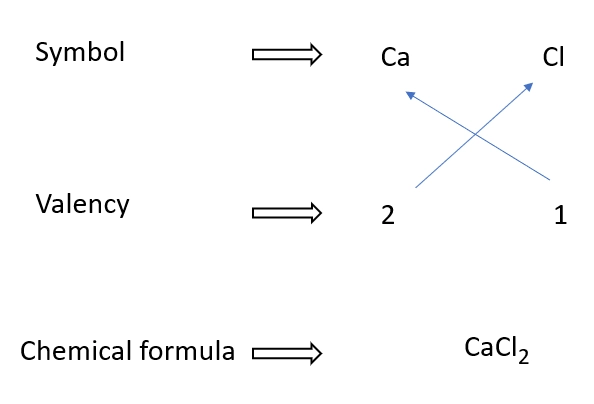
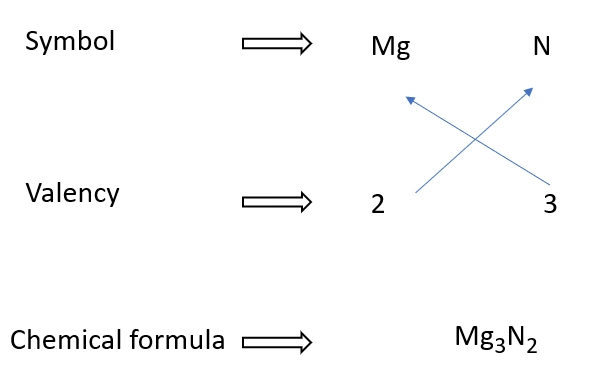
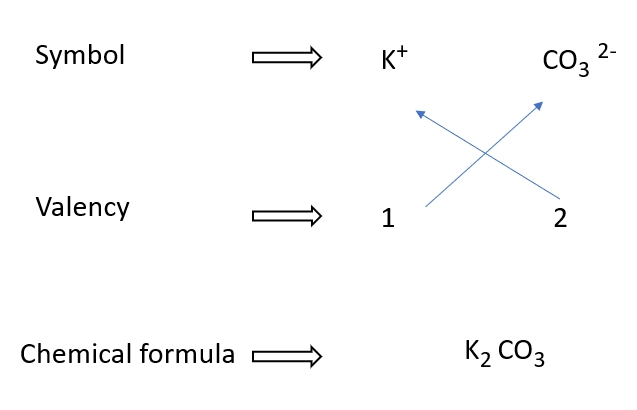
An ionic compound has no overall charge, so the total positive charge must equal the total negative charge. The swap-and-drop method, also called the crossover or criss-cross method, finds the ratio of ions that makes this happen.
- Write both ions with their charges, positive first. For calcium chloride: Ca²⁺ and Cl⁻.
- Swap the charge numbers, ignoring the signs. Each number becomes the subscript of the other ion. Here Ca gets 1 and Cl gets 2.
- Drop the 1s. Ca₁Cl₂ becomes CaCl₂.
- Simplify to the lowest whole-number ratio if both subscripts share a factor.
- Check the charges: (+2) + 2 × (−1) = 0.
Simplifying matters. Magnesium oxide uses Mg²⁺ and O²⁻, and swapping gives Mg₂O₂. Both numbers divide by 2, so the correct formula is MgO. Calcium oxide, CaO, works the same way.
Charges in the final formula are not written down. The correct formula for sodium chloride is NaCl, not Na⁺Cl⁻. The positive metal ion is written first.
Now try the method yourself. Pick two ions and the builder swaps, drops and checks the charges for you. It only balances charges, so not every pair makes a compound you will meet in the lab.
Worked example: sodium chloride
Sodium is in Group 1, so it forms Na⁺. Chlorine is in Group 7, so it forms Cl⁻. One positive charge cancels one negative charge, so the ratio is 1 : 1 and the formula is NaCl.
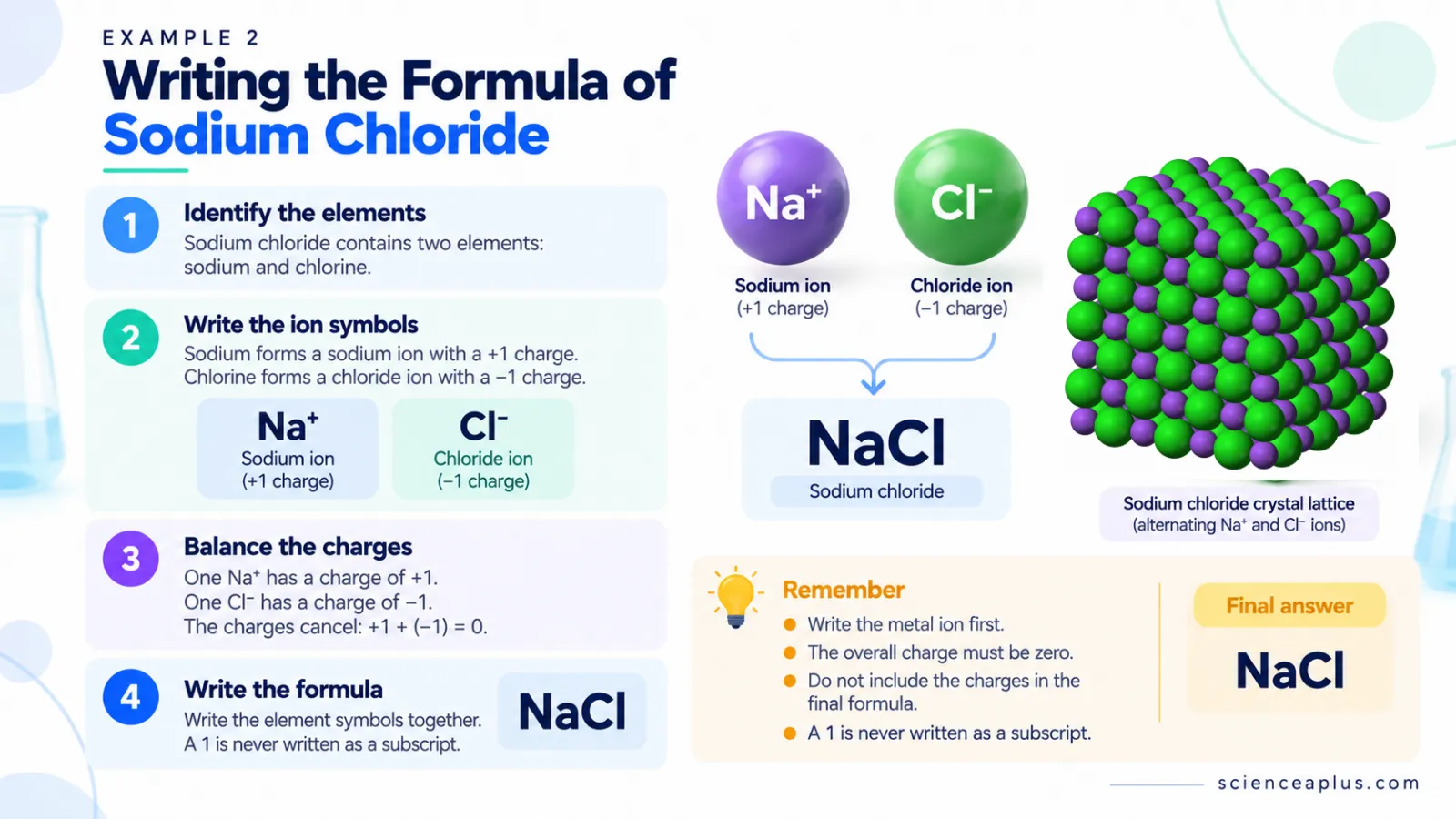
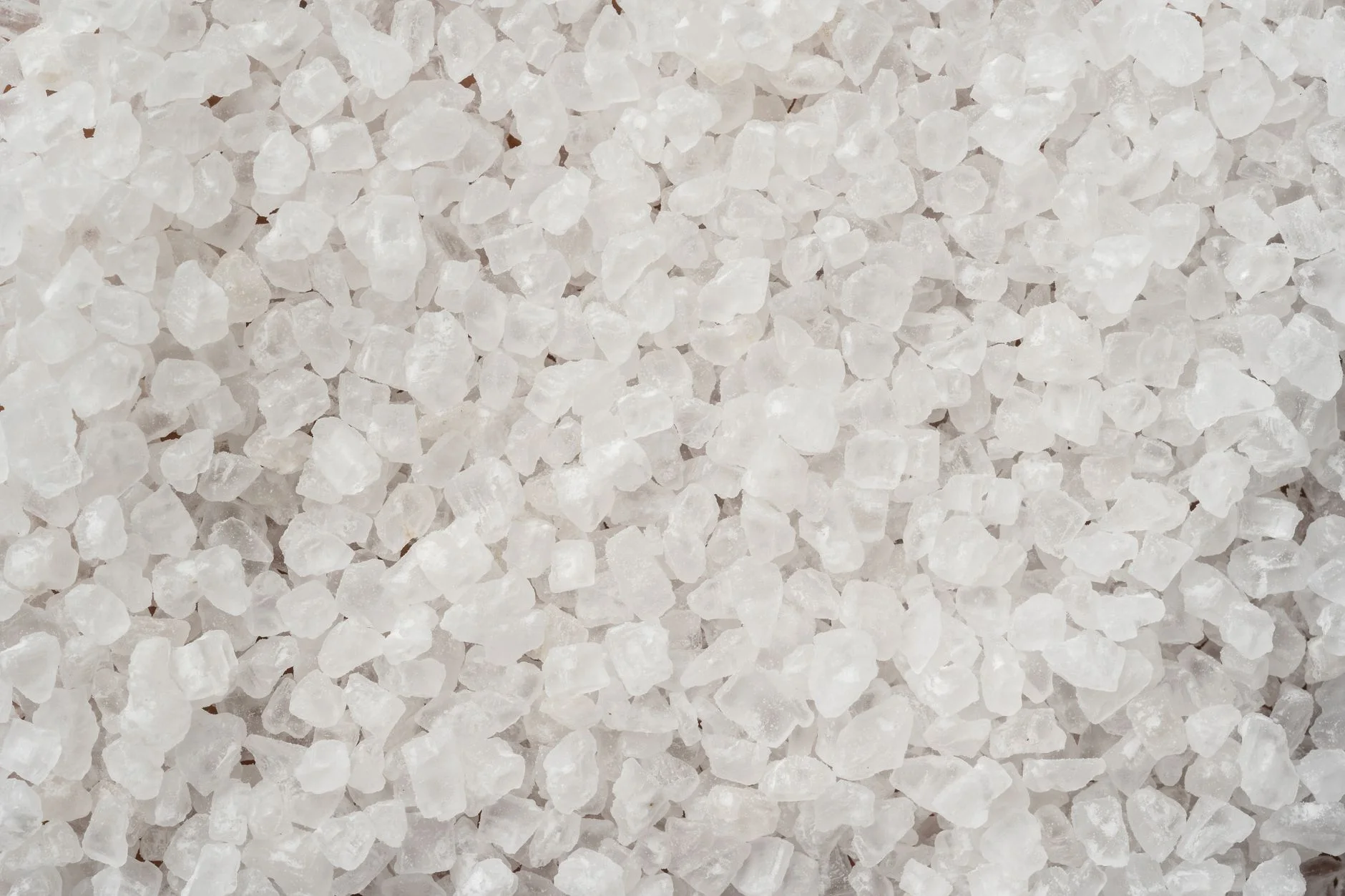
You may wonder why it is not Na₂Cl₂. The reason is that sodium chloride is not made of separate molecules. It is a giant structure, or lattice, of ions held together by strong electrostatic forces that act in all directions between oppositely charged ions. The formula only gives the simplest whole-number ratio of ions in that lattice, which is one sodium ion for every chloride ion. AQA expects students to be familiar with the structure of sodium chloride.
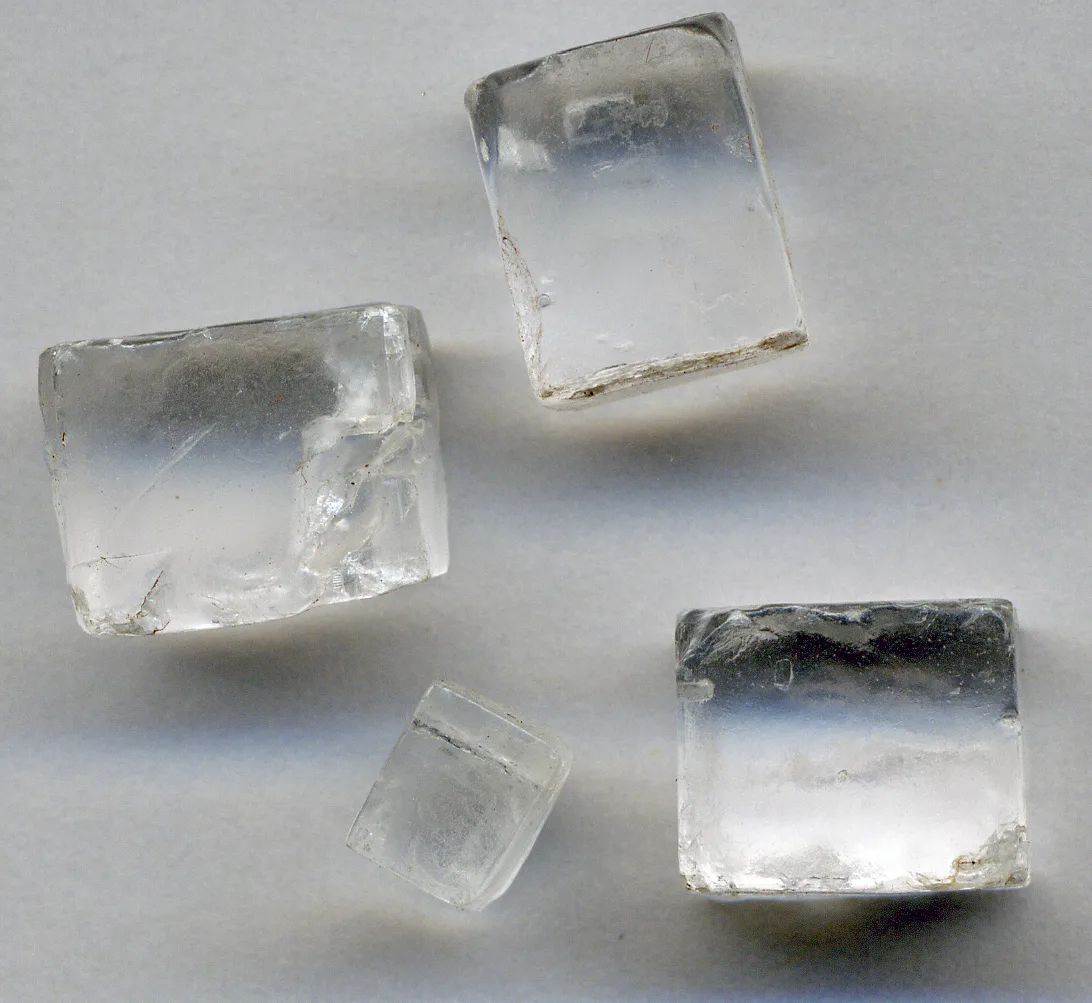
In nature, sodium chloride occurs as the mineral halite, also called rock salt. When pure it is colourless or white and grows as cubic crystals. For more on how lattices explain melting points and conductivity, see properties of ionic and covalent compounds.
Harder examples: when the charges are unequal
The method really earns its keep when the charges differ. Here are three examples with the checks written out.
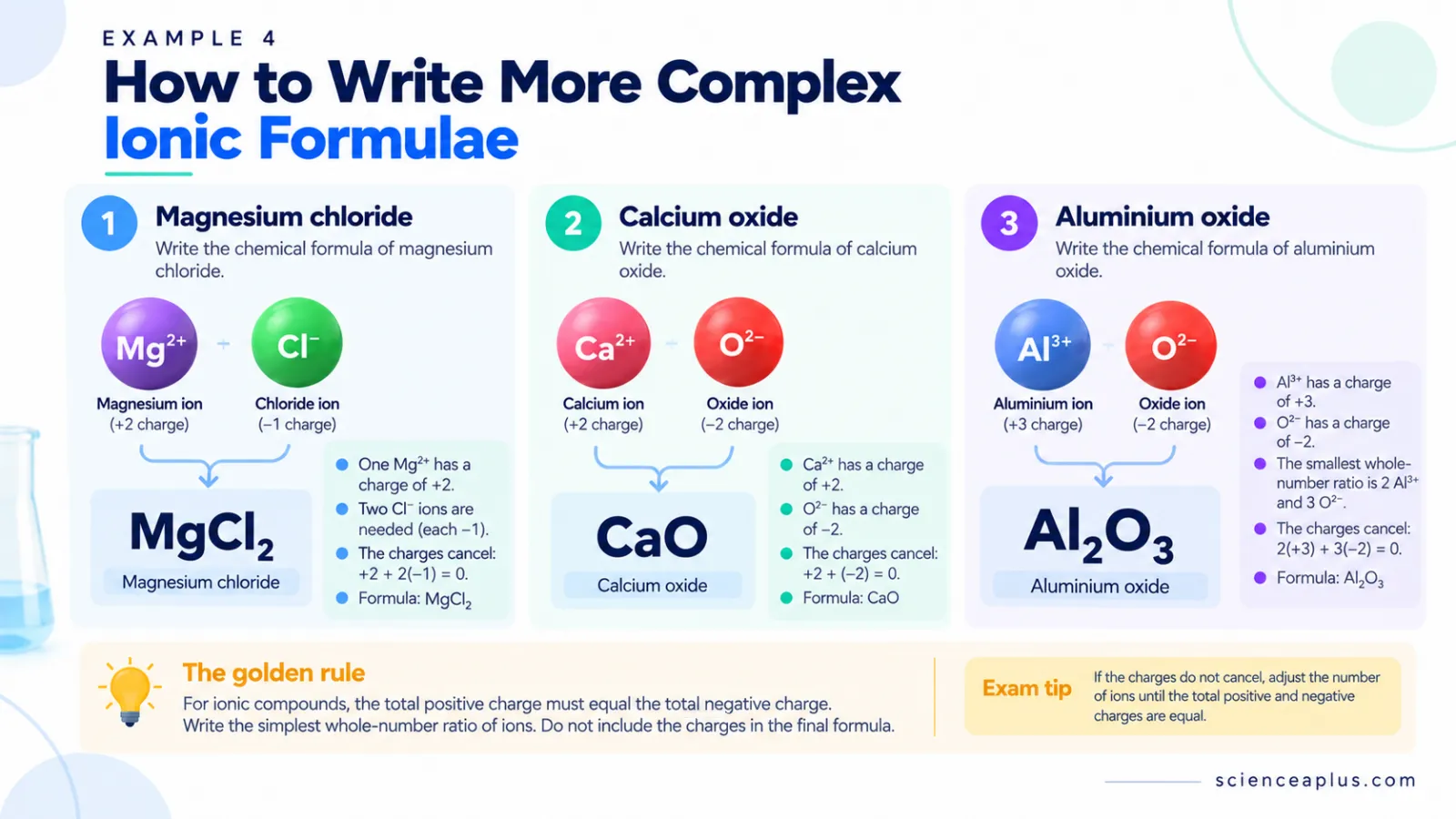
- Sodium oxide: Na⁺ and O²⁻. Swap and drop to get Na₂O. Check: 2 × (+1) + (−2) = 0.
- Magnesium nitride: Mg²⁺ and N³⁻. Swapping gives Mg₃N₂. Check: 3 × (+2) + 2 × (−3) = 0.
- Aluminium oxide: Al³⁺ and O²⁻. Swapping gives Al₂O₃. Check: 2 × (+3) + 3 × (−2) = 0.
Al₂O₃ → 2 × (+3) + 3 × (−2) = 0
Polyatomic ions: the common ions table
Not every ion is a single atom. A polyatomic ion is a group of atoms that carries one overall charge and stays together as a single unit. Edexcel describes an ion as "an atom or group of atoms with a positive or negative charge", and these are the groups. The common ones are worth learning as a set:
| Name | Formula | Charge |
|---|---|---|
| Ammonium | NH₄⁺ | 1+ |
| Hydroxide | OH⁻ | 1− |
| Nitrate | NO₃⁻ | 1− |
| Hydrogencarbonate | HCO₃⁻ | 1− |
| Carbonate | CO₃²⁻ | 2− |
| Sulfate | SO₄²⁻ | 2− |
| Phosphate | PO₄³⁻ | 3− |
The charge belongs to the whole group, not to any single atom inside it. In SO₄²⁻, the 2− is the charge of the entire sulfate ion.
Ammonium is the only common positive polyatomic ion on this list, and it is easy to confuse with a gas you may already know. Ammonia, NH₃, is a molecule with no charge, whereas ammonium, NH₄⁺, is an ion with a 1+ charge. You can read about the gas in our article on ammonia gas (NH₃).
Worked example: lithium hydroxide
Lithium is in Group 1, so it forms Li⁺. Hydroxide is OH⁻. One positive charge balances one negative charge, so we need one of each and the formula is LiOH.
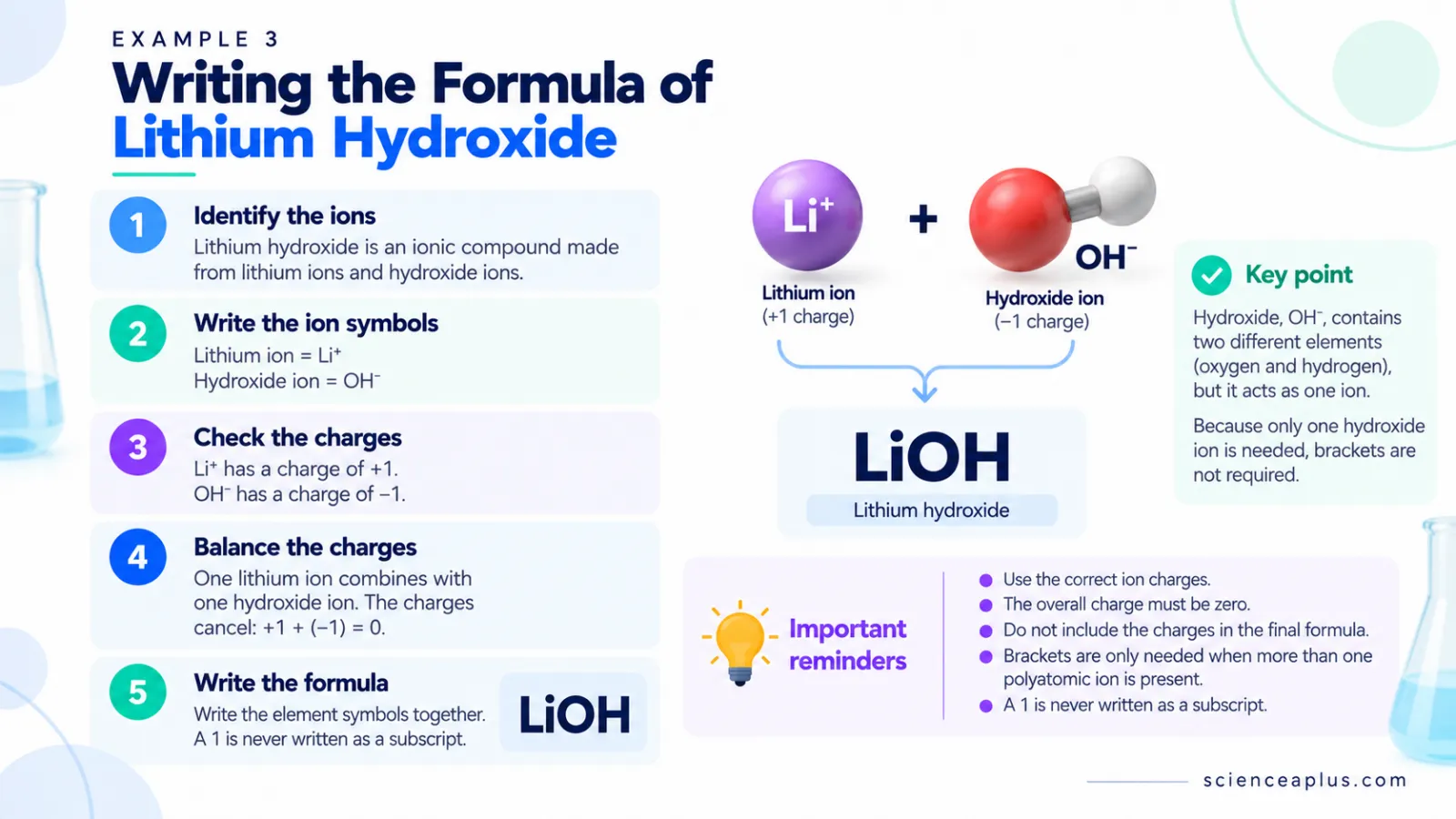
There are no brackets here, because we need only one hydroxide ion. Hydroxide ions, OH⁻, are what make a solution alkaline, while hydrogen ions, H⁺, make a solution acidic. Our guide to acids and bases shows how these two ions link to the salts you name and write.
When to use brackets in a chemical formula
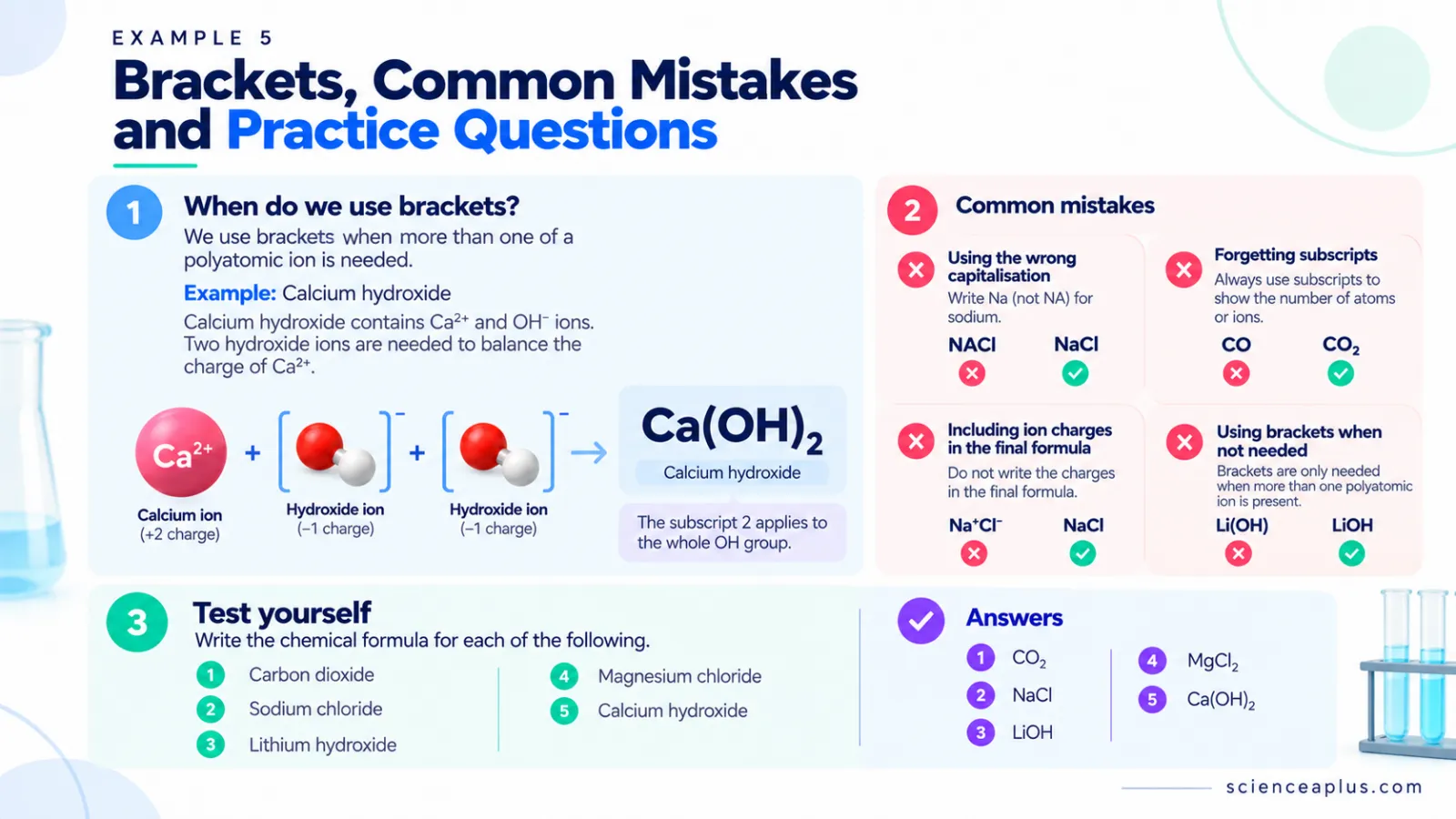
The rule is simple: use brackets when you need more than one of a polyatomic ion. Put the whole ion in brackets and write the number outside, as a subscript. The number outside multiplies every atom inside the brackets.
Take calcium hydroxide. Calcium forms Ca²⁺ and hydroxide is OH⁻, so we need two hydroxide ions to cancel the 2+. Swap and drop gives Ca(OH)₂. Counting atoms, the subscript outside the bracket applies to both O and H, so there is 1 Ca, 2 O and 2 H, making 5 atoms in total.
Here are more examples to work through:
- Magnesium nitrate, Mg(NO₃)₂: Mg²⁺ needs two NO₃⁻ ions. It contains 1 Mg, 2 N and 6 O, which is 9 atoms. Writing MgNO₃₂ would be meaningless, because the 2 would appear to belong to the oxygen.
- Aluminium sulfate, Al₂(SO₄)₃: Al³⁺ and SO₄²⁻ swap to give two Al and three SO₄. It contains 2 Al, 3 S and 12 O, so 17 atoms. Check the charges: 2 × (+3) + 3 × (−2) = 0.
- Ammonium phosphate, (NH₄)₃PO₄: three NH₄⁺ ions balance one PO₄³⁻ ion. Here the brackets go round the positive ion. It contains 3 N, 12 H, 1 P and 4 O, which is 20 atoms. Check: 3 × (+1) + (−3) = 0.
Just as important is knowing when not to use brackets. If you need only one polyatomic ion, leave them out. NaNO₃, K₂CO₃ and CaCO₃ have no brackets, because each contains a single nitrate or carbonate ion. The same applies to simple ions: never write Na(Cl) or Li(OH).
Naming ionic compounds: -ide, -ate and Roman numerals
Edexcel asks students to explain the endings -ide and -ate in the names of compounds, and AQA expects you to name compounds from formulae. The endings carry real information.
-ide or -ate?
An -ide ending usually means the compound contains just the two elements named. Sodium chloride (NaCl) contains only sodium and chlorine, and magnesium nitride (Mg₃N₂) contains only magnesium and nitrogen. An -ate ending means the negative ion also contains oxygen. Nitrate, sulfate and carbonate are all -ate ions.
There is one exception worth remembering: hydroxide, OH⁻, ends in -ide even though it contains oxygen and hydrogen.
Two names that look almost identical show why the endings matter. Magnesium nitride is Mg₃N₂, made from N³⁻. Magnesium nitrate is Mg(NO₃)₂, made from the polyatomic ion NO₃⁻. One letter changes the whole compound.
The endings also tell you which salt an acid makes. Hydrochloric acid gives chlorides, nitric acid gives nitrates and sulfuric acid gives sulfates.
Roman numerals in chemical names
Some metals, especially transition metals, form ions with more than one charge. A Roman numeral in brackets after the metal tells you the charge on its ion. Iron(II) is Fe²⁺ and iron(III) is Fe³⁺. Cobalt(II) is Co²⁺.
- Iron(II) chloride, FeCl₂: Fe²⁺ needs two Cl⁻ ions.
- Iron(III) chloride, FeCl₃: Fe³⁺ needs three Cl⁻ ions.
- Iron(III) oxide, Fe₂O₃: two Fe³⁺ balance three O²⁻, since 2 × (+3) + 3 × (−2) = 0.
- Copper(II) nitrate, Cu(NO₃)₂: Cu²⁺ needs two NO₃⁻ ions, so brackets are used.
The iron(III) oxide example is more than an exercise. Rust is hydrated iron(III) oxide, Fe₂O₃·xH₂O, and it forms when iron meets both air (oxygen) and water. The amount of water varies, which is why the formula uses x. Read the full story in is iron rusting a chemical change?
Chemical formulae in everyday things
Formulae are not just exam marks. The photographs below show four substances you can see and touch, each with a formula you now know how to read.



Write the formula of ammonium sulfate. (2 marks)
The formula is (NH₄)₂SO₄. Ammonium is NH₄⁺ and sulfate is SO₄²⁻. Two ammonium ions (2 × +1) balance one sulfate ion (−2). Brackets are needed round NH₄ because there are two ammonium ions.
Explain the difference between magnesium nitride and magnesium nitrate. (2 marks)
Magnesium nitride contains only magnesium and nitrogen, as the ions Mg²⁺ and N³⁻, and its formula is Mg₃N₂. Magnesium nitrate also contains oxygen, as the nitrate ion NO₃⁻, and its formula is Mg(NO₃)₂.
Empirical formula vs molecular formula
A molecular formula shows the actual number of atoms of each element in one molecule. An empirical formula shows the simplest whole-number ratio of atoms. You get from one to the other by dividing every subscript by the largest number that goes into all of them.
- Glucose has the molecular formula C₆H₁₂O₆. Dividing by 6 gives the empirical formula CH₂O.
- Hydrogen peroxide, H₂O₂, has the empirical formula HO.
- Ethane, C₂H₆, has the empirical formula CH₃.
- Water, H₂O, is the same both ways, because the ratio 2 : 1 cannot be simplified.
Edexcel asks you to deduce an empirical formula from the formula of a molecule, and the molecular formula from the empirical formula and the relative formula mass. OCR asks for the empirical formula from the relative numbers of atoms or from a model. Formulae of ionic compounds, like the sodium chloride formula earlier, are always empirical, which is why AQA describes finding the empirical formula of an ionic compound from a model or diagram. To turn a formula into a relative formula mass, follow our guide to the molar mass of compounds.
Formulae are fixed: balancing equations without changing them
When you balance a symbol equation, you must never change a formula. A formula describes one particular substance, so altering a subscript changes the substance. Changing H₂O to H₂O₂ does not balance anything; it gives you hydrogen peroxide instead of water.
AQA specifies "multipliers in equations in normal script before a formula and in subscript within a formula". In other words, you balance with big numbers in front, and the small subscripts stay exactly as they are. The law of conservation of mass says no atoms are lost or made in a reaction, so each side must have the same number of each atom.
2H₂ + O₂ → 2H₂O
Count the atoms. On the left, 2H₂ gives 4 H and O₂ gives 2 O. On the right, 2H₂O gives 4 H and 2 O. Both sides match, and no formula was altered. For longer examples and a full method, read what is a chemical reaction, which covers balancing equations in depth.
Equations can also carry state symbols after each formula: (s) for solid, (l) for liquid, (g) for gas and (aq) for an aqueous solution.
Common mistakes when writing chemical formulae
Most lost marks come from the same handful of slips. Check your work against this list before you move on.
- Wrong capitals. NACl is not a formula, and CO is not the same as Co.
- Leaving the charges in. Write NaCl, not Na⁺Cl⁻. Charges help you work out the formula but do not appear in it.
- Writing 1s. Na₁Cl₁ is wrong. A subscript of 1 is never written.
- Not simplifying. Mg₂O₂ should be MgO.
- Brackets in the wrong place. Mg(NO₃)₂ needs them. MgNO₃₂ and Li(OH) are both wrong.
- Splitting a polyatomic ion. Sulfate is SO₄²⁻ and the group stays together.
- Mixing up -ide and -ate. Nitride is N³⁻, while nitrate is NO₃⁻.
- Forgetting the Roman numeral. Iron(II) is Fe²⁺ and iron(III) is Fe³⁺, so FeCl₂ and FeCl₃ are different compounds.
- Using the ionic method for a molecule, or the prefix method for an ionic compound.
Accuracy matters outside the exam hall too. Aluminium, for example, is extracted by electrolysis of a molten mixture of aluminium oxide, Al₂O₃, and cryolite. If you wrote the oxide formula wrongly, every mass you calculated for that process would be wrong too. You can follow the process in what is electrolysis.
Practice questions: chemical formulae with answers
Try each question before you open the answer.
Write the formula of potassium bromide. (1 mark)
KBr. Potassium forms K⁺ and bromine forms Br⁻, so one of each balances the charges.
Write the formula of iron(III) oxide and show that the charges balance. (2 marks)
Fe₂O₃. Iron(III) is Fe³⁺ and oxide is O²⁻. Swapping the charge numbers gives Fe₂O₃. Check: 2 × (+3) + 3 × (−2) = 0.
Write the formula of ammonium carbonate. (2 marks)
(NH₄)₂CO₃. Ammonium is NH₄⁺ and carbonate is CO₃²⁻. Two ammonium ions balance one carbonate ion, and brackets are needed round NH₄ because there are two of them.
Frequently asked questions about writing chemical formulae
How do you write a chemical formula step by step?
Identify the elements, write their symbols, then find how many atoms or ions of each you need. For molecules, use the prefixes in the name. For ionic compounds, swap the charge numbers, drop any 1s and simplify. Finally, check the atom count or confirm that the charges add up to zero.
What does the small number in a chemical formula mean?
The small number, called a subscript, tells you how many atoms of the element immediately before it are in the formula. In H₂O, the 2 means two hydrogen atoms. If there is no subscript, there is one atom. A subscript of 1 is never written, so you will not see H₂O₁.
How do you know the charge on an ion?
For many elements, use the group number. Group 1 metals form 1+ ions, Group 2 metals form 2+ ions, Group 6 non-metals form 2− ions and Group 7 non-metals form 1− ions. Aluminium forms Al³⁺. Some ions, such as Ag⁺, Zn²⁺ and Cu²⁺, have to be learned.
What is the swap and drop method?
Swap and drop, also called the crossover method, finds the formula of an ionic compound. Write the ions with their charges, swap the charge numbers so each becomes the other ion's subscript, drop any 1s, simplify if you can, and check that the positive and negative charges cancel to zero.
When do you use brackets in a chemical formula?
Use brackets when you need more than one polyatomic ion, such as hydroxide, nitrate or sulfate. Put the ion in brackets and write the number outside, as in Ca(OH)₂ or Mg(NO₃)₂. If you need only one, as in NaOH or CaCO₃, you do not use brackets.
What is the difference between -ide and -ate?
An -ide ending usually means the compound contains only the two elements named, as in sodium chloride or magnesium nitride. An -ate ending means the negative ion also contains oxygen, as in nitrate, sulfate and carbonate. Hydroxide is an exception, because it ends in -ide but contains oxygen and hydrogen.
Why is sodium chloride written NaCl and not Na₂Cl₂?
Sodium chloride is a giant lattice of ions, not separate molecules. Each Na⁺ ion is balanced by one Cl⁻ ion, so the simplest whole-number ratio is 1 : 1. A formula for an ionic compound always shows this simplest ratio, so NaCl is correct and Na₂Cl₂ is not.
What do Roman numerals mean in a chemical name?
A Roman numeral in a name shows the charge on the metal ion. Iron(II) chloride contains Fe²⁺, so its formula is FeCl₂. Iron(III) chloride contains Fe³⁺, so its formula is FeCl₃. Transition metals need the numeral because they can form ions with different charges.
What is the difference between an empirical formula and a molecular formula?
A molecular formula shows the real number of atoms of each element in one molecule, such as C₆H₁₂O₆ for glucose. An empirical formula shows only the simplest whole-number ratio of those atoms, which is CH₂O for glucose. Ionic formulae are always empirical.
Can you change a formula to balance an equation?
No. Changing a subscript changes the substance, so H₂O would become H₂O₂, which is hydrogen peroxide. To balance an equation, put a big number in front of the whole formula. That multiplies every atom in the formula without altering the substance itself.