Key points at a glance
- Molar mass is the mass of one mole of a substance, measured in grams per mole (g mol-1).
- To find it, add up the relative atomic masses of every atom in the formula. Nothing more complicated than that is ever required.
- Ar is the relative atomic mass of a single element. Mr is the relative formula mass of a whole compound. Both are just numbers; molar mass is the same number with the unit g mol-1 attached.
- A subscript multiplies only the symbol before it, and a number outside a bracket multiplies everything inside the bracket.
- The relationship you will use constantly is moles = mass ÷ Mr.
- Use the Ar values printed on the periodic table you are given. Chlorine is 35.5 and copper is 63.5 – do not round them to whole numbers.
Molar mass is the bridge between the grams you can weigh out on a balance and the number of particles actually reacting. Almost every calculation in chemistry – reacting masses, concentrations, titrations, percentage yield – starts by working one out, so it is worth being quick and reliable at it.
What is molar mass?
The mass of one mole of any substance is its molar mass. Molar mass is measured in grams per mole (g mol-1) or kilograms per mole (kg mol-1).
A mole is simply a fixed number of particles – a counting unit, in the same way that "a dozen" is a counting unit. One mole of any substance contains the same number of particles as one mole of any other. What changes from substance to substance is how much that many particles weigh, and that is exactly what molar mass tells you.
Ar, Mr and molar mass
These three terms describe almost the same thing, and mixing them up is the commonest source of confusion in this topic.
| Term | Stands for | Applies to | Unit | Example |
|---|---|---|---|---|
| Ar | Relative atomic mass | One element | None – it is a ratio | Ar of oxygen = 16 |
| Mr | Relative formula mass | A compound or molecule | None – it is a ratio | Mr of water = 18 |
| Molar mass | Mass of one mole | Either | g mol-1 | Molar mass of water = 18 g mol-1 |
The convenient part is that the numbers are identical. Once you have worked out that the Mr of water is 18, the molar mass is 18 g mol-1 – no conversion needed. Some books use "relative molecular mass" for molecules and "relative formula mass" for ionic compounds; relative formula mass is the safer term because it works for both.
Relative atomic masses are not whole numbers because most elements exist as a mixture of isotopes, and Ar is the weighted average across that mixture. That is why chlorine is 35.5 rather than 35 or 36.
How to calculate molar mass of compounds?
The molar mass of an element or compound can be calculated if its formula is known, because the molar mass of a compound is the sum of the molar masses of all the atoms in it. Work through it in four steps:
- Write out the formula and list every element in it.
- Count the atoms of each element. A subscript applies only to the symbol immediately before it; a number outside a bracket multiplies everything inside.
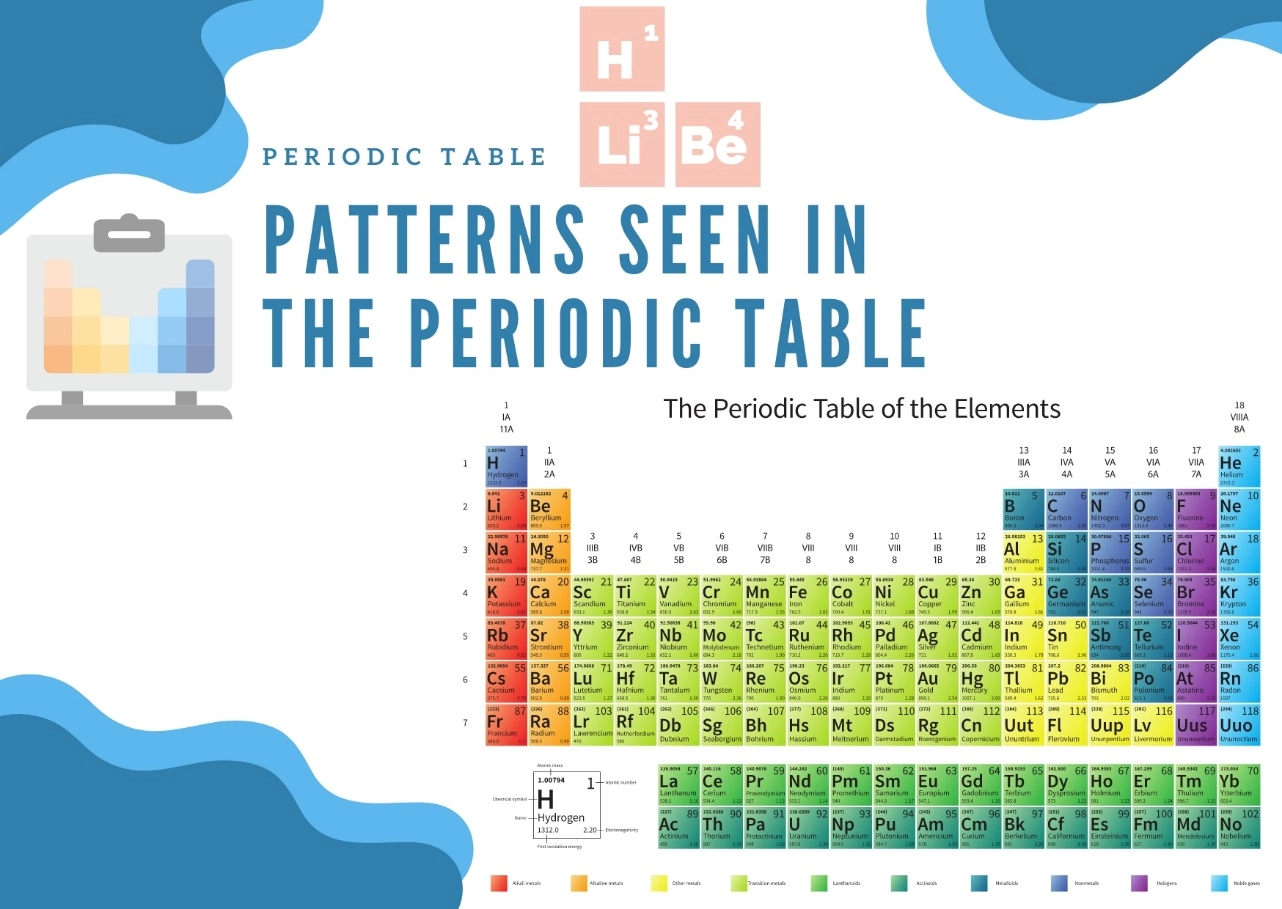
- Look up each Ar on the periodic table you are given.
- Multiply and add. Multiply each Ar by the number of those atoms, then total the results.
Molar mass of several elements in a table
| Element | Symbol | Molar Mass (g/mol) |
|---|---|---|
| Hydrogen | H | 1.008 |
| Helium | He | 4.003 |
| Lithium | Li | 6.941 |
| Carbon | C | 12.011 |
| Nitrogen | N | 14.007 |
| Oxygen | O | 15.999 |
| Fluorine | F | 18.998 |
| Sodium | Na | 22.990 |
| Magnesium | Mg | 24.305 |
| Aluminium | Al | 26.982 |
| Silicon | Si | 28.086 |
| Chlorine | Cl | 35.453 |
| Potassium | K | 39.098 |
| Calcium | Ca | 40.078 |
| Iron | Fe | 55.845 |
| Copper | Cu | 63.546 |
| Zinc | Zn | 65.38 |
| Bromine | Br | 79.904 |
| Silver | Ag | 107.868 |
| Iodine | I | 126.904 |
| Gold | Au | 196.967 |
In GCSE and IGCSE questions these values are normally rounded, so you would use H = 1, C = 12, N = 14, O = 16, Na = 23, Cl = 35.5 and so on. The worked examples below use the rounded values, which is what the periodic table in an exam gives you. Always use the values on the paper in front of you rather than remembered ones.
Worked examples: calculating molar mass
Molar mass of water
A water molecule is made up of two hydrogen atoms (H) and one oxygen atom (O). The molar mass of water (H2O) is therefore the sum of the masses of two hydrogen atoms and one oxygen atom.
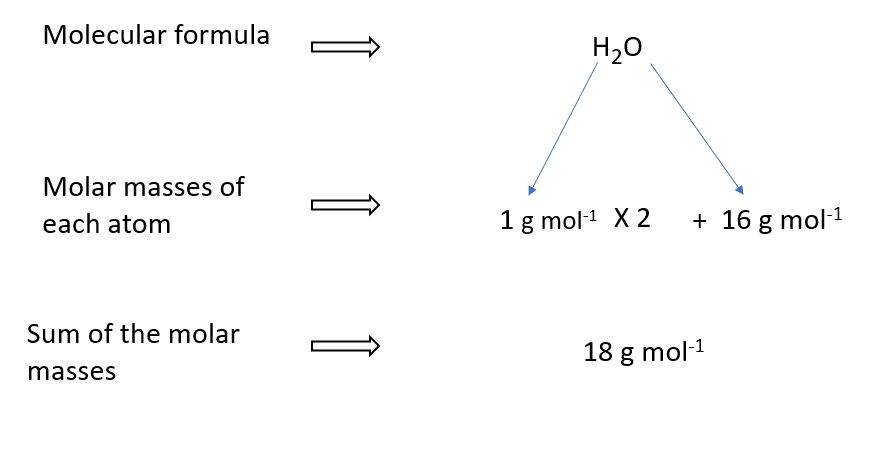
- Formula: H2O – two hydrogen atoms, one oxygen atom.
- Hydrogen: 2 × 1 = 2
- Oxygen: 1 × 16 = 16
- Total: 2 + 16 = 18, so the molar mass of water is 18 g mol-1.
Molar mass of HCl
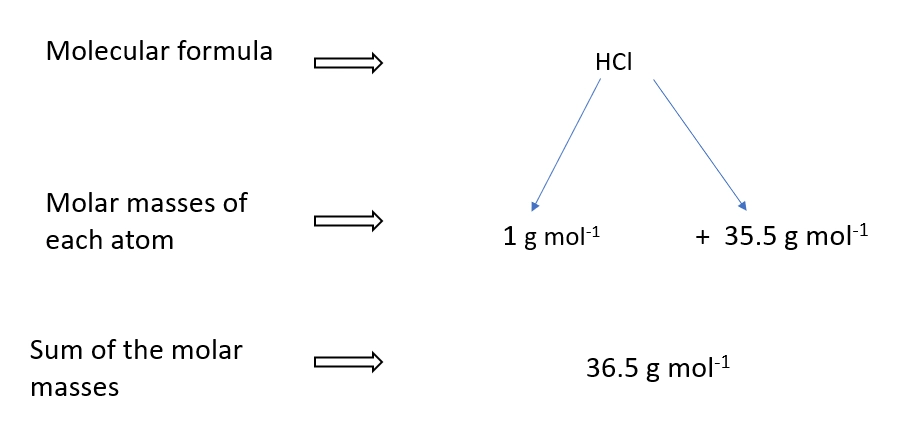
- Formula: HCl – one hydrogen atom, one chlorine atom.
- Hydrogen: 1 × 1 = 1
- Chlorine: 1 × 35.5 = 35.5
- Total: 1 + 35.5 = 36.5 g mol-1. Note the half – rounding chlorine to 35 here is a very common way to lose marks.
Molar mass of O2
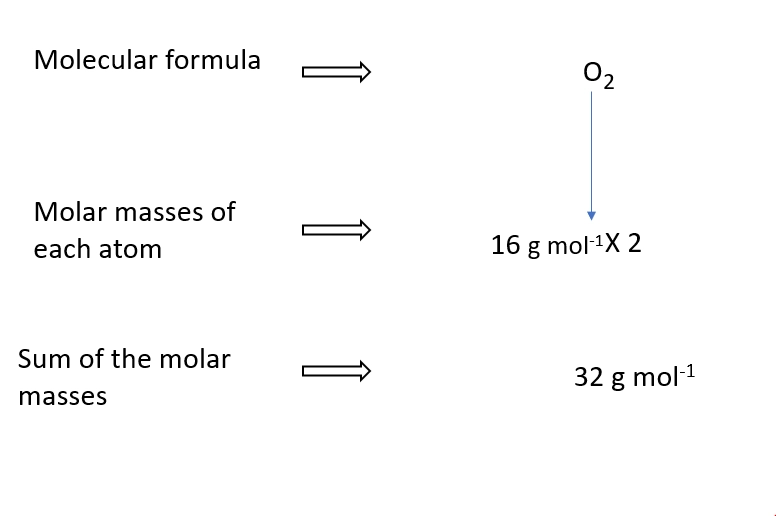
- Formula: O2 – oxygen gas exists as diatomic molecules.
- Oxygen: 2 × 16 = 32 g mol-1.
Watch this one carefully. One mole of oxygen atoms has a mass of 16 g, but one mole of oxygen molecules has a mass of 32 g. If a question says "oxygen gas", it means O2.
Molar mass of NaCl
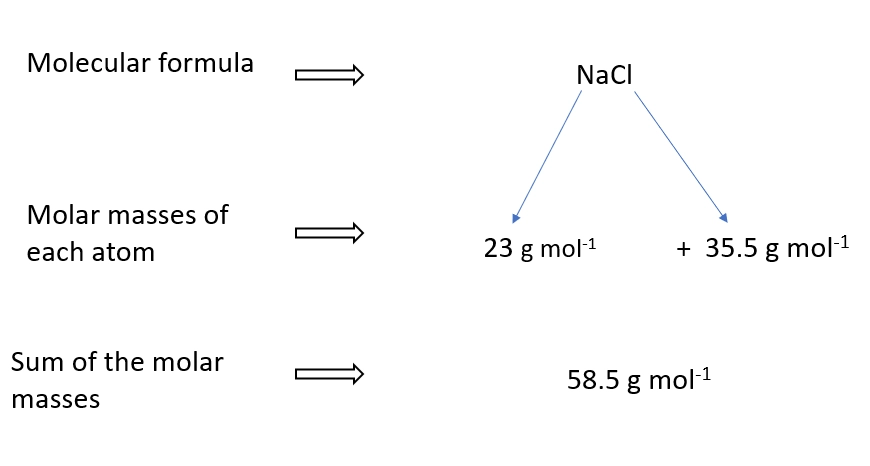
- Formula: NaCl – one sodium ion, one chloride ion.
- Sodium: 1 × 23 = 23
- Chlorine: 1 × 35.5 = 35.5
- Total: 58.5 g mol-1.
Sodium chloride is ionic, so there is no such thing as an NaCl molecule. The 58.5 is the mass of one mole of NaCl formula units, which is why "relative formula mass" is the more accurate name.
Molar mass of NaOH
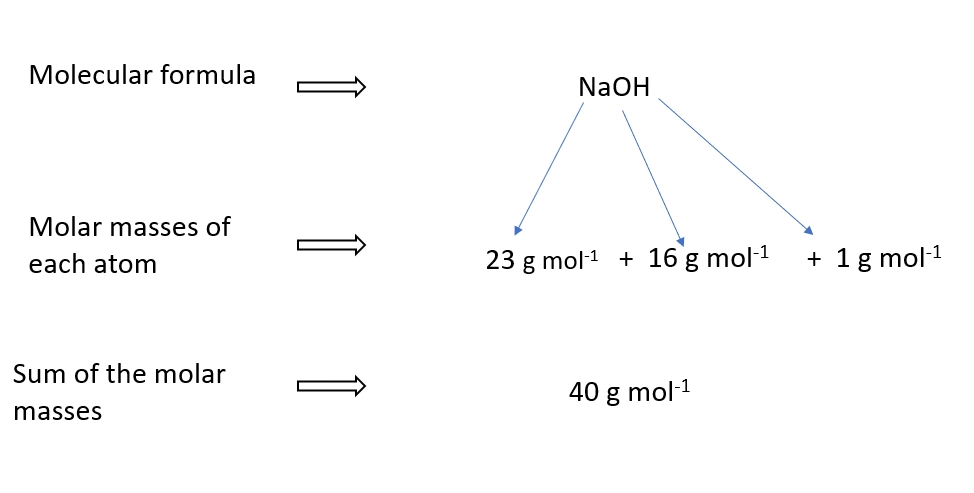
- Formula: NaOH – one sodium, one oxygen, one hydrogen.
- Sodium: 23; oxygen: 16; hydrogen: 1
- Total: 23 + 16 + 1 = 40 g mol-1.
Molar mass of ethanol
Ethanol is written C2H5OH, which is the same as C2H6O. Count the hydrogens carefully: five in the C2H5 part and one more in the OH group, making six in total.
- Carbon: 2 × 12 = 24
- Hydrogen: 6 × 1 = 6
- Oxygen: 1 × 16 = 16
- Total: 24 + 6 + 16 = 46 g mol-1.
Using the unrounded values from the table above (C = 12.011, H = 1.008, O = 15.999) gives 46.07 g mol-1, which agrees to the nearest whole number.
Molar mass of CO2
- Formula: CO2 – one carbon atom, two oxygen atoms.
- Carbon: 1 × 12 = 12
- Oxygen: 2 × 16 = 32
- Total: 12 + 32 = 44 g mol-1.
Molar mass of NH3
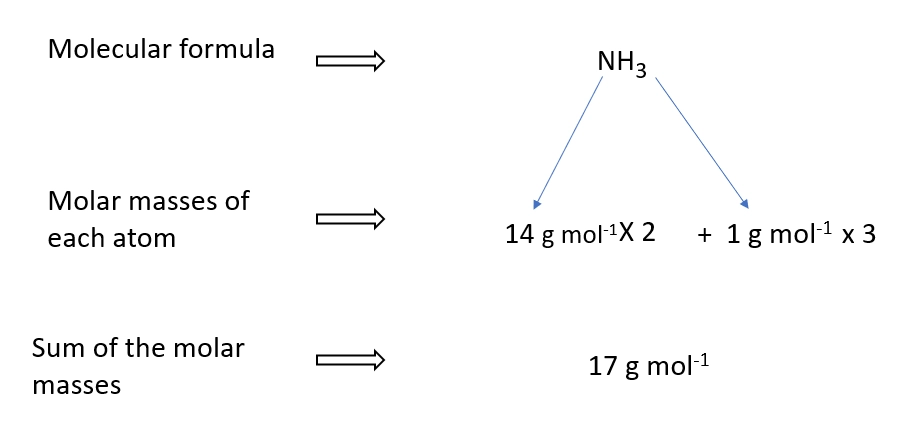
- Formula: NH3 – one nitrogen atom, three hydrogen atoms.
- Nitrogen: 1 × 14 = 14
- Hydrogen: 3 × 1 = 3
- Total: 14 + 3 = 17 g mol-1.
Brackets and water of crystallisation
Two formats catch people out. Both follow the same rule – multiply everything inside by the number outside.
A formula with brackets: calcium nitrate, Ca(NO3)2
- Work out the mass of one nitrate group first: N (14) + 3 × O (16) = 14 + 48 = 62.
- There are two nitrate groups: 2 × 62 = 124.
- Add the calcium: 40 + 124 = 164 g mol-1.
A hydrated salt: copper(II) sulfate crystals, CuSO4·5H2O
The dot does not mean multiply – it means that five water molecules are locked into the crystal for every one CuSO4. This is called water of crystallisation, and its mass must be included.
- CuSO4: 63.5 + 32 + (4 × 16) = 63.5 + 32 + 64 = 159.5
- 5H2O: 5 × 18 = 90
- Total: 159.5 + 90 = 249.5 g mol-1.
Using molar mass: the mole equation
Once you have a molar mass, one relationship does the rest of the work:
moles = mass (g) ÷ Mr
Rearranged, that gives mass = moles × Mr and Mr = mass ÷ moles. Many students draw it as a triangle with mass on top and moles and Mr underneath: cover the quantity you want and the triangle shows you what to do with the other two. There is more on rearranging expressions like this in our guide to rearranging formulas.
Worked example: how many moles?
Calculate the number of moles in 25 g of calcium carbonate, CaCO3.
- Mr of CaCO3 = 40 + 12 + (3 × 16) = 40 + 12 + 48 = 100
- moles = mass ÷ Mr = 25 ÷ 100
- = 0.25 mol
Worked example: what mass?
What is the mass of 2.0 mol of carbon dioxide?
- Mr of CO2 = 44
- mass = moles × Mr = 2.0 × 44
- = 88 g
Finding the molar mass of an unknown acid by titration
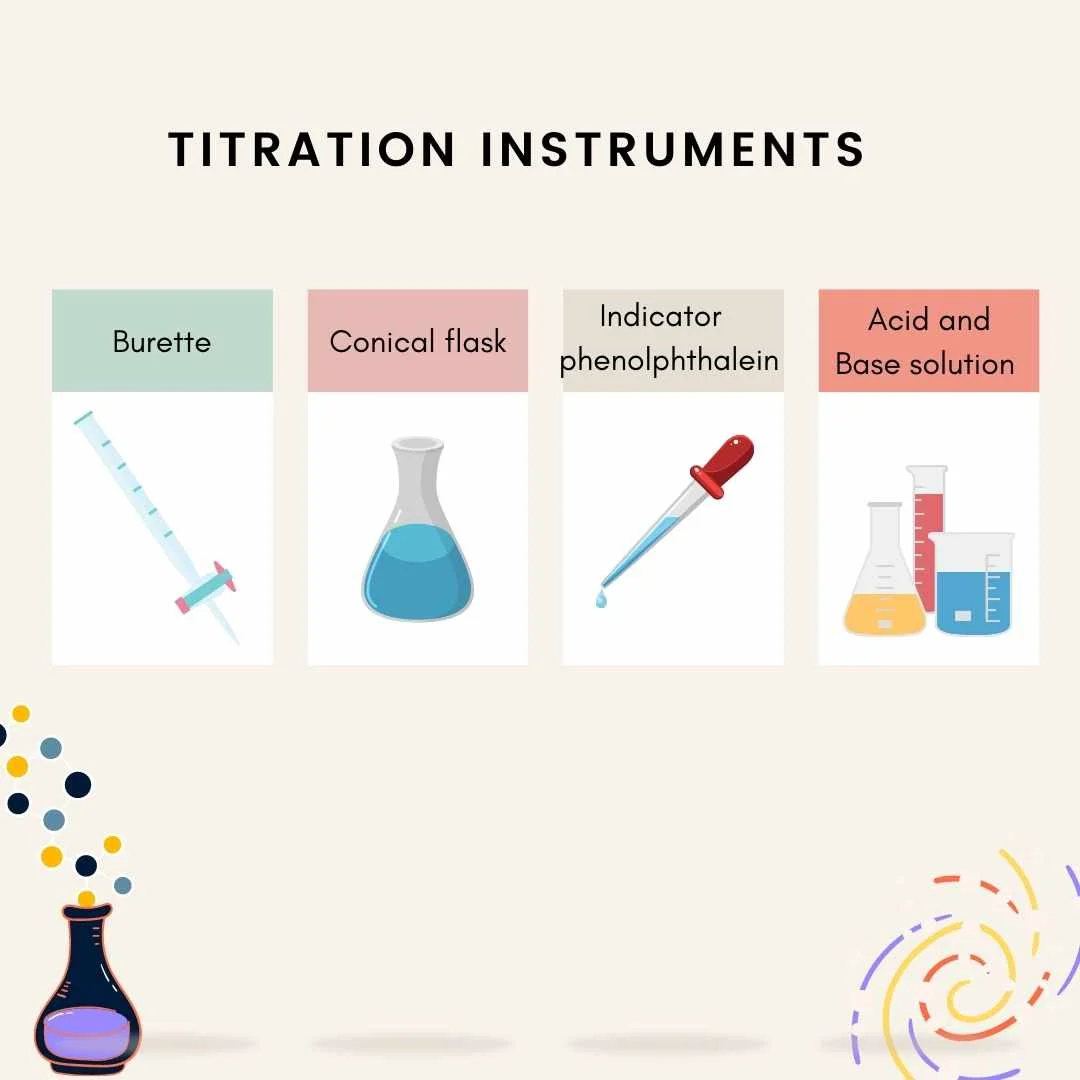
Titration is the standard laboratory method for finding the molar mass of an acid you cannot identify. You measure out a known mass of it, find out how many moles that turned out to be, and divide one by the other. Our separate lesson on acid-base titration covers the practical technique in detail.
The method
- Weigh out an accurately known mass of the unknown acid.
- Dissolve it in distilled water and make the solution up to a known volume in a volumetric flask – typically 250 cm3. You now know the mass per cubic decimetre, but not yet the concentration in moles.
- Pipette a measured portion, usually 25.0 cm3, into a conical flask and add a few drops of indicator.
- Titrate with a standard solution of sodium hydroxide of accurately known concentration, adding it from a burette until the indicator changes colour.
- Repeat until you have concordant titres, and take the mean of those.
The calculation, worked through
2.40 g of a monoprotic acid HA was dissolved and made up to 250 cm3. A 25.0 cm3 portion needed 20.0 cm3 of 0.100 mol dm-3 sodium hydroxide. Find the molar mass of the acid.
- Moles of NaOH used: moles = concentration × volume in dm3 = 0.100 × (20.0 ÷ 1000) = 0.00200 mol.
- Moles of acid in the 25 cm3 portion: the equation is HA + NaOH → NaA + H2O, a 1:1 ratio, so this is also 0.00200 mol.
- Moles of acid in the whole 250 cm3: the portion was one tenth of the flask, so 0.00200 × 10 = 0.0200 mol.
- Molar mass: Mr = mass ÷ moles = 2.40 ÷ 0.0200 = 120 g mol-1.
One warning about step 2. The 1:1 ratio only holds for a monoprotic acid – one that releases a single H+ ion per molecule, such as hydrochloric or ethanoic acid. A diprotic acid such as sulfuric acid releases two, so it reacts with twice as much alkali, and the moles of acid would be half the moles of NaOH. Read the equation before you divide.
Practice questions
- Calculate the Mr of magnesium oxide, MgO.
- Calculate the Mr of sulfuric acid, H2SO4.
- Calculate the Mr of magnesium hydroxide, Mg(OH)2.
- How many moles are there in 8.0 g of sodium hydroxide, NaOH?
- What is the mass of 0.50 mol of glucose, C6H12O6?
Answers: 1. 24 + 16 = 40. 2. (2 × 1) + 32 + (4 × 16) = 2 + 32 + 64 = 98. 3. 24 + 2 × (16 + 1) = 24 + 34 = 58. 4. Mr = 40, so moles = 8.0 ÷ 40 = 0.20 mol. 5. Mr = (6 × 12) + (12 × 1) + (6 × 16) = 72 + 12 + 96 = 180, so mass = 0.50 × 180 = 90 g.
Exam tips
- Use the Ar values on the periodic table you are given. Chlorine is 35.5 and copper is 63.5; rounding them to whole numbers throws the final answer out.
- Work out the contents of a bracket first, then multiply. Ca(OH)2 contains two oxygens and two hydrogens, not one of each.
- Remember that hydrogen, nitrogen, oxygen and the halogens exist as diatomic molecules when they are elements. The Mr of oxygen gas is 32, not 16.
- Include the water of crystallisation. The Mr of CuSO4·5H2O is 249.5, not 159.5.
- Show every line of your working. Method marks are available even when the final number is wrong, but only if the examiner can see what you did.
- Give molar mass the unit g mol-1. Mr and Ar themselves have no units, because they are ratios.
Frequently asked questions about molar mass
How do you calculate the molar mass of a compound?
Write out the formula, count how many atoms of each element it contains, look up each relative atomic mass on the periodic table, multiply each Ar by the number of those atoms, and add the results. The answer is in grams per mole.
What is the difference between Ar and Mr?
Ar is the relative atomic mass of a single element, such as 16 for oxygen. Mr is the relative formula mass of a whole compound, found by adding up the Ar values of every atom in the formula, such as 18 for water.
Is molar mass the same as relative formula mass?
They are the same number, but not quite the same quantity. Mr is a ratio and has no units; molar mass is a mass per mole and carries the unit g mol-1. If the Mr of carbon dioxide is 44, its molar mass is 44 g mol-1.
Why is the molar mass of chlorine 35.5 and not a whole number?
Because chlorine exists naturally as a mixture of two isotopes with different masses, and the relative atomic mass is the weighted average across that mixture. Most elements have several isotopes, which is why their Ar values are rarely exact whole numbers.
What is the molar mass of water?
18 g mol-1. Water is H2O, so it contains two hydrogen atoms at 1 each and one oxygen atom at 16, giving 2 + 16 = 18.
How do you work out molar mass when the formula has brackets?
Calculate the mass of everything inside the bracket first, then multiply by the number outside it. For Ca(NO3)2, one nitrate group is 14 + 48 = 62, two of them are 124, and adding calcium gives 164.
What does the dot mean in CuSO4·5H2O?
It shows water of crystallisation – five water molecules built into the crystal for each CuSO4 unit. Their mass counts towards the molar mass, adding 5 × 18 = 90 to give 249.5 g mol-1.
How do you convert grams to moles?
Divide the mass in grams by the molar mass: moles = mass ÷ Mr. For example, 25 g of calcium carbonate with an Mr of 100 gives 25 ÷ 100 = 0.25 mol.
How can a titration give the molar mass of an unknown acid?
You weigh out a known mass of the acid, titrate a measured portion against an alkali of known concentration, and use the titre to find how many moles of acid you had. Dividing the mass by the number of moles gives the molar mass. Check the equation first, because a diprotic acid reacts with twice as much alkali as a monoprotic one.