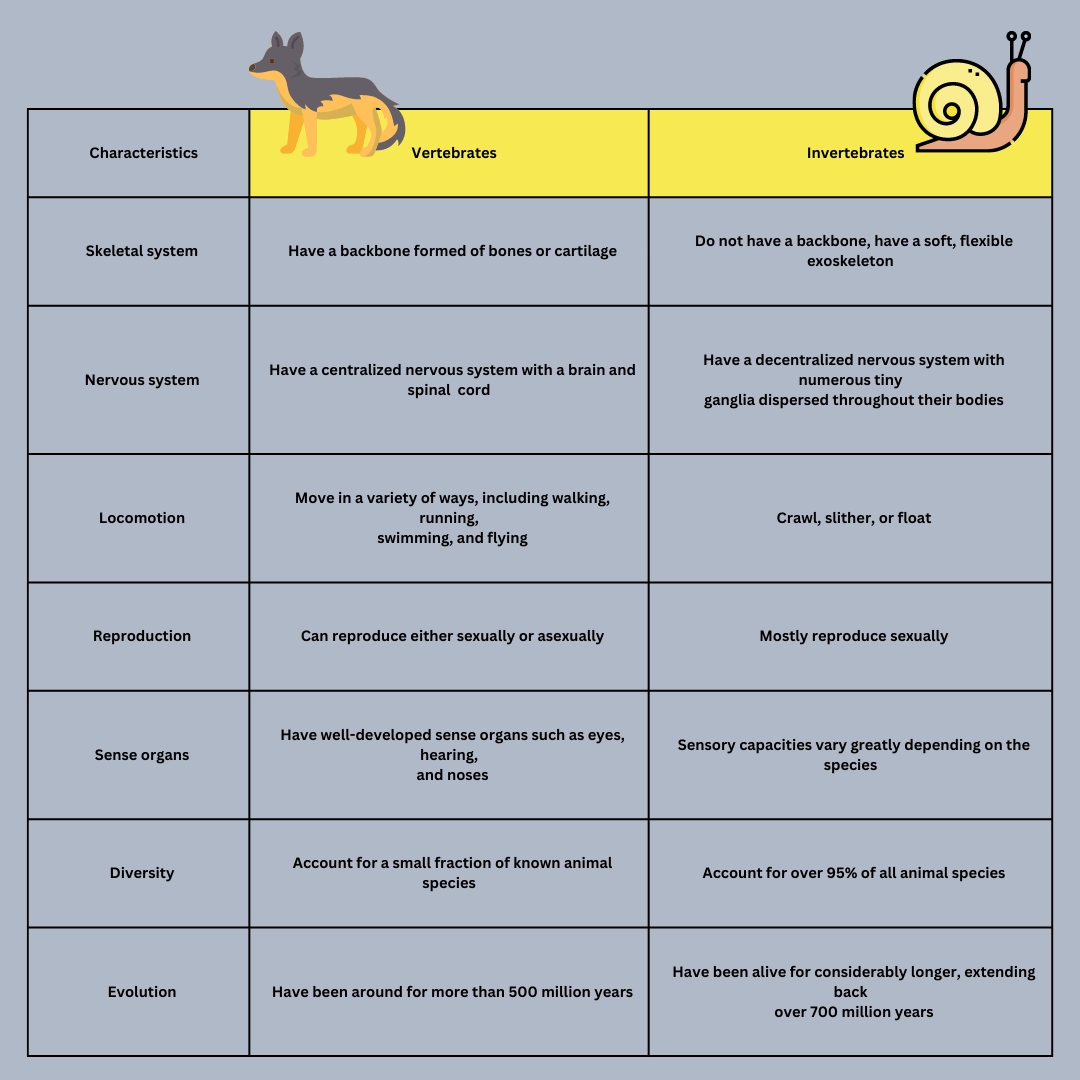
Differences between Vertebrates and invertebrates
| Characteristic | Vertebrates | Invertebrates |
|---|---|---|
| Skeletal system | Have an internal skeleton (endoskeleton) of bone or cartilage, including a backbone that supports and protects the spinal cord | Have no backbone. Some have a hard exoskeleton of chitin (insects, crabs), some a shell (snails, clams), some a fluid-filled hydrostatic skeleton (earthworms), and some no hard skeleton at all (jellyfish) |
| Nervous system | Centralised, with a brain and a spinal cord | Usually less centralised, with a simple brain or nerve ring and ganglia spread along the body |
| Locomotion | Walking, running, swimming and flying | Crawling, swimming, drifting, and flying in the case of insects |
| Reproduction | Almost all reproduce sexually. Asexual reproduction is very rare in vertebrates | Reproduce sexually, but many can also reproduce asexually – for example budding in Hydra, fragmentation in flatworms and parthenogenesis in aphids |
| Sense organs | Well-developed sense organs such as eyes, ears and noses | Sensory abilities vary enormously from one species to another |
| Diversity | Account for only a small fraction of known animal species | Account for over 95% of all known animal species |
| Evolution | Have been around for more than 500 million years | Appeared earlier, more than 700 million years ago |
Vertebrates and invertebrates are two major animal groupings that differ in a variety of ways.
Skeletal system: Vertebrates have a backbone formed of bones or cartilage that supports and protects the spinal cord. Invertebrates have no backbone. Instead, some have a hard exoskeleton made of chitin (insects and crabs), some have a shell (snails and clams), some have a fluid-filled hydrostatic skeleton (earthworms), and some have no hard skeleton at all (jellyfish).
Nervous system: Invertebrates have a decentralized nervous system with numerous tiny ganglia (clusters of nerve cells) dispersed throughout their bodies, whereas vertebrates have a centralized nervous system with a brain and spinal cord.
Locomotion: Vertebrates move in a variety of ways, including walking, running, swimming, and flying, whereas many invertebrates crawl, slither, or float.
Reproduction: Almost all vertebrates reproduce sexually, and asexual reproduction is very rare among them. Many invertebrates reproduce sexually as well, but a great many can also reproduce asexually – Hydra reproduces by budding, flatworms by fragmentation, and aphids by parthenogenesis.
Sense organs: Vertebrates have well-developed sense organs such as eyes, hearing, and noses, although invertebrates' sensory capacities vary greatly depending on the species.
Diversity: Invertebrates account for the vast majority of known animal species, accounting for over 95% of all animal species, while vertebrates account for a far smaller fraction of known animal species.
Evolution: Vertebrates have been around for more than 500 million years, while invertebrates have been alive for considerably longer, extending back over 700 million years.
Differences between Vertebrates and invertebrates simplified
For Grade 3:
- Vertebrates have a backbone or spine, while invertebrates do not.
- Examples of vertebrates are fish, birds, mammals, and reptiles, while examples of invertebrates are insects, spiders, and worms.
- Vertebrates generally have more complex body structures and systems compared to invertebrates.
For Grade 5:
- Vertebrates have an internal skeleton made of bone or cartilage, while invertebrates have external skeletons or no skeleton at all.
- Vertebrates have a well-developed nervous system with a brain and spinal cord, while invertebrates have a less complex nervous system.
- Vertebrates are usually larger and more mobile than invertebrates.
For Grade 9:
- Vertebrates are classified into five main groups: fish, amphibians, reptiles, birds, and mammals, while invertebrates are classified into numerous phyla.
- Vertebrates have a closed circulatory system, in which the blood always stays inside blood vessels. Many invertebrates, such as insects and most molluscs, have an open circulatory system in which blood washes directly around the organs – although some invertebrates, including earthworms and squid, have a closed system too.
- Vertebrates have a more advanced respiratory system, with lungs or gills, while invertebrates have a variety of respiratory structures such as spiracles or tracheae.
For Grade 10:
- Vertebrates have bilateral symmetry, meaning they have a left and right side that are mirror images of each other, while invertebrates may have radial symmetry or no symmetry at all.
- Vertebrates have a more complex digestive system with specialized organs, such as a stomach and intestines, while invertebrates may have a simple digestive cavity or tube.
- Birds and mammals are endothermic: they hold their body temperature steady using energy released by respiration. Fish, amphibians and reptiles are ectothermic, as almost all invertebrates are, and rely on their surroundings to control their body temperature.
For Grade 11:
- Vertebrates have a more developed immune system compared to invertebrates, with the ability to produce antibodies and white blood cells.
- Vertebrates have a greater capacity for learning and memory compared to invertebrates.
- Vertebrates have a higher metabolic rate and require more energy to maintain their body functions compared to invertebrates.