Key points at a glance
- Prokaryotic cells have no nucleus and no membrane-bound organelles. Their DNA is a single circular loop lying free in the cytoplasm.
- Eukaryotic cells have a true nucleus enclosed in a membrane, plus organelles such as mitochondria and, in plants, chloroplasts.
- Bacteria and archaea are prokaryotic. Animals, plants, fungi and protists are eukaryotic.
- Prokaryotic cells are much smaller – typically a few micrometres across, against tens of micrometres for a plant or animal cell.
- Both types have a cell membrane, cytoplasm, ribosomes and DNA. The differences are about organisation, not about the basic chemistry of life.
- Plant and animal cells are both eukaryotic. Plant cells additionally have a cellulose cell wall, chloroplasts and a permanent vacuole.
Differences between Eukaryotic cells and prokaryotic cells
Prokaryotic cells and eukaryotic cells are two types of cells with distinct structures and functions.
Prokaryotic cells, such as bacteria, are the cells of single-celled organisms that do not have a nucleus or any other organelle enclosed in a membrane. Their genetic material is a single circular chromosome lying in a region of the cytoplasm called the nucleoid, which is not separated off by a membrane. Many bacteria also carry small extra rings of DNA called plasmids.
In contrast, eukaryotic cells are more complex cells, and they are found in plants, animals, fungi and protists. Many eukaryotes are multicellular, but plenty are single-celled, such as yeast and amoeba. Eukaryotic cells have a nucleus, which is a membrane-bound compartment that holds the cell's genetic material, as well as other membrane-bound organelles that perform specific functions, such as mitochondria.
Another significant distinction between eukaryotic and prokaryotic cells is size. Because eukaryotic cells are significantly larger than prokaryotic cells, they can have more complex internal structures and perform more specialised functions.
Prokaryotic and eukaryotic cells compared
| Feature | Prokaryotic cell | Eukaryotic cell |
|---|---|---|
| Typical size | About 1–5 micrometres across | About 10–100 micrometres across |
| Nucleus | Absent – DNA lies free in the cytoplasm | Present, enclosed by a double membrane |
| Genetic material | One circular chromosome, not wound around histone proteins | Several linear chromosomes wound around histone proteins |
| Plasmids | Commonly present | Rare |
| Membrane-bound organelles | None | Mitochondria, endoplasmic reticulum, Golgi apparatus and others |
| Ribosomes | Present, and smaller | Present, and larger |
| Cell wall | Present, containing peptidoglycan (murein) | Cellulose in plants, chitin in fungi, absent in animals |
| Cell division | Binary fission | Mitosis, and meiosis for gametes |
| Examples | Bacteria, archaea | Animals, plants, fungi, protists |
Examples of eukaryotic and prokaryotic cells
Examples of eukaryotic cells include:
- Animal cells, such as those found in humans, dogs, and cats.
- Plant cells, such as those found in trees, flowers, and grasses.
- Fungal cells, such as those found in mushrooms, yeast, and molds.
- Protist cells, such as those found in algae, amoebas, and paramecia.
Examples of prokaryotic cells include:
- Bacteria, such as E. coli, Streptococcus, and Staphylococcus.
- Archaea, such as Halobacterium and Methanococcus.
These are just a few examples of the many types of eukaryotic and prokaryotic cells that exist in the natural world.
How big is a cell?
Cell sizes are measured in micrometres (µm), sometimes called microns. The units matter, so learn the conversions:
- 1 millimetre (mm) = 1,000 micrometres (µm)
- 1 micrometre (µm) = 1,000 nanometres (nm)
- So 1 mm = 1,000,000 nm
Most bacterial cells are only a few micrometres across, while most plant and animal cells are in the range of tens of micrometres. That means a typical animal cell can be ten or more times the diameter of a bacterium, and correspondingly far larger in volume. Sub-cellular structures are smaller again: a mitochondrion is a fraction of a micrometre, and a ribosome only a few tens of nanometres.
Why the microscope matters
A light microscope can magnify up to roughly 1,500 times, and it can separate two points that are around 200 nanometres apart. That is enough to show a nucleus, a chloroplast and the outline of a cell, but not enough to show a ribosome or the detail of a membrane.
An electron microscope has both much higher magnification and much higher resolution – the ability to distinguish two points that are very close together. Resolution, not magnification, is the limiting factor: magnifying a blurred image simply gives a bigger blurred image. Electron microscopes are why we know what the inside of a mitochondrion looks like, and why sub-cellular structures were largely unknown before they were developed.
Calculating magnification
One equation covers every question on this:
magnification = size of image ÷ size of real object
Worked example: a cell is drawn 30 mm across at a magnification of ×3,000. How wide is the real cell?
- Rearrange: real size = image size ÷ magnification.
- Real size = 30 ÷ 3,000 = 0.01 mm.
- Convert to micrometres: 0.01 × 1,000 = 10 µm.
Always convert both measurements to the same unit before dividing. Mixing millimetres and micrometres in the same calculation is the single most common error here, and it puts the answer out by a factor of a thousand.
Organelles and what they do
| Structure | Found in | Function |
|---|---|---|
| Nucleus | All eukaryotic cells | Contains the chromosomes and controls the activities of the cell |
| Cytoplasm | All cells | Jelly-like material where most of the cell's chemical reactions happen |
| Cell membrane | All cells | Partially permeable barrier controlling what enters and leaves the cell |
| Mitochondria | Plant and animal cells | Site of aerobic respiration, releasing energy from glucose |
| Ribosomes | All cells | Site of protein synthesis |
| Cell wall | Plant, fungal and bacterial cells | Strengthens the cell and stops it bursting; made of cellulose in plants |
| Chloroplasts | Plant cells (green parts only) | Contain chlorophyll and carry out photosynthesis |
| Permanent vacuole | Plant cells | Filled with cell sap; keeps the cell firm and supports the plant |
| Plasmid | Many bacterial cells | Small ring of extra DNA, often carrying genes such as antibiotic resistance |
Note that root cells and other underground plant cells contain no chloroplasts, because they never receive light. Having a cell wall and a nucleus is not enough to make a cell photosynthetic.
Similarities between eukaryotic cells and prokaryotic cells
Despite the many differences between prokaryotic and eukaryotic cells, there are some important similarities, including:
- Both types of cells are surrounded by a plasma membrane that regulates the movement of molecules into and out of the cell.
- Both types of cells contain DNA as their genetic material, which encodes the information necessary for cell function.
- Both types of cells use ribosomes to synthesise proteins from the genetic code.
- Both types of cells use ATP as an energy source for cellular processes.
- Both types of cells have the ability to respond to changes in their environment, including changes in temperature, pH, and nutrient availability.
- Both types of cells have the ability to replicate and divide to create new cells.
- Both types of cells have some form of internal organisation, although this is far more elaborate in eukaryotic cells.
While these similarities are important, it is the differences between the two types of cells that give rise to the diversity of life on Earth.
Differences in gene expression between prokaryotic and eukaryotic cells
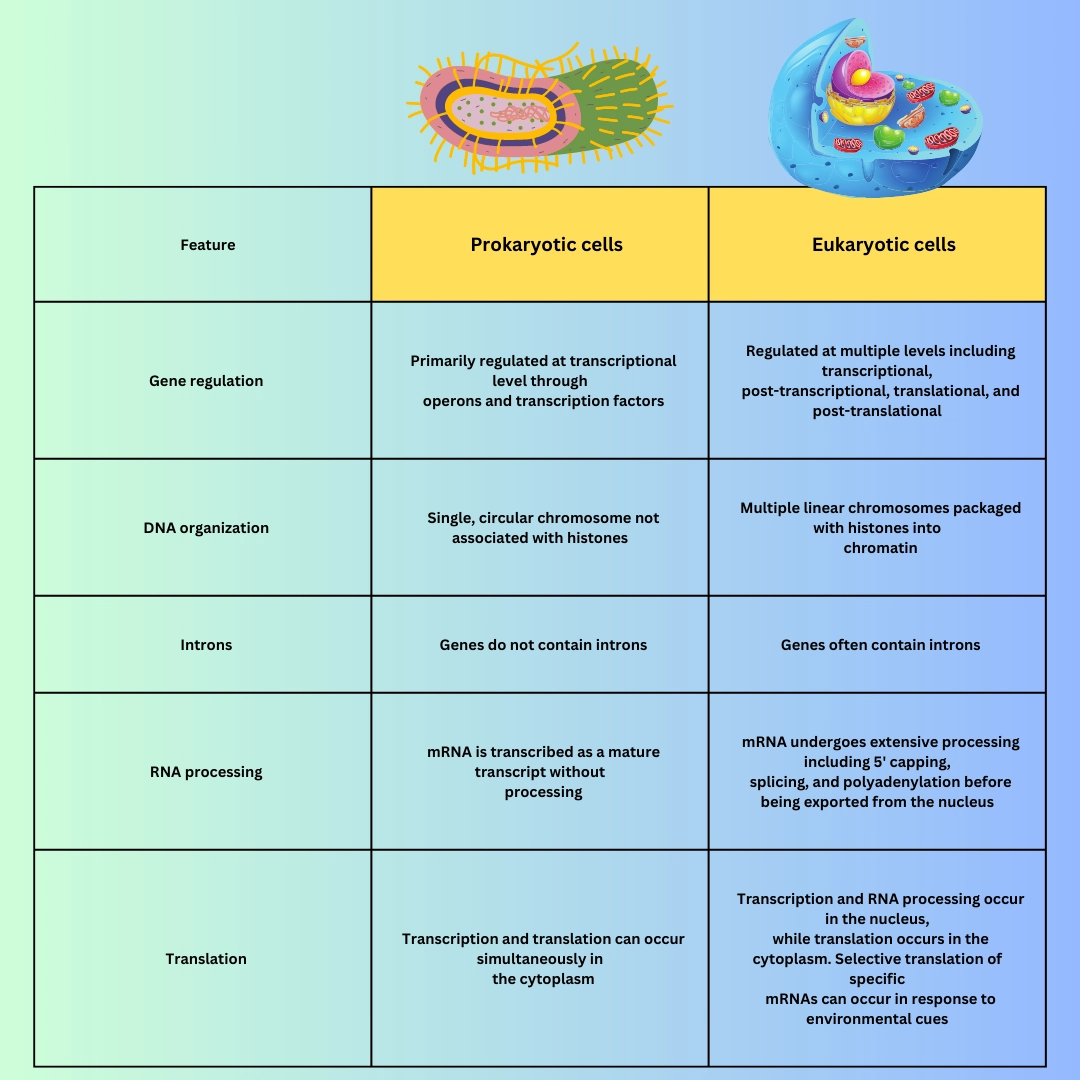
This section goes beyond what most GCSE courses require, but it is useful background if you are moving on to A level or IB. Prokaryotic cells and eukaryotic cells differ in their gene expression in several ways:
- Gene regulation: In prokaryotic cells, gene expression is primarily regulated at the transcriptional level. The genes are arranged in operons, which are groups of functionally related genes that are transcribed together. The operons are regulated by transcription factors, which can either activate or repress transcription. In contrast, eukaryotic gene expression is regulated at multiple levels, including transcriptional, post-transcriptional, translational, and post-translational levels.
- DNA organisation: Prokaryotic cells have a single, circular chromosome, which is not associated with histone proteins. In contrast, eukaryotic cells have multiple linear chromosomes, which are packaged with histone proteins into chromatin. This chromatin structure affects gene expression by making some genes more or less accessible to the transcription machinery.
- Introns: Eukaryotic genes often contain introns, non-coding sequences within a gene that are transcribed but then spliced out of the mature mRNA. Prokaryotic genes generally do not contain introns.
- RNA processing: Eukaryotic mRNA undergoes extensive processing, including 5' capping, splicing, and polyadenylation, before it is exported from the nucleus. These modifications can affect the stability and translatability of the mRNA. In prokaryotes, by contrast, the transcript is essentially ready to use as it is made.
- Translation: In prokaryotic cells, transcription and translation can occur simultaneously because both processes occur in the cytoplasm. Eukaryotic cells have a nuclear membrane that separates transcription and RNA processing in the nucleus from translation in the cytoplasm.
These differences in gene expression between prokaryotic and eukaryotic cells contribute to the distinct characteristics of these two types of cells. For the basics of how DNA codes for proteins, see our notes on DNA, RNA, mitosis and meiosis.
Differences between plant cell and animal cell
Plant cells and animal cells are both eukaryotic, so both have a nucleus, cytoplasm, a cell membrane, mitochondria and ribosomes. What differs is what the plant cell has in addition.
Plant cells have a cellulose cell wall, a large permanent central vacuole that stores cell sap, and chloroplasts, which carry out photosynthesis. Plant cells are often larger than animal cells, and the rigid cell wall gives them a fixed shape.
Animal cells, on the other hand, lack a cell wall and have vacuoles that are smaller, more numerous, and temporary. Animal cells lack chloroplasts and are therefore unable to photosynthesise. Instead, they obtain the energy they need from the food they consume.
Another distinction between plant and animal cells is their shape; plant cells are typically rectangular or box-like because of the cell wall, whereas animal cells are more rounded or irregular.
What do animal cells have that plant cells don't?
Animal cells contain several structures that are absent from a typical plant cell:
- Lysosomes: membrane-bound organelles containing digestive enzymes. Lysosomes break down large molecules and worn-out organelles, and they play a role in cellular recycling.
- Centrioles: cylindrical structures involved in cell division. Centrioles are composed of microtubules and help organise the spindle fibres during mitosis. Most flowering plant cells do not have them.
- Flagella: some animal cells have flagella, whip-like structures extending from the cell surface and used for movement. In humans, sperm cells have a flagellum that lets them swim towards the egg.
- Cilia: some animal cells have cilia, hair-like structures used for movement. Ciliated cells line the airways, where they sweep mucus and trapped dust away from the lungs.
- Tight junctions: specialised regions of the plasma membrane that seal the gap between adjacent cells. Tight junctions are important for maintaining the barrier function of tissues such as the digestive tract.
In contrast, plant cells have several structures that are not found in animal cells: a cellulose cell wall, chloroplasts, and a large permanent vacuole.
Similarities and differences between plant and animal cells
Plant cells and animal cells have many similarities, including:
- Both types of cells are eukaryotic, meaning that they contain a nucleus and other membrane-bound organelles.
- Both types of cells have a plasma membrane that regulates the movement of molecules into and out of the cell.
- Both types of cells use ribosomes to synthesise proteins from the genetic code.
- Both types of cells use ATP as an energy source for cellular processes.
- Both types of cells have the ability to respond to changes in their environment, including changes in temperature, pH, and nutrient availability.
The significant differences
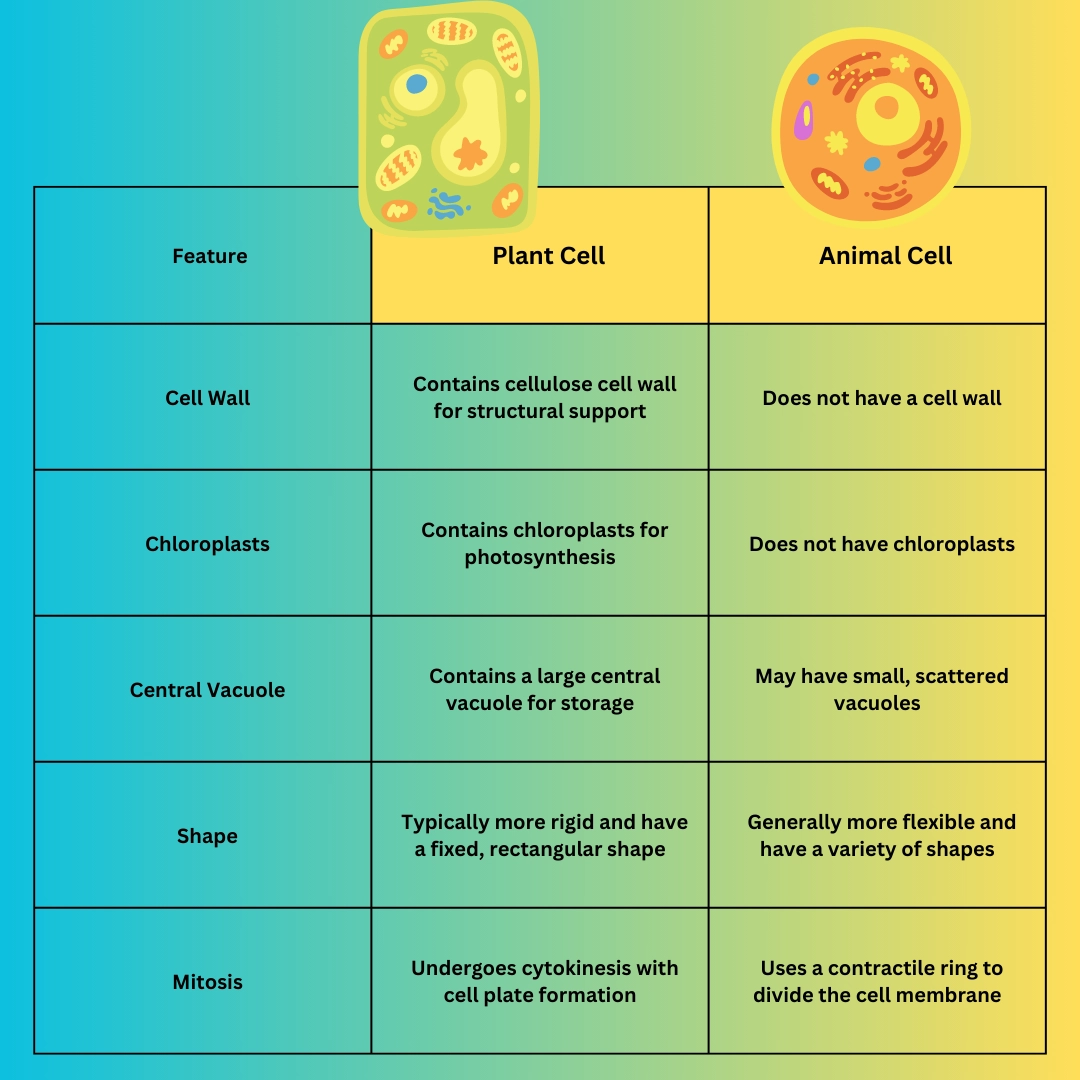
- Cell wall: Plant cells have a cell wall made of cellulose, which provides structural support and stops the cell bursting when it takes in water by osmosis. Animal cells do not have a cell wall.
- Chloroplasts: Plant cells in the green parts of the plant contain chloroplasts, which carry out photosynthesis. Animal cells do not have chloroplasts.
- Central vacuole: Plant cells have a large permanent vacuole filled with cell sap, which keeps the cell turgid and supports the plant. Animal cells may have small, temporary vacuoles, but no permanent central one.
- Shape: Plant cells are typically rigid with a fixed, box-like shape, while animal cells are more flexible and have a variety of shapes.
- Cytokinesis: Both plant and animal cells divide their cytoplasm at the end of mitosis, but they do it in different ways. In a plant cell a cell plate forms across the middle of the cell and becomes the new cell wall, while an animal cell uses a contractile ring to pinch the cell membrane inwards and divide the cell in two.
These similarities and differences reflect the roles that plant and animal cells play in their respective organisms.
Differences between plant cell and animal cell vacuoles
Plant cells have a large permanent central vacuole, while animal cells have smaller, temporary ones. The central vacuole in a plant cell stores water, ions, sugars and waste products, helps regulate the pH of the cytoplasm, and above all keeps the cell turgid. When the vacuole loses water the cell becomes flaccid and the plant wilts, which is why watering a wilted houseplant revives it within hours.
Animal cell vacuoles are generally smaller and are involved in transport, temporary storage and waste disposal rather than support.
Differences between plant cell and animal cell nucleus
| Feature | Plant cell nucleus | Animal cell nucleus |
|---|---|---|
| Nuclear envelope | A double membrane with nuclear pores; the outer membrane is continuous with the endoplasmic reticulum | The same – a double membrane with nuclear pores, continuous with the endoplasmic reticulum |
| Chromosomes | Linear DNA molecules wound around histone proteins | The same – linear DNA molecules wound around histone proteins |
| Appearance of the chromosomes | Spread out as chromatin while the cell is growing, condensing into visible rod-shaped chromosomes when the cell divides | The same – chromatin while the cell is growing, condensed rod-shaped chromosomes at cell division |
| Nucleolus | One or more nucleoli, always inside the nucleus, where ribosomes are made | The same – one or more nucleoli, always inside the nucleus |
| Position in the cell | Usually pushed to the edge of the cell, against the cell wall, by the large central vacuole | Usually nearer the centre of the cell |
| Organising the spindle | Most flowering plant cells have no centrioles; the spindle forms without them | A pair of centrioles lies just outside the nucleus and helps organise the spindle |
| Dividing the cytoplasm afterwards | A cell plate forms across the middle of the cell and becomes the new cell wall | The cell membrane pinches inwards, forming a cleavage furrow |
Exam point: the nucleus itself is built the same way in plant and animal cells. The genuine differences are about where the nucleus sits in the cell and what happens around it when the cell divides – not about the envelope, the chromosomes or the nucleolus.
The nucleus in both plant and animal cells contains the cell's genetic material and serves as the control centre of the cell. The specific points to know are:
- Position in the cell: In a mature plant cell the large central vacuole pushes the cytoplasm and the nucleus out to the edge of the cell, up against the cell wall. In an animal cell the nucleus is usually nearer the centre.
- Nuclear envelope: This is the same in both. In plant and animal cells alike the nucleus is surrounded by a double membrane containing nuclear pores, and the outer membrane is continuous with the endoplasmic reticulum.
- Chromosome structure: This is also the same in both. Plant and animal chromosomes are linear DNA molecules wound around histone proteins. In both, they are spread out as chromatin while the cell is growing and condense into visible rod-shaped chromosomes only when the cell divides.
- Nucleolus: In plant and animal cells alike the nucleolus lies inside the nucleus, where ribosomes are made. It is never found outside the nucleus.
- Mitosis: Plant cell mitosis involves the formation of a cell plate during cytokinesis, while animal cell mitosis involves the formation of a cleavage furrow.
So the nucleus itself is built the same way in plant and animal cells. The real differences are about where the nucleus sits in the cell, and about what happens around it when the cell divides.
Exam tips
- Say a prokaryote has no nucleus and that its DNA is a single circular loop free in the cytoplasm. "It has no organelles" is not accurate, because it does have ribosomes.
- Do not write that plant cells "have a cell wall so animals do not". Fungi and bacteria have cell walls too – the point about plants is that theirs is made of cellulose.
- Convert units before doing any magnification calculation, and state the unit in your answer. An answer of "10" with no unit rarely scores.
- Remember that magnification and resolution are different things. Resolution is the reason an electron microscope shows more, not magnification alone.
- Plasmids are found in bacteria, not in a plant or animal nucleus. Questions about antibiotic resistance are usually testing whether you know this.
- If asked for a similarity between prokaryotic and eukaryotic cells, safe answers are: both have a cell membrane, cytoplasm, ribosomes and DNA.
Frequently asked questions about eukaryotic and prokaryotic cells
What is the main difference between prokaryotic and eukaryotic cells?
Prokaryotic cells have no nucleus and no membrane-bound organelles; their DNA lies free in the cytoplasm as a single circular loop. Eukaryotic cells keep their DNA inside a nucleus enclosed by a membrane and also contain organelles such as mitochondria.
Are bacteria prokaryotic or eukaryotic?
Bacteria are prokaryotic. So are archaea. Every other kind of organism – animals, plants, fungi and protists – is made of eukaryotic cells.
Do prokaryotic cells have DNA?
Yes. Prokaryotes have a single circular chromosome lying in a region of the cytoplasm called the nucleoid, and many also carry small extra rings of DNA called plasmids. What they lack is a membrane around that DNA, not the DNA itself.
Do prokaryotic cells have ribosomes?
Yes, and this is a common trick question. Prokaryotes make proteins, so they must have ribosomes. Their ribosomes are smaller than those in eukaryotic cells, but they are present in every prokaryotic cell.
How much bigger is a eukaryotic cell than a prokaryotic cell?
Most bacteria are only a few micrometres across, while plant and animal cells are usually tens of micrometres. That makes a typical eukaryotic cell around ten times the diameter of a bacterium, and very much greater in volume.
What do plant cells have that animal cells do not?
A cellulose cell wall, chloroplasts in the green parts of the plant, and a large permanent vacuole filled with cell sap. Both are eukaryotic, so both have a nucleus, cytoplasm, cell membrane, mitochondria and ribosomes.
Do all plant cells have chloroplasts?
No. Only cells that receive light contain them, which is why root cells have none. A cell can have a cell wall and a vacuole and still not photosynthesise.
How do you calculate the magnification of a cell?
Divide the size of the image by the size of the real object. To find the real size instead, divide the image size by the magnification. Convert both measurements to the same unit before you divide, since 1 mm equals 1,000 micrometres.
Why is resolution more important than magnification?
Resolution is the ability to distinguish two points that are very close together. Magnifying an image beyond the resolution limit just produces a larger blur with no extra detail, which is why electron microscopes, with far better resolution, revealed structures that light microscopes never could.