What is peer pressure? Peer pressure is the influence that people of a similar age or group have on what you think, say and do. It can be spoken, such as being asked or dared, or unspoken, such as noticing what everyone else is doing and wanting to fit in. It can push you towards good choices or bad ones, which is why we talk about positive and negative peer pressure.
Almost everyone feels it, and it is not a sign of weakness. Humans are social animals, and for teenagers in particular, friends matter more than they did in childhood. This guide explains the types of peer pressure, gives real-life examples of both kinds, looks at what research such as the Gardner and Steinberg driving-game study and Asch's conformity experiment actually found, and shows practical ways to deal with it. If you are a parent or teacher, there is a section for you too.
Why do peers matter so much?
During the teenage years, friends often become more important and what they think matters more. That is a normal part of growing up. You are working out who you are, and your friends are a mirror. Good friendships build confidence, teach you to cooperate and make life more fun. The same drive to belong is what makes peer pressure powerful. The next section explains the science behind this in detail, and you can read more about why friendship matters so much in our separate guide.
The main types of peer pressure
Peer pressure is not always someone saying "go on, do it". Psychologists and youth workers usually describe a few different forms.
- Direct (spoken) pressure: someone asks, dares, teases or pushes you. "Everyone's going, don't be boring" is a classic example.
- Indirect (unspoken) pressure: nobody says anything, but you see what the group wears, plays, eats or posts, and you feel you should match it.
- Pressure from one person or a whole group: a single close friend can sway you, but so can a crowd, a team or a class group chat.
- Online pressure: likes, streaks, group chats and trends that make you feel you must keep up. Our guide to the advantages and disadvantages of social media covers this side in more depth.
- Self-pressure: sometimes the pressure comes from inside. You imagine what others expect and act on it, even though nobody asked.

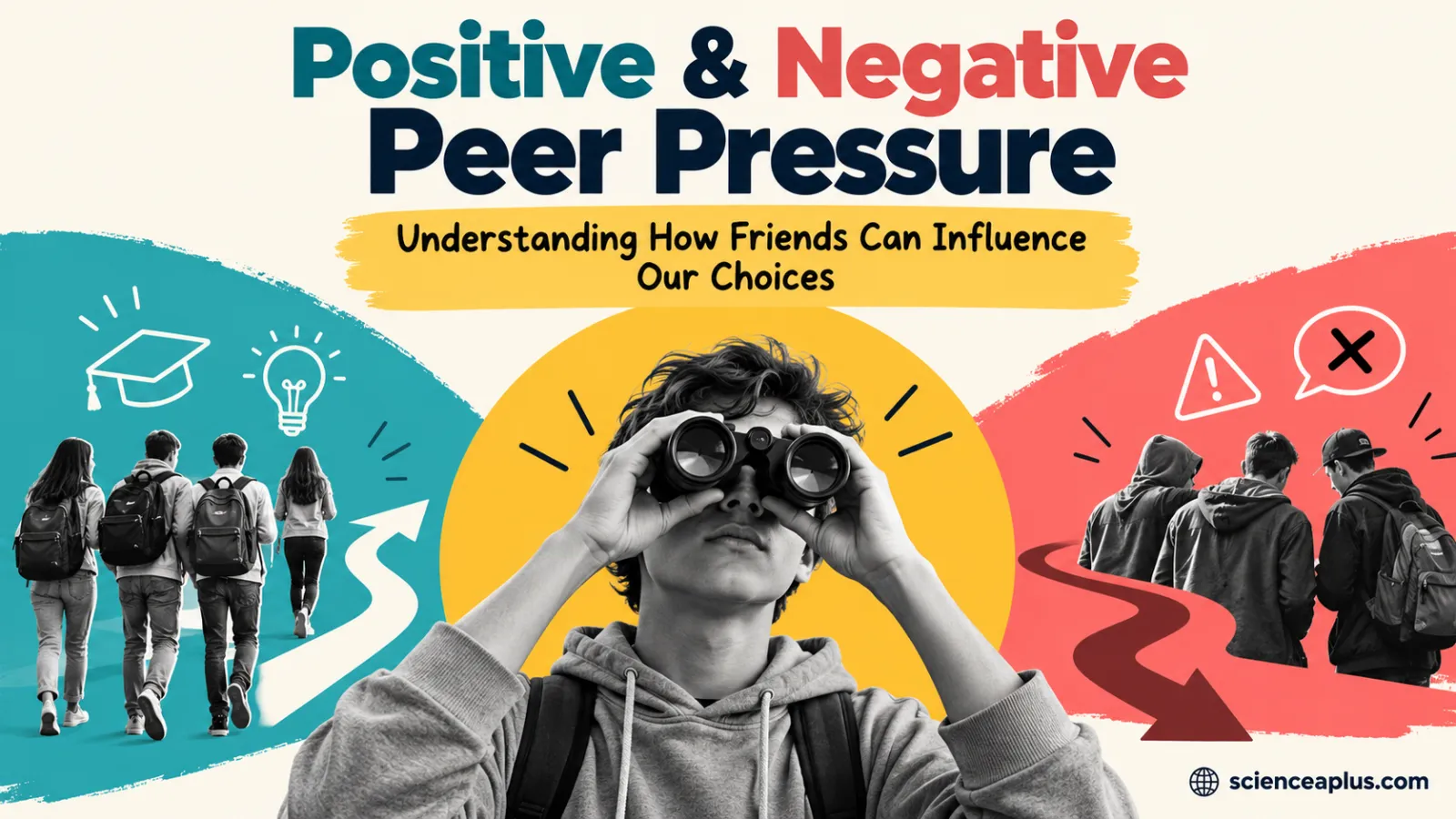
The graphic above lists the areas where peers can influence us: our goals and decisions, the people we spend time with, our attitude to school, our activities and hobbies, the way we communicate, and our beliefs and behaviour. Notice that nothing on that list is automatically good or bad. What matters is the direction of the push.
What is positive peer pressure? Examples
Positive peer pressure happens when friends or classmates encourage choices that are good for your health, learning, relationships or future. It often feels like support rather than pressure, which is why people sometimes do not even notice it.

Here are everyday examples:
- Studying together. A friend suggests a revision session before a test, and you both end up learning more than you would alone.
- Joining a team or club. A classmate asks you to try out for football, drama or the chess club, and you find something you love.
- Kindness and inclusion. Your group invites someone who is sitting alone, and you follow their lead.
- Standing up for what is right. A friend says "that is not funny" when someone is being picked on, which makes it easier for you to speak up too.
- Keeping going. When you want to give up on a hard project, a friend reminds you of how far you have come.
- Healthy habits. Walking to school together, drinking water and sleeping properly can all spread through a friendship group.
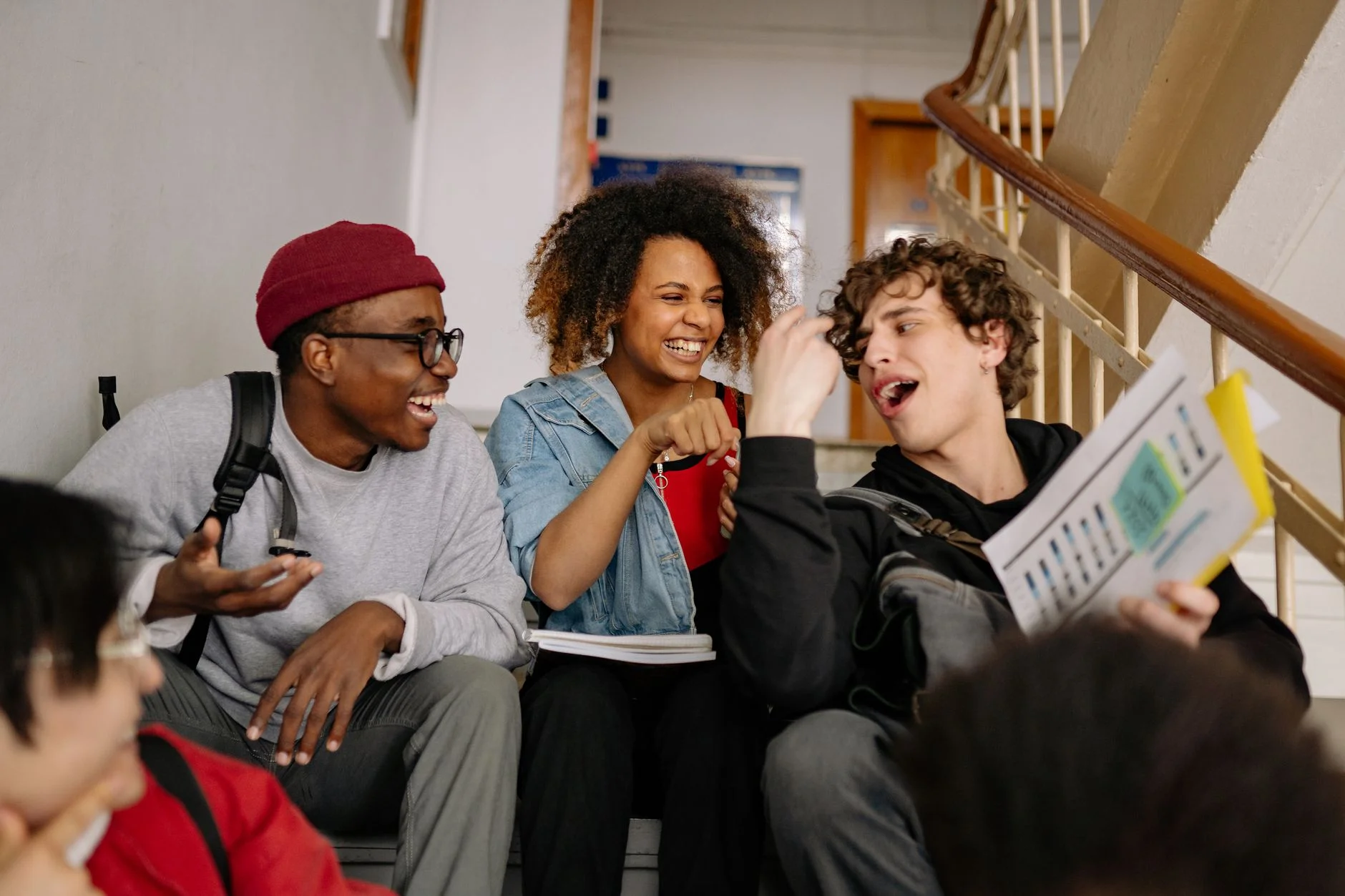
Positive peer pressure works because people copy the behaviour around them, which is the same mechanism as negative peer pressure. The difference is the outcome. Surrounding yourself with friends who respect your choices makes good decisions the easy default.
What is negative peer pressure? Examples
Negative peer pressure is when people your age push, tempt or expect you to do something that is unsafe, harmful, against your values or simply something you do not want to do. The graphic below shows how it can feel: friends laughing and pointing, while the person in the middle looks down, as if wishing they were somewhere else.

Common examples include:
- Alcohol, vaping, smoking or drugs: being offered something at a party and teased for saying no. Research on young people links peer pressure with drinking, drug use and bullying behaviour.
- Risky dares: climbing onto roofs, walking on railway lines, racing on bikes or scooters without a helmet.
- Bullying or exclusion: joining in with mocking someone because everyone else is, or freezing a person out of a group chat.
- Cheating or lying: copying homework, covering for a friend or going along with a "prank" you know is wrong.
- Body image and appearance: feeling you must wear certain brands, diet, or change how you look to be accepted.
- Sharing things you are uncomfortable with: pictures, messages or personal secrets, because "everyone does it".
- Skipping school or work: being talked into truanting or not trying because it is "not cool".
Positive vs negative peer pressure at a glance
| Positive peer pressure | Negative peer pressure | |
|---|---|---|
| What it encourages | Learning, kindness, health, trying new things | Risky, harmful or dishonest behaviour |
| How it feels afterwards | Proud, supported, more confident | Worried, guilty, anxious or pressured |
| Does it respect "no"? | Yes, you can decline without a fuss | No, you are teased, guilt-tripped or left out |
| Example | "Come to the revision group with us." | "Don't be boring, just try it." |
| Long-term effect | Builds skills, friendships and goals | Can harm health, school life and self-esteem |
Many situations are mixed. A friendship group can encourage you to work hard and also to stay up too late. That is why the next part looks at why pressure from friends feels so strong, and what scientists have measured.
Why does peer pressure feel so strong?
Peer pressure feels strong because belonging matters to the human brain. For most of human history, being part of a group meant safety, food and help. Being left out was dangerous. Today the stakes are social rather than physical, but the feeling of being left out can still be uncomfortable. That is not a character flaw. It is how people are built.
Scientists have studied this with careful experiments rather than guesswork. Three pieces of research are especially useful for GCSE Psychology, PSHE and general understanding: a driving-game study by Margo Gardner and Laurence Steinberg, a brain-scanning follow-up, and Solomon Asch's famous line-judgement experiment.
The Gardner and Steinberg driving-game study (2005)
In 2005 the psychologists Margo Gardner and Laurence Steinberg published an experiment in the journal Developmental Psychology. They wanted to know whether having friends nearby changes how much risk people take, and whether this changes with age.
They tested three age groups: early adolescents (average age 14), late adolescents (average age 19) and adults (average age 37). Each person played a computerised driving game, the ‘Chicken Game’. The aim was to advance a car as far as possible along a course while avoiding a crash. A wall could appear suddenly, and the player had to decide whether to keep going or brake.
The key manipulation was simple. Some people played alone. Others played with two friends of the same age in the room, watching.
Notice what this does not say. The teenagers were not more reckless than adults when they played alone. The change came from the presence of peers. Nobody told them to take risks. Friends simply being in the room was enough. The researchers also found that people in groups focused more on the possible benefits of a risky choice than on its costs.
What happens in the adolescent brain?
A later study helped explain why. In 2011 a team led by Jason Chein scanned the brains of adolescents and adults with an fMRI scanner while they played a similar driving game, either alone or while peers watched from another room. The researchers found that adolescents, but not adults, took more risks when observed by peers.
The scans showed something more. When teenagers were being watched by friends, parts of the brain linked to reward, including the ventral striatum and the orbitofrontal cortex, became more active. This did not happen in adults. In plain words, the brain's reward system seems to respond more strongly to the possibility of impressing friends.
At the same time, the parts of the brain involved in planning and self-control, mostly in the prefrontal cortex, are still developing well into the twenties. That does not mean teenagers cannot make good decisions. They often do, especially when they have time to think. It means that quick, in-the-moment decisions with friends watching can be harder, so it helps to prepare in advance. For more on how the brain works, see our guides to neuroscience and the brain and amazing facts about the brain.

Other research suggests a hopeful side: if friends can raise risk-taking, they can also encourage good behaviour. This was not tested in the studies above, so treat it as a promising idea rather than a result of those experiments. Teenagers who are around people who make careful, kind, ambitious choices may be more likely to see those choices as normal.
Asch's conformity experiment (1951) and its limits
The older, more famous experiment is by the American psychologist Solomon Asch. In the best-known version, about 50 male students at Swarthmore College in the USA were told they were taking part in a vision test. Each sat in a group with seven other people, who were actually actors working with Asch.
The group looked at a line and had to say which of three other lines matched it in length. The answer was obvious. But on 12 of the 18 trials, the actors all gave the same wrong answer before the real participant spoke.
- About 32% of the real participants' answers on those critical trials went along with the wrong majority.
- About 75% of participants conformed at least once.
- About 25% never conformed at all.
- When people did the task alone, they made almost no mistakes (less than 1%).
Asch also found a very practical result. When just one actor gave the correct answer, conformity dropped to around 5%. A single ally made it much easier to say what you really saw. This is one of the best arguments for finding at least one friend who shares your values.
Limitations of the Asch experiment
Good scientists question their evidence, and psychology exams reward you for doing the same. The main criticisms are:
- The sample: only male American college students took part, so the results may not apply to girls, other ages or other cultures.
- The task: judging lines is not the same as deciding whether to try alcohol or to cheat. Real-life pressure involves friendships and feelings.
- The period: the study was done in the 1950s. A British replication in 1980 (Perrin and Spencer, using engineering, maths and chemistry students) found conformity on only 1 of 396 trials, which may suggest results depend on time, place and who is tested.
- Ethics: participants were deceived and did not know the real purpose, which would be difficult to approve today.
Put the three studies together and a clear picture emerges. Group influence is real. It is stronger in some circumstances, particularly when friends are watching during the teenage years. And it is not fixed, because simple things such as having one ally change what people do.
Why understanding the science helps
Knowing that peer influence has biological and social causes helps in two ways. First, you can stop blaming yourself for feeling the pull. Second, you can plan. If you know that decisions made quickly with friends watching are the hardest, you can decide in advance what you will do. People who sleep well, eat properly and manage stress also find it easier to think clearly under pressure, and our guide to sleep and mental health explains why rest matters so much.
The next part turns the science into a toolkit you can use on a Friday night, in a corridor or in a group chat.
How to resist negative peer pressure
Resisting negative peer pressure is a skill, not a personality trait, and skills can be practised. You do not need to be loud, rude or "the one who ruins the fun". You need a few ready-made responses and a clear idea of your own limits. The graphic below shows a five-step method: pause, think, say no, walk away and seek support.

Step 1: Pause
Pressure works best when it is fast. "Come on, just do it, now!" is designed to stop you thinking. Take a breath, slow down and buy yourself a few seconds. Even "give me a minute" changes the pace.
Step 2: Think
Ask yourself three quick questions. Could this hurt me or someone else? Would I be happy for a parent, carer or teacher to know about it? Will I be glad about this tomorrow? If the answer to any of them is no, you have your decision.
Step 3: Say no, simply and calmly
You do not have to explain or win an argument. A short, relaxed answer is hard to argue with. Here are some options you can use:
- "No thanks, I'm good."
- "Not for me, but you carry on."
- "I've got training in the morning."
- "My mum would go mad, and I'd be grounded for a month."
- "That's not funny. I'm going to leave it."
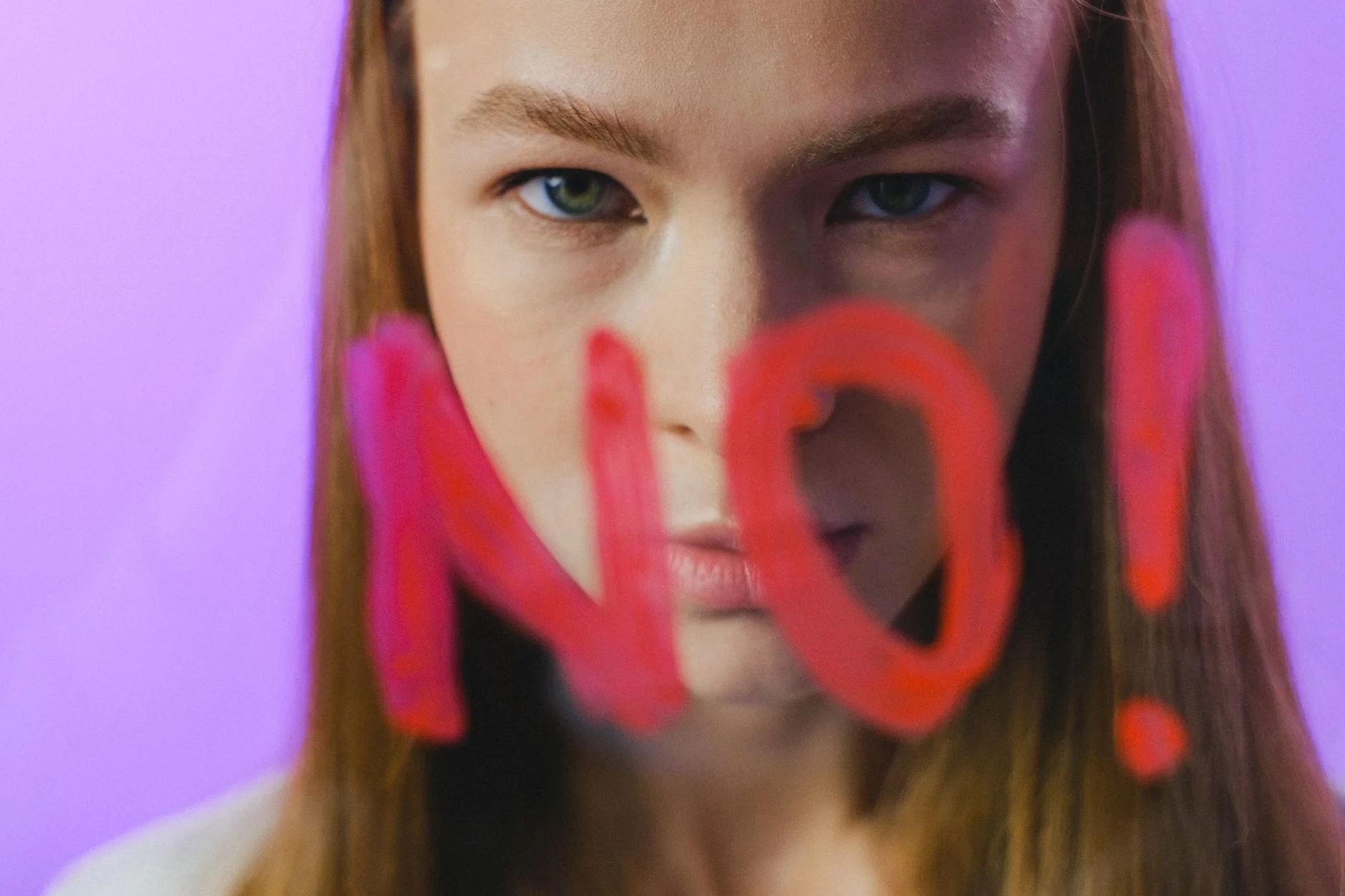
Humour, a change of subject or a ready excuse can all be used. An honest "I don't want to" is also enough. Remember that saying no is not weakness. It takes confidence.
Step 4: Walk away or change the activity
If saying no is not enough, move. Go to the toilet, get a drink, start a different game or head home. Suggesting an alternative ("let's get food instead") often works because many other people in the group are also unsure and are relieved when someone changes direction.
Step 5: Seek support
Tell someone you trust: a parent or carer, a teacher, a school counsellor, an older sibling or a friend. If you cannot talk to anyone you know, the helplines in the "Where to get help" section are free and confidential.
Practice checklist: get ready before the moment arrives
Prepare in advance for situations you expect, such as a party, a school trip or a new group chat. Tick these off as you go. Your ticks are remembered in your browser.
- I know my own limits, such as alcohol, vaping, dares or sharing pictures
- I have one sentence ready to say no
- I have an excuse or exit plan, such as a lift home or a time to leave
- My phone is charged and I know who to call
- I have told a trusted adult where I am going
- I have at least one friend who respects my choices
Test your thinking: what would you do?
Tap each question to reveal a suggested answer. There is rarely only one right response, so use these to think about your own.
At a party, someone offers you a vape and says "everyone's tried it". What could you say?
"No thanks, I'm good" is enough. It is also worth knowing that "everyone" is rarely true. Many teenagers do not vape, and saying no may make it easier for someone else to say no as well.
Your friends are mocking a classmate in the group chat. Everyone is joining in. What are your options?
You can stay silent and not join in, message the person privately to check they are all right, or tell your friends it is not funny. One person speaking up often changes what the rest do, which matches Asch's finding about a single ally. If it is bullying, tell a teacher or another trusted adult.
A close friend asks you to let them copy your homework "just this once". What now?
You can offer to explain it instead, or revise together. A good friend will understand that you are being helpful without getting yourselves into trouble.
Alcohol, vaping and drugs: honest facts and where to turn
For many young people, the toughest pressure involves substances. It helps to approach this without panic or judgement. Some teenagers will be offered alcohol, vapes or drugs, and saying no can feel awkward even when you are sure about your decision.
Some practical points:
- It is against the law to sell alcohol to anyone under 18 in the UK, for under-18s to buy it, or for an adult to buy it for them. In England and Wales, 16 and 17-year-olds can have beer, wine or cider with a meal if accompanied by an adult.
- Knowing the facts helps you make decisions without relying on rumours from friends.
- If you are worried about yourself or a friend, you can ask for help, and asking does not get you in trouble.
Our in-depth guide to youth and drugs, and leading a drug-free life covers risk factors, warning signs and healthy alternatives in more detail.
FRANK is the UK's confidential drugs information service. You can call 0300 123 6600 at any time, day or night, or text a question to 82111. The website is talktofrank.com. In an emergency, always call 999.
How to be a positive influence yourself
Peer pressure is a two-way street. You are somebody else's peer, and your choices change what feels normal in your group. Being a positive influence does not mean lecturing people. It means doing small things that make good choices easier for everyone.
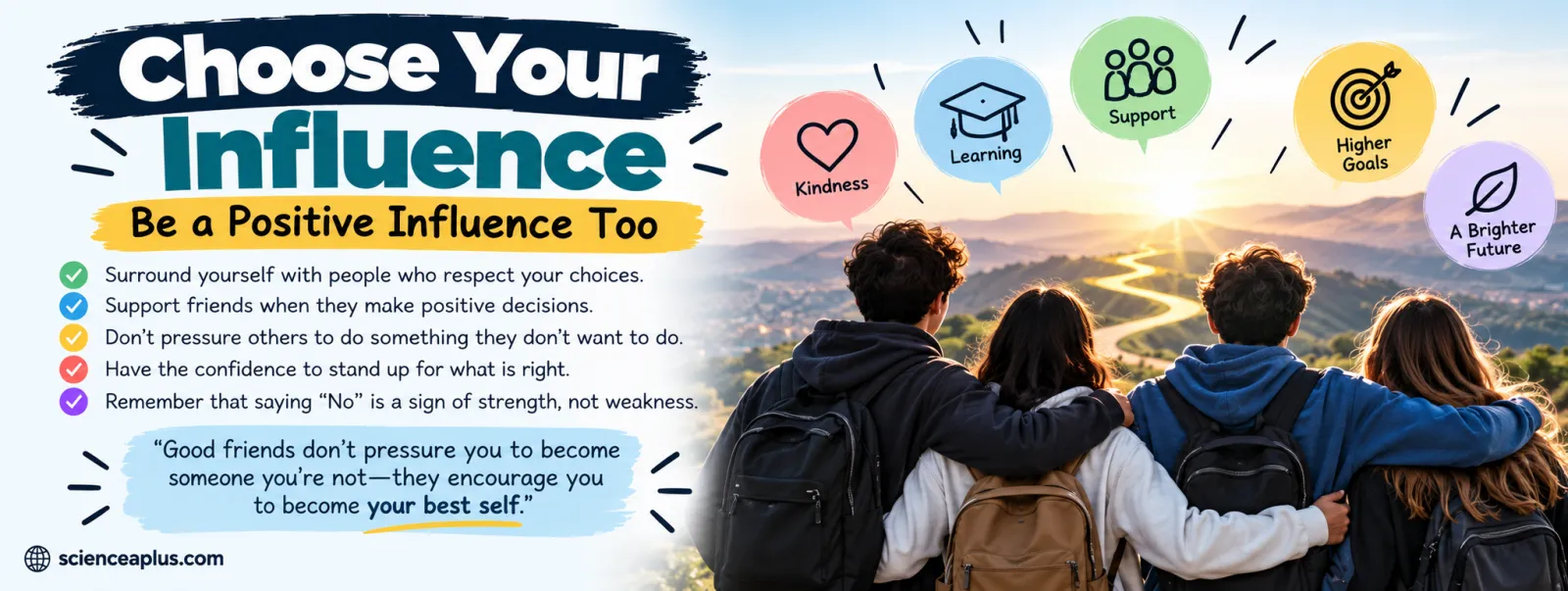
- Surround yourself with people who respect your choices, and respect theirs.
- Support friends when they make positive decisions, even when it is inconvenient.
- Do not pressure others to do something they do not want to do.
- Have the confidence to stand up for what is right.
- Remember that saying "no" is a sign of strength, not weakness.
Setting realistic goals together is another good way to turn friendship into a positive force. And when a friend is going through a hard time, a few kind words matter, so have a look at our ideas for encouraging words for a friend.
Peer pressure online
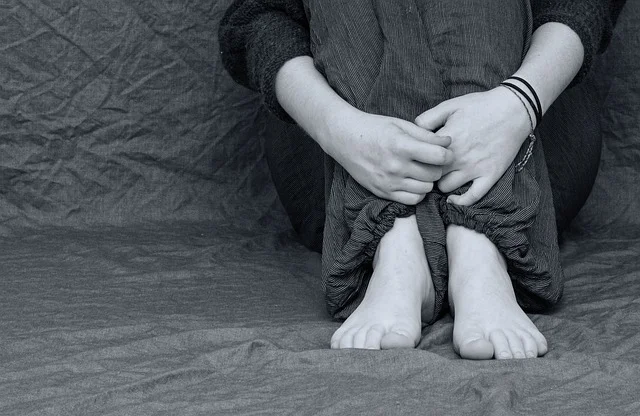
Peer pressure no longer stops at the school gates. Group chats, social media and games mean friends can reach you in the evening, at the weekend and during the holidays. Online pressure can look like pressure to reply instantly, to post a certain kind of picture, to join in with a mean joke, or to take part in a challenge you are not comfortable with. Because everything is visible, likes and comments can make it feel as if you are being measured all the time.
- You are allowed to mute, leave or turn off notifications. A group chat that makes you anxious does not need your attention at midnight.
- Pause before you share. If you would not say it or show it in front of your teacher or grandparent, think twice.
- Remember that feeds are a highlight reel. What you see online is selected, edited and often posed.
- Screenshots last. Anything you send can be passed on, even if the app says it disappears.
If someone is pressuring you to send pictures or messages that you do not want to send, you can say no, block them and tell a trusted adult. You can also contact Childline, who will not judge you.
Peer pressure and stress
Constant pressure to fit in can build up. Young people who feel under pressure from friends can feel stressed, anxious or low, and may sleep badly. If you recognise this, you are not alone and help is available. Learning to manage stress is part of the solution, and our guide to a stress-free life has some useful ideas. Pressure can also come from school and exams. Our article on motivation and study strategies for GCSE shows how to build habits that you own, rather than ones copied from others.
For parents, carers and teachers: how to help
If you are a parent, carer or teacher, the aim is not to control who a young person is friends with. Teenagers who feel judged tend to say less. These approaches are more likely to keep the conversation open.
- Talk early and often, and listen more than you speak. Short, casual chats in the car or while cooking often work better than a "big talk".
- Do not label the friends. Ask about the behaviour instead. "How did you feel when they asked you to do that?" works better than "I don't like those people."
- Practise scripts together. Role-play a refusal. It feels silly, but rehearsal makes it easier in the real moment.
- Offer an exit. A code word or a "call me and I'll come" promise, with no interrogation afterwards, can keep a young person safer.
- Encourage varied friendships and activities. Teams, clubs and volunteering give teenagers more than one social group, and more chances to find supportive friends.
- Model the behaviour. Young people notice how adults deal with pressure from colleagues, neighbours and social media.
- Know when to seek help. If a young person seems withdrawn, anxious, is avoiding school or is involved in risky behaviour, speak to their GP or school, or call NHS 111 for advice.
Where to get help in the UK
| Service | Who it is for | How to contact |
|---|---|---|
| Childline | Anyone under 19, about anything | 0800 1111, free and confidential, open 24 hours; online chat and email at childline.org.uk |
| FRANK | Anyone who wants honest information about drugs | 0300 123 6600 (24/7); text 82111; talktofrank.com |
| NHS 111 or your GP | Health and mental health worries that are not an emergency | Call 111, or contact your GP surgery |
| Samaritans | Anyone who needs someone to listen | 116 123, free, any time |
| Emergency services | Someone is in immediate danger or needs urgent medical help | 999 |
This article is for general education and is not medical advice. If you are worried about your health, safety or wellbeing, or someone else's, speak to a trusted adult, your GP or one of the services above.
Flip cards: what would you do?
Frequently asked questions about peer pressure
What is peer pressure in simple words?
Peer pressure is the influence people your own age have on what you do, say or think. It may be spoken, such as being dared, or unspoken, such as copying what everyone else does. It can be positive, like studying together, or negative, like being pushed to try something unsafe.
What are examples of positive peer pressure?
Positive peer pressure includes friends encouraging you to revise, join a sports team, include someone who is left out, speak up against unkindness, or keep going when something is hard. It leaves you feeling supported and proud, and you can say no without being punished or teased.
What are examples of negative peer pressure?
Negative peer pressure includes being pushed to try alcohol, vapes or drugs, take risky dares, bully or exclude someone, cheat, skip school, or share pictures you are uncomfortable with. The sign to watch for is that saying no leads to teasing, guilt-tripping or being left out.
Why are teenagers more affected by peer pressure?
Friends matter more during adolescence, and, according to a widely used model of adolescent brain development, brain systems for reward develop earlier than self-control areas, which keep maturing into the twenties. Research found that early adolescents took about twice the risk in a driving game when friends were present, while adults showed no change.
What did the Gardner and Steinberg study find?
In 2005, Gardner and Steinberg tested people aged about 14, 19 and 37 on a driving game, alone or with two peers present. With peers, early adolescents took about twice the risk, late adolescents about 50% more, and adults no more. Alone, all ages took similar risks.
What did Asch's conformity experiment show?
Asch's 1951 experiment showed that people sometimes give an answer they know is wrong to match a group. About 32% of critical answers conformed and about 75% of people conformed at least once, but around 25% never did. One person disagreeing greatly reduced the effect.
How do you say no to peer pressure?
Pause, think about whether it could harm you or others, and give a short, calm answer such as "No thanks, I'm good". You can add an excuse, suggest something else or walk away. Having a code word with a trusted adult gives you an easy exit.
Is peer pressure always bad?
No. Peer pressure can be helpful when friends encourage learning, kindness, fitness or courage. The question is whether the influence helps or harms you and others. Many people are influenced in both directions, so the skill is noticing which is which and choosing for yourself.
Who can I talk to about peer pressure in the UK?
You can talk to a parent, carer, teacher or school counsellor. Childline is free and confidential for anyone under 19 on 0800 1111. FRANK gives drug information on 0300 123 6600. For health worries, contact your GP or NHS 111, and call 999 in an emergency.