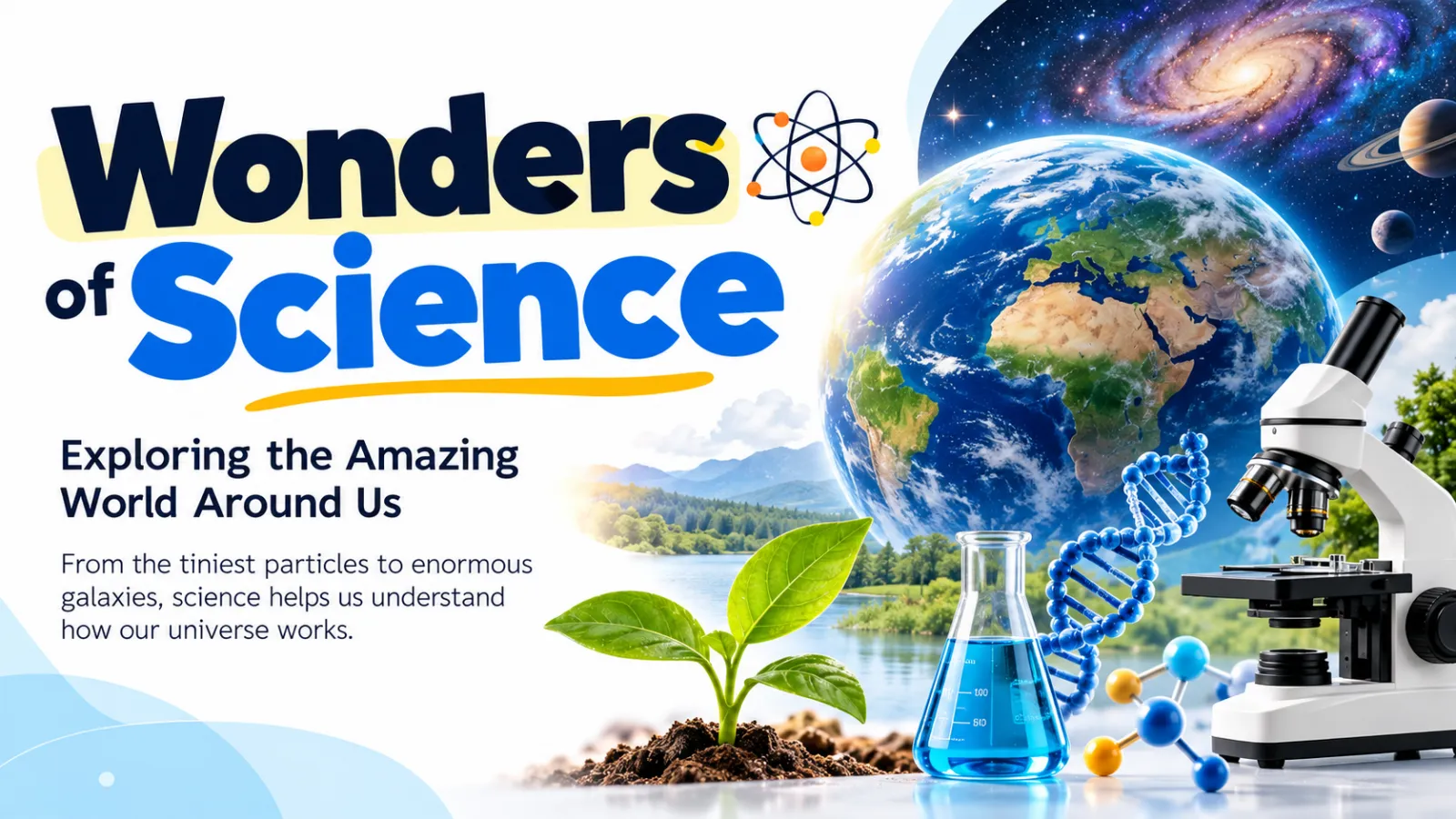
The wonders of science are the discoveries and inventions that changed how we understand the world and how we live in it, from the structure of an atom to the size of the universe. Each one began with a question, careful observation and evidence that others could test.
This guide explains ten of these wonders in plain language, with real numbers you can use in homework or a school essay. Along the way we will look at amazing scientific discoveries in space, biology and medicine, and be honest about their limits and misuse. Model essays and a quiz are at the end.
What are the wonders of science?
There is no official list, so this article picks ten that show science at its best. Together they cover the very large, the very small, living things and human ingenuity:
- The universe
- Atoms
- The human brain
- DNA
- Photosynthesis
- The deep ocean
- The immune system
- Medicine
- Great ideas (Newton, Darwin and Einstein)
- Inventions that changed the world
These wonders of modern science matter because they explain everyday things, such as why we get ill, why plants grow and how a phone finds your location. They also give us tools to solve problems, from disease to climate change.
1. A universe full of wonders
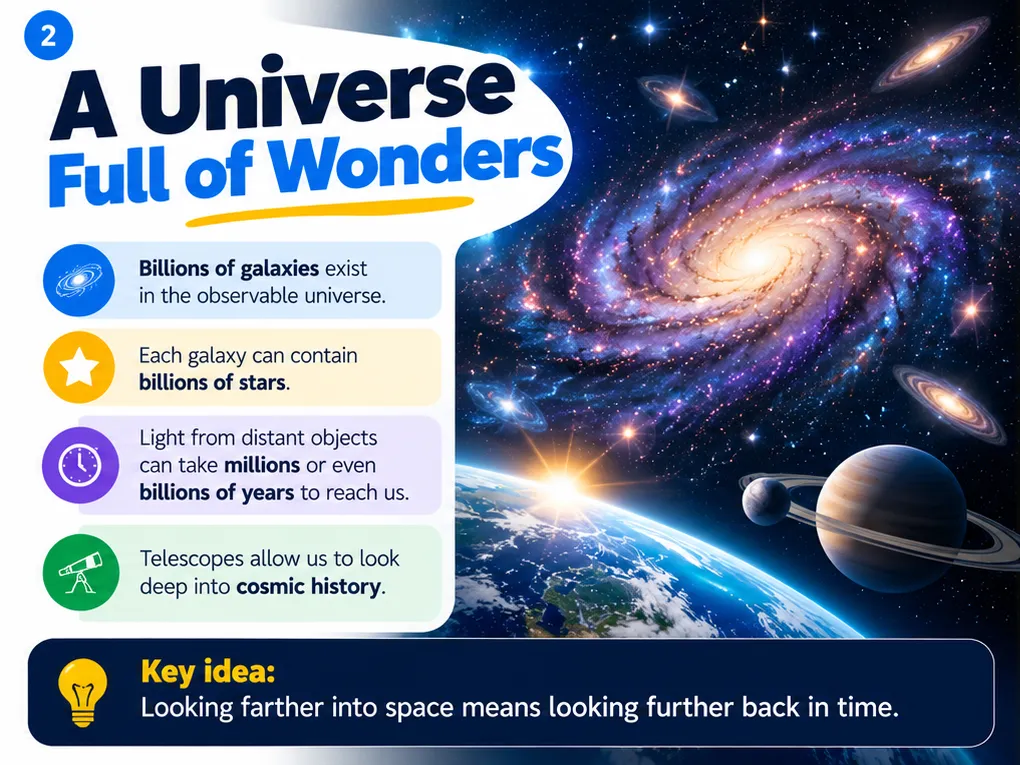
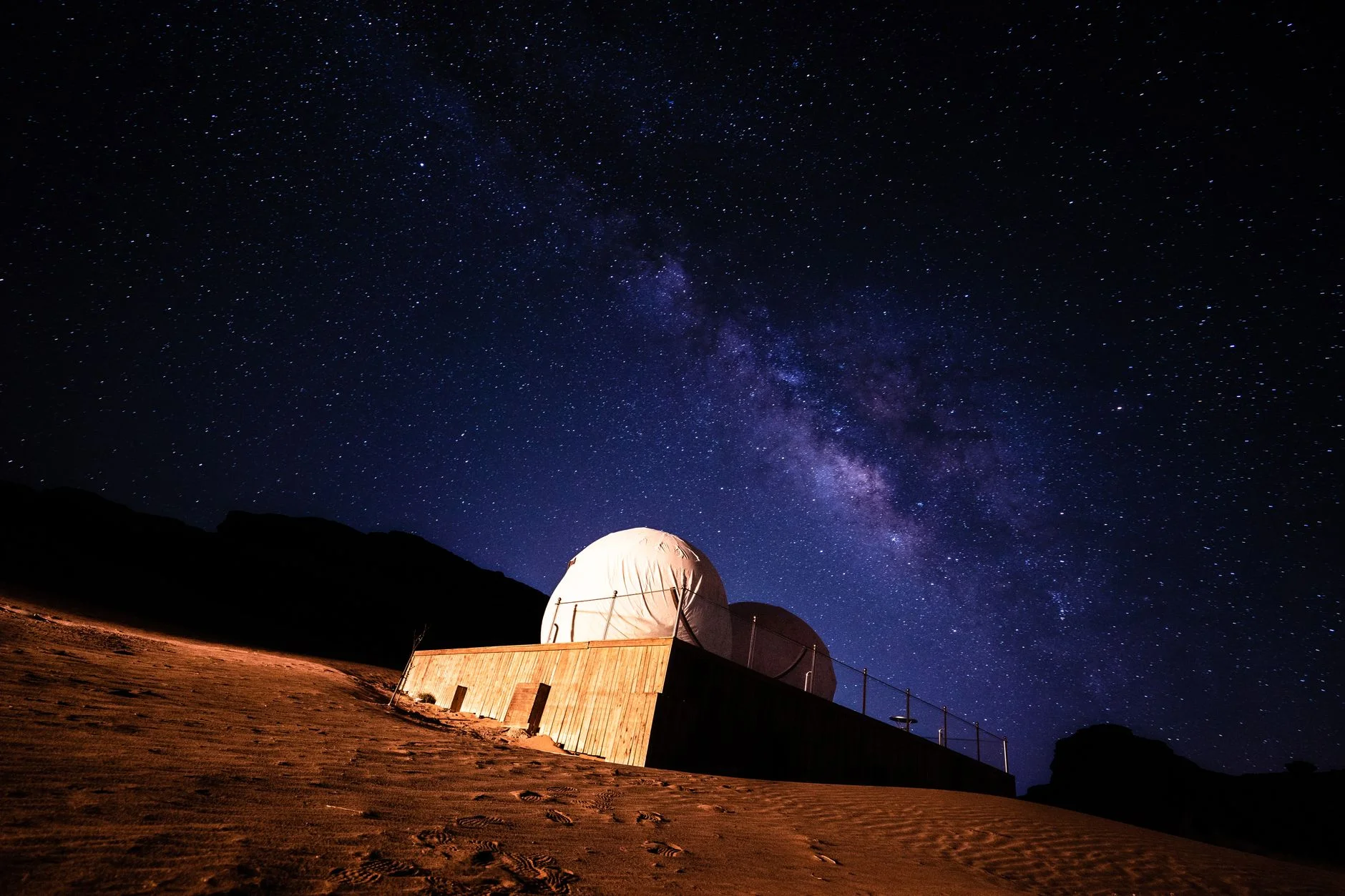
The universe is about 13.8 billion years old. The observable universe contains at least hundreds of billions of galaxies, perhaps more, and our own galaxy, the Milky Way, holds roughly 100–400 billion stars. Many of those stars have planets, and the first planet found orbiting a Sun-like star, 51 Pegasi b, was announced in 1995 by Michel Mayor and Didier Queloz, who shared the 2019 Nobel Prize in Physics. NASA’s count of confirmed exoplanets passed 6,000 in September 2025.
Our best explanation for how it all began is the Big Bang. This is the idea that the universe has been expanding from an extremely hot, dense early state. The evidence is strong: galaxies are moving apart (seen as redshift), the cosmic microwave background was discovered in 1965, and the measured amounts of the lightest elements match predictions. The Big Bang describes how the universe evolved, not what came before it.
The biggest eye on this story is the James Webb Space Telescope, which launched on 25 December 2021. You can read more in our guide to NASA’s Webb telescope, and see how our own neighbourhood formed in the origin of our Solar System.
Looking back in time
Light travels at 299,792 km per second, which is fast but not instant. Moonlight takes about 1.3 seconds to reach us (the Moon is 384,400 km away), and sunlight takes about 8 minutes 20 seconds. A light-year is the distance light covers in a year, roughly 9.46 trillion km.
This means looking far away is the same as looking back in time. Light from a distant galaxy left it long ago, so telescopes show us the universe as it was, not as it is now.
Try the calculator below to see how long light takes to reach us from the Moon, the Sun, Jupiter and Neptune.

2. The invisible world of atoms
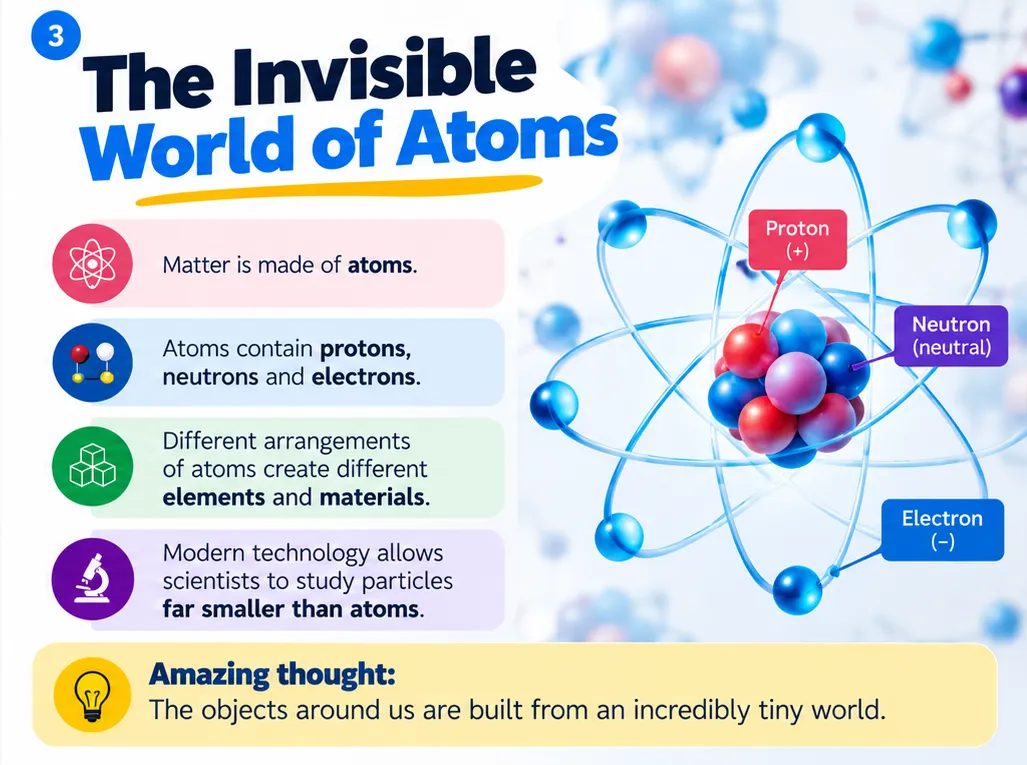
Everything around you is made of atoms. A typical atom is about 0.1 nanometre across (10⁻¹⁰ m), far too small to see even with a normal microscope. Yet an atom is mostly empty space. The nucleus is about 100,000 times smaller than the atom itself. Imagine the nucleus as a pea in the middle of an area 700 m across, with the electrons somewhere out near the edge.
The nucleus holds protons (positive) and neutrons (no charge), while electrons (negative) move around it. The picture came together in stages. J.J. Thomson discovered the electron in 1897, and Ernest Rutherford’s gold-foil experiment (carried out by Hans Geiger and Ernest Marsden in 1909) led him to propose the nuclear atom in 1911.
The number of protons decides the element. Today 118 elements are known, and they are arranged in the periodic table. For more detail, see our guide to the structure of the atom and its sub-atomic particles, or find out which element is the most common in the universe.
3. The human brain
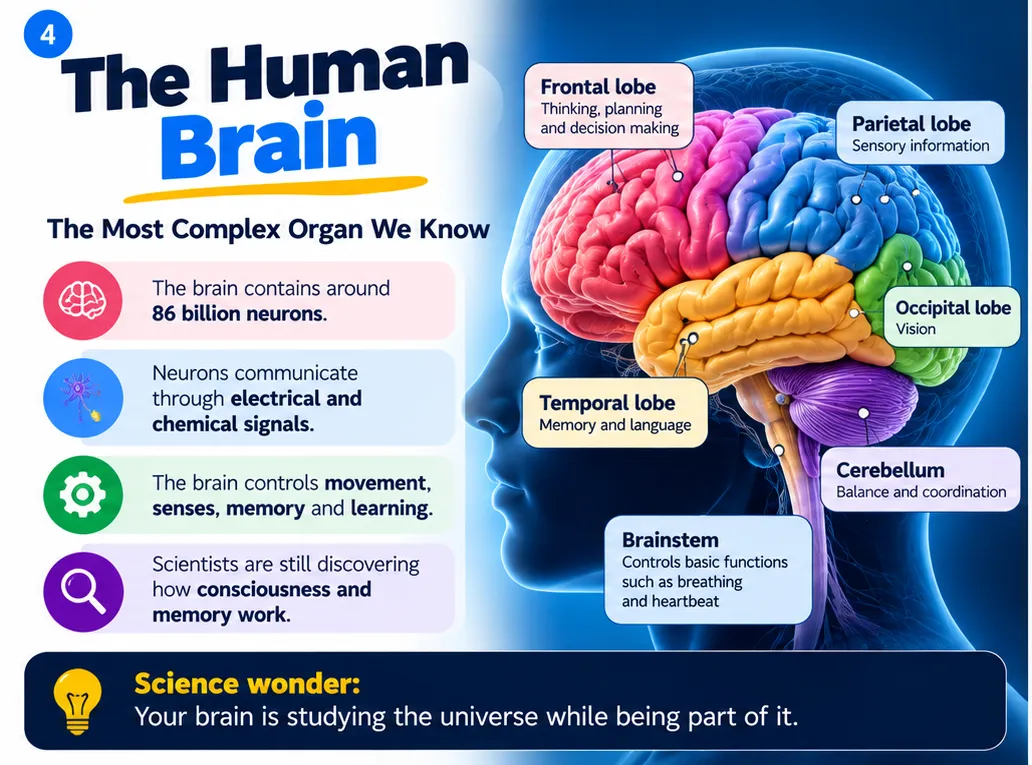
Few wonders of science are closer to home than the organ reading this sentence. An adult brain weighs only about 1.3–1.4 kg, yet it contains about 86 billion neurons, each passing tiny electrical signals to its neighbours.
The brain makes up about 2% of your body mass but uses roughly 20% of the body’s energy at rest. In the fastest nerve fibres, signals travel at up to about 120 m/s, which is roughly 430 km/h.
Think about what that means. Planning your day, catching a ball and remembering a friend’s name all happen because billions of neurons work together in networks. Unlike a computer, the brain has no single “processor”. Its power comes from the connections between cells, and those connections change as you learn.
Different regions handle different jobs. The table below shows the main ones you need to know.
The cerebellum and brainstem are easy to overlook, but they keep you upright and alive without you ever thinking about it. The four lobes of the cerebrum handle the rest.
| Part | Main job |
|---|---|
| Frontal lobe | Planning, decisions and movement |
| Parietal lobe | Touch and other senses |
| Occipital lobe | Vision |
| Temporal lobe | Hearing, memory and language |
| Cerebellum | Balance and coordination |
| Brainstem | Breathing and heart rate |
The energy figure explains why you feel mentally tired after a long exam. Thinking is real work for the body, and the brain needs a steady supply of fuel and oxygen to keep its neurons firing.
4. DNA: the code of life
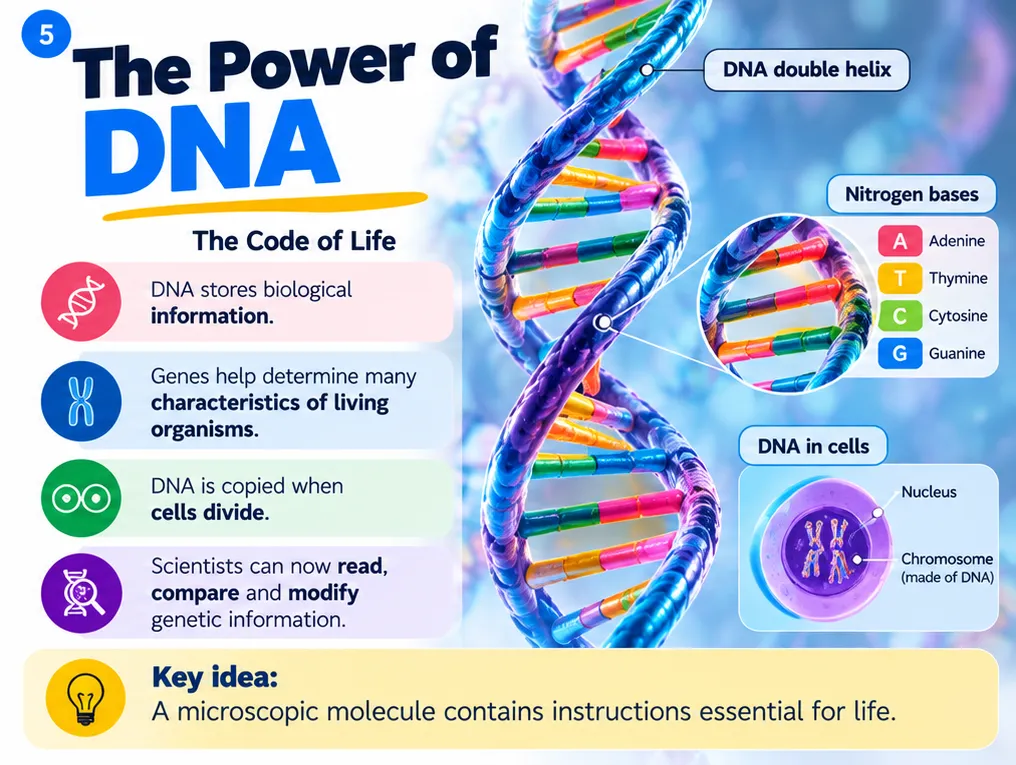
Every instruction for building a human being is written in DNA. In 1953 James Watson and Francis Crick published the double helix structure, building on X-ray images by Rosalind Franklin (the famous Photo 51, taken with Raymond Gosling) and work by Maurice Wilkins. Without Franklin’s images, the structure might have taken much longer to solve.
The double helix is like a twisted ladder. The rungs are made of pairs of bases, and the pairing is always the same: A with T, and C with G. That strict rule is why DNA can be copied accurately before a cell divides.
The numbers are staggering. The human genome is about 3 billion base pairs long and includes roughly 20,000 protein-coding genes. If you stretched out the DNA from a single human cell, it would measure about 2 metres.
Reading the code took decades. The Human Genome Project was declared complete in 2003, although only about 92% had been sequenced. The first truly complete, gap-free human genome was published in 2022 by the T2T Consortium. For the full vocabulary, see our page on DNA, RNA, mitosis and meiosis.
Knowing the code has practical uses. Doctors can look for gene changes linked to inherited conditions, forensic scientists can match DNA from a sample to a person, and plant scientists can study the genes of crops. Because DNA is copied before every cell division, copying errors matter, and the strict base-pairing rule is what keeps most copies accurate.
This is one of the most useful of the amazing scientific discoveries, because it feeds into medicine, forensics and crop science.
Each fact above is a reminder that these discoveries were made by people asking careful questions and testing their ideas. Watson and Crick, Franklin, Wilkins and Gosling each added a piece, which is how science usually works: many people, one growing picture, checked again and again.
5. Photosynthesis: powered by the Sun
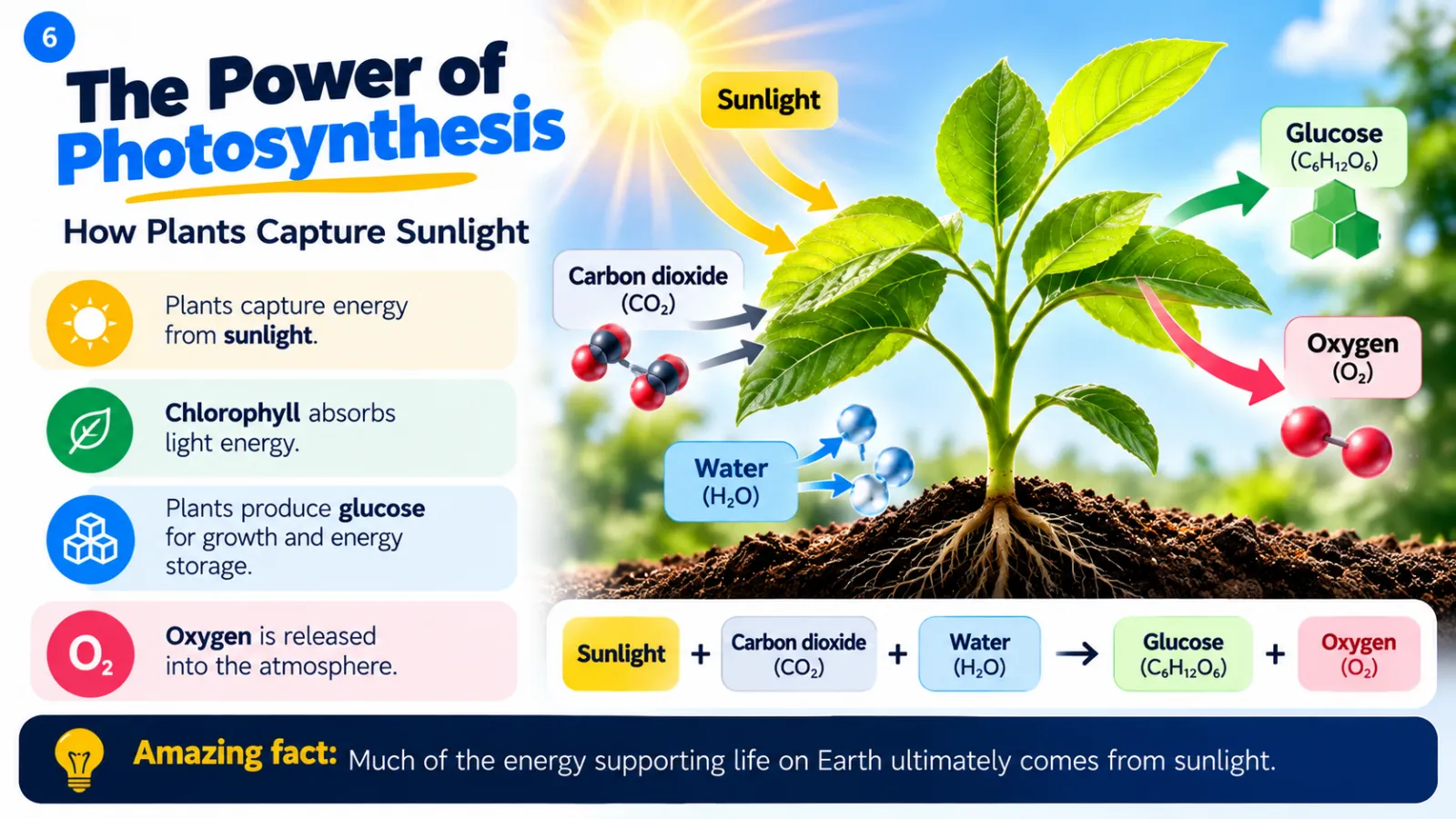
Plants, algae and some bacteria turn light into food. In photosynthesis, carbon dioxide and water are converted into glucose and oxygen, using light energy absorbed by chlorophyll in the chloroplasts.
carbon dioxide + water → glucose + oxygen
6CO₂ + 6H₂O → C₆H₁₂O₆ + 6O₂
Almost all food chains start with photosynthesis, so nearly every meal you eat can be traced back to it. Scientists estimate that roughly half of Earth’s oxygen production comes from the ocean, mostly from phytoplankton (NOAA). Forests are not the whole story. Our full guide to photosynthesis covers the stages and the limiting factors.
Why does this count among the great wonders of modern science? Because it links the Sun, the air, the oceans and your lunch in a single reaction. Every breath of oxygen you take is a by-product of it, and every plant, from a blade of grass to a giant tree, depends on the same simple equation. Chlorophyll is the pigment that absorbs the light, which is why it sits inside the chloroplasts where the reaction happens.
6. The deep ocean
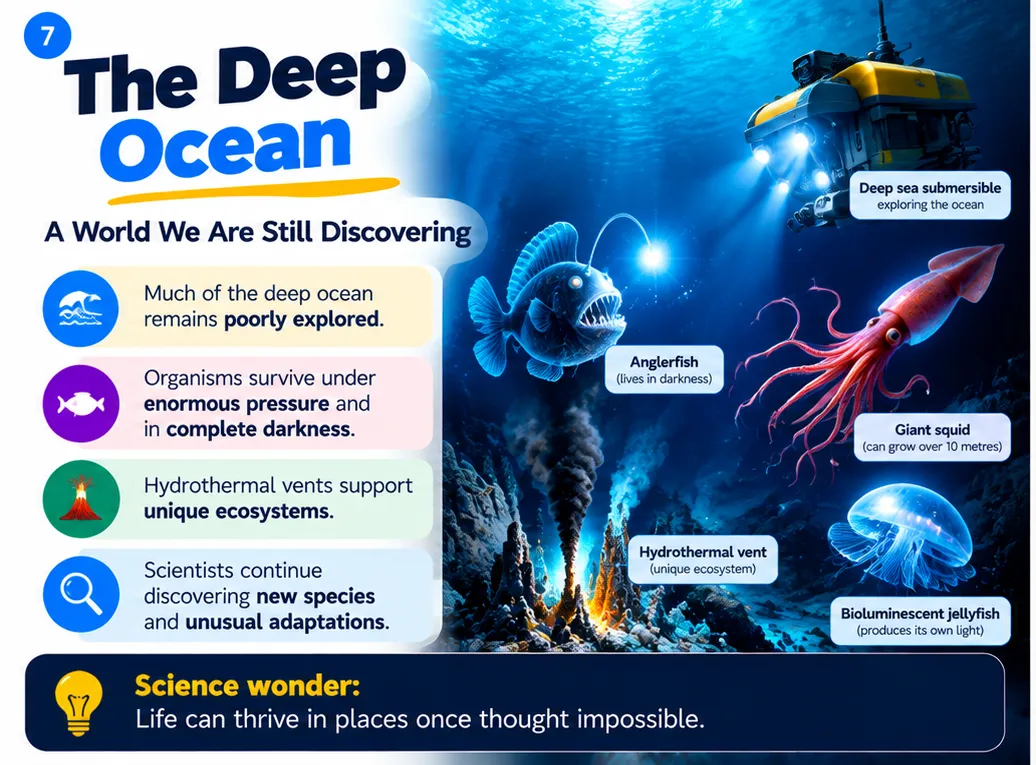
The deep ocean is one of the greatest wonders of science because we know so little about it. The Challenger Deep, in the Mariana Trench, is roughly 10,900–11,000 m deep (often quoted as about 10,935 m). The pressure at the bottom is more than 1,000 times the atmospheric pressure at the surface, which is why only specially built submersibles can go there.
It is also far less explored than most people expect. Only about 29% of the seabed (28.7% in April 2026) has been mapped to modern standards, a gap that the Seabed 2030 project is working to close. We have better maps of some other worlds than of parts of our own ocean floor.
Life without sunlight
In 1977 the submersible Alvin found hydrothermal vents on the Galápagos Rift. Whole ecosystems live around them, powered not by sunlight but by chemosynthesis: bacteria make food using energy from chemicals in the hot vent water. This changed ideas about where life can exist, and it matters for how scientists think about life on other worlds.
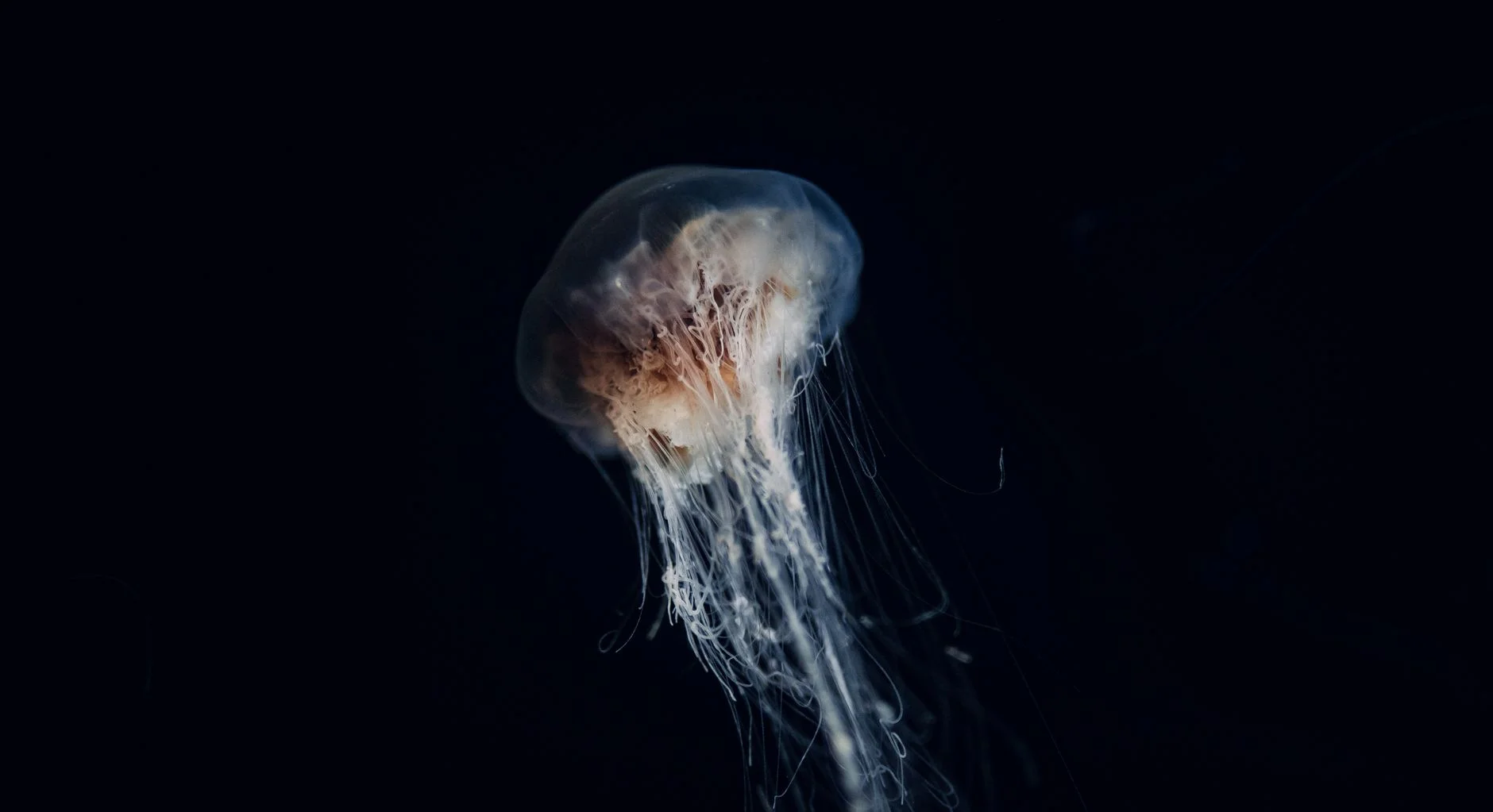
Deep-sea animals have strange adaptations. The giant squid can reach about 12–13 m long, yet it was first filmed alive in its deep-sea habitat only in 2012. A 2017 study of deep-sea video from Monterey Bay, California, found that about 76% of the animals seen in the water column can make their own light, a trick called bioluminescence.
Food chains in the sea still begin with photosynthesis in sunlit surface waters, then stretch down into the dark. To see how energy passes from plankton to the top predators, read our guide to ocean food chains and food webs.
7. The immune system
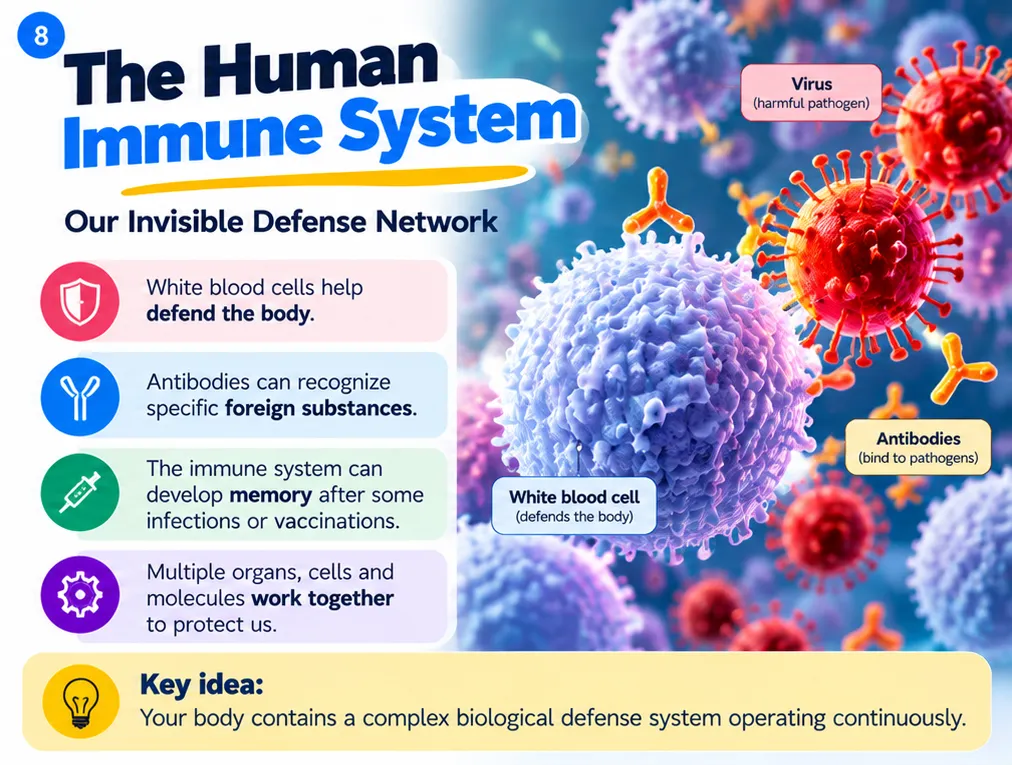
Every day your body meets bacteria, viruses and fungi. Your immune system deals with nearly all of them without you noticing. Its first line of defence is a set of barriers, such as skin, and chemical defences, such as stomach acid. If a pathogen gets past these, white blood cells take over.
There are two main kinds of white blood cell. Phagocytes engulf pathogens and digest them. Lymphocytes make antibodies, proteins that are specific to one antigen, the marker on the surface of a pathogen. The first time you meet a new pathogen the response is slow. Memory cells then stay in the body, so the next time the response is much faster. This is the idea behind vaccines.
For the full story of how these cells work together, see our guide to the basics of the human immune system.
8. Wonders of medicine

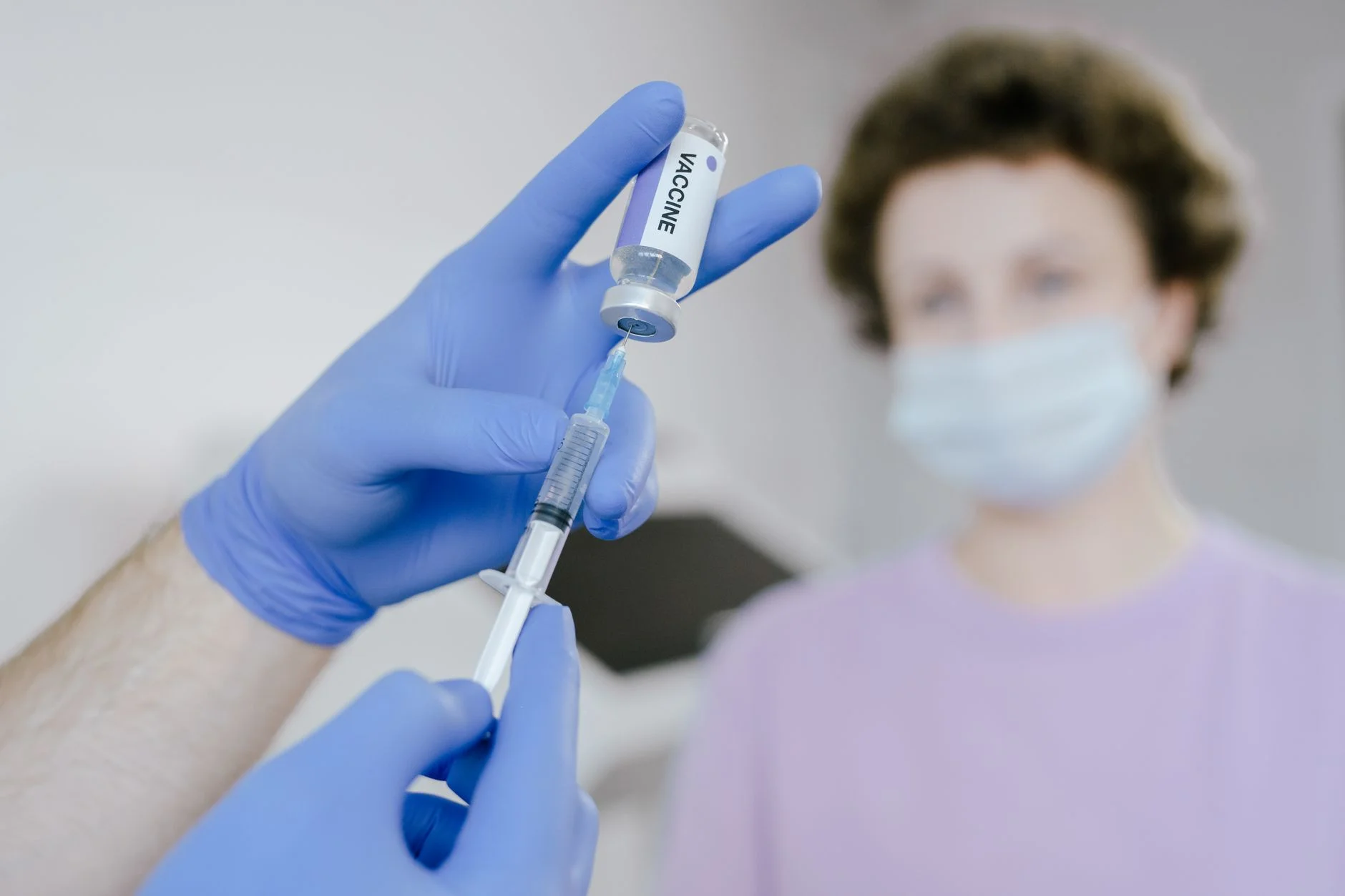
The wonders of medicine are the part of science most of us feel directly. They began with vaccination. In 1796 Edward Jenner developed a smallpox vaccine, and in 1980 the World Health Organization declared smallpox eradicated. The WHO estimates that vaccines now prevent about 3.5–5 million deaths every year. If you want to understand the worries some people have, our article on vaccine hesitancy explains the science calmly.
Other discoveries followed. Wilhelm Röntgen discovered X-rays in 1895, which let doctors see inside the body without surgery. In 1928 Alexander Fleming noticed penicillin, and in the 1940s Howard Florey and Ernst Chain turned it into a medicine, sharing a Nobel Prize in 1945. In 1954 surgeons in Boston carried out the first successful human kidney transplant. Modern scans build on these ideas to show organs in great detail.
The catch: antibiotic resistance
Medicine also shows why science needs care. When antibiotics are overused, bacteria evolve so that the drugs no longer kill them. This is antimicrobial resistance. Bacterial resistance was directly responsible for an estimated 1.27 million deaths worldwide in 2019, according to a study in The Lancet.
The solution is also scientific: new drugs, better diagnosis and using antibiotics only when a doctor prescribes them. If you have symptoms that worry you, speak to a GP or call NHS 111.
9. Big ideas that changed how we think
Some of the greatest amazing scientific discoveries are not objects at all. They are ideas that changed the questions people ask. A handful of them explain an enormous amount of the world around us.
- 1687: Isaac Newton publishes the Principia, setting out the laws of motion and gravity. The same rules describe a falling apple and an orbiting planet.
- 1858–1859: Alfred Russel Wallace (1858) and Charles Darwin (On the Origin of Species, 1859) put forward natural selection as the mechanism of evolution.
- 1905: Albert Einstein publishes special relativity.
- 1915: Einstein publishes general relativity, a new theory of gravity.
- 2012: The Higgs boson is discovered at CERN’s Large Hadron Collider.
- 2015: LIGO makes the first detection of gravitational waves, on 14 September (announced in 2016).
Each idea followed the same pattern. Someone noticed that the old explanation did not fit the evidence, proposed a better one and invited others to test it. Newton’s laws held for more than two centuries before Einstein’s theories refined them for extreme situations. That is how science works: ideas are kept only while the evidence supports them.
The Higgs boson and gravitational waves show the pattern still continues. Both were predicted by theory long before anyone could detect them. Building the Large Hadron Collider and LIGO took years of international cooperation, and each result confirmed a prediction that physicists had been testing for decades.
Why relativity matters in daily life
Relativity can sound like pure theory, yet it affects your phone. GPS satellites must correct for the effects of relativity, otherwise the positions they calculate would drift. It is a neat example of a wonder of modern science doing practical work.
Some big questions are still open. If you enjoy that edge of knowledge, read our guide to dark energy in the universe.
10. Inventions that changed the world
Discoveries become inventions that changed the world when people turn them into tools. Each one in the table below made information, health or travel easier for millions of people.
| Invention | Year | Why it mattered |
|---|---|---|
| Printing press (Johannes Gutenberg) | c. 1440 | Books became cheaper, so knowledge spread far faster. |
| Improved steam engine (James Watt) | 1760s–1770s | Reliable power for factories and, later, transport. |
| Telephone (Alexander Graham Bell, patented) | 1876 | Voices could travel over long distances. |
| X-rays (Wilhelm Röntgen) | 1895 | Doctors could see inside the body without surgery. |
| Apollo 11 Moon landing | 20 July 1969 | The first humans on the Moon, an achievement of engineering and teamwork. |
| World Wide Web (Tim Berners-Lee, at CERN) | 1989 | A simple way to share and link information across the internet. |
| International Space Station | Occupied since November 2000 | A permanent laboratory in orbit, continuously occupied. |
Voyager 1, launched in 1977, entered interstellar space in 2012. For the full story of rockets, telescopes and satellites, see our guide to exploring the universe.
Notice how the inventions connect. The printing press spread the ideas behind the Scientific Revolution, the steam engine powered the factories that made scientific instruments, and the telephone paved the way for global communication. The World Wide Web, invented at CERN in 1989, was created so that scientists could share information more easily. It later changed the lives of people far outside physics.
Spaceflight combines many of these steps. Apollo 11 landed on the Moon on 20 July 1969, and the ISS has been continuously occupied since November 2000. Both depended on advances in materials, computing and communication built by thousands of people over many years.
Is science a blessing or a curse?
This is one of the most common essay questions, and the honest answer has two sides. Science is a tool. Its effects depend on what people choose to do with it.
On the negative side, burning fuels and dumping waste cause pollution. Scientific knowledge has been used to build weapons. Misinformation can spread quickly on the same web that shares good information. Antibiotics are also losing strength because of overuse: bacterial resistance was directly responsible for an estimated 1.27 million deaths worldwide in 2019.
On the positive side, vaccines prevent an estimated 3.5–5 million deaths every year, according to the WHO. Smallpox was declared eradicated in 1980. Science also provides the measurements and technology needed to track pollution and look for solutions.
Wonders of science essay (about 100 words)
Science has transformed life. It has shown us that the universe is about 13.8 billion years old, that atoms are mostly empty space and that the human brain contains about 86 billion neurons, more than we can imagine. Vaccines and antibiotics save lives, while the printing press, the telephone and the World Wide Web connect people everywhere. Science also brings problems, such as pollution and antibiotic resistance, so we must use it wisely. Even so, the wonders of science remain a great human adventure, because every answer leads to a new question and a new chance to improve the world for everyone.
Wonders of science essay (about 250 words)
The wonders of science are all around us, from the stars overhead to the cells inside us. Over several centuries, careful observation and experiments have replaced guesswork with evidence. Scientists have shown that the universe is about 13.8 billion years old and that light from the Sun takes about eight minutes to reach Earth. Looking at distant galaxies is therefore like looking back in time, which is a remarkable idea for any student to explore.
Science has also changed daily life in ways we rarely notice. The structure of DNA, published in 1953, led to modern genetics, and the human genome contains about three billion base pairs. Edward Jenner’s smallpox vaccine in 1796 began a path that ended with smallpox being declared eradicated in 1980. Alexander Fleming’s discovery of penicillin in 1928 gave doctors a way to treat bacterial infections. Inventions such as the printing press, the telephone and the World Wide Web have made it easier to share ideas, while Apollo 11 in 1969 showed what teamwork and careful engineering can achieve.
Science is not perfect, and people can sometimes misuse what it gives them. Pollution, weapons and antibiotic resistance are serious problems, and some of them were caused by human choices rather than by science itself. The same curiosity that helped create these problems also gives us the tools to measure them and to look for answers. For me, the greatest wonder of science is not one discovery but the method itself: ask a question, test it, share the results and be willing to change your mind.
Frequently asked questions about the wonders of science
What are the wonders of science?
The wonders of science are discoveries and inventions that changed how we understand or live in the world. They include the universe, atoms, the brain, DNA, photosynthesis, the deep ocean, the immune system, medicine, great scientific ideas and inventions such as the printing press and the World Wide Web.
What is the greatest wonder of science?
There is no single agreed answer, which makes it a good essay topic. Many people choose DNA, vaccines or the structure of the universe. A strong answer picks one wonder, gives evidence such as dates and numbers, and explains why it matters more than the alternatives.
How do I write an essay on wonders of science?
Choose three or four wonders, write down a key fact for each, and plan an introduction, body and ending. Use specific evidence, include one risk or limit of science for balance, and finish with your own view. Keep paragraphs short and proofread carefully.
What are 10 wonders of science?
This guide covers ten: the universe, atoms, the human brain, DNA, photosynthesis, the deep ocean, the immune system, medicine, great ideas by scientists such as Newton, Darwin and Einstein, and inventions that changed the world. You can swap in others, such as space exploration, in your own list.
What are the wonders of science in daily life?
Science shows up in vaccines, antibiotics and X-rays, in phones that use GPS, and in the World Wide Web. It also explains everyday things, such as why plants make the oxygen we breathe through photosynthesis and how your brain controls movement, breathing and memory.
Is science a blessing or a curse?
It is a tool that can be used well or badly. Vaccines prevent an estimated 3.5–5 million deaths every year, yet pollution, weapons and antibiotic resistance are real problems. Most people conclude that science is a blessing when it is used responsibly and guided by good ethics.
What are the wonders of biology?
Biology’s wonders include DNA, which carries instructions in a double helix of about 3 billion base pairs, and the brain with about 86 billion neurons. Photosynthesis, the immune system and the life around deep-sea hydrothermal vents, which runs on chemosynthesis rather than sunlight, are also remarkable.
What are the wonders of medicine?
Key wonders of medicine include vaccines, which led to smallpox being declared eradicated in 1980, and antibiotics such as penicillin, noticed by Alexander Fleming in 1928. X-rays, discovered in 1895, and the first successful human kidney transplant in 1954 also changed healthcare.
What are the wonders of space exploration?
Highlights include the Apollo 11 Moon landing on 20 July 1969, Voyager 1 entering interstellar space in 2012, and the International Space Station, continuously occupied since November 2000. The James Webb Space Telescope, launched on 25 December 2021, and the discovery of thousands of exoplanets continue the story.