Critical thinking is the careful judging of claims, evidence and arguments before you decide what to believe or do. Logical thinking is reasoning in clear, ordered steps so that each conclusion follows from the statements before it. The two overlap heavily, which is why people mix them up. Logic is the tool that checks whether an argument holds together. Critical thinking is the wider habit of asking whether the argument deserves your trust at all.
What is critical thinking?
A widely used definition describes critical thinking as the intellectually disciplined process of actively and skilfully conceptualising, analysing and evaluating information gathered from observation, experience, reflection, reasoning or communication. In plain English: you gather information, test it, and only then decide.
The American philosopher John Dewey, who wrote How We Think, called this “reflective thinking”, an early version of what we now call critical thinking. Later work by expert panels listed the skills involved: interpretation, analysis, inference, evaluation, explanation and self-regulation (checking and correcting your own thinking). The same lists include spotting unstated assumptions and drawing conclusions that the evidence actually warrants.
That list matters because it shows critical thinking is a set of skills, not a personality type. You can be a sharp critical thinker about a science report and a poor one about a message in your own group chat. The skills transfer only if you practise them in many settings. Our guide to why critical thinking is important covers the everyday payoff.
What is logical thinking?
Logical thinking is the part of reasoning that follows rules. You start from premises (statements you accept for the sake of the argument) and move to a conclusion through steps that can be checked. If you can write the steps down and someone else can follow them, the thinking is logical.
Logic cares about structure. “All metals conduct electricity; copper is a metal; so copper conducts electricity” works because of its shape, whatever the topic. Swap in nonsense words and the shape still holds. That is both logic’s strength and its limit: the rules can tell you whether a conclusion follows, but they cannot tell you whether the starting statements are true.
Critical thinking vs logical thinking: the differences
Think of logic as one instrument and critical thinking as the whole orchestra. Critical thinking uses logic, but it also asks questions that logic alone cannot answer: Who made this claim? What evidence do they have? What are they leaving out? Is there another explanation?
| Question | Logical thinking | Critical thinking |
|---|---|---|
| Main job | Check that conclusions follow from premises | Judge whether claims and evidence deserve belief |
| Typical question | “Does this step follow from the last?” | “How do we know this is true, and who says so?” |
| Deals with | Arguments, patterns, rules, structure | Evidence, sources, assumptions, bias, context |
| Can it be wrong? | Yes, when the structure is faulty (a fallacy) | Yes, when evidence is ignored or weighed badly |
| Example | Working out which of four statements must be true in a puzzle | Deciding whether a newspaper claim about a “miracle” diet is reliable |
Neither is better. A perfectly logical argument built on a false premise still gives a false conclusion. A well-researched claim presented in a muddled, self-contradicting way is hard to trust. You need both.
Where creative thinking fits in
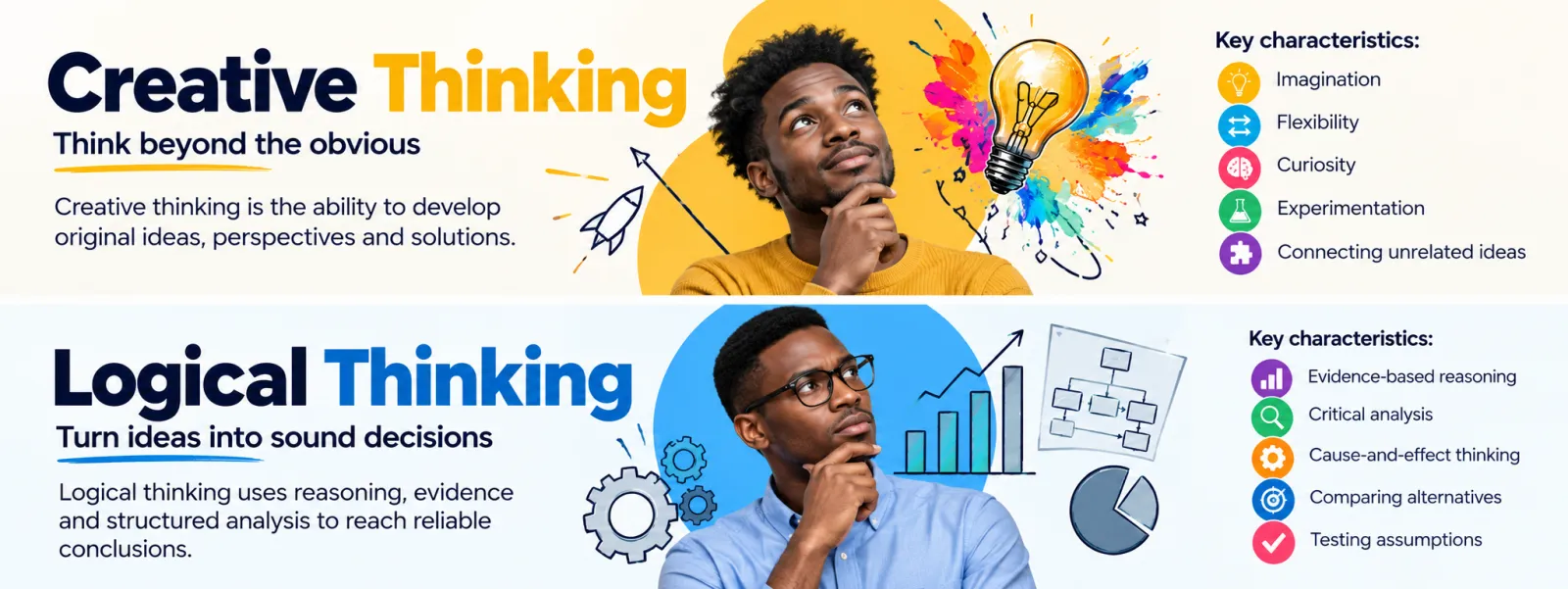
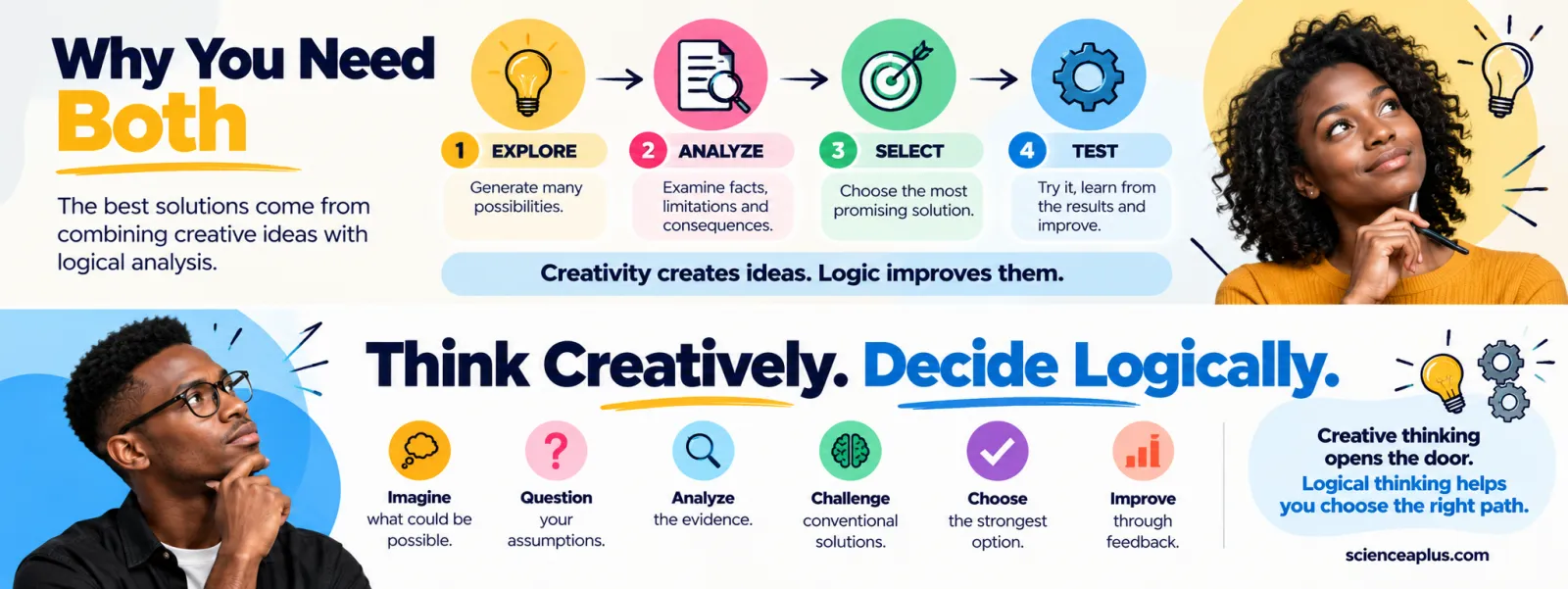
The old version of this article compared creative and logical thinking, and the comparison is still useful. Creative thinking produces options: new ideas, new angles, unexpected links between unrelated things. Logical and critical thinking then test those options and choose between them. Creativity opens up the possibilities; analysis narrows them down.
Real problem-solving moves back and forth. You generate several ideas, examine the facts and consequences of each, pick the most promising, try it and learn from the result. If it fails, you go back to generating ideas with more information than before. Scientists work like this when they invent a new experiment (creative) and then work out whether its results really support their hypothesis (critical).
Creative thinking has its own methods. If you want to practise the idea-generating half, see why lateral thinking is worth practising and the hands-on exercises in these lateral thinking basics. This article concentrates on the checking half.

Strengths and limits of each way of thinking
Each approach has real strengths and real traps. Knowing the traps helps you decide which gear you need.
Critical thinking
- Strengths: it helps you weigh evidence, question assumptions, notice biases and reach conclusions you can defend.
- Traps: it can slow you down. Checking everything forever is not practical, and doubting every claim equally is not the same as judging them well. Good critical thinkers decide how much checking a decision deserves.
Logical thinking
- Strengths: it makes reasoning clear and checkable, which helps in maths, computing, law, science and everyday arguments.
- Traps: it depends on the premises you start with, and it will not invent new ideas for you. It can also look convincing while hiding a false assumption.
Creative thinking
- Strengths: it generates original options and fresh ways to look at a problem.
- Traps: ideas can be unrealistic if nobody tests them, and creativity is harder to measure than a correct answer.
The next sections build the logical toolkit step by step, starting with the three main types of reasoning.
Three kinds of reasoning: deductive, inductive and abductive
Critical thinking draws on three main forms of reasoning. Each answers a different kind of question, and each can be strong or weak. Knowing which one you are looking at tells you how to test it.
Deductive reasoning: from rules to certainty
Deduction starts with general statements and works out what must follow. If the premises are true and the form is valid, the conclusion is guaranteed.
- All metals conduct electricity.
- Copper is a metal.
- So copper conducts electricity.
Deduction does not add new information beyond what the premises already contain. Its power is certainty. Mathematical proofs are deductive, and so are the predictions scientists derive from a hypothesis: if this idea is true, then this result should appear in the experiment.
Inductive reasoning: from examples to a likely rule
Induction goes the other way. You collect observations and propose a general pattern. Every sample of a pure substance you have tested melts at a fixed temperature, so you expect the next one to do the same.
The conclusion is only probable, never certain, because a new observation might break the pattern. People once believed that all swans were white because every swan they had seen was white. One sighting of a black swan was enough to overturn the rule. The strength of an inductive argument depends on how many examples you have, how varied they are and whether they were chosen fairly.
Most of science works by induction followed by deduction: observe, propose a pattern, predict, test. The steps are laid out in our guide to how to use the scientific method.
Abductive reasoning: the best explanation
Abduction starts with a surprising observation and asks, “What would best explain this?” The American philosopher Charles Sanders Peirce is usually credited with the term. It is often called inference to the best explanation.
Imagine you come home and the grass is wet. It might have rained, a neighbour’s sprinkler might have been on, or someone might have used a hose. You look for more clues: are the pavements wet too? Is the ground dry under the tree? You choose the explanation that fits all the evidence best, and you stay ready to change your mind. Doctors, detectives and scientists all do this.
| Type | Direction | Conclusion is… | Everyday example |
|---|---|---|---|
| Deductive | General rule → specific case | Certain, if valid and premises true | “The shop shuts at 5 p.m. It is 6 p.m., so it is shut.” |
| Inductive | Specific cases → general pattern | Probable | “The bus has been late three Mondays running, so it will probably be late next Monday.” |
| Abductive | Surprising fact → best explanation | Plausible, open to revision | “My phone is dead, so I probably forgot to charge it.” |


Valid vs sound arguments
These two words are the most useful vocabulary in logic, and they are often confused. They apply to deductive arguments.
- An argument is valid if it is impossible for the premises to be true and the conclusion false. Validity is about the structure.
- An argument is sound if it is valid and all its premises are actually true.
So validity is a test of the reasoning, and soundness is a test of the reasoning plus the facts. Compare these three arguments.
- Valid and sound: All mammals are vertebrates. A dolphin is a mammal. So a dolphin is a vertebrate.
- Valid but unsound: All birds can fly. A penguin is a bird. So a penguin can fly. The structure is perfect, but the first premise is false, so the conclusion cannot be trusted.
- Invalid: If it rained, the pavement is wet. The pavement is wet. So it rained. The conclusion might be true, but it does not follow: a burst pipe or a street-cleaning lorry would also make the pavement wet.
The third example has a name: affirming the consequent. It is a classic invalid form, and it appears in everyday life constantly (“If the medicine works, I will feel better. I feel better, so the medicine worked.”). Feeling better could have other causes, which is exactly why medical trials use control groups.
Strong and weak arguments (for induction and abduction)
Inductive and abductive arguments are not called valid or invalid, because they never guarantee the conclusion. Instead we call them strong or weak, and a strong argument with true premises is sometimes called cogent.
Check these four things when you judge an inductive argument:
- Sample size: three examples are not enough to describe a whole population.
- Sample variety: were the examples chosen fairly, or only from one place or group?
- Counter-examples: did anyone look for cases that break the pattern?
- Alternative explanations: could something else produce the same pattern?
The last point is why a claim that sounds scientific can still be weak. Beliefs that avoid testing or ignore counter-examples are discussed in our article on what pseudoscience is.
Try it: reveal the answers
Decide your answer first, then tap to check.
Is this argument valid? “All footballers are fit. Maya is fit. So Maya is a footballer.” (2 marks)
No, it is invalid. The first premise says footballers are fit, not that only footballers are fit. Maya could be fit because she swims or runs, so the conclusion does not follow even if both premises are true.
Is this argument valid and sound? “All planets in the Solar System orbit the Sun. Mars is a planet in the Solar System. So Mars orbits the Sun.” (2 marks)
It is both. It is valid because the conclusion must follow from the premises, and it is sound because both premises are true. Change the second premise to “Pluto is a planet in the Solar System” and the argument stays valid but becomes unsound, because Pluto is classed as a dwarf planet.
Which type of reasoning is this? “Every time I have eaten peanuts I have had a rash, so I probably have an allergy.” (1 mark)
Inductive (or abductive): it moves from repeated observations to a probable general conclusion. It is not deductive, because the conclusion is not guaranteed. In real life a doctor would test the idea rather than rely on the pattern alone.
Common logical fallacies, with examples
A fallacy is a flaw in reasoning that makes an argument look stronger than it is. Some fallacies break the logical structure (formal fallacies, like affirming the consequent). Others are informal: the argument may look fine, but it dodges the real issue or relies on something irrelevant. Spotting them is one of the quickest ways to improve your critical thinking.
Here are eight you will meet every week. Try to work out the flaw before you flip each card.
Two more worth knowing: hasty generalisation (drawing a broad rule from a tiny sample, such as “my two cousins hate maths, so teenagers hate maths”) and affirming the consequent, which you met earlier.

Cognitive biases: why clever people still make mistakes
A fallacy is a flaw in an argument. A cognitive bias is a systematic tendency in the way our minds handle information, so it affects the thinker before an argument is even made. Psychologists have studied many biases in experiments that have been repeated and discussed for decades. Four of the best-known are below.
Confirmation bias
We tend to look for, notice and remember information that fits what we already believe. In 1960 the psychologist Peter Wason gave people a number-sequence puzzle (the “2-4-6 task”). The secret rule was simply “any ascending sequence”, but most people guessed a narrower rule, such as “add two each time”, and tested it only with examples that fitted. They rarely tried a sequence that could prove them wrong. Wason’s work is where the term confirmation bias comes from.
In a 1979 study by Lord, Ross and Lepper, people with strong views for or against the death penalty read descriptions of two (invented) studies. They rated the study that matched their opinion as better done and picked holes in the one that did not. Same evidence quality, different judgement.
Anchoring
The first number we see can pull later estimates towards it. In a 1974 experiment by Amos Tversky and Daniel Kahneman, a wheel of fortune stopped on either 10 or 65. People were then asked what percentage of African countries are members of the United Nations. The typical guess of those who saw 10 was about 25%; for those who saw 65 it was about 45%. The wheel was obviously irrelevant, yet it still shifted the answers.
Availability
We judge how common something is by how easily examples come to mind. In 1973 Tversky and Kahneman asked people whether more English words begin with the letter K or have K as the third letter. Most chose “begin with K”, but in fact K is more common as the third letter. Words starting with K are simply easier to recall. In the same way, dramatic news stories, such as shark attacks, make rare events feel common. Many people fear shark attacks far more than everyday risks such as drowning, simply because shark attacks make far bigger headlines.
Overconfidence and the Dunning-Kruger effect
In 1999 David Dunning and Justin Kruger tested Cornell University students on logical reasoning, grammar and humour. The students who scored lowest, around the 12th percentile, rated their own ability at about the 62nd percentile. That finding became famous as the Dunning-Kruger effect.
Be careful with this one. Some researchers argue that much of the pattern comes from statistics (regression to the mean combined with the common tendency to rate ourselves above average) rather than from people being unable to judge their own skill. Dunning has replied that the misjudgements are real whatever their cause. The honest summary is that people are often poorly calibrated about their own ability, and the explanation is still debated.
| Bias | What happens | Antidote |
|---|---|---|
| Confirmation | We seek evidence that agrees with us | Deliberately look for evidence that could prove you wrong |
| Anchoring | The first number shifts later estimates | Make your own estimate before seeing others’ numbers |
| Availability | Memorable examples feel more common | Look up real statistics |
| Overconfidence | We rate our ability or accuracy too highly | Ask for feedback and check your answers |
Can you test your own reasoning? The Wason card puzzle
In 1966 Wason introduced a card task that shows how hard it is to test a rule properly. Four cards show 3, 8, blue and red. Each card has a number on one side and a colour on the other. Which cards must you turn over to test the rule: “If a card shows an even number, its other side is blue”?
Which cards do you turn over?
The 8 and the red card. The 8 could reveal a non-blue back, and the red card could reveal an even number on its back, either of which would break the rule. The 3 cannot break the rule, and the blue card cannot either, because the rule does not say that only even numbers have blue backs. In Wason’s original study, fewer than 10% of people found this answer.
The same logic is easy when it is put in a social setting. Imagine the rule “If you drink alcohol, you must be over 18” and cards showing “16”, “drinking beer”, “25” and “drinking soda”. Most people correctly pick “16” and “drinking beer”. The structure is identical; only the context changed. Evolutionary psychologists Leda Cosmides and John Tooby have argued that this shows we are good at spotting people who break social rules. Whatever the explanation, it shows how much context affects reasoning.
How to evaluate sources and evidence
Fallacies and biases matter most when you are deciding what to believe from a news story, a social media post or a revision website. Before you share or rely on a claim, run through this short check. It takes a minute and catches most problems.

- Who is making the claim, and what do they know about the subject first-hand?
- What evidence is given: data, a named study, a demonstration, or just opinion?
- Can you trace it back to the original source rather than a screenshot or a repost?
- Who gains if you believe it? A seller, a campaign or a channel that earns money from clicks has a reason to exaggerate.
- Do other independent sources agree, or is this the only place you can find it?
- When was it written, and could newer evidence have changed the picture?
- How does it make you feel? Strong anger or excitement is a signal to slow down and check.
Primary, secondary and opinion sources
A primary source is the original: a data table, an experiment report, a letter or a first-hand record. A secondary source explains or summarises primary sources, as textbooks and news reports do. An opinion piece argues a view. All three can be useful, but they deserve different levels of trust. For a scientific claim, the best question is usually, “What study is this based on, and what did that study actually find?”
Science students use these habits constantly when they plan experiments, judge results and write conclusions. See why critical thinking matters for science students for subject-specific examples.
A six-step routine for any problem or claim
You can combine creative and critical thinking in one repeatable routine, which matches the “explore, analyse, select, test” cycle in the graphic below.
- Define the question. Write it in one sentence. Vague questions give vague answers.
- Explore options. List as many possible answers or explanations as you can, without judging them yet.
- Gather evidence. Find facts, numbers and independent sources for and against each option.
- Test the reasoning. Check validity, look for fallacies, and ask which assumptions you are making.
- Choose and act. Pick the best-supported option and say how confident you are, for example “probably” or “almost certainly”.
- Review. Check the result. If you were wrong, work out why and update your view.
Step 6 is the one most people skip, and it is where the learning happens. Careers that depend on judgement use exactly this loop; for workplace examples, see how to improve critical thinking for your job and, for health settings, critical thinking in nursing.
Critical and logical thinking exercises
Like any skill, these improve with practice. Try one each day for a week.
- Fallacy hunt: watch an advert or read a comment thread and name one fallacy per item.
- Steel-man it: state the strongest version of a view you disagree with, then decide whether you still disagree.
- Two sides, one page: write three reasons for and three against an opinion you hold.
- Source trace: take a statistic from a social media post and find where it came from.
- Puzzle time: logic grids, Sudoku and cube puzzles train step-by-step reasoning.
- Estimate, then check: guess a number (such as the population of your town), write down your confidence, then look it up and see how well calibrated you were.
- Mistake log: note one decision that went wrong each week and which bias or fallacy may have been involved.
Test yourself
Frequently asked questions about critical and logical thinking
What is the difference between critical thinking and logical thinking?
Logical thinking checks that each conclusion follows from the statements before it. Critical thinking is broader: it uses logic but also judges evidence, sources, assumptions and bias. A logical argument can be built on a false premise, so critical thinkers ask whether the starting claims deserve to be trusted.
What is logical thinking in simple words?
Logical thinking means reasoning step by step so that every conclusion follows from the facts or rules you started with. If you can explain your steps and another person can follow and check them, your thinking is logical. Maths, coding and puzzles all train this skill.
What are the three types of logical reasoning?
The three types are deductive, inductive and abductive reasoning. Deduction moves from general rules to a certain conclusion. Induction moves from observations to a probable general pattern. Abduction looks for the best explanation of a surprising observation. Each is judged differently: deduction by validity, the others by strength.
What is the difference between a valid and a sound argument?
A valid argument has a structure where the conclusion must be true if the premises are true. A sound argument is valid and also has premises that are actually true. “All birds can fly, a penguin is a bird, so a penguin can fly” is valid but unsound.
What are examples of logical fallacies?
Common examples include ad hominem (attacking the person), straw man (distorting a view), false dilemma (offering only two options), circular reasoning, post hoc (assuming cause from sequence), appeal to authority, slippery slope and bandwagon. Each makes an argument look stronger than its evidence justifies.
What is a cognitive bias?
A cognitive bias is a systematic tendency in how people notice, remember and judge information. Examples include confirmation bias (favouring evidence that fits what you already believe), anchoring (being swayed by the first number you see) and availability (judging frequency by how easily examples come to mind).
Is the Dunning-Kruger effect real?
Studies, including the original 1999 one, found that low scorers often rate their ability too highly. However, some researchers argue that the pattern is largely a statistical effect of regression to the mean and the tendency to rate ourselves above average. Dunning maintains that the misjudgements are real. The cause is still debated.
How can I improve my critical thinking skills?
Practise on real material. Trace claims to their original source, name fallacies in adverts, write the strongest version of views you disagree with, and keep a log of your own mistakes. Discussing arguments with others helps because they notice gaps you cannot see yourself.
How do you evaluate whether a source is reliable?
Ask who made the claim and what first-hand knowledge they have, what evidence is given, whether you can trace it to an original source, who benefits if you believe it, whether independent sources agree, and when it was written. Strong emotions are a cue to check more carefully.
Does creative thinking matter as well as critical thinking?
Yes. Creative thinking generates ideas and new approaches, while critical and logical thinking test them and choose the best. Good problem-solving moves between the two: explore options, analyse the evidence, select the most promising idea, then test it and improve it.