Is there anyone out there? Astrobiology is the science that tries to answer that question. It is the study of the origin, evolution, distribution and future of life in the universe, and it drives the modern search for life beyond Earth. In this guide you will learn what astrobiology is, what life needs to survive, how life may have begun on our own planet, and where scientists are looking for life on other planets. One fact comes first: as of 2026, no life has been confirmed beyond Earth. Everything below is a careful search, not a discovery.
What is astrobiology?
So, what is astrobiology? It is the scientific study of life in the universe: how life began, how it changes over time, where it could exist and what its future might be. The term “exobiology” was coined by Joshua Lederberg in 1960, and NASA founded its Astrobiology Institute in 1998 to bring researchers together.
Astrobiology is not one subject but several working as a team. No single scientist could answer the question alone, so the field borrows from many sciences.
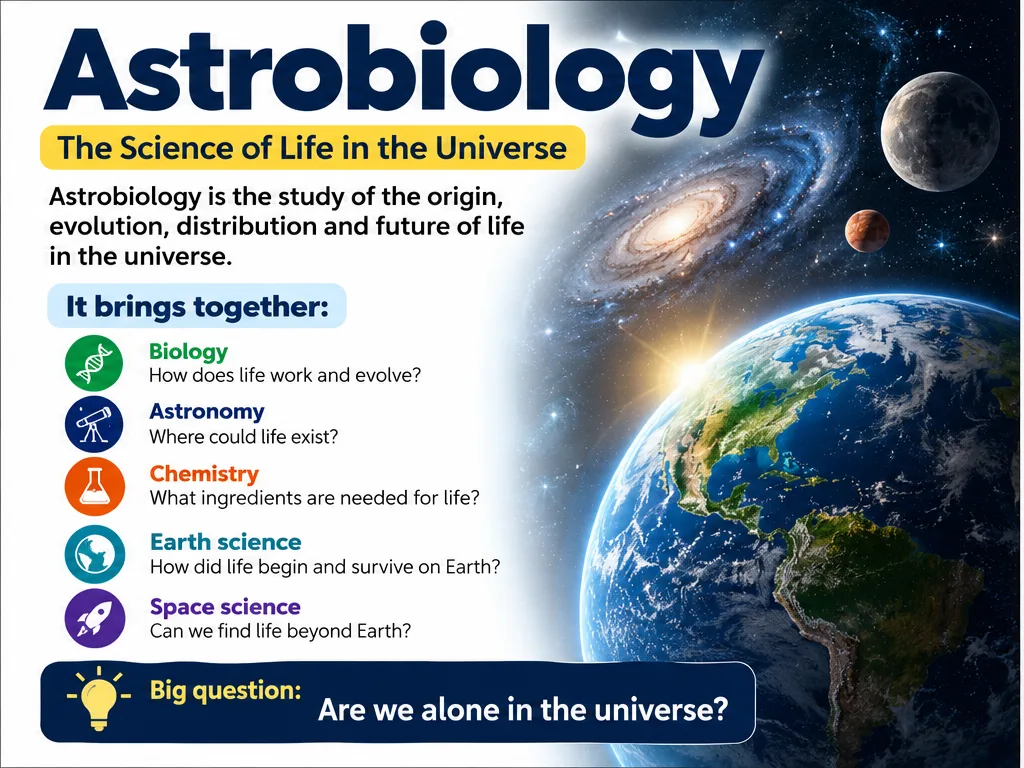
- Biology explains how living things work and survive, from single cells to whole ecosystems.
- Chemistry shows how simple molecules can join to make the building blocks of life.
- Astronomy finds planets and moons and studies the stars they orbit.
- Geology reads the rocks, which hold Earth’s oldest evidence of life.
- Planetary science studies the atmospheres, oceans and surfaces of other worlds.
Put together, these sciences let us ask sensible questions about life on other planets. Instead of guessing, astrobiologists ask what life needs, then look for places that offer it.
What does life need?
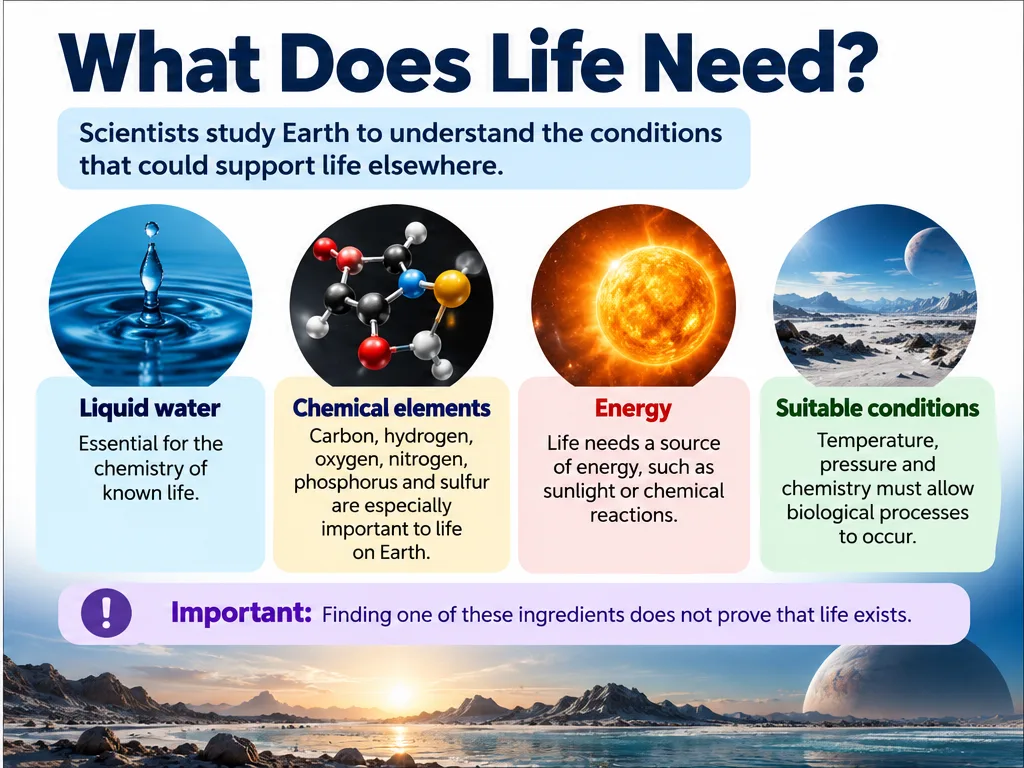
We only know one example of life: life on Earth. So astrobiologists start with what that life needs, then hunt for those ingredients elsewhere. This is called searching for “life as we know it”. It may be too narrow, but it gives us a place to start. Life as we know it needs four things:
- Liquid water, which acts as a solvent.
- The right chemical elements.
- A source of energy.
- Suitable conditions, for long enough.
The elements of life: CHNOPS
Living things are built mostly from six elements. Biologists remember them with the letters CHNOPS.
| Element | Why life needs it |
|---|---|
| Carbon (C) | Forms four bonds and long chains, so it makes the backbone of carbohydrates, proteins, lipids and DNA. |
| Hydrogen (H) | Found in water and in every organic molecule. |
| Nitrogen (N) | Part of amino acids (so proteins) and of the bases in DNA. |
| Oxygen (O) | Found in water and in most organic molecules. |
| Phosphorus (P) | Part of DNA and of the energy-carrying molecule ATP. |
| Sulfur (S) | Found in some amino acids, so it helps shape proteins. |
Carbon is the star of the show. Its ability to form four bonds and to join into long chains makes it ideal for building complex molecules. Some scientists have wondered about silicon-based life, but that idea is speculative. No one has found it.
Liquid water: the universal solvent
Water is the key requirement. Chemical reactions in cells happen with molecules dissolved in water, and water lets them move around and meet. That is why the cry of the space agencies is “follow the water”. A world with liquid water is a much better candidate for life than a dry one.
An energy source
Life also needs energy to power its chemistry. On the surface of Earth, plants and algae use light. In deep oceans and underground, some microbes use chemical energy instead, taking it from reactions with minerals and gases. Either way, cells release usable energy through processes such as cellular respiration. A world needs an energy supply as well as water and elements.
How did life begin on Earth?
To search for life elsewhere, we need to know how it started here. The honest answer is that nobody knows for certain, but the evidence gives us a timeline.
- About 4.54 billion years ago: Earth formed.
- 3.7–4.1 billion years ago: some contested chemical evidence of life.
- About 3.5 billion years ago: Earth’s oldest evidence of life, in stromatolites and fossil microbes.
This means life appeared remarkably early, soon after the planet cooled. If life can arise that quickly on one planet, perhaps it can arise on others too. But we have a sample size of one, so we should be careful.
The Miller–Urey experiment
In 1952 (published in 1953), Stanley Miller and Harold Urey tested whether the building blocks of life could form naturally. They sealed simple gases in glassware and passed electric sparks through them, to mimic lightning. The result was a mixture that contained amino acids, the molecules that join to make proteins. The experiment did not make life, but it showed that life’s ingredients can form from simple chemistry.
Vents or warm pools?
Scientists have different ideas about where life first appeared. Two leading hypotheses are hydrothermal vents on the sea floor and shallow warm pools on land. Both offer water, chemicals and energy. The evidence is not strong enough to choose, so the origin of life is still an open question.
All of this shapes the search. If life began from ordinary chemistry, water and energy, then any world with the same ingredients is worth a look. Next, we will see how tough life can be, and where those ingredients might turn up.
Life at the extremes: what extremophiles teach astrobiology
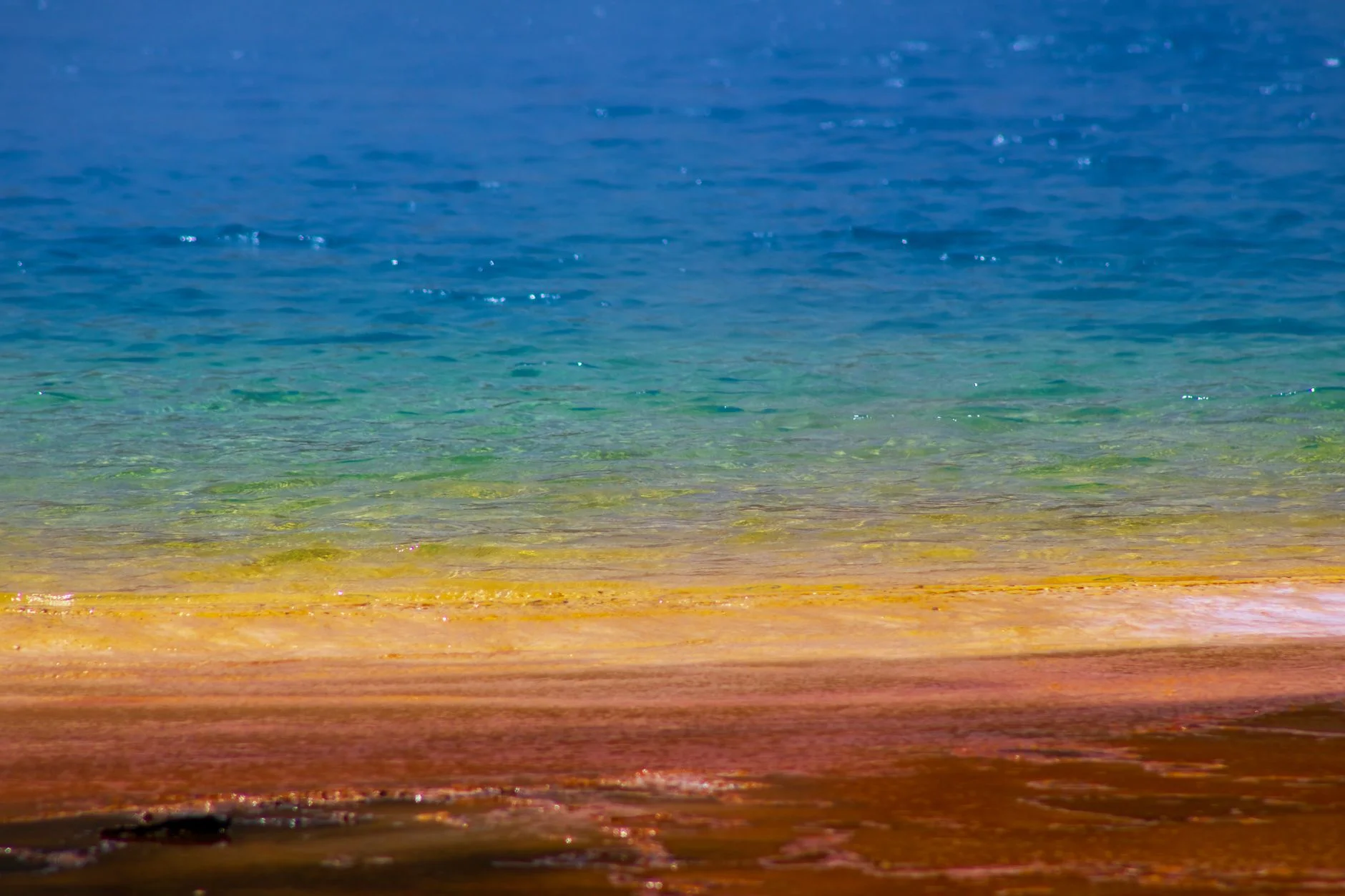

For a long time, scientists assumed that life needed mild conditions: moderate temperatures, fresh water, plenty of oxygen and sunlight. Then they started looking in places that seemed hopeless, and found living things almost everywhere. Organisms that thrive in conditions that would kill most animals and plants are called extremophiles, meaning "lovers of extremes".
Extremophiles matter for astrobiology because they widen the list of places where life on other planets might survive. If microbes can live in boiling springs or deep underground rock on Earth, then a frozen moon or an acidic cloud layer is not automatically lifeless.
Where extremophiles live on Earth
Extremophiles have been found in Antarctic ice, in rock buried deep underground, in strongly acidic pools and in very salty water. Each of these habitats is a small-scale test of how far life can stretch before it breaks.
Some of the best-known examples are worth knowing:
- Thermus aquaticus was discovered in the hot springs of Yellowstone National Park. Its heat-stable enzyme is used in the PCR technique that copies DNA in laboratories, so a microbe from a hot spring ended up helping modern genetics.
- Strain 121 is an archaeon that can grow at 121 °C, a temperature well above the boiling point of water at normal pressure.
- Tardigrades, tiny animals often called water bears, can survive in a dormant state when conditions turn harsh.
Notice that none of these organisms break the rules of biology. They still use liquid water, the same basic chemistry and a source of energy. What they show is that the range of conditions in which those requirements can be met is much wider than people once thought.
Flip the cards: six extremes and how life copes
Try to recall the survival fact before you flip each card. It is a quick way to revise the key examples.
What extremophiles mean for the search for life beyond Earth
The lesson for the search for life beyond Earth is practical. Instead of looking only for planets that resemble Earth, astrobiologists also consider hidden habitats: oceans under ice, rock beneath a planet's surface, and places where chemical energy is available even without sunlight.
There is an important limit, though. Surviving somewhere is not the same as living and reproducing there. A dormant tardigrade in space is alive but not growing, so the best places to look are those where an organism could actually be active over long periods.
The habitable zone: the "Goldilocks" region around a star
When astronomers look at distant stars, they ask a simple question first: could a planet here have liquid water on its surface? The habitable zone is the range of distances from a star where the answer could be yes. It is often called the Goldilocks zone, because the conditions need to be "just right": not too hot and not too cold.
The zone is not a fixed distance. It depends on how bright the star is. A bright, hot star has a habitable zone further out, while a dim star has one much closer in. That is why planets around small, cool stars can sit in the zone while orbiting very close.
Why liquid water is the starting point
Liquid water works as a solvent, letting the chemicals of life move around and react. This is why what is astrobiology so often comes back to water. If a planet is too close to its star, water boils away; too far, and it freezes. The habitable zone marks the in-between range where the surface could hold liquid water.
The same idea can be tested in our own solar system. Earth sits comfortably inside the zone. Venus and Mars sit near its edges, and both are very different worlds from ours.
Habitable worlds outside the zone
The zone also leaves out some promising places. Moons that orbit far from the Sun can still have subsurface oceans that are kept liquid by tidal heating, as their orbits around giant planets squeeze and stretch them. Europa and Enceladus, which we meet in the next part, are the leading examples.
So the habitable zone is a useful first filter when searching for life on other planets, not a final verdict. It helps astronomers choose which distant planets to study, while extremophiles and tidal heating remind us to keep an open mind about the rest.
Where could we find life in our solar system?
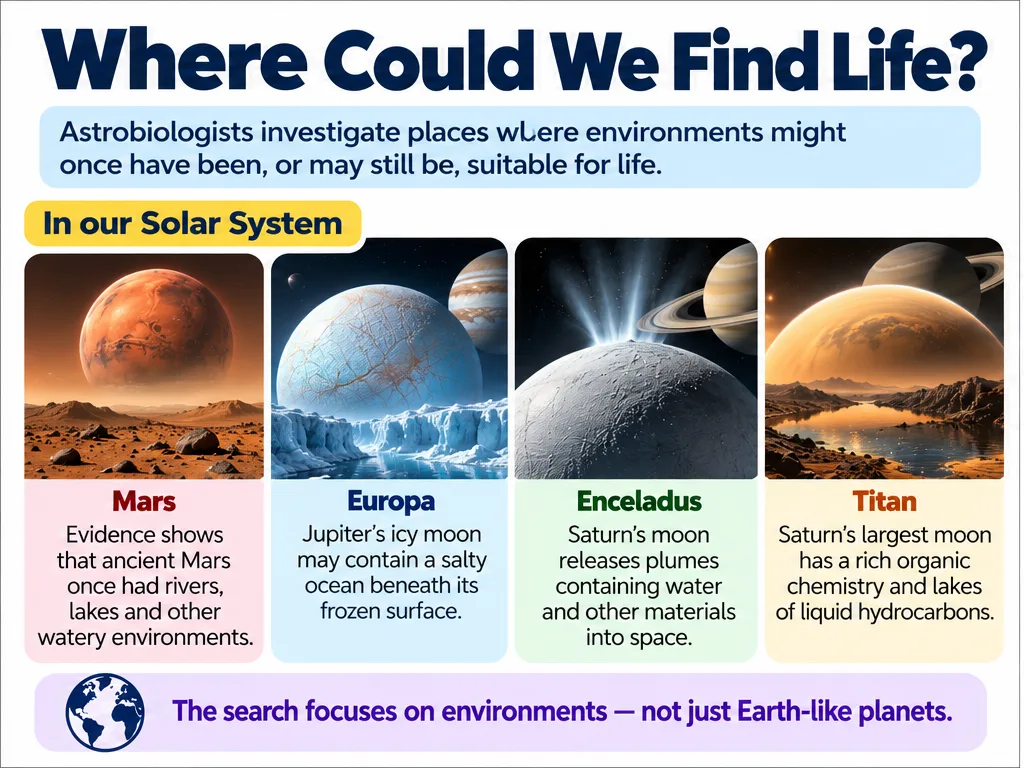
Earth is the only place we know that has life, so the obvious first step in the search for life beyond Earth is to check our neighbours. The best targets are not always the ones you would expect. Some are dry, frozen worlds today but were wetter in the past. Others sit far from the Sun, yet hide oceans beneath their ice.
For life on other planets and moons, scientists look for the same three ingredients we met earlier: liquid water, the CHNOPS elements and a usable source of energy. Four worlds stand out.
Mars: a once-wet world
Today Mars is cold, dry and dusty. But rovers have found clear signs that it once had rivers and lakes. NASA’s Perseverance rover has been exploring Jezero crater, an ancient lake bed, since 2021. Curiosity has found organic molecules in Martian rock.
Organic molecules are not proof of life, because chemistry without living things can make them too. Methane has also been detected in the Martian atmosphere, but those detections are debated. Perseverance has collected rock samples, yet the Mars Sample Return mission, designed to bring them to Earth, was left unfunded by Congress in January 2026. For now, the best tests of Mars life will have to be done by robots on the surface.
Europa: an ocean under the ice
Europa is a moon of Jupiter. Beneath its icy shell lies a salty ocean. Jupiter’s gravity squeezes and stretches the moon, and this tidal heating keeps the water liquid even though Europa is very far from the Sun.
Two spacecraft are on their way to Jupiter. NASA’s Europa Clipper launched in October 2024 and arrives at Jupiter in 2030, then flies past Europa many times. ESA’s JUICE launched in 2023, arrives at Jupiter in 2031, and will fly past Europa twice before orbiting Ganymede. Neither will drill through the ice, but they will measure the shell, the surface and what lies beneath.
Enceladus: plumes from a small moon
Enceladus is a small moon of Saturn. It shoots jets of water vapour into space, and the Cassini spacecraft flew through these plumes. It found salts, organic molecules and molecular hydrogen. Phosphates were detected in 2023.
That matters because phosphorus is one of the CHNOPS elements, and molecular hydrogen could be a chemical energy source. Enceladus is the rare case where a spacecraft has sampled an ocean without landing.
Titan: a different kind of chemistry
Titan, Saturn’s largest moon, has a thick atmosphere and lakes of liquid methane and ethane. Its surface is far too cold for liquid water, but its air and ground host rich organic chemistry. If you are wondering how it compares with other worlds, our article asks whether Titan is a planet, and another looks at the atmospheres of Earth, the Moon and Titan.
NASA’s Dragonfly rotorcraft is planned to launch in 2028 and arrive in 2034. It will fly from place to place, testing the chemistry of the surface. Titan lets us ask a bigger question: could life work in a very different way from life on Earth?
The four worlds compared
| World | Water | Energy | Mission |
|---|---|---|---|
| Mars | Ancient rivers and lakes; dry today | Sunlight; possible chemical energy underground | Perseverance (since 2021) and Curiosity; Mars Sample Return lost funding in 2026 |
| Europa | Subsurface salty ocean under ice | Tidal heating from Jupiter | Europa Clipper (launched Oct 2024, reaches Jupiter 2030); JUICE (launched 2023, reaches Jupiter 2031) |
| Enceladus | Water-vapour plumes from a subsurface ocean | Tidal heating; molecular hydrogen in plumes | Cassini sampled the plumes; phosphates found in 2023 |
| Titan | Methane and ethane lakes; water not liquid on the surface | Organic chemistry in a thick atmosphere | Dragonfly (planned launch 2028, arrival 2034) |
Life beyond the solar system
The next step is to look at planets orbiting other stars. There are more than 6,000 confirmed exoplanets (NASA, 2025). Most were found by two methods. In the transit method, a planet crosses its star and dims the light slightly. In the radial velocity method, a planet’s pull makes its star wobble.
Some systems are especially interesting for what is astrobiology trying to answer. TRAPPIST-1 has seven Earth-sized planets, and several lie in the habitable zone. Proxima Centauri b orbits the nearest star to the Sun, about 4.2 light years away, in its habitable zone. Being in that zone, though, only means liquid water is possible, not that it is present.
K2-18b and the limits of the evidence
The James Webb Space Telescope can study the light that passes through an exoplanet’s atmosphere, and this shows which gases are present. Read more about the instrument in our guide to NASA’s James Webb Space Telescope.
The planet K2-18b showed clear methane, and some analyses also report carbon dioxide. A claimed hint of dimethyl sulfide (DMS), a gas that on Earth is linked to living things, has been much discussed. That claim is disputed and not confirmed. Other scientists say the data do not support it, and non-living processes might also explain a signal like this.
So are we alone? Nobody knows yet. Next, we will see how scientists design experiments to answer that question, and why a single gas is rarely enough to prove anything.
How do scientists search for life beyond Earth?
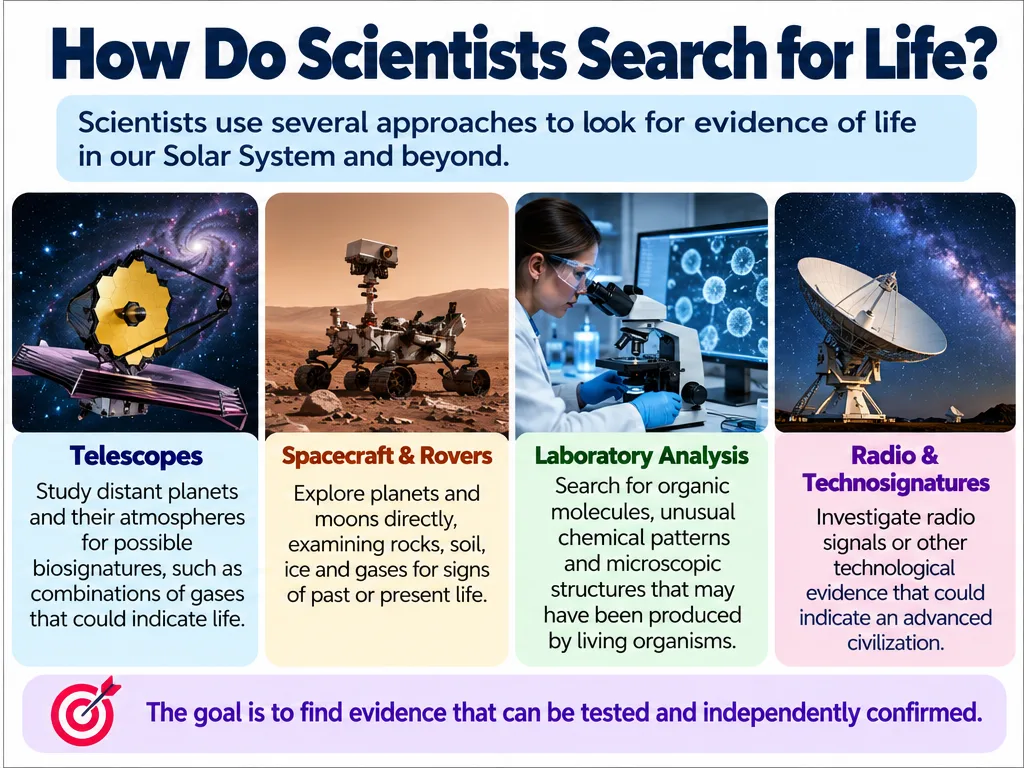
Astrobiologists cannot simply visit another star system, so the search for life beyond Earth uses several strategies at once. Some missions land on or orbit nearby worlds. Others use telescopes to read light from planets that are trillions of kilometres away.
Inside our own solar system, rovers and orbiters study Mars. Perseverance has explored Jezero crater since 2021, and Curiosity found organic molecules. Spacecraft such as Cassini have flown through the water-vapour plumes of Enceladus, and Europa Clipper (launched October 2024, reaching Jupiter in 2030) and ESA’s JUICE (launched 2023, reaching Jupiter in 2031) are heading for Jupiter’s icy moons. NASA’s Dragonfly rotorcraft is planned to launch in 2028 and reach Titan in 2034.
Beyond the solar system, more than 6,000 exoplanets have been confirmed. Astronomers find them using the transit method (a tiny dip in starlight as a planet crosses its star) and radial velocity (a slight wobble in the star caused by a planet’s pull). Then telescopes such as JWST measure the gases in an exoplanet’s atmosphere., and about the wider toolkit in exploring the universe with rockets, telescopes and satellites.
Rocks that fall to Earth can also be searched. In 1996, scientists claimed that the Martian meteorite ALH84001 contained microfossils. Most scientists now think the features were made without life. Our article on meteorites and the universe explains how these space rocks are studied.
What is a biosignature?
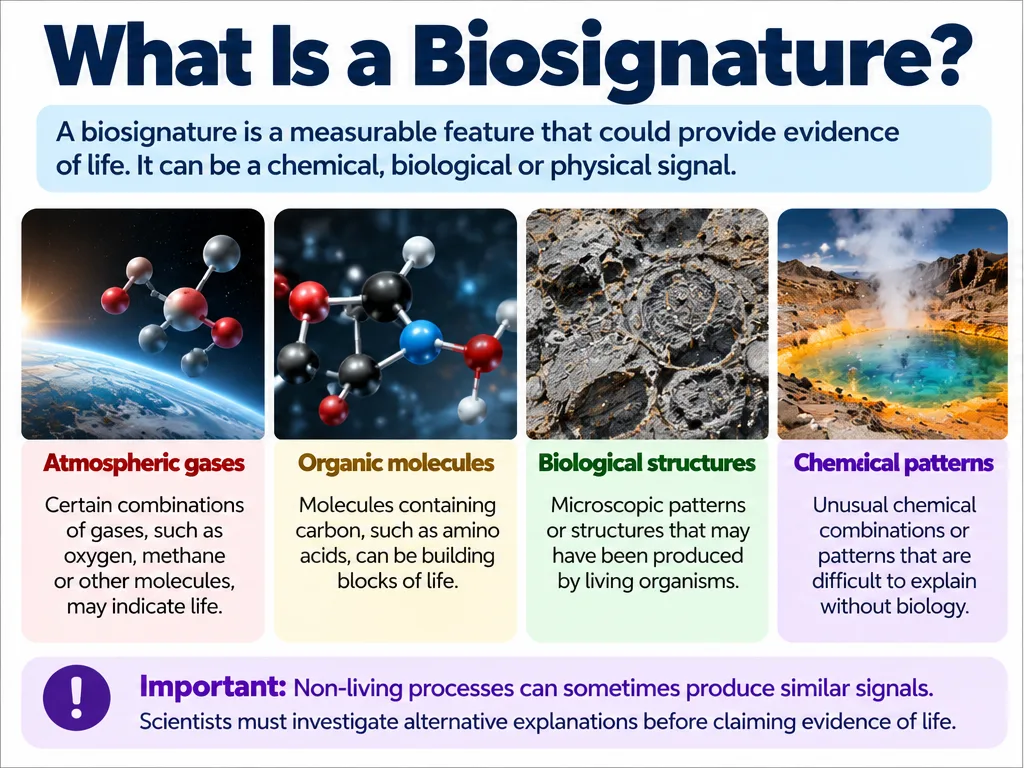
A biosignature is a measurable sign that life is, or once was, present. Because we cannot see living things on distant worlds, we look for the chemical and physical traces that life leaves behind.
- Gases: oxygen and methane together in an atmosphere, because they should react and disappear unless something keeps replacing them.
- Organic molecules: carbon-based compounds, such as those found by Curiosity on Mars.
- Fossils and structures: for example stromatolites, which are Earth’s oldest evidence of life at about 3.5 billion years.
- Chemical patterns: unusual isotope ratios that are hard to explain without biology.
A related idea is the technosignature, which is evidence of technology such as radio signals or laser pulses. SETI looks for these. The famous Wow! signal of 1977 was never repeated.
The big problem is false positives. Non-living processes can mimic a biosignature. In 2020 a phosphine claim at Venus made headlines, but it is disputed. JWST detected methane on the exoplanet K2-18b (carbon dioxide is also reported, less firmly), and a hint of dimethyl sulfide (DMS) has been claimed, but that is disputed and not confirmed.
Why isn’t finding methane enough to prove life? (3 marks)
Methane can be made by non-living processes as well as by living things, so on its own it could be a false positive. Methane detections on Mars are also still debated. A stronger case is methane found together with oxygen, because the two are out of chemical equilibrium and something would need to keep replacing them. Even then, scientists need several independent lines of evidence.
Are we alone? The Drake equation and the Fermi paradox
The oldest question in astrobiology is also the hardest: are we alone in the universe? In 1961 Frank Drake wrote an equation to organise what we would need to know to answer it:
N = R* × fp × ne × fl × fi × fc × L
Here N is the number of civilisations we might be able to detect, R* is the rate of star formation, and the other terms are fractions and lifetimes, such as the share of stars with planets and the share of planets where life appears. The Drake equation is not a calculation with a known answer. It is a way of showing which unknowns matter most. Try changing the values yourself and see how wildly the result swings.
Then comes the Fermi paradox: if life is common, why have we seen no evidence of it? Possible answers include that life is rare, that distances are too great, that time scales do not line up, or that we simply have not looked enough. The answer is not known.
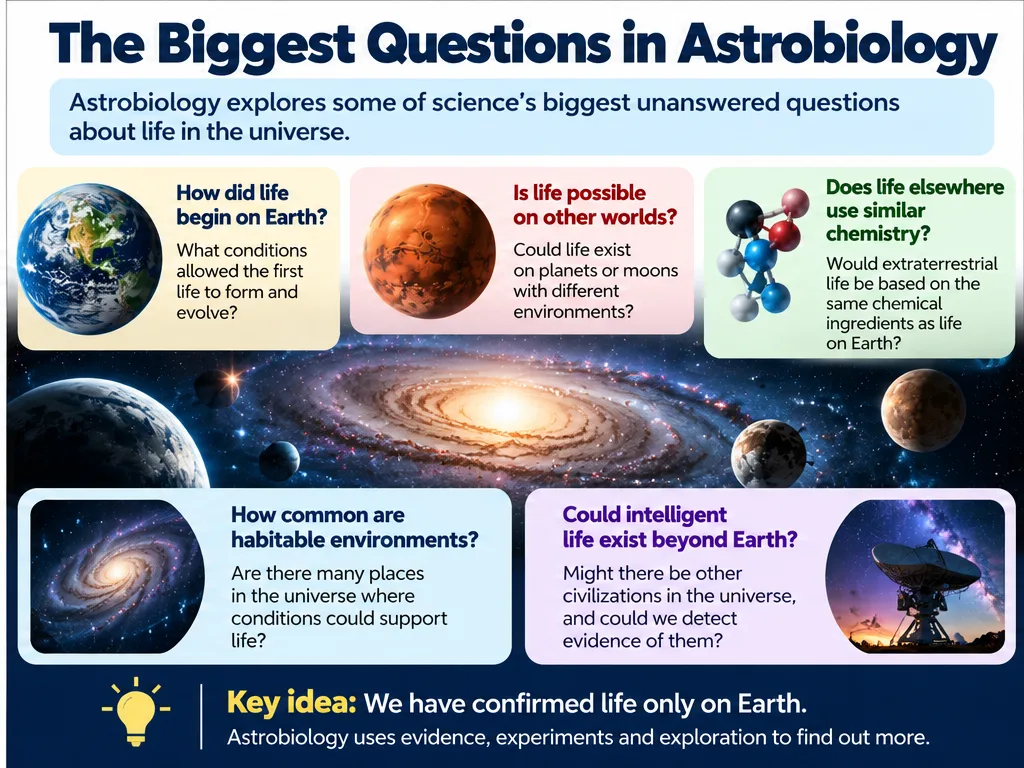
Our own planet gives a starting point. Our solar system formed about 4.54 billion years ago, and life appeared on Earth soon afterwards in geological terms. That is one example, and one example is not enough to say how common life is.
Test yourself: astrobiology quiz
Key points: astrobiology recap
- Astrobiology studies the origin, evolution, distribution and future of life in the universe, using biology, chemistry, astronomy, geology and planetary science.
- Scientists search using rovers, orbiters, plume sampling, meteorites and telescopes that study exoplanet atmospheres.
- A biosignature is a measurable sign of life, such as oxygen and methane together, organic molecules, fossils or isotope patterns.
- False positives are a real risk, so claims such as Venus phosphine and K2-18b’s DMS hint remain disputed.
- The Drake equation organises unknowns, and the Fermi paradox asks why we have seen no evidence yet.
- No life has been confirmed beyond Earth as of 2026.
Frequently asked questions about astrobiology
What is astrobiology in simple terms?
Astrobiology is the study of the origin, evolution, distribution and future of life in the universe. It combines biology, chemistry, astronomy, geology and planetary science to ask how life begins, where it could exist, and how we might recognise it. No life has been confirmed beyond Earth as of 2026.
Has life been found on other planets?
No. As of 2026, no life has been confirmed anywhere beyond Earth. There have been claims, such as the 1996 microfossil claim about Martian meteorite ALH84001 and the 2020 phosphine claim at Venus, but most scientists now think the first was non-biological and the second remains disputed.
What does life need to survive?
Life as we know it needs liquid water as a solvent, the elements carbon, hydrogen, nitrogen, oxygen, phosphorus and sulfur (CHNOPS), an energy source such as light or chemical energy, and suitable conditions for long enough. Astrobiologists look for these ingredients when ranking worlds as possible homes for life.
What is the habitable zone?
The habitable zone is the range of distances from a star where a planet’s surface could hold liquid water. Its position depends on how bright the star is. Being inside it does not guarantee life, and moons outside it can still have subsurface oceans heated by tides.
What is a biosignature?
A biosignature is a measurable sign that life may be, or once was, present. Examples include gases such as oxygen and methane together, organic molecules, fossils or structures, and chemical patterns such as isotopes. Non-living processes can sometimes mimic them, so scientists need several lines of evidence before claiming a detection.
Where could life exist in the solar system?
The best candidates are Mars, which once had rivers and lakes, and the ocean moons Europa and Enceladus, which have subsurface salty water. Saturn’s moon Titan has methane and ethane lakes and rich organic chemistry. Venus’s clouds were also proposed, but the phosphine claim is disputed.
What is the Drake equation?
The Drake equation, written by Frank Drake in 1961, is N = R* × fp × ne × fl × fi × fc × L. It organises the unknowns involved in estimating how many communicating civilisations might exist. It is not a calculation with a known answer, because most of its terms are still uncertain.
What is the Fermi paradox?
The Fermi paradox asks: if life is common in the universe, why have we not seen any evidence of it? Possible answers include that life is rare, that distances are too great, that timing does not line up, or simply that we have not looked hard enough yet.
Are we alone in the universe?
Nobody knows. No life has been confirmed beyond Earth as of 2026, but more than 6,000 exoplanets have been confirmed, and extremophiles show life can survive in harsh places. Missions to Europa and Titan, and JWST observations of exoplanet atmospheres, will keep testing the question.