Cosmology is the science of the origin, structure, evolution and fate of the universe as a whole. Astronomers study individual objects such as a star or a planet. Cosmologists step back and ask the big questions: how did everything begin, what is it made of, and where is it all going?
It also happens to be home to the most beautiful things in space. Glowing clouds of gas, spinning islands of stars and the faint afterglow of the Big Bang all belong to the story. In this guide we explain cosmology in plain language, then explore nebulae, galaxies and stars, with plenty of GCSE links along the way.
What is cosmology?
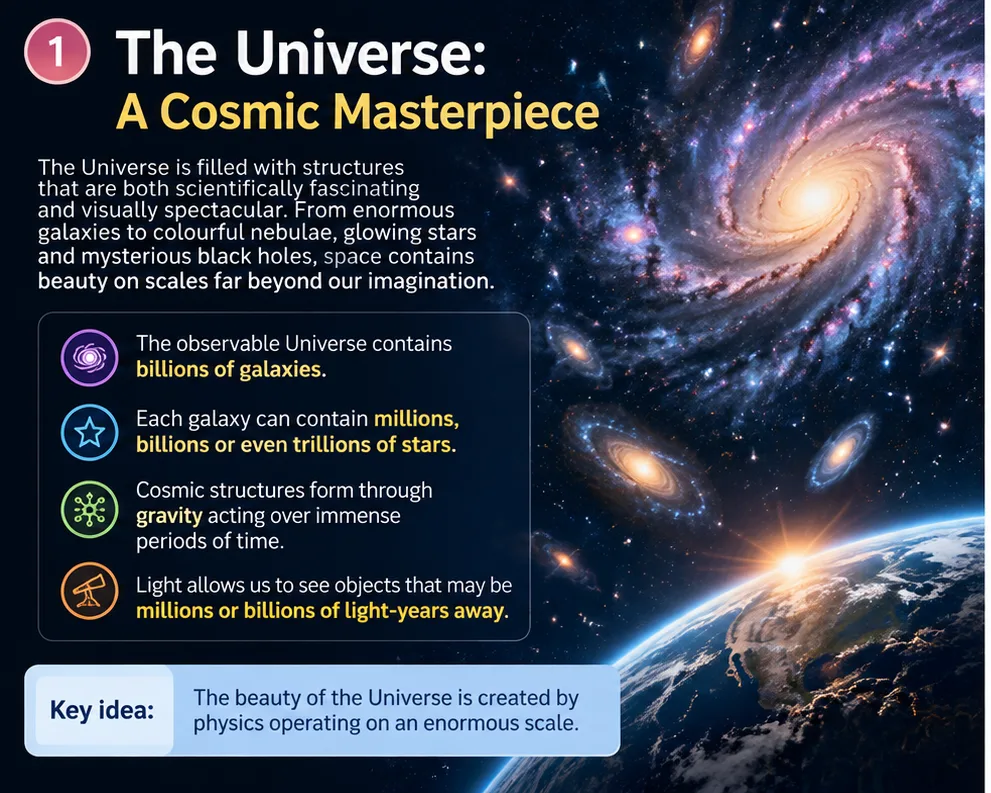
The word comes from the Greek for “order” and “study”, and cosmology tries to explain the order of the whole universe. Its biggest discovery is that the universe has a history. It is about 13.8 billion years old, a figure measured by the Planck satellite, and it has been expanding ever since.
The first clue came in the 1920s. Georges Lemaître (1927) and Edwin Hubble (1929) found that more distant galaxies are moving away from us faster. This is the Hubble–Lemaître law, and it is the same “red-shift” evidence you meet at GCSE. If galaxies are flying apart today, they must have been closer together in the past.
The second clue is the cosmic microwave background (CMB). Arno Penzias and Robert Wilson discovered it in 1965. It is leftover radiation from about 380,000 years after the Big Bang, and it has cooled to roughly 2.7 K today. Think of it as the oldest light in the universe.
Because space itself has stretched while light travelled, the observable universe is about 93 billion light-years across, even though the universe is only 13.8 billion years old. So how big is the universe? We can only see part of it, and that part is already enormous.
What is the universe made of?
Here is the surprise: the stars, planets and people we know make up only a small slice. Planck measurements give this rough recipe.
| Ingredient | Share of the universe | What we know |
|---|---|---|
| Ordinary matter | about 5% | Atoms: stars, gas, dust, planets and us |
| Dark matter | about 27% | Invisible, felt only through gravity |
| Dark energy | about 68% | Drives the expansion to speed up |
Dark matter was inferred from how galaxies rotate (Vera Rubin’s work in the 1970s) and from gravitational lensing, where unseen mass bends the light of objects behind it. Dark energy is even stranger. If you want to go deeper, read our explainer on dark energy in the universe.
Nebulae: clouds of colour
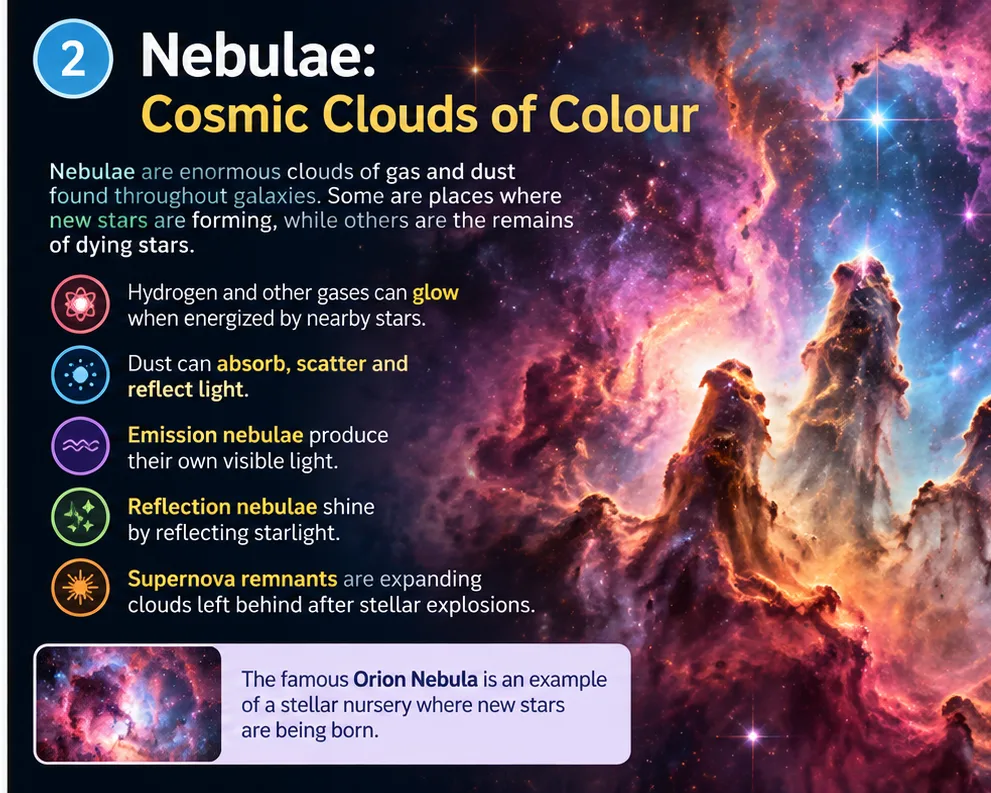
When people search for beautiful things in space, nebulae usually top the list. A nebula is a cloud of gas, mostly hydrogen and helium, mixed with dust. Some are stellar nurseries where new stars are born. Others are the glowing leftovers of stars that have died.
The Pillars of Creation are a famous example. These towers of gas and dust sit inside the Eagle Nebula (M16), about 6,500 to 7,000 light-years away, and new stars are forming within them.
The Orion Nebula is much closer, at roughly 1,300 to 1,350 light-years. You can spot it without a telescope as a fuzzy patch in the sword of Orion, and binoculars show it far better.
Types of nebulae
Not every nebula shines in the same way. The type depends on what is lighting it up, or what is blocking the light.
| Type | How it shines | Example |
|---|---|---|
| Emission nebula | Gas is ionised by hot young stars and glows, red from hydrogen-alpha | Orion Nebula |
| Reflection nebula | Dust scatters starlight, often looking blue | Dust around the Pleiades |
| Dark nebula | Dense dust blocks the light from behind | Horsehead Nebula |
| Planetary nebula | Outer layers shed by a dying Sun-like star | Ring Nebula, Helix Nebula |
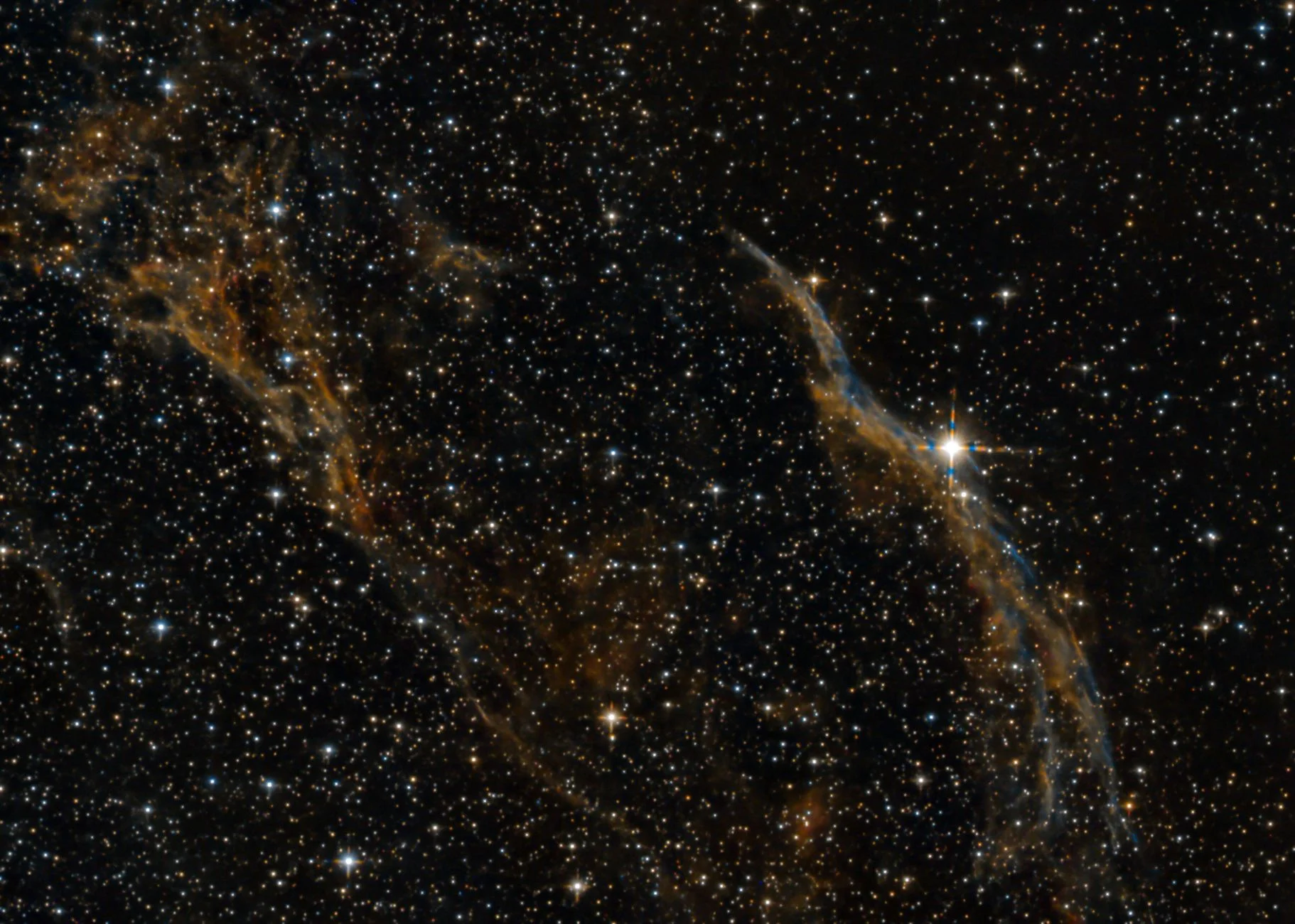
| Supernova remnant | Debris from an exploded massive star | Crab Nebula, Veil Nebula |
The Crab Nebula is the remains of a supernova that people saw in 1054 AD. It shows that nebulae are not only beautiful but also a record of how stars end. We follow that story, from nebula to star and back again, in the life cycle section later in this guide.
Galaxies: islands of stars
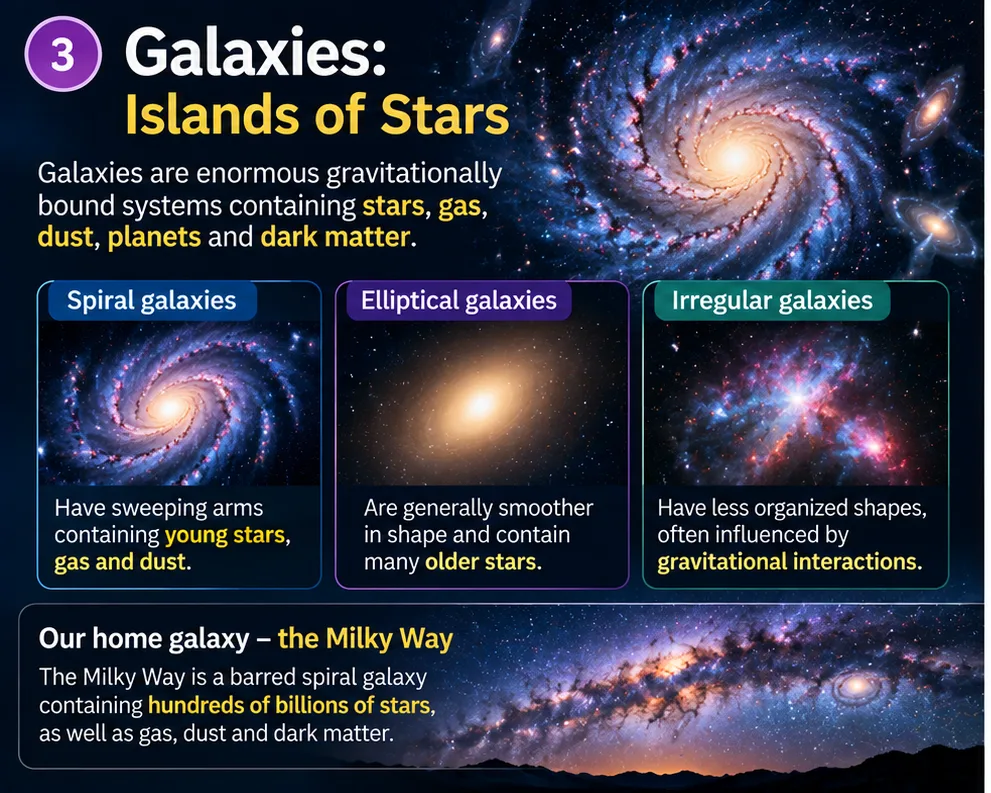
Zoom out from a single nebula and you meet something far bigger. A galaxy is a gravitationally bound system of stars, gas, dust and dark matter. Gravity is the glue: it keeps billions of stars circling a common centre instead of drifting apart.
Galaxies are the building blocks of the universe that cosmologists study. The observable universe holds hundreds of billions of galaxies or more, and each one is home to millions or billions of stars. When you look at the beautiful things in space, from glowing spirals to fuzzy golden ovals, you are usually looking at a galaxy.
Some galaxies are tidy and symmetrical. Others are ragged and untidy. Astronomers sort them by shape, and that sorting tells us a surprising amount about how they formed and how old their stars are.
Types of galaxies: the Hubble tuning fork
In 1926 Edwin Hubble published a way to classify galaxies by their appearance. His diagram looks like a tuning fork, with the smooth ovals on the handle and the spirals on the two prongs. There are four main types of galaxies, and barred spirals are a sub-group of the spirals.
| Type | Shape | What to look for |
|---|---|---|
| Spiral | Flat disc with curved arms around a bright central bulge | Gas and dust, young blue stars in the arms; includes barred spirals |
| Barred spiral | Spiral whose arms start at the ends of a straight bar of stars | Our own Milky Way is one |
| Elliptical | Smooth ball or egg shape, no arms | Mostly older, redder stars and little new star formation |
| Lenticular | Disc with a bulge but no clear arms | Sits between spirals and ellipticals on the fork |
| Irregular | No regular shape | Untidy, often with bursts of star formation |
Hubble’s labels describe what a galaxy looks like, not a strict order of how it grows up. Modern astronomers know that galaxies change over time. Collisions and mergers can turn spirals into ellipticals, and a galaxy can run out of gas and stop making new stars.
Our home: the Milky Way
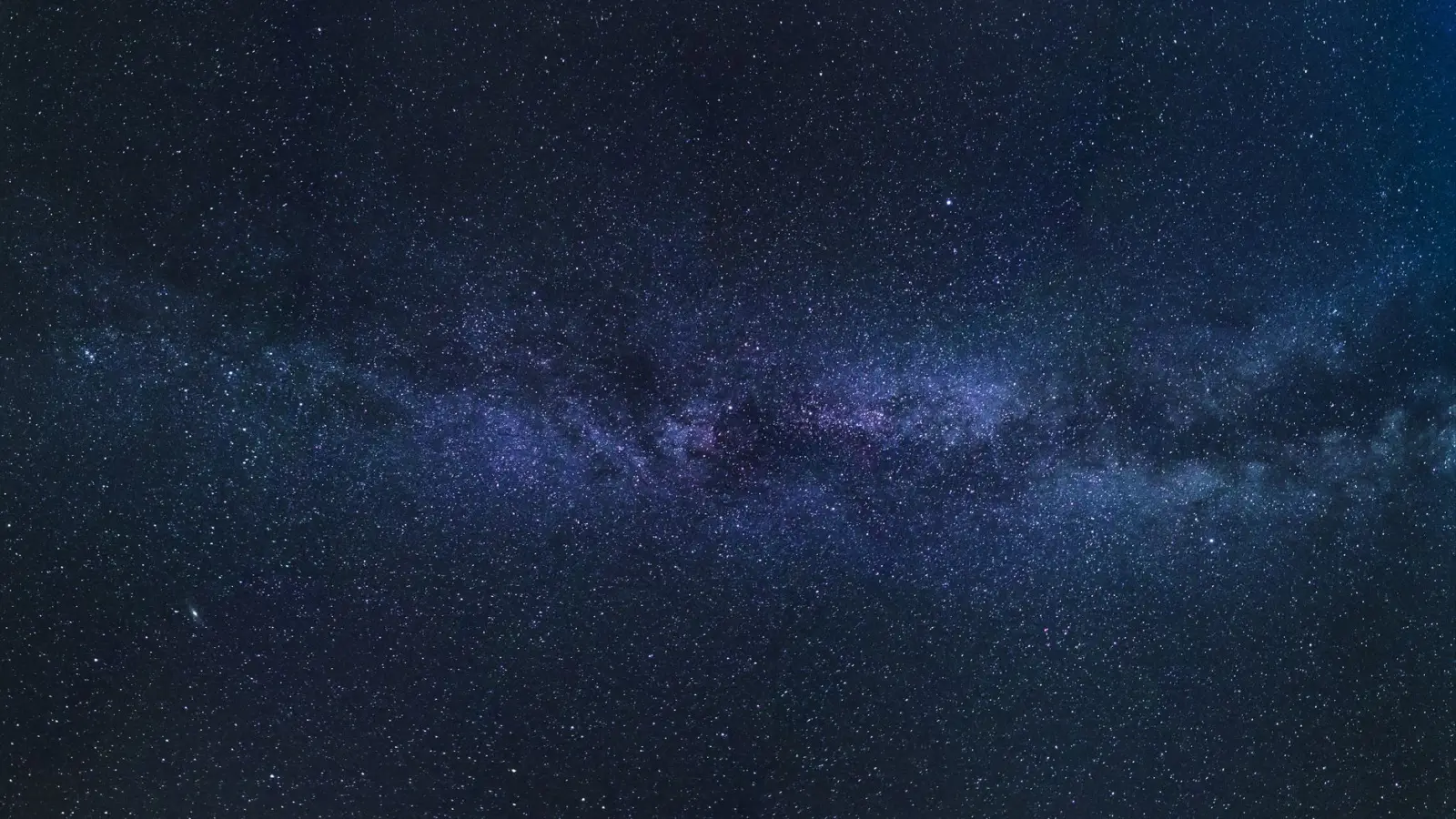
We live inside a galaxy, which makes it hard to photograph from outside. Scientists have pieced together its shape from careful measurements of the stars we can see. The result is a barred spiral galaxy with a glowing centre and sweeping arms. Here are the key numbers.
- Size: about 100,000 light-years across (some estimates for the full disc are larger).
- Stars: roughly 100 to 400 billion.
- Our address: the Sun is about 26,000 light-years from the centre.
- Orbit: the Sun takes around 230 million years to travel once around the galaxy.
- Neighbourhood: the Milky Way is part of the Laniakea Supercluster, which we will meet again when we reach the cosmic web.
Think about that orbit for a moment: 230 million years for a single lap. The Milky Way is not static scenery. It is a huge, slowly turning wheel, and we are riding on it.
From a dark site you can see the galaxy’s disc edge-on as a pale band stretching across the sky. That band is the combined light of countless stars too faint to pick out one by one. Sadly, light pollution hides it from most people in towns and cities: a study in 2016 found that about a third of humanity can no longer see it.
Andromeda, our neighbour
The nearest large galaxy to us is Andromeda, also known as M31. It lies about 2.5 million light-years away and is the most distant large galaxy easily visible to the naked eye. On a clear, dark night it looks like a faint, elongated smudge. Binoculars show it better.
That smudge is the combined glow of vast numbers of stars. It is also approaching. Andromeda and the Milky Way are drawn together by gravity, but a 2025 study using Hubble and Gaia data found only about a 50 % chance that they merge within the next 10 billion years. Earlier predictions of a collision in 4 to 5 billion years are now thought very unlikely.
Use the calculator below to explore this idea yourself. Pick a galaxy or a star, and see how far back in time you are looking.
How far back in time are you looking?
Distances in space are measured in light-years: the distance light travels in one year. So a galaxy 2.5 million light-years away is seen as it was 2.5 million years ago. Telescopes that look at very distant galaxies are, in effect, looking at the early universe. That is why cosmology and astronomy are such closely linked sciences.
The beauty of stars
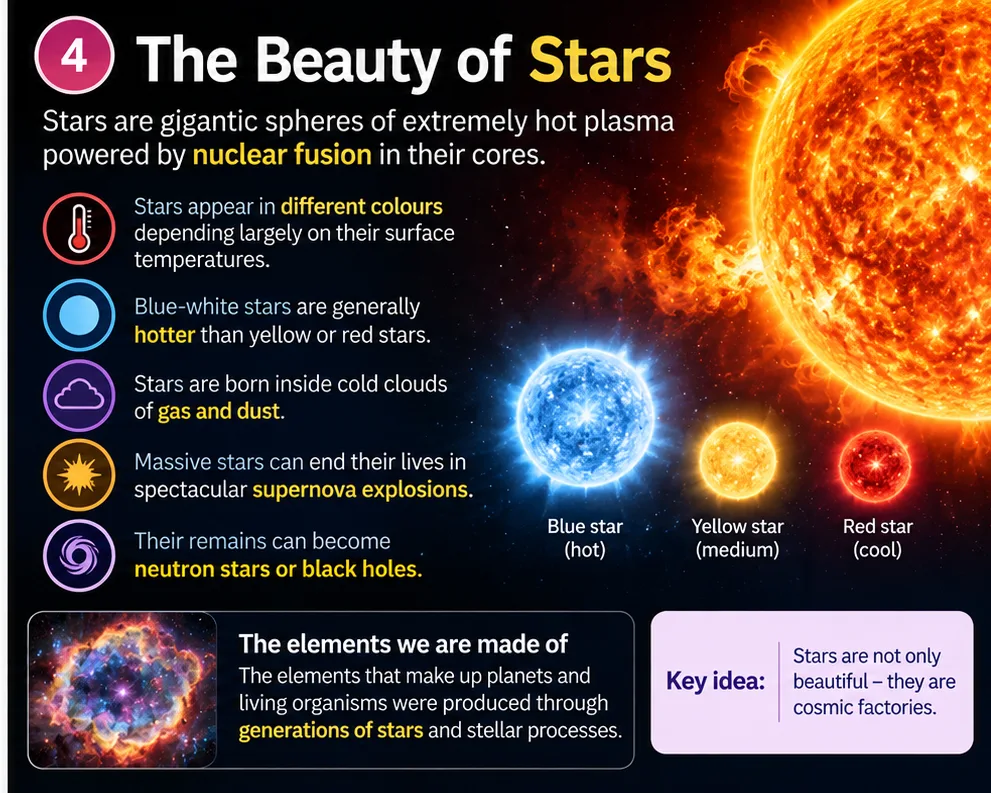
Of all the beautiful things in space, stars are the ones we see first. On a dark night they look like tiny white pinpricks, yet each one is a huge ball of gas that shines because of nuclear fusion in its core. In a star like the Sun, hydrogen nuclei are squeezed together to make helium, and the energy released lights up the sky.
Stars are not all alike. Some are cool and red, some are hot and blue, and they live very different lives. Understanding why is one of the most satisfying parts of cosmology, and it is a big topic in GCSE physics too.
Why stars have different colours
The colour of a star tells you its surface temperature. Hotter objects glow bluer, cooler ones glow redder, rather like the metal in a fire going from dull red to white-hot. So a star’s colour shows its surface temperature, not its age or its distance.
| Colour | Surface temperature | Example |
|---|---|---|
| Red | below about 3,700 K (cool) | Betelgeuse, a red supergiant (about 3,600 K) |
| Yellow | about 5,800 K | The Sun |
| White | between yellow and blue | Many bright stars you can see at night |
| Blue | 10,000–30,000 K or more (hot) | Rigel, a blue supergiant |
Next time you look at Orion, compare red Betelgeuse with blue Rigel. You are seeing a temperature difference of thousands of kelvin with your own eyes.
The life of a star
Every star starts in a cloud of gas and dust and ends in a very different way depending on its mass. This is the star life cycle that GCSE courses ask you to learn. The path for a star about the size of the Sun looks like this:
- Nebula: gravity pulls a cloud of gas and dust together.
- Protostar: the clump heats up as it contracts.
- Main sequence: hydrogen fuses to helium and the star shines steadily for most of its life.
- Red giant: the star swells up and cools as its fuel changes.
- Planetary nebula and white dwarf: the outer layers drift away and the hot core is left behind.
A much more massive star follows the same early steps, but its ending is far more dramatic:
- Nebula: a bigger cloud collapses.
- Protostar: a hotter, denser clump forms.
- Main sequence: hydrogen fuses to helium.
- Red supergiant: the star grows enormous.
- Supernova: the star explodes.
- Neutron star or black hole: what remains depends on the mass of the core.
Black holes sound like pure destruction, but they raise fascinating questions about what they might be good for. If you want to go further, our article on black holes and what we can learn from them picks up where this life cycle ends.
We are made of star stuff
Here is the most surprising result of all this. Hydrogen and most helium date from the Big Bang, but elements heavier than helium were made in stars. Fusion inside stars builds elements up to iron, and heavier elements form in supernovae and neutron-star mergers.
That means the carbon in your body and the oxygen you breathe were made in stars. When people say we are made of star stuff, they mean it literally. If you are curious about the simplest ingredient, read about the most common element in the universe. Even gold, the precious metal, is a heavy element that had to be forged by violent events far beyond the Sun.
Test your memory of the cosmic sights from this article with these cards.
Colours we cannot see: the electromagnetic universe
Your eyes detect only a thin slice of the light the universe produces. Telescopes capture the whole electromagnetic spectrum: radio, microwave, infrared, visible, ultraviolet, X-ray and gamma rays. Each band reveals something different. Infrared sees through dust to find newborn stars, X-rays show gas heated to millions of degrees, and radio waves map cold hydrogen between the stars.
The cosmic microwave background is a good example. It is leftover radiation from about 380,000 years after the Big Bang, and it has cooled to roughly 2.7 K, so it now arrives as microwaves. No human eye could ever see it, yet it is one of the most important images in cosmology.
So how do we turn invisible light into a picture? Scientists map each wavelength to a visible colour, for example infrared to red and shorter wavelengths to blue. This is called false colour or representative colour. The choices are made on purpose to show real differences in temperature, chemistry or energy. Instruments such as the James Webb Space Telescope work mainly in infrared, so every one of its pictures relies on this technique.
The cosmic web: the biggest structure of all
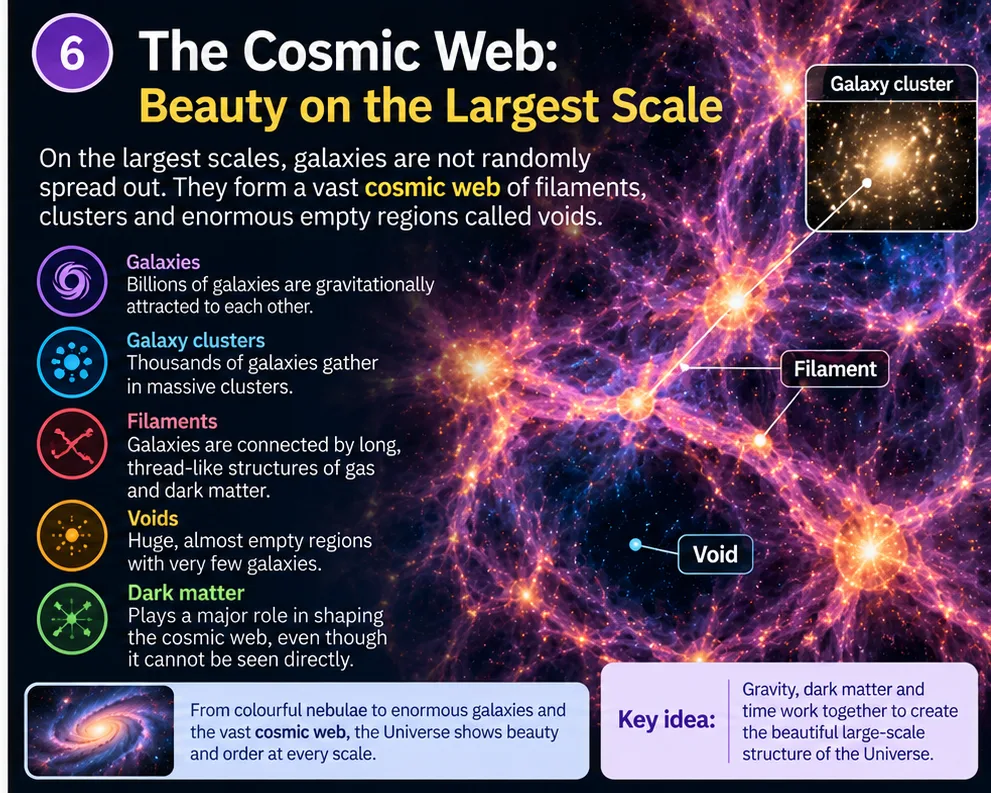
Zoom out far enough and galaxies stop looking scattered. They gather in groups, clusters and superclusters, linked by long filaments that surround enormous empty voids. This pattern is called the cosmic web. It looks a little like soap bubbles or a sponge, with galaxies strung along the threads.
Gravity builds the web, and dark matter provides most of the pull. Dark matter makes up about 27% of the universe, far more than the roughly 5% that is ordinary matter, so it forms the invisible scaffolding that galaxies follow. Our own Milky Way sits inside the Laniakea Supercluster, identified in 2014.
The same gravity that built the web also helped shape our neighbourhood. If you are curious how one small patch of the web formed a star and planets, read about the origin of our solar system. Rocky leftovers from that era still fall to Earth today, and meteorites carry clues about it.
See cosmic beauty for yourself
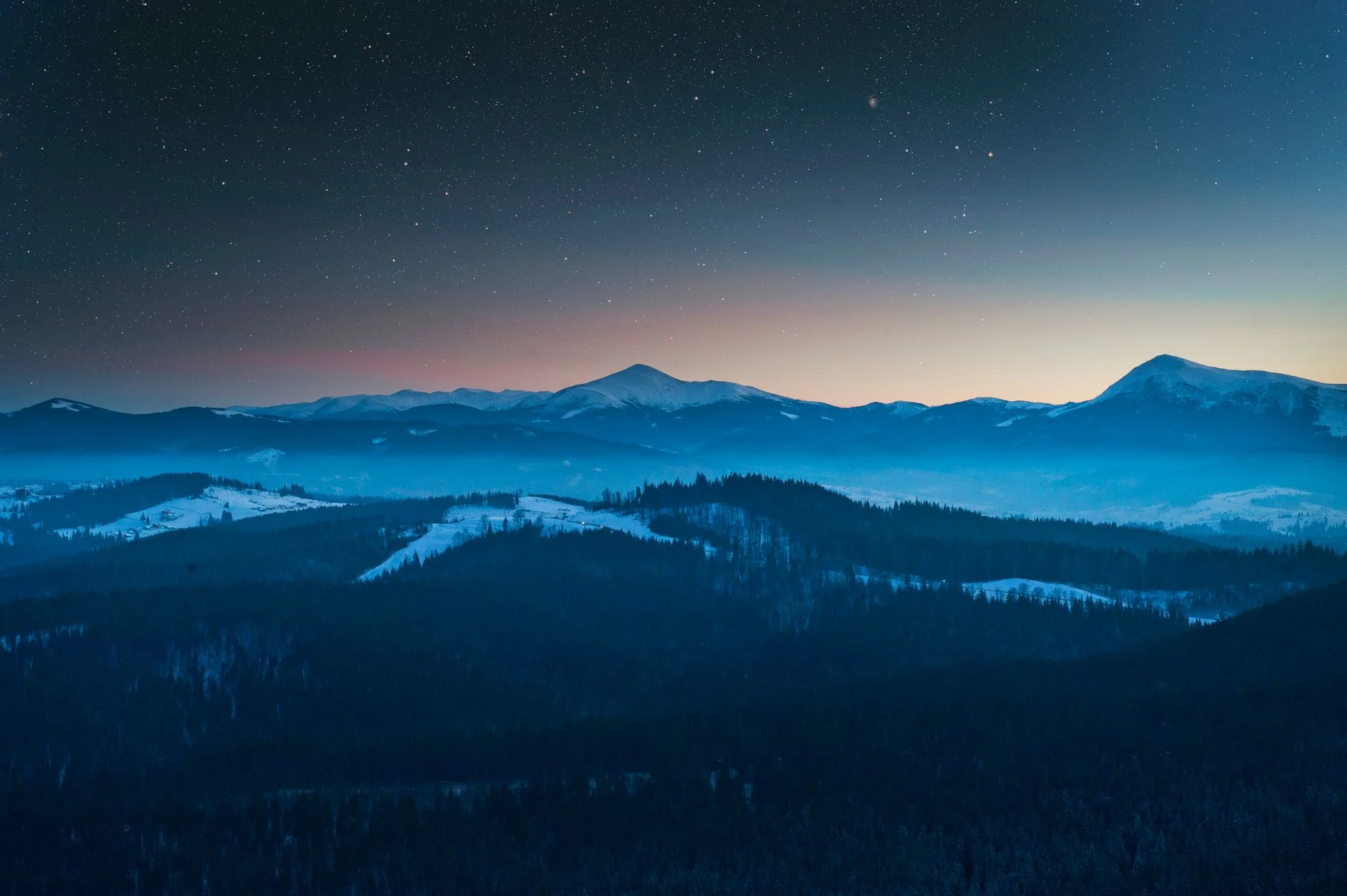
You do not need a telescope to start. Work through this list over a few clear nights, and tick each step off as you go.
- Pick a night with little cloud and let your eyes adjust to the dark for about 20 minutes.
- Get away from street lights if you can. About a third of humanity cannot see the Milky Way because of light pollution.
- Look for the Milky Way band stretching across a dark sky.
- Find Orion, then look at the “sword” hanging below the belt for the Orion Nebula, about 1,300 light-years away. Binoculars show it more clearly.
- Find the Pleiades star cluster and notice how many stars you can count.
- Look for the faint smudge of the Andromeda Galaxy, about 2.5 million light-years away and the most distant large galaxy easily visible to the naked eye.
- Compare star colours: look for red Betelgeuse and blue-white Rigel in Orion.
Learning the patterns helps a lot, and our guide to how many constellations there are is a good place to begin. You will also notice stars seem to shimmer. That is Earth’s air, not the stars themselves, as explained in why stars twinkle and planets do not.
Test yourself: cosmology and the beauty of space
Key points
- Cosmology is the science of the universe as a whole, which is about 13.8 billion years old.
- Nebulae are clouds of gas and dust. The main types are emission, reflection, dark and planetary nebulae, plus supernova remnants.
- Galaxies are bound systems of stars, gas, dust and dark matter. Hubble’s classes are spiral, elliptical, lenticular and irregular.
- Star colour shows surface temperature, from cool red to hot blue.
- Heavier elements, including the carbon in your body, were made in stars.
- Many space images use false colour that is chosen scientifically.
- Galaxies form a cosmic web of clusters, filaments and voids shaped by dark matter.
- You can see the Milky Way, the Orion Nebula and Andromeda from a dark site without a telescope.
Frequently asked questions about cosmology
What is cosmology?
Cosmology is the science of the origin, structure, evolution and fate of the universe as a whole. Astronomy studies individual objects such as planets, stars and galaxies, whereas cosmology asks big-picture questions: how the universe began, what it is made of, how it has expanded and how it might end.
What is a nebula?
A nebula is a cloud of gas and dust in space. The gas is mostly hydrogen and helium. Some nebulae glow because hot young stars ionise the gas, some reflect starlight, some block light, and others are the remains of dying stars. Many are places where new stars are born.
What are the types of nebulae?
The main types are emission nebulae, which glow when gas is ionised by hot young stars, such as the Orion Nebula. Reflection nebulae scatter starlight, dark nebulae block it, planetary nebulae are shells shed by dying Sun-like stars, and supernova remnants, such as the Crab Nebula, come from exploded stars.
What are the types of galaxies?
Edwin Hubble’s classification, drawn as a tuning fork, has four main types. Spiral galaxies, including barred spirals like the Milky Way, have arms. Elliptical galaxies are smooth and oval. Lenticular galaxies sit between the two, and irregular galaxies have no clear shape.
What colour are stars and why?
Stars range from red through yellow and white to blue, and colour reveals surface temperature. Red stars are the coolest, below about 3,700 K. Our yellow Sun is about 5,800 K. Blue stars are the hottest, from 10,000 K up to 30,000 K or more. Betelgeuse is red; Rigel is blue.
Are space images real colours?
Some are close to what your eyes would see, but many use false or representative colour. Telescopes detect wavelengths such as infrared, ultraviolet or X-rays that are invisible to us, so scientists map them to visible colours. The choices are scientific, showing real differences in temperature, chemistry and energy.
How old and how big is the universe?
The universe is about 13.8 billion years old, according to Planck data. The observable universe is about 93 billion light-years across, which is larger than 13.8 billion because space has expanded while light travelled. Nobody knows how much lies beyond the part we can observe.
What is the cosmic web?
The cosmic web is the large-scale pattern of the universe. Galaxies gather in groups, clusters and superclusters, joined by filaments around vast empty voids. Gravity and dark matter shaped it. Our Milky Way lies within the Laniakea Supercluster, which astronomers described in 2014.
Are we really made of star stuff?
Yes. Hydrogen and most helium date from the Big Bang, but elements heavier than helium were made in stars. Fusion builds elements up to iron, while supernovae and neutron-star mergers make heavier ones. The carbon in your body and the oxygen you breathe were forged in stars.