Walk through a garden on a still, damp morning and you may see tiny beads of water lined up along the edges of leaves. Walk through the same garden at noon on a hot, breezy day and the leaves look dry, yet they are losing water all the time. Both are real examples of plants losing water, but they are different processes. This guide explains transpiration vs guttation clearly enough for GCSE, then goes on to the transpiration stream, the factors that change the rate, the potometer practical and the maths questions that come with it.
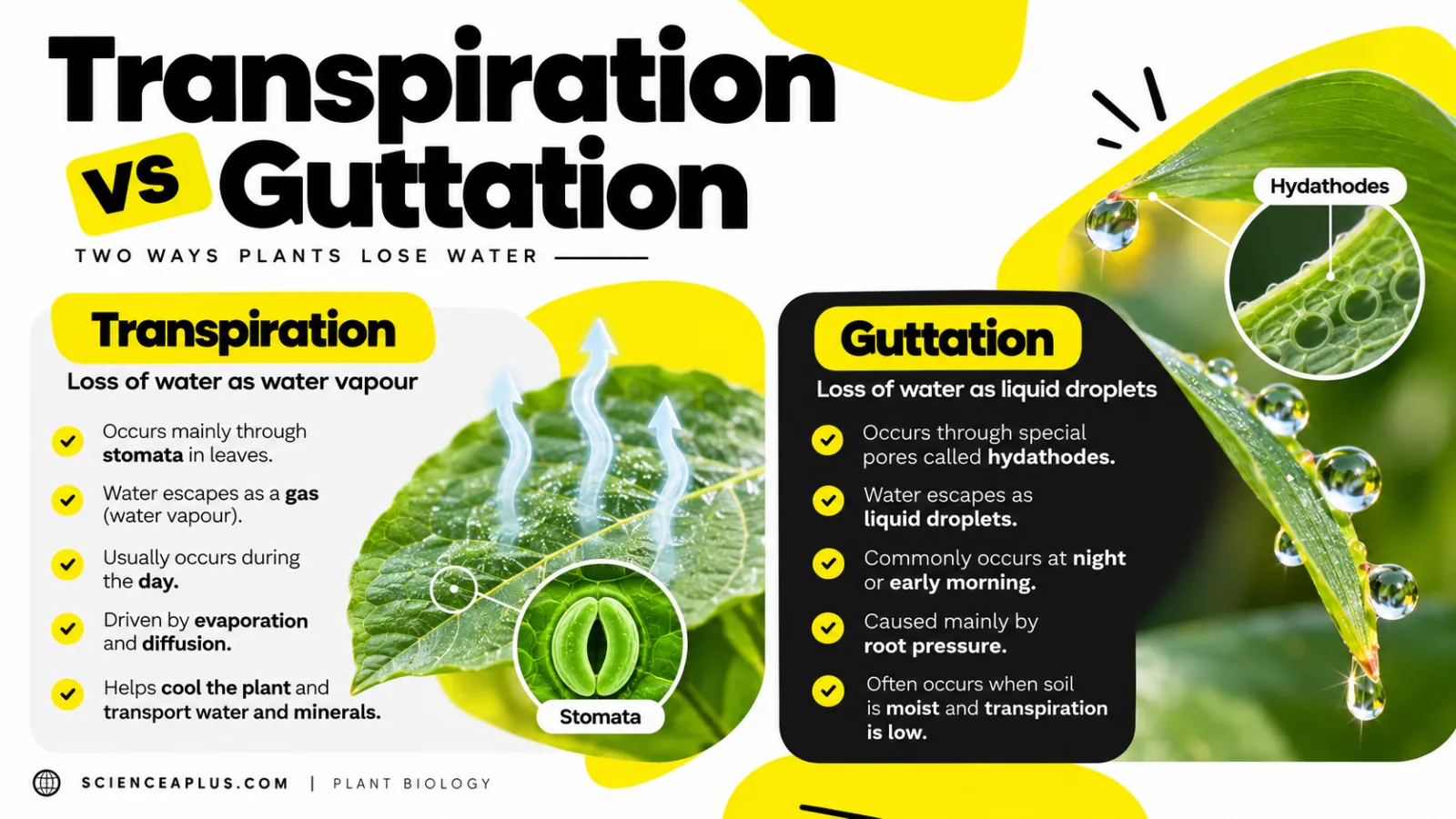
The one-line answer is simple. Transpiration is the loss of water as water vapour, mainly through the stomata of the leaves. Guttation is the loss of water as liquid droplets, through special pores called hydathodes. Everything else, such as the time of day, the driving force and the composition of the water lost, follows from that difference.
What is transpiration?
Transpiration is the evaporation of water from the surfaces of a plant’s cells inside the leaf, followed by diffusion of the water vapour out of the leaf through open stomata. A plant takes in water through its roots, carries it up in the xylem and loses most of it from its leaves. Only a small fraction stays in the plant for photosynthesis and growth.
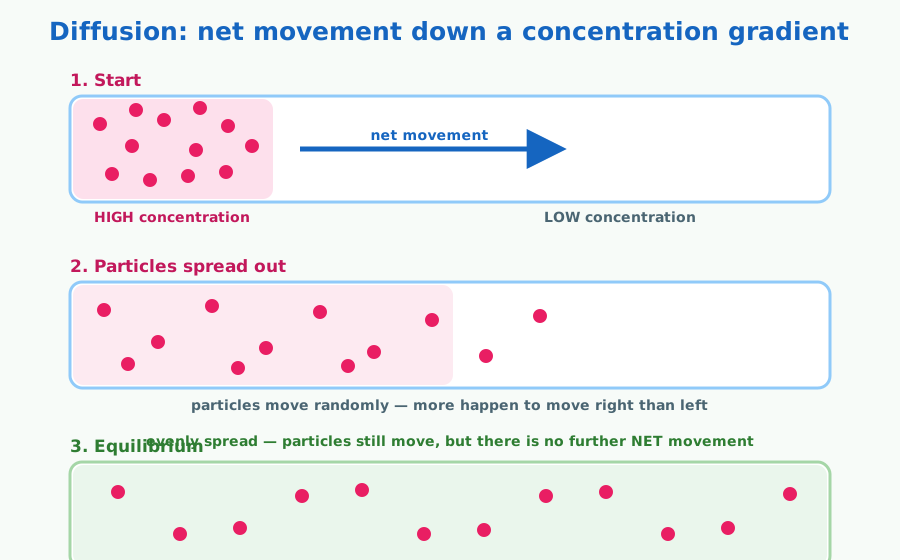
Notice the two physical processes hidden in that definition. First, water evaporates from the damp walls of the spongy mesophyll cells into the air spaces of the leaf. Second, the vapour diffuses out through the stomata because there is more water vapour inside the leaf than in the outside air. This is the same diffusion you study for gases and solutes, and it explains why humid air slows transpiration down.
Transpiration does several useful jobs:
- It pulls water up the plant. The loss of water from the leaves creates the transpiration pull that draws a continuous stream of water through the xylem. That is the transpiration stream, explained in detail below.
- It carries mineral ions. Nitrate, magnesium and other ions dissolved in the soil water move up the xylem in the stream.
- It cools the leaf. Evaporation takes energy from the leaf, much as sweat cools your skin.
- It keeps cells firm. Water that reaches the leaf cells helps them stay turgid, which supports the plant, and supplies the water needed for photosynthesis.
Transpiration is also a cost. A plant cannot take in carbon dioxide for photosynthesis without opening its stomata, and open stomata let water out. Much of plant biology is a negotiation between getting enough carbon dioxide and not losing too much water.
What is guttation?
Guttation is the exudation of drops of liquid water from the leaves of a plant. The water leaves through hydathodes, which are pores at the edges and tips of leaves, usually at the ends of veins. Unlike stomata, hydathodes do not open and close with the same guard-cell control, so water can keep escaping when the leaf is not transpiring.
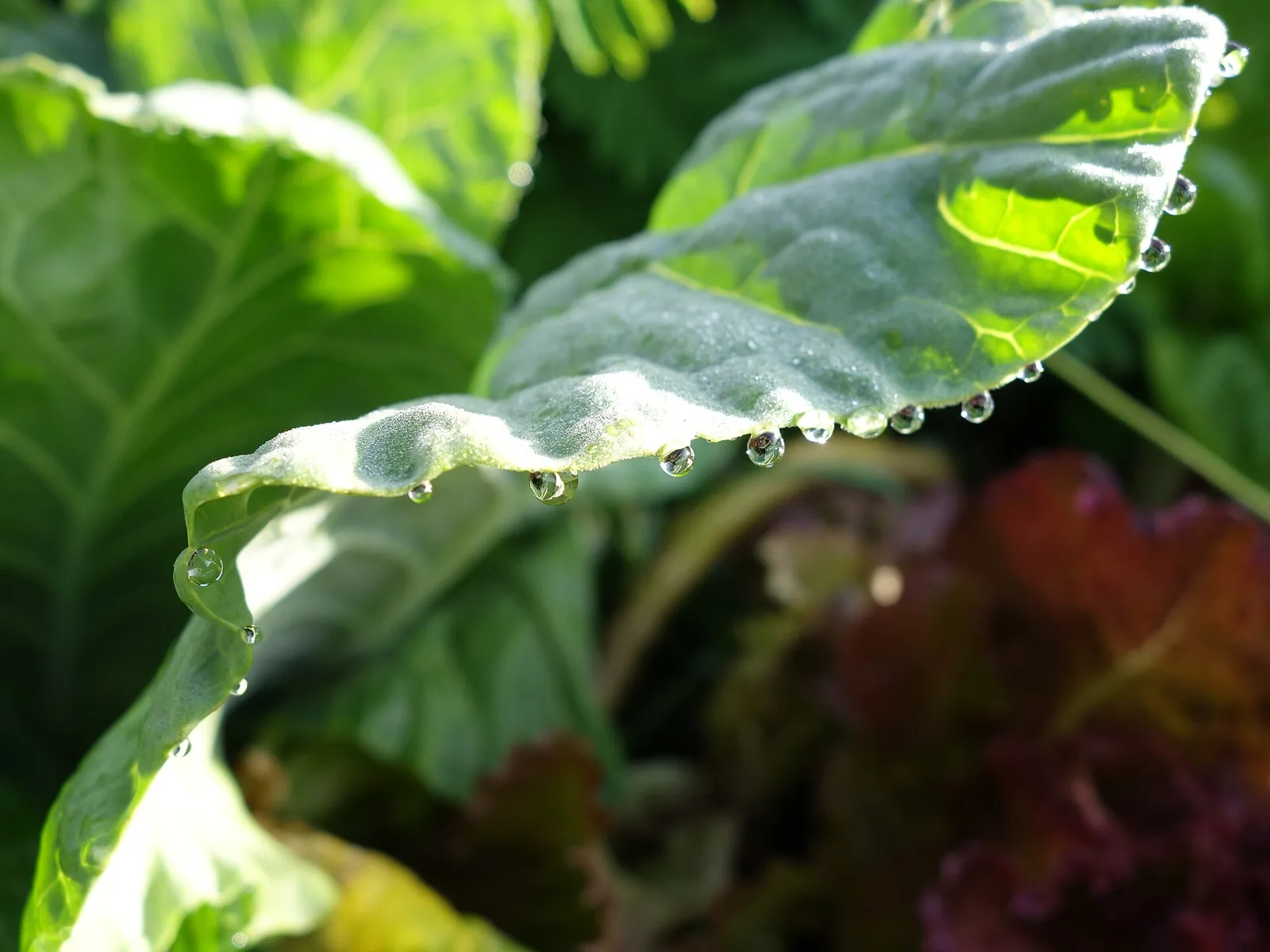
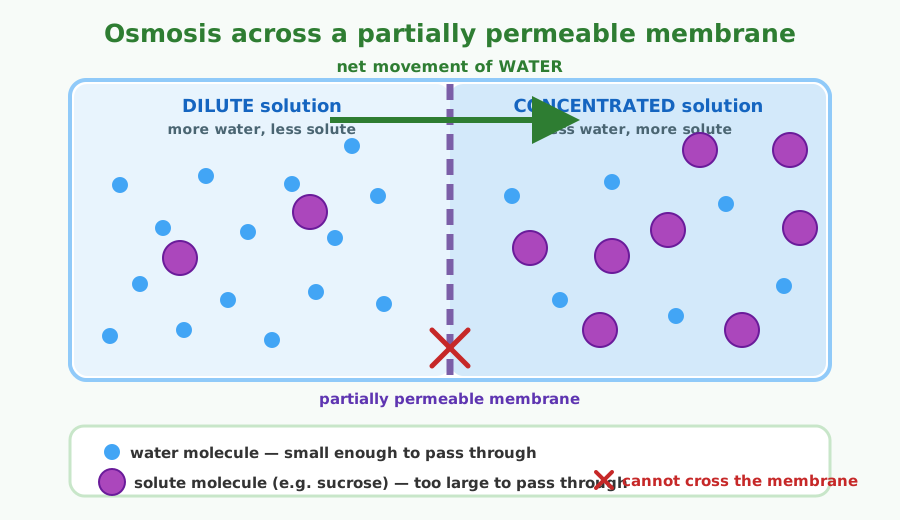
The driving force is root pressure. The cells of the root actively move mineral ions into the xylem, which lowers the water potential there, so water follows by osmosis. If the soil is wet and the leaves are not pulling water up by transpiration, this pressure pushes liquid up the xylem and out through the hydathodes.
That is why guttation is most often seen in the early morning, after a night when the soil stayed moist, the air was humid and the stomata were mostly closed. It is common on grasses and cereal seedlings and on many small garden plants. It is a normal process, not a sign that a plant is ill.
The liquid is not pure water. It carries dissolved substances from the xylem, mainly mineral salts and some sugars and other organic compounds, and the mixture varies between species. Transpired water vapour, in contrast, leaves behind its dissolved minerals in the plant. The later section on guttation fluid returns to this, including why the droplets matter to insects and to plant disease.
Transpiration vs guttation: the key differences
Put the two processes side by side and the contrasts become easy to remember. The table below, which is a favourite revision summary, covers the form of the water, the structures involved, the driving force, the usual time of day, where it happens, what is lost and the conditions each process favours.
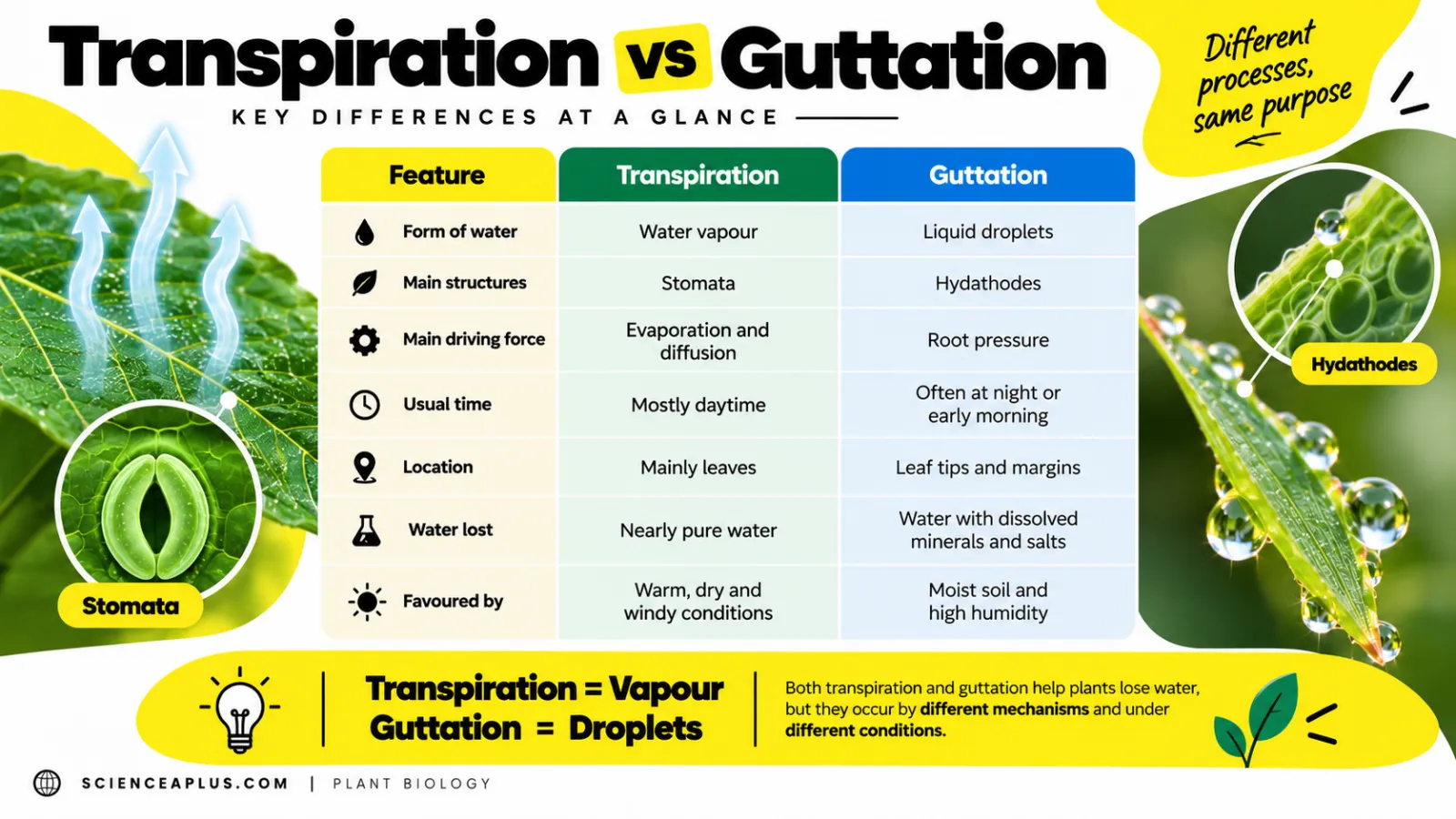
One subtlety: “mostly daytime” does not mean “only daytime”. Transpiration continues at night at a low rate, because some stomata stay slightly open and a little water escapes through the waxy cuticle.
Both processes move water out of a plant, which is what the card’s headline “different processes, same purpose” is getting at. Be careful with the word “purpose” in an exam, though. Transpiration has clear benefits for the plant, while guttation is better described as a side effect of root pressure when transpiration is low.
The transpiration stream: how water reaches the top of a plant
The path of water through a plant is a favourite exam question, so learn it as a sequence. Water enters a root hair cell by osmosis, crosses the root cortex, enters the xylem, travels up the stem and into the leaf veins, moves out into the mesophyll cell walls, evaporates into the air spaces and diffuses out through the stomata.
- Root hair cells have a huge surface area. Mineral ions are taken in by active transport, which keeps the water potential inside the cell lower than in the soil, so water moves in by osmosis.
- Xylem vessels carry the water upwards. They are tubes with no end walls between cells, so water flows through without being blocked.
- Mesophyll cell walls in the leaf are always wet. Water evaporates from them into the air spaces.
- Stomata let the vapour diffuse out into the air.
Xylem: a pipe built for the job
Mature xylem vessels are dead, hollow cells joined end to end. The walls are strengthened with lignin, laid down in rings or spirals, which makes the tubes rigid enough to stay open when the water inside is under tension. Small gaps called pits let water pass sideways from one vessel to another, which helps it route around any blockage. Because the cells are dead and empty, there is no cytoplasm to slow the flow.
Do not confuse xylem with phloem: phloem carries sugars from photosynthesis, not water and ions.
Cohesion–tension: what actually pulls the water up
At A-level you explain the pull with the cohesion–tension theory. It is worth learning in outline for GCSE too, because it explains why a thin column of water can climb a very tall tree.
- Water evaporates from the mesophyll cell walls and leaves the leaf as vapour. This lowers the pressure at the top of the water column, creating tension (a negative pressure).
- Water molecules are cohesive. They are attracted to each other by hydrogen bonds, so the whole column is pulled up as one, like a continuous rope of water.
- Water molecules are also adhesive. They are attracted to the walls of the xylem, which helps to hold the column up and stops it from sliding back down.
Because the water column is under tension, the xylem walls are pulled inwards. That is why the lignified walls matter: without them the tubes would collapse.
Why root pressure cannot do the whole job
A common mistake, repeated on many websites, is to say that capillary action creates root pressure. It does not. Capillary rise in narrow tubes can only lift water a short distance, and root pressure is generated by the roots’ active uptake of ions, not by capillarity. Root pressure is also small. It can push water out of hydathodes at night, but it cannot lift water to the top of a tall tree. For that, the plant relies on the transpiration pull through cohesion and tension.
Why guttation happens: root pressure and the right conditions
Guttation needs three things to happen together. The soil must contain plenty of water, so the roots can build up pressure. The stomata must be mostly closed or the air very humid, so that little water is leaving as vapour. And the plant must have working hydathodes.
A warm, damp night fits perfectly. With the stomata closed and no sunlight, the transpiration pull almost stops. The roots keep moving ions into the xylem and water keeps following, so pressure builds and the leaves exude drops. As the sun comes up and the air warms, the stomata open, transpiration restarts, the pull replaces the push and the drops are reabsorbed or evaporate.
Guttation, dew or rain?
Drops on a leaf at dawn are not always guttation. Dew forms when water vapour in the air condenses on a surface that has cooled below the dew point. It forms on any cool surface, including fence wires and car roofs. Guttation drops come from the plant itself. Clues that you are looking at guttation include drops that sit in the same places, at leaf tips or along the margins, at the ends of veins, and drops that reappear on the same leaves each morning.

Photographs rarely settle the question: the drops on this grass could be dew, guttation or both.
Describe how water moves from the soil into the xylem of a root. (3 marks)
Root hair cells take up mineral ions by active transport, which gives them a lower water potential than the soil water. Water therefore moves into the root hair cells by osmosis. It then passes across the cortex and into the xylem, where root pressure and the transpiration pull move it upwards.
Why does guttation usually happen at night rather than at midday? (2 marks)
At night the stomata are mostly closed and the air is humid, so there is little transpiration. Root pressure then pushes water out through the hydathodes. At midday the transpiration pull is strong and the water leaves as vapour instead.
How guard cells open and close the stomata
Stomata (one is a stoma) are tiny pores, mostly in the lower epidermis of the leaf, each surrounded by a pair of guard cells. Many broad-leaved land plants have more stomata on the underside of the leaf than the top, where it is cooler and less exposed to the sun, but this varies between species.
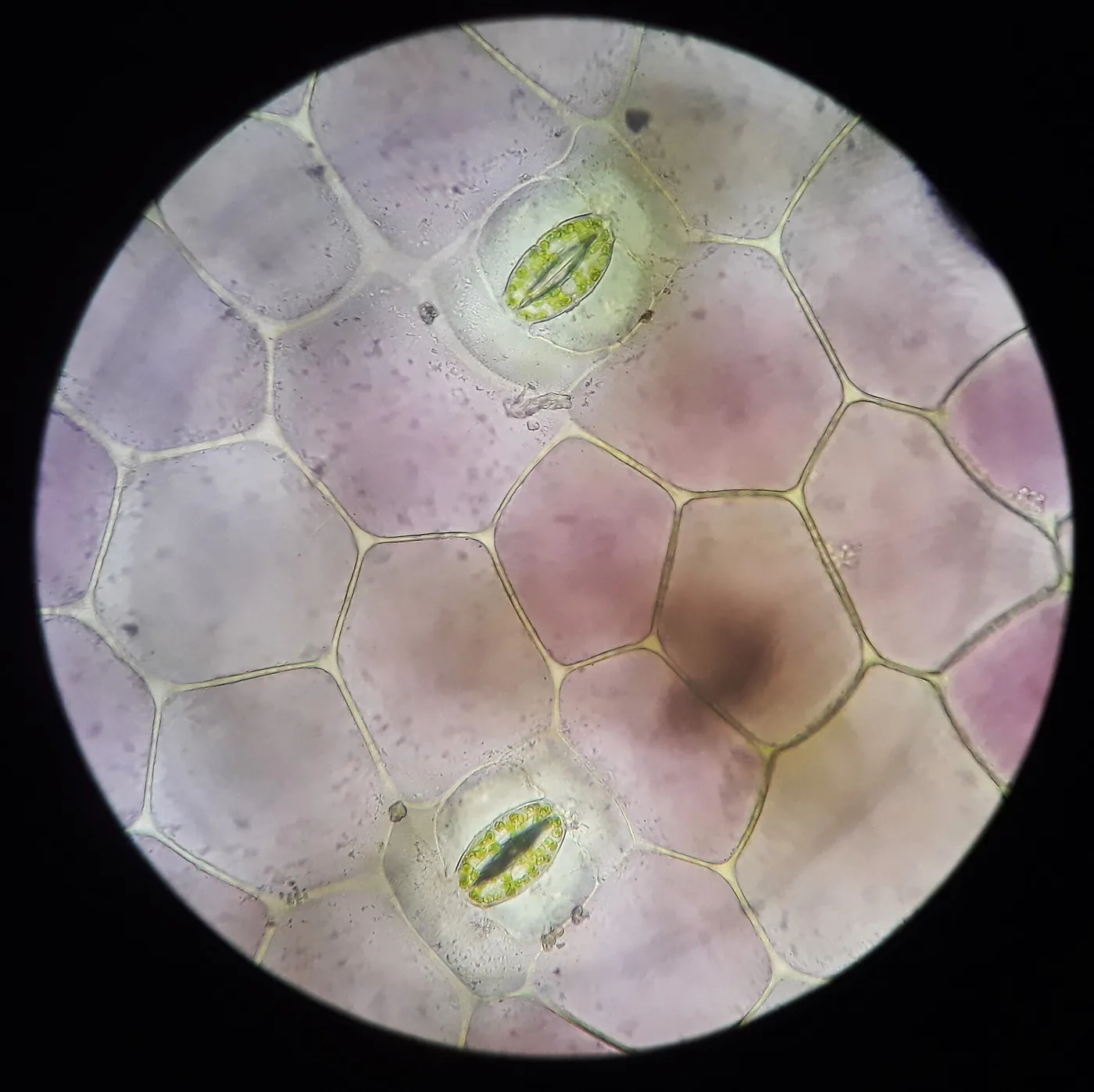
Guard cells work like a pair of inflatable pipes. Their inner walls, next to the pore, are thicker and less stretchy than their outer walls.
- Stoma open: water enters the guard cells by osmosis, so they become turgid. The thin outer wall stretches more than the thick inner wall, so the two cells bow apart and the pore opens.
- Stoma closed: when water leaves the guard cells they become flaccid, the cells straighten and the pore closes.
In most plants light is the main cue for opening. In the light, guard cells take up potassium ions and water follows by osmosis. In a drought, the plant hormone abscisic acid signals the guard cells to close the pores, saving water at the cost of slower photosynthesis. This is the trade-off mentioned earlier.
Factors affecting the rate of transpiration
Four environmental factors appear in every GCSE and A-level specification: light intensity, temperature, humidity and wind speed. For each one you should be able to give the effect and the explanation. The explanation earns the marks.
| Factor | Effect on transpiration rate | Why |
|---|---|---|
| Light intensity ↑ | Increases | Light makes the stomata open for photosynthesis, so more vapour can diffuse out |
| Temperature ↑ | Increases | Water evaporates faster and molecules diffuse faster. Warm air also holds more water vapour, so the gradient out of the leaf is steeper |
| Humidity ↑ | Decreases | The air already contains much water vapour, so the concentration gradient between leaf and air is shallower |
| Wind speed ↑ | Increases | Moving air carries away the humid layer around the leaf, keeping the gradient steep |
One extra point lifts an answer: the effects have limits. In very hot, dry conditions or when the soil is short of water, guard cells close the stomata and the rate falls even though the weather would favour a high rate.
A fan is switched on near a potometer. Predict and explain the change in the bubble’s speed. (3 marks)
The bubble moves faster. The moving air removes water vapour from around the leaf, which keeps the concentration gradient between the air spaces and the outside air steep. Water vapour therefore diffuses out faster, so the shoot takes up water faster.
Plants that save water: xerophytes
A plant living in a hot, dry, windy or salty habitat is called a xerophyte. Xerophytes have adaptations that reduce water loss by transpiration, and exam questions often ask you to link each adaptation to its effect. Nearly all of them work by making the diffusion path longer, the concentration gradient shallower or the surface area smaller.
- Thick waxy cuticle: a waterproof layer slows loss directly through the leaf surface.
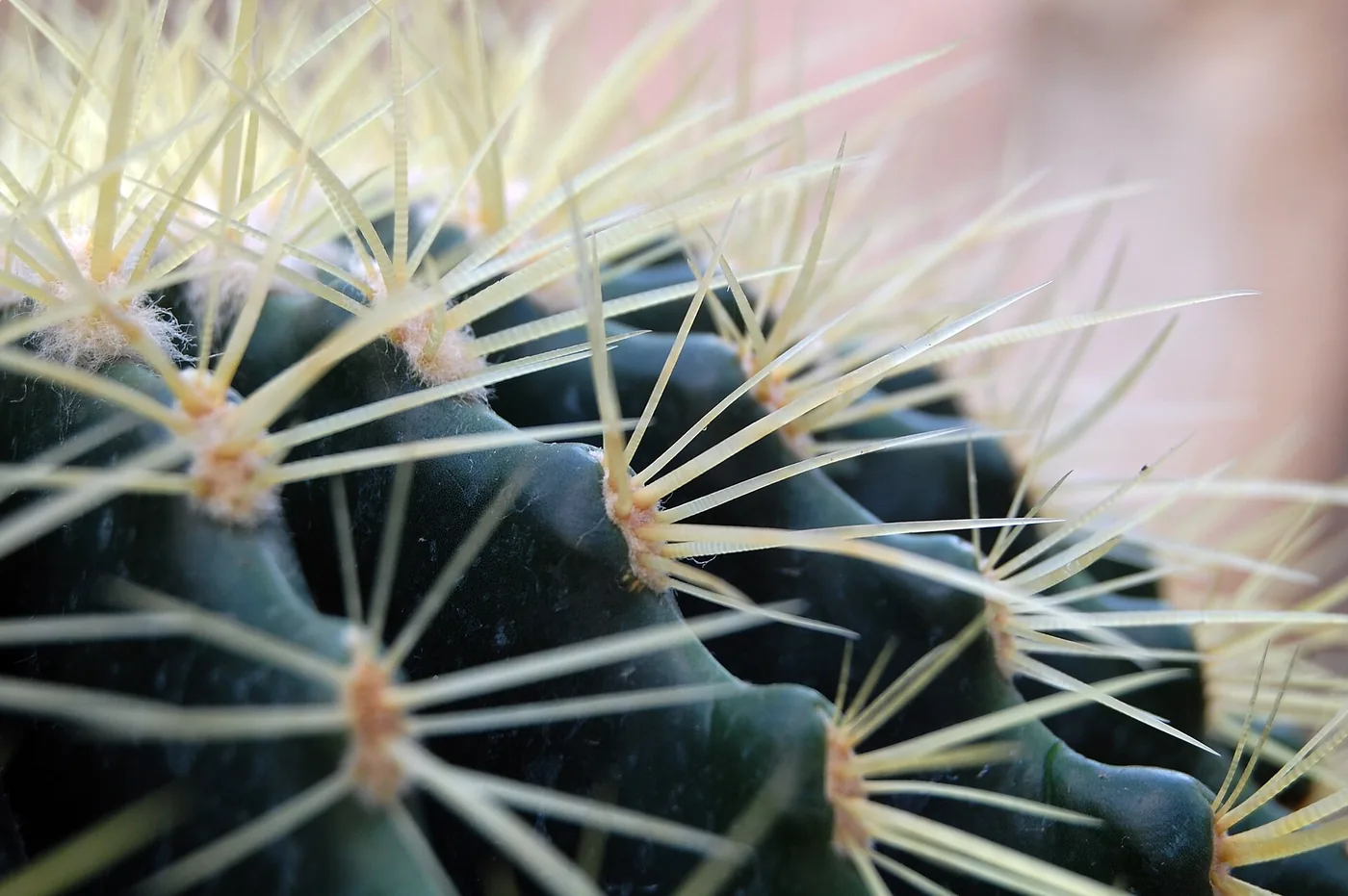
- Small or reduced leaves, such as spines: a smaller surface area means less area for evaporation. Cactus spines are modified leaves.
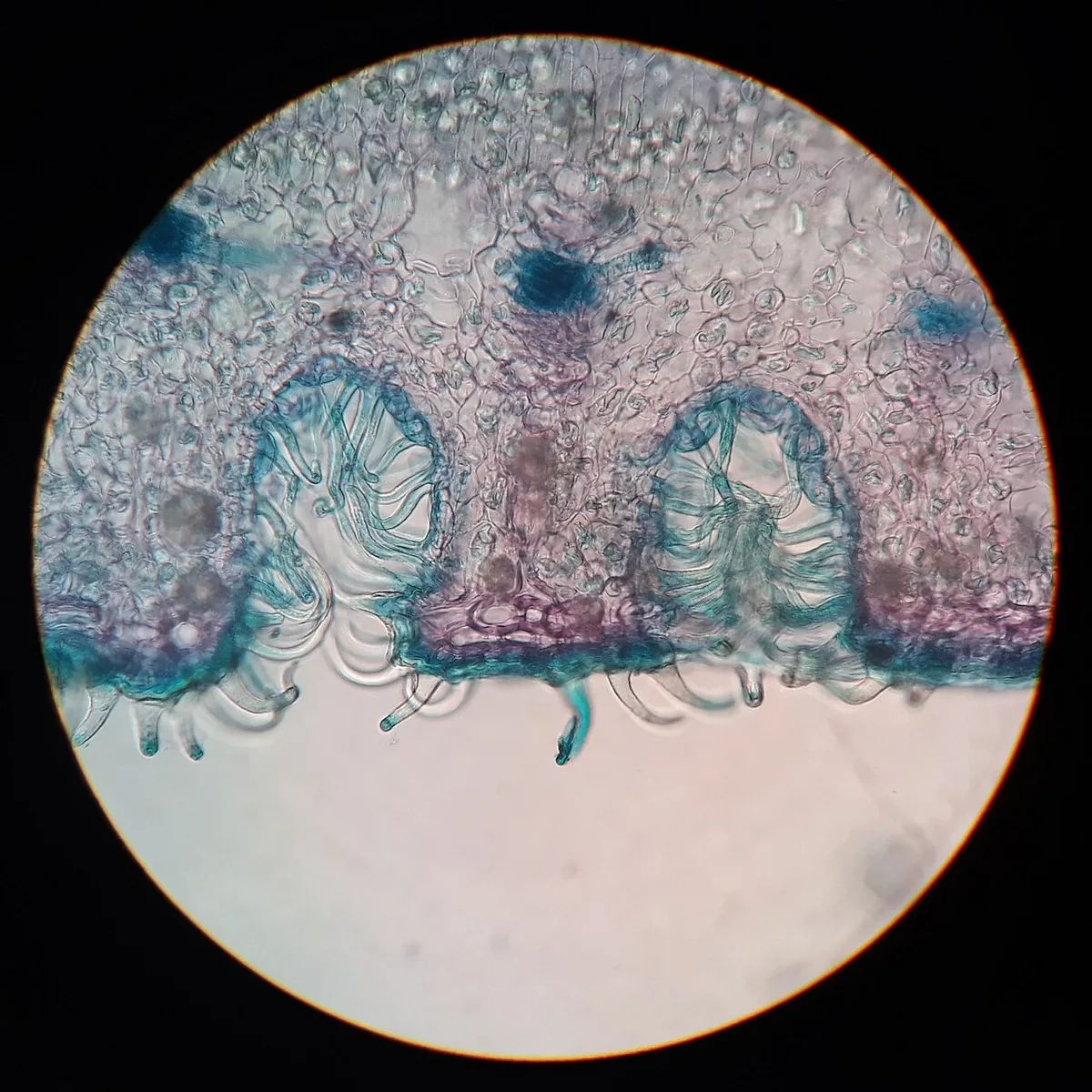
- Sunken stomata or stomatal crypts: stomata in pits trap a pocket of humid air next to the pore, so the gradient is shallower. Oleander is a well-known example, with hairs inside the crypts.
- Rolled leaves and hairs: marram grass on sand dunes rolls its leaves so that the stomata sit inside a humid space, and hairs trap moist air and reduce air movement.
- Water storage: cacti store water in swollen, fleshy stems.
- CAM photosynthesis: some succulents open their stomata at night, when it is cooler, and store carbon dioxide for use in the day, so the pores stay shut when evaporation would be greatest.
- Few stomata: fewer pores means fewer routes for vapour to escape.
The idea of surface area to volume ratio links these adaptations together. A flat, thin leaf has a large surface area for its volume, which suits light capture and gas exchange but also loses water. A round cactus stem has a much smaller surface area for its volume, so it loses water slowly and stores a lot. See also our guide to adaptations in plants and animals and in the cactus worksheet.
Why transpiration matters beyond the plant
Water vapour from leaves joins the air and eventually forms clouds, so plants are part of the water cycle. Wilting is the everyday sign of the balance tipping: when a plant loses water faster than the roots replace it, the cells lose turgor and the soft tissues sag. Watering restores the pressure.
Investigating transpiration with a potometer
A potometer measures how fast a leafy shoot takes up water. Because most of the water a shoot absorbs is lost by transpiration, the uptake is used as an estimate of the transpiration rate. As the shoot draws water in, an air bubble in a thin capillary tube moves along a scale, and the distance it travels in a measured time shows how fast the shoot is drinking.
- Cut a healthy leafy shoot from the plant under water and keep the cut end submerged, so no air enters the xylem.
- Assemble the potometer under water as well, so the tubing, reservoir and capillary are full of water with no air bubbles.
- Fit the shoot into the apparatus under water, then lift it out and make sure the joints are tight. Seal any gaps with petroleum jelly to stop leaks.
- Dry the leaves, because water on the surface would change the result.
- Introduce a single air bubble into the capillary tube, for example by lifting the end of the tube out of the water for a moment.
- Record the position of the bubble on the scale, start the timer and wait a fixed time, such as 10 minutes.
- Record the new position. Calculate the distance moved and the rate. Reset the bubble and repeat at least three times.
- Change one variable, such as switching on a fan or a lamp, and keep every other variable the same.
Calculating the rate
The bubble moves along a tube with a circular cross-section, so the water taken up forms a cylinder. Its volume is the area of the circle multiplied by the distance moved.
volume = πr² × distance moved
rate = volume ÷ time
Use the same units throughout. If the radius of the capillary is in millimetres and the distance in millimetres, the volume is in cubic millimetres (mm³). Try the calculator, or work the example by hand first.
Sources of error and how to reduce them
- Leaks or air in the system. Check every joint, assemble under water and seal with petroleum jelly.
- Air in the xylem. Cut the shoot under water, at a slant to give a larger area for uptake.
- Uptake is not the same as water loss. A little water is used in photosynthesis or stored in cells, so the potometer slightly overestimates the loss.
- Changing conditions. Light, temperature and draughts must be kept steady. Allow the shoot to settle before you start timing.
- Different shoots. Leaf area differs from one shoot to the next, so for fair comparisons divide the rate by the leaf area (for example mm³ per cm² per minute), or use the same shoot for every test.
Maths practice: potometer and transpiration questions
Try each question before opening the answer. Numbers are made up for practice.
1. The capillary tube has a radius of 0.5 mm. The bubble moves 30 mm in 10 minutes. Calculate the volume of water taken up and the rate in mm³ per minute. (3 marks)
Volume = π × 0.5² × 30 = π × 0.25 × 30 ≈ 23.6 mm³. Rate = 23.6 ÷ 10 ≈ 2.36 mm³ per minute.
2. With a fan on, the bubble moves 60 mm in 10 minutes in the same tube. Calculate the rate and the percentage increase compared with question 1. (3 marks)
Volume = π × 0.25 × 60 ≈ 47.1 mm³, so the rate ≈ 4.71 mm³ per minute. Percentage increase = (4.71 − 2.36) ÷ 2.36 × 100 ≈ 100 %. The fan doubles the rate.
3. A shoot has a total leaf area of 40 cm² and takes up 141 mm³ of water per hour. Calculate the rate per cm² of leaf. (2 marks)
141 ÷ 40 ≈ 3.5 mm³ per cm² per hour.
4. A potted plant loses 4.5 g of water in 3 hours. It had a mass of 90 g. Calculate the percentage of its mass lost and the rate per hour. (3 marks)
Percentage lost = 4.5 ÷ 90 × 100 = 5 %. Rate = 4.5 ÷ 3 = 1.5 g per hour.
If you want more practice with the maths skills that GCSE biology papers use, see the guide to improving your maths in GCSE cell biology.
What is in guttation fluid, and can it cause harm?
Guttation drops are mostly water, with dissolved mineral salts such as potassium, calcium and magnesium, plus sugars and other organic compounds. The exact mixture depends on the plant and the soil. Because the drops come from the xylem, anything dissolved in the xylem can end up in them.
Two well-documented effects are worth knowing about, though neither is a reason to worry about ordinary garden guttation.
- Plant disease. Bacteria can use the hydathodes as an entrance. The black rot bacterium of cabbage and related crops, Xanthomonas campestris pv. campestris, enters through hydathodes at the leaf margin, which is why black rot lesions are V-shaped from the edge of the leaf.
- Insects. Guttation drops can be a drink for insects. In a 2009 study in the Journal of Economic Entomology, Girolami and colleagues found that drops from maize grown from neonicotinoid-coated seed contained high concentrations of the insecticide, up to 200 mg/L for imidacloprid, and that bees given such drops died within minutes. Critics note that the bees were fed the drops directly, so the study does not show how often bees take such drops in real fields.
Test yourself
Frequently asked questions about transpiration and guttation
What is the main difference between transpiration and guttation?
Transpiration is the loss of water as vapour, mainly through stomata, and it is driven by evaporation and diffusion. Guttation is the loss of liquid water droplets through hydathodes, driven by root pressure. Transpiration happens mostly in the day, while guttation is more common at night or in the early morning.
What is guttation in plants?
Guttation is the release of liquid water, containing dissolved minerals and sugars, from pores called hydathodes at the edges and tips of leaves. It happens when the soil is moist and transpiration is low, so root pressure pushes water up the xylem and out of the leaf.
Is guttation the same as dew?
No. Dew is water vapour from the air that condenses on a cool surface, so it appears on all sorts of objects. Guttation is liquid pushed out of the plant itself, so the drops are found at hydathodes, typically at leaf tips and margins, and they contain dissolved substances from the plant.
Why does guttation happen at night?
At night the stomata are mostly closed and the air is often humid, so very little water is lost by transpiration. The roots continue to move ions into the xylem, water follows by osmosis, and the resulting root pressure forces drops of water out through the hydathodes.
What is the transpiration stream?
The transpiration stream is the continuous movement of water from the roots through the xylem to the leaves, where it evaporates. Cohesion between water molecules and tension created by evaporation pull the water upwards, so the whole column of water moves together.
What factors affect the rate of transpiration?
Higher light intensity, higher temperature and faster wind speed increase transpiration, while higher humidity decreases it. Light opens the stomata, warmth speeds evaporation, wind removes humid air near the leaf, and humid air makes the concentration gradient of water vapour shallower. Severe water shortage closes the stomata.
How do you calculate the rate of transpiration with a potometer?
Measure the distance the bubble moves in a known time. Work out the volume of water taken up using volume = πr² × distance, where r is the radius of the capillary tube. Then divide the volume by the time to give the rate, for example in mm³ per minute.
Why do you cut the shoot under water in a potometer experiment?
Cutting under water stops air from entering the xylem. An air bubble in the xylem would break the continuous column of water, so the shoot could not draw water up properly. This would make the readings unreliable and the potometer would not measure true uptake.
Can guttation be harmful?
Usually it is harmless, but the drops are not pure water. Some bacteria, such as the cabbage black rot bacterium, enter through hydathodes. Drops from plants grown from neonicotinoid-coated seeds were found to contain high insecticide concentrations in one 2009 study, which also reported that bees died after drinking them.
How do xerophytes reduce water loss?
Xerophytes reduce transpiration using adaptations such as a thick waxy cuticle, small or spiny leaves, sunken stomata, rolled leaves, hairs and water-storing stems. Some, like cacti, open stomata at night. Each adaptation reduces surface area, lengthens the diffusion path or makes the water vapour gradient shallower.