
An evaluation argument is a claim about how good or bad something is, backed by stated standards (criteria) and evidence. Instead of simply describing a topic, you make a judgement and defend it. Throughout this article we use one running example: are solar panels a good way to generate electricity?
What is an evaluation argument?

If you are asking what is an evaluation argument, the short answer is this: it is a piece of reasoning that answers the question “How good or bad is it?” Writing guides describe evaluation arguments as claims about the quality of something, usually rating it somewhere between positive and negative. You will also see the same idea called an evaluative argument. The two names mean the same thing, and the evaluation argument definition does not change between them.
Two features make it different from an opinion. First, the writer says what “good” means by choosing criteria. Second, every criterion is supported by evidence. “I like it” is a taste. “It performs well on these three standards, and here is the data” is an evaluation.
You do this all the time. Is a revision method a good one? You might judge it on how much you remember afterwards, how long it takes and whether you can stick with it. That is already an evaluation argument in miniature, and it works the same way for bigger questions. Are solar panels a good way to generate electricity? Is a new vaccine effective? Is a plastic bag worse than a cotton one? Each question needs standards, a verdict and proof.
It is also not a report. A report says what is there. An evaluation says what it is worth, and why. This habit of weighing claims is a core part of critical and logical thinking, which is why examiners ask for it so often in science.
Many websites explain evaluation arguments using films, restaurants and phones. Here we use science, because that is where the skill is tested for GCSE students, and because real numbers make the reasoning easier to check.
The three parts of an evaluation argument: criteria, judgement and evidence

Every strong evaluation argument has the same three parts. Learn these and you can build one for almost any subject.
- Criteria are the standards you use to decide what counts as good or bad. They must be defined and justified, not just assumed.
- Judgement is your verdict on how far the subject meets those standards.
- Evidence is the support for each criterion: measurements, data, studies or reliable sources.
Here they are applied to the solar panel example. The numbers come later, in the worked examples.
| Part | Question it answers | Solar panel example |
|---|---|---|
| Criteria | What makes this a good choice? | A good electricity source has low emissions, supplies power when it is needed, and costs a reasonable amount. |
| Judgement | How far does it meet those standards? | Very good on emissions, weaker on supplying power on demand, acceptable on cost. |
| Evidence | What facts support each judgement? | Lifecycle emissions, how much electricity panels actually generate, and how long they take to pay back (figures below). |
Notice that the judgement is not “solar panels are good”. It is a verdict for each criterion, which then feeds into an overall conclusion. That is what separates a reasoned evaluation from a slogan.
Three kinds of criteria: operational, moral and aesthetic
Not all standards are the same sort of thing. Writing guides usually sort criteria into three types.
- Operational criteria are about practical function and results. For example, a car’s safety, or how effective a vaccine is.
- Moral criteria are about right and wrong.
- Aesthetic criteria are about appearance or appeal.
Most science evaluations lean on operational criteria because they can be tested. Moral and aesthetic criteria still matter, especially when science meets society, but they are harder to prove with measurements. A good writer says which type of criterion they are using, so the reader knows what kind of evidence to expect.
Test yourself with the cards below. Decide which type of criterion each question uses, then tap to check.
How an evaluation argument differs from other arguments
An evaluation is one of several kinds of argument. A well-known composition textbook lists four: definition, evaluation, causal and proposal. Knowing which one you are writing keeps your essay focused.
| Type | Question it answers | Science example |
|---|---|---|
| Definition | What is the nature of this thing? | Is a virus a living thing? |
| Evaluation | How good or bad is it? | How good a way to generate electricity are solar panels? |
| Causal | Does one thing cause another? | Does burning fossil fuels cause global warming? |
| Proposal | What should we do? | Should every new house have solar panels? |
An argumentative essay is the wider family: any essay that defends a position. An evaluation argument is a specific kind, where the position is a judgement of quality. In practice the types overlap. A proposal usually rests on an evaluation (“we should do this because it is the best option”), so being able to evaluate well helps with every other type.
How to write an evaluation argument in five steps
Start by choosing your criteria, because every step below depends on them. Then follow the five steps on the card. We will keep using solar panels as the example.
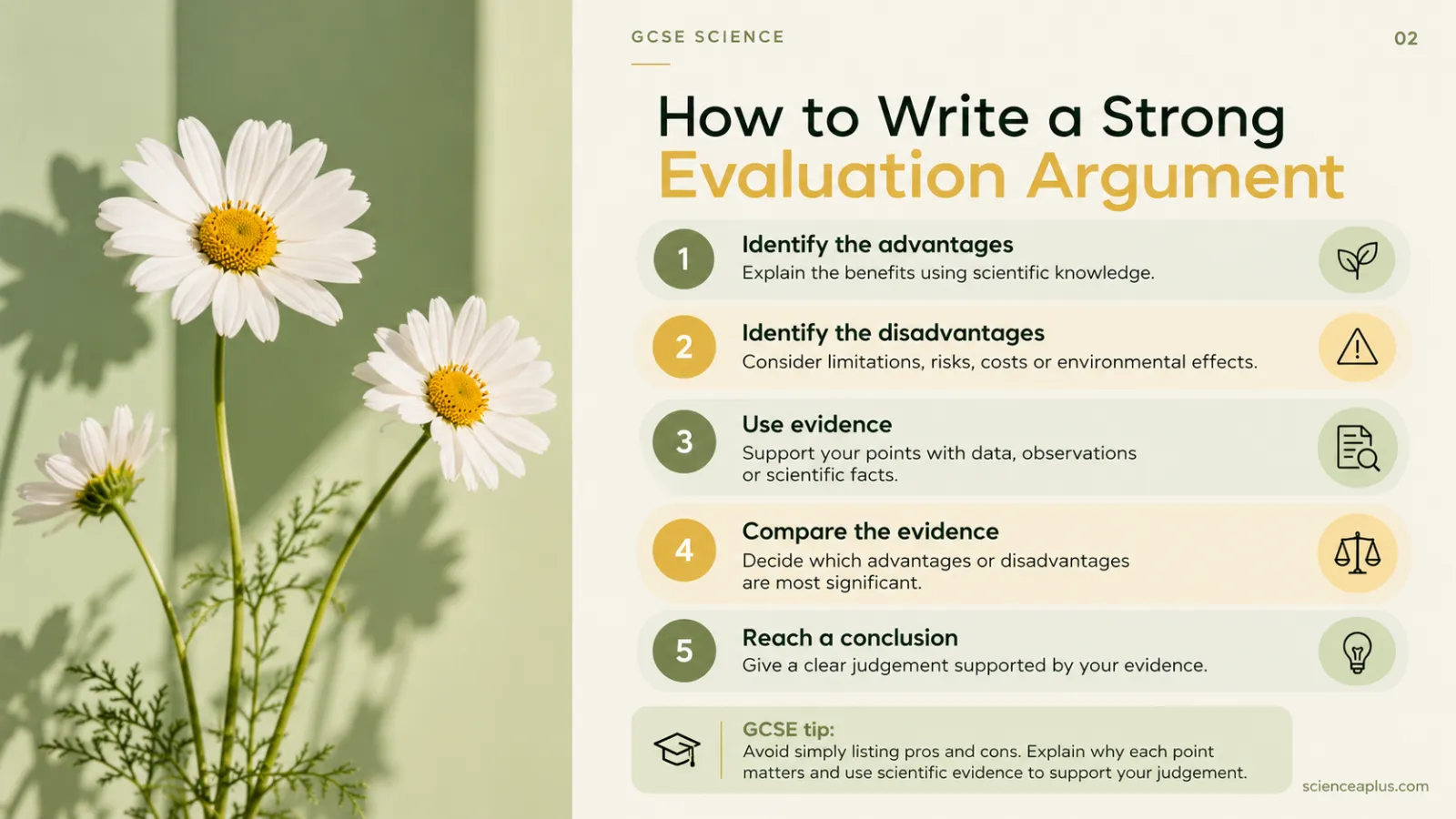
1. Identify the advantages
List what the subject does well against your criteria. For rooftop solar panels, an advantage is that they generate electricity without burning fuel. Keep each advantage tied to a criterion, otherwise the list drifts into general facts.
2. Identify the disadvantages
Do the same for the weaknesses. Solar panels only generate when there is light, so their output rises and falls with the weather and the seasons. They also cost money upfront. A fair evaluation names the weaknesses honestly instead of hiding them.
3. Use evidence
Every advantage and disadvantage needs support. In science that usually means numbers with units, a named source and a date. “Panels are cheap to run” is a claim; a measured figure from a named organisation is evidence. If your evidence has limits (an old study, a small sample), say so.
4. Compare the evidence
This is the step that earns most of the credit, and the one students skip. Do not leave the points side by side. Decide which matters most and explain why. Is a low-emissions source worth more than one that is available at all times? Your answer depends on the criteria you ranked in step one. This is also where critical thinking shows: you are weighing evidence, not just collecting it.
5. Reach a conclusion
State your verdict clearly, with the main reason. “Overall, rooftop solar is a strong way to cut emissions, but it works best alongside other sources” is a verdict. “There are good and bad points” is not. A good conclusion repeats the judgement and its strongest reason without adding brand new evidence.
What “evaluate” means in GCSE science
Everything above is the composition idea. In GCSE science, the same skill hides behind one command word. The AQA specification defines it like this: “Evaluate: Students should use the information supplied, as well as their knowledge and understanding, to consider evidence for and against when making a judgement.” (AQA GCSE Science command words, version 1.6, May 2025.)
Read that definition against the three parts. “Information supplied” and “knowledge” are the evidence. “For and against” is the advantages and disadvantages. “Making a judgement” is the conclusion. An evaluate question is an evaluation argument with a mark scheme.

The AQA Combined Science: Trilogy specification (8464) asks students to “evaluate associated personal, social, economic and environmental implications; and make decisions based on the evaluation of evidence and arguments” (working scientifically skill WS 1.4). That means the skill appears in questions about energy, health, materials and the environment, not only in practical work.
AQA says extended response questions are worth 4 or 6 marks and typically use command words including evaluate. Its guidance adds that tabulating an answer can be “particularly helpful” for compare or evaluate questions, and its praised example was “a clearly laid out evaluation, with a judgement that is supported by reasons”.
One revision site, Cognito, suggests that a 6-mark answer usually runs to about 6 to 10 sentences, with two or three developed Point–Evidence–Explanation chains written in full sentences. Treat that as a revision site’s advice, not an exam board rule. Other UK exam boards use similar command words, but the exact definitions differ, so check the list for your own board and specification. For the wider skill of building an answer, see our guide to how to write a science essay.
Evaluation argument essay outline
If you are writing a full evaluation argument essay rather than an exam answer, this outline keeps the three parts in order. In an evaluative essay the thesis states your final judgement and the reasons behind it, so it works as the roadmap for everything that follows. Good criteria are relevant and observable (or at least determinable).
- Introduction. Name the subject, state your criteria and give your verdict. This is your thesis.
- Background, only if needed. Give the reader just enough context to follow the evidence.
- One paragraph per criterion. Judge the subject on that criterion, with evidence. Put your strongest criterion last so the essay builds.
- The best counterargument and your reply. Show you have considered the other side, then explain why your verdict still stands.
- Conclusion. Repeat the verdict with its main reason. Do not add new evidence.
A sample thesis for the solar example: “Rooftop solar is a good choice for lowering emissions, but a weaker one for meeting demand on winter evenings, so it works best alongside other sources.” It names the subject, shows two criteria and gives a verdict, all in one sentence.
Words and sentence starters for an evaluation argument
Evaluative language is how your judgement shows up on the page. The table groups useful words by the job they do.
| Job | Useful words | Sentence starter |
|---|---|---|
| Judging value | effective, significant, limited, reliable | “This is an effective way to cut emissions because…” |
| Comparing | whereas, outweighs, more than, less than | “The emissions benefit outweighs the cost because…” |
| Conceding | although, despite, however | “Although the upfront cost is high, …” |
| Qualifying | in most cases, where, depends on | “This depends on how much sunlight the site receives.” |
| Concluding | overall, on balance, therefore | “On balance, the evidence suggests…” |
Evaluation argument examples: worked science answers
Definitions only go so far, so here are two worked evaluation argument examples with real figures, each with the criteria stated and a verdict at the end. Check the date and source of every number; a good evaluation always does.
Example 1: evaluate the use of solar panels
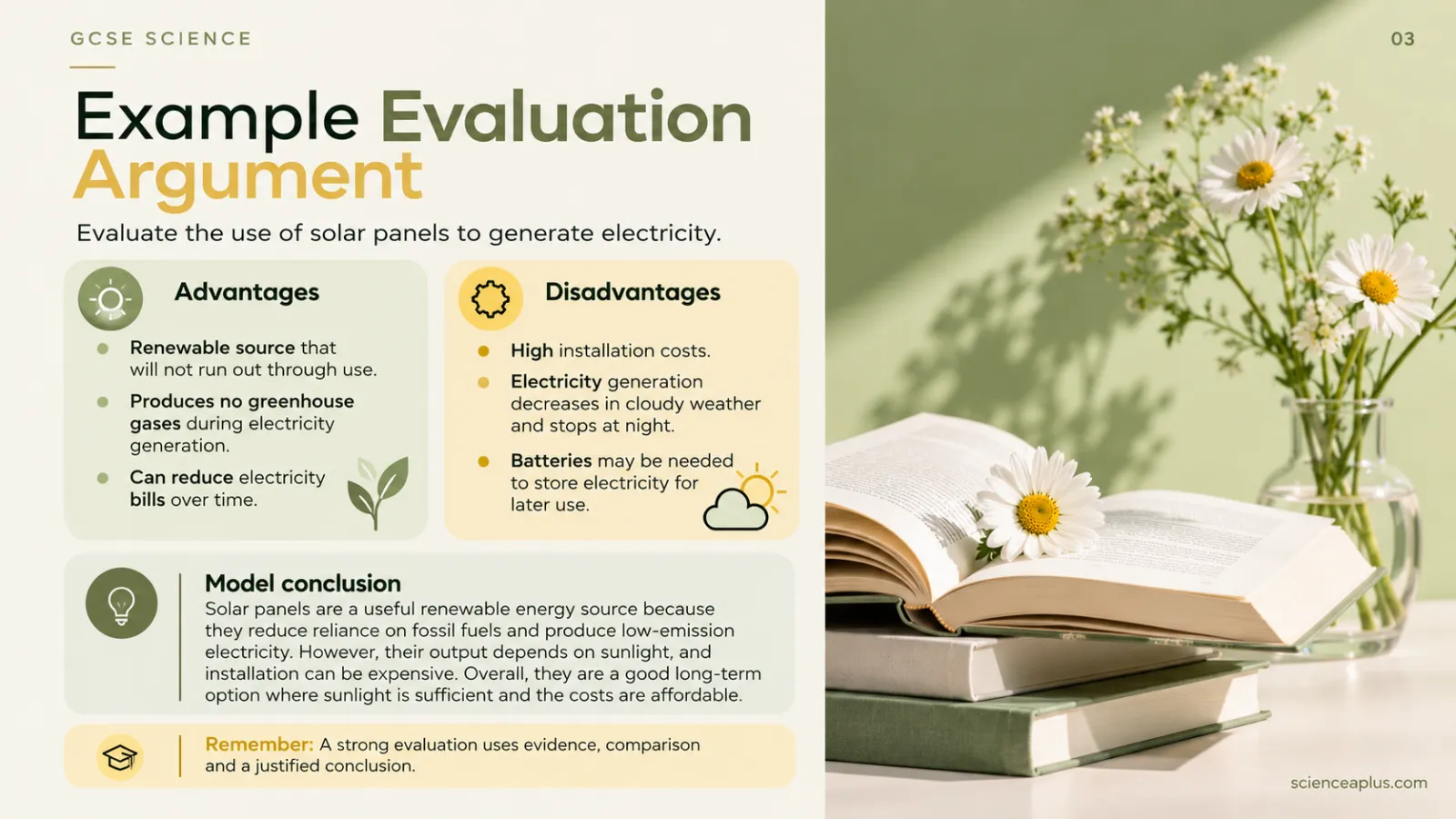
Our criteria are low emissions, availability and cost. The evidence table below gathers one set of figures for each. The sources are the IPCC (2014), the UK government’s Digest of UK Energy Statistics (published July 2026) and MoneySavingExpert, which cites the Energy Saving Trust (updated September 2026).
| Criterion | Evidence | What it suggests |
|---|---|---|
| Emissions | Median lifecycle emissions in g CO₂e per kWh (IPCC, 2014): coal 820, gas (combined cycle) 490, rooftop solar 41, utility solar 48, nuclear 12, onshore wind 11, offshore wind 12. | Rooftop solar is about 12 times lower than gas and about 20 times lower than coal. Wind and nuclear are lower still. |
| Availability | UK load factor (DUKES, 2026): solar 11.08% in 2025 and 9.22% in 2024; onshore wind 24.02% and offshore wind 36.12% in 2025. | Solar generated far less than its full-power maximum, and less than wind, so other sources must fill the gaps. |
| Cost | A typical 4.5 kWp home system costs about £7,600. Break-even is about 9 years in London, 9–10 in Aberystwyth and 11–12 in Stirling. The inverter will likely need replacing within about 10 years, at around £800. | The payback is shorter than the panels’ lifespan of around 25 years or more, but it varies by location. |
A few notes help you read the table like a scientist. Load factor is the electricity actually generated as a percentage of what the equipment would generate running at full power all year. It varies from year to year with the weather, which is why two years are shown. The cost figures assume typical use of 2,500 kWh a year, a 15p per kWh export payment and no maintenance or repair costs, so real figures vary and this is not buying advice. The emissions figures are 2014 medians across many studies.
The card above says solar panels produce “no greenhouse gases”. That is true for generation only. In the IPCC table, solar’s direct emissions are zero, but making the panels and supplying the materials gives it a lifecycle footprint of about 41 g CO₂e per kWh. “Low-carbon” is therefore a more accurate phrase than “no emissions”. For more on the technology, read how solar panels work and the pros and cons of solar energy. To see the same criteria applied to a different source, try the advantages and disadvantages of wind energy.



Weak and strong versions
A weak answer: “Solar panels are renewable but expensive, so they are good and bad.” It has no criteria, no evidence and no verdict.
A strong answer: “Rooftop solar panels are a strong way to cut emissions but cannot supply the grid alone. Their median lifecycle emissions, about 41 g CO₂e per kWh, are roughly twelve times lower than gas. However, the UK load factor was only about 11% in 2025, so other sources must supply electricity at night and on dull days. Cost matters to households, but a break-even of about 9 to 12 years is shorter than the panels’ lifespan of around 25 years. Overall, the emissions benefit outweighs the drawbacks, provided solar is used alongside other sources.”
The strong version names each criterion, gives a figure with units, concedes a weakness with “however”, compares the points and ends with a verdict.
Weigh it yourself
Scores and weights are where your judgement enters an evaluation. The calculator below starts with illustrative scores comparing rooftop solar with a gas power station. They are not measurements, so change them, or type in your own two options and your own scores for each criterion. Watch what happens when you change the weights.
The default result is the lesson. With equal weights the two options tie, but weighting low emissions as the most important criterion tips the verdict to solar. Neither answer is “correct”; what makes the evaluation sound is that you can justify your weights with evidence.
Example 2: evaluate cotton bags and plastic carrier bags
This example comes from a government life cycle study, so the evidence is unusually detailed. The Environment Agency (2011) compared carrier bags available in 2006 by their global warming potential. It found that paper, LDPE plastic, non-woven polypropylene and cotton bags would each have to be reused at least 3, 4, 11 and 131 times respectively to have a lower global warming potential than a conventional HDPE carrier bag that is not reused. If 40.3% of the HDPE bags were reused as bin liners, those figures rose to 4, 5, 14 and 173.
The surprise is why. With no reuse, the HDPE bag had the lowest impacts in eight of the nine categories studied, because it was the lightest bag. One criterion therefore favours the thin plastic bag unless a heavier bag is used many times.
But a good evaluation also states what the evidence leaves out. The report does not consider the effects of litter or of changes in consumer behaviour, and the bags date from 2006. So the sensible verdict depends on your criterion. On climate impact alone, the best advice is to keep reusing whatever bag you already own. On litter, this study cannot answer the question. For the environmental side of the argument, see the disadvantages of plastics.
Practise with exam-style questions
Try to write your own answer before you open the model response. Aim for criteria, evidence and a verdict.
Evaluate replacing plastic carrier bags with cotton bags, on global warming potential alone. (4 marks)
A cotton bag has a lower global warming potential than a single-use HDPE carrier bag only after about 131 uses, according to the Environment Agency study (2011, using 2006 bags). Until then the plain plastic bag has the lower impact, mainly because it is lighter. If the plastic bag would have been reused as a bin liner, the break-even rises to about 173 uses. Judgement: replacing is worthwhile only if the cotton bag is used well over 131 times; litter is not considered in this comparison.
A student says solar panels produce no greenhouse gases. Evaluate this claim. (3 marks)
The claim is true for direct emissions while the panels generate electricity. However, manufacture and the supply chain mean the median lifecycle emissions are about 41 g CO₂e per kWh (IPCC, 2014). That is far lower than gas at 490 g CO₂e per kWh, so solar is best described as low-carbon rather than as producing no emissions.
How to evaluate an experiment
In practical science, the thing you evaluate is often your own method and results. The same three parts apply: your criteria are the quality of the data, your evidence is the results table, and your judgement is how far the results support your conclusion. AQA’s specification asks students to evaluate data “in terms of accuracy, precision, repeatability and reproducibility” (working scientifically skill WS 3.7), so these words need to be exact.


| Term | AQA meaning | Question to ask |
|---|---|---|
| Accurate | Judged to be close to the true value. | How close is the result to the accepted value? |
| Precise | Very little spread about the mean. It says nothing about closeness to the true value. | Are the repeat readings close together? |
| Repeatable | The original experimenter repeats the investigation with the same method and equipment and gets the same results. | Did I get the same results when I did it again? |
| Reproducible | Another person, or different equipment or techniques, gets the same results. | Would someone else get the same results? |
| Fair test | Only the independent variable has been allowed to affect the dependent variable. | Did I control everything else? |
| Anomaly | A value judged not to be part of the variation caused by random uncertainty. | Does any reading stand out from the rest? |
Here is a made-up example. A student times how long it takes to collect 50 cm³ of gas in four runs of the same reaction and records 41 s, 43 s, 42 s and 58 s. Enter the readings in the calculator, or change them to your own.
The judgement writes itself from the evidence. Three readings are close together, which suggests the method is repeatable. The 58 s reading is a possible anomaly, so the next step is to look for a reason (a leaking bung, a late start of the timer) rather than simply delete it. Only ignore a result you can explain. For the full process of planning and testing a hypothesis, see how to use the scientific method.
How to evaluate a source: 12 children or 657,461?
Evaluation arguments are not only about objects and experiments. You can also evaluate the evidence itself. A well-known case shows how. This section is educational and gives no medical advice; questions about vaccines are for a GP or NHS 111.
In 1998, The Lancet published a paper by Wakefield and colleagues describing a series of 12 children. The parents linked the onset of behavioural symptoms to the MMR vaccine in eight of them. The Lancet retracted the paper in 2010.
In 2019, Hviid and colleagues published a study in the Annals of Internal Medicine of 657,461 children born in Denmark between 1999 and 2010. In that group, 6,517 were diagnosed with autism. The adjusted hazard ratio for MMR vaccination was 0.93 (95% confidence interval 0.85 to 1.02), and the authors concluded that the study strongly supports that MMR vaccination does not increase autism risk.
Use the three parts to compare them. Take sample size as a criterion: 12 children cannot support a general claim in the way 657,461 can. Take the quality of the link as another: the first paper described a small series in which parents linked symptoms to the vaccine, while the second compared outcomes across a very large group of Danish children. Take the status of the paper as a third: one was retracted, the other stands. A good evaluation still notes limits. The Danish authors state that individual medical charts were not reviewed, and no single study is perfect.
The NHS puts it plainly: “Research has shown there is no link between the MMR vaccine and autism.” The lesson for any science answer is to ask how big the sample is, whether the work was checked and corrected, and whether many studies agree.
Evaluation argument topics for science
Practice makes the steps automatic. These prompts are questions only, so you must find the evidence yourself. For each one, choose three criteria, rank them, and write a verdict. You can build a revision timetable around them using our guide on how to start revising for GCSE science.
| Topic | Criteria to try |
|---|---|
| Electric cars or petrol cars? | Lifecycle emissions, running cost, range |
| Nuclear power or wind power? | Emissions, reliability of supply, waste, public acceptance |
| LED bulbs or filament bulbs? | Energy use, lifetime, cost over time |
| Recycling or reusing plastic? | Energy used, waste avoided, practicality |
| A home water filter or tap water? | Cost, taste, evidence for any health benefit, waste from cartridges |
| Biofuels or petrol? | Emissions, land use, cost |
| A field trip or a virtual lab? | Quality of data, cost, safety, learning gained |
| Flashcards or rereading for revision? | Recall in a test, time taken, effort |
Before you finish: evaluation argument checklist
Tick these off before you hand in an essay or an exam answer. Your ticks are saved in your browser.
- I stated my criteria.
- I gave evidence for and against.
- My numbers have units and a source.
- I said which point matters most.
- I explained why it matters most.
- I gave a clear verdict.
- My conclusion has no brand new points.
- I used the information given in the question.
Frequently asked questions about evaluation arguments
What is an evaluation argument?
An evaluation argument is a claim about how good or bad something is, supported by clear criteria and evidence. The writer decides what counts as “good” (the criteria), judges how far the subject meets those standards, and backs each judgement with facts. It differs from a simple description because it ends in a verdict.
What are the three parts of an evaluation argument?
The three parts are criteria, judgement and evidence. Criteria are the standards you use, such as cost, safety or emissions. The judgement is your verdict on how far the subject meets them. Evidence is the support for each criterion, for example measurements, data or studies from reliable sources.
What is an example of an evaluation argument?
Evaluating solar panels is a good example. You might choose low emissions, availability and cost as criteria, then use evidence such as lifecycle emissions, UK load factors and break-even times. Your conclusion could be that rooftop solar is strong on emissions but works best alongside other sources, because it cannot supply the grid alone.
How do you write an evaluation argument?
Choose and rank your criteria, then follow five steps: identify the advantages, identify the disadvantages, use evidence, compare the evidence and reach a conclusion. The comparison step matters most, because you must say which points carry the most weight and why. Finish with a clear verdict instead of a list of pros and cons.
What is the difference between an evaluation argument and an argumentative essay?
An argumentative essay is the wider category: any essay that defends a position. An evaluation argument is one kind, where the position is a judgement about quality. It focuses on criteria and evidence, whereas other argumentative essays might prove a cause, define a term or propose a plan.
Is an evaluative argument the same as an evaluation argument?
Yes. Evaluative argument and evaluation argument are two names for the same thing: an argument that judges how good or bad something is. Some textbooks say “evaluative essay” or “argument of evaluation”. The structure stays the same, with criteria, a judgement and evidence supporting that judgement.
What does evaluate mean in GCSE science?
For AQA GCSE Science, evaluate means using the information supplied, plus your own knowledge and understanding, to consider evidence for and against when making a judgement. You must weigh both sides and reach a decision. Other exam boards use similar command words, but their exact definitions vary, so check yours.
How do you answer an evaluate question in a science exam?
Read the information supplied, then give points for and against, each with evidence from the question or your knowledge. Say which side is stronger and why, then finish with a clear judgement. AQA says a table can be particularly helpful, but the answer still needs a judgement supported by reasons.
What words can I use in an evaluation argument?
Useful words include effective, significant and limited for judging value; whereas and outweighs for comparing; although and however for conceding; and overall, on balance and therefore for concluding. Always follow an evaluative word with “because” and a piece of evidence, or it remains only an opinion.