To write a science essay, answer the exact question set, build an argument from reliable evidence, plan it as an introduction, a few focused body paragraphs and a conclusion, then check every fact, unit and reference before you submit. A good science essay does not list everything you know. It makes a clear claim and proves it step by step.
This guide is written for GCSE, A-level and first-year university students. It follows four main steps (understand, research, plan, write), then covers referencing, plagiarism, responsible use of AI and a final checklist. Along the way you will find a worked paragraph, a look at how GCSE six-mark answers are marked and a quiz to test yourself.
What makes a science essay different from other essays?
An English essay can rest on interpretation. A science essay rests on evidence. Every claim should be something you can support with data, an experiment, a well-established theory or a trustworthy source, and every explanation should use correct scientific ideas.
That changes how you write. You use precise terms (diffusion, not “things spreading out”), you quote numbers with units, and you separate what the evidence shows from what you think it might mean. If you want a deeper look at weighing evidence, read our guide on why critical thinking is important for science students.
Your thesis is the central answer to the question, in one or two sentences. It must be something that can be supported, not just a matter of opinion. “Antibiotic resistance is mainly driven by overuse of antibiotics” is a thesis. “Antibiotics are interesting” is not.
Step 1: Understand the question
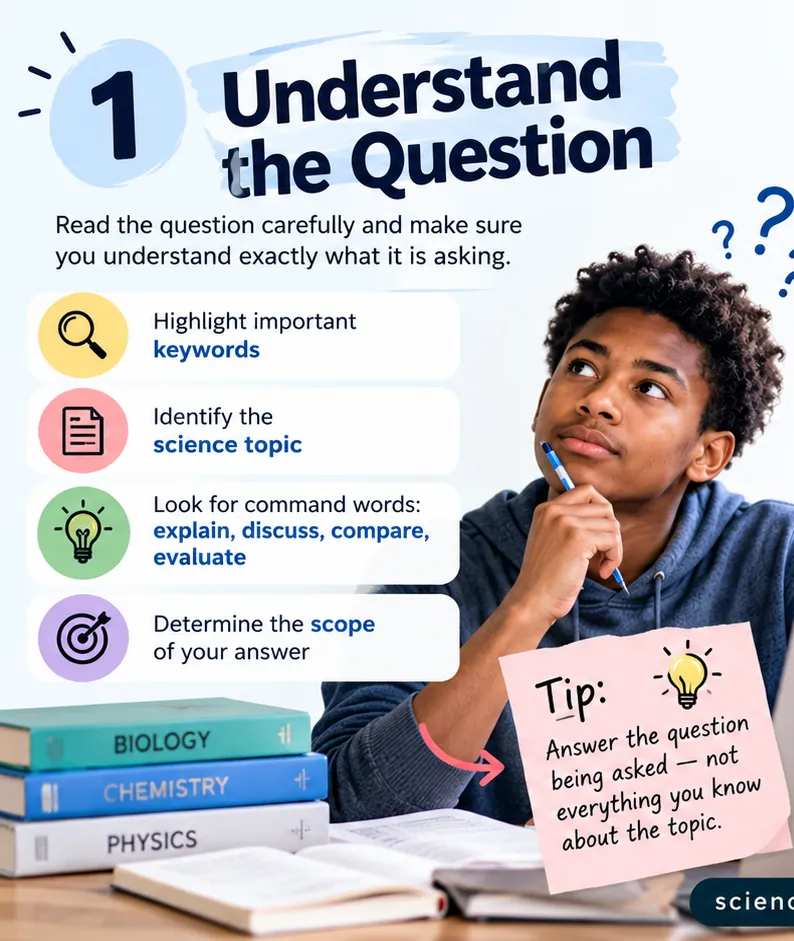
Most lost marks in science essays come from answering a different question from the one that was asked. Spend the first few minutes reading the title slowly, at least twice.
- Underline the keywords. These are the science terms the essay must cover, such as “natural selection”, “greenhouse effect” or “enzyme”.
- Name the topic area. Is it biology, chemistry or physics, or does it cross over? That tells you which ideas and vocabulary to use.
- Circle the command word. This tells you what to do with the content (more on this below).
- Decide the scope. Look for limits such as a time period, an organism, a place or a single process. Anything outside those limits is a distraction.
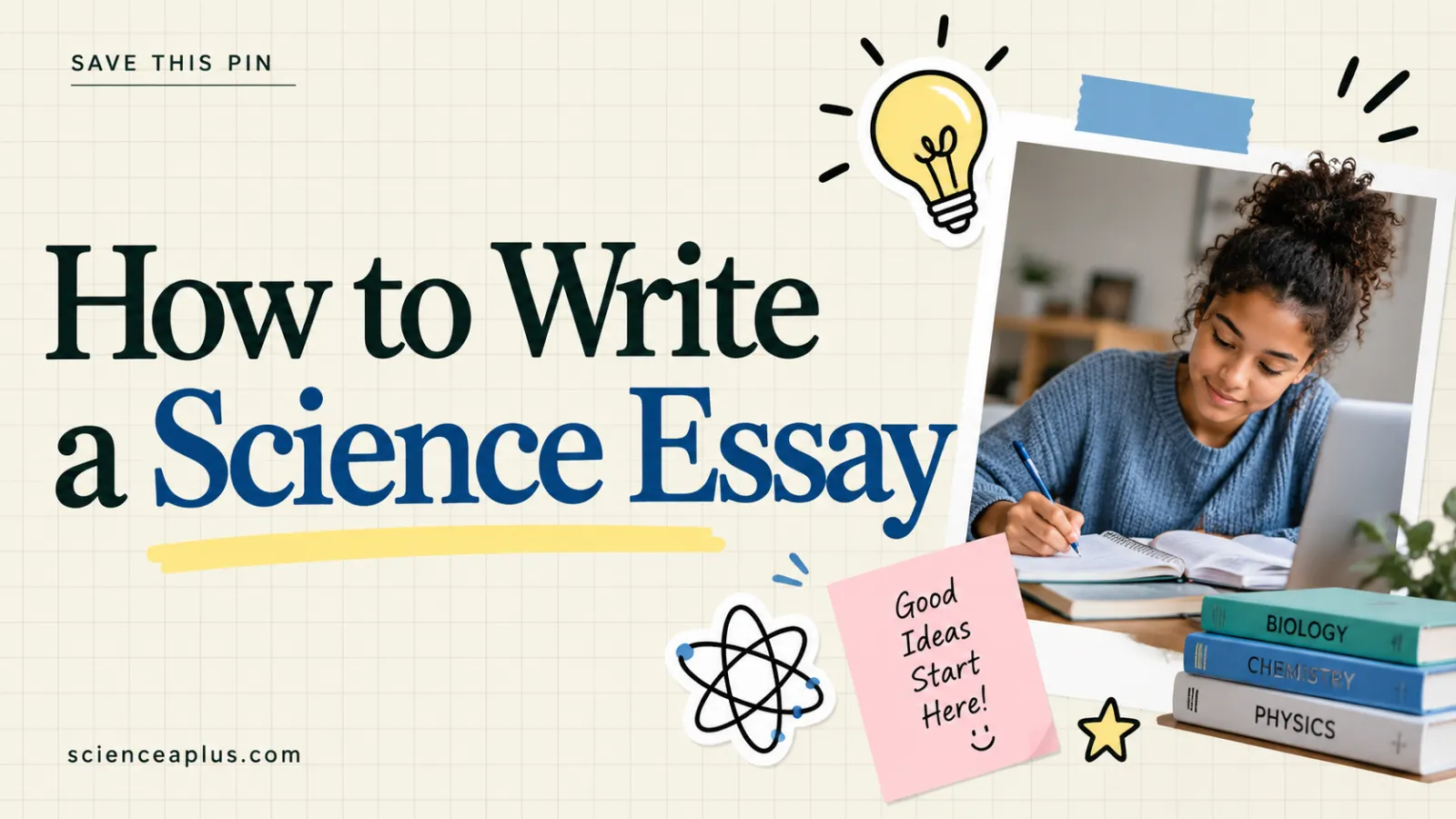
The infographic’s tip says it well: answer the question being asked, not everything you know about the topic.
Command words: what is the question asking you to do?
Exam boards publish lists of command words, and they are a useful guide for coursework and university essays too. The table below uses AQA’s GCSE science command words where they exist, and common wording for the others.
| Command word | What AQA says it means | What your essay should do |
|---|---|---|
| Describe | “Recall some facts, events or processes in an accurate way” | Say what happens, in order, with detail |
| Explain | “Make something clear, or state the reasons for something happening” | Give causes and mechanisms, not just facts |
| Compare | “Describe the similarities and/or differences between things, not just write about one” | Cover both sides of every point |
| Evaluate | “Use the information supplied, as well as your own knowledge and understanding, to consider evidence for and against when making a judgement” | Judge strengths and weaknesses, then decide |
| Justify | “Use evidence from the information supplied to support an answer” | Back each claim with data or a reason |
| Suggest | “Used where students need to apply their knowledge and understanding to a new situation” | Use known science to propose a possible answer |
Two other words, “discuss” (consider different viewpoints or aspects, then reach a conclusion) and “assess” (weigh up which factors matter most), are not on AQA’s GCSE science list. They are used at A-level and university, so check your own course guidance for what they mean there.
Notice how different these jobs are. “Describe how antibiotic resistance develops” wants a sequence. “Evaluate the use of antibiotics in farming” wants a judgement with reasons on both sides. If you describe when you were asked to evaluate, you will not reach the higher marks however accurate your facts are.
Try it: what is each question asking?
Tap each question to reveal what a strong answer needs to do.
“Explain why enzymes stop working at high temperatures.” What is the job?
“Explain” needs a because. Say that high temperatures change the shape of the enzyme’s active site, so the substrate no longer fits and the enzyme is denatured.
“Compare the structure of plant and animal cells.” What goes wrong if you only describe plant cells?
“Compare” needs similarities and differences about several things. Describing only plant cells would miss half of the question, so link each feature to both cell types.
“Evaluate the use of wind turbines to generate electricity.” What must the answer finish with?
“Evaluate” needs a decision. Weigh the advantages against the disadvantages using evidence, then give a reasoned judgement rather than just two lists.
If you want to practise turning a question into a testable idea, our guide to how to use the scientific method shows how scientists move from question to conclusion, which is the same logic a good essay follows.
Step 2: Research reliable information
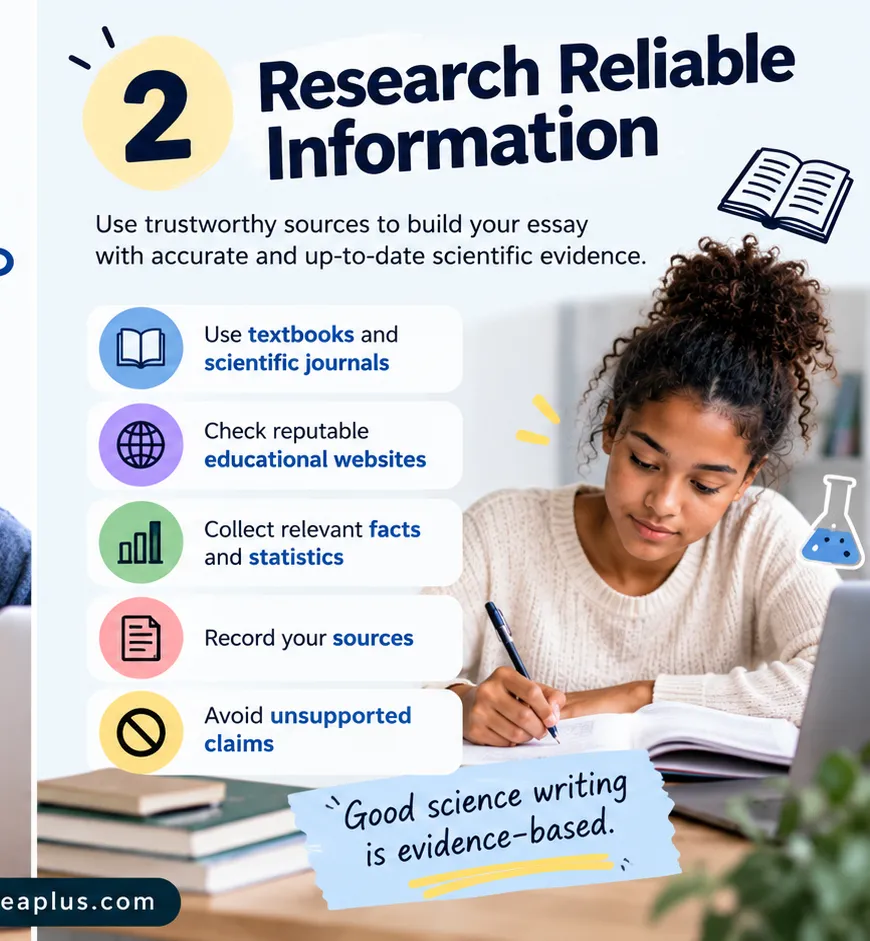
Science essays are only as good as their sources. Before you collect anything, decide what kinds of evidence would actually answer the question: definitions, mechanisms, experimental results, statistics or expert reviews.
Where to look
- Your textbook and specification. For GCSE and A-level this is your safest starting point, because the content is matched to what you are assessed on.
- Scientific journals and review articles. Best for university work. Start with the abstract, then the results and conclusion.
- Reputable educational and public-body websites. Examples include exam board resources, the NHS, universities and learned societies such as the Royal Society of Chemistry.
- Your own practical results. Data you collected yourself is strong evidence, as long as you describe how you collected it.
Be careful with anonymous websites, forums and social media posts. Ask who wrote it, whether they are an expert, when it was written and whether the claim is backed by a source you can check. If you cannot trace a surprising statistic back to its source, do not use it.


Take notes you can actually use
Good notes make essay writing much faster. For every useful fact, record the point itself, a number if there is one, and exactly where it came from. Write the source details at the time, not later. Rebuilding a reference list the night before the deadline is where mistakes (and accidental plagiarism) creep in.
Put the notes in your own words as you go. This forces you to understand the idea, and it also protects you from copying a sentence by accident. Our tips on studying science faster from textbooks show how to get the key points out of a dense page quickly.
Using data and evidence
Evidence is the heart of a science essay, so use it carefully.
- Quote the number and the unit together. “The rate increased” is weak. “The rate increased from 2 to 5 cm³ per minute” is evidence.
- Say what the data shows, not more. A pattern in a graph is not proof of a cause. Use cautious wording such as “suggests” or “is consistent with” unless the evidence is strong.
- Mention limitations. Small samples, uncontrolled variables and anomalous results all matter, and acknowledging them shows scientific thinking.
- Refer to figures and tables by number (“Figure 1 shows…”) and explain what they show instead of leaving the reader to guess.
Scientific language, units and style
Precise language is part of the marking. These habits are worth building early.
- Use the correct scientific term and, where helpful, define it briefly the first time. Do not use two words for the same thing, or the same word for two things.
- Put a space between a number and its unit and do not add an “s” to unit symbols: write 5 cm, not 5cms.
- Be consistent with significant figures and decimal places, so your numbers look measured rather than guessed.
- Write species names in italics, with a capital letter for the genus and a lower-case species name (Homo sapiens).
- Write formally. Avoid contractions (“don’t”), slang and phrases like “a lot of”. Prefer “many” or give the quantity.
- Define abbreviations on first use, for example deoxyribonucleic acid (DNA).
Strong linking words keep the argument moving: “therefore”, “as a result”, “however”, “in contrast”, “this suggests”. If you find yourself writing “and then” repeatedly, you are probably describing rather than explaining. Our guide to improving memory for learning and exams can help you hold key terms and definitions in your head so you can use them fluently.
Step 3: Create an essay plan
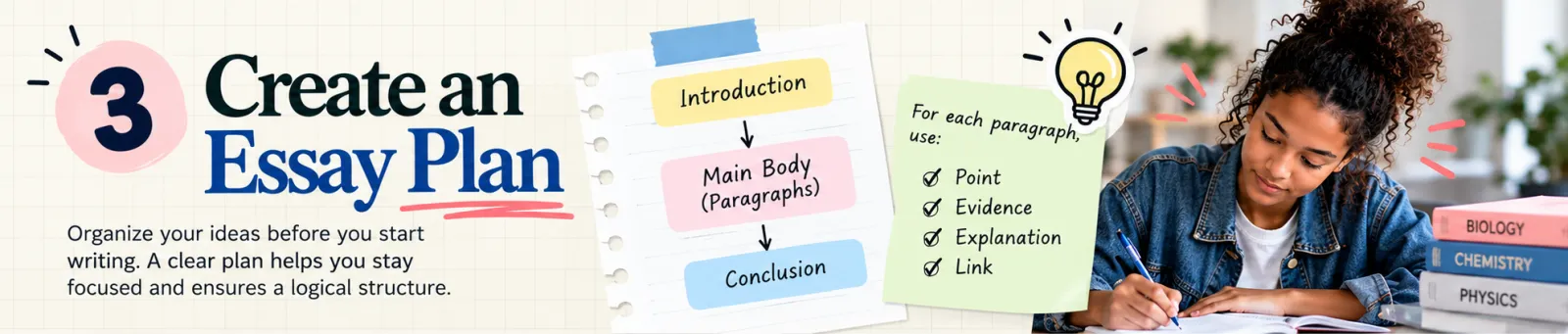
A plan is the cheapest way to improve an essay. It takes ten minutes, and it stops you writing yourself into a corner. Planning also lets you decide what to leave out, which matters just as much as what you include.
A simple science essay structure
- Introduction (about 10% of the words): background, key terms, the focus of the essay and your central argument.
- Main body (about 80%): three to five paragraphs, each making one point with evidence and explanation.
- Conclusion (about 10%): your answer to the question, supported by your strongest evidence.
The percentages are a rough guide, not a rule. For a short GCSE answer the “introduction” may be a single sentence. For a longer university essay it may be a full paragraph. What matters is that all three parts exist and each does its job.
Plan each paragraph with PEEL
The infographic above uses a four-part paragraph: point, evidence, explanation, link. You will also see it written as PEEL (point, evidence, explain, link). Plan one line for each part in every body paragraph.
| Part | What to write | Starter phrase |
|---|---|---|
| Point | One clear claim that answers part of the question | “One reason is that…” |
| Evidence | A fact, figure, experiment or example with its source | “For example, …” / “Data from … show…” |
| Explain | Why the evidence supports your point, using scientific ideas | “This is because…” |
| Link | Tie back to the question or lead to the next paragraph | “Therefore…” / “This shows that…” |
Step 4: Write a strong introduction

The introduction tells the reader what to expect. It should be clear, relevant and concise. Four ingredients work well:
- Brief background that puts the topic in context.
- Key scientific terms or concepts, defined if they are essential.
- The focus of the essay, so the reader knows what is covered.
- Your central argument or approach, in a sentence.
Here is an example introduction for the title “Explain how exercise affects the human body.”
Regular exercise changes how the body supplies energy to its muscles. During exercise, muscle cells respire faster, so they need more glucose and oxygen and produce more carbon dioxide. This essay explains how the circulatory and breathing systems respond to that demand, and argues that increases in heart rate and breathing rate are the body’s way of matching supply to the needs of working cells.
It is short, it uses the keywords from the question, it signals the structure and it states an argument. Notice what it leaves out: a long history of exercise science or a general sentence about how “everyone knows” exercise is healthy.
Writing the body paragraphs
Each body paragraph is a mini-argument. Start with the point, support it with evidence, explain why that evidence matters and link back to the question. Keep to one idea, and make sure the explanation does the heavy lifting: evidence without explanation is the most common weakness in student essays.
A worked example, paragraph by paragraph
Here is a body paragraph that continues the exercise essay from the introduction. The labels show the PEEL parts.
| Part | Sentence |
|---|---|
| Point | The first change during exercise is that the heart beats faster. |
| Evidence | A person’s heart rate can be measured with a pulse monitor before exercise and again straight afterwards, and it is higher after exercise. |
| Explain | This happens because working muscle cells respire faster and need more oxygen and glucose. A faster heart rate moves blood around the body more quickly, so these substances are delivered sooner and carbon dioxide is carried away. |
| Link | Therefore, the higher heart rate helps match the supply of oxygen to the demand of the muscles, which leads to the next change: faster breathing. |
Joined up, it reads as one smooth paragraph:
The first change during exercise is that the heart beats faster. A person’s heart rate, measured with a pulse monitor, is higher straight after exercise than before it. This happens because working muscle cells respire faster and need more oxygen and glucose. A faster heart rate moves blood around the body more quickly, so these substances are delivered sooner and carbon dioxide is carried away. Therefore, the higher heart rate helps match the supply of oxygen to the demand of the muscles, which leads to the next change: faster breathing.
Notice that the evidence here is a type of measurement, not an invented statistic. In your own essay, you would add real numbers from your results or a named source. The paragraph also uses linking words (“because”, “so”, “therefore”) that show cause and effect, which is exactly what the command word “explain” asks for.

How to make an argument convincing
- Use the strongest evidence first or last in a paragraph, not buried in the middle.
- Deal with the other side. If a question says “evaluate” (or “discuss” at A-level or university), include a counter-argument and say why it is weaker or stronger than your view.
- Be specific. “Temperature affects reaction rate” is a start. Saying which direction and why is the real answer.
- Stay objective. Aim to persuade with evidence rather than with strong opinions or emotional language.
How GCSE six-mark answers are marked
If you are writing for AQA GCSE science exams, longer answers are marked differently from short ones. Extended-response questions use a level of response mark scheme. Many AQA six-mark questions use three levels of two marks (Level 1 is 1–2, Level 2 is 3–4, Level 3 is 5–6), but not all: in the same paper’s Q07.2 the six marks are split into two levels (1–3 and 4–6) (AQA GCSE Biology 8461/1H, June 2018 mark scheme).
The examiner starts at the lowest level and works up, checking whether your answer meets each descriptor. They look at the overall quality of the answer and use a best-fit judgement, then decide the mark within the level. A few points are worth knowing:
- The descriptor for the top level is about the quality of the answer, for example whether the key steps are all there and logically sequenced.
- The indicative content is a guide. Students do not have to cover every point to reach the top level.
- Irrelevant points are ignored, but full marks can only be given if nothing you wrote contradicts a correct response.
AQA’s specification also says extended responses must show “a sustained line of reasoning which is coherent, relevant, substantiated and logically structured”. In plain English: a clear order, relevant points and reasons for each one. That is exactly what a PEEL structure gives you.

Level 1 versus Level 3: an example
Take the question “Explain how exercise affects the body” for six marks. Open the answers below to compare how the same ideas can be used.
A weaker answer (likely lower level)
When you exercise your heart beats faster and you breathe faster. Your muscles get tired. Exercise is good for you because it keeps you healthy.
A stronger answer (likely higher level)
During exercise, muscle cells respire faster, so they need more oxygen and glucose and produce more carbon dioxide. The heart rate increases, so blood is pumped round the body faster and delivers oxygen and glucose to the muscles more quickly. Breathing rate and depth also increase, so more oxygen enters the blood and more carbon dioxide leaves it. Together these changes match supply to the needs of the muscles.
The first answer states facts but never says why. The second links each change to a reason and keeps to a logical order. These are teaching examples we wrote to show the difference between description and explanation, not official AQA mark scheme answers, so do not treat them as a guaranteed level.
Writing the conclusion
The conclusion answers the question. It should be short, usually three to five sentences in a longer essay, and it should not introduce new evidence.
- Restate your answer in new words, not by copying the introduction.
- Pull together your strongest evidence in one or two sentences.
- Acknowledge a limit if there is one, such as small sample sizes or conflicting data.
- Finish with a point of significance, such as a recommendation or what should be tested next.
Referencing, plagiarism and using AI responsibly
How to reference in Harvard style
Referencing shows where your evidence comes from and lets your reader check it. Harvard is an author–date style, but it has no single official version, so always follow the guide your school or university gives you. The basic pattern is the same everywhere.
- In the text, give the author’s surname and the year in brackets straight after the fact: (Surname, Year).
- At the end, list every source in a reference list in alphabetical order by surname, with enough detail for the reader to find it, usually author, year, title, publisher or website and, for web pages, the date you accessed it.
- Be consistent. Use one format throughout.
Some courses use numbered references instead, and some GCSE and A-level essays need only a short list of sources. Check the instructions for your task.
What counts as plagiarism?
Plagiarism means presenting someone else’s words or ideas as your own. It includes copying text without quotation marks, changing a few words and leaving the rest, using a diagram without a source and handing in work written by someone else. It does not matter whether it is deliberate. The fix is simple: write in your own words from your notes and reference every source you use.
Using AI responsibly
AI chatbots can be useful for explaining a confusing idea or for checking your grammar, but they can also make up facts and fake references. Before you use one for coursework, read our article on artificial intelligence in writing assistance and your school’s policy.
The Joint Council for Qualifications (JCQ), which covers the main exam boards, published guidance called AI Use in Assessments: Your role in protecting the integrity of qualifications first published in April 2023 and last revised in April 2025. It says that where AI content is used, the reference must show the name of the AI tool and the date the content was generated, and that where AI is used as a source of information, the student must keep a copy of the questions and the AI-generated content in a non-editable form (such as a screenshot) and give a brief explanation of how it was used, submitted with the work. Copying or paraphrasing AI-generated content so that the work is no longer your own, or failing to acknowledge AI use, can be treated as malpractice. Teachers also have to be satisfied that the work is yours.
Review before you submit
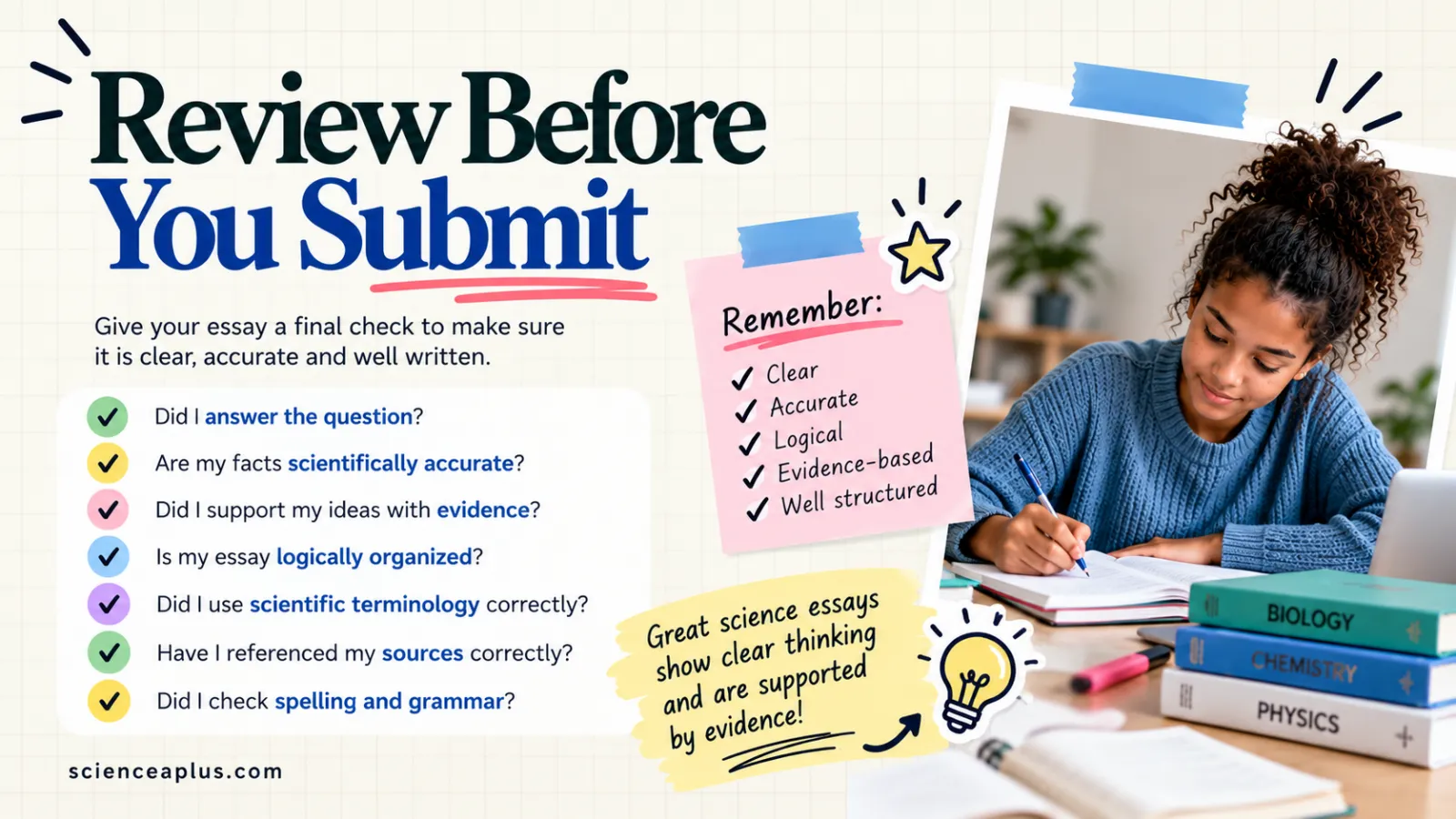
Never hand in a first draft. Leave at least a short break between writing and checking, because mistakes are much easier to see with fresh eyes. Read the essay once for sense and once for detail, and ideally read it aloud: your ears catch clumsy sentences that your eyes skip over.
Your final checklist
Tick each item as you check it. Your ticks are saved in this browser, so you can come back to the list on your next draft.
- I answered the question that was asked, and I followed the command word.
- My facts are scientifically accurate and I checked any I was unsure of.
- Every main point is supported with evidence, and I explained why it matters.
- The essay is logically organised: introduction, focused body paragraphs, conclusion.
- I used scientific terms correctly and defined key ones.
- Numbers have units and a sensible number of significant figures.
- I referenced my sources correctly and listed all of them.
- I declared any AI use as required and the writing is my own.
- I checked spelling, grammar and punctuation, and cut any waffle.
Common mistakes to look for
- Describing when asked to explain. If a paragraph has no “because”, add the reason.
- Facts with no link to the question. If a sentence does not help answer it, cut it.
- Vague quantities. Replace “a lot”, “very high” and “quite fast” with figures where you can.
- Over-claiming. One study rarely “proves” anything. Words like “suggests” are more accurate.
- Missing units or wrong symbols. Check every number.
- A conclusion that repeats the introduction word for word, or adds new evidence.
Good writing is also a communication skill. Our guide to effective oral and written communication skills for students has more ideas for clear, confident writing, and if you are writing under exam conditions, starting your GCSE science revision with practice questions and past papers will help you get used to extended answers.
Test yourself
Frequently asked questions about writing a science essay
How do you start a science essay?
Start with a short introduction that gives brief background, defines key scientific terms, states the focus of the essay and gives your central argument. Use the keywords from the question and avoid vague opening sentences. Two to four sentences is enough for a short essay; longer essays need a full paragraph.
What is the structure of a science essay?
A science essay has an introduction, a main body and a conclusion. The body is made of focused paragraphs, each making one point supported by evidence and explanation. The conclusion answers the question and pulls together your strongest evidence, without adding new facts. Diagrams and references are added where needed.
What is PEEL in a science essay?
PEEL stands for point, evidence, explain, link. You make one clear point, support it with a fact, figure or example, explain why that evidence supports the point using scientific ideas, and link back to the question. It keeps paragraphs focused and makes your reasoning easy for a marker to follow.
What are command words in science?
Command words are the instruction words in a question, such as describe, explain, compare, evaluate and justify. They tell you what to do with your knowledge. AQA publishes a list of them with definitions for GCSE sciences, and checking the one in your question stops you writing the wrong type of answer.
How is a six-mark science answer marked?
In AQA GCSE science, six-mark extended answers are marked using levels. Many use three levels of two marks each (Level 1 is 1–2, Level 2 is 3–4 and Level 3 is 5–6), though some use two levels. The examiner judges the overall quality and logic of the answer, then picks a mark within the level. You do not need every point in the indicative content.
How long should a science essay be?
Follow the word limit in your task. If none is given, aim for the length the marks or the question suggest. Exam answers are short and focused, while university essays are usually longer. Quality matters more than length: every paragraph should help answer the question.
How do I write a conclusion for a science essay?
Restate your answer in new words, summarise your strongest evidence in one or two sentences and mention any important limitation. Keep it short and do not add new evidence. End with a point of significance, such as what the findings mean or what could be investigated next.
How do I reference sources in a science essay?
Harvard, an author–date style, is common: put the author’s surname and year in brackets in the text, then list full details of each source alphabetically at the end. Versions vary, so follow the guide from your school or university and keep one format throughout.
Can I use AI to write my science essay?
You should not submit AI-written work as your own. JCQ guidance says AI use must be acknowledged with the tool name and date, and that copying or paraphrasing AI content so the work is no longer your own can be malpractice. Always follow your school’s and exam board’s rules.
What is the difference between a science essay and a lab report?
A science essay builds an argument from evidence from many sources to answer a question. A lab report describes an experiment you carried out, usually with sections such as aim, method, results and conclusion. Both need accurate data and units, but an essay is organised around an argument.