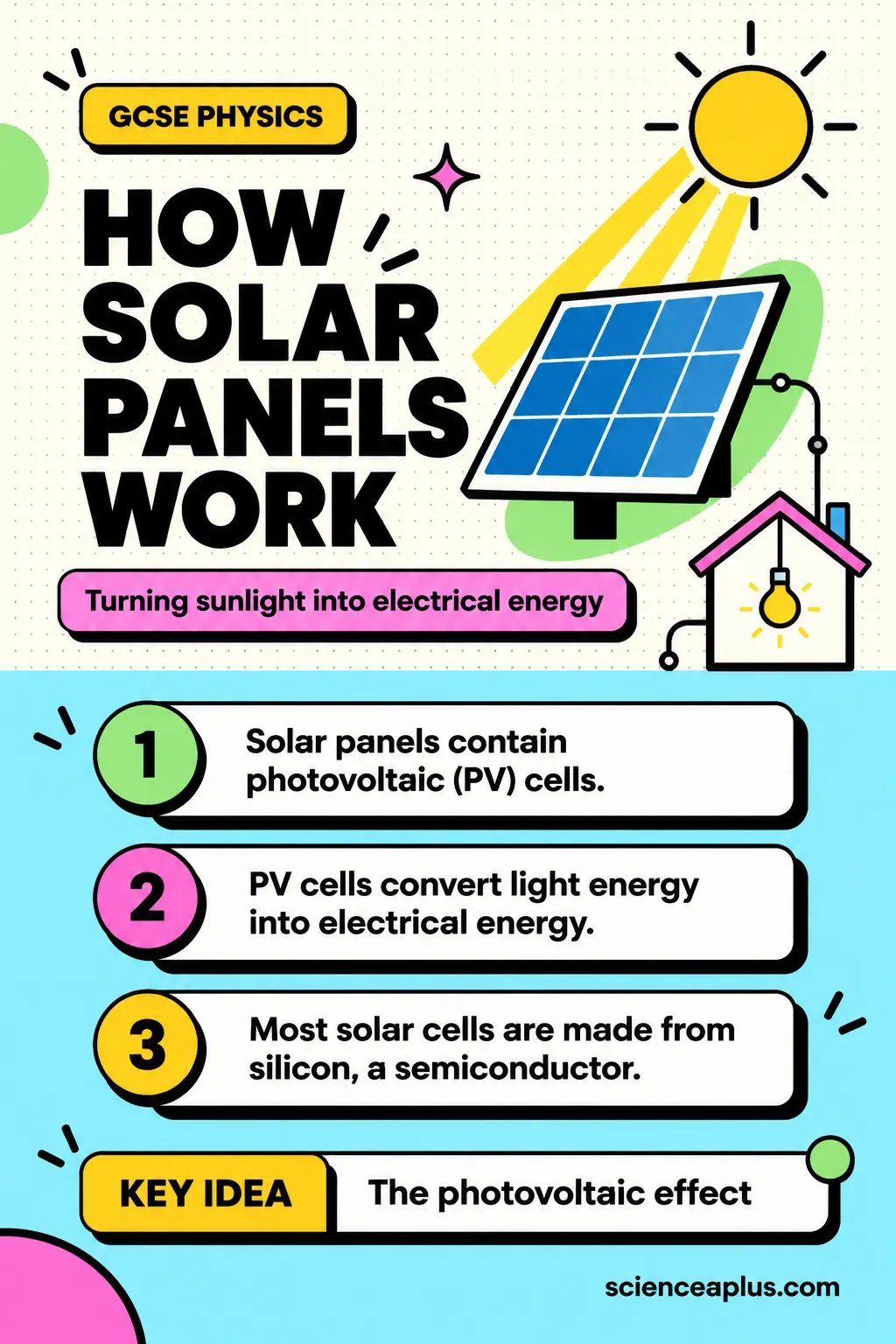
Solar panels work by using the photovoltaic effect: light, which travels as packets of energy called photons, hits silicon solar cells and frees electrons. An electric field built into each cell pushes those electrons into a circuit as direct current (DC), and an inverter then turns that DC into the alternating current (AC) that your home uses. Nothing burns, nothing spins and nothing is used up. This guide explains how solar panels work, step by step, from the physics inside a single cell to the wiring on your roof.
How do solar panels work? The short answer
If you want the quick version of how solar panels work, here it is in five steps. Every later section in this article zooms in on one of them.
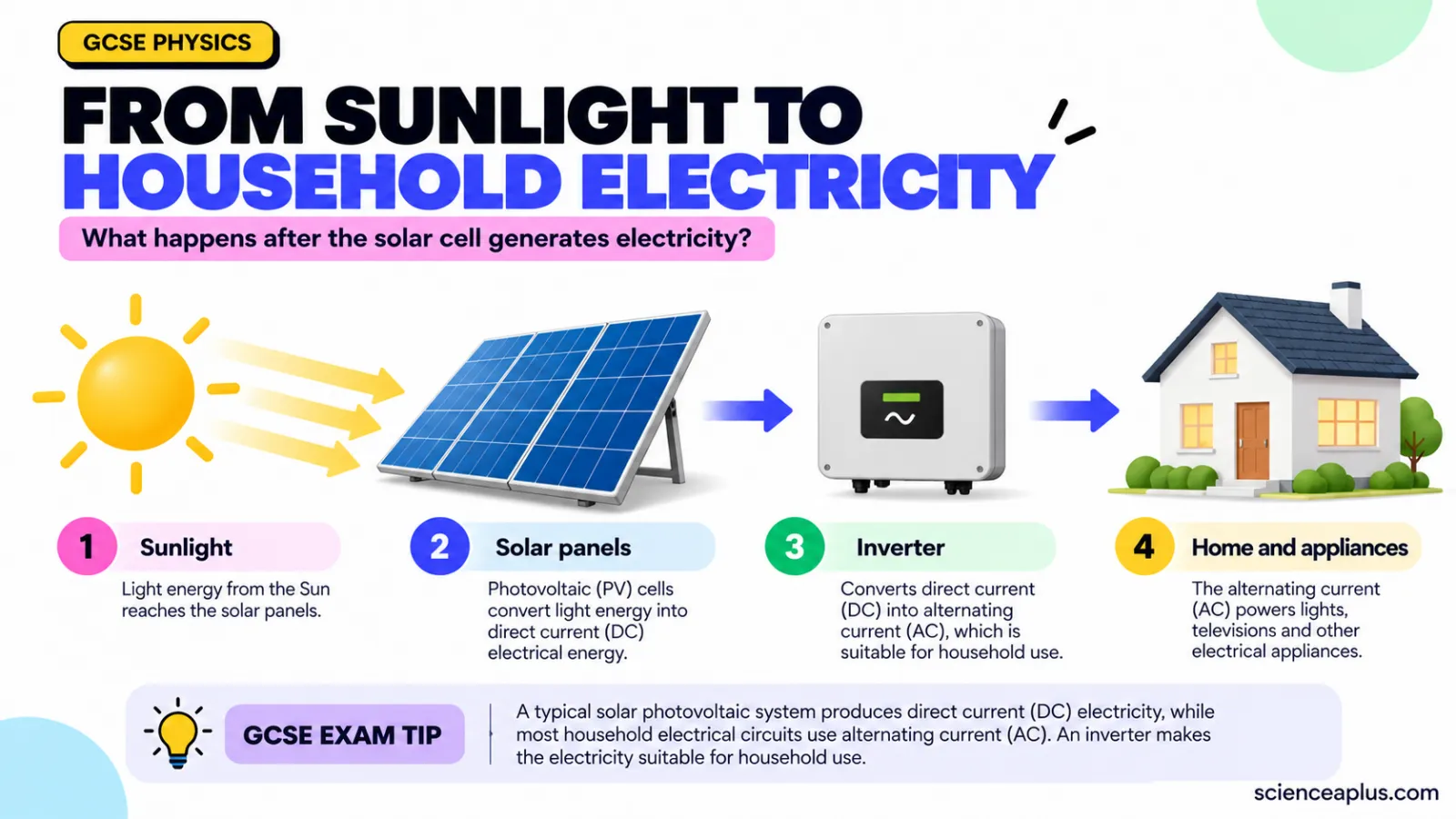
- Sunlight arrives. Light from the Sun carries energy to the panel in photons.
- The cells absorb it. Each solar cell is a thin slice of silicon. When a photon is absorbed, an electron gains enough energy to break free.
- A current flows. An electric field inside the cell pushes the freed electrons one way round a circuit. This produces direct current (DC).
- The inverter converts it. The inverter changes DC into AC at the voltage and frequency that household appliances expect.
- The electricity is used. It powers the home first. Any surplus can charge a battery or be exported to the grid.
In energy terms, a solar panel is a transfer device. Light energy is transferred to electrical energy, and some of the energy is wasted as thermal energy because the panel warms up. Unlike a fossil-fuel power station, a panel has no moving parts. For the wider picture of how people use the Sun’s energy, from heating to farming to transport, see our guide to all the ways solar energy is used.
Solar PV panels vs solar thermal panels
The word “solar panel” covers two quite different devices, and mixing them up is a common mistake. A photovoltaic (PV) panel makes electricity. A solar thermal collector makes hot water. They can look similar on a roof, but they work in completely different ways.

A thermal collector has a dark surface that absorbs the Sun’s heat and passes it to water or another fluid, which then goes to a hot-water tank. There is no semiconductor and no electric current involved. A PV panel, by contrast, uses the photovoltaic effect in silicon. This article is about PV panels.
| Feature | Solar PV panel | Solar thermal collector |
|---|---|---|
| What it makes | Electricity | Hot water |
| How it works | The photovoltaic effect in semiconductor cells | A dark surface absorbs heat and passes it to a fluid |
| Key material | Silicon solar cells | A dark absorbing plate with pipes or a tank |
| Where the energy goes | Appliances, a battery or the grid | A hot-water tank |
Because the two are so often confused, remember this simple test. If the panel is connected to an inverter and cables, it is PV. If it is connected to pipes and a tank, it is thermal.
Light, photons and electrons
To understand how solar panels work, you need three ideas: light carries energy, atoms contain electrons, and electrons can move when they gain enough energy.
Light travels as photons, tiny packets of energy. The more intense the light, the more photons arrive each second. Solar panels are tested using a standard amount of sunlight: 1,000 watts per square metre (1 kW/m²). This is the figure used on rating labels, and real sunshine is often weaker than this.
Every atom has a nucleus surrounded by electrons. You can revisit the basics in our lesson on the structure of the atom and sub-atomic particles. In a metal, some electrons are already free to move. In silicon, nearly all of them are held in bonds between atoms until something gives them energy. A photon can provide that energy.
Once electrons are free and are pushed in one direction, they form an electric current. Remember the exact definition, because examiners look for it:
current = rate of flow of charge
The next section looks inside one cell to show exactly how a photon turns into a push on a current.
How solar panels work inside a solar cell
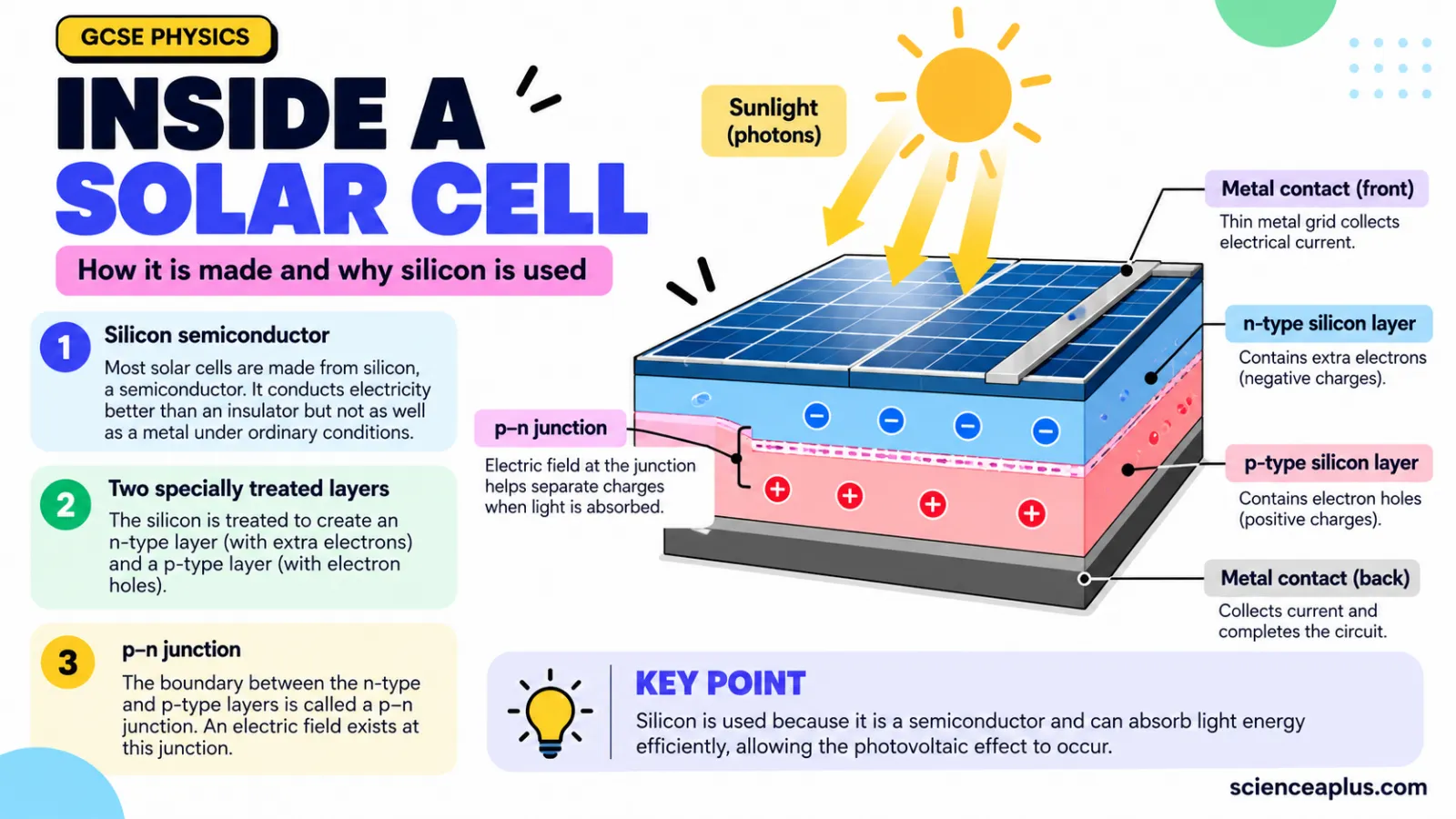
A solar panel is a collection of solar cells, and the cells are where the physics happens. Each cell is a thin slice of silicon with a metal grid on the front, a metal contact on the back, and two differently treated layers of silicon in between. The diagram shows the layers, though the thicknesses are not to scale.
Why silicon?
Most solar cells are made from silicon, which is a semiconductor. A semiconductor conducts better than an insulator such as glass, but far worse than a metal such as copper. That in-between behaviour is exactly what a solar cell needs. Its electrons stay put until they are given energy, and then they can move.
The atomic structure explains why. A silicon atom has 14 electrons arranged 2,8,4 (see our lesson on electronic configuration), so it has four electrons in its outer shell. In a silicon crystal, each atom shares one outer electron with each of four neighbours. Every outer electron is therefore locked into a bond until something frees it.
Most panels use one of two forms of silicon. Monocrystalline cells are cut from a single crystal and tend to be more efficient. Polycrystalline cells are made from many crystals and tend to be cheaper to produce. In both, the silicon is processed into a diode, a component that lets current go one way, with metal contacts to carry the current out.
n-type and p-type silicon
Pure silicon would not drive a current by itself, so manufacturers add tiny amounts of other elements. This is called doping, and it produces two kinds of silicon.
| Layer | Usually doped with | What it contains |
|---|---|---|
| n-type silicon | Phosphorus | Extra free electrons, which carry negative charge |
| p-type silicon | Boron | “Holes”, which are missing electrons that behave like positive charges |
Neither layer is charged overall. The n-type layer simply has electrons that are free to move, and the p-type layer has gaps that electrons can move into. A hole is not a particle in its own right. It is the empty space left where an electron could be.
The p–n junction
Where the n-type and p-type layers meet, we call the boundary the p–n junction. Electrons near the boundary drift across to fill holes on the other side, which leaves a thin region with a built-in electric field. This field points in one direction only. It is the reason a solar cell can push charge round a circuit without any battery.
The field is already there before any light arrives. That is a key point for exams, because many students write that light “creates” the electric field. It does not. Light supplies the energy, and the junction supplies the direction.
The photovoltaic effect, step by step
The photovoltaic effect is the name for what happens when light falls on a cell and produces a potential difference and a current. It takes three steps.
- Photons are absorbed. Light striking the silicon delivers energy in photons, and the silicon absorbs them.
- Electron–hole pairs form. An electron that absorbs a photon gains enough energy to break free from its bond. It leaves behind a hole, so each photon that does the job creates a free electron and a hole together.
- The field separates them. The electric field at the p–n junction pushes the free electrons towards the n-type side and the holes towards the p-type side. This build-up of opposite charges on the two sides is a potential difference across the cell.
Now connect the cell to a circuit. The thin metal grid on the front and the metal contact on the back collect the charge, and electrons flow round the external circuit from the n-type side, through whatever is connected, and back to the p-type side. That flow of charge is the current. The cell always pushes the same way, so the current is direct current (DC).
This also explains why the front of a cell has fine silver lines rather than a solid sheet of metal. The lines collect current while leaving most of the surface open so light can get in.
Explain how a solar cell produces a current when light falls on it. (4 marks)
Photons of light are absorbed by the silicon. Electrons gain enough energy to break free from their bonds, leaving holes behind. The electric field at the p–n junction separates the electrons and holes, with electrons moving to the n-type side and holes to the p-type side, which creates a potential difference. When the cell is connected to a circuit, electrons flow through the external circuit, and this flow of charge is the current.
Types of solar cell
Silicon is the workhorse, but it is not the only choice. Here are the main types you will meet.
- Monocrystalline silicon has a uniform dark appearance and tends to be the more efficient of the two common silicon types.
- Polycrystalline silicon is made from many crystals and tends to be cheaper to make.
- Thin-film cells use very thin layers of materials such as cadmium telluride (CdTe) or copper indium gallium selenide (CIGS). Amorphous silicon, the type found in many pocket calculators, is also a thin-film material.
- Perovskite cells are a promising newer material. They are mainly still in laboratories and early products, and they can be combined with silicon in layered “tandem” cells. Later in this article we look at how far this has taken efficiency.
Whatever the material, the principle is the same. Light is absorbed, charges are separated by a built-in field, and a current flows. Understanding that one idea is the most important step in knowing how solar panels work.
The next section shows how single cells that give such a small voltage are combined into the panels you see on roofs.
From cell to panel to array
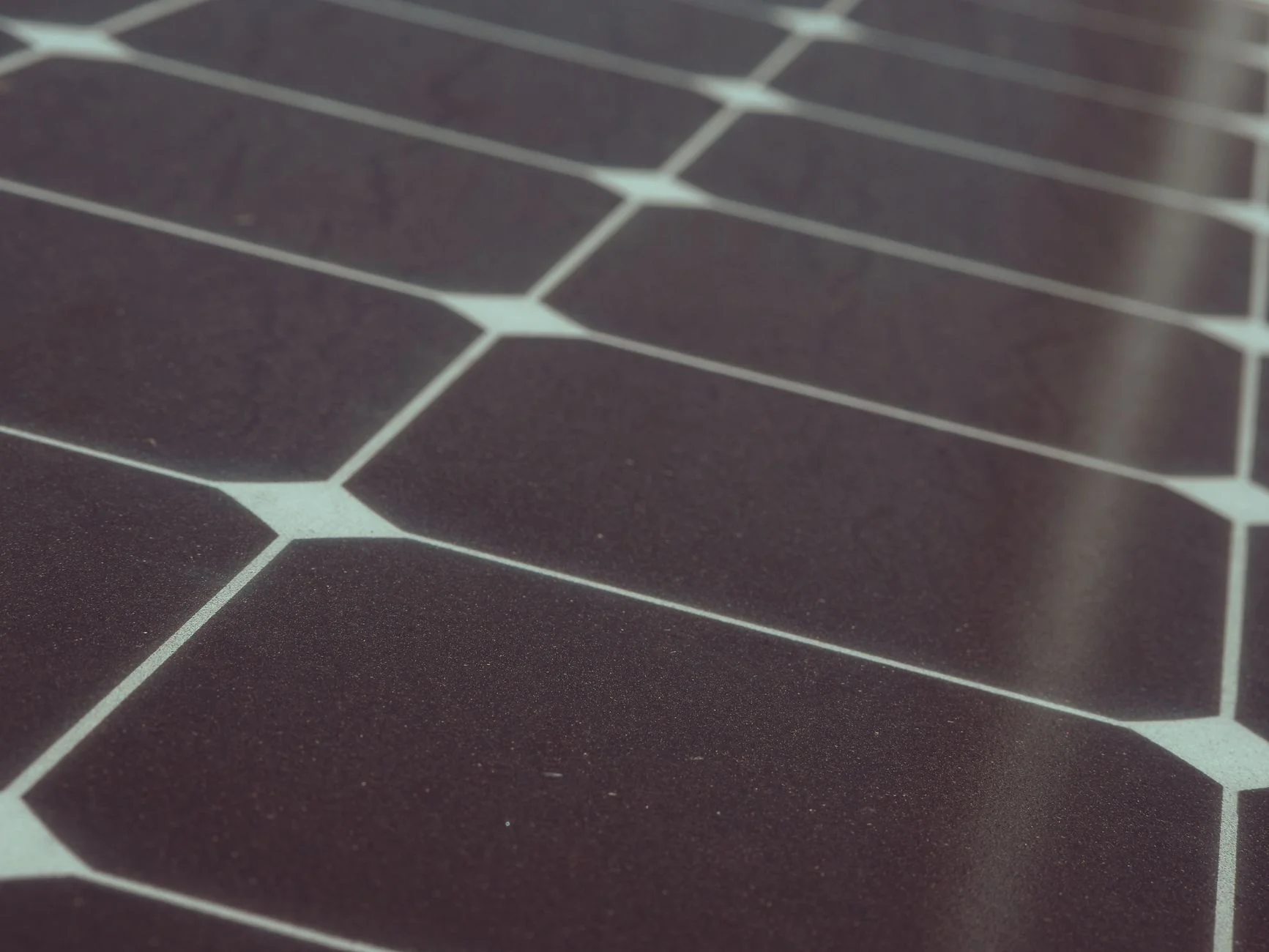
One silicon cell is small and gives only a modest voltage. At its maximum power point it delivers about 0.5 V, and about 0.6 V when nothing is connected (the open-circuit voltage). That is not enough to run anything useful, so cells are wired together.
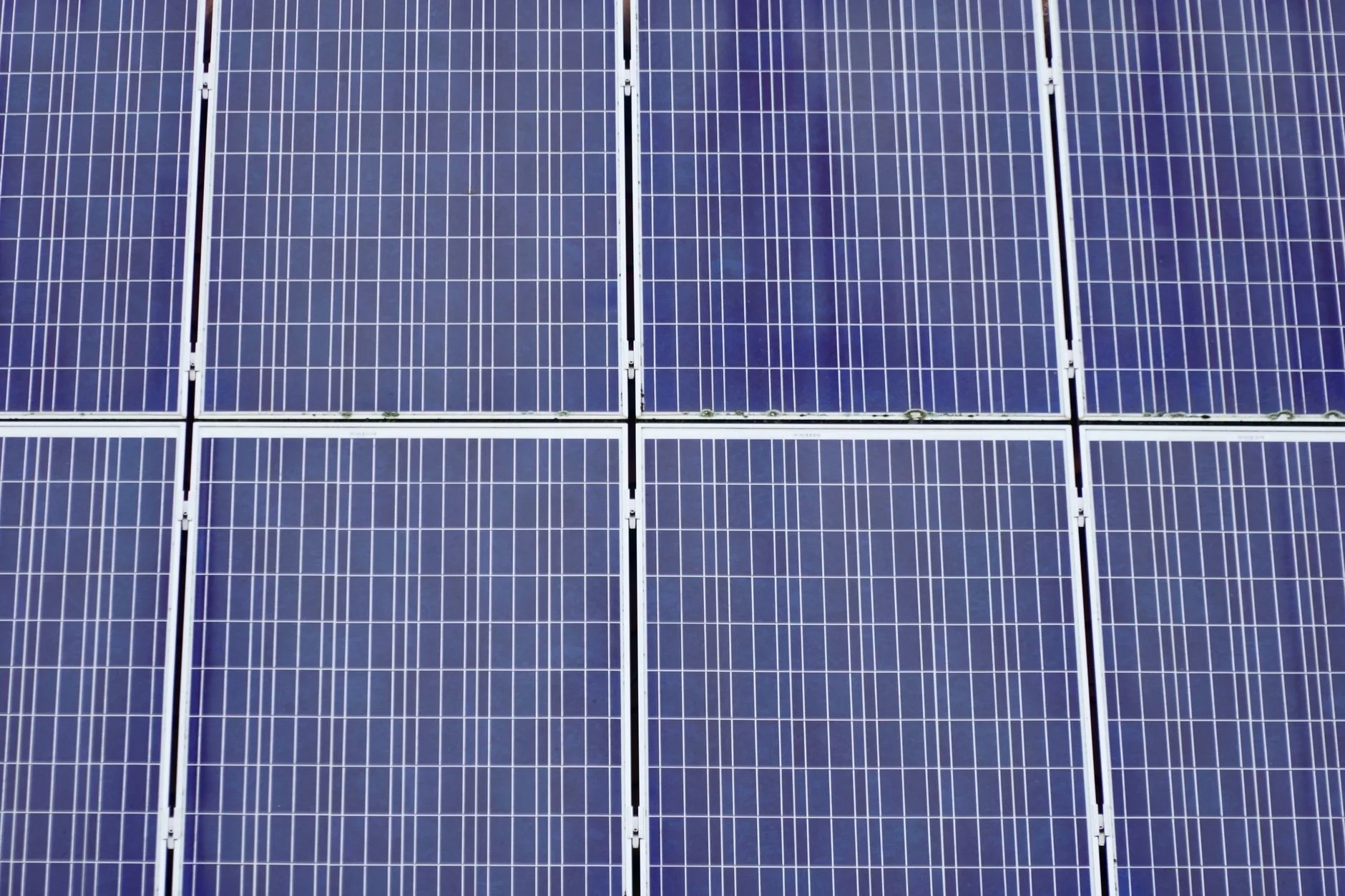
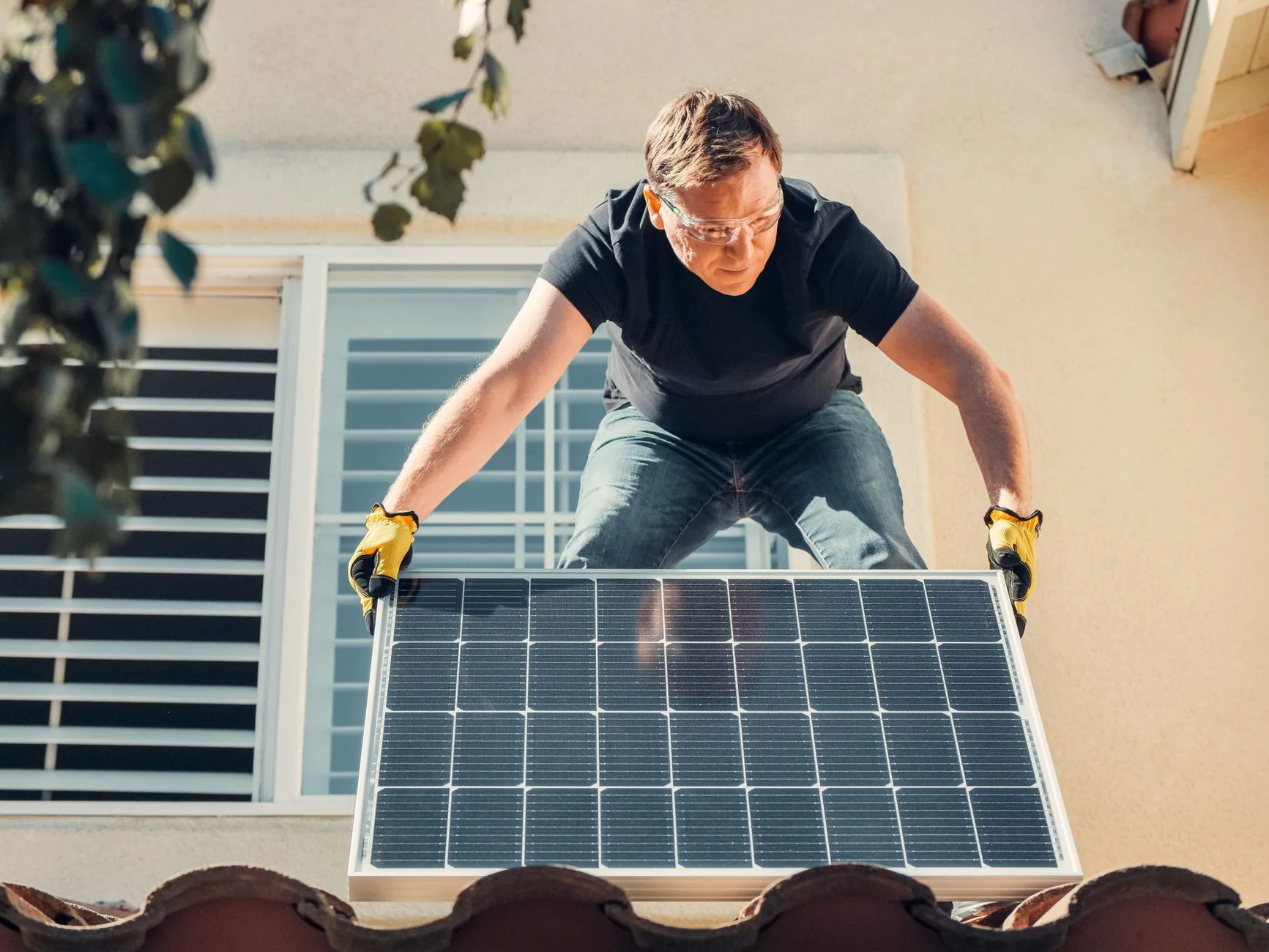
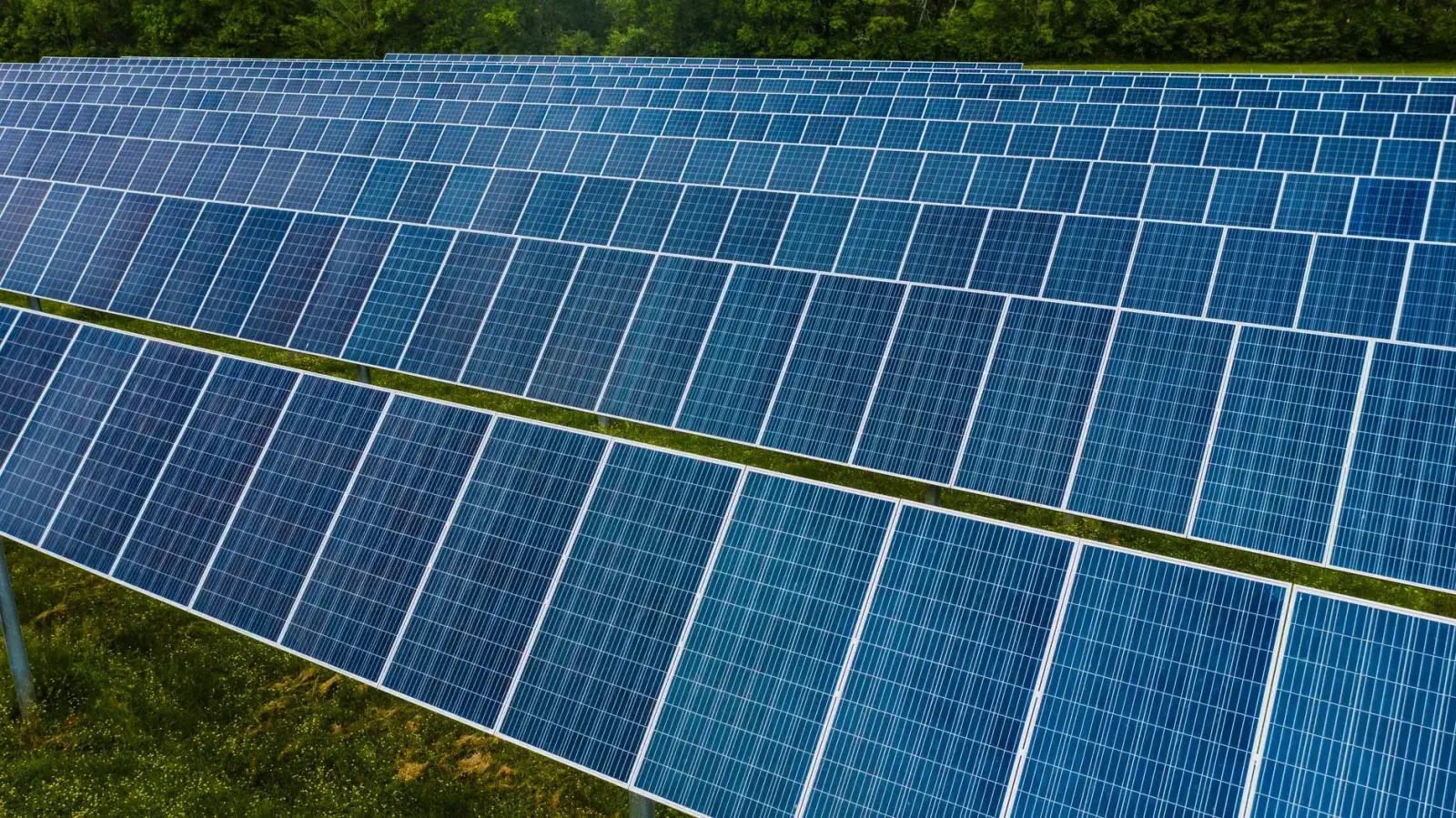
The wiring follows the same rules as any circuit in GCSE physics:
- Cells connected in series add their voltages, and the current stays the same as one cell’s current.
- Cells connected in parallel add their currents.
A module of about 36 cells in series is suitable for charging a 12 V battery, with an open-circuit voltage of about 21 V. The most common modules for homes and solar farms have 60 or 72 cells, with the 60-cell type easier to handle on a roof and the 72-cell type used more on large sites. Several modules connected together make an array.
To see how the numbers fit together, use the equation from the AQA specification:
P = V × I
Imagine a panel that delivers 10 A at 30 V. Its power is 30 × 10 = 300 W. This is only a worked example to practise the equation, not the specification of any real panel.
What is a solar panel made of?
The old description of a panel as silicon “sandwiched” between metal sheets is wrong. A modern module is built in layers. From front to back:
- Tempered glass on the front protects the cells while letting light through.
- Encapsulant film, usually EVA, bonds the layers together and protects the cells.
- Interconnected solar cells, wired in series.
- A second protective layer, usually a polymer backsheet. Some “bifacial” modules use glass at the back too.
The layers are laminated together under heat. An aluminium frame gives the module strength and a way to mount it, and a junction box on the back holds the cable connections and bypass diodes. Rigid panels like these are the most common type, though flexible ones exist too, as explained in our guide to solar energy and the details of solar panels.
From DC to AC: what the inverter does
Solar cells push charge in one direction only, so a panel produces direct current (DC). The mains supply is different. Our homes run on alternating current (AC), where the potential difference keeps reversing. According to the AQA specification, the domestic electricity supply in the UK has a frequency of 50 Hz and is about 230 V.
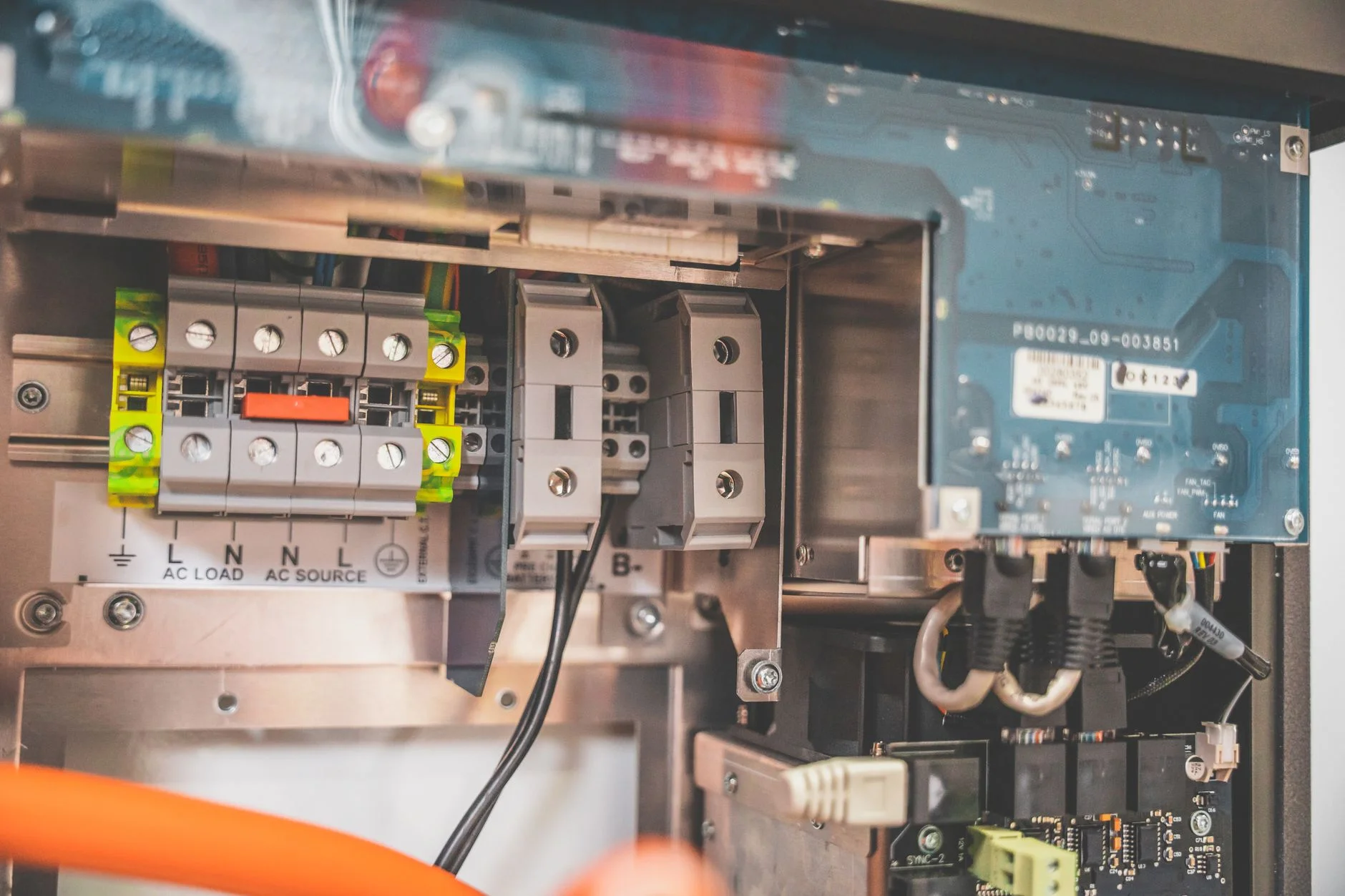
The inverter bridges that gap. It takes the DC from the panels and converts it into AC at mains voltage and frequency, so that appliances and the grid can use it. Without an inverter, a house could not run most of its devices from rooftop panels.
This differs from how power stations work. A generator makes AC directly, by electromagnetic induction as a magnet and coil spin relative to each other, and you can read how in our guide to how generators work. A solar cell has no moving parts and makes DC. For more on the two types of current, try the direction of current practical.
Where does the electricity go?
A typical home system uses its electricity in a clear order of priority:
- The home uses what it needs first.
- Any surplus can charge a home battery.
- What is left can be exported to the grid.
In Great Britain, the Smart Export Guarantee has been in place since 1 January 2020. Under it, some electricity suppliers must pay small-scale low-carbon generators, including solar PV up to 5 MW, for electricity they export to the grid. At night there is no light, so the house runs from a battery if it has one, or from the grid.
What affects solar panel output?
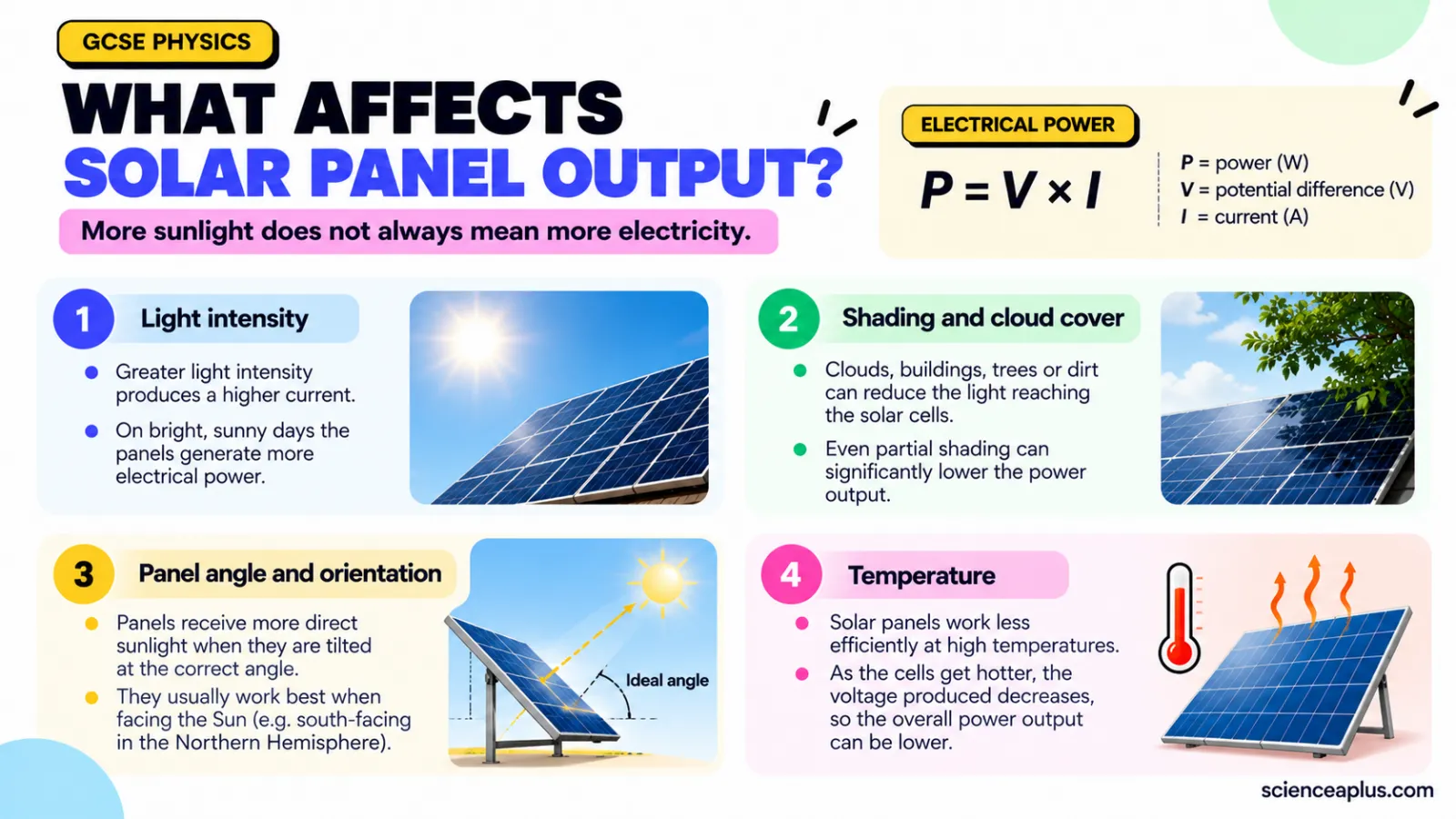
A panel’s rating describes its output in ideal test conditions. In real life, four things change how much electricity it makes: how bright the light is, whether anything blocks it, which way the panel points and how hot it gets.
Light intensity and cloud
More light means more photons, so more current and more power. On a cloudy day, output falls, but panels still generate electricity from diffuse light that gets through the cloud. At night, with no light, they generate nothing.
Shading and dirt
Shade is more damaging than many people expect. A shaded cell in a series string could be forced into reverse bias and overheat, creating a “hot spot”. To prevent that, bypass diodes are wired across groups of cells (commonly one diode for every group of roughly 12–24 cells) and let current from the healthy cells go round the shaded one. Shading even part of a panel can still cut output a lot. Dirt does something similar, and our solar panel maintenance guide covers what to do about it.
Angle and direction
In the UK, a south-facing roof is best. East- or west-facing roofs typically yield roughly 15–20% less than a south-facing roof, depending on pitch and location. The angle of the panel matters too, because the more directly the light strikes it, the more energy each square metre receives.
Temperature
It surprises many people that heat reduces a panel’s efficiency. In a silicon cell, the voltage falls by about 2.2 mV for every degree Celsius, while the current rises only very slightly. The result is that maximum power falls by about 0.4–0.5% for each °C above 25 °C. Panels are rated at a cell temperature of 25 °C, and cells in sunshine are usually hotter than that, so test-condition figures tend to overstate normal output.
How efficient are solar panels?
Efficiency tells you how much of the energy arriving at a panel ends up as useful electrical energy. The AQA specification gives it two ways:
efficiency = useful power output ÷ total power input
The same ratio works with energy transfers instead of power. For a solar panel, the input is the sunlight landing on it and the useful output is the electricity. Rating tests use sunlight of 1,000 W/m² and a cell temperature of 25 °C, so every panel is compared on equal terms.
The numbers have improved enormously. The first practical silicon solar cell, shown at Bell Labs in 1954, was about 6% efficient. Today, according to the industry’s ITRPV report, mainstream new modules reach roughly 23.5%, and the best commercially listed module reached about 24.8% in December 2025. As a rule of thumb, most new panels convert about 20–24% of the sunlight that hits them into electricity.
In the laboratory, a single-junction silicon cell reached 27.81% and a perovskite–silicon tandem cell reached 34.85% (both announced in 2025, so newer records may exist). Remember that a single-junction silicon cell has a theoretical (intrinsic) limit of about 29.4%, which is why tandem designs that add a second material are so interesting. Try the calculator to see how area, sunlight and efficiency combine.
Panels also lose a little output each year. For crystalline silicon, the typical loss, called degradation, is about 0.5% per year. Module warranties commonly guarantee a set percentage of rated output after 25 years or more (often around 80–90%, depending on the product), and modules are expected to last more than 20 years.
A short history of solar cells
The idea is older than most people think. This timeline shows how a laboratory curiosity became a mainstream technology.
- 1839: French physicist Edmond Becquerel sees small electric currents when metal electrodes in a solution are exposed to light. He cannot explain why.
- 1883: Charles Fritts makes selenium cells, but they are only about 1% efficient.
- 1954: At Bell Labs, Daryl Chapin, Calvin Fuller and Gerald Pearson make the first practical silicon solar cell, about 6% efficient. They link cells into a “solar battery”.
- 1958: Vanguard 1, launched on 17 March, becomes the first satellite powered by solar cells.
- Today: Large solar arrays on spacecraft such as the International Space Station supply power, and rooftop panels are everywhere.
- 2025: New efficiency records are set for silicon and tandem cells.
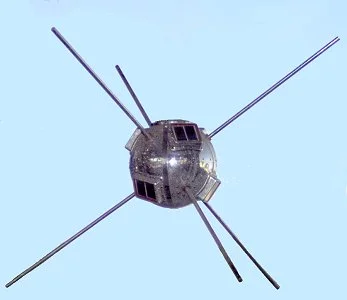
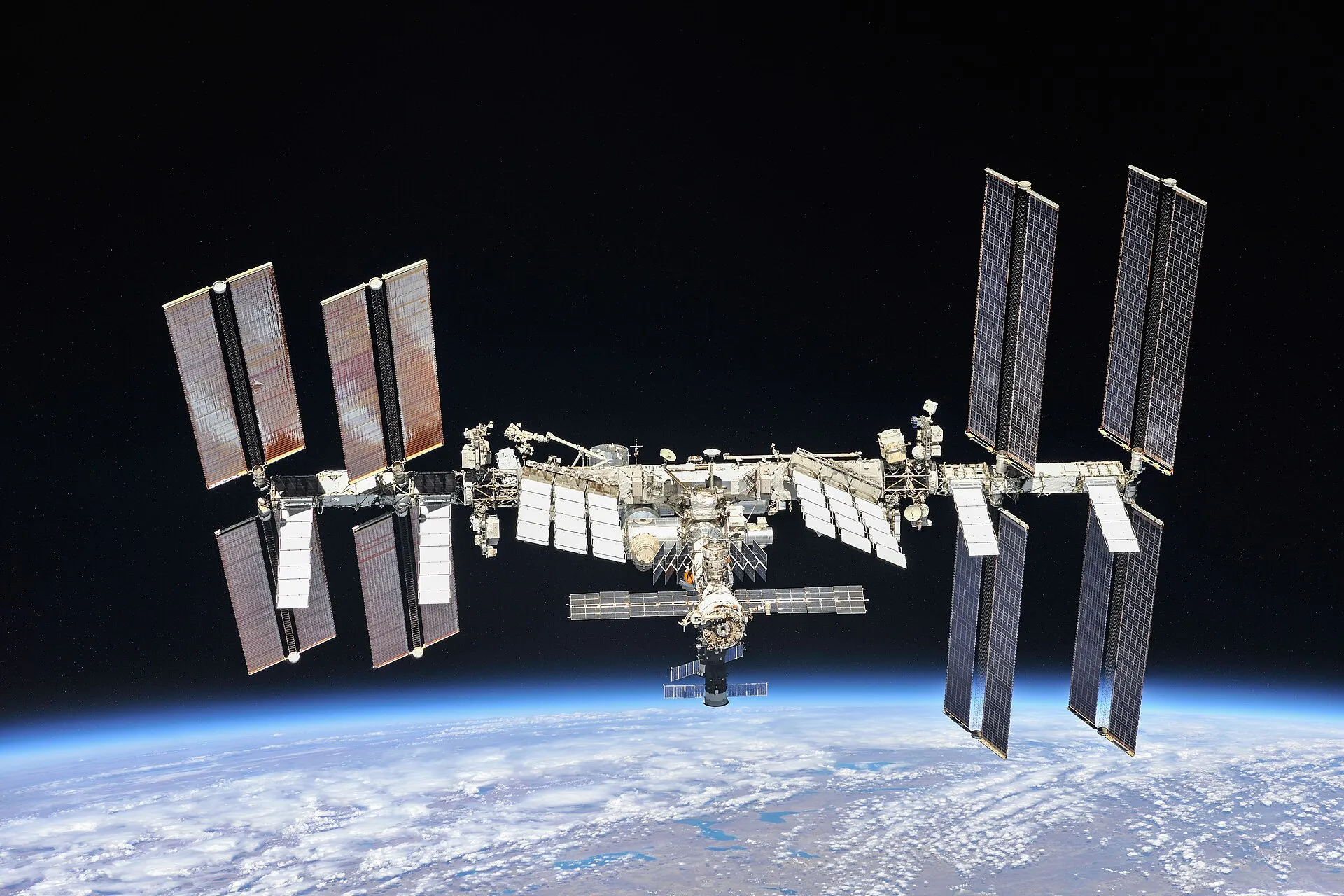
Vanguard 1 was the fourth artificial satellite. Its radio contact ended in 1964, yet it is still in orbit, which makes it the oldest artificial object in orbit, together with its rocket’s upper stage. For more space technology, see our overview of rockets, telescopes, satellites and the International Space Station.
Solar panels: advantages and limitations at a glance
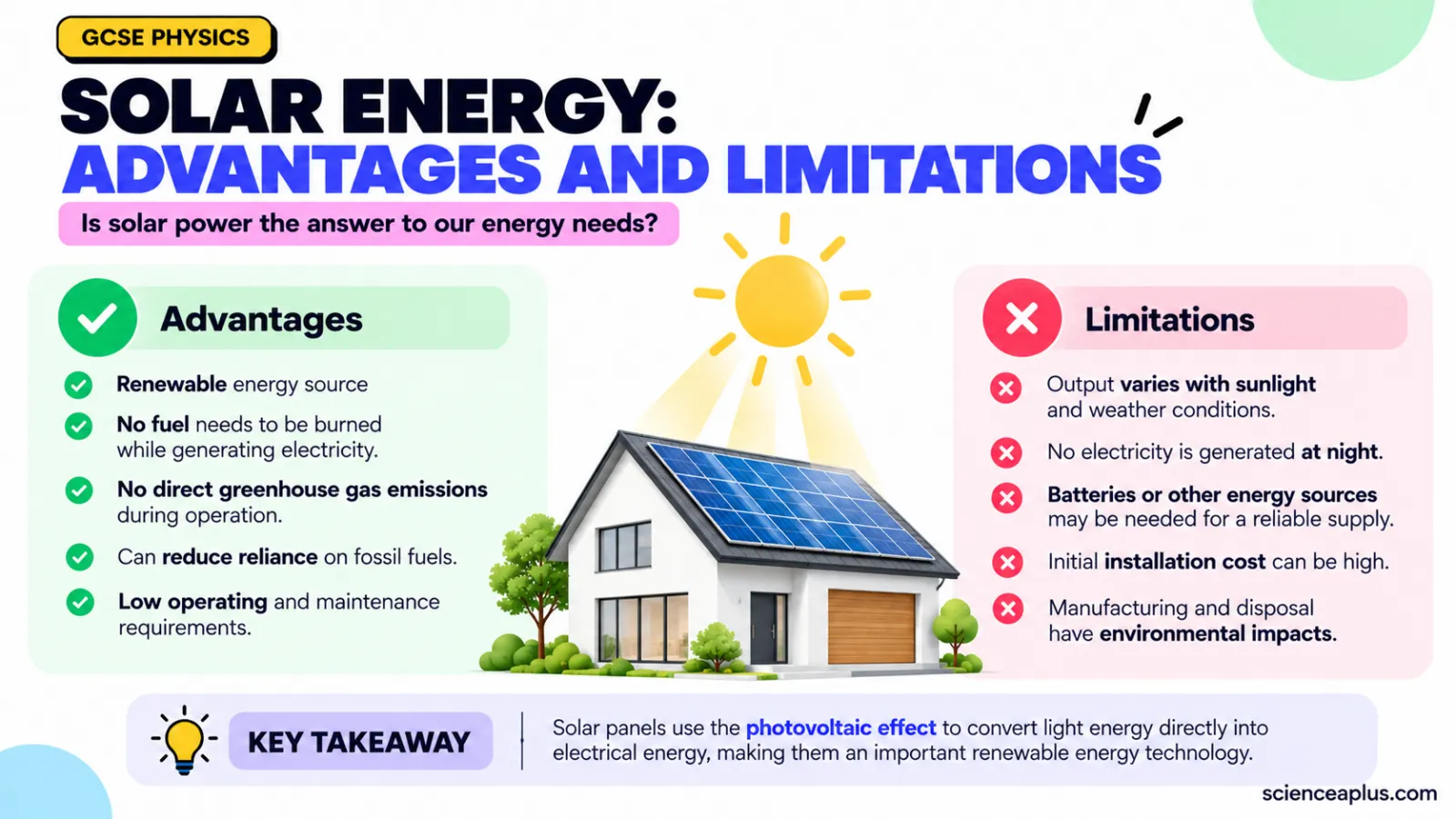
Solar power is renewable, which AQA defines as a resource that is replenished as it is used, and it releases no direct greenhouse gas emissions while it generates. The limitations are mainly about reliability: output varies with the weather and drops to nothing at night, so a home may need a battery or the grid. Our full guide to the pros and cons of solar energy weighs these up in detail.
It is also worth being realistic about what solar can deliver. Our article on renewable energy expectations versus reality looks at why the headline figures and the real-world results do not always match.
Name that part: flip cards
Test your recall of the key terms. Try to answer before you flip each card.
Frequently asked questions about how solar panels work
How do solar panels work in simple terms?
Light hits silicon solar cells and gives electrons enough energy to break free. An electric field inside each cell pushes the freed electrons in one direction, creating direct current. An inverter then changes the DC into alternating current, which powers your home, charges a battery or is exported to the grid.
What are solar panels made of?
A panel has tempered glass at the front, then an encapsulant film, the silicon solar cells and a polymer backsheet, all laminated together. An aluminium frame gives strength, and a junction box on the back holds the cable connections and bypass diodes. The cells themselves are mostly silicon with thin metal contacts.
Why is silicon used in solar cells?
Silicon is a semiconductor, so its electrons stay in bonds until light gives them energy, and then they can move. It can also be doped to make n-type and p-type layers, which form the p–n junction. The junction’s built-in electric field is what drives the current.
Do solar panels work on cloudy days?
Yes, but they produce less. Cloud reduces the light reaching the cells, so there are fewer photons and less current, but panels still generate electricity from diffuse light that passes through the cloud. The exact drop depends on how thick the cloud is, so no single figure applies.
Do solar panels work at night?
No. Without light there are no photons to free electrons, so panels generate no electricity after dark. Homes with solar panels use the grid at night, or a battery if they have one that stored surplus electricity earlier in the day.
Why do solar panels need an inverter?
Solar panels produce direct current, which flows in one direction. Household appliances and the UK grid use alternating current at about 230 V and 50 Hz. The inverter converts the panels’ DC into AC at the right voltage and frequency, so the electricity can be used safely at home or exported.
How efficient are solar panels?
Most new panels convert roughly 20–24% of the sunlight that hits them into electricity. The first practical silicon cell in 1954 managed about 6%. Efficiency is useful power output divided by total power input, and a single-junction silicon cell has a theoretical limit of about 29.4%.
Do solar panels work better in hot weather?
No. Panels need light, not heat. As a silicon cell gets hotter, its voltage falls, and maximum power drops by about 0.4–0.5% for each degree Celsius above 25 °C. Bright, cool days give the best performance, which is why test ratings use a cell temperature of 25 °C.
How long do solar panels last?
Modules are expected to last more than 20 years. Crystalline silicon panels lose about 0.5% of their output each year, and performance warranties typically guarantee around 80–90% of rated output after 25 years or more, depending on the product. Output declines slowly rather than stopping suddenly.