Why is critical thinking important for science students? Because science is a way of deciding what to believe, not a list of facts to memorise. Critical thinking is the habit of asking “how do we know?”, checking the evidence, spotting weak experiments, and drawing only the conclusions the data can support. It is also exactly what GCSE examiners reward when they ask you to evaluate or justify.
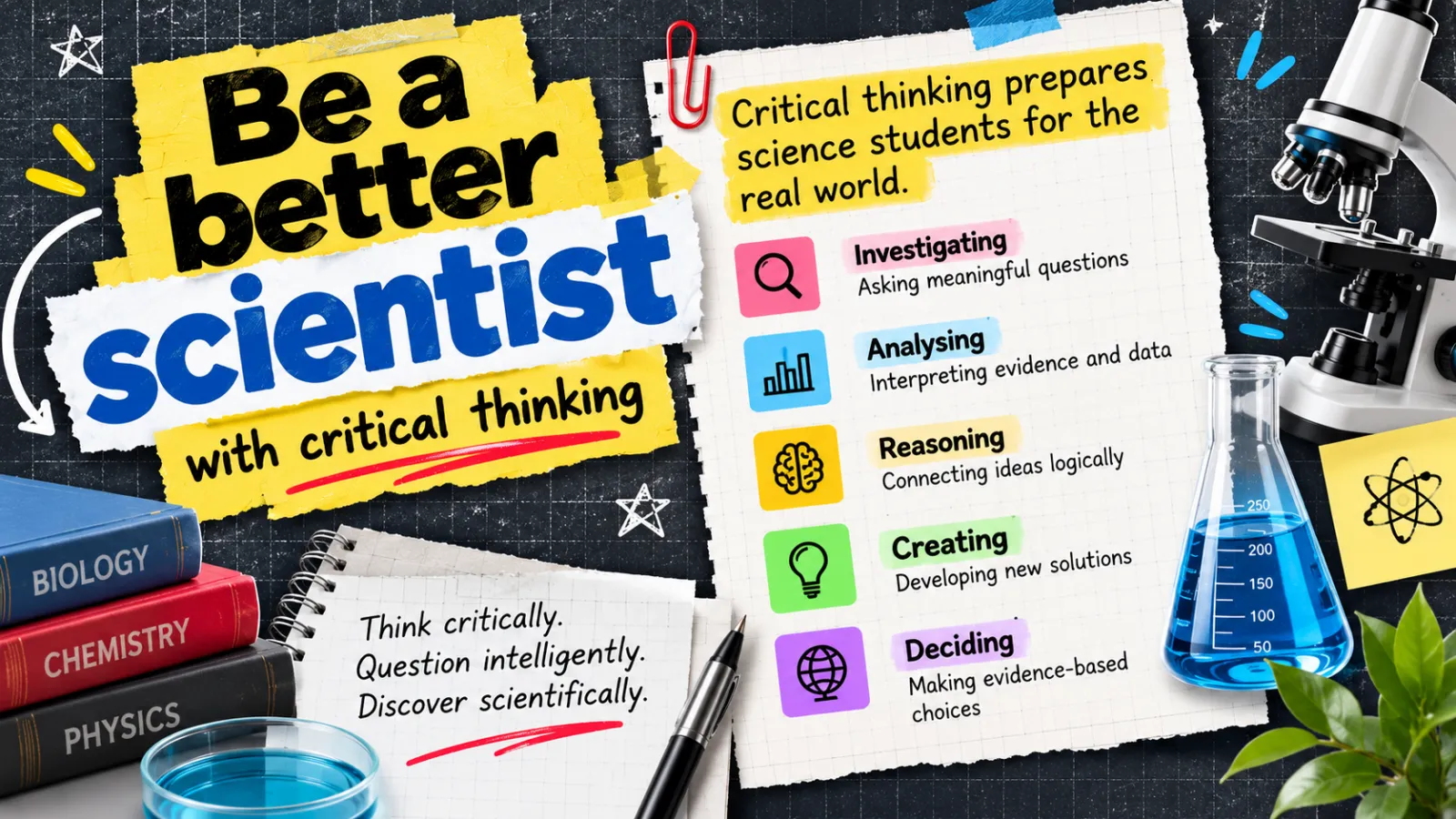
What critical thinking means in a science lesson
Most articles about critical thinking talk about arguments, fallacies and cognitive biases. Those matter, and we cover them in our guide to critical and logical thinking. This article does something narrower. It looks at what critical thinking looks like at a lab bench, in a data table and in an exam paper.
In a science lesson, thinking critically means doing a handful of specific things:
- asking what the evidence for a claim actually is, and where it came from;
- checking whether an experiment was a fair test;
- judging how much you can trust a measurement, given the possible errors;
- deciding whether a pattern in the data shows a cause or only a link;
- being willing to change your mind when new evidence arrives.
None of that is a personality trait. It is a set of skills that you can practise, and the national curriculum treats it as a core part of science rather than an optional extra.
Science is built on checking, not on being told
The national curriculum for England describes “working scientifically” as the understanding of the nature, processes and methods of science. It is not meant to be taught as a separate topic. It is meant to be woven into biology, chemistry and physics, so that every topic is also practice at thinking like a scientist.
Look at what the key stage 3 programme of study actually asks pupils to do. They should pay attention to objectivity and concern for accuracy, precision, repeatability and reproducibility. They should understand that scientific methods and theories develop as earlier explanations are modified to take account of new evidence and ideas, together with the importance of publishing results and peer review. They should also evaluate risks and evaluate data, “showing awareness of potential sources of random and systematic error”.
At key stage 4 the wording becomes stronger. Students should be “making decisions based on the evaluation of evidence and arguments” and “appreciating the power and limitations of science”. Every one of those phrases is critical thinking applied to science.
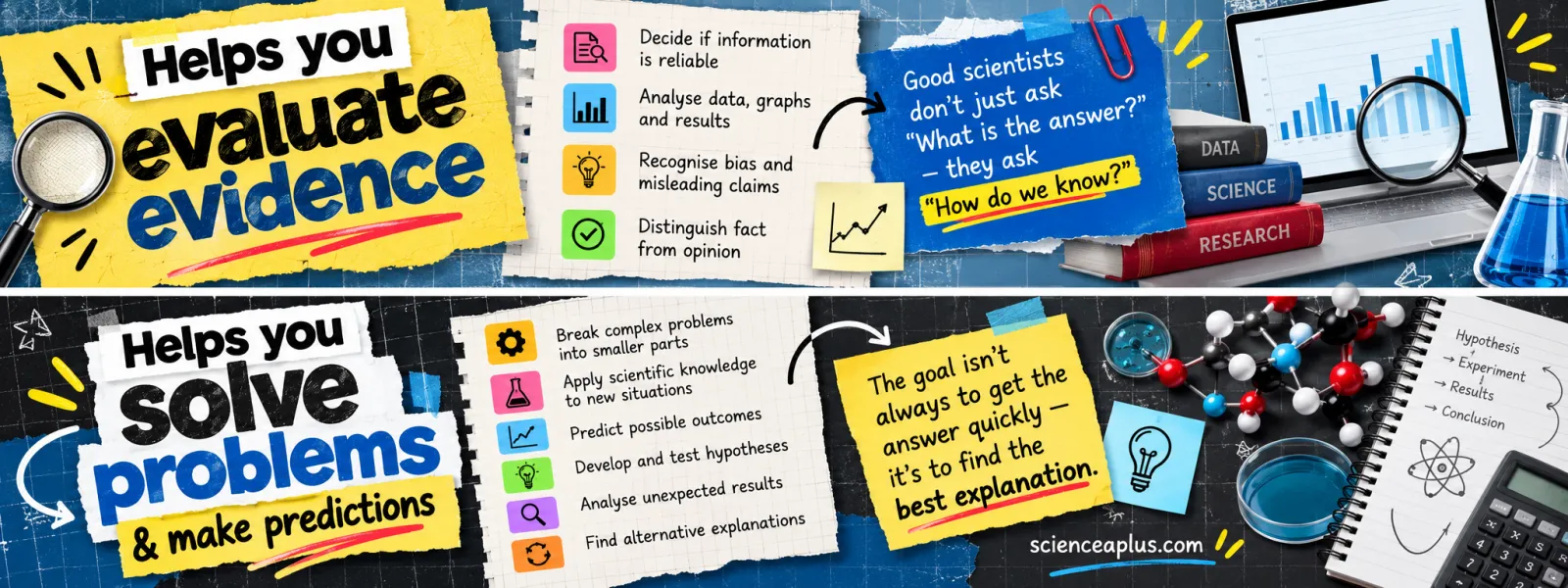
This is why a student who only memorises facts hits a ceiling. Facts can be looked up. What an exam and the real world reward is the ability to look at a new graph, a new experiment or a new headline and say something sensible about it.
If you want the step-by-step version of how investigations are organised, our guide to how to use the scientific method walks through it. Here we are interested in the thinking that sits on top of those steps.
Evaluating evidence and data
Evidence is not all equal. A careful measurement repeated many times is stronger than a single reading. A result checked by independent experts is stronger than a claim posted online. Critical thinking in science is largely the skill of telling these apart.
When you meet a piece of evidence, work through four checks.
- Source. Who produced it, and could they have a reason to want a particular answer?
- Sample. How many measurements, people or organisms were involved, and were they representative? The curriculum expects students to “apply sampling techniques” for exactly this reason.
- Method. Was it a fair test, with only one thing changed at a time?
- Review. Has anyone independent checked the result?
The last check is peer review. The AQA GCSE specification expects students to explain that peer review helps to detect false claims and to establish a consensus about which claims should be regarded as valid. It also says that reports of scientific developments in the popular media are not subject to peer review and may be oversimplified, inaccurate or biased.
When peer review and replication work
A famous example is the 1998 paper in The Lancet that suggested a link between the MMR vaccine and developmental problems in children. Later research did not support its claims, and in February 2010 The Lancet formally retracted the paper. The lesson for students is not about one paper. It is that science corrects itself because other people check the work, and that a single study, however loudly it is reported, is never the end of the story.
Replication matters beyond headline cases. In 2016 the journal Nature surveyed 1,576 researchers. More than 70% said they had tried and failed to reproduce another scientist’s experiments, and more than half had failed to reproduce their own. That is not a reason to distrust science. It is a reason to value careful methods, honest reporting and repeat testing, which are all things you practise in school practicals.

Data tell you more than a conclusion does
Students often copy a conclusion into their notes without looking at the data underneath. Critical thinkers do the reverse. They look at the table or graph first, then decide for themselves whether the conclusion fits. The AQA specification asks students to “comment on the extent to which data is consistent with a given hypothesis” and to say which of two hypotheses better explains the data. Notice the phrase “the extent to which”. Real data rarely give a clean yes or no.
That is why you should get used to answering in shades of certainty: “the results support the hypothesis, but only three repeats were taken”, rather than “the results prove the hypothesis”. Science rarely deals in proof. It deals in how strongly the evidence points one way.
Our guide to accessing and analysing information gives more practical advice on judging sources, which is the first half of evaluating evidence.
A student tests one plant and says “fertiliser makes plants grow taller”. What is wrong with that conclusion? (3 marks)
Only one plant was tested, so the sample is far too small and the result could be chance. There were no repeats, so we cannot judge reliability. There is no comparison with a control plant given no fertiliser, so we cannot tell what caused the growth. Better evidence needs several plants in each group, other variables such as light and water kept the same, and a mean calculated.
Why is a result more convincing once other scientists have repeated it? (2 marks)
If independent scientists using their own equipment get similar results, the result is reproducible, so it is much less likely to be due to chance or to a mistake in the first experiment. This is why published results are checked by peer review and then tested again.
Experimental design: thinking before you measure
The best moment to think critically about an experiment is before you start it. A badly designed investigation cannot be rescued by neat graphs afterwards. That is why the curriculum asks students to select, plan and carry out the most appropriate type of enquiry, including “identifying independent, dependent and control variables”.
The AQA specification gives clear definitions you can use directly:
- the independent variable is the one that is changed or selected by the investigator;
- the dependent variable is the one that is measured for each change in the independent variable;
- control variables are kept the same, and you must be able to explain why.

Control variables are where critical thinking earns its marks. Suppose you investigate how temperature affects the rate of an enzyme-catalysed reaction. Temperature is the independent variable and the time taken (or amount of product) is the dependent variable. But what else could change the result? The concentration of the enzyme, the volume of solution, the pH and the way you time the reaction all could. A critical thinker lists these threats in advance and decides how to hold each one steady.
A checklist for planning a fair test
Use this before any practical. The ticks are remembered in your browser, so you can come back to it.
- I can state my question and a prediction I can test.
- I know my independent, dependent and control variables.
- I have chosen apparatus that measures with enough precision.
- I have planned enough repeats to calculate a mean.
- I have a control (a comparison with nothing changed) where it makes sense.
- I have thought about the hazards and how to reduce the risk.
The last item is not an afterthought. The national curriculum asks students to “evaluate risks”, and the AQA specification expects them to suggest ways of reducing the risk of harm in practical contexts. Risk assessment is critical thinking about consequences. For a worked example of careful, step-by-step practical work, see our standard solution practical.
If you are newer to practical work, our page on lab basics and simple experiments is a gentle place to start. Psychology uses the same logic of variables and controls with people instead of chemicals, as explained in the scientific method in psychology.
Evaluating your own method
After the practical comes the evaluation, and this is where many students lose marks by writing vague comments such as “human error”. The AQA specification asks students to assess whether sufficient, precise measurements have been taken and to evaluate methods with a view to determining whether or not they are valid. Better evaluations are specific and give a fix:
- “The thermometer only reads to the nearest 1 °C, so use one that reads to 0.1 °C.”
- “Only two repeats were taken, so one odd result could not be spotted. Take at least three.”
- “The reaction was timed by eye, so reaction time adds error. Use a data logger or a clear colour change.”
Uncertainty and error: how much can you trust a number?
Every measurement has some uncertainty. A key part of thinking like a scientist is accepting that, estimating it, and not claiming more than your data allow. Four words cause confusion, so it is worth getting them straight. The definitions below follow the AQA GCSE specification.
The difference between random and systematic error is the heart of this section. Random error scatters your readings around the true value, so repeating and averaging helps. Systematic error pushes every reading the same way, so repeating does not help. Only checking your equipment and method will reveal it.
A real case: the neutrinos that seemed too fast
In September 2011 the OPERA experiment reported that neutrinos fired from CERN near Geneva to a detector at Gran Sasso in Italy, about 730 km away, appeared to arrive roughly 60 nanoseconds earlier than light would. If true, it would have broken a cornerstone of physics. Instead of announcing a revolution, the team asked other scientists to check their work. In 2012 the anomaly was traced to equipment faults, mainly a loose fibre-optic cable connection in the timing system, with a problem with a timing clock as well, and later measurements agreed with the speed of light.
This is a textbook systematic error, and a model of critical thinking. The scientists were suspicious of their own extraordinary result, they published the details so others could scrutinise them, and they found the fault.
Mean, range and uncertainty
For GCSE you will often estimate uncertainty from repeat readings. A simple approach is to calculate the mean and use half the range as the uncertainty. Try the calculator below with your own readings. It also flags a result that sits far from the others, which you should investigate rather than automatically delete.
Three repeat readings are 10.2 s, 10.4 s and 10.3 s. A fourth reading of 13.9 s is much higher. What should a student do? (2 marks)
Examine the 13.9 s reading to find out why it is different, for example a late stop on the timer. If it is clearly a poor measurement it can be ignored and the mean calculated from the others; if no cause can be found, repeat the measurement to check before deciding.
A balance reads 0.5 g even with nothing on it. Is this a random or a systematic error? (1 mark)
Systematic error, because every reading is wrong by the same consistent amount. Repeating the readings would not remove it; zeroing (taring) the balance would.
Correlation is not causation
This is the single most useful idea for reading data critically. Two things can rise and fall together without one causing the other. A scatter graph with points that follow a line shows a correlation. It does not show a cause. The AQA specification expects students to use a scatter diagram to identify a correlation between two variables, and it is careful to add that a causal mechanism has been proven for some risk factors but not for others.
A famous light-hearted example comes from the New England Journal of Medicine. In October 2012, Franz Messerli reported a correlation (r = 0.791) between chocolate consumption per person and the number of Nobel laureates per 10 million people across 23 countries. Nobody seriously believes that eating chocolate wins Nobel prizes. A more sensible explanation is a third factor, such as national wealth and spending on education and research, that influences both. Scientists call this kind of hidden factor a confounding variable.
How do scientists decide something is a cause?
Smoking and lung cancer is the classic case. In 1950, Richard Doll and Austin Bradford Hill published a study in the British Medical Journal reporting an association between smoking and carcinoma of the lung. A single study could not settle the question. The case for cause was built up from many studies by different teams, together with a biological mechanism: tobacco smoke contains substances that damage cells and cause cancer. The AQA specification uses smoking and lung cancer as an example of a risk factor linked to disease, and research has shown how smoking causes lung cancer.
So the way to move from correlation towards cause is to look for several things at once:
- a consistent pattern across many studies and groups;
- a plausible mechanism that explains how one thing leads to the other;
- a fair test where possible, changing only one variable and controlling the rest;
- ruling out other explanations, including confounding variables and chance.



Misconceptions: when what “everyone knows” is wrong
Critical thinking also means testing your own beliefs. Everyone arrives in the classroom with ideas that feel obvious but are wrong, and these misconceptions can be stubborn precisely because they seem to match everyday experience.
“Summer is when the Earth is closest to the Sun”
It sounds sensible, but NASA explains that Earth’s seasons are caused by the tilt of its axis, about 23.5 degrees from the plane of its orbit, which changes how directly sunlight reaches each hemisphere through the year. Distance is not the cause. Earth is actually closest to the Sun in early January, when the northern hemisphere is in winter. A critical thinker spots the test of the idea: if distance caused the seasons, the whole planet would have summer at the same time, but the northern and southern hemispheres have opposite seasons.
“Heavy things fall faster than light things”
Everyday experience seems to back this up: a hammer drops faster than a feather. But that is air resistance at work. In 1971, Apollo 15 commander David Scott dropped a 1.32 kg geological hammer and a 0.03 kg falcon feather together on the Moon, where there is almost no air. They reached the surface at the same time. This is a beautiful example of a result that overturned a belief by changing the conditions, which is exactly what a good experiment does.
Notice how both examples follow the same pattern. First you state the belief, then you work out what it predicts, then you compare the prediction with the evidence. When prediction and evidence disagree, the belief changes. That is also the best way to revise: write down what you think is true, then check it. Our advice on studying science from textbooks shows how to turn that into a routine.
Scientific literacy and misinformation
You do not need to become a scientist to need scientific thinking. Every week you meet claims about health, food, technology and the environment, often as short headlines or videos with no method attached. Scientific literacy is the ability to understand enough of how science works to judge those claims sensibly.
The GCSE specifications build this in directly. AQA asks students to explain that popular media reports of science are not peer reviewed and may be oversimplified, inaccurate or biased. It also asks them to consider why our perception of risk often differs from the measured risk, giving examples such as voluntary versus imposed risks, familiar versus unfamiliar risks, and visible versus invisible hazards. Both are about thinking critically about information that arrives with an emotional charge.
Five questions to ask of any science claim
- Where is the evidence? A claim with no data or source is an opinion.
- How big was the study? Tiny samples give unreliable results.
- Was there a comparison? A treatment with no control group tells you little.
- Could something else explain it? Think about confounding variables and chance.
- Has anyone else found the same? One result is a clue. Many independent results are evidence.
This is not about being cynical. A sceptic who says “prove it” to everything and a believer who accepts everything are both lazy thinkers. The scientific habit is to match your confidence to the strength of the evidence, and to be ready to update.
For a deeper look at how critical thinking and science teaching fit together, you can read our article on critical thinking and science education.
- I looked for the original data, not just the headline.
- I checked the sample size and whether there was a control group.
- I asked whether a third factor could explain the link.
- I looked for independent studies that agree.
“Working scientifically” in the UK curriculum
If you study science in England, critical thinking is not hidden in the small print. It is the “working scientifically” strand, which the national curriculum says must always be taught through the substantive content of biology, chemistry and physics. Here is how the critical-thinking skills map onto the programmes of study, using the curriculum’s own wording.
| Skill | Key stage 3 wording (extracts) | Key stage 4 wording (extracts) |
|---|---|---|
| Attitudes to evidence | “objectivity and concern for accuracy, precision, repeatability and reproducibility” | “being objective, evaluating data in terms of accuracy, precision, repeatability and reproducibility” |
| Planning | “identifying independent, dependent and control variables” | “planning experiments to make observations, test hypotheses or explore phenomena” |
| Error and uncertainty | “potential sources of random and systematic error” | “making estimations of uncertainty” |
| Evaluating methods | “evaluate the reliability of methods and suggest possible improvements” | “evaluating methods and suggesting possible improvements and further investigations” |
| Peer review | “the importance of publishing results and peer review” | “the importance of peer review of results and of communication of results to a range of audiences” |
| Decisions | “evaluate risks” | “making decisions based on the evaluation of evidence and arguments” |
Notice how much of this is about judging, not recalling. Many of these extracts use verbs such as evaluate, identify, plan and make decisions. That is a strong hint about how exam questions will be written.
Exam command words: evaluate, justify and friends
Exam boards word their command words slightly differently, but the ideas are consistent. In the Pearson Edexcel GCSE sciences list, justify means to give evidence to support an answer, and evaluate means to review information (such as data or methods) and bring it together to form a conclusion, drawing on evidence including strengths and weaknesses, and come to a supported judgement. In AQA’s list, suggest is used where you need to apply your knowledge and understanding to a new situation, and evaluate means using the information supplied, plus your own knowledge, to consider evidence for and against when making a judgement. The wording differs slightly between boards, so always check the list for your own specification.
Put simply, these are not “write everything you know” questions. They are “use the information in front of you” questions. For more on this family of words, see our guide to what “compare and contrast” means.
A worked example
Imagine a question gives you two sets of data. A school trial of a new plant food shows that 20 tomato plants given plant food grew taller on average than 20 plants given only water. The question says: “Evaluate the claim that the plant food makes plants grow taller. (4 marks)”
A strong answer weighs the evidence, then reaches a judgement:
- for the claim: the mean height of the group given plant food was greater, and 20 plants per group is a reasonable sample;
- against or limiting the claim: the ranges of the two groups overlap, so some plants without plant food grew as tall as some with it;
- missing information: were light, water and soil the same? Was the trial repeated by someone else?
- judgement: the data support the claim, but more controlled and repeated trials are needed before being confident.
What is the difference between “describe” and “evaluate”? (2 marks)
“Describe” asks you to say what happens or what the data show. “Evaluate” asks you to go further: weigh up the evidence, consider strengths and limitations, and come to a conclusion that is backed by evidence from the question.
How to build the habit
Critical thinking improves with practice, like any other skill. You do not need special equipment, only a different way of reading.
- Annotate every graph. Write one sentence about the pattern and one about how sure you are.
- Write the “what else?” list for every practical, listing variables that might affect the result.
- Turn notes into questions. Instead of copying “X causes Y”, write “How do we know X causes Y?” and find the evidence.
- Compare ideas side by side. Our page on revising with comparisons shows how to contrast similar ideas, which forces you to think about what makes each one different.
- Test yourself with past-style questions that use “evaluate” and “justify”, and mark your own answers against the mark scheme.
If you are planning your GCSE revision, our advice on how to start revising for GCSE science fits these habits into a realistic timetable.
Frequently asked questions about critical thinking in science
Why is critical thinking important in science?
Critical thinking is important in science because science depends on evidence, and evidence can be weak, biased or misread. It helps you judge whether an experiment was fair, whether data support a conclusion, and whether a claim is reliable. Without it, science becomes a list of facts to memorise.
What is critical thinking for science students?
For science students, critical thinking means asking how we know something, checking the evidence and method, judging how reliable the data are, and drawing conclusions that match the evidence. It includes planning fair tests, spotting errors, and telling a correlation from a cause. It is the thinking behind “working scientifically”.
How do you use critical thinking in a science experiment?
Before the experiment, identify the independent, dependent and control variables and plan repeats. During it, record measurements carefully. Afterwards, look for anomalies, estimate uncertainty, and ask what limits your conclusion. Finally, suggest specific improvements, such as a more precise instrument or more repeats.
What is working scientifically?
Working scientifically is the part of the national curriculum for England that covers how science is done: asking questions, planning investigations, collecting and analysing data, evaluating methods and understanding how scientific ideas develop. It is taught through biology, chemistry and physics content rather than as a separate subject.
What is the difference between correlation and causation?
A correlation means two variables change together. Causation means a change in one produces a change in the other. A correlation can arise from a third factor, from chance, or from a real cause. To argue for causation you need controlled experiments, repeated evidence or a known mechanism.
What is the difference between accuracy and precision?
An accurate measurement is close to the true value. Precise measurements cluster closely together. You can be precise but not accurate, for example when a faulty balance gives very similar readings that are all too high. Good practical work aims for both, using careful technique and checked equipment.
What do “evaluate” and “justify” mean in a science exam?
“Justify” means giving evidence to support an answer. “Evaluate” means using the information given to weigh up the evidence and reach a conclusion. Exam boards word these slightly differently, so check your specification. For both, use figures and facts from the question rather than writing general knowledge.
How can I improve my critical thinking for science GCSEs?
Practise on data. Annotate graphs, write a “what else could affect this?” list for each practical, and answer past-style evaluate and justify questions, then mark them. Turn notes into questions such as “how do we know?”. Comparing similar ideas side by side also helps you see what makes each one different.
Why do scientists repeat experiments?
Repeating experiments helps reduce the effect of random error, because averaging many readings smooths out unpredictable variation. It also helps spot anomalous results. When different scientists repeat an experiment with their own equipment and get similar results, the finding is reproducible, which makes it far more trustworthy.
How do I spot misleading science claims?
Ask where the evidence is, how large the study was, whether there was a comparison group, whether something else could explain the result, and whether independent studies agree. Be cautious of headlines that claim a cause from a correlation, or reports that have not been through peer review.