How do you start revising for GCSE science? Start by finding out exactly which course you are taking, then turn the specification into a checklist of topics, find your weak spots with practice questions, and revise the weakest topics first using retrieval practice. Finish with past papers and a weekly routine you can keep up. This guide walks through those six steps for GCSE Biology, Chemistry and Physics, and for Combined Science.
Science is one of the easier subjects to start revising badly. There is a lot of content, three subjects to juggle, practicals to remember and equations to rearrange. Most students open a textbook, reread chapter one and call it revision. A better start takes about an hour and saves weeks of wasted effort. If you are still deciding when to begin, our sister guide on why you should start revising for GCSE early covers the reasons. This article is the practical follow-up: what to actually do, in what order, for science.
Everything below uses AQA's published specifications, because AQA is the most common exam board in England. Other boards such as OCR, Pearson Edexcel and WJEC Eduqas set their own papers and practical lists, so check your own board's specification before you copy any numbers.
Step 1: Find out exactly which GCSE science you are taking

Before you revise a single topic, answer three questions. Are you taking Combined Science (two GCSEs from one course) or the separate sciences (three GCSEs: Biology, Chemistry and Physics)? Which exam board? And are you entered for the Foundation or Higher tier? Your teacher can tell you all three in one minute, and the answers decide how much you need to learn and how the exam papers look.
If you are unsure which route is right for a younger sibling or yourself, our article on double science versus triple science explains the difference in detail.
How the AQA science papers are set out
With AQA, every science course is linear, which means all the exams are sat at the end of the course. Here is how the papers compare:
| Course | Papers | Length and marks | Share of each paper |
|---|---|---|---|
| GCSE Biology (8461) | 2 | 1 hour 45 minutes, 100 marks each | 50% each |
| GCSE Chemistry (8462) | 2 | 1 hour 45 minutes, 100 marks each | 50% each |
| GCSE Physics (8463) | 2 | 1 hour 45 minutes, 100 marks each | 50% each |
| Combined Science: Trilogy (8464) | 6 (two biology, two chemistry, two physics) | 1 hour 15 minutes, 70 marks each | 16.7% each |
Notice what that means for revision. In the separate sciences, each paper covers half of a subject, so you can plan Paper 1 topics and Paper 2 topics as two blocks. In Combined Science, you sit six shorter papers, so every one of the 24 topics matters and there are fewer places to hide a weak topic. AQA also offers Combined Science: Synergy (8465), which is organised differently, so check which one your school entered you for.
What each paper covers
Knowing which topics sit in which paper lets you build a sensible order. These are the AQA topic groups:
| Subject | Paper 1 | Paper 2 |
|---|---|---|
| Biology | Cell biology; Organisation; Infection and response; Bioenergetics | Homeostasis and response; Inheritance, variation and evolution; Ecology |
| Chemistry | Atomic structure and the periodic table; Bonding, structure and the properties of matter; Quantitative chemistry; Chemical changes; Energy changes | The rate and extent of chemical change; Organic chemistry; Chemical analysis; Chemistry of the atmosphere; Using resources |
| Physics | Energy; Electricity; Particle model of matter; Atomic structure | Forces; Waves; Magnetism and electromagnetism; Space physics |
In Combined Science the topic groups are the same, with one difference: the physics course has no Space physics topic. AQA also warns that some later papers may draw on earlier ideas. Chemistry Paper 2 can use the fundamental ideas from atomic structure, bonding and quantitative chemistry, and Physics Paper 2 can use energy transfers from the Energy and Electricity topics. So the "early" topics are never really finished; they come back.
Foundation or Higher: what the tier means for your revision
Both tiers sit papers of the same length, but the Foundation papers are aimed at grades 1 to 5 and the Higher papers at grades 4 to 9. In the separate sciences, a Higher student who narrowly misses grade 4 receives an "allowed" grade 3, and anyone below the minimum standard is recorded as unclassified. In Combined Science the grade is a pair of numbers on a 17-point scale from 1–1 to 9–9, with Foundation covering 1–1 to 5–5 and Higher covering 4–4 to 9–9.
Your tier changes how you revise in two practical ways:
- Foundation: secure the core ideas in every topic first. A strong, even performance across all topics beats a perfect score in two topics and blanks elsewhere.
- Higher: expect more calculation, rearranging and extended "explain" questions. Practise writing full, linked explanations, not single facts.
Whichever tier you are in, the exams test three things. Roughly 40% of the marks reward knowing and understanding science (AO1), about 40% reward applying it to unfamiliar situations (AO2), and around 20% reward analysing information, evaluating evidence and improving experiments (AO3). That last 20% is why learning facts alone caps your grade: you also need to practise using the facts on data, graphs and practical methods.
Once you know your course, your papers and your tier, you have the frame for the rest of the plan. Next comes the step most students skip: turning the specification into a list you can tick off. If you are also unsure of the basic vocabulary of the three sciences, our guide to definitions in biology, chemistry and physics is a handy companion while you work through the list.
Step 2: Turn the specification into a checklist
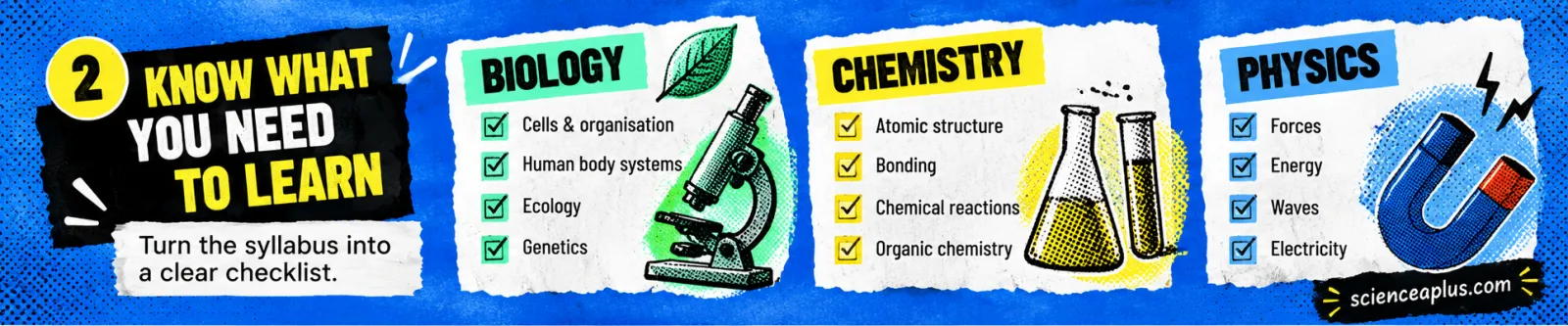
The specification is the single most useful document for revision, and almost nobody reads it. Each AQA science specification is split into numbered topics and sub-topics, and every statement is something an examiner is allowed to ask. Your job in step 2 is to copy those statements into a checklist you can tick, colour or rank.
The sketch above shows the idea. For Biology you might list cells and organisation, human body systems, ecology and genetics. For Chemistry: atomic structure, bonding, chemical reactions and organic chemistry. For Physics: forces, energy, waves and electricity. Those are the broad headings. Your real checklist should go one level deeper, down to statements such as "describe how to calculate magnification" or "explain why alkenes are more reactive than alkanes".
How to build your checklist in one evening
- Download the specification for each subject from your exam board's website and find the "subject content" section.
- Copy each topic heading into a table in a notebook, a spreadsheet or a document.
- Under each heading, add the sub-topics as separate lines. Do not worry about detail yet.
- Add three columns: Notes made, Questions tried and Confidence.
- Add the required practicals as their own block. You will use that block again in step 4.
If you do this on paper, a single A3 sheet per subject is enough for most topics. If you use a screen, keep one file per subject so that you can sort by confidence later.
Here is a short starter checklist you can tick right now. The ticks are saved in your browser, so you can come back to it later.
- I know whether I am taking Combined Science or the separate sciences
- I know my exam board and my tier (Foundation or Higher)
- I have downloaded each specification
- I have copied the topic headings into a checklist
- I have a list of the required practicals for my course
- I have found the equation sheet and past papers for my board
While you build the list, try to keep notes in the order of the specification. If you take notes from several sources at once, you end up with duplicates and gaps. A good way to start a new topic is the "one-page" method described in our guide to studying science faster from textbooks: read a section once, close the book and write down what you remember, then check what you missed.
Check you have the right equipment for practical topics
Practical questions often ask you to name a piece of apparatus or describe how to use it. It is worth spending ten minutes learning the names and uses of lab equipment early, because the same words appear in biology, chemistry and physics questions. Our illustrated list of biology lab equipment is a quick way to check you know what a pipette, a quadrat or a boiling tube is for.
Step 3: Find your weak areas before you revise anything
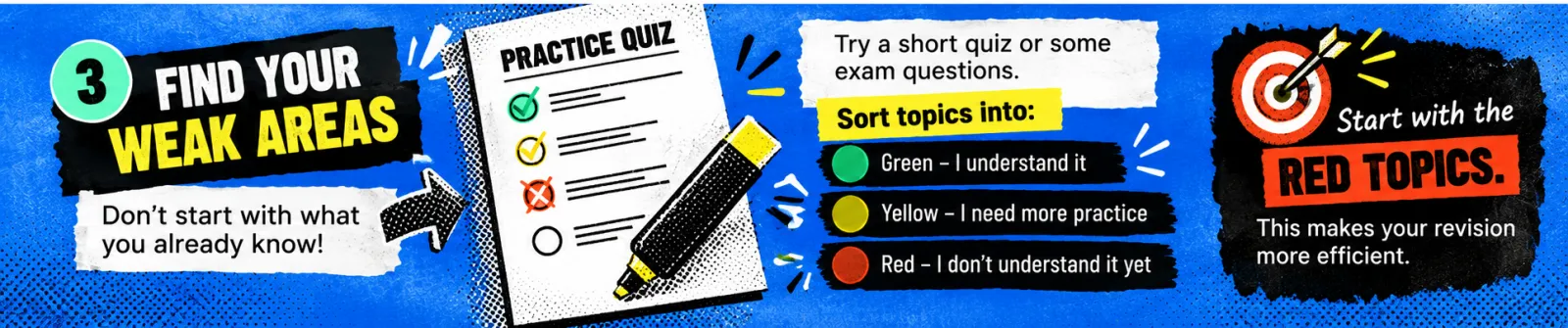
Most students begin with the topic they like best. It feels productive, because it is easy. It also wastes revision time on marks you already have. The better method is to test first and then revise. A short quiz on a topic, done before you revise it, tells you what you really know and what you only recognise when you see it in your notes.
A simple red, amber and green diagnostic
Here is the method in the picture above, adapted for science:
- Pick one topic from your checklist, for example "Cell biology".
- Without notes, answer 8 to 10 exam-style questions on it. Use a past paper, a revision guide or a teacher's quiz.
- Mark yourself using the mark scheme, not your memory of what you meant.
- Colour the topic. Green means you scored most of the marks. Amber means you scored about half. Red means most marks were lost.
- Repeat for every topic over a week or two.
The aim is not to produce a high score. A red topic at this stage is good news because you have found it early. Start your revision with the red topics, then the ambers. Leave the greens for quick retrieval checks later.
Why the weak areas are often the same ones
Weak areas in science tend to cluster, because the subjects build on themselves. A student who is red on quantitative chemistry (moles and calculations) will often struggle with later calculations in rates, energy changes and electrolysis. A student who is red on cell structure will find transport, enzymes and photosynthesis harder. When two or three red topics share a root, fix the root first. That might be a gap in maths, a missing definition or a diagram you never learned.
If cell biology is your root problem, work through our beginner's walk-through, how to learn cell biology basics, before you move on to the Paper 1 topics that depend on it.
Try it now: three quick science questions
These are not past-paper questions. They are warm-ups to show you how the diagnostic feels. Try to answer each one in your head or on paper before you open it.
Which organelle is the site of aerobic respiration in an animal cell? (1 mark)
The mitochondria.
Why does the rate of a reaction usually increase when you increase the concentration of a reactant? (2 marks)
There are more particles in the same volume, so collisions between reacting particles happen more often. More frequent collisions mean a higher rate of reaction.
An object has a mass of 2 kg and a resultant force of 10 N acts on it. What is its acceleration? (2 marks)
a = F ÷ m = 10 ÷ 2 = 5 m/s².
Whichever you could not answer, add to your red list. If all three felt easy, move on to harder questions from a past paper, because the diagnostic only works when it is difficult enough to find a gap.
How many topics should be red?
There is no ideal number. In the first diagnostic round, it is normal for a third or more of your topics to be amber or red, especially for the separate sciences with their many topics. What matters is the trend. When you repeat the quiz two or three weeks later, ambers should have turned green and reds should have turned amber. If a topic stays red after two rounds of revision, change the method rather than repeating it: ask your teacher, watch a different explanation or switch from reading to doing questions.
Step 4: Learn actively with retrieval practice
You now know what to learn and which topics are weakest. Step 4 is how to learn them. The honest answer is that the most common methods, rereading, highlighting and summarising, are some of the least effective. In a large review of ten study techniques, Dunlosky and colleagues (2013, Psychological Science in the Public Interest) rated practice testing and distributed practice (spreading study over time) as having high usefulness. They rated summarising, highlighting and rereading as low utility. Copying notes out neatly is a similar passive method: it feels busy but asks little of your memory.
In plain terms: close the book and try to pull the information out of your head. That is retrieval practice, and it works because struggling to recall something is what strengthens the memory. Rereading feels easier and fluent, but fluent is not the same as learned.
A four-part routine for each topic
- Read once. Read the topic in your guide or notes, or watch one short explanation.
- Close it and write. Write everything you remember on a blank page: definitions, diagrams, equations, steps.
- Check and fix. Compare with your notes in a different colour pen. The gaps are what you revise next.
- Test later. Come back after a day, then after about a week, then after a month, and answer questions on the topic again.
The "come back later" part matters. One long session on a topic feels productive, but short repeated sessions spread across weeks usually stick better. Our guide on how to improve memory for exams goes further into why.
Flashcards that really work in science
Flashcards are retrieval practice in your pocket, if you write them well. Put a question on the front, not a topic title: "State the function of the ribosome" is better than "Ribosomes". Keep one fact per card and add a small sketch where a diagram helps. Shuffle the pile so you do not learn the order. For detailed advice, see our article on making flashcards. Try these five cards to see the style:
Subject tactics: Biology, Chemistry and Physics are not revised the same way
The same retrieval routine works for all three sciences, but each has its own typical traps.
Biology: words, processes and diagrams
Biology rewards precise vocabulary and clear sequences. Make cards for key terms, then practise writing short process chains: for example, the order of events in infection and response, or how a nerve impulse travels. Draw diagrams from memory, label them, then compare. Ten diagrams you can draw cold are worth more than twenty you have looked at. The AQA biology papers also include the required practicals, covered below, so learn the variables and the reasons for each step.
Chemistry: calculations and patterns
Chemistry mixes recall (the periodic table, tests for ions, organic names) with calculation (moles, concentrations, yields). Revise recall by cards and calculation by doing questions, because you cannot learn a calculation by reading it. Start with quantitative chemistry early, since it supports later topics. Our article on the standard solution practical shows how the maths and the practical skills fit together.
Physics: equations, units and rearranging
Physics depends on knowing what an equation means and how to use it. For each equation, learn four things: what each symbol stands for, its unit, how to rearrange it, and one worked example. Practise changing the subject of the equation until it is automatic. Then try the equation in a short question with a mixed-up unit, because converting units is where marks are quietly lost.
The maths inside GCSE science
Many students lose marks in science, not because of the science but because of the maths. AQA's specifications include a full section on mathematical skills. They list arithmetic and numerical computation (including standard form, ratios, fractions, percentages, estimates and significant figures), handling data (mean, mode and median, and orders of magnitude), algebra (changing the subject of an equation and substituting values with units), and graphs (the equation y = mx + c, slope and intercept, and finding the slope of a tangent as a rate of change). Geometry and trigonometry appear in physics.
AQA also sets the level: Foundation science questions are not lower than Key Stage 3 maths, and Higher questions are not lower than Foundation GCSE maths. So you do not need A-level skills, but you do need to be fluent in the basics.
If your maths is wobbly, schedule a short maths block into every week. Our article on improving your maths skills in GCSE science gives examples, and the guide to scientific calculators and how to use them will help you avoid button-press errors. Try the calculator below, which does the repeat-readings maths you meet in many required practicals.
Notice that it gives you a mean and a range, and also flags a result that looks out of line. In an exam, you must decide whether an unusual value is a true anomaly and whether to leave it out when calculating a mean. Only ignore a result if you can give a reason.
The equation sheet: what you need to memorise
Equations worry students more than almost anything else in GCSE physics. The good news is that the rules have been changing in your favour. Formulae and equation sheets have been provided in GCSE maths, physics and combined science exams since 2022, under temporary arrangements that were extended year by year (most recently for 2025 to 2027), so students have not needed to memorise them. In February 2026 the Department for Education asked Ofqual to make this permanent. Ofqual's decision, published on 5 May 2026, means exam boards must continue to provide the sheets from 2028 for the rest of the life of the current specifications. Exam boards must also publish the sheets by 1 September the year before each exam series, and must not set a question that can be answered solely by copying from the sheet.
That sounds like it removes the need to learn anything. It does not. The sheet gives you the equation, not the skills to use it. You still need to know when to use each one, how to rearrange it, how to convert units and what the answer means. The announcements named maths, physics and combined science, not biology or chemistry on their own, so ask your teacher what you will be given in those papers.
Required practicals: learn them as a set of exam questions

AQA lists 10 required practicals for Biology, 8 for Chemistry and 10 for Physics. In Combined Science: Trilogy, there are 21: 7 biology, 6 chemistry and 8 physics. Schools must confirm that you have done them, but there is no separate practical exam. Instead, written papers ask about them, and AQA states that questions on the practical skills make up at least 15% of the overall marks. Other boards have different lists, so check yours.
Rather than rereading a method, revise each practical with the same five questions:
- What was the aim, and what was the independent, dependent and control variable?
- What equipment did you use, and why that equipment?
- What are the main steps of the method, in order?
- What are the risks, and how do you reduce them?
- How do you process the results, and how could the method be improved?
The AQA lists include practicals such as using a microscope, osmosis in plant tissue, food tests, enzyme activity and photosynthesis in biology; titration, electrolysis, rates of reaction and chromatography in chemistry; and specific heat capacity, resistance, density, force and extension, and waves in physics. Tick them off below as you revise each one.
- I can name the independent, dependent and control variables for each required practical
- I can describe each method in order, from memory
- I can list the main hazards and how to reduce them
- I can draw and interpret the graph or table that each practical produces
- I can suggest two improvements to each practical
Step 5: Practise with past papers, mark schemes and command words

Past papers are the closest thing to a rehearsal, but they work best when you use them in the right order. Do not leave them until the last week. Use topic questions first, once you have revised a topic. Then move to full papers once you have covered most of the specification. AQA publishes past papers and mark schemes on its website, in its past papers and mark schemes finder, so you can download the ones for your own course and tier.
How to use a past paper properly
- Sit it like the real thing. Set a timer, put your notes away and use only what the exam allows.
- Mark it with the mark scheme. Be strict. If the mark scheme wants a key word and you wrote a vague idea, it is a lost mark.
- Sort your lost marks. Tick one reason for each: did not know it, knew it but forgot, misread the question, or made a maths slip.
- Fix the cause. Add "did not know" topics to your revision list. For "misread", practise underlining the command word.
- Redo the questions you lost marks on a week later, without looking.
The third step is the most valuable. A paper that tells you that you lose marks through misreading is giving you a different job from one that tells you that you do not know quantitative chemistry. Our guide on how to practise and remember what you study has more ideas for turning mistakes into learning.
Timing: about a minute per mark
The AQA separate-science papers give you 105 minutes for 100 marks, which is about one minute per mark. The Combined Science papers give you 75 minutes for 70 marks, which is a little over a minute per mark. When you practise, use that as a rule of thumb: a 2-mark question deserves about two minutes, and a 6-mark question about six. If you are stuck, move on and return, because every mark is worth the same.
Command words: read the instruction word first
Exam questions begin with a command word that tells you what kind of answer to write. Misreading it is a common way to lose marks even when you know the science. These definitions come from AQA's published command words list:
| Command word | What AQA says it means | What to do |
|---|---|---|
| Calculate | Use numbers given in the question to work out the answer | Show your working and give the unit |
| Describe | Recall facts, events or a process accurately | Say what happens, in order, without reasons |
| Explain | Make something clear or state the reasons for something | Give a reason, often using "because" or "so" |
| Compare | Describe similarities and/or differences, not just write about one thing | Mention both things in every sentence |
| Evaluate | Use information and knowledge to consider evidence for and against, to make a judgement | Give points for and against, then a conclusion |
| Suggest | Apply your knowledge to a new situation | Use the science you know on the unfamiliar context |
| Give, Name, Write | A short answer only | Do not write an essay |
| Justify | Use evidence from the information supplied to support an answer | Quote the data given in the question |
The "what to do" column is practical advice, not AQA wording. Our article on what compare and contrast mean is useful if you tend to write about only one side. Try this one:
A student writes "Explain why the rate of reaction increases at a higher temperature" and answers "it goes faster". Why is that not enough? (2 marks)
The command word is "explain", so a reason is needed, not a description. A full answer: particles move faster and have more energy, so collisions happen more often and more of them have enough energy to react.
Step 6: Build a revision routine you can keep
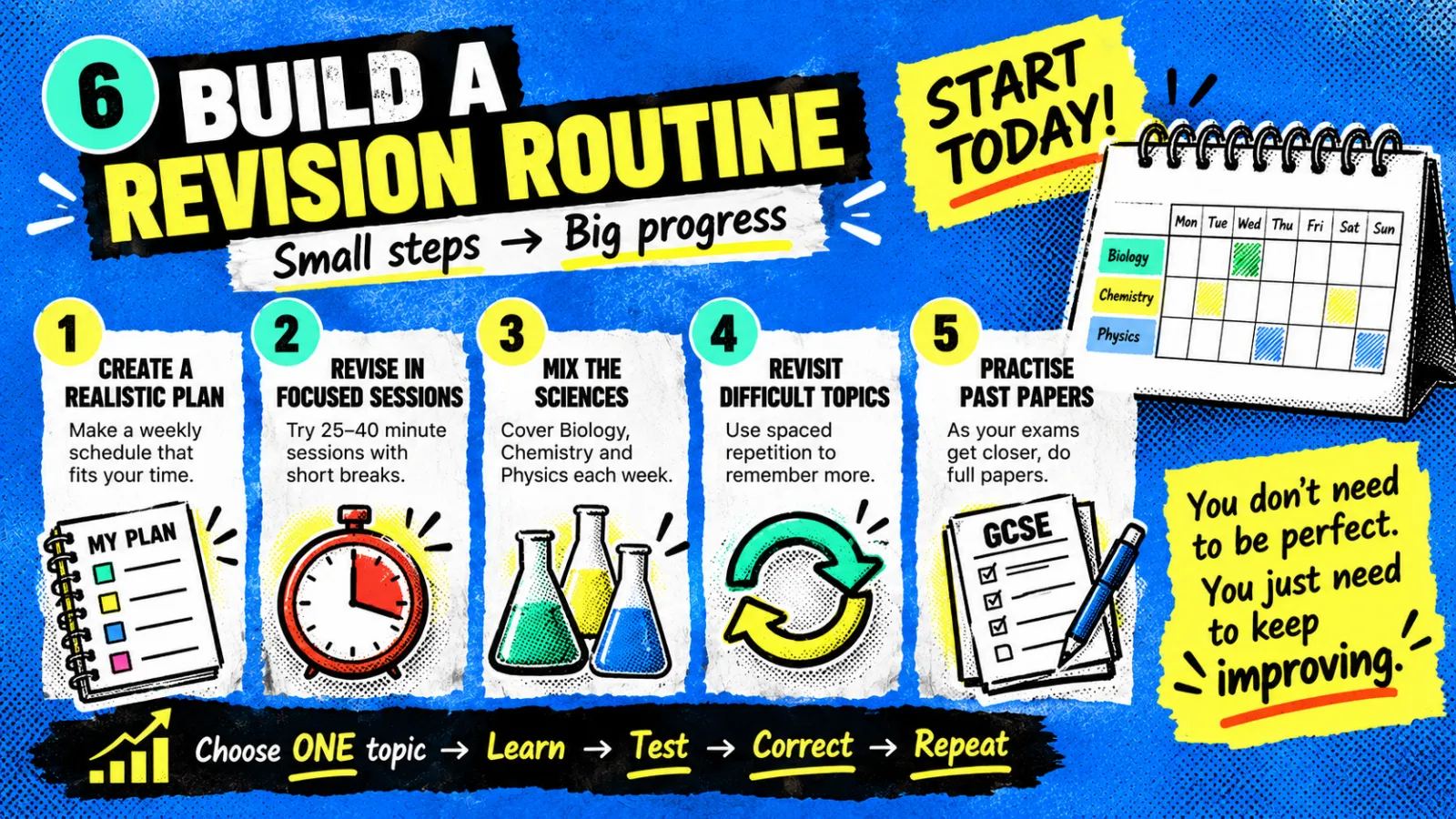
The routine is where the plan succeeds or fails. A brilliant plan you drop in week two is worth less than a modest plan you keep for six months. The poster above sums up the idea: decide when you will revise, break it into small tasks, and review often.
A starter plan for your first four weeks
This is a template, not a rule. Adjust it to your school timetable, other subjects and activities. It assumes about 30 to 45 minutes of science revision on five days a week, which is easy to maintain.
| Week | Focus | What you do |
|---|---|---|
| 1 | Set-up and diagnostics | Steps 1 to 3: confirm your course, build the checklist, and complete a diagnostic quiz on the first topics. Colour them red, amber or green. |
| 2 | Red topics | Revise two or three red topics with the four-part retrieval routine. Make flashcards for definitions and equations. |
| 3 | Practicals and maths | Revise two or three required practicals using the five questions. Add one short maths block per week. |
| 4 | Exam practice | Do topic questions, mark them strictly, and re-quiz the topics you covered in week 2. |

After week four, repeat the cycle with new topics, and keep returning to old ones for short retrieval checks. Put the sessions in a calendar like fixed appointments. Aim for a mix of subjects: for example, biology on Monday, chemistry on Tuesday, physics on Wednesday, and a mixed catch-up on Thursday, with the weekend lighter.
When motivation drops
It will, probably around week three. Make the next step so small that you cannot say no: one flashcard pile, one diagram, one 6-mark question. If you are stuck in a slump, read our short article on what to do when you have no motivation to study. If a topic stays red after two rounds, ask your teacher rather than avoiding it.
Frequently asked questions about revising for GCSE science
How do I start revising for GCSE science?
Start by finding out your course, exam board and tier. Turn the specification into a checklist, take a short quiz on each topic and colour it red, amber or green, then revise the red topics first using retrieval practice. Add past papers and a weekly routine as you go.
How long should I revise GCSE science each day?
There is no official figure, so build a routine you can keep. About 30 to 45 minutes of science on five days a week is a manageable start, and you can increase it nearer the exams. Regular short sessions usually work better than occasional long ones.
Which science should I revise first?
Revise the subject or topic where you scored lowest in your diagnostic quiz, whichever science it is. Quantitative chemistry and cell biology are worth early attention, because many later topics build on them. Rotate through all three sciences during the week.
How many required practicals are there in GCSE science?
For AQA there are 10 in Biology, 8 in Chemistry, 10 in Physics and 21 in Combined Science: Trilogy. Other exam boards have different lists, so check your specification. Questions on practical skills count for at least 15% of the marks in AQA's written papers.
Do I have to memorise equations for GCSE physics?
For physics and combined science exams, students need not memorise equations, because they are provided in the exam. This has applied since 2022 under temporary arrangements, and Ofqual's decision of May 2026 means exam boards must keep providing the sheets from 2028 for the rest of the life of the current specifications. You still need to know how to use them.
What is the difference between Foundation and Higher tier?
Foundation papers target grades 1 to 5, and Higher papers target grades 4 to 9. Higher papers include more demanding questions, such as longer explanations and harder calculations. Your teacher decides which tier you are entered for, so ask them if you are unsure.
Are past papers enough to revise for GCSE science?
No. Past papers show you what the exam looks like and where you lose marks, but they do not teach the content. Use them after you have revised each topic, mark them strictly with the mark scheme, and go back to the specification to fix the gaps they reveal.
Is retrieval practice better than rereading?
Research suggests so. A review by Dunlosky and colleagues (2013) rated practice testing and distributed practice as highly useful, and rated rereading and highlighting as low. In practice, that means closing your notes and answering questions from memory, then checking and repeating after a gap.
What do command words like "explain" and "evaluate" mean?
Command words tell you what type of answer is wanted. For AQA, "explain" means make something clear or state the reasons, and "evaluate" means use information and knowledge to consider evidence for and against in order to make a judgement. "Describe" asks you to recall facts or a process accurately.
When is the best time to start revising for GCSE science?
The sooner the better, because the courses are long and the exams are all at the end of the course. A gentle start with the checklist and diagnostic quizzes costs little and saves time later. Short, regular sessions beat a last-minute rush.